
InspectAPedia® FREE Encyclopedia of Building & Environmental Construction, Diagnosis, Maintenance & Repair |
Question? Just ask us! InspectAPedia
|
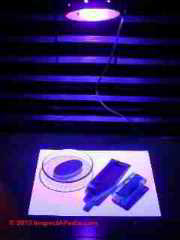 UV light, Woods Lamp
Buy & Use
for building investigations of animals, materials odors, urine, blood, other contaminants

- POST a QUESTION or COMMENT about how to use black light or UV light or a Woods lamp in building investigations
How to use a black light or UV light:
This article describes uses of UV light in building investigations. We describe the use of a black light, UV light to screen buildings for pet urine or urine from humans or other animals even where no stains are visible in or around buildings.
We provide a catalog of materials that glow or flouresce under UV light and cite scholarly-research for many of those materials and the forensic use of black light.
We also use UV light to screen buildings for other body fluids, including blood. Small black lights are available from pet supply stores, art supply stores, and forensic and police equipment suppliers and are generally inexpensive.
InspectAPedia tolerates no conflicts of interest. We have no relationship with advertisers, products, or services discussed at this website.
Guide to Using Ultra Violet Light (UV light or "black light") for Forensic Building Investigations
 One of the most effective uses of UV light in building investigations is the tracking down of odors & contaminants such as urine, urine stains, or odors & allergens from pets, rodents, or other animals, even human.
But because a large number of materials will fluoresce under a black light, we need to give some thought to how to interpret what our UV light is actually revealing when we shine it on a building material or surface.
Discussed here: Catalog of materials that fluoresce under black light (UV light) & sources of UV lights, supplies. Using a black light to find sources of indoor building smells and odors from dogs, cats, rodents, bats, unusual pets, and even people can be tricky; here are our suggestions.
Article Contents
- BLACK LIGHT & UV LIGHT USES
- UV LIGHT BLACK LIGHT USE FAQs
- WHICH MATERIALS GLOW under UV lighting& what is a "black light"?
- DEFINITION of FLUORESENCE UV lights or BLACK LIGHT- WOODS LAMP
- HOWTO USE UV LIGHT to find ODORS, URINE, ANIMALS &c
- LIGHT, GUIDE to FORENSIC USE - separate article
Watch out: While in our OPINION the ordinary use of UV flashlights and UV lamps for purposes of building or environmental inspection or security screening constitutes no unusual health risk, excessive or inappropriate exposure to high levels or protracted durations of ultraviolet light may be unsafe and possibly carcinogenic.
A much cited study indicated that "The risk was not significantly or consistently raised for exposure to fluorescent lights at home or at work."[12]
Question: using a black light to track down iridescent powder substance in carpet
Can you be of help identifying a carpet (?) problem I am having in my apartment?
I discovered this as I was using a black light to look at some iridescent fishing lures the other evening. I noticed several yellowish glowing spots in the bedroom carpeting. This caused me to check the living room and dining area carpeting, where I found the same type yellowish glowing areas.
The areas are ‘dusty’ in appearance and appear in a variety of patterns. I further checked the baseboards, some less trafficked areas behind the bed and other furniture, and the furniture and counter surfaces and found the same yellowish areas.
It quickly returns after cleanup. These areas do not appear in normal daylight, but do appear under a black light. Of course, the iridescence is greater at night when I can darken the apartment, but it can be seen under the black light during the day. It should also be noted that my feet and toe nails show the same yellowish glow. I walk around bare footed in my apartment.
Bathing removes the powdery substance from my feet and my physician says I have no mold or other infection in my feet. It should also be noted that when I purchased my black light over a year ago, for fun I checked out my apartment and carpeting for mold, pet urine, etc. and found none.
I will be checking with a local 'home' inspection type company next week regarding this.
Thanks for you help, - J.N. 07/21/2012
Reply: What materials glow under UV lighting & what is a "black light"?
A competent onsite inspection by an expert usually finds additional clues that help accurately diagnose a problem concerning building contaminants or conditions. That said, there are a number of materials that will fluoresce under an ultraviolet UV or "black light", even clean white sheets appear to do so.
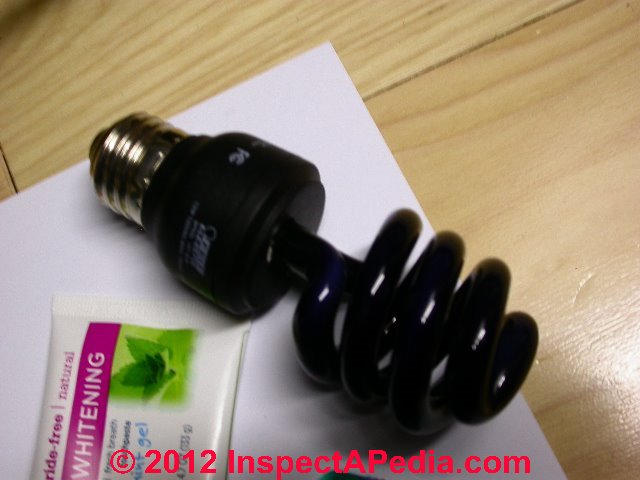
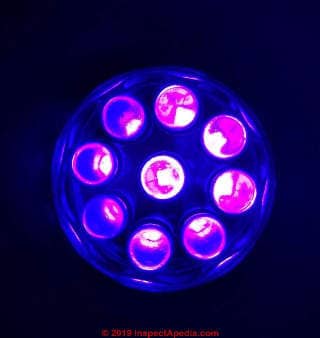
At above left we illustrate our darkroom test set-up for light source comparisons, in this case with a "blacklight" or UV ultraviolet light bulb (Woods lamp) installed in our test fixture using a 13W bulb produced by Feit Electric (photo at left).[5]
You may have spotted pet urine stains and pet urine-contaminated dust from carpeting, or insect fragments, or possibly some urea-containing materials.
The observation that many materials contain fluorescent molecules means that interpreting light or presumed stain patterns needs to be done with some sense of location, age, material, and context.
Definition of Fluorescence & UV lights or black lights - the Woods Lamp
 We should explain the mechanism of fluorescence before listing things that fluoresce under black light or really UV light: According to a nice Q&A by the U. Illinois physics department, although infra-red and ultraviolet spectrums or frequencies are beyond what the human eye can see (some animals can see in these light frequency ranges),
Some materials have the special property that they absorb ultra-violet light and then re-emit the light at lower frequencies that our eyes can see. This is called "fluorescence. [3]
The actual wavelength of black lights or UV bulbs that operates in the UV range is 280-410nm usually narrowed to 368-371 nm wavelength light.
Because UV flashlights or bulbs may also emit some energy in the wavelength range that is visible to humans, when you plug in a lamp that contains a "black light" bulb, it won't appear to emit zero "light" (that you can see), but it emits so little light in the range visible to humans that these bulbs are popularly called "black lights".
Fluorescence is the emission of light by a substance that has absorbed light or other electromagnetic radiation. It is a form of luminescence. In most cases, the emitted light has a longer wavelength, and therefore lower energy, than the absorbed radiation.
The most striking example of fluorescence occurs when the absorbed radiation is in the ultraviolet region of the spectrum, and thus invisible to the human eye, while the emitted light is in the visible region, which gives the fluorescent substance a distinct color that can only be seen when exposed to UV light.
Fluorescent materials cease to glow immediately when the radiation source stops, unlike phosphorescence, where it continues to emit light for some time after. Fluorescence has many practical applications, including mineralogy, gemology, medicine, chemical sensors (fluorescence spectroscopy), fluorescent labelling, dyes, biological detectors, cosmic-ray detection, and, most commonly, fluorescent lamps.
Fluorescence also occurs frequently in nature in some minerals and in various biological states in many branches of the animal kingdom. - Jstor, retrieved 2017/11/07, original source: http://www.jstor.org/topic/fluorescence/
The term flourescence originated with Stokes (1853)
- Stokes, George Gabriel. "ON THE CHANGE OF REFRANGIBILITY OF LIGHT. NO. II." [PDF] Philosophical Transactions of the Royal Society of London 143 (1853): 385-396.
Excerpts:
The chief object of the present communication is to describe a mode of observation, which occured to me after the publication of my former paper, which is so convenient, and at the same time so delicate, as to supercede for many purposes methods requiring sun-light. On account of the easiness of the new method, the cheapness of the small quantity of apparatus required, and above all, on account of its rendering the observer independent of the state of the weather, it might be immediately employed by chemists in discriminating between different substances.
I have taken the present opportunity of mentioning some other matters connected with the subject of these researches. The articles are numbered in continuation of those of the former paper.
How to Use UV Lights for Surface Inspection
We have had a number of discussions with forensic investigators and building inspectors, have tested several UV light devices, and have experimented with the forensic use of UV light in our lab and in the field. And of course there are numerous expert sources for this topic.
In general inspectors find that you can use a good quality ultraviolet light source even in daylight (notice the use of small UV flashlights for document checks in airport security screening procedures).
But for weak or dilute sources of fluorescent materials, such as very dilute fluorescein septic dye that might appear in a waterway up to a week after a septic loading and dye test, screening the target using ultraviolet lighting under low light or dark conditions is still more effective.
Catalog of Materials & Products that "glow" or fluoresce under Ultra Violet Light - UV light, Black Light

Here is an alphabetical list of examples of fluorescing materials you might commonly see during an investigation inside or around a building. In parentheses our c=XX note indicates common colors you will see from each material when it is exposed to ultra violet light in a dark area.
Use a UV flashlight, a "black light" bulb in a portable light fixture, or similar equipment to screen for these or other fluorescing substances in and around buildings.
- Accelerants in chemical fuels used in igniting fires
- Amber will flouresce under black light
- Amino Acids
- Caro, GM Munoz, U. J. Meierhenrich, W. A. Schutte, B. Barbier, A. Arcones Segovia, H. Rosenbauer, WH-P. Thiemann, A. Brack, and J. M. Greenberg. "Amino acids from ultraviolet irradiation of interstellar ice analogues." Nature 416, no. 6879 (2002): 403-406.
Abstract excerpt:
Here we report the detection of amino acids in the room-temperature residue of an interstellar ice analogue that was ultraviolet-irradiated in a high vacuum at 12 K. We identified 16 amino acids; the chiral ones showed enantiomeric separation.
Some of the identified amino acids are also found in meteorites. Our results demonstrate that the spontaneous generation of amino acids in the interstellar medium is possible, supporting the suggestion that prebiotic molecules could have been delivered to the early Earth by cometary dust, meteorites or interplanetary dust particles. - Animals of various life forms such as some scorpions (emperor), jellyfish (colors vary by species)
- Antifreeze
- Parsa, Tania, Sandra J. Cunningham, Stephen P. Wall, Steven C. Almo, and Ellen F. Crain. "The usefulness of urine fluorescence for suspected antifreeze ingestion in children." The American journal of emergency medicine 23, no. 6 (2005): 787-792.
- Arsenic in treated wood
- Block, Colleen N., Tomoyuki Shibata, Helena M. Solo-Gabriele, and Timothy G. Townsend. "Use of handheld X-ray fluorescence spectrometry units for identification of arsenic in treated wood." Environmental Pollution 148, no. 2 (2007): 627-633.
Harvard
- Block, Colleen N., Tomoyuki Shibata, Helena M. Solo-Gabriele, and Timothy G. Townsend. "Use of handheld X-ray fluorescence spectrometry units for identification of arsenic in treated wood." Environmental Pollution 148, no. 2 (2007): 627-633.
- Art works: various oils, paints, over-painting atop original flouresce
- Artichokes
- Morales, Fermín, Aurélie Cartelat, Ana Álvarez-Fernández, Ismael Moya, and Zoran G. Cerovic. "Time-resolved spectral studies of blue-green fluorescence of artichoke (Cynara cardunculus L. Var. Scolymus) leaves: Identification of chlorogenic acid as one of the major fluorophores and age-mediated changes." Journal of agricultural and food chemistry 53, no. 25 (2005): 9668-9678.
- Automotive antifreeze (c=yellow-green)
- Bacteria: some tests for pathogens in water rely on use of a black light or UV -
see SWIMMING WATER TESTS for details.
see UV ULTRAVIOLET LIGHT WATER TREATMENT for details of use of UV light for water disinfection
see UV WATER DISINFECTION, PORTABLE for details of portable UV light water disinfection systems- Amann, Rudolf, Bernhard M. Fuchs, and Sebastian Behrens. "The identification of microorganisms by fluorescence in situ hybridisation." Current Opinion in Biotechnology 12, no. 3 (2001): 231-236.
- Schaffer, J., A. Volkmer, C. Eggeling, V. Subramaniam, G. Striker, and C. A. M. Seidel. "Identification of single molecules in aqueous solution by time-resolved fluorescence anisotropy." The Journal of Physical Chemistry A 103, no. 3 (1999): 331-336.
- Note: there is extensive research citing use of UV light to identify microorganisms including various bacteria and even other single-molecules (Schaffer 1999)
- Banknotes, bills, currency, printed by some countries including the U.S. include imprints that flouresce or glow undre black light. See the fluorescent stripe across the end of the U.S. $20. note.
- Beverages (some, not all) or drink spills, such as the quinine in tonic water (c=blue-white)
- Blaschko's Lines, stripes appearing on human skin under UV light.
Possibly showing up areas where there has been a loss of skin pigment. Medically diagnostic.
- Happle, R. "Lyonization and the lines of Blaschko." Human genetics 70, no. 3 (1985): 200-206.
- JACKSON, ROBERT. "The lines of Blaschko: a review and reconsideration." British Journal of Dermatology 95, no. 4 (1976): 349-360.
- Bluing agents used in some laundry detergents glow blue-white unswe UV; residue in washed fabrics may cause flourescence.
- Body fluids, including blood, saliva, semen, sweat, urine, both from humans and from other animals (c often yellow). For medical and forensic work we use luminol, an ultra-sensitive spray that fluoresces in the presence of blood.
See BLOOD in ART WORKS, TESTING FOR - Cancer, skin - see notes at Skin (below)
- Canola oil
- Catsup
- Carbon residues at fire sites
- Chenille fabrics
- Chlorophyll - glows red under UV or "black" light, try this on deciduous tree leaves.
- Cotton, depending on production, finish, dyes, including white cotton swabs and cotton balls
- Currency: some paper money such as U.S. bills include a security strip
- Decayed plant matter (rotten skins or fruits, e.g. banana) show up as fluorescent spots with a dark center such as on fruit.
- Newell, S. Y., T. L. Arsuffi, and R. D. Fallon. "Fundamental procedures for determining ergosterol content of decaying plant material by liquid chromatography." Applied and Environmental Microbiology 54, no. 7 (1988): 1876-1879.
- Detergents, soaps, & bluing or softening agents & other cleaners (Mr. Clean, Irish Spring) residue in washed fabrics may cause flourescence.
- Document authentication markings, imprints, lines, stamps such as drivers licenses and some currencies.
- Emeralds
,
- Wood, D. L. "Absorption, fluorescence, and Zeeman effect in emerald." The Journal of Chemical Physics 42.10 (1965): 3404-3410.
- Eye damage, scratches
Watch out: do not shine a UV light into or do anything else to someone's eye unless you are a trained physician - Fertilizers (some)
- McMurtrey, J. E., E. W. Chappelle, M. S. Kim, J. J. Meisinger, and L. A. Corp. "Distinguishing nitrogen fertilization levels in field corn (Zea mays L.) with actively induced fluorescence and passive reflectance measurements." Remote Sensing of Environment 47, no. 1 (1994): 36-44.
- Fiberglass - fibers will flouresce green, as may other materials or fibers
- Nayeb-Hashemi, H., P. Kasomino, and Nader Saniei. "Nondestructive evaluation of fiberglass reinforced plastic subjected to combined localized heat damage and fatigue damage using acoustic emission." Journal of nondestructive evaluation 18, no. 4 (1999): 127-137.
- Fish (live)
- Flowers are fluorescent , varying by genera/species, often in a blue-white colour
- Fungi (and molds)
. Tinea (athlete's foot fungus) may flouresce orange
- Jasalavich, Claudia A., Andrea Ostrofsky, and Jody Jellison. "Detection and identification of decay fungi in spruce wood by restriction fragment length polymorphism analysis of amplified genes encoding rRNA." Applied and Environmental Microbiology 66, no. 11 (2000): 4725-4734.
Abstract:
We have developed a DNA-based assay to reliably detect brown rot and white rot fungi in wood at different stages of decay. DNA, isolated by a series of CTAB (cetyltrimethylammonium bromide) and organic extractions, was amplified by the PCR using published universal primers and basidiomycete-specific primers derived from ribosomal DNA sequences.
We surveyed 14 species of wood-decaying basidiomycetes (brown-rot and white-rot fungi), as well as 25 species of wood-inhabiting ascomycetes (pathogens, endophytes, and saprophytes). DNA was isolated from pure cultures of these fungi and also from spruce wood blocks colonized by individual isolates of wood decay basidiomycetes or wood-inhabiting ascomycetes.
The primer pair ITS1-F (specific for higher fungi) and ITS4 (universal primer) amplified the internal transcribed spacer region from both ascomycetes and basidiomycetes from both pure culture and wood, as expected.
The primer pair ITS1-F (specific for higher fungi) and ITS4-B (specific for basidiomycetes) was shown to reliably detect the presence of wood decay basidiomycetes in both pure culture and wood; ascomycetes were not detected by this primer pair. We detected the presence of decay fungi in wood by PCR before measurable weight loss had occurred to the wood.
Basidiomycetes were identified to the species level by restriction fragment length polymorphisms of the internal transcribed spacer region.
- Jasalavich, Claudia A., Andrea Ostrofsky, and Jody Jellison. "Detection and identification of decay fungi in spruce wood by restriction fragment length polymorphism analysis of amplified genes encoding rRNA." Applied and Environmental Microbiology 66, no. 11 (2000): 4725-4734.
- Honey
- Hydrocarbons (in fossil fuels)
- Lint from fabrics, clothing, typically will flouresce bright white under UV illumination
- Inks, varying, including orange and yellow highlighter felt tip pen inks
- Katsup ("Ketchup") will flouresce
- Laundry detergent & some other cleaning compounds using detergents flouresce to a blue-white glow
- Makeup (cosmetics) may flouresce under UV light, in various colours.
- Marble: flouresces purple when freshly cut, declining to a dim white on old marble
- Metal fatigue, when UV is used with an indicator fluid
- Minerals, including fluorescent rocks such as calcite, fluorite, gypsum, quartz, rubies, talc, and other gemstones; the impurities in gemstones fluoresce.
- Nail polish, some formulas flouresce under UV
- Oils, petroleum products such as engine oil flouresce under long wave UV light.
- Oil paints: Oil paint and recent varnishes do not flouresce under UV light. See notes at Varnish.
- Olive oil
- Kyriakidis, Nikolaos B., and Paulos Skarkalis. "Fluorescence spectra measurement of olive oil and other vegetable oils." Journal of AOAC International 83, no. 6 (2000): 1435-1439.
- Organic compounds & organic materials in paints and pigments in oil paintings
- Oakley, Lindsay H., Stephen A. Dinehart, Shelley A. Svoboda, and Kristin L. Wustholz. "Identification of organic materials in historic oil paintings using correlated extractionless surface-enhanced Raman scattering and fluorescence microscopy." Analytical chemistry 83, no. 11 (2011): 3986-3989.
- Paper (some types)
made after about 1950 will flouresce with a bright blue-white due to use of flourescing compounds in modern paper production.
- Manso, M., and M. L. Carvalho. "Elemental identification of document paper by X-ray fluorescence spectrometry." Journal of Analytical Atomic Spectrometry 22, no. 2 (2007): 164-170.
- Party decorations designed to "glow in the dark" including face paint, hair spray, jewelry, socks, nail polish, treated colored paper, specialty balloons, specialty plastic cutlery, plates &c.
- Petroleum products
including Vaseline™
- Schuldiner, Jacob. "Identification of petroleum products by chromatographic fluorescence methods." Analytical Chemistry 23, no. 11 (1951): 1676-1680.
- Phosphorous
- Francko, David A., and Robert T. Heath. "UV‐sensitive complex phosphorus: Association with dissolved humic material and iron in a bog lake." Limnology and Oceanography 27, no. 3 (1982): 564-569.
- Pipe cleaners (white)
- Plant or food material high in chlorophyll (c = blood red)
- Plastics glow at various bright colors depending on the plastic composition; clear plastic such as soft drink bottles may glow blue or violet
- Postage stamps (some) depending on country, age, printing inks and adhesives and paper used
- Proteins in animal materials and in some sea life such as live corals, jellyfish flouresce, often in a blue-white.
- Quinine - glows blue-white under UV light (identify tonic water)
- Refrigeration leak tracer dye
- Rodent hair (flouresces blue-white) & rodent urine (see Urine in this list)
- Rock-salt
- Rocks, depending on mineral content.
- Salt (varies according to impurities)
- Scorpions - glow aqua-blue-green under UV light
- Septic testing dye. The red or green fluorescein tracer dye used in septic testing is usually visible to the naked eye but at low concentrations it may still be observed using a UV light.
See SEPTIC DYE TEST PROCEDURE
or see more details at SPOTTING SEPTIC DYE BREAKOUTS - Skin, human, skin cancer, skin trauma can be observed by UV light, useful in skin examination by dermatologists and also in assault & rape investigations.
Skin conditions and infections that might be detected using UV or a Woods Lamp include Acne (flouresces orange-red) Erythrasma, Malassezia folliculitis (flouresces bluish white), lice, pigmentation changes: increased pigmentation (melasma, infection), decrease in skin pigmentation, Pityriasis versicolor (scaly rash, yellow-orange glow), Porphyria (flouresces pink-red) Pseudomonas: folliculitis & infection ( fluoresces green), Scabies, Tinea capitis (ringworm, fungal infection (flouresces blue-green or dull blue; note that other fungal infections may not flouresce). - Gupta, Lalit Kumar, and M. K. Singhi. "WOOD'S LAMP." [PDF] Indian Journal of Dermatology, Venereology, and Leprology 70, no. 2 (2004): 131. Retrieved 2017/11/07, original source: http://www.ijdvl.com/article.asp?issn=0378-6323;year=2004;volume=70;issue=2;spage=131;epage=135;aul..
Excerpts retrieved 2017/11/07
Wood's lamp was invented in 1903 by a Baltimore physicist, Robert W. Wood.[1] It was first used in dermatology practice for the detection of fungal infection of hair by Margarot and Deveze in 1925.[2] Wood's lamps are small, durable, inexpensive, safe and very easy to use. Although mainly used in the diagnosis of some infective and pigmentary dermatoses, they have recently been used as a diagnostic tool for certain skin cancers.
Wood's lamp [Figure - 1] emits long-wave UV radiation (UVR), also called black light, generated by a high pressure mercury arc fitted with a compound filter made of barium silicate with 9% nickel oxide, the “Wood's filter.”
This filter is opaque to all light rays except a band between 320 and 400 nm with a peak at 365 nm. Fluorescence of tissues occurs when Wood's (UV) light is absorbed and radiation of a longer wavelength, usually visible light, is emitted. The output of Wood's lamp is generally low (< 1 mw/cm2).[2] The fluorescence of normal skin is very faint or absent and is mainly due to constituents of elastin, aromatic amino acids and precursors or products of melanin.[3] - Oakley, Amanda, "Wood Lamp Skin Examination", [web article], retrieved 2017/11/07, original source: https://www.dermnetnz.org/topics/wood-lamp-skin-examination/
Excerpts:
Wood lamp examination is a diagnostic test in which the skin or hair is examined while exposed to the black light emitted by Wood lamp. Black light is invisible to the naked eye because it is in the ultraviolet spectrum, with wavelength just shorter than the colour violet. The lamp glows violet in a dark environment, because it also emits some light in the violet part of the electromagnetic spectrum. ...
A Wood lamp is used to identify the extent of pigmented or depigmented patches and to detect fluorescence. Normal healthy skin is slightly blue in colour but shows white spots where there is thickened skin, yellow where it is oily, and purple spots where it is dehydrated.
Clothing lint often shines bright white. A positive result is reported if a pigmentary disorder is more noticeable when examined using the Wood lamp or if fluorescence is noted.
Fluorescence is a coloured glow seen when certain substances such as collagen and porphyrins absorb black light and emit it again at a longer wavelength in the visible spectrum. - Kraemer, Kenneth H., John J. DiGiovanna, Alan N. Moshell, Robert E. Tarone, and Gary L. Peck. "Prevention of skin cancer in xeroderma pigmentosum with the use of oral isotretinoin." New England Journal of Medicine 318, no. 25 (1988): 1633-1637.
- Lynnerup, Niels, Henrik Hjalgrim, and Birthe Eriksen. "Routine use of ultraviolet light in medicolegal examinations to evaluate stains and skin trauma." Medicine, Science and the Law 35, no. 2 (1995): 165-168.
Abstract:
The use of ultraviolet light induced fluorescence as an aid in forensic medical examinations of rape victims was evaluated preliminarily in a retrospective, non-consecutive study. In a four-month period, 17 cases were referred by the police for examinations at the Institute of Forensic Pathology. Ultraviolet light illumination (UVI) was used in seven cases, and in six cases fluorescent skin areas were observed.
The fluorescence was due to lesions in four cases and stainings with saliva and semen in other two cases. In at least two cases, skin trauma detected with UVI were unobserved in ordinary light. It is concluded that UVI should be a routine part of forensic medical examinations. It may assist the forensic medical examiner in finding skin trauma and in locating stains, thus enabling retrieval of material for serological analyses. UVI is simple to carry out, requiring only a small, portable ultraviolet light source. - Soap, soap residue on skin may flouresce
- Spices, some such as turmeric
- Stamps, some postage
- Stones, some minerals & gemstones
- Talcum powder (common in bedrooms, bathrooms). ASBESTOS in TALCUM POWDER provides more information about asbestos in baby powder, body powders, and other talcum powder products.
- Teeth, particularly after brushing with a tooth whitener
- Toothpaste, brands containing tooth whitener
- Tumeric
- Urine from animals, including humans & pets (c=yellow)
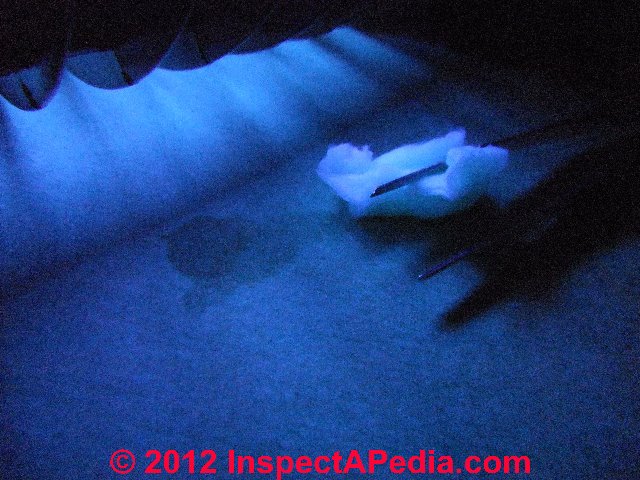
Watch out: as our photo at left illustrates, a "faux-UV" light such as this lamp (photo at left) sold as a mosquito killing product produces so little ultraviolet light that it does not cause urine to fluoresce. The urine-soaked cotton held in tweezers in our photo was not able to be identified by a test using this particular light source. - Varnish, as an organic compound; under UV light later varnish restorations of a varnish retouch shows up as darker areas. Similarly, recent oil paint applied over older varnish layers will appear as dark areas. Oil paint and recent varnishes do not flouresce under UV light. A lovely example is cited below
- Ultraviolet light, Ultraviolet Fluorescence (UVF) and Ultraviolet Reflectography (UVR) Varnish retouches, retrieved 2017/11/07 original source http://www.webexhibits.org/pigments/intro/uv.html
- Vaseline or similar petroleum jelly products
- "Vaseline glass" (glass containing 2% uranium dioxide by weight as a yellow ie yellowish-green coloring agent) (c=green)
- Vitamin A & B; B12 glows yellow; (c=yellow), thiamine & riboflavin also flouresce. Vitamin D3 has been studied using UV.
- Esvelt, R. P., H. K. Schnoes, and H. F. DeLuca. "Vitamin D3 from rat skins irradiated in vitro with ultraviolet light." Archives of biochemistry and biophysics 188, no. 2 (1978): 282-286.
- Wood species: Separately at IPE DECK BOARD CUPPING we discuss the use of UV light and fluoresence to identify some (not all) wood species.
Research & Resources on UV Flourescent Light Uses
 UV light or black light information, sources, suppliers

- [1] About.com - Chemistry http://chemistry.about.com/cs/howthingswork/f/blblacklight.htm
- [2] Several light & forensic suppliers, e.g. Doje's (see our article on checking for blood in art work by Frida Kahlo)
- [3] U. Illinois Dept of Physics, http://van.physics.illinois.edu/qa/listing.php?id=1913
- [4] Glow Paint Industries, an Australian company ( 07-5483-9181) http://www.glowinthedark.net.au/ claims to provide the world's longest list of products that glow in the dark, listing toys, party supplies, home improvement products, recreation & sport products, paints, and more.
- [5] UV WATER DISINFECTION, PORTABLE discusses using a tiny portable UV light to attempt to disinfect drinking water
- UV ULTRAVIOLET LIGHT WATER TREATMENT discusses larger capacity ultra violet light water disinfection systems selection, installation, use, maintenance, diagnosis.
Watch out: "blacklight bulbs" that resemble incandescent light bulbs with a purple-colored exterior coating are sold as "black lights" but do not emit UV and cannot be used for forensic purposes. Those bulbs simply emit a dark purple light.
- Anderson RR. In vivo fluorescence of human skin. A potential marker of photoaging (letter). Arch Dermatol 1989;125:999-1000.
- Caplan RM. Medical uses of the Wood's lamp. JAMA 1967;202: 123-6
- Eaglestein W, Pariser DM. Wood's light examination. In: Office techniques in dermatology. New York: McGraw-Hill; 1982.
- Hickey-Friedman, Laramie. "A REVIEW OF ULTRA-VIOLET LIGHT AND EXAMINATION TECHNIQUES." [PDF] Objects Specialty Group postprints (American Institute for Conservation of Historic and Artistic Works. Objects Specialty Group) 9 (2002): 161-168.
Excerpt:
This presentation topic will include a brief history of ultra-violet light technology, fluorescence, and the introduction of UV examination into conservation via museums, concluding with a discussion of current research involving UV examination and possibilities for qualitative analysis. During a review of technical reports numerous notations appeared which identified restoration materials by the color of the fluorescent reflectance.
citing also the following articles - Dake, H.C. and J. De Ment. 1941. Fluorescent light and its applications. New York: Chemical Publishing Company
- de la Rie, E. R. 1982. Fluorescence of paint and varnish layers (Part I). Studies in Conservation. Vol. 27. 1-7.
- Marfunin, A.S. 1979. Spectroscopy, luminescence and radiation centers in minerals. Translated by V. V. Schiffer. Berlin: Springer-Verlag.
- Radley, J. A. and J. Grant. 1954. Fluorescence analysis in ultra-violet light. London: Chapman & Hall Ltd. 11-110.
- Rorimer, J.J. 1931. Ultra-violet rays and their use in the examination of works of art. New York: Metropolitan Museum of Art.
- Skoog, D. A. and J.J. Leary. 1992. Principles of instrumental analysis. 4th Ed. New York: Harcourt Brace College Publishers. 123-194.
- Zuzak, K. J., Schaeberle, M. D., Lewis, E. L., and I.W. Levin. 2002. Visible reflectance
hyperspectral imaging: characterization of a non-invasive, in vivo system for determining tissue
perfusion. Analytical Chemistry. 2021-2028. - Wood RW. Secret communications concerning light rays. J Physiol 1919;5e serie: t IX. Quoted from: Asawanonda P, Charles TR. Wood's light in dermatology. Int J Dermatol 1999;38:801-7.
...
Continue reading at LIGHT, GUIDE to FORENSIC USE or select a topic from the closely-related articles below, or see the complete ARTICLE INDEX.
Or see UV LIGHT BLACK LIGHT USE FAQs - questions & answers about using UV light for investigative purposes, posted originally at the end of this page
Or see these
Recommended Articles
Suggested citation for this web page
UV LIGHT BLACK LIGHT USES at InspectApedia.com - online encyclopedia of building & environmental inspection, testing, diagnosis, repair, & problem prevention advice.
Or see this
INDEX to RELATED ARTICLES: ARTICLE INDEX to BUILDING FORENSICS
Or use the SEARCH BOX found below to Ask a Question or Search InspectApedia
Ask a Question or Search InspectApedia
Try the search box just below, or if you prefer, post a question or comment in the Comments box below and we will respond promptly.
Search the InspectApedia website
Note: appearance of your Comment below may be delayed: if your comment contains an image, photograph, web link, or text that looks to the software as if it might be a web link, your posting will appear after it has been approved by a moderator. Apologies for the delay.
Only one image can be added per comment but you can post as many comments, and therefore images, as you like.
You will not receive a notification when a response to your question has been posted.
Please bookmark this page to make it easy for you to check back for our response.
Our Comment Box is provided by Countable Web Productions countable.ca
Citations & References
In addition to any citations in the article above, a full list is available on request.
- [1] About.com - Chemistry http://chemistry.about.com/cs/howthingswork/f/blblacklight.htm
- [2] Several light & forensic suppliers, e.g. Doje's (see our article on checking for blood in art work by Frida Kahlo at BLOOD in ART WORKS, TESTING FOR)
- Judy and Don Doje, Doje's Forensic Supplies, P.O. Box 500, Ocoee, FL 34761
- [3] U. Illinois Dept of Physics, http://van.physics.illinois.edu/qa/listing.php?id=1913
- [4] Glow Paint Industries, an Australian company ( 07-5483-9181) http://www.glowinthedark.net.au/ claims to provide the world's longest list of products that glow in the dark, listing toys, party supplies, home improvement products, recreation & sport products, paints, and more.
- [5] FEIT ELECTRIC COMPANY, INC. 4901 Gregg Road Pico Rivera, CA 90660-2108, Tel: (800) 543-FEIT (3348), website: http://www.feit.com/ web search 5/14/2012
- [6] "What You Need to Know about UL 1598, 3rd Edition", Intertek, Tel: 800-967-5352, USA, offices in the Americas, Germany, Sweden, Asia Pacific, Italy, UK. Website: www.intertek.com/lighting, web search 5/14/12 [Copy on file as UL-1598-White-Paper.pdf]
- [7] "ANSI Coded Light Bulbs", Bulbstock.com, web search 5/14/12, original source: http://www.bulbstock.com/AnsiCodedLightBulbs.html
- [8] ANSI American National Standards Institute, website: www.ansi.org [Don't expect to easily find anything you need to know at the ANSI website - Ed.] Example: [http://www.ansi.org/news_publications/news_story.aspx?menuid=7&articleid=2628]
The National Electrical Manufacturers Association (NEMA), on behalf of the American National Standard Lighting Group (ANSLG), has published ANSI/ANSLG C78.81-2010, Electric Lamps - Double-Capped Fluorescent Lamps - Dimensional and Electrical Characteristics. The recently published standard sets forth the physical and electrical characteristics of the principal types of fluorescent lamps intended for application on conventional line frequency circuits and electronic high-frequency circuits.
ANSI/ANSLG C78.81-2010 revises a 2005 edition and provides specifications for the lamp itself, the interactive features of the lamp, and the lamp ballast, including conventional systems relying on auxiliary support from external ballasts. In addition, three new fluorescent lamp data sheets are included: 25-Watt, 48-Inch T8, High-Frequency Fluorescent Lamp; 28-Watt, 48-Inch T8, High-Frequency Fluorescent Lamp; and 30-Watt, 48-Inch T8, High-Frequency Fluorescent Lamp. Only double-based lamps of the regular linear shape are included in the standard; single-based compact, circular, square, and U-shaped lamps are found in NEMA/ANSI C78.901:2005, For electric lamps single base fluorescent lamps - dimensional and electrical characteristics.
NEMA, an ANSI organizational member and accredited standards developer, is a membership organization of manufacturers of products used in the generation, transmission, distribution, control, and end-use of electricity used in utility, medical imaging, industrial, commercial, institutional and residential applications. - [9] Wikipedia Web: https://www.wikipedia.org/ provided background information about some topics discussed at this website provided this citation is also found in the same article along with a " retrieved on" date. NOTE: because Wikipedia entries are fluid and can be amended in real time, we cite the retrieval date of Wikipedia citations and we do not assert that the information found there is necessarily authoritative.
Entry on color temperature, 5/14/2012, original source: http://en.wikipedia.org/wiki/Color_temperature
Entry on lumen, 5/14/12, original source: http://en.wikipedia.org/wiki/Lumen_(unit)
Entry on Wien's displacement law, 5/14/12, original source http://en.wikipedia.org/wiki/Wien's_displacement_law - [10] "Notes on LEDs & Kelvin Color Scale", Autolumination, website: autolumination.com, web search 5/14/12, original source: http://autolumination.com/colors.htm [copy on file as LED_Notes_AutoIll.pdf]
- [11] Light Booth, Type LBM-B", Mathis. Mathis is headquartered in Brasil (Website: http://www.mathis.com.br/, Email: mathis@mathis.com.br) with offices in Switzerland & the USA and other countries.
Werner Mathis AG Rütisbergstrasse 3 CH-8156 Oberhasli/Zürich, Switzerland Telefon 41(0)44-852 5050 Telefax 41(0)44-850 6707 E-Mail info@mathisag.com Homepage www.mathisag.com, other worldwide locations: Werner Mathis U.S.A. Inc. 2260 HWY 49 N.E./P.O. Box 1626 Concord N.C. 28026, U.S.A. Phone: 1-704-786-6157 Fax: 1-704-786-6159 E-mail: usa@mathisag.com, Mathis (India) PVT. LTD. 203, Swastic plaza Pokhran Road No. 2, Thane 400 601, India Phone: +91 22 2585 4304 E-mail: india@mathisag.com, and Mathis (India) PVT. LTD. 203, Swastic plaza Pokhran Road No. 2, Thane 400 601, India Phone: +91 22 2585 4304 E-mail: india@mathisag.com.
Mathis provides a lighting boot for visual assessment and comparison of colors, use to compare color variations and metamerism on samples. The light booth provides four or five standardized light sources (daylight -D65, fluorescent -TL84, incandescent - A home light color temp. of 2,856, ultraviolet - UV to evaluate optical brightener or fluorescent dyes, and a 5th optional lamp providing D50-artificial daylight 5,000K, D75-artificial daylight 7,500K, H-horizon light 2,300K, CWF- store light, cool fluorescent 4,150K.) Web search 5/14/12, original source: http://www.mathis.com.br/arquivos/PDF/ing/LBM-ing.pdf, [copy on file as Mathis_Light_Booth_LBM-ing.pdf] - [12] A. J. Swerdlow, J. S. English, R. M. MacKie, C. J. O'Doherty, J. A. Hunter, J. Clark, and D. J. Hole, "Fluorescent lights, ultraviolet lamps, and risk of cutaneous melanoma.", BMJ
v.297(6649); Sep 10, 1988 PMC1834365 (This article has been corrected. See BMJ. 1988 November 05; 297(6657): 1172.) -
Abstract: Exposure to solar radiation is increasingly being associated with a risk of cutaneous melanoma, and some risk has also been attributed to exposure to fluorescent lights. The risk of cutaneous melanoma associated with exposure to some sources of artificial ultraviolet radiation was examined in a case-control study in a Scottish population with fairly low exposure to natural ultraviolet radiation.
The risk was not significantly or consistently raised for exposure to fluorescent lights at home or at work. The use of ultraviolet lamps and sunbeds, however, was associated with a significantly increased risk (relative risk = 2.9; 95% confidence interval 1.3 to 6.4), and the risk was significantly related to duration of use. The risk was particularly raised among people who have first used [corrected] ultraviolet beds or lamps more than [corrected] five years before presentation (relative risk = 9.1; 95% confidence intervals 2.0-40.6), in whom it was significantly related to cumulative hours of exposure. The risks associated with exposure to ultraviolet lamps and sunbeds remained significant after adjustment for other risk factors for melanoma. - [13] Hug, William F., "Inspection/Detection System with a light module for use in forensic applications", United States Patent No. 4,933,816, Jun 21 1990.
- [14] Pounds, C. A., Grigg, R., and Mongkolaussavaratana, T., "The Use of 1,8-
Diazafluoren-9-one (DFO) for the Fluorescent Detection of Latent Fingerprints on Paper.
A Preliminary Evaluation," Journal of Forensic Sciences, JFSCA, Vol 35, No. 1, Jan. 1990,
pp. 169-175.
- Abstract: The use of a new amino acid reagent 1,8-diazafluoren-9-one (DFO), which produces a highly fluorescent species with latent fingerprints on paper, is described. Spectral characteristics of the fluorescent fingerprint show excitation (kox approximately 470 nm) and emission (ko~ approximately 570 nm) maxima in the visible'part of the spectrum. Some printing inks fluoresce under these conditions and would therefore hinder fingerprint detection, but optical brighteners present in paper do not interfere. Fluorescent fingerprints visualized by DFO revealed more fingerprint detail than ninhydrin, the standard method for such surfaces.
retrieved 07/24/2012 original source http://library-resources.cqu.edu.au/JFS/PDF/vol_35/iss_1/JFS351900169.pdf [ copy on file as /Inspection Methodology/UV_Fingerprint_Detect.pdf ] - [16] Barsley, Robert E. D.D.S., J.D.; West, Michael H. D.D.S.; Fair, John A. M.S., R.P.S, "Forensic Photography: Ultraviolet Imaging of Wounds on Skin", The American Journal of Forensic Medicine and Pathology, December 1990 - Volume 11 - Issue 4, Abstract:
The use of ultraviolet light (UVL) to study and document patterned injuries on human skin has opened a new frontier for law enforcement. This article discusses the photographic techniques involved in reflective and fluorescent UVL. Documentation of skin wounds via still photography and dynamic video photographic techniques, which utilize various methods of UV illumination, are covered. Techniques important for courtroom presentation of evidence gathered from lacerations, contusions, abrasions, and bite marks are presented through case studies and controlled experiments. Such injuries are common sequelae in the crimes of child abuse, rape, and assault. - [17]
Karen A. Santucci, MD*,
David G. Nelson, MD*,
Kemedy K. McQuillen, MD‡,
Susan J. Duffy, MD*,
James G. Linakis, PhD, MD*, "Wood's Lamp Utility in the Identification of Semen", Pediatrics Vol. 104 No. 6 December 1, 1999
pp. 1342 -1344
(doi: 10.1542/peds.104.6.1342),
Abstract Background. The accurate detection of semen is critical to forensic, medical, and legal personnel. The Wood's lamp (WL) emits ultraviolet light (UVL) and has been identified as useful in rape evaluations because it is purported to cause semen to fluoresce. This study was intended to determine if semen can be distinguished from other products by WL analysis. Methods. Investigators reviewed the previous training and frequency of use of the WL by emergency medicine and pediatric emergency medicine physicians at 2 medical centers. The participants were asked to use a WL to distinguish between a semen sample (< 6 hours old) and 13 commonly used products. Next, 29 semen samples were collected and evaluated under high-power microscopy and under UVL. Results. A total of 41 physicians participated in the study (68% male). The number of years practicing in an emergency setting spanned from .3 to 25 years with a mean of 7.1 years. A total of 51% of participants trained in emergency medicine, 23% in pediatrics and pediatric emergency medicine.
A total of 22% reported formal training in the collection of forensic evidence. A total of 62% of the physicians believed they have identified semen in the past; one third felt they could differentiate semen from other products under UVL. None of the 41 physicians were able to differentiate semen from other products using a WL. Moreover, the semen samples used for the study did not fluoresce under WL analysis. None of the 29 semen samples fluoresced whether wet or dry. The medicaments most commonly mistaken for semen were A&D ointment (Cardinal Health, Inc, Dublin, OH), Surgilube (Division of Atlanta, Inc, Melville, NY), Barrier cream (Carrington Laboratories, Inc, Irving, TX), and bacitracin (Division of Atlanta, Inc, Melville, NY). Conclusions. Participating physicians were unable to distinguish between semen and other common products, using the WL. Although the WL has been purported to be a useful tool as a screening device for the detection of seminal stains, the investigators have found it to be unreliable. Semen, previously reported to fluoresce under WL analysis, does not appear to do so. The correct identification of semen may be complicated by the presence of previously existing ointments and creams, some of which may be iatrogenically introduced (ie, Surgilube). - [18] Dr. Bruce Budowle1,*,
F. Samuel Baechtel,
Catherine T. Comey,
Alan M. Giusti,
Leonard Klevan, "Simple protocols for typing forensic biological evidence: Chemiluminescent detection for human DNA quantitation and restriction fragment length polymorphism (RELP) analyses and manual typing of polymerase chain reaction (PCR) amplified polymorphisms", ELECTROPHORESIS
Volume 16, Issue 1, pages 1559–1567, 1995,
Abstract Methods for identity testing are described that enable extraction of DNA from biological samples, determination of the quantity of human DNA, and genetic analyses of the materials using restriction fragment length polymorphism (RFLP) typing and/or amplified fragment length polymorphism (AMP-FLP) typing of PCR products. The salient features of the procedures are simplicity, manual typing, nonradioactive chemiluminescent assays or silver staining for detection, and low cost. Most application-oriented laboratories involved in forensic and/or paternity testing should be able to implement these procedures. - [19] C.Y. Wenemail address
,
J.K. Chen, "Multi-resolution image fusion technique and its application to forensic science", Forensic Science International
Volume 140, Issue 2 , Pages 217-232, 10 March 2004,
Abstract Image fusion is a process of combining two or more images into an image. It can extract features from source images, and provide more information than one image can. Multi-resolution analysis plays an important role in image processing, it provides a technique to decompose an image and extract information from coarse to fine scales. In some practical forensic examinations (such as the cartridge image check), we cannot obtain all information from just one image; on the contrary, we need information from images with difference light sources (or light ways). In this paper, we apply an image fusion method based on multi-resolution analysis to forensic science. Synthetic and real images (such as images from closed-up photography and flash photography) are used to show the capability of the multi-resolution image fusion technique. - Steve Bliss's Building Advisor at buildingadvisor.com helps homeowners & contractors plan & complete successful building & remodeling projects: buying land, site work, building design, cost estimating, materials & components, & project management through complete construction. Email: info@buildingadvisor.com
Steven Bliss served as editorial director and co-publisher of The Journal of Light Construction for 16 years and previously as building technology editor for Progressive Builder and Solar Age magazines. He worked in the building trades as a carpenter and design/build contractor for more than ten years and holds a masters degree from the Harvard Graduate School of Education. Excerpts from his recent book, Best Practices Guide to Residential Construction, Wiley (November 18, 2005) ISBN-10: 0471648361, ISBN-13: 978-0471648369, appear throughout this website, with permission and courtesy of Wiley & Sons. Best Practices Guide is available from the publisher, J. Wiley & Sons, and also at Amazon.com - Allergen Tests in Buildings advice about how to test, what to look for, in evaluating the level of dog, cat, or other animal allergens in a building
- "IgG Food Allergy Testing by ELISA/EIA, What do they really tell us?" Sheryl B. Miller, MT (ASCP), PhD, Clinical Laboratory Director, Bastyr University Natural Health Clinic - ELISA testing accuracy: Here is an example of Miller's critique of ELISA - www.betterhealthusa.com/public/282.cfm - Townsend Letter for Doctors and Patients
The critique included in that article raises compelling questions about IgG testing assays, which prompts our interest in actually screening for the presence of high levels of particles that could carry allergens - dog dander or cat dander in the case at hand.
- www.tldp.com/issue/174/IgG%20Food%20Allergy.html - contains similar criticism in another venue but interestingly by the same author, Sheryl Miller. Sheryl Miller, MT (ASCP), PhD, is an Immunologist and Associate Professor of Basic and Medical Sciences at Bastyr University in Bothell, Washington. She is also the Laboratory Director of the Bastyr Natural Health Clinic Laboratory. - Allergens: Testing for the level of exposure to animal allergens is discussed at http://www.animalhealthchannel.com/animalallergy/diagnosis.shtml (lab animal exposure study is interesting because it involves a higher exposure level in some cases
- Allergens: WebMD discusses allergy tests for humans at webmd.com/allergies/allergy-tests
- In addition to citations & references found in this article, see the research citations given at the end of the related articles found at our suggested
CONTINUE READING or RECOMMENDED ARTICLES.
- Carson, Dunlop & Associates Ltd., 120 Carlton Street Suite 407, Toronto ON M5A 4K2. Tel: (416) 964-9415 1-800-268-7070 Email: info@carsondunlop.com. Alan Carson is a past president of ASHI, the American Society of Home Inspectors.
Thanks to Alan Carson and Bob Dunlop, for permission for InspectAPedia to use text excerpts from The HOME REFERENCE BOOK - the Encyclopedia of Homes and to use illustrations from The ILLUSTRATED HOME .
Carson Dunlop Associates provides extensive home inspection education and report writing material. In gratitude we provide links to tsome Carson Dunlop Associates products and services.
 | HOME | ABOUT | ASK a QUESTION | CONTACT | CONTENT USE POLICY | DESCRIPTION | POLICIES | PRIVACY | |
| © 2024 - 1985 Publisher InspectApedia.com - Daniel Friedman | |||||||||