
InspectAPedia® FREE Encyclopedia of Building & Environmental Construction, Diagnosis, Maintenance & Repair |
Question? Just ask us! InspectAPedia
|
 Hot Water Heat Air Bleeder Valves
Guide to Air Bleeders for Radiators, Baseboards, Convectors
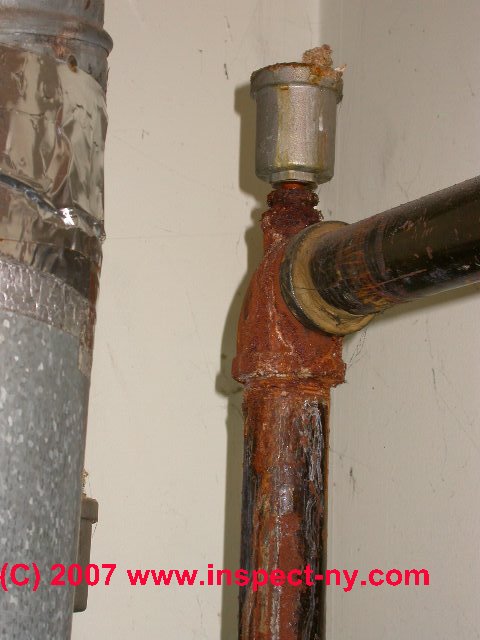
- POST a QUESTION or COMMENT about air bleeder vents on hot water heating systems
A guide to using air bleed valves to get rid of unwanted air in hot water heating systems: fix cold or noisy hot water heating radiators or baseboards.
Here we explain how to diagnose and repair problems with air bleed valves and we describe methods used to remove un-wanted, air from noisy or air-bound hot water heating system pipes, radiators, convectors, and baseboards
We illustrate how to buy and add air bleeders at baseboard elbows using a baseboard tee and air bleeder valves
What is a baseboard tee, how do they work with baseboard air bleeder valves, how to install air bleeders, vents, purgers.
InspectAPedia tolerates no conflicts of interest. We have no relationship with advertisers, products, or services discussed at this website.
A Guide to Air Bleeder Valves for Hot Water Heating Systems: Radiators, Baseboards, Convectors

Why You May Need to Bleed Air from a Hot Water Heating System
If a hot water heating system develops too much air in the piping you may hear bubbling or gurgling in the heating pipes when the heating system is operating, or worse, so much air may be in the heating piping, radiators, or baseboards that heat may simply not circulate at all.
[Click to enlarge any image]
Here we explain how to locate, inspect, use, or replace automatic and manual air bleed valves on hot water heat, and we explain methods used to remove air from air-bound hot water heating systems by finding and repairing or using automatic or manual air bleeder valves, or by using two different service procedures to force air out of air bound pipes in a hot water heating system.
Hydronic heating air vents and air purge devices: types, where to buy; How to diagnose and fix heating system noises & air in hot water heating system pipes. Service Procedures to force air out of an air-bound hot water heating system.
How to bleed a hydronic (hot water) heating system: how to purge air out of heating system boilers, radiators, baseboards, or piping.
Hot Water Heating System Air Bleed-out Procedure
How to Open Manual Air Bleeder Valves on Heating Radiators and Baseboards to Bleed Out Air - step by step guide
Here we describe the procedure for using manual air bleeder valves to remove un-wanted air in a hot water heating system in order to correct noisy gurgling pipes or to correct loss of heat due to an air-bound radiator, heating convector, or section of hot water heating baseboard.
Step 1: turn on and turn up the heat.
First make sure that your thermostat is calling for heat and that the heating system boiler has been running for ten minutes or so - to insure that the system is warm and up to normal operating pressure.
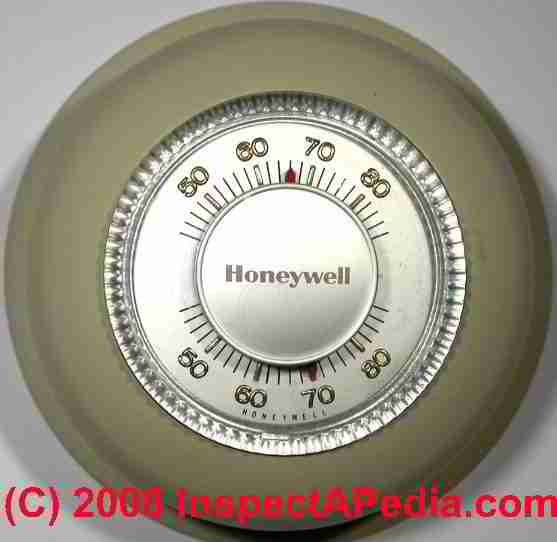
This step is necessary to ensure that heating system pressure will easily push out air from the air-bound radiator or baseboard, and to subsequently force hot heating water into the previously cold radiator or baseboard, confirming that you have successfully removed air that was preventing heat from rising into that unit.
In our photo, the room temperature (bottom scale) is at about 70 °F and the thermostat is set to 65 deg. F - in this condition the heating system will be off and removing un-wanted air in the system would be more difficult.
Step 2: find the air-bound radiator or baseboard:
if you have not already done so, once the heating system is up to operating temperature and pressure, check each radiator, convector, or heating baseboard to see if it has warmed up.
If you find one or more that remain cold, and provided that the cold heating radiator's valve is in the "open" position (counterclockwise), proceed to step 3 to see if that unit was air-bound.
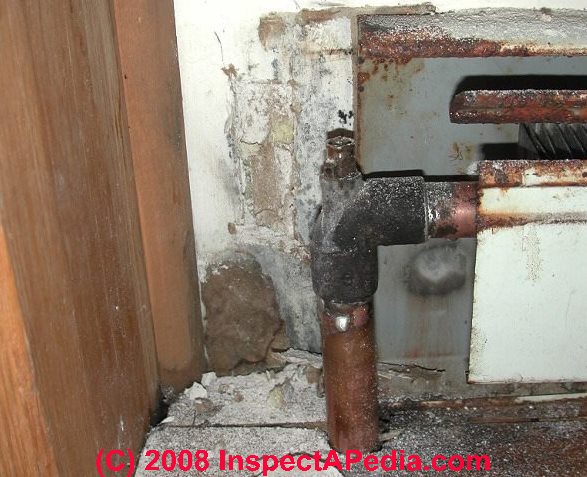
Our photo above shows a manually-operated air bleeder on a heating baseboard. Manually operated air bleeder valves are opened (turn counter-clockwise) using either an air bleeder valve key (if the bleeder valve stem is square) or a simple flat-bladed screwdriver (if the air bleeder valve stem is slotted).
In a building whose heat is delivered by hot water radiators or by hot water convector units
every one of these may have its own individual manually-operated air bleeder valves installed.
If one radiator or convector is not heating up, find and open the air bleeder valve to let out air. Close the valve immediately when water begins to come out.
We hold a cup under the valve spout during this operation so we don't spill water in the living area. (Photo below.)
Step 3: bleed out excess air:
Open the air bleed valve (turn it counter-clockwise) and listen for the hiss of escaping air. A "roller skate key" like device called a radiator air bleeder valve key may be needed to turn the recessed square end of older manual air bleeders on radiators and heating convectors.
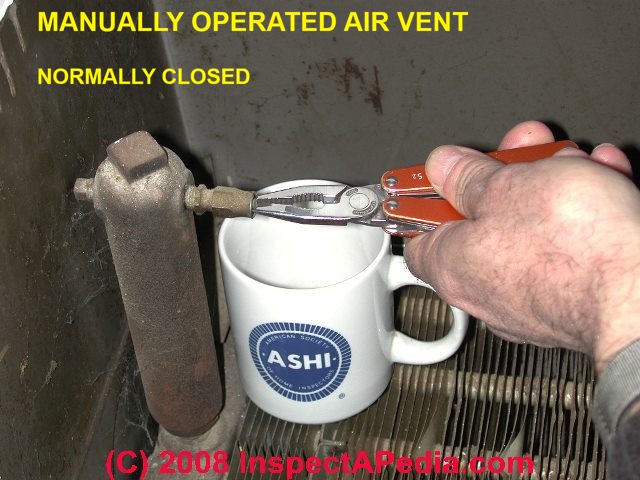
In pinch we've been able to open and close the valve using needle-nose pliers (photo at left) that have a point fine enough to reach into and grasp the square end of the valve control.
Question: where to buy a radiator air bleeder valve key
2016/10/19 Harry Rust said:
I want to bleed the air "if there is any trapped" in all the old heavy radiators in my house. I don't know the proper name of the tool used to do this but I think it looks similar to a key. Anyway, I need to know where to get one. Thank you.
Reply:
Harry, the little key tool you described is widely sold in several sizes of which 1/8" square is standard; it's described as a Radiator Air Vent Key or Radiator Air Bleeder Key, for less than $1.00 each.
You'll find these at your local hardware store if your are lucky enough to have one that's not been squashed by the big box stores. Air bleeder valves are also sold by local plumbing suppliers, by building supply stores such as Lowes and Home Depot, and from online plumbing suppliers.
Below you can see a typical radiator air vent key or "radiator air bleeder key" produced by Durst.
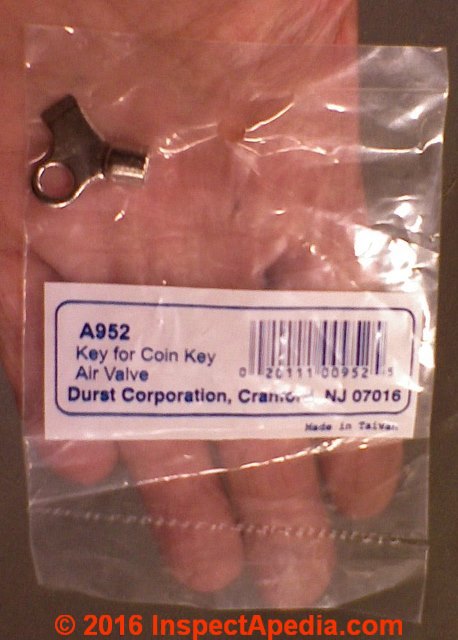
Slotted type air bleeder valve stems use a screwdriver to operate the valve. They're often sold under the description "Coin Air Vent Key Bleeder" but as the slotted valve stem is usually recessed you may find that a coin doesn't work well.
Watch out: If no air comes out of the air bleeder valve valve, just water, then the radiator or baseboard served by that valve is not air-bound.
If nothing comes out of the air bleeder - no air and no water, the system may not be hot enough or it may be air-bound.
See NO AIR & NO WATER COMES OUT in this article just below.
Step 4: close the air bleeder valve.
When water begins to come out of the valve, close it.
Step 5: feel the heating pipes
entering the baseboard, radiator or convector. Provided that the room thermostat is calling for heat, in a minute or so the pipes and radiator should begin to warm up and eventually become hot.
If this does not occur either the heating system is off, there is another airbound location, or there is a separate problem with the heating system.
In that case see HEATING LOSS DIAGNOSIS-BOILERS.
Other air bleeder valves are opened using a simple flat-bladed screwdriver.
Separately at AIR BLEEDER VALVE FUNCTIONS you can see photos of all of the various types of hot water heating system air bleeder valves including both manual air bleeders and automatic or float-type air bleeder valves.
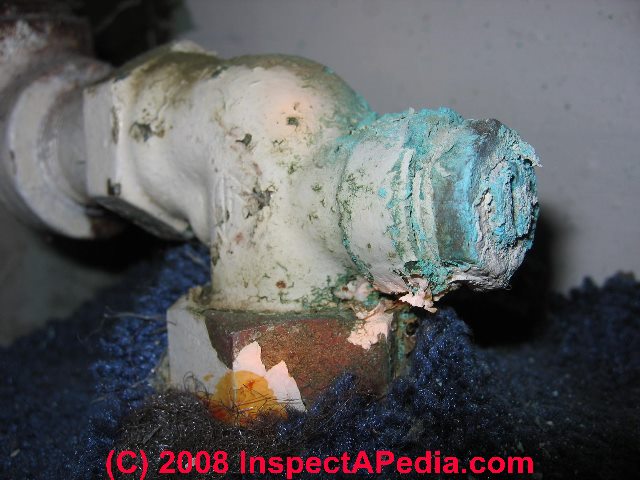
Watch out: if the manual, screwdriver-operated air bleeder valve is badly corroded such as the one shown in our photo of a manual air bleed valve at the bottom of a heating radiator (photo at left) chances are it has been leaking and it be stuck.
This particular valve was one we handled with great care. If it was not easy to open and shut it again with a screwdriver (without much force) we'd have chosen to leave the valve alone until it could be replaced.
How Do we Know That the Air Bleed Valve Operation Has Been Successful?
- If you open a manual air bleeder valve on a hot water heating system and air hisses out, there was air that needed removal. If only water comes out, that device was not the one that is air bound.
- If the heating boiler is already running and hot, quite quickly, in a minute or three, the radiator or convector that was air bound will get hot to the touch. Feel first at the pipes that enter the radiator, convector or heating baseboard since that's where hot water will begin entering the previously air-bound device.
Reader Comments, Questions & Answers About The Article Above
Below you will find questions and answers previously posted on this page at its page bottom reader comment box.
Reader Q&A - also see RECOMMENDED ARTICLES & FAQs
On 2022-02-20 by Inspectapedia Com Moderator - how to force air out of air bound heating system
@Darlene V Quinn,
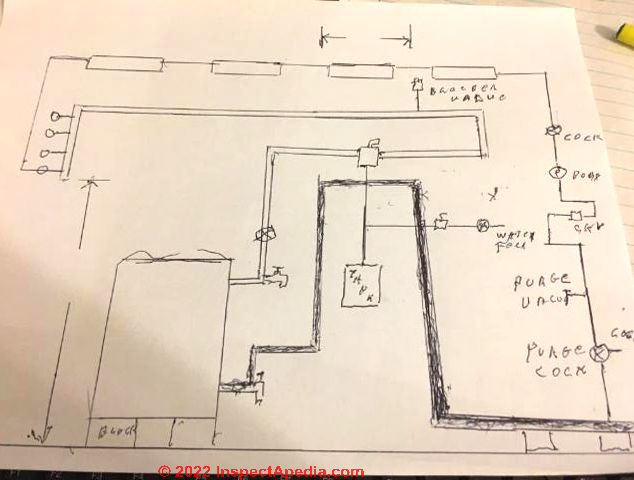
At the list of Recommended Articles you will see articles describing other ways to try to force the air out of an air bound heating system such as using the water feed valve or even using a separate pump and hose connected to a boiler drain.
But unless you're familiar with or trained and working on hot water heating systems, I don't recommend you try those as they might be more successful and safer if you bring in a heating service technician.
On 2022-02-20 by Darlene V Quinn
I have hot-water baseboard heat and I don't think I have any bleeder valves for each floor, at least I haven't found any. Each of my three floors are on separate zones. Are they sometimes installed without the bleeder valves? Do I have to hook up a hose to my boiler for each level to get the air out of the pipes? Thanks.
On 2022-01-18 by Inspectapedia Com Moderator - how can I find my air bleeders?
@Scott,
Yes definitely; follow the piping.
So where are air bleeder valves found on hot water heating systems? (also see the article above on this page)
Not to be too silly about this myself, what's needed is a combination of rational thinking - where would one put an air bleeder? and irrational thinking - where else can I look for one.
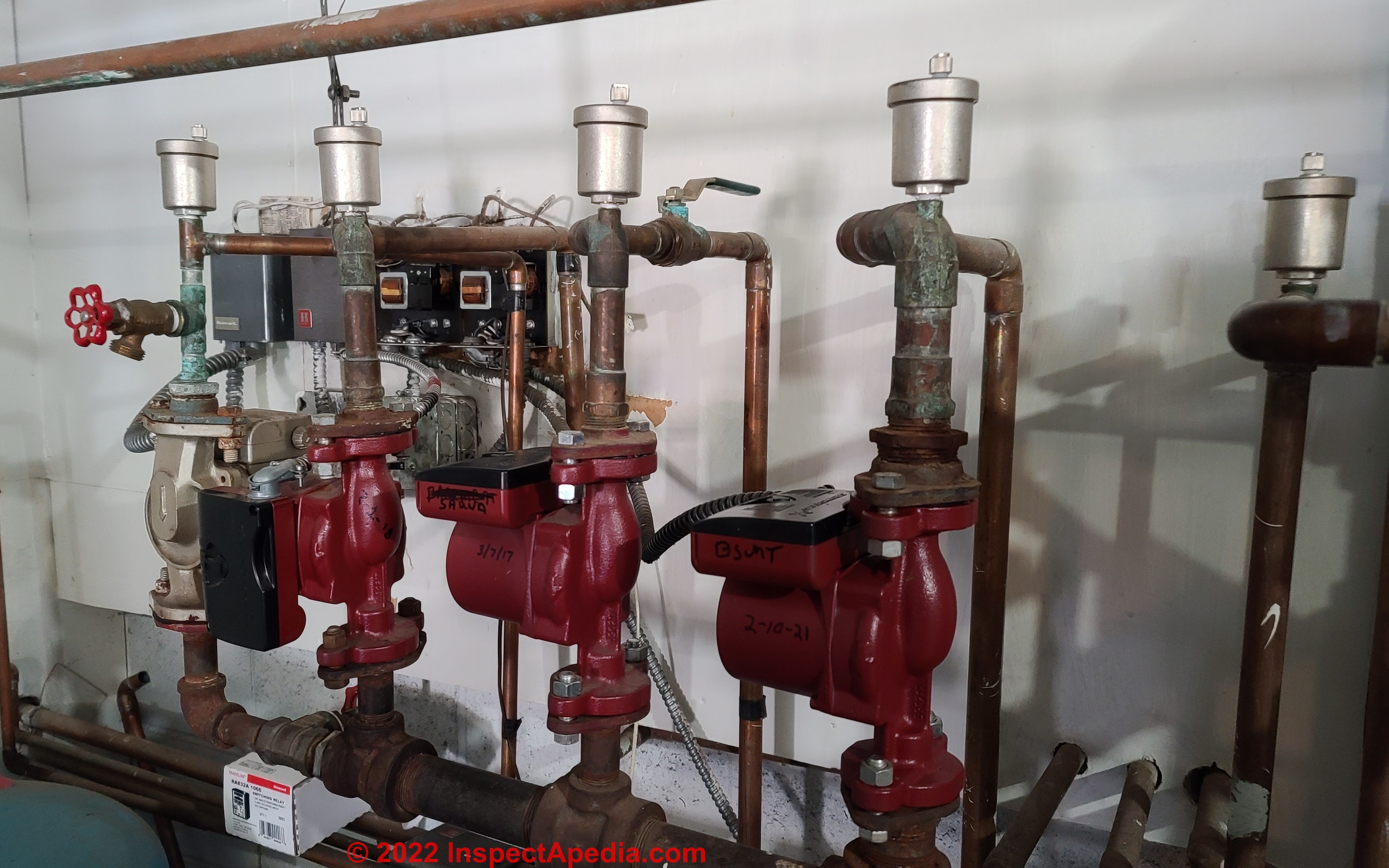
Air bleeders belong at high points in the piping system
Air bleeders may be found at one end, hopefully the high-end, of long near-horizontal runs
Air bleeders are often found at the entry or exit or both ends of runs of heating baseboard
Air bleeders may be found above the boiler on the hot water outlet lines
Air bleeders may be found at a high point on the hot water return lines to the boiler
Air bleeders are sometimes found atop a special hot water riser or vertical pipe high in the building, even in an attic space
Air bleeders may be found anywhere in the hot water heating piping system that a service technician previously found or thought there was a trapped-air problem.
On 2022-01-18 by Scott
@Inspectapedia Com Moderator,
If the hot water heater has an air bleeder at the heater, can there be bleeders else where on the pipes that need to be bled?
I'm guessing they would be located at an end cap and not the corners. (sorry for the noobish questions, last time i bled, it was in a house that had radiators. this one has baseboards and is from the 1950s, so not sure where the bleeder would be)
On 2021-12-26 by Inspectapedia Com Moderator - bleeder valves can help with circulating sounds in the system
@Mario Malatino,
Yes, in general, in the air bleeder at the top of the high in loop is a good place to remove air in the system and will make the circulating sounds that you're hearing much more quiet.
On 2021-12-26 by Mario Malatino
System has a high loop in the return and it sounds empty, can I install a bleeding valve to stop water sound in my system ? Have bleed and purged many times.
can i add a bleeder valve on top of my return loop. ? if so what king ?
On 2021-12-04 by Inspectapedia Com Moderator - options to control one room's radiator output
@Tom,
Three options:
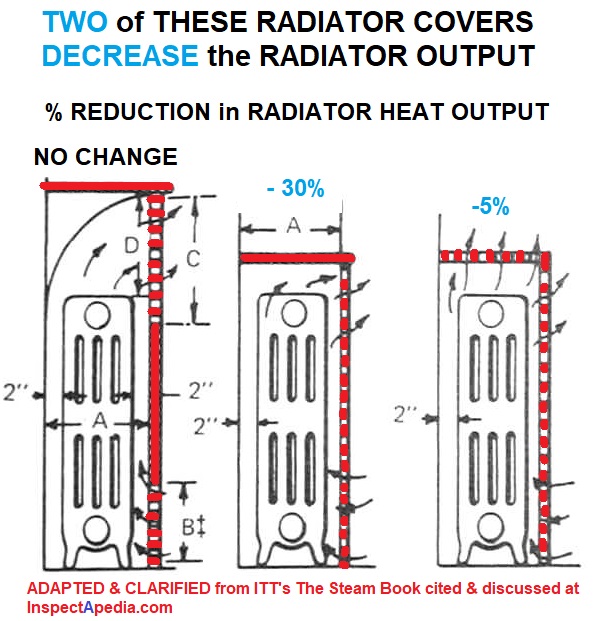
1. Immediate, no-cost: just put a board atop the radiator, at least as wide and as long as needed to completely cover the radiator top and to project an inch or two past it - this alone will cut the radiator's heat output by about 20%. If your daughter doesn't have a board or even some books or magazines to put atop the radiator, she can hang a towel or two over the radiator to reduce air movement around it, slowing heat transfer into the room
I attach a sketch showing two fancier radiator cover designs that will cut heat output.
2. Easy, low-cost, but some work: buy or build a radiator cover such as those we show at
RADIATOR BASEBOARD or CONVECTOR COVERS
3. Providing the radiator is piped as they usually are, repair or install the / a radiator control valve or better yet, install a thermostatically-controlled radiator valve that will automate the heat output as if there were a room thermostat, as we describe at
RADIATOR VALVES & HEAT CONTROLS
On 2021-12-04 by Tom
My daughter in Long Island has a 3 zone hot water heating system. I am in Florida and trying to help her remotely. 3 zones= Main area, great room and basement.
One of the bedrooms in the main area is much hotter than other main areas. It doesn't’t look like there are any shut off valves at the radiator to reduce heat or totally turn it off. How can she control the heat in that room without affecting other areas?
On 2021-09-08 by inspectapedia.com.moderator - do you need bleeder valves to drain hot water system
Charles,
Conventional tank type water heaters don't use air bleeder valves, but have to a pressure relief valve.
You could open the pressure relief valve as that control is designed to be tested by opening it once a year.
But there is some risk of finding it leaking afterwards.
A better approach to speed the draining of your hot water tank is to open nearby hot water valves and of course, with the water supply into the tank turned off.
On 2021-09-08 by Charles Russo
I want to know if you have to open the bleeder valves on hot water system to drain it fully
On 2021-02-02 by (mod) - using SharkBite elbows with 1/4" NPT drain for air bleeders on hydronic heating systems.
 Alex:
Alex:
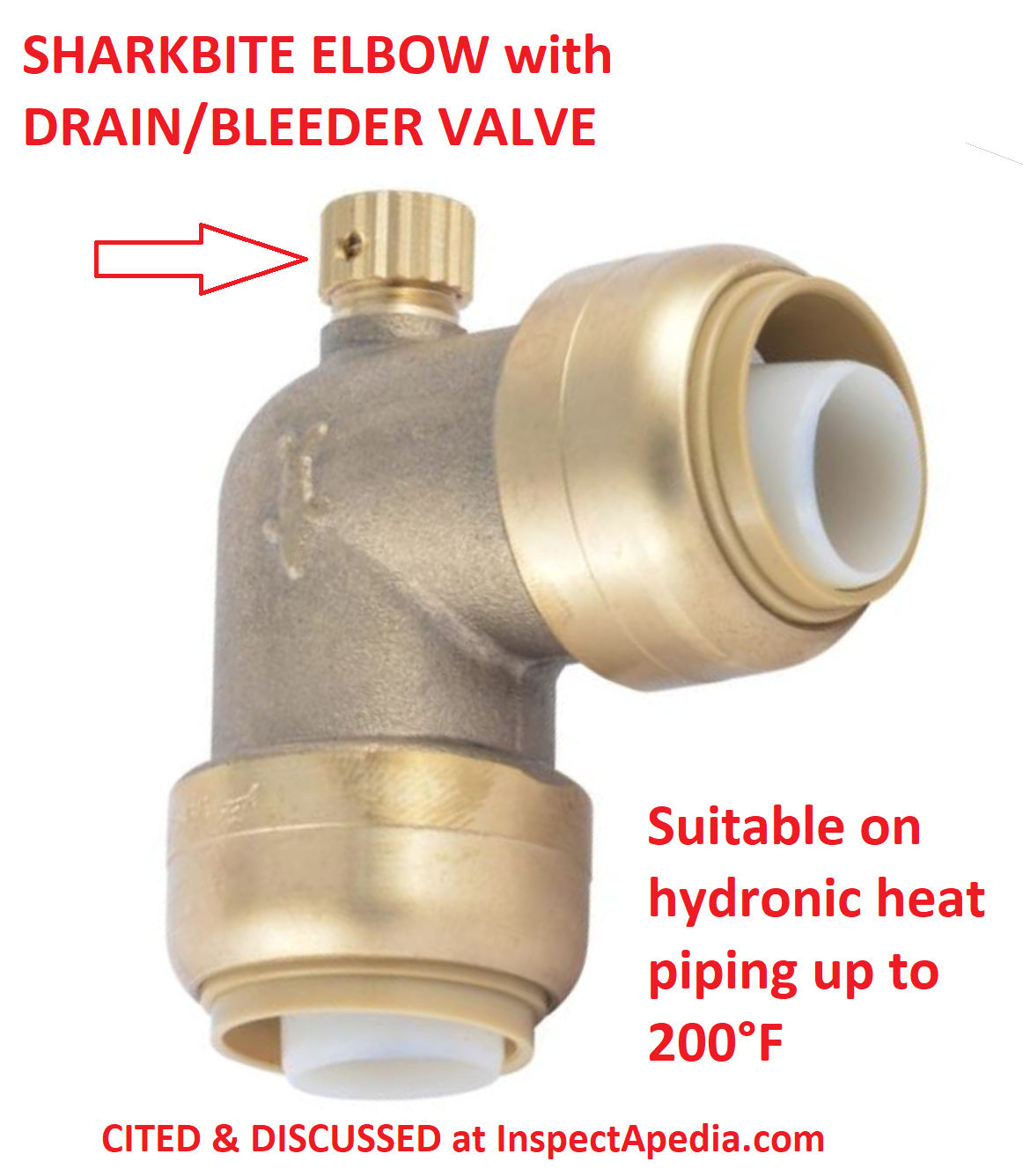
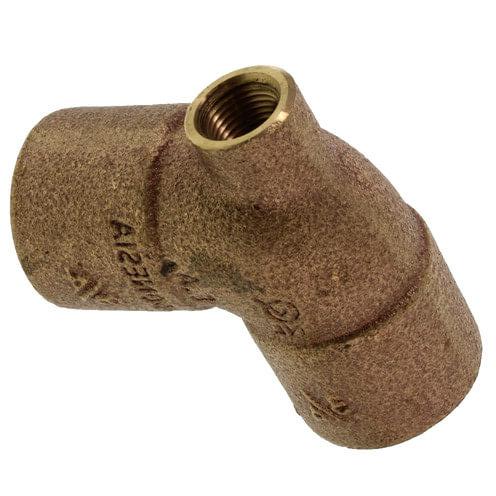
Good news: you can use SharkBite fittings that let you simply cut the copper baseboard tubing and press-fit the necessary connectors to install elbows, bends, or whatever's needed, That avoids having to try to de-solder and that might work for you if you can find the space to add air bleeder elbows at the high or entry or exit (or both) ends of your baseboards.
Below I'll show the part you want: the SharkBite 3/4" push-to-connect elbow fitting with drain; position the elbow so that the "drain" faces "up" for best result.
Also install air bleeders (float type automatic) right at the heating boiler on the supply and return ends of the circulating loops.
Watch out: you can use SharkBite fittings on hydronic heating up to temperatures of 200°F - which ought to be at or below any residential hot water heating system HI LIMIT.
On 2021-02-02 by Alex B
Hello,
I have an old boiler system / baseboard heating in a 3 story townhouse with very high ceilings and no bleeder valves. Needless to say my baseboards sound like Niagara Falls in the winter and i can only imagine how much air is in the pipes on the top floor where most of the bedrooms are.
Actually I do now have 2 bleeder valves as of recently when we had to move a base board and drained the system. I stuck them on the loudest spots that I could access easily. It certainly helped in those spots.
However getting that 90 degree drain valve (pic below) in there while de-soldering the old joint on the pipe return bend was a huge PIA and I almost destroyed the piping getting the pieces apart. Not looking forward to doing the other 8 like this.
A contractor I know recommended I use a straight union drain piece (same as the other one but no 90 degree bend) where I can just cut into the pipe and solder it straight in.
No melting old joints or risk being stuck with a bit of water in there making it impossible. However I am worried this would not be really effective releasing air as it is not in a corner where air can collect. Curious if anyone has tried this method or know if it is a viable option.
Thanks!
On 2020-12-25 0 - by (mod) -
Jim
If replacing or at least opening and chekcing the air bleeder valve doesn't do the trick then the system is airbound somewhere else in the piping rather than close to the bleeder valve.
In that case you can use the procedure that we describe at
AIRBOUND HEAT SYSTRM REPAIR BY PUMP
On 2020-12-24 by Jim Zavislak
Air bleeder valve on a new furnace (1 yr old )has not remved air from system? What can I do ?
On 2020-09-13 by (mod) - how do I find and stop hissing sound
Jim
I'd try turning some things off to see what stops the noise;
My very first concern is safety: I'm looking for an electrical sizzling hazard - a bad connection, for example.
You can hear hissing at lots of water heating equipment - sometimes it's an internal leak such as a cracked boiler section or a drip and leak in the bottom of a water heater.
On 2020-09-13 by Jim Harper
We have a constant high pitched hissing averaging 23 decibels that is heard by both self and wife. We have a single family house about 32 yes old wirh gas heat and water heater with central Airconditioning with outside condenser. We cannot find the source of the hissing. I thought it might have been a hearing problem in my head, except that both my wife and I hear it at the same time.
Fire dept came by and found no gas leaks. We recently had a broken hot water heater and leaking supply plumbing that was changed out with new heater and plumbing, with also the removal of an old water softener not used for years (when our city water source changed from well to Lake Michigan water and it was no longer needed).
We thought the old water heater was causing the sound as it was old (11-12 years) Tradesmen who came said they could not hear it. Does anybody have any ideas? Thanks guys.
Jim Harper
Carol Stream, IL (suburban Chicago)
On 2020-02-23 by (mod) - when to leave air bleeders open or closed
Anon
Thanks for asking a question about leaving hot water heating air bleeders open or closed.
The answer is, as Mark Cramer says, " ... it depends."
If the air bleeder is a float type vent then the screw cap on the vent is kept loose about 1 1/2 turns so that the float vent can automagically vent air that it collects.
The only time we close off the screw cap on float vents is if the vent is leaking water. In that case, screw down the vent cap to stop the leak and then ask your heating service tech to replace the vent with a new one.
If the air bleeder is a manual air bleeder that opens and closes by a screw or square "skate key" type wrench then those vents are normally closed - else water would come out of the vent continuously.
On 2020-02-23 by Anonymous
Should they be opened or closed when running normally
What if I Open the Air Bleeder but No Air & No Water comes out?
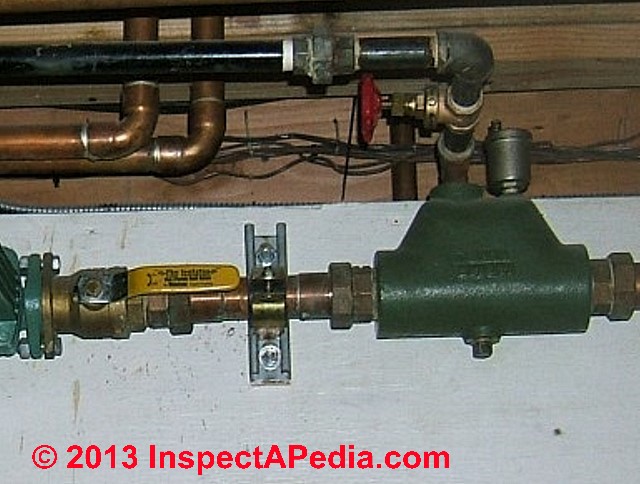 Photo at left: a Taco air scoop with an automatic air purge valve on its upper right tapping. This is an effective position for a float type automatic air bleed or purge valve.
If no air and no water comes out at a vent your heating system may be air-bound AND the vent itself may be debris clogged or jammed.
Watch out: First though, be sure that the thermostat is calling for heat and that the system is up to full operating temperature. That alone may put enough pressure in the system to successfully bleed air out of the cold radiator or baseboard.
If even after the heating boiler has been running for ten to fifteen minutes and is up to full temperature (burner has cycled off) you still get nothing coming out of a radiator or baseboard air bleed valve then your system is probably air-bound. At that point you need one of the two air-bound heating system repair approaches described by the two blue links just below.
11/27/2014 Anonymous said:
-If your system is not filled with water, you can't bleed the air out of the topmost radiators. You may need to open the fill valve in the basement, then bleed until air comes out. Typically, the pressure limiter valve in the basement will drip a little bit after the system is full of water, but usually this stops after a day or so.
Also--if your system has the "scoop" type of automatic air purger, it can still get air bound in the top story of the house. Then you simply have to open the valves in the system in the basement until all the air is out. Takes a while to figure this out.
Reply:
Anon
Good point and thanks for the comment - indeed in More Reading links just above you'll find two articles
AIR BOUND HEAT SYSTEM REPAIR by PUMP - live link just below
AIRBOUND HEAT SYSTEM REPAIR by WATER FEED VALVE - live link just below
that describe how to get past an air-bound system when the bleeder valve alone won't do the trick.
What if there are no manual air bleed-out valves on my heating system?
If your hot water heating system has become air-bound (one or more sections of heating radiators or baseboards are staying cold even though the boiler is on and the circulator pump is running), and if your system does not have an air bleed valve to remove air blocking water flow, you probably need to call a heating service technician who will use one of the methods we describe
at AIRBOUND HEAT SYSTEM REPAIR by WATER FEED VALVE
or
at AIR BOUND HEAT SYSTEM REPAIR by PUMP.
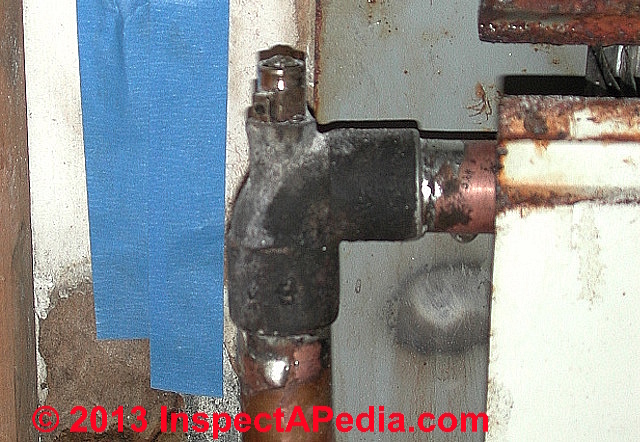
It is also quite possible to add manual or even automatic air-purging devices onto existing hot water heating systems when and where they are needed. Below we illustrate the two main types of air purge or bleeder valves: at below left is a float type air purge valve mounted atop an American brand air purger. At below right is a manual air bleed valve on a baseboard tee.
See AIR BLEED VALVE INSTALLATION
Are the Hot Water Heating System Air Bleeder Vents Left Normally Open or Closed?
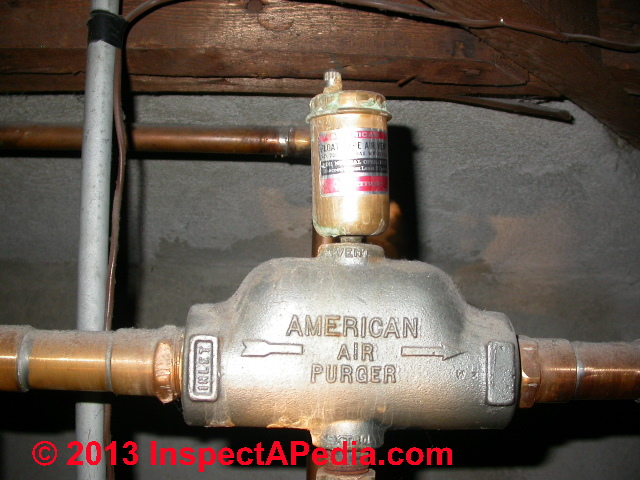
Above: A float type air bleeder vent installed atop the air scoop over a hydronic heating boiler. Normally the screw cap on float vents is left OPEN so that the vent can work to automatically remove air it collects.
[Click to enlarge any image]
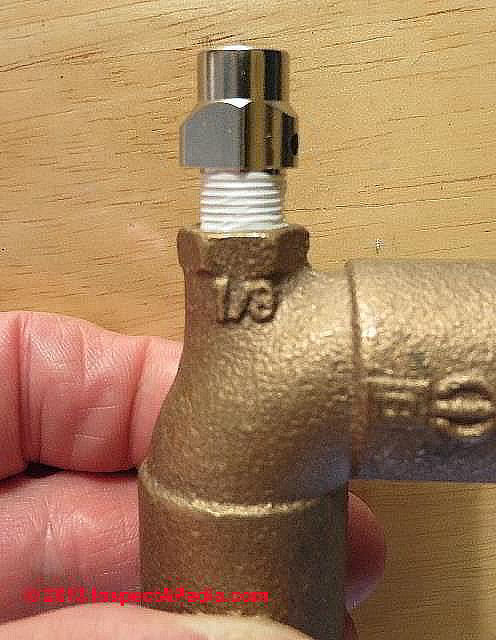
Below: a screw type air bleeder valve on an elbow at a hot water heating baseboards. These manually-operated hot water heating system air vents are kept closed except when manually bleeding air from the system.
But before rushing over to one of those cold radiator or baseboard fix-it articles, check the article summary
at AIR-BOUND HEATING SYSTEMS to see if there is an automatic air purging device that needs repair or replacement on your heating system.
What if nothing comes out of the air bleeder valve when it is opened?
Reader Question: Hi - I have baseboard water heat. Nothing comes out of the air bleeder valves (All but one is manual, they fit a flat head screwdriver.) I just ran water through the whole system to get rid of all the air bubbles.
The pressure on the little gauge looks good and pretty consistent. Now the pipes seem to be hot, but still when I open the bleeder valves I get no water and no hiss of air. Is this normal? Is it ok? Do I need to do something? Thanks very much for your informative articles. - Abby 10/7/12
Reply:
If no water comes out of the air bleeder valves I suspect the valve body is clogged or blocked.
What if I can't open the air bleeders on some of my radiators
Reader question: The bleeding screw in some of my radiators have rounded off so cannot unscrew them. Can I buy replacement plugs and if so would they be simple to fit myself. Combi boiler system.
Thanks, Maggie 10/14/12
Reply:
Maggie I have two possible solutions to rounded-off air bleed screw fittings.
First, try using a mini Vise-Grip tool that can reach inside the opening of the air bleeder and get a good bite on the air bleeder. I've successfully opened, bled, and closed tight air bleeders in this condition, allowing us to defer replacing the device.
The other solution is to shut down heat, cool down the system, and replace the entire air bleeder. Prepare the new replacement unit with teflon tape or pipe dope. Put down a towel, Remove pressure from the system (but you shouldn't have to actually drain it), work fast, and don't cross-thread the new fitting.
Question: can I change a manual air bleeder to an automatic one
Can an automatic bleeder be screwed in where the manual bleeder is on my radiator or will i have a puddle of water on my floor when auto bleeder starts working? - Darrell 11/20/12
Reply:
Yes you can change a manual air bleeder to an automatic one provided you choose a device that works in the position in which you need to mount it.
You are correct to worry about unintended leaking, since most automatic air bleeders require (to work) that their screw cap be left loose. So it makes sense to use these conversions where someone will quickly notice if there is a leak, and to avoid them otherwise. In my OPINION.
Question: how to bleed a heating convector with a broken vent key: Steps in replacing a broken air bleeder valve
2016/10/27 Nicci said:
Hi, my son has a convector radiator in his bedroom which desperately needs bleeding, however the inner part where you enter the key has broken off so i'm unable to turn to let out air. Can anyone please advise whether it's still possible or whether the radiator would need new part?
This question was posted originally at RADIATOR VALVES & HEAT CONTROLS
Reply: how to replace a radiator air bleeder valve
Nicci,
In an emergency, such as over a holiday weekend when your son is freezing to death and all of the heating and plumbing suppliers are closed, one could bleed air by removing the vent entirely, then screwing it (or a pipe plug) back into the opening when water appears.
The air bleeders on radiators are rather standard in thread and dimension. You can simply replace the bleeder device by unscrewing it and screwing in a new one with a bit of pipe dope or teflon tape. BUT first you'll need to let the heating system cool down and you'll need to drain enough water from the system that you don't have a flood from water squirting out of the air bleeder opening during the repair.
Air bleeder valves are described in detail at InspectApedia in this
article AIR BLEEDER VALVES
Here are the steps that a heating service technician would follow - more or less, as we don't know a thing about your specific heating system
- Turn off the boiler
- Let it cool down
- Turn off water supply into the boiler
- Drain water until the pressure drops down to maybe 0-5 psi. You do not need to fully drain the system, just drain enough that there is no water pressure.
- Prep the replacement bleeder device so that when you unscrew the old one if water comes out anyway you can minimize the mess by acting promptly to place and screw in the new one.
- Place a bath towel on the floor where your flood is going to occur (maybe)
- Unscrew the bleeder device - DO NOT PANIC if water starts coming out. Keep calm, carry on.
- Screw in the new air bleeder device - don't panic or you may cross thread it
- Mop up the water
- Take a deep calming breath
- Turn the water supply to the boiler back on
- The pressure/reducer/water feed valve should automagically refill the boiler to the proper cold-starting pressure.
...
Continue reading at AIR BLEEDER VALVE FUNCTIONS or select a topic from the closely-related articles below, or see the complete ARTICLE INDEX.
Or see AIR BLEEDER VALVE DIAGNOSTIC FAQs - questions and answers posted originally on this page.
Or see these
Recommended Articles
- AIR-BOUND HEATING SYSTEMS - home
- AIR BLEEDER VALVES
- AIR BLEEDER VALVE FUNCTIONS
- AIR BLEED VALVE INSTALLATION
- AIR BLEED VALVE LEAK REPAIR
- AIR BLEED VALVE SOURCES
- AIR ELIMINATOR / FLOAT VENT REPLACEMENT
- AIRBOUND RADIANT HEAT
- AIRBOUND HEAT SYSTEM REPAIR by PUMP
- AIRBOUND HEAT SYSTEM REPAIR by WATER FEED VALVE
- AIR SCOOPS PURGERS SEPARATORS
- RADIATOR PLUG REMOVAL
- RADIATOR VALVES & HEAT CONTROLS
- STEAM VENTS - home
Suggested citation for this web page
AIR BLEEDER VALVES at InspectApedia.com - online encyclopedia of building & environmental inspection, testing, diagnosis, repair, & problem prevention advice.
Or see this
INDEX to RELATED ARTICLES: ARTICLE INDEX to HEATING RADIATORS
Or use the SEARCH BOX found below to Ask a Question or Search InspectApedia
Or see
INDEX to RELATED ARTICLES: ARTICLE INDEX to HEATING BOILERS
Or use the SEARCH BOX found below to Ask a Question or Search InspectApedia
Ask a Question or Search InspectApedia
Try the search box just below, or if you prefer, post a question or comment in the Comments box below and we will respond promptly.
Search the InspectApedia website
Note: appearance of your Comment below may be delayed: if your comment contains an image, photograph, web link, or text that looks to the software as if it might be a web link, your posting will appear after it has been approved by a moderator. Apologies for the delay.
Only one image can be added per comment but you can post as many comments, and therefore images, as you like.
You will not receive a notification when a response to your question has been posted.
Please bookmark this page to make it easy for you to check back for our response.
Our Comment Box is provided by Countable Web Productions countable.ca
Citations & References
In addition to any citations in the article above, a full list is available on request.
- The Steam Book, 1984, Training and Education Department, Fluid Handling Division, ITT [probably out of print, possibly available from several home inspection supply companies] Fuel Oil and Oil Heat Magazine, October 1990, offers an update,
- Principles of Steam Heating, $13.25 includes postage. Fuel oil & Oil Heat Magazine, 389 Passaic Ave., Fairfield, NJ 07004.
- The Lost Art of Steam Heating, Dan Holohan, 516-579-3046 FAX
- Principles of Steam Heating, Dan Holohan, technical editor of Fuel Oil and Oil Heat magazine, 389 Passaic Ave., Fairfield, NJ 07004 ($12.+1.25 postage/handling) - or - Fuel oil & Oil Heat Magazine, 389 Passaic Ave., Fairfield, NJ 07004.
- "Residential Steam Heating Systems", Instructional Technologies Institute, Inc., 145 "D" Grassy Plain St., Bethel, CT 06801 800/227-1663 [home inspection training material] 1987
- "Residential Hydronic (circulating hot water) Heating Systems", Instructional Technologies Institute, Inc., 145 "D" Grassy Plain St., Bethel, CT 06801 800/227-1663 [home inspection training material] 1987
- Heating, Ventilating, and Air Conditioning Volume I, Heating Fundamentals,
- Boilers, Boiler Conversions, James E. Brumbaugh, ISBN 0-672-23389-4 (v. 1) Volume II, Oil, Gas, and Coal Burners, Controls, Ducts, Piping, Valves, James E. Brumbaugh, ISBN 0-672-23390-7 (v. 2) Volume III, Radiant Heating, Water Heaters, Ventilation, Air Conditioning, Heat Pumps, Air Cleaners, James E. Brumbaugh, ISBN 0-672-23383-5 (v. 3) or ISBN 0-672-23380-0 (set) Special Sales Director, Macmillan Publishing Co., 866 Third Ave., New York, NY 10022. Macmillan Publishing Co., NY
- Installation Guide for Residential Hydronic Heating Systems
- Installation Guide #200, The Hydronics Institute, 35 Russo Place, Berkeley Heights, NJ 07922
- The Steam Book, 1984, Training and Education Department, Fluid Handling Division, ITT [probably out of print, possibly available from several home inspection supply companies] Fuel Oil and Oil Heat Magazine, October 1990, offers an update,
- Principles of Steam Heating, Dan Holohan, technical editor of Fuel Oil and Oil Heat magazine, 389 Passaic Ave., Fairfield, NJ 07004 ($12.+1.25 postage/handling).
- "Residential Steam Heating Systems", Instructional Technologies Institute, Inc., 145 "D" Grassy Plain St., Bethel, CT 06801 800/227-1663 [home inspection training material] 1987
- "Residential Hydronic (circulating hot water) Heating Systems", Instructional Technologies Institute, Inc., 145 "D" Grassy Plain St., Bethel, CT 06801 800/227-1663 [home inspection training material] 1987
- Installation Guide for Residential Hydronic Heating Systems
- Installation Guide #200, The Hydronics Institute, 35 Russo Place, Berkeley Heights, NJ 07922
- In addition to citations & references found in this article, see the research citations given at the end of the related articles found at our suggested
CONTINUE READING or RECOMMENDED ARTICLES.
- Carson, Dunlop & Associates Ltd., 120 Carlton Street Suite 407, Toronto ON M5A 4K2. Tel: (416) 964-9415 1-800-268-7070 Email: info@carsondunlop.com. Alan Carson is a past president of ASHI, the American Society of Home Inspectors.
Thanks to Alan Carson and Bob Dunlop, for permission for InspectAPedia to use text excerpts from The HOME REFERENCE BOOK - the Encyclopedia of Homes and to use illustrations from The ILLUSTRATED HOME .
Carson Dunlop Associates provides extensive home inspection education and report writing material. In gratitude we provide links to tsome Carson Dunlop Associates products and services.
 | HOME | ABOUT | ASK a QUESTION | CONTACT | CONTENT USE POLICY | DESCRIPTION | POLICIES | PRIVACY | |
| © 2024 - 1985 Publisher InspectApedia.com - Daniel Friedman | |||||||||