
InspectAPedia® FREE Encyclopedia of Building & Environmental Construction, Diagnosis, Maintenance & Repair |
Question? Just ask us! InspectAPedia
|
 Baseboard Heat Guide
Heating Baseboard
Inspect, Repair, Cleaning
- POST a QUESTION or COMMENT about baseboard heat and heating baseboard installations
Hot water baseboard heating systems:
This article describes the types of baseboard heat used in buildings and we explain the diagnosis and repair of heating baseboard troubles including no-heat or leaks or other problems. This article focuses on the installation, diagnosis & repair of hot water heating baseboards.
We discuss: How to inspect, diagnose, and repair problems with baseboard heat. Inadequate linear feet of hot water baseboard: factors that determine how much baseboard is required. If your hot water baseboard is cold and the heating system is "on" - here we diagnose the problem.
Where leaks occur on hot water baseboards; Guide to unusual heating baseboards in buildings. How to raise up heating baseboard that lacks adequate clearance from the finish floor surface.
This article series answers most questions about all types of heating systems and gives important inspection, safety, and repair advice.
InspectAPedia tolerates no conflicts of interest. We have no relationship with advertisers, products, or services discussed at this website.
Baseboard Heat: How to Identify and Diagnose Problems With Hot Water or Electric Heating Baseboards
 How Does Heating Baseboard Work?
Hot water heating baseboard is warmed by hot water circulating through either finned copper tubing or through cast iron baseboard sections.
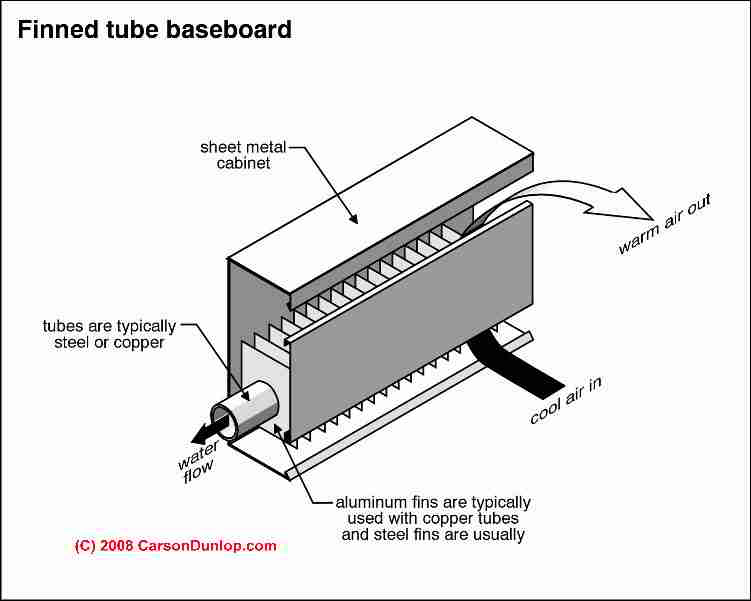
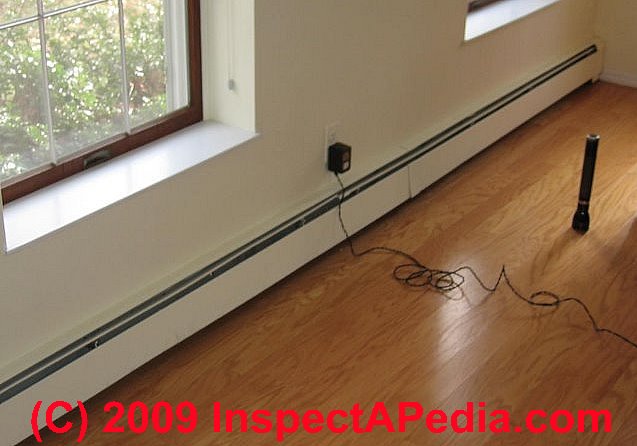
Our photo of a heating baseboard at left and also Carson Dunlop Associates' sketch (below left) show a typical modern hot water heating baseboard system installation.
Heating baseboard warms the room by a combination of radiation (the hot baseboard radiates heat onto surfaces in the room) and convection (cool air enters at the baseboard bottom, is warmed, and exits at the baseboard top - see Carson Dunlop Associates 's baseboard sketch at the top of this page).
[Click to enlarge any image]
If your heating baseboards are not in fact getting warm when your thermostat is calling for heat and the boiler is indeed running,
see AIRBOUND HEAT SYSTEM REPAIR by WATER FEED VALVE.
How Does Cast Iron Heating Baseboard Work?
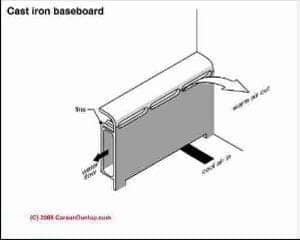
Carson Dunlop Associate's sketch of cast iron heating baseboard shows the heating water and air flow pathways of these heating units.
You can see by the larger water volume as well as the increased mass of the cast iron, that cast iron heating baseboards have more thermal mass than conventional finned-tube baseboard.
The increased thermal mass means more even heat distribution as the baseboards will continue to radiate heat for some time even when hot water stops circulating through the system.
Sketch of a cast iron heating baseboard courtesy of Carson Dunlop Associates, a Toronto home inspection, education & report writing tool company [ carsondunlop.com ].
How Many Feet of Baseboard Heaters do We Need to Heat a Room?
The answer is ... it depends. Electric heating baseboard is figured at five to eight watts per square foot of the room.
And for hot water heat, running a heat loss model such as the excellent program provided by Slant Fin™ can give a good estimate of the number of linear feet of heating baseboard will be needed for a given room or building area. But the following variables make an enormous difference in the answer:
- The number and square feet of windows in the room and the window's R-value
- The room's insulation levels or R-values for its walls, floor, ceiling
- The room ceiling height
- The level of air leakage into or out of the room
- The heat output per linear foot of the model of heating baseboard chosen
- The flow-rate and temperature of hot water passing through the heating baseboard.
- Electric baseboard heat linear feet requirements are discussed
at FEET of BASEBOARD HEAT NEEDED?
Guide to Diagnosing & Fixing Cold Heating Baseboards
 Cold Heating Baseboard Diagnostic Guide: how to diagnose a heating baseboard section, loop, zone, or room that is not receiving heat.
Make sure that your room thermostat is set to a temperature higher than the temperature in the room - so that it is calling for heat.
See THERMOSTATS.)
Make sure that your heating boiler is working, that is that the heating boiler turns on and off normally.
A hot water heating boiler may not turn on immediately when you turn up the room thermostat: if the water temperature in the boiler is already above the aquastat's cut-in temperature the circulators will send hot water to the radiator and the boiler will turn on later when its temperature is dropped by returning water from the cooler radiators in the building.
If your heat is provided by baseboards there will not normally be individual shutoff valves at those devices, but if your system uses one circulator and provides multiple heating zones (and thermostats) there will be zone control valves (usually near the boiler) that are opened or closed by the room thermostat(s).
Air-Bound Baseboard Heating Zone Diagnosis
Once your thermostat is calling for heat and the heating boiler has been running for ten minutes or more, just feel the baseboard. Don't cut your fingers on the fins, and don't bend them if you can help it.
If some sections of baseboard are not easy to access that's ok - you can simply feel the start and the end of a section of baseboard to determine where the loop of heat piping is hot and where along the system the baseboard piping first feels cold.
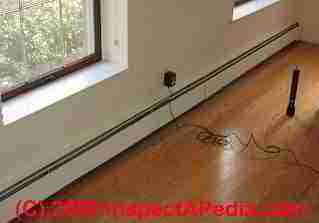
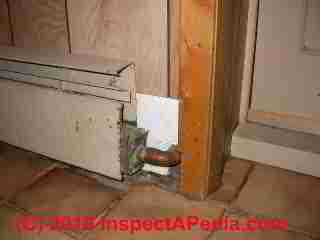
Our photo (left) shows an older finned copper tubing baseboard system with the end-cover removed - it's easy to just touch the copper pipe to feel its temperature - hot or cold, that's all we need to know.
If just some sections of an individual zone or loop of heating baseboard are not getting hot,
feel along the piping entering and leaving each section of baseboard in each room to find which sections are hot and which are cold - this is a first diagnostic step in determining what's wrong.
If your heat is distributed entirely through one zone (one thermostat, one loop of heating piping & baseboards) and if part of that loop is warm (usually just the beginning portion of the loop), then there is a good chance that your heating zone or loop is air-bound.
We provide detailed, step by step procedures for diagnosing and curing an air-bound hot water heating system, beginning
at AIRBOUND HEAT SYSTEM REPAIR by WATER FEED VALVE.
Also see heating baseboard air bleed valves discussed
at AIR BLEEDER VALVES for more details.
Since on many hot water heating systems a key air bleeding or air vent point is at the air scoop or air separator closer to the boiler,
see AIR SCOOPS SEPARATORS PURGERS.
Thermostat, Zone Valve, or Circulator Pump No-heat Diagnosis for Baseboard Heat
If your heating system is divided into multiple zones of baseboards or a mix of baseboards and radiators:
If the heating boiler is running and some baseboard sections or rooms are hot but others are not, first check to see if your heating system uses multiple thermostats and multiple heating zones.
It may be that the thermostat controlling the "cold" rooms is not calling for heat or is not working.
See THERMOSTATS.
It could also be that the circulator (see Circulator Pumps & Relays)
or zone valve (see ZONE VALVES, HEATING) controlling flow of hot water to that heating zone is not working.
If your heating baseboard is installed over a carpeted floor, be sure that the carpeting has not blocked the air inflow space under the bottom edge of the metal baseboard cover. Blocking this air intake will drastically reduce the heat output from your heating baseboards, thus increasing your heating bill.
Heating Baseboard Defects
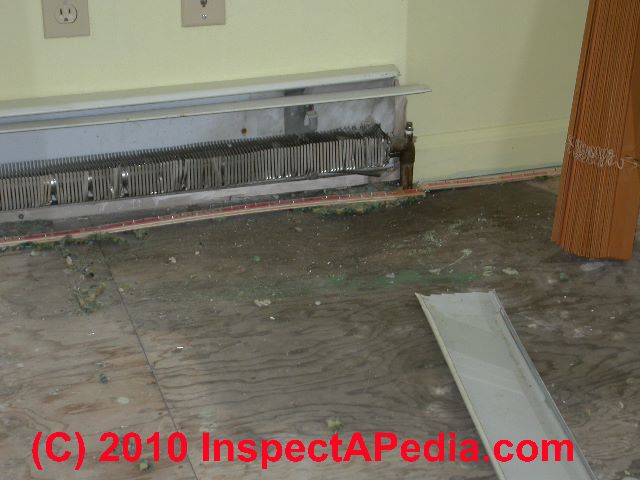
- Air-bound heating baseboards
can prevent sections or entire loops of heating baseboards from getting hot. Details are
at AIRBOUND HEAT SYSTEM REPAIRS
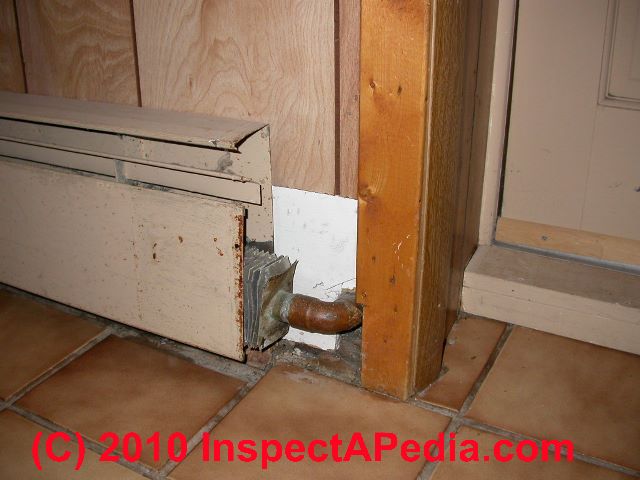
- Missing baseboard covers:
the covers are required to assure proper heating of room air by convection.
See RADIATOR BASEBOARD or CONVECTOR COVERS for tips on how to make or buy replacement covers for hot water heating baseboards - Missing baseboard end caps:
same as above (photo above right)
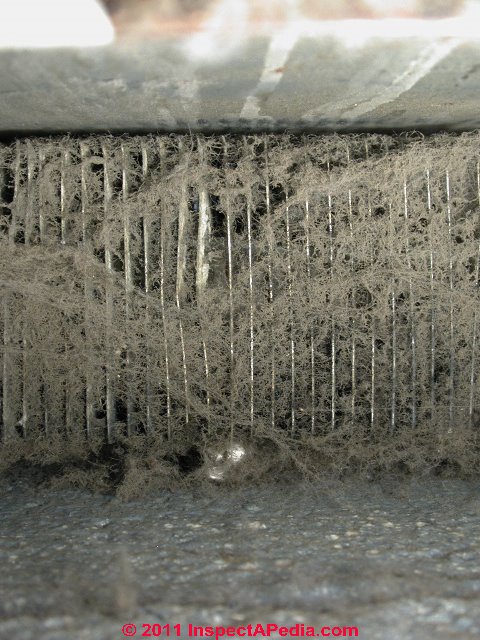
- Damaged or dust-clogged heating baseboard fins -
reduces air-flow and thus heating output. It's easy to fix this problem by careful vacuuming of the heating baseboard fins using a crevice tool on your home vacuum cleaner.
Watch out: be gentle or use a special brush attachment when vacuuming heating baseboard tubing and fins, or remove the baseboard covers if necessary.
If you are heavy-handed with the vacuum cleaner you may bend and damage the fins covering the baseboard tubing, resulting in reduced heat output. - Inadequate clearance
between the baseboard bottom and the floor surface - blocks entry of cool air into the baseboard - Leaky hot water baseboard
connections, air bleeders, elbows.
See LEAKS at BASEBOARD, CONVECTOR, RADIATOR for details.
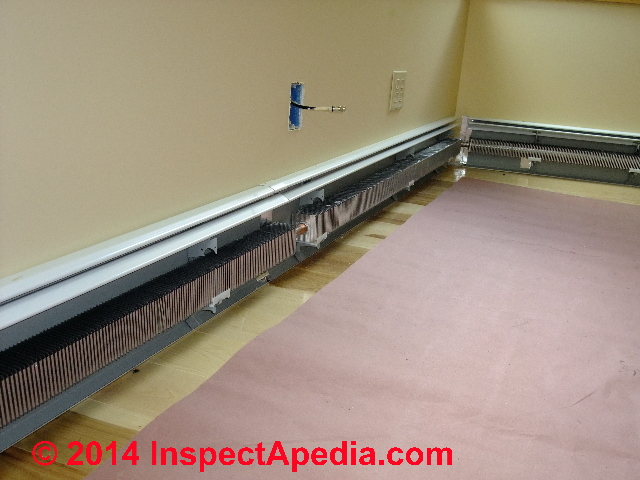
- Inadequate total linear feet of heating baseboard for the room size -
inadequate heat output may leave the room too chilly on cold windy days.
Solutions to inadequate hot water heating baseboard installations include increasing the hot water flow rate through the baseboard by changing the circulator pump to a higher output unit, increasing the water temperature flowing through the baseboard, increasing the diameter of piping between the heating boiler and the baseboard input and output ends, or changing the baseboard itself to a higher BTU output (per linear foot) model.
Our photo (left) shows heating baseboard being installed in a Poughkeepsie, NY home. The linear feet in this room was held to a minimum for room design reasons, leading the builders (DF & Galow Homes) to select a higher-output baseboard design.
Watch out: Unfortunately the installing Poughkeepsie plumber took some shortcuts and "saved money" by reducing the hot water piping feed and return piping from our design point of 3/4" diameter to his own preference for (easier and faster to install) 1/2" diameter piping.
We may need to install a higher capacity output circulator pump at this home or perhaps we'll need to install larger diameter supply and return piping. This installation remains under evaluation. - Unsafe electric heating baseboard installation details & clearances
such as from curtains and electrical outlets or wires.
See ELECTRIC BASEBOARD HEAT SAFETY
Tepid or Cold Baseboards: How to Fix a Baseboard that Does Not Get Hot - Quick Advice
Make sure that your room thermostat is set to a temperature higher than the temperature in the room - so that it is calling for heat.
Make sure that your heating boiler is working, that is that the heating boiler turns on and off normally.
A hot water heating boiler may not turn on immediately when you turn up the room thermostat:
if the water temperature in the boiler is already above the aquastat's cut-in temperature the circulators will send hot water to the radiator and the boiler will turn on later when its temperature is dropped by returning water from the cooler radiators in the building.
Complete details about diagnosing and fixing cold radiators are found
at COLD HEATING BASEBOARD / RADIATOR REPAIR
and
Reader Question about a Cold Baseboard Heat Room on a Single Zone - do I need to replace the aquastat?
2/13/2014 Question - Honeywell Aquastat Control Replacement said:
Hi Just wondering if I'm about to get ripped off or should i tell this person not to do the work. I have a 1800 sq foot 2 story house and the farthest bedroom on first floor (2 outside walls) away from the furnace in the basement (consistently freezing cold outside) has been much colder than the rest of the house (tenants keep heat at 75 and this room hovers around 64-68) It's a gas furnace
- He told me its a Peerless Boiler and he is factory authorized dealer and the date on the boiler is May 2012. I have hot water radiator heat.
This new heating guy says the one year old Aquastat Control needs to be replaced - that it is a part failure unrelated to the workmanship of the previous contractor who did the work last year (i switched from Oil to Gas). That if he replaces the control that there is a 70% chance that this will solve the coldness problem in the back bedroom will get warm.
If the whole rest of the house has been warm without any problem - is this really the problem, wouldn't the rest of the house be cold too? He wants to charge me $535 for the control 4 hours of labor at $65 an hour.
Now - its 2 days later, the room is still cold and now he's saying the baseboard heaters were installed wrong and need to be 'reworked' for $450.
That they are upside down and this is why the room isn't warm (same original contractor who put in the new furnace put in these baseboards in last year). I called the original contractor (wish i brought him over this time to begin with) but I'm working with a property manager now).
He says that what this guy is saying is not true - that they were put in correctly. It was me who decided to use a 4' shorter length on one of the walls and this could be the issue, but why then did this new guy have to replace the control for $795. Do they really cost $535 or is that way high? Thank you for any help or advice anyone can provide. -Paula
Reply:
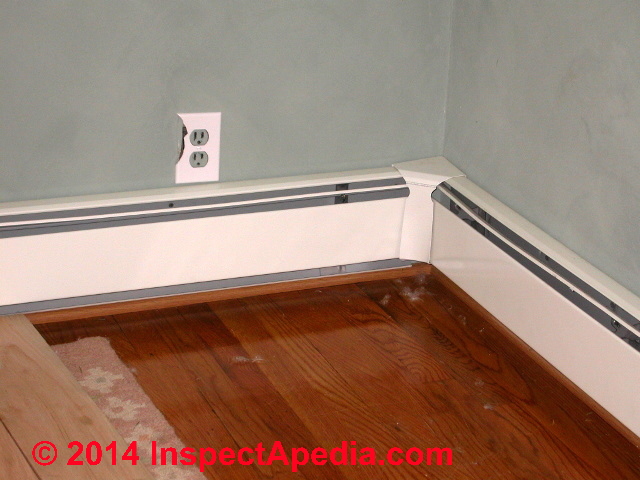
Really? I can't make sense out of the explanation given by your service tech.
The aquastat turns the boiler on and off, and may control one circulator. I can't see how it knows one room of the home from another. The tech may be honest but a lousy communicator, but from just the information in your note, I don't get it.
In the article above you'll see more photos of normal baseboard installations. I've never seen heating baseboard installed upside down - I wouldn't even know how to do that.
At left I have inserted a photograph of a normal hot water heating baseboard installation with the baseboards "right side up" and with decent clearance between the baseboard bottom and the floor surface. [We'll ignore for now that broken electrical receptacle cover hazard.]
[Click to enlarge any image]
Use the CONTACT link to send me some photos of your baseboards and we can comment further.
Reader Question: contractor re-routed baseboard piping, now some rooms don't heat-up
I just bought a house with baseboard heat, oil boiler. I have no experience with this type of system.
We hired a contractor to remodel our kitchen and in the process he replaced some pipe in the baseboard area. We asked that a portion of the baseboard heaters be removed so that cabinets could be installed along that wall. Instead, he replaced the pipe and lowered the pipe that runs along the wall with the new cabinets so that the pipe is touching the hardwood floor beneath.
The cabinets are installed above the pipe- he cut out a notch for them. My first question is: is this safe?
My second question is: since he replaced lines, the thermostat in that area of the house always reads about 10 degrees lower than the setting. I have check the valves- they are all open. He says he bled the lines of a lot of air and yet still it is not right. Any ideas what he can do to get the temperatures to even out? - Anon: 5 Mar 2015
Reply:
The contractor would have trouble completely "removing" a section of baseboard if that section was carrying hot water on to heat another portion of the home as s/he would then have to find some new (and more costly) route to get the heating water to that second area. That's why it's more common to do what you described.
As long as the heating pipes have adequate clearance to quietly handle their slight expansion and contraction as the piping heats and cools you'll avoid an annoying noise problem.
The temperature of water in your baseboards is unlikely to be much over about 180F and is not going to start a fire.
If you had some different safety concern in mind let me know.
Second if temperature in the house is never reaching the thermostat setting for that area then the heat would run continuously - which would be costly. It's possible, especially if the baseboard piping was cut and drained during the work you describe and moreso if there are long horizontal runs, that the system is airbound or partly air-bound.
The symptom would be that the boiler and circulator run and zone valves open (if you've got zone valves) but baseboard doesn't get hot.
See AIR-BOUND HEATING SYSTEMS [live link is at "Continue reading" just below]
A second possibility is that if you removed too much baseboard from the heating zone controlled by the thermostat that you cite, the problem could be that the heat-loss rate of the home in that area simply exceeds the heat supply rate from the remaining baseboard sections.
If that's the problem then you'd see that your baseboards are hot and the boiler runs for long intervals or constantly but the room just doesn't get warm. If that's the trouble you'd need to add more baseboard, improve insulation, stop air leaks, or add auxiliary heat.
Reader Comments, Questions & Answers About The Article Above
Below you will find questions and answers previously posted on this page at its page bottom reader comment box.
Reader Q&A - also see RECOMMENDED ARTICLES & FAQs
On 2023-02-28 by Trevor Carlton
This is very helpful as I'm searching for heating options for my upcoming home renovation project. The article's focus on safety and energy efficiency was beneficial, as these are key factors I am looking for in a new system.
(Reposted by moderator without disallowed advertising link)
On 2022-05-14 by Inspectapedia Com Moderator - radiators fluctuate between too cold and too hot
@Amber,
I'm sorry for the aggravation and discomfort that your friend has been dealing with. It sounds like both of you have been doing what you can to address the issue. Hopefully his case manager will be able to connect with his apartment manager/maintenance and get the heat problem fixed.
We know nothing about his actual radiator or building so can't give a definitive answer on how to address your questions.
There are ways to cover the radiator to block the heat but unless done correctly, it could actually increase rather than reduce the heat output. Please see more about radiator covers at:
HEATING RADIATORS & BASEBOARD COVERS
And again, not knowing anything about his system, a starting point for adjusting radiator control valves can be found at:
RADIATOR VALVES & VENT CONTROLS
This article also has links to several other related radiator control articles that may help.
On 2022-05-13 by Amber
Hi. I'm asking for a friend. But any advice would help tremendously. So my friend lives in a public housing type situation. So any issues have maintainence guy come and fix or they call and you wait for weeks on end. It started in the winter. His place was freezing. The maintainence guy would come turn the thermostat up. Did that three times. Then came and replaced it.
I bought him a small room heater to assist til it's fixed. You know it's bad when your wearing winter coat in your room. He's got radiators all through the place. The basement area where alot of meters and heaters etc are downthere locked up.
But anyway so towards the end of January they finally got professionals in a red truck work on the heat in the building which is 3 floors so other tenants there too with no heat...older adults seniors I might add. It took roughly 2 hrs due to bleeding the lines the pipes leaked water but eventually they blasted heat. Now the issue is having them turn it off. I'm writing this it's 82 degrees outside.
I don't know if the maintainence guy is just forgetful or they got a new guy bc this guy came and did the same thing. Turned down the heat on the thermostats from 80 to 70. Then did it again a week later to 60. Then he came and did something but it's blasting. My friend is very polite but it's so hot inside.
He's got an air conditioner on that's He's trying to cool down but obviously as you know heat works its just over compensating . Even the not too cold days we had all the window open to push the heat out. Now the ac on we try to keep them closed but it's not much of a difference. I'm trying to find a cheap a.c to put in his room too.
He's called the maintainence people and his case worker to tell her the issue. They need to have the same guys who worked on the heat come back to turn it off. We are wasting electricity. His electric is included in his rent but I'm just surprised at how slow they are getting at this. I mean it's 3 floors .
We got 1 vet who just moved out 2 weeks ago over the issue. Do you have any recommendations? The building itself is part of catholic charities and they have these case workers who call and deal with any issue that cannot be fixed with maintainence but it's freaking May. The heat being on in April was OK with the chilly days we had.
My building had the heat of April 15th so we had a few nights a weeks worth where I had to layer up so spending the night over here at his place was better. [I'm more a colder person normally] but even I am like bare foot which I hate and I just...sorry to rant. He called his manager and sternly told her what this building is like.
Hoping to have her call the right people. Would it be OK to cover these radiators? Or is there like a valve at the end of thepipe I can stop the water flow in each thingy? It's just crazy to me how slow they are working.
Luckily there's no babies and kids here but the older gentlemen down the hall who can't take this type of heat. Is there any other steps or tips I can do to help him keep cool til they stop playing around and fix this?
Thanks for everything
On 2022-04-14 by Inspectapedia Com Moderator - can louver position on a hydronic heating baseboard block the heat transfer
@Lisa,
Thanks that's an interesting question.
The ability of the louver position on a hydronic heating baseboard to block the heat transfer into the room varies as it works in concert with other factors, but in general it's certainly the case the closing the louvers on heating baseboards in one room in a building can substantially lower the temperature in that room provided that the wall thermostat is located somewhere else.
Keep in mind that there are other factors such as the building's heat loss rate or the room's heat loss rate and of course the operating temperature in velocity of the water flowing through the heating baseboard.
Those are examples of why there's no single correct answer that fits all buildings when you ask the effect of the baseboard Louver on temperatures in a given room.
On 2022-04-13 by Lisa
Would the louver on a hot water baseboard prevent the room from heating over 61 degrees when the thermostat was set at 70? Just wondering how much the louver will suppress the heat.
On 2021-03-10 by (mod) - popping noise at baseboard heaters as heat comes on
That's a normal heating system noise caused by thermal expansion of materials, usually the piping itself.
The noise will be louder and more extensive if heating piping or materials are routed through building materials like floors without any clearance space.
See details at THERMAL EXPANSION of MATERIALS
On 2021-03-10 by phil
when the baseboard system begins to heat the room the baseboard begins to make sounds like poping or expanding what cause this to happen
On 2021-01-23 by xsie - baseboard fins in "wrong direction" ?
Re: Honeywell Aquastat Control Replacement
I know this is an old question, but just wanted to add that it is possible that the baseboard FINS (not the baseboards themselves) were installed in the wrong direction.
This would definitely impede heat flow from the pipes but usually shouldn’t be too difficult to fix.
On 2020-12-02 by (mod) - so why are the baseboards or radiators not working?
Thanks for your opinion, Peter. In our view you are, however mistaken and your vehement charges inappropriate.
Bottom line about baseboard heat: if the thermostat is calling for heat and the circulator pump(s) is (are) running, and/or the zone valve (if present) is open, and if the baseboard or radiator itself is not air-bound then the most-common cause of cold baseboard or radiator will be that the system hot water or heating piping is air-bound somewhere en-route or on occasion, the circulator impeller itself is not working or is clogged.
That's not a fault in the design of heating baseboards nor is there any dishonesty or fraud involved.
At the RECOMMENDED ARTICLES below you'll find the detailed diagnosis and repair articles we recommend.
On 2020-12-02 by Peter
Actually your explanation how it works and should be done is not saying why is not working these radiators. These radiators was invented by stupid liar. Because no matter what these radiators was bedly designed.
These fins not absorbin enough heat and never can create heat standa up or old fashioned cast iron radiators,plus these radiators can not be serviced,because there is no bleeders. Very stupid design and shpuld taken from market at all.
Actully companies installed all sold these bad radiator should pay back for of radiator in north America or install better radiators.
On 2020-09-18 by New flooring
We currently have hot water baseboard heat. We are installing new flooring 3/4 thick over existing flooring. Will this significantly degrade the efficiency of the heat by reducing the airflow to the bottom of the baseboards?
On 2020-05-14 by (mod) - remedies for baseboard bottoms blocked by new flooring
It's going to be expensive to remove and reinstall all of the baseboard heaters in a building to raise them up on the wall to clear carpeting or additional layers of flooring.
Where the added floor covering is carpet, we often cut back the carpet padding or even remove carpeting from the wall to about an inch in front of the baseboard.
If wood flooring was added under the baseboards right up to the wall, it's likely that flooring fasteners were not "nailed" from under the baseboard itself - you just can't reach under there to do so.
So it might be possible to cut out flooring along the edges of the room to permit air to enter the underside of the baseboards as intended. Otherwise I agree with you that blocked baseboards increase the building heating cost by requiring the boiler to run longer and basboards to remain hot longer to heat the space.
An alternative worth considering is to make sure that you're running your boiler at its highest reasonable temperature, say close to 200 degF.
On 2020-05-14 by Dave - baseboard heat efficiency when baseboard bottoms blocked
I recently bought a house in new England with cast iron baseboard heat throughout. I like how well it works but I'm concerned about the efficiency as in many rooms the floor has been redone so the bottom of the radiator basically touches the floor now, the original feet sit in pockets in the new floor.
Clearly this means much less air is getting under and around the radiator than should. They do heat the rooms fine, but my super low ceilings are really making the life easy there.
My question is would it be worth the hassle of somehow raising them up?
I'd have to cut the plumbing and extend it an inch on each end some how to get to the normal installed height, but if that saves me a few hundred in oil each winter it would be very worth it. Or am I just making a mountain out of a molehill
On 2020-05-12 by Ann - irregular heat delivery
Hot water baseboard heating of 1973 has 2 zone valves (one on main floor and one in the finished basement). I have an on-going problem that the tech/plumber doesn't acknowledge and is dismissive about. Both zone valves open/close properly. Both thermostats were recently replaced to see if that is the problem.
It wasn't. Problem: If main floor thermostat is set at say 70F and basement one is set at 65F, all seems good.
But if main floor thermostat is set low, say 60F and the basement thermostat is set at 70F, the main floor rads will still heat up even though the actual room temp may be 75F due to sunlight or cooking. The main floor rads (as well as the basement rads) seem to be affected by the basement thermostat
. The reverse doesn't happen. ie, the upstairs thermostat set at a higher temp rightly doesn't cause the basement to call for heat. Any idea? (By the way, the plumber didn't even bother to feel the upstairs rads for heat; simply said "Everything is working as it should". It isn't. )
On 2020-03-16 by CAROLYN
Hi, My apt suite was built in 1963 with the old baseboard heater (boiler).
My question is:
Every winter does the Landlord (have to bleed the pipes) cause you constantly hear water running, splashing, etc & we quite often have no heat.
Landlord never comes into our suites to bleed it, he has it running all year.
Thank You Carolyn
On 2019-03-10 by Lee
Hi - I need to find someone to check my baseboards - bleed air, determine if circulator pump is working properly and is right size. One zone of my 3-zone house outside Boston, Massachusetts has not been heating properly this winter.
Who should I look for to help me with this? If you can refer me to a specific company, great. If not, a general description of who I should look for is fine. Thanks, Lee
On 2018-11-19 - by (mod) - thermostat or heat won't turn off? Airbound baseboards?
John, at the end of this article in the More Reading links see AIR-BOUND HEATING SYSTEMS
Gale see THERMOSTAT WON'T TURN OFF found in the ARTICLE INDEX Above
On 2018-10-17 by john
no water going to baseboards. is circulator pump
On 2018-10-14 by Gayle
The baseboards never stop running and it turned down to 1 on the knob and it’s still way too hot in the apartment. Is the baseboards not suppose to stop running once it gets to a certain temperature?
Question: hot water heat freeze-ups
(june 19, 2014) anonymous said:
I have hot water baseboard system boiler in my crawlspace (.Basement) im thinking about replacing the boiler with a horizontal warm air furnace adams furnace. I keep getting freeze ups and they are very difficult to repair.
The furnace adams make is supposed to be 95 percent efficient. Plus the fact there are no pipes to freeze is the warm air furnace the way to go? Thanks paul
Reply: Sorting out: hot air heat (furnace, forced warm air) is different from baseboard heat (water or electric)
Paul,
You were commenting about hot water and hot air heat on a steam heat article - so this may be a bit confusing to other readers, but in general, conversion to another heating method is fine if you can bear the expense; each heating type has its pros and cons so IMO there is not a single "right" answer.
Keep in mind that when you change from steam heat or hot water heat to forced warm air heat, your costs are much greater than just the heater itself as you have to install a heat delivery system : air ducts and registers. That can be convenient in some building designs and quite costly in others.
See details at ANTIFREEZE for BOILERS
and at WINTERIZE A BUILDING - home
On 2015-02-16 - by (mod) - draining building water supply pipes affected baseboard heat?
Val it would be odd for draining the building water supply piping to have an impact on the heating system piping - UNLESS - there were a failed or missing check valve or backflow preventer between the boiler and its water supply piping. If that were the case you'd think that if the building were drained entirely the boiler would have been completely emptied.
Try the diagnosis and repair steps shown at More Reading above in the article titled
AIRBOUND HEAT SYSTEM REPAIRS
On 2015-02-16 by val
water company drained all water pipes in order to change meter. once water was restored I bleed radiator at highest point, I turned the heat back on. raditors got hot but the hot water baseboard heaters did not get hot.
On 2015-02-16 by Anonymous
small baseboard heater is bathroom not getting hot
On 2015-02-05 - by (mod) - how to adjust baseboard heat in different rooms
Usually yes
On 2015-02-04 by Anonymous
If I close the vent in another room, will it be warmer further down to other rooms that are not as warm?
On 2015-01-07 - by (mod) - piping baseboard heat in series versus in parallel
Anon
Indeed this is a surprise: when a heating system is air-bound we expect the warm pipes and baseboards to be on the incoming side of the air-bound location - that is, hot water flows from the boiler as far as it can get before it is blocked by air (or more rarely by something else). But your heating system baseboard piping is an unknown.
If the baseboards were piped in parallel rather than in series, the problem could be air within individual baseboard sections. If there are no air bleeders on those baseboards I'd ask the heating service tech to add them as part of a project to properly purge the system from air.
...
Continue reading at AIR-BOUND HEATING SYSTEMS or select a topic from the closely-related articles below, or see the complete ARTICLE INDEX.
Or see these
Recommended Articles
- AIR BLEEDER VALVES - how to find and operate those cute little controls on baseboards (or radiators)
- AIR-BOUND HEATING SYSTEMS - no heat because air is trapped in piping
- BASEBOARD HEAT - home
- DIAGNOSE & FIX HEATING PROBLEMS-BOILER - if the boiler is just not working like it should
- ELECTRIC HEAT - home
- NO HEAT - BOILER
Suggested citation for this web page
BASEBOARD HEAT at InspectApedia.com - online encyclopedia of building & environmental inspection, testing, diagnosis, repair, & problem prevention advice.
Or see this
INDEX to RELATED ARTICLES: ARTICLE INDEX to HEATING BOILERS
Or use the SEARCH BOX found below to Ask a Question or Search InspectApedia
Ask a Question or Search InspectApedia
Try the search box just below, or if you prefer, post a question or comment in the Comments box below and we will respond promptly.
Search the InspectApedia website
Note: appearance of your Comment below may be delayed: if your comment contains an image, photograph, web link, or text that looks to the software as if it might be a web link, your posting will appear after it has been approved by a moderator. Apologies for the delay.
Only one image can be added per comment but you can post as many comments, and therefore images, as you like.
You will not receive a notification when a response to your question has been posted.
Please bookmark this page to make it easy for you to check back for our response.
Our Comment Box is provided by Countable Web Productions countable.ca
Citations & References
In addition to any citations in the article above, a full list is available on request.
- Mark Cramer Inspection Services Mark Cramer, Tampa Florida, Mr. Cramer is a past president of ASHI, the American Society of Home Inspectors and is a Florida home inspector and home inspection educator. Mr. Cramer serves on the ASHI Home Inspection Standards. Contact Mark Cramer at: 727-595-4211 mark@BestTampaInspector.com
- John Cranor [Website: /www.house-whisperer.com ] is an ASHI member and a home inspector (The House Whisperer) is located in Glen Allen, VA 23060. He is also a contributor to InspectApedia.com in several technical areas such as plumbing and appliances (dryer vents). Contact Mr. Cranor at 804-873-8534 or by Email: johncranor@verizon.net
- Eric Galow, Galow Homes, Lagrangeville, NY. Mr. Galow can be reached by email: ericgalow@gmail.com or by telephone: 914-474-6613. Mr. Galow specializes in residential construction including both new homes and repairs, renovations, and additions.
- Our recommended books about building & mechanical systems design, inspection, problem diagnosis, and repair, and about indoor environment and IAQ testing, diagnosis, and cleanup are at the InspectAPedia Bookstore. Also see our Book Reviews - InspectAPedia.
- Carbon Monoxide Gas Toxicity, exposure limits, poisoning symptoms, and inspecting buildings for CO hazards
- DUST, HVAC CONTAMINATION STUDY An Investigation of Indoor Dust Debris Blamed on a Heating/Cooling System Reveals Carpet Dust
- "Residential Hydronic (circulating hot water) Heating Systems", Instructional Technologies Institute, Inc., 145 "D" Grassy Plain St., Bethel, CT 06801 800/227-1663 [home inspection training material] 1987
- Heating, Ventilating, and Air Conditioning Volume I, Heating Fundamentals,
- Boilers, Boiler Conversions, James E. Brumbaugh, ISBN 0-672-23389-4 (v. 1) Volume II, Oil, Gas, and Coal Burners, Controls, Ducts, Piping, Valves, James E. Brumbaugh, ISBN 0-672-23390-7 (v. 2) Volume III, Radiant Heating, Water Heaters, Ventilation, Air Conditioning, Heat Pumps, Air Cleaners, James E. Brumbaugh, ISBN 0-672-23383-5 (v. 3) or ISBN 0-672-23380-0 (set) Special Sales Director, Macmillan Publishing Co., 866 Third Ave., New York, NY 10022. Macmillan Publishing Co., NY
- Installation Guide for Residential Hydronic Heating Systems
- Installation Guide #200, The Hydronics Institute, 35 Russo Place, Berkeley Heights, NJ 07922
- In addition to citations & references found in this article, see the research citations given at the end of the related articles found at our suggested
CONTINUE READING or RECOMMENDED ARTICLES.
- Carson, Dunlop & Associates Ltd., 120 Carlton Street Suite 407, Toronto ON M5A 4K2. Tel: (416) 964-9415 1-800-268-7070 Email: info@carsondunlop.com. Alan Carson is a past president of ASHI, the American Society of Home Inspectors.
Thanks to Alan Carson and Bob Dunlop, for permission for InspectAPedia to use text excerpts from The HOME REFERENCE BOOK - the Encyclopedia of Homes and to use illustrations from The ILLUSTRATED HOME .
Carson Dunlop Associates provides extensive home inspection education and report writing material. In gratitude we provide links to tsome Carson Dunlop Associates products and services.
 | HOME | ABOUT | ASK a QUESTION | CONTACT | CONTENT USE POLICY | DESCRIPTION | POLICIES | PRIVACY | |
| © 2024 - 1985 Publisher InspectApedia.com - Daniel Friedman | |||||||||