
InspectAPedia® FREE Encyclopedia of Building & Environmental Construction, Diagnosis, Maintenance & Repair |
Question? Just ask us! InspectAPedia
|
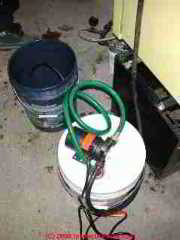 Heating Boiler Anti-Freeze Installation
- POST a QUESTION or COMMENT about the procedure for adding antifreeze to a hot water heating system & its boiler
Heating boiler antifreeze procedure:
This article describes how to add anti-freeze to a heating boiler and to the hot water or hydronic heating system piping, baseboards, convectors, radiators, etc. to protect the system from freeze damage.
We describe the actual procedure for adding anti-freeze to the system, and we answer questions about how much anti-freeze to add and what type of anti-freeze to use.
This article also discusses the risk of poisoning the building water supply piping if you use the wrong type of boiler antifreeze, and we explain the effects of using anti-freeze in a heating system on the thermal conductivity of water and on building heating system efficiency and operating cost.
InspectAPedia tolerates no conflicts of interest. We have no relationship with advertisers, products, or services discussed at this website.
How & Why do You Add Antifreeze to a Boiler?
Heating boiler antifreeze, usually a non-toxic polypropylene glycol anti-freeze and water mixture is installed in hot water heating boilers and plumbing systems to reduce the risk of expensive freeze damage to the heating system piping and of course to avoid costly water or even mold contamination that occurs when an unattended building suffers burst heating piping and leaks.
Even if a heating system is in good and reliable working order, loss of electrical power or running out of fuel means loss of heat that in freezing weather means burst pipes and water damage to the building.
Article Contents
- ANTIFREEZE for BOILERS
- WHAT KIND OF ANTIFREEZE Is Used in Hot Water Heating Systems
- HOW MUCH ANTIFREEZE is Needed for a Heating Boiler?
- HOW TO MEASURE ANTIFREEZE PROTECTION Level in a Heating Boiler
- EFFECTS of ANTIFREEZE on the Thermal Conductivity of Water & on Building Heating Costs
- DO I NEED TO DRAIN the BOILER to Add Antifreeze?
- DO I NEED TO FLUSH & CLEAN the BOILER Before Adding Antifreeze?
- WHERE TO BUY HEATING BOILER ANTIFREEZE & Anti-Freeze Hydrometers or Refractometers
- ANNUAL MAINTENANCE for Anti-Freeze Protected Heating Boilers & Systems
- PROPYLENE GLYCOL DETECTION & POISONING SYMPTOMS
Reader Question: How do you add anti freeze to you boiler and what kind do you use? - Don Rose 9/26/2012
Reply:
Don, some help on winterizing a boiler as well as a whole building is at Winterize- Heat Off Procedure.
The basic procedure is to use a pony pump (a transfer pump) to add antifreeze (buy at your local heating supplier) to the water mix in the boiler until our test gauge shows that we've got enough antifreeze in the system to protect down to at least a bit below the lowest expected temperature.
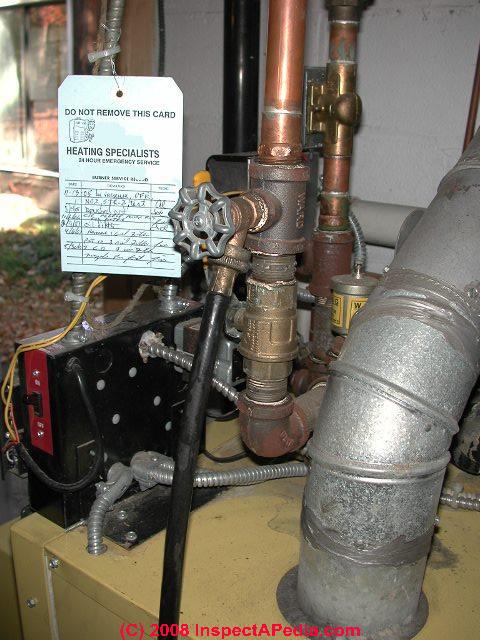
The service tech uses a pony pump connected to a boiler drain or zone drain valve, typically using a pair of washing machine hoses to form a loop between a boiler drain, a bucked of antifreeze & water mix, and a zone drain.
Hose & Pump Connections for Adding Anti-Freeze to a Boiler
Typically one washer hose connects to a zone drain or to a drain on the hot water riser out of the boiler (our photo at above left)
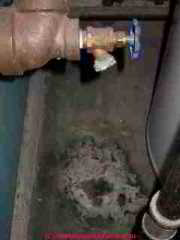
A second washer hose connects to a boiler drain (photo at left).
The output side of the transfer pump is connected to one of these hoses; the other hose drains into a bucket from which we can use a hygrometer or refractometer to measure the antifreeze concentration in the heating system's water (now water-antifreeze mix).
The inlet side of the transfer pump is connected by a pick-up hose to an open bucket of water/antifreeze mix or more pure antifreeze supply.
The pump pushes antifreeze into the system from the bucket; keeping the drain end of the second hose below the level of antifreeze in the bucket avoids introducing air into the system and thus avoids having to bleed that air out.
Exact transfer pump hookup points and step by step procedures: Since the transfer pump hose connections are the same those used when forcing water through a hydronic system to correct an airbound heating system problem, you can see another example of this transfer pump to boiler hook-up
at AIR BOUND HEAT SYSTEM REPAIR by PUMP.
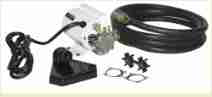
Watch out: if you are going to perform this boiler anti-freeze addition task frequently buy a good quality transfer pump If you buy a "cheap" transfer pump it may not last long when handling antifreeze mixture.
Watch out: for building water damage and loss coverage insurance issues. If you are winterizing a building by adding glycol based antifreeze you might have an insurance coverage issue with your insurance company and thus you might not be covered should a loss occur.
Check with your insurance company.
What Kind of Anti-Freeze Is Used in Hot Water Heating Systems - Boilers, Baseboards, Radiators, Radiant Heat Tubing, Convectors
Usually heating system antifreeze products use propylene glycol. As we explain here, there are some good reasons for using a non-toxic anti-freeze in heating boilers.
Watch out: Be sure you are buying the right antifreeze product: an anti-freeze intended for use in heating boilers, not automobiles or trucks - the chemicals are different, and as we explained above, automotive antifreeze (ethylene glycol) is toxic (poisonous). Not only is the care and handling of toxic chemicals more demanding, on some heating systems there can be a risk of accidentally introducing toxic antifreeze into the home water supply system.
The applications for propylene glycol anti-freeze such as that used in hot water heating systems include:
- Air-Hydronic heat pumps and furnaces that use a water-to-air heating system approach
- Geothermal heating systems
- Hydronic (hot water) heating systems: boiler, piping, radiators, baseboards, convectors, radiant heat system tubing & pumps
- Plumbing system winterization - filling pipes & plumbing fixtures with an anti-freeze mixture
- Radiant "in-floor" or "in-ceiling" heating systems that use hot water in tubing
- Snow-melt systems
- Solar heating systems
- Water based cooling systems such as roof mounted chillers & cooling towers
- Water based heat extraction systems such as ground source heat pumps
- Adapted from "Antifreeze & Heat Transfer Fluid", Noble Company [1]
How Might Anti-Freeze Leak Out of a Boiler & Into Building Water Supply Piping?
Should the heating boiler include a tankless coil used for making domestic hot water, and should there be a simultaneous loss of water pressure inside the tankless coil and a tankless coil perforation or leak, then the contents of the anti-freeze treated boiler can leak backwards into the building water supply piping. While this combination of events is unlikely, it is possible, and it has happened.
Watch out: some boiler antifreeze products are not suitable for use in heating systems (or plumbing systems) that use galvanized steel piping. Check with the manufacturer and check your system's heating piping.
How Much Antifreeze is Needed for a Heating Boiler to Protect from Freezing?
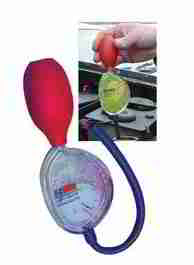
There is no simple right answer to the anti-freeze quantity question, despite some DIY articles saying you need 10 gallons of antifreeze for a typical 2800 sq.ft. home.
The answer depends on the total volume of water that is in the hot water heating system; the volume of baseboards, radiators, pipes, pumps, expansion tank, and the boiler itself.
But nevertheless, it is very easy to know when you have added enough anti-freeze to a heating boiler, as we explain here.
What a heating service tech does is use an inexpensive anti-freeze hydrometer or refractometer designed to measure propylene glycol (PG) concentration to actually measure the antifreeze concentration in the antifreeze-water mix in the boiler.
The heating service tech will add boiler antifreeze, circulate it through the system to mix it thoroughly with the system water (or de-ionized water in new and some commercial installations), and then will check the mixture level by reading the freeze-protection temperature on the hydrometer/refractometer.
When the gauge indicates that freeze protection is down to the required temperature, you've added enough antifreeze. Record the test results (freeze protection temperature) and date that the antifreeze was added on to the heating boiler's service tag.
The amount or volume of antifreeze you need to add to the boiler to reach the desired freeze-protection temperature will also depend on the concentration of the anti-freeze product itself.
For example, to protect a heating system down to zero °F using NOBURST-100 you'll need to add enough anti-freeze to reach a 50% concentration in the system. [1]
How to Measure Anti-Freeze Protection Level in a Heating Boiler
Use a hydrometer or refractometer to test the water-anti-freeze mixture in your heating system. The hydrometer, if you've bought the right type, will read the freeze-protection temperature right off a scale within the instrument.
Watch out: not all hydrometers accurately measure both types of antifreeze chemicals (automotive system antifreeze, i.e. ethylene glycol and heating system antifreeze, i.e. propylene glycol. Make sure that your antifreeze concentration measurement is made using a propylene glycol (PG) refractometer or hydrometer or using a hydrometer that can (according to its scale and instructions) measure both types of anti-freeze chemical concentrations.
While we use a hydrometer or refractometer to measure the anti-freeze concentration in the hot water heating system, and while we will read the freeze-point to which the system is protected directly off of the scale on the hydrometer/refractometer, you can get a general idea of the quantity of antifreeze that you may need to add to the hot water heating system by converting the % concentration of antifreeze necessary to protect to a given low temperature into gallons.
| Hot Water Heating System Freeze Protection Chart - Antifreeze Concentration Data | |||||
|---|---|---|---|---|---|
| Example Heating System Anti-Freeze Product | % Concentration of Anti-Freeze in the Heating System | Approximate Freeze Point | Approximate Fluid Flow Point Note 3 |
Approximate Burst Protection Note 3 |
Volume of Anti-Freeze Per Gallon of Heating System Water |
Polypropylene glycol or Ethylene glycol anti-freeze Notes 1, 2 |
|||||
| RhoGard™ | 40% | +12F | -0F | -10F | .4g / .6g |
| RhoGard™ | 50% | +5F | -10F | -55F | 1g / 1g |
| RhoGard™ | 100% | -60F | -70F | -100F | 1g / 0g |
| Noburst® -100 | 50% | 0F | -10F | -60F | .5g / .5g |
| Noburst® -100 | 75% | -30F | -40F | -10F | .3g / .7g |
| Noburst® -100 | 100% | -100F | -80F | -60F | 1g / 0g |
Notes to the table above
1. For heating system or plumbing system anti-freeze products based on propylene glycol, the level of freeze protection is a function of the concentration of anti-freeze in the heating system water, typically ranging from 40% anti-freeze to 100% anti-freeze.
There are some variations in the absolute level of freeze protection given by various products due to the inclusion of special additives and by variations among manufacturer's formula.
Some of this data reported by the antifreeze manufacturers cites data obtained from Dow Chemical Company; Noble Corp. points out that all of the freeze protection data assume a [starting?] fluid temperature of 150 °F.
2. These are example antifreeze concentrations.
Product literature from the manufacturer gives the effects of other concentration levels. Also, these companies offer a variety of anti-freeze products with varying performance and freeze-protection levels besides the example products shown here. [1][2][3]
3. Fluid Flow Point defines the temperature below which the heating system fluid may no longer flow reliably and Burst Point defines the temperature below which the piping system or other components are at risk of actual bursting from the expanding pressure of freezing fluid
Of course chances are you will have no idea how much water was in your hot water heating system to start with, unless you drain and measure the system contents, or (unlikely and too difficult) add up and calculate all of the internal volumes of all of the system components.
Now you can see why a hydrometer or refractometer is the way to go in measuring the antifreeze concentration and level of freeze protection for the heating boiler & its piping, radiators, baseboards, etc.
Effects of Anti-Freeze on the Thermal Conductivity of Water & on Building Heating Costs
We care about the thermal conductivity of water because that figure describes the heat transfer efficiency of the the heating system - how efficiently we transfer heat from the hot water in the system through the metal tubing and fins of a copper baseboard or a cast iron radiator into the building air and into the area being heated.
If we reduce the thermal conductivity of water (by lowering its temperature or by changing its chemistry by the addition of antifreeze) we increase (usually just a bit) the cost of heating the building.
In a nutshell, using antifreeze in a building hot water heating system means a reduction in thermal conductivity of the heating liquid by around 30% (comparing straight water to 50% concentration of antifreeze in the table below). The effect is about a 10% decrease in relative heating system efficiency. In short, you will pay a little more to heat the building for the benefit of avoiding the high cost of burst heating pipes and related water damage.
- For example, the thermal conductivity of water (ignoring dissolved minerals etc) is 0.35 BTU/Hr/Ft/°F - and of course is freeze-proof only down to 30 °F or 0 DegC.
- At a 50% concentration of NOBURST-100, the thermal conductivity of the water-anti-freeze mix is reduced to 0.27 0.35 BTU/Hr/Ft/°F - supporting our assertion that the thermal conductivity of water is reduced when adding antifreeze.
Watch out: Don't add more antifreeze than necessary as doing so can reduce the effectiveness of heat transfer in the heating system unnecessarily.
| Table of Heat Transfer Properties of Water Modified With Anti-Freeze Products 1 | |||
|---|---|---|---|
| Liquid / Mixture | Relative Heating System Efficiency | Thermal Conductivity as BTU/HR/FT/°F |
Freeze Protection |
| Water | 1.00 | 0.35 | + 320F |
| Ethylene Glycol | |||
| 50% concentration | 0.90 | 0.24 | - 340F |
| 75% concentration | 0.77 | 0.18 | - 600F |
| 100% concentration | 0.69 | 0.15 | + 50F source data error? |
| Noburst-100 | |||
| 50% concentration | 0.93 | 0.27 | - 600F |
| 75% concentration | 0.83 | 0.22 | - 800F |
| 100% concentration | 0.80 | 0.17 | - 1000F |
Notes to the table above
1. Adapted from Noble Company "Antifreeze & Heat Transfer Fluid" [1]
2. Ethylene glycol data is from Noble's citation of data for DowTherm brand Ethylene Glycol, trademark and product of the Dow Chemical Company [1]
3. This data describes a function of specific heat and fluid density and assumes that there is no change in fluid flow data - that is, the flow rate in GPM remains unchanged. [1]
Do I Need to Drain the Heating Boiler to Add Antifreeze?
No. It is possible to add antifreeze to an existing system using a transfer pump. But if the system is to be cleaned first, that step will require draining as we explain next.
Watch out: some "do-it-yourself" websites offering tips on how to add boiler antifreeze are giving bad advice. For example, it is not necessary to drain the boiler to add antifreeze, and doing so will significantly increase the time, cost, and trouble of the job as you'll have to deal with air purging the system as well as disposing of boiler drainage.
Do I need to flush & clean the Heating Boiler Before Adding Antifreeze?
You will also read a recommendation by boiler antifreeze manufacturers such as Noble & Rhomar that the boiler and entire hot water heating system should be emptied, flushed, and de-scaled. This step may make sense for commercial heating systems or for a boiler with known scaling problems but it may not always be necessary for residential heating boilers.
If you are going to follow the manufacturer's recommendations you may have to flush and de-scale and clean the boiler before adding the anti-freeze product. This means a lot more time, cost, and products - a lot more work, which is why the techs I've watched don't take this step unless there is already a reason to believe the boiler needs such cleaning.
Certainly the service technicians we've watched installing antifreeze into a hydronic heating system do not generally take this step.
The hot water heating system that was freeze-proofed during the service procedure that we photographed for this article included a boiler that at the time was about five years old. That system has now been in service without difficulty of any sort for an additional decade.
Manufacturers of hydronic heating antifreeze products such as Noble Co. & Rhomar Water Management include in their product literature a recommendation to thoroughly clean and flush both new and existing hot water heating systems before adding their products.
More about the concern for scale and bacterial formation in anti-freeze-protected heating systems is
at OTHER RISKS from Using an Anti-Freeze Mixture in a Heating Boiler System below in this article.
Where to Buy Heating Boiler Antifreeze & Anti-Freeze Hydrometers or Refractometers
The type of antifreeze used in heating boilers often includes an anti-corrosion additive and may include a de-scaling product, generally sold in 5-gallon pails. Usually heating boiler antifreeze consists of propylene glycol while automotive antifreeze, which requires different properties, consists of ethylene glycol (a toxic chemical).
Here are boiler antifreeze and boiler anti-freeze hydrometer sources:
- Camco Boiler Antifreeze (also sold as an automotive product and for use in solar heating systems)
- E-Z Red S102 or EZRSP102 Antifreeze Hydrometer (less than $10. U.S.), available at Amazon and from E-Z Red Company, E-Z Red Company 8 Leonard Way PO Box 80 Deposit, NY 13754, Tel: 1.800.522.7947, E-mail: ezred@ezred.com, Website: www.ezred.com
- Glycol Antifreeze, Park Supply of America 18-431, in 5-gallon containers (pricey at Amazon)
- Noburst® -100 Antifreeze, Noble Co., propylene glycol based. Here is the NOBURST®-100 Boiler antifreeze MSDS. Noble Company, PO BOx 350, Grand Haven MI 49417-0350, Tel: 80-878-5788, Email: sales@noblecompany.com [1]
- Rhomar RhoGard™ Antifreeze, Rhomar Water Management, Inc., Propylene glycol antifreeze and heat transfer fluid, Rhomar RhoGard MSDS. Website: http://www.rhomarwater.com. This product is rated safe for aluminum and other metals such as cast iron, copper, and steel, and includes corrosion protection.
- Thermo Protect Antifreeze for boilers, (tough finding product literature, search in process)
- Utility Chemicals No-Freez (non-toxic antifreeze, perhaps a good idea if the heating system includes a tankless coil). This product uses propylene glycol as its active ingredient. Here is the MSDS. Contact: Utility Manufacturing Co., Inc., 700 Main St., Westbury NY 11590, Tel: 516-997-6300.
Contact us to suggest products for the above list. No fees are involved. InspectApedia.com has no financial relationship whatsoever with the products or procedures and services discussed at this website.
Annual Maintenance Recommendations for Anti-Freeze Protected Heating Boilers & Systems
Use the same hydrometer / refractometer to check the level of freeze protection at annual boiler service time
Inspect all accessible areas and components and piping of the heating system for leaks at time of annual service, or if you observe an unexplained drop in system pressure.
Watch out: most hydronic heating systems include an automatic water feed valve that will add make-up water to the system should there be a water leak or loss.
As a result, if your heating system suffers a small leak that goes un-noticed for some time, because make-up water is being added to the system to keep the water volume at a safe and functional level, the amount of anti-freeze in the system will become diluted.
For that reason, the level of freeze protection afforded by the anti-freeze that remains will be diminished and the risk of freeze damage increased.
Other Risks from Using an Anti-Freeze Mixture in a Heating Boiler System
- Expansion tank size adequacy:
because adding glycol to heating system water increases the rate of thermal expansion of liquid in the system, you may need to increase the size of the heating system's expansion tank, particularly if the heating system uses a large volume of heating fluid, such as a large house or a building that heats by convection (large diameter heating piping).
Watch the pressure/temperature relief valve on the heating system for spillage. - Corrosion, bacterial growth, scale formation:
while heating system antifreeze companies may add a variety of chemicals (such as acid inhibitors) to their product to improve its performance, in general, using glycol mixture in warm water can increase the risk of both scale formation and bacterial growth as well as the formation of organic acids that can have corrosive effects on the system.
This may be why the manufacturers want you to start with a cleaned, de-scaled heating system when adding their product.
Heating Boiler Antifreeze Life
 On 2020 07 19 JC said: How often should boiler antifreeze be replaced?
How often should boiler antifreeze be replaced?
Moderator reply:
See our discussion just below, JC and let me know if any quetsions remain.
On 2020-03-04 by Anonymous - Should the anti freeze be changed periodically?
Yas
It's not normally necessary to change the antifreeze in your heating system sooner than 3-5 years (for the shortest-life antifreeze products)
and
some antifreeze products (like pre-mixed Sentinel X500 glycol ) have a 20 year life.
That's the case unless your system has a serious sediment clogging problem that requires draining and flushing.
On 2020-03-03 by Yaske
Should the anti freeze be changed periodically in a hydronic heating system? If so, at what intervals?
On 2016-02-09 by Bob - Does antifreeze in a hot water boiler have to be added on a regular basis?
Does antifreeze in a hot water boiler have to be added on a regular repeated basis, in other words boosted every 2 or 3 years?
Moderator reply: life of and maintenance of boiler antifreeze
Because under normal conditions the water in the hot water heating system is fixed - it should not leak out nor need addition, the antifreeze is not diluted in use; heating boiler antifreeze (typically proplyene glycol) should last for a decade or longer.
Boiler manufacturers say that a high quality glycol boiler antifreeze will last for "many years" but improper maintenance (such as boiler leaks) or biological contamination that can develop in some hot water heating systems will shorten the life.
You can exend the boiler antifreeze life by following the antifreeze manufactuers instructions that may include:
- When buying and installing boiler antifreeze note the concentration of the product being bought and dilute it properly; use a testing tool to assure the proper antifreeze concentration (typically 30-50%).
- Whenever you add water or antifreeze to a hot water heating system (a hydronic heating system or "hot water heat boiler"), run the system up to at least 185 degF to reduce the chances of bacterial or algae growth in the system.
- Do not use automotive antifreeze in heating boiler systems. Some of these can clog the boiler heat exchanger.
- Some boiler antifreeze products can be tested for the level of rust inhibitor in the system, but not all; if yours can be tested, have that test performed every few years.
- Monitor / maintain the proper pH for the boiler system - the specifics willb e described by the boiler antifreeze manufacturer. If pH is too high you may face corrosion problems.
Examples:
- Camco 30027 BOiler Antifreeze
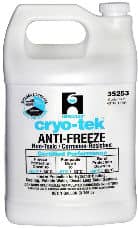
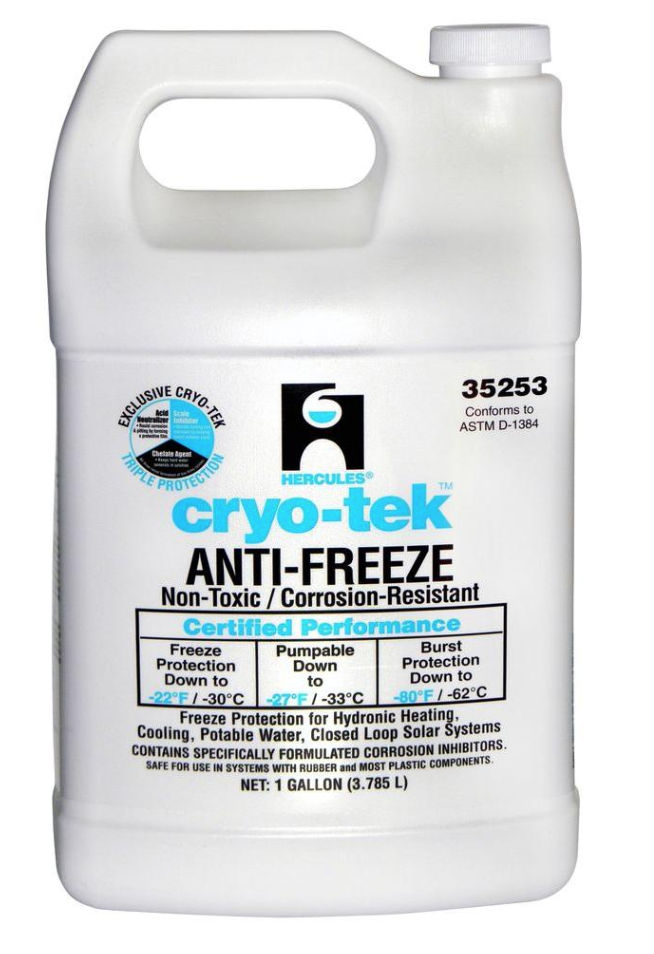
- Cryo-Tek Boiler Antifreeze # 35253 from Hercules - excerpt from Home Depot's information
Hercules Cryo-Tek 1 Gal. Antifreeze, with a triple protection inhibitor system, helps protect against mineral deposits and sedimentation in hydronic heating and closed loop systems, solar heating systems, radiant heat and general plumbing systems. This non-flammable, odorless liquid is also non-toxic. Pre-mixed with water and ready to use. - Dow Chemical boiler antifreeze Dowtherm SR1 and DowFrost boiler treatment.
Level of Freeze Protection vs. Boiler Antifreeze Level |
|
| Antifreeze Concentration | Freeze Point of the System |
| 30% | 10˚F / -12˚C |
| 35% | 2˚F / -17˚C |
| 40% | -8˚F / -22˚C |
| 45% | -18˚F / -28˚C |
| 50% | -29˚F / -34˚C |
Reader Comments, Questions & Answers About The Article Above
Below you will find questions and answers previously posted on this page at its page bottom reader comment box.
Reader Q&A - also see RECOMMENDED ARTICLES & FAQs
On 2020-02-10 - by (mod) - boiler water looks nasty - replace it?
Tony,
It's common for the hydronic heat water to look a bit nasty, and not usually a concern as it's a fixed volume of water; if there is sediment that may clog a circulator or control then perhaps the system does need to be flushed and re-filled.
THe use of a water conditioner and anti-scale additive is not often needed on hydronic heat but would be used on steam heat.
On 2020-02-10 0 by Tony
I had a new closed hot water system installed 9 months ago ,when I checked the water in the system it’s brown and slushy , should I replace the water with anti freeze or some other protectant ?
On 2020-01-04 - by (mod) -
I think the point of the isolation valve was to make darn sure that you can't accidentally backfeed antifreeze into the potable water piping in your building.
On 2019-12-28 by Larry O'shaughnessy
I have a GTP residential Glycol feeder and it call for an isolation valve to be installed for future servicing.
Do I really need this. It appears the installer did not connect this to unit.
Model GRE07-e7-4
On 2019-10-19 - by (mod) -
Gerry
Take a look at the antifreeze concentration levels giving in the article above. You'll choose a level or percentage antifreeze in your heating system based on the coldest temperature against which you need protection
On 2019-10-05 by Gerry
Boiler antifreeze
On 2019-10-05 by Gerry
I have an outside boiler that holds 115 gallons of water how much boiler and Fridh will need
On 2019-03-24 by (mod) - Corrosiveness of Antifreeze products that are designed for use in hot water heating systems
Willard
Antifreeze products that are designed for use in hot water heating systems in fact include anti-corrosive additives or treatments and will not normally be a source of corrosion. So actually you would expect less corrosion when using such an antifreeze product than if you didn't use it.
Perhaps your plumber can help us out by clarifying her remark or giving the product names that she considers harmful to heating systems.
On 2019-03-22 by Willard McGraw
My plumber has advised me that antifreeze in my radiant heating system is/will corrode the piping, valves and other components of the heating system including the boiler. Is this correct? Thank you for your advice.
On 2018-10-13 by (mod) -
Vlad
You're right;
The aquastat control turns on the oil or gas burner based on boiler temperature (and a few sophistications on that)
while
the thermostat, on a call for heat, in most installations, simply turns on the circulator pump to cause hot water to circulate through the various heating zones.
An exception is in some countries such as Canada where custom is to wire the circulator to run continuously during winter weather; in that case (giving more even heat and improved freeze-proofing), the thermostat will turn the burner on and off.
The "heat loss" that you cite is not necessarily undesirable, depending on where those heating pipes are routed, as they may be delivering heat to areas where it's actually needed, for example to avoid frozen pipes or to keep a crawl area dry.
Lowering heat transfer rate from heating pipes to the occupied space will always increase the system operating cost.
On 2018-10-13 by Vlad
There is a thermostat inside boiler that turns on boiler burners by water temperature inside the boiler, not just by call for heat. When temperature drops beyond the certain level (it depends on boiler settings) AND there is a call for heat, burners will start.
Burners will stop when boiler temperature will reach the settings. Therefore, lowering wetting action by adding antifreeze will just delay heat transfer. It will cause longer times to release the heat from water and from the boiler, not to burn more gas or oil.
In other words, boiler will keep its water temperature longer. There is some heat loss during journey of hot water to radiators though. It means that extra energy will only be used for
(1) additional time to run the circulation pumps (which is minimal in residential heating) and
(2) on extra heat losses during water journey via pipes to heat exchangers (like radiators etc). On the other hand lowering heat transfer will also lead to lower heat loses when no call for heat.
...
Continue reading at PUMPS, PONY PUMPS or select a topic from the closely-related articles below, or see the complete ARTICLE INDEX.
Or see ANTIFREEZE for BOILERS FAQs - questions & answers posted originally on this page.
Article Series Contents
- ANTIFREEZE for BOILERS
- BACKFLOW PREVENTER VALVE, HEATING SYS - protect building occupants from toxic boiler wate
- CHEMICAL TREATMENTS, BOILER for a discussion of the types of boiler treatments available, how & why they are used
- PROPYLENE GLYCOL DETECTION & POISONING SYMPTOMS
- RADIATORS - home
- RADIATOR VOLUME & BTUs
- WINTERIZE A BUILDING - home
Suggested citation for this web page
ANTIFREEZE for BOILERS at InspectApedia.com - online encyclopedia of building & environmental inspection, testing, diagnosis, repair, & problem prevention advice.
Or see this
INDEX to RELATED ARTICLES: ARTICLE INDEX to HEATING BOILERS
Or use the SEARCH BOX found below to Ask a Question or Search InspectApedia
Ask a Question or Search InspectApedia
Try the search box just below, or if you prefer, post a question or comment in the Comments box below and we will respond promptly.
Search the InspectApedia website
Note: appearance of your Comment below may be delayed: if your comment contains an image, photograph, web link, or text that looks to the software as if it might be a web link, your posting will appear after it has been approved by a moderator. Apologies for the delay.
Only one image can be added per comment but you can post as many comments, and therefore images, as you like.
You will not receive a notification when a response to your question has been posted.
Please bookmark this page to make it easy for you to check back for our response.
Our Comment Box is provided by Countable Web Productions countable.ca
Citations & References
In addition to any citations in the article above, a full list is available on request.
- [1] "Antifreeze & Heat Transfer Fluid", Noble Company, PO BOx 350, Grand Haven MI 49417-0350, Tel: 80-878-5788, Email: sales@noblecompany.com, Web page: http://www.noblecompany.com/, NOBURST product series product literature, retrieved 10/8/2012, original source: http://www.noblecompany.com/Portals/0/PRODUCT%20INFO/ Product%20Guides/Noburst%20PIG%200811%20lr.pdf [Copy on file as Noburst_Product_Lit_PIG_0811_lr.pdf]
- [2] Rhomar RhoGard™ Antifreeze, Rhomar Water Management, Inc., Propylene glycol antifreeze and heat transfer fluid, Rhomar Website: http://www.rhomarwater.com. This product is rated safe for aluminum and other metals such as cast iron, copper, and steel, and includes corrosion protection.
- [3] Utility Chemicals No-Freez (non-toxic antifreeze, perhaps a good idea if the heating system includes a tankless coil). This product uses propylene glycol as its active ingredient. Utility Manufacturing Co., Inc., 700 Main St., Westbury NY 11590, Tel: 516-997-6300.
- [4] E-Z Red S102 or EZRSP102 Antifreeze Hydrometer (less than $10. U.S.), available at Amazon and from E-Z Red Company, E-Z Red Company 8 Leonard Way PO Box 80 Deposit, NY 13754, Tel: 1.800.522.7947, E-mail: ezred@ezred.com, Website: www.ezred.com
- [6] "Boiler Water Chemistry: Boiler Antifreeze or Water", Outdoor Wood Burning Boilers, web search 10/8/2012, original source: http://outdoorwoodburningboilers.com/boilerWaterChemistry/index.shtml
- Fuel Oil & Oil Heating Magazine, 3621 Hill Rd., Parsippany, NJ 07054, 973-331-9545
- Domestic and Commercial Oil Burners, Charles H. Burkhardt, McGraw Hill Book Company, New York 3rd Ed 1969.
- National Fuel Gas Code (Z223.1) $16.00 and National Fuel Gas Code Handbook (Z223.2) $47.00 American Gas Association (A.G.A.), 1515 Wilson Boulevard, Arlington, VA 22209 also available from National Fire Protection Association, Batterymarch Park, Quincy, MA 02269. Fundamentals of Gas Appliance Venting and Ventilation, 1985, American Gas Association Laboratories, Engineering Services Department. American Gas Association, 1515 Wilson Boulevard, Arlington, VA 22209. Catalog #XHO585. Reprinted 1989.
- The Steam Book, 1984, Training and Education Department, Fluid Handling Division, ITT [probably out of print, possibly available from several home inspection supply companies] Fuel Oil and Oil Heat Magazine, October 1990, offers an update,
- Principles of Steam Heating, $13.25 includes postage. Fuel oil & Oil Heat Magazine, 389 Passaic Ave., Fairfield, NJ 07004.
- The Lost Art of Steam Heating, Dan Holohan, 516-579-3046 FAX
- Principles of Steam Heating, Dan Holohan, technical editor of Fuel Oil and Oil Heat magazine, 389 Passaic Ave., Fairfield, NJ 07004 ($12.+1.25 postage/handling).
- "Residential Steam Heating Systems", Instructional Technologies Institute, Inc., 145 "D" Grassy Plain St., Bethel, CT 06801 800/227-1663 [home inspection training material] 1987
- "Residential Hydronic (circulating hot water) Heating Systems", Instructional Technologies Institute, Inc., 145 "D" Grassy Plain St., Bethel, CT 06801 800/227-1663 [home inspection training material] 1987
- "Warm Air Heating Systems". Instructional Technologies Institute, Inc., 145 "D" Grassy Plain St., Bethel, CT 06801 800/227-1663 [home inspection training material] 1987
- Heating, Ventilating, and Air Conditioning Volume I, Heating Fundamentals,
- Boilers, Boiler Conversions, James E. Brumbaugh, ISBN 0-672-23389-4 (v. 1) Volume II, Oil, Gas, and Coal Burners, Controls, Ducts, Piping, Valves, James E. Brumbaugh, ISBN 0-672-23390-7 (v. 2) Volume III, Radiant Heating, Water Heaters, Ventilation, Air Conditioning, Heat Pumps, Air Cleaners, James E. Brumbaugh, ISBN 0-672-23383-5 (v. 3) or ISBN 0-672-23380-0 (set) Special Sales Director, Macmillan Publishing Co., 866 Third Ave., New York, NY 10022. Macmillan Publishing Co., NY
- Installation Guide for Residential Hydronic Heating Systems
- Installation Guide #200, The Hydronics Institute, 35 Russo Place, Berkeley Heights, NJ 07922
- The ABC's of Retention Head Oil Burners, National Association of Oil Heat Service Managers, TM 115, National Old Timers' Association of the Energy Industry, PO Box 168, Mineola, NY 11501. (Excellent tips on spotting problems on oil-fired heating equipment. Booklet.)
- Our recommended books about building & mechanical systems design, inspection, problem diagnosis, and repair, and about indoor environment and IAQ testing, diagnosis, and cleanup are at the InspectAPedia Bookstore. Also see our Book Reviews - InspectAPedia.
- In addition to citations & references found in this article, see the research citations given at the end of the related articles found at our suggested
CONTINUE READING or RECOMMENDED ARTICLES.
- Carson, Dunlop & Associates Ltd., 120 Carlton Street Suite 407, Toronto ON M5A 4K2. Tel: (416) 964-9415 1-800-268-7070 Email: info@carsondunlop.com. Alan Carson is a past president of ASHI, the American Society of Home Inspectors.
Thanks to Alan Carson and Bob Dunlop, for permission for InspectAPedia to use text excerpts from The HOME REFERENCE BOOK - the Encyclopedia of Homes and to use illustrations from The ILLUSTRATED HOME .
Carson Dunlop Associates provides extensive home inspection education and report writing material. In gratitude we provide links to tsome Carson Dunlop Associates products and services.
 | HOME | ABOUT | ASK a QUESTION | CONTACT | CONTENT USE POLICY | DESCRIPTION | POLICIES | PRIVACY | |
| © 2024 - 1985 Publisher InspectApedia.com - Daniel Friedman | |||||||||