
InspectAPedia® FREE Encyclopedia of Building & Environmental Construction, Diagnosis, Maintenance & Repair |
Question? Just ask us! InspectAPedia
|
 Guide to Heating System Boiler Check Valves, Flow Control Valves, Backflow Preventers
- POST a QUESTION or COMMENT about check valves and flow control valves on heating systems
Check valves & flow control valves on hot water heating systems:
This article explains types of check valves used on hot water heating systems.
This article series answers most questions about Heating System Boiler Controls on central heating systems to aid in troubleshooting, inspection, diagnosis, and repairs.
InspectAPedia tolerates no conflicts of interest. We have no relationship with advertisers, products, or services discussed at this website.
Check Valves on Hot Water Hydronic Heating Systems - Flow Control, Flo-Control Valves, Inspection, Settings, Problems
 The photo above shows a modern cad cell relay on an oil fired heating boiler - one of the safety controls which we discuss in this article.
Here we explain heating boiler check valves, also referred to as flow control valves, flo-control valves: controls that prevent hot water from circulating in the heating system when it is not supposed-to. We also discuss IFC circulators - internal flow control circulators, and heating system backflow preventer valves.
We discuss: What are flow-control valves & how do they work? What are IFC circulators - internal flow control valves? How do automatic water feed valves also function as a check valve on heating systems? Cleaning & maintenance guide for heating system of well prime
Because on some hot water heating systems the check valve or flow-control valve is integrated into the circulator pump assembly, also
see CIRCULATOR PUMPS & RELAYS.
[Click to enlarge any image]
For an example of how the check valve or flo-control valve functions on hot water heating systems, and what goes wrong, also
see HEAT WON'T TURN OFF - STOP UNWANTED HEAT.
Check valves on heating boilers prevent hot water from circulating through the building when it is not supposed to be doing so - such as when the boiler and its water are still hot but the thermostat has stopped calling for heat.
Why Are the Baseboards or Radiators Hot Even Though the Thermostat is Set Lower than Room Temperature? Un-wanted Gravity or Convection Circulation of Hot Water
If electrical power switch to a hot water heating boiler is in the on position and the room thermostat is set below the current room temperature, the heating system (hot water or steam) boiler or (warm air) furnace should not run.[1]
If you need more help see ELECTRICAL POWER SWITCH FOR HEAT
But for hot water heating systems (baseboards, radiators), other defects could cause or permit hot water to circulate through the heating system by "gravity" (convection, warm water rising on its own through the heating piping) even though the thermostat is not calling for heat.
[Warm water is less dense than cold water and will rise up through cooler water, displacing it and sending cooler water down to the boiler.]
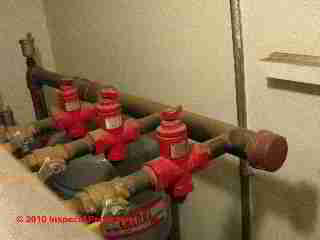
The problem, if this is occurring, is usually that a check valve (photo above-left) (found internal to some circulator pumps, or external as a physical device) intended to prevent hot water from circulating on its own - when the circulator pump is off - is either set to a "forced open" position, or it has become defective (less likely).
 If that's the problem (diagnosed by a heating and service technician) then the valve or circulator needs to be replaced.
While waiting for that repair to be made, you can still turn off the heat when it is not needed, by turning off electrical power to the boiler. With the heating boiler switched off it will cool down and water will stop heating the radiators by gravity or convection circulation.
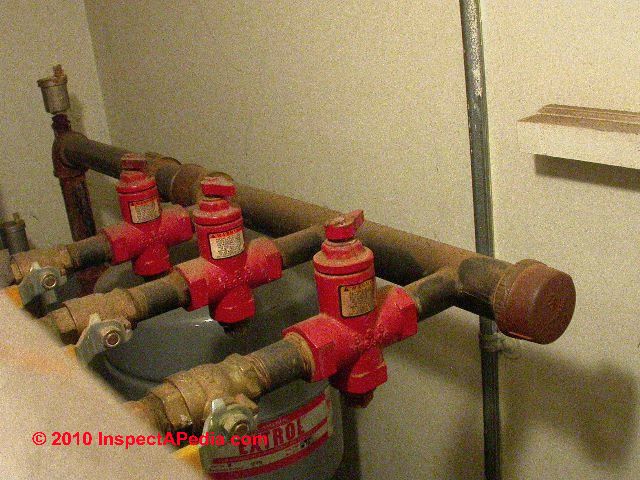
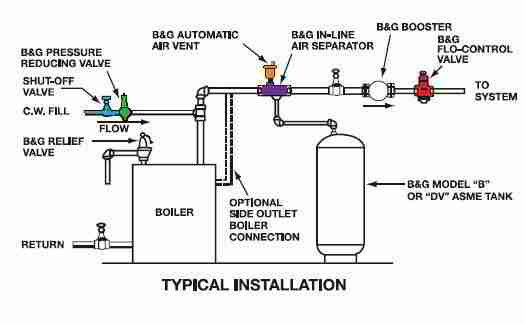
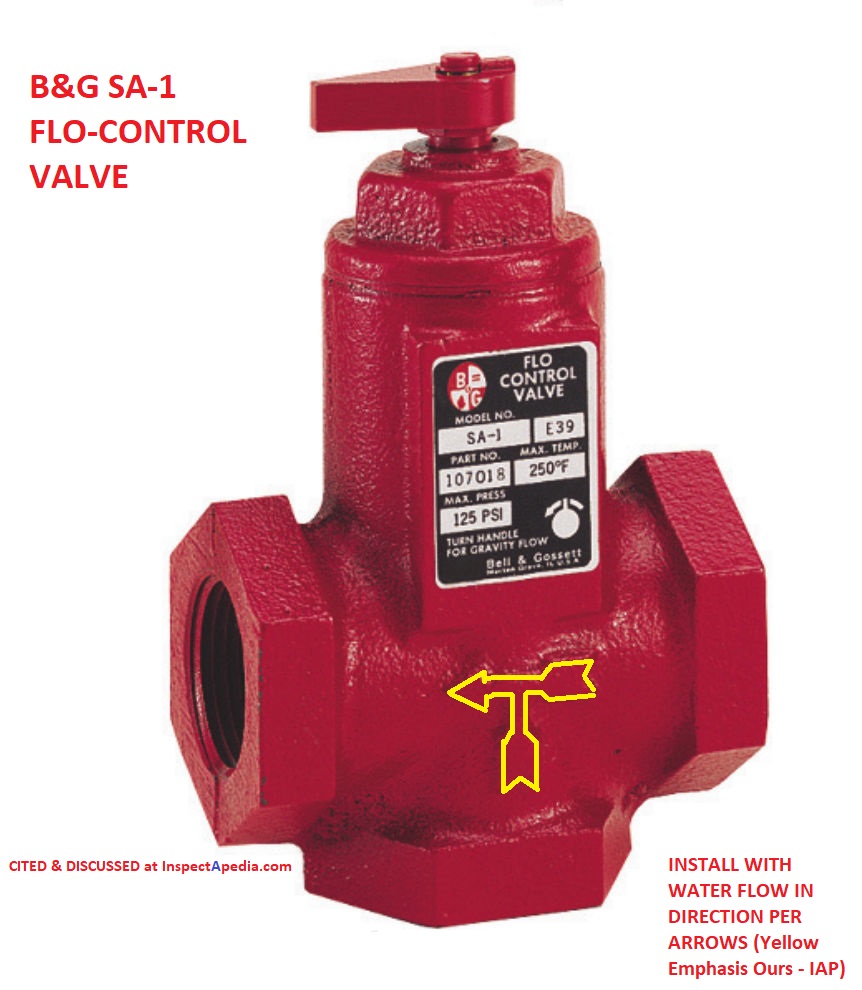
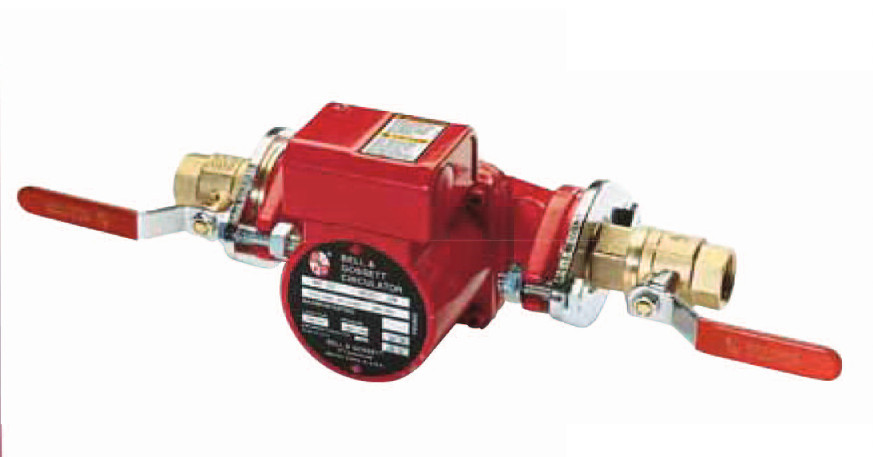
The red Bell & Gossett B&G flo-control valves shown in our photo above and in the sketch at left are designed to prevent hot water from circulating in a heating system unless the circulator pump is also running.
The valve provides a vertical-lift check valve function: until the circulator pump begins to run, the valve will prevent hot water from circulating through the piping system.
The B&G installation sketch (left, edited) shows a simplified but typical location of a flo-control valve - the red device at the right-most side of the sketch.
Flow-Control Valve Installation Position
It's important that B&G flo-controls and similar flow control valves on hot water heating boilers are properly installed: the stem with the little lever needs to be upright. This flo-control valve is installed only in a vertical position, either at the top of a vertical pipe (where heat piping changes direction from vertical to horizontal) or in a horizontal heating pipe, but with the valve in an upright position.
The valve has to be installed with its cast-in flow-arrow pointing in the correct direction - in the direction off flow of heating water.
Flow control valves such as the Bell & Gossett Flo-Control Valves V51843E series (Xylem brand) must be installed upright - with the operating stem or handle "up" and in the proper direction for hot water flow from the boiler into the heating zone piping as indicated by the arrow on the valve body.
Watch out: The stem or control handle is always in the top or vertical position when the valve is installed. Otherwise the automatic flow control or check valve feature of the valve will not work properly.
Some flow control valves are manufactured with a side or bottom inlet from which water is fed from the boiler but in any case the valve body itself is upright and flow is in the direction of the arrow cast into the valve body. The un-used opening in the valve (side if the valve is fed from the bottom, bottom if the flo-control valve is fed from the side) is plugged with a pipe plug.
Which way do we turn the lever on a flo-control valve?
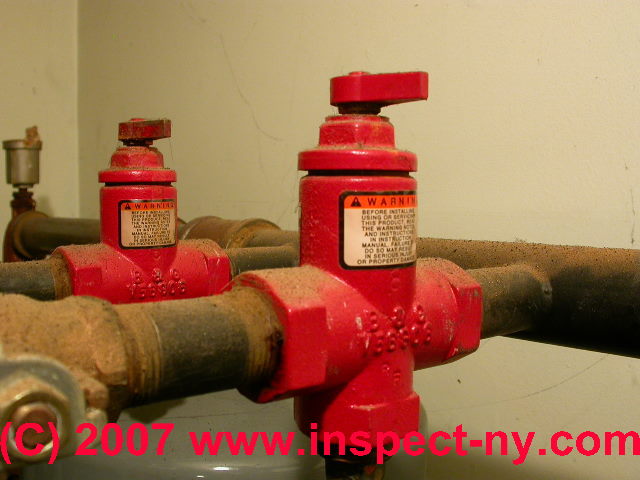
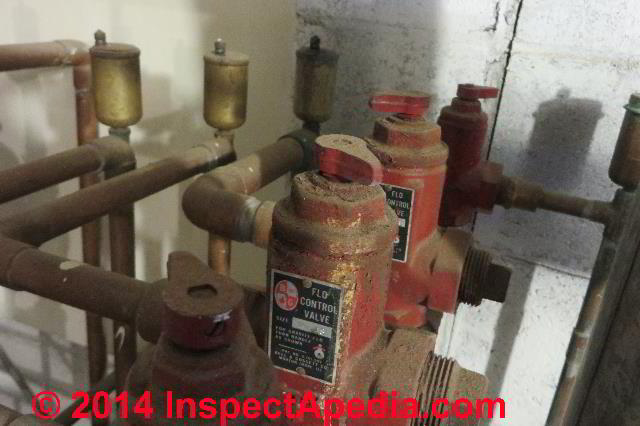 The lever on the top of the B&B flow control valves shown here allows the user or service technician to force the valve to an "open" position, overriding the valve's automatic internal operation.
Manually Open Flo-Control Valve: the valve is turned fully counter-clockwise to put the valve in a manually-opened position.
This position may also be used to manually open the valve during filling of the heating system with water or during air-purging operations.
Watch out: with the valve in manually-open position some hot water is likely to circulate from the boiler by convection or "gravity" . When that circulation is not needed or wanted be sure to return the flow control valve to automatic operation.
Automatic Flo-Control Valve Operation: depending on the valve brand and model this position may be marked as Winter or Automatic. Or the valve lever is turned fully clockwise.
As we illustrate later in this article, other flow control valves will have position markings cast into the valve body and marked Open, Winter, or Closed.
Clockwise, or Winter is the normal setting for this control.
When would we turn the lever counter-clockwise or to the Open position? We can think of several instances:
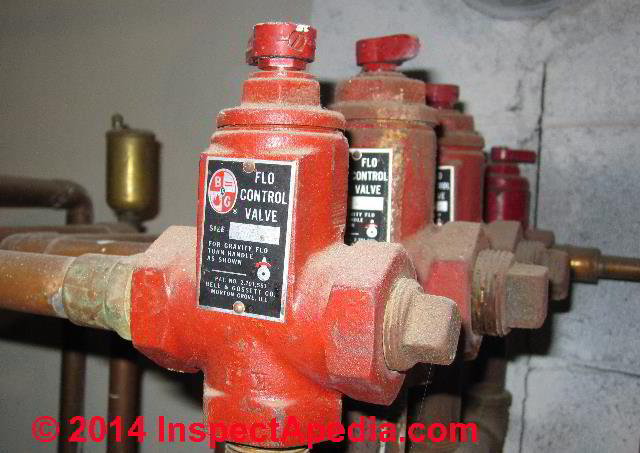 Manually Closed Flo-Control Valve: The valve handle is turned fully clockwise to prevent hot water circulation [for some models the instructions also include for this position: other than when the circulator is running. ]
[Click to enlarge any image]
The label on the B&G Flo Control valves at left includes instructions on which way to turn the lever.
- Emergency heat:
the circulator pump is broken and we want hot water for heat to be able to circulate in the home by gravity until the circulator can be repaired or replaced - this is an "emergency heat" function that could be very useful.
See CIRCULATOR PUMPS & RELAYS
Emergency heat means the building has lost electrical power and we want hot water for heat to be able to circulate in t he building by gravity.
Of course the length of time you'll have hot water for heat in the first place may be limited since the heating boiler's burner or safety controls will usually also be "off" if there is no electricity. But there are exceptions such as a combination wood-oil heating boiler system.
See WOOD-OIL COMBINATION HEATERS. - Filling the system with water or removing air:
The heating system piping is air-bound and we are trying to force water through the system to flush out un-wanted air.
See AIRBOUND HEAT SYSTEM REPAIR by WATER FEED VALVE.
This feature is also used when the heating system piping is being filled with water after system drain-down or servicing. - Indirect fired water heaters:
to permit hot water circulation to an indirect fired domestic hot water heating system even when no building heat is called for the valve may be set to OPEN in summer weather.
Watch out: B&G warns users to remember to return the lever to the "closed" (fully clockwise) position after the emergency or service.
Otherwise you'll get un-wanted hot water heat circulation by gravity even if the room circulator is not calling for heat. Also, these valves sometimes leak around the packing nut below the flo-control valve lever. The valve instruction and service manual describes how to remove, clean, and repair the valve without disassembling system piping.
Reader Question: Definition of Open Winter Closed positions on a flow control valve
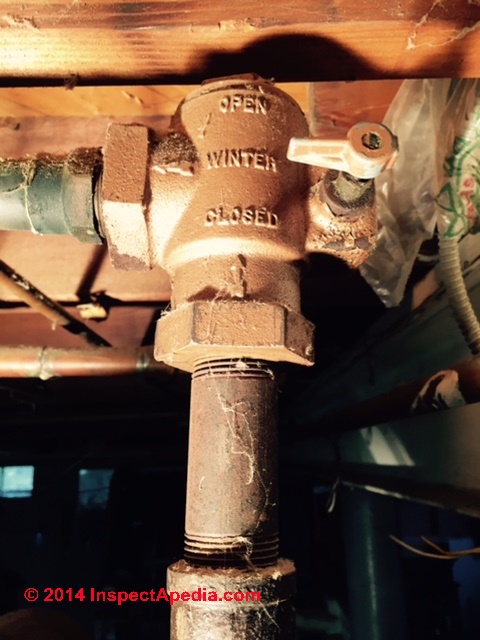 I have a home hot water heating system with two loops, one for the bedrooms and another for the rest of the house.
[Click to enlarge any image]
The gas fired boiler is in the basement. Above the boiler where the piping turns horizontal on both loops are two of what I assume are check valves. They have arrows for flow direction and a lever that can be turned to point at; 'Open', 'Winter' or 'Closed'.
From your helpful articles, I think I understand that 'Winter' might be used to prevent unwanted gravity circulation and that 'Open' could be used for emergency heat and to help purge air from the system, but what about 'Closed'?
Thanks, - M.F. Dec 7 2014
Reply:
- OPEN position on the flow control valve
- means hot water will flow by convection (and possibly by circulator) - you do not want this position. - CLOSED position on the flow control valve
- means the zone is manually shut off and no water should flow regardless of whether or not a circulator is running - WINTER position on the flow control valve
- is the position you want. In this position, if the valve is working as designed, it will prevent hot water from circulating through this zone by convection
- that is when a circulator is not running and presumably when a thermostat is NOT calling for heat, but when the thermostat DOES call for heat, the valve will open to permit hot water to flow (presumably boosted by a circulator pump).
The way this works internally is that in WINTER position the valve is normally closed but when there is a pressure drop on the outlet (house) side of the valve (presumably caused by a circulator pump starting to run) the valve will open and permit water to flow.
IF the valve is in WINTER and the circulator is OFF, and if you then feel along the pipes on the house side of this valve, once you get a few feet away from the boiler the pipes should be cool (unless heat was just recently running). If the pipes are always hot even when you are not calling for heat (say after 4-8 hours), then the valve is probably no longer working as it should, and it'll need to be replaced.
You might decide to leave it alone until warmer weather just so you don't have to shut down and drain the system during very cold weather - or if the heat waste is bugging you go ahead now.
Reader follow-up - Now I believe that the boiler has a leak
The valves do have the words "Flow Control Valve" on them but no branding info.
1. I now understand the Winter and Open position but is the Summer lever position the same as what you describe as Closed?
2. If I might digress. The reason I've been getting so involved with the furnace again is that when I first turned it on this year it smelled when warming up. It had never done that before in its' 24 years. I thought it might be a dead mouse that was drying out but then I started to hear gurgling in the piping and radiators.
Now I believe that the boiler has a leak and I'm smelling the water on a rusty boiler. I have no proof of this.
I know from the schematics on the web that the boiler is made of three pieces of cast iron and bolted together. I have not opened the housing.
There is no evidence of a leak around the furnace, floor or anywhere around the copper pipes in the two zones. It's now 24 years old. Is a leak something that I might expect at this stage?
Does one normally fix or replace a boiler of this type? It's a Weil-Mclain Series 3 Model HE-4
Reply:
If a cast iron boiler is not cracked and the problems are in its controls or piping it usually makes sense to fix those. For an old rusted-out steel boiler or a badly cracked cast iron boiler typically the boiler gets replaced.
B&G Flo-Control Valve Maintenance & Repair
Reader Question: 12/20/2014 Ryan said: how to clean a Flo-Control® valve / check valve on a boiler
 I want to know how to clean a flow control valve. Have heat, but no hot water.
Reply:
Ryan the control valves shown at the top of this page are not intended for field cleaning by a homeowner, but in fact the entire center works of the valve can be removed for cleaning or for replacement of parts if necessary. Below on this page you'll see a parts explosion for a typical B&G SA-1 check valve - very widely used on hydronic heating boilers.
Without understanding how your hot water is made I can but guess that you are using an indirect-fired water heater whose heat exchanger operates as an additional heating zone provided by your boiler.
A control, relay, thermostatic sensor, or circulator pump for that zone could certainly explain having no hot water. Start by determining that the circulator runs and feeling the pipes for hot water flow to the heater.
Reader follow-up:
We have been looking at that. We have a wood furnace that by passes the oil furnace in the winter and heats the house and the hot water.
We have noticed that the circulating pump for the hot water tank is working. The pipes are hot up to the red flow valve to the hot water tank, then go cool to cold.
Hot water is going into the valve, and then when I reversed the water it came through cold from the holding tank. All the water in the holding tank is cold. The light is on and is calling for heat.
Reply:
So if your valve has a manual OPEN lever you can try putting it into that position so that the valve is manually kept open - that may give hot water until you can replace the valve. "B&G Flo-Control Valves are used for preventing gravity flow in forced water systems and to permit summer-winter operation of indirect water heaters. " - B&G
On the B&G Flo-Control valves such as the B&G V5182E series, turn the handle fully COUNTER-CLOCKWISE to put the valve into a manual OPEN position.
The valve body CAN be removed without removing the whole assembly from the system, but only if there are isolating valves on either side of the Flo-Control valve.
You'd have to cool the heating system to less than 100F, remove pressure by opening a drain valve, put the valve in manual open (fully counterclockwise), remove the retainer clip-ring at the valve top, remove the valve handle and packing nut, clean the assembly, install new B&G valve packing, and re-assemble. When reassembled the handle is turned fully clockwise to return the flo-control valve to automatic operation.
Watch out: B&G warns: "System fluids under pressure or temperature can be very hazardous.
Be sure that pressure has been reduced to zero, the system temperature is below 100F, and the drain is left open during service.
Failure to follow these instructions could result in serious personal injury or death and property damage." -References or Citations
Watch out: don't try this unless you have the required re-packing/repair parts on hand and don't try it if the system is hot (scalding burn risks) and don't try it in weather so cold that if you're forced to keep heat off for a time there could be building freeze-damage risks.
B&G Flo- Control Valve References & Manuals
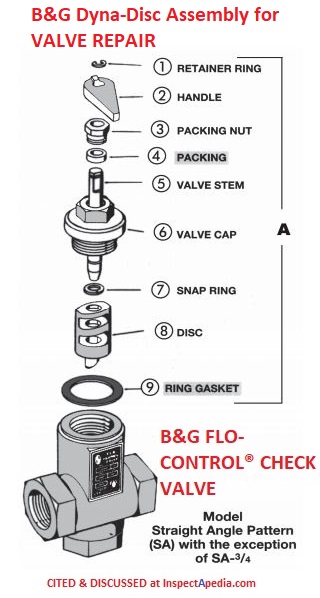
- BELL & GOSSETT SERVICE PARTS CATALOG [PDF] (2011) Bell & Gossett (a Xylem brand), Xylem Inc.
8200 N. Austin Avenue
Morton Grove, Illinois 60053
Phone: (847) 966-3700
Fax: (847) 965-8379
www.xyleminc.com/brands/bellgossett replacement parts for B&G circulators, Flo-Control® valves & other B&G products.
B&G Flo-Control® valve repair parts are found on p.37 in this catalog. - BELL & GOSSETT FLO-CONTROL VALVE CATALOG [PDF] (2018) includes parts explosion and illustration of spar parts for SA Valves, Angle Valves, and Straight Valves such as the model shown here and available from statesupply.com
- BELL & GOSSETT (Xylem) FLO- CONTROL VALVES INSTRUCTION MANUAL V51842E [PDF] retrieved 2017/10/29, original source: http://bellgossett.com/hydronic-plumbing-accessories/flow-control-valves/hydrotrol-flow-control-valves/?tab=literature
- Bell & Gossett "FLO-CONTROL VALVES INSTRUCTION MANUAL, B&G V51842E", [PDF] older version of the above manual, Bell & Gossett, Xylem Brand, retrieved 20 Dec 2014, original source: http://documentlibrary.xylemappliedwater.com/wp-content/blogs.dir/22/files/2012/08/V51842E.pdf
- BELL & GOSSETT (XYLEM) HYDRONIC HEATING & PLUMBING EQUIPMENT, CONTROLS, PUMPS, CATALOG [PDF] A-505 retrieved 2017/10/29, original source: http://bellgossett.com
- B&G HYDROTROL FLOW CONTROL VALVE MANUAL A-411A [PDF] retrieved 2017/10/29, original source: http://bellgossett.com/hydronic-plumbing-accessories/flow-control-valves/hydrotrol-flow-control-valves/?tab=literature
- BELL & GOSSETT HYDROTROL FLOW CONTROL VALVE INSTALLATION A07177B [PDF] retrieved 2017/10/29, original source: http://bellgossett.com/hydronic-plumbing-accessories/flow-control-valves/hydrotrol-flow-control-valves/?tab=literature
- AtReferences or Citations we provide additional links to installation & operating or maintenance manuals for flo-control valves and excellent resources to understand these flow control valves: the B&G Flo-Control Valves - installation, operation, and service instructions manual from Bell and Gossett - an ITT company.
B&G Hydrotrol™ Check Valves
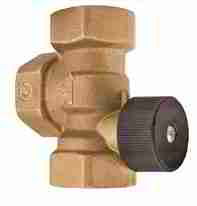
Bell & Gossett (and other manufacturers) also provide a separate Hydrotrol™ valve to prevent hot water from circulating in a building by gravity when the room thermostat is not calling for heat.
This brass valve includes a knob that permits bypassing this check valve with a simple half-turn, achieving the same emergency heat or service functions we described above.
The Hydrotrol HT flow control valve - a specialty check valve e is used to prevent hot water from circulating through a building where the boiler is kept on to provide domestic hot water via a tankless coil or indirect water heater, during non-heating-season months.
It is also installed to prevent overheating of individual heating zones by gravity. But unlike the red B&G Flo-Control valves discussed above, the Hydrotrol flo-control valve can be installed both vertically and horizontally in heating piping.
- B&G HYDROTROL FLOW CONTROL VALVE MANUAL A-411A [PDF] retrieved 2017/10/29, original source: http://bellgossett.com/hydronic-plumbing-accessories/flow-control-valves/hydrotrol-flow-control-valves/?tab=literature
- BELL & GOSSETT HYDROTROL FLOW CONTROL VALVE INSTALLATION A07177B [PDF] ] retrieved 2017/10/29, original source: http://bellgossett.com/hydronic-plumbing-accessories/flow-control-valves/hydrotrol-flow-control-valves/?tab=literature
- B&G HYDROTROL FLOW CONTROL VALVE SUBMITTAL SHEET A-444A [PDF] retrieved 2017/10/29, original source: http://bellgossett.com/hydronic-plumbing-accessories/flow-control-valves/hydrotrol-flow-control-valves/?tab=literature
Taco Flo-Chek Check Valves

Here we illustrate Taco's Flo-Chek heating zone control valve. The flow adjustment on this valve is made by the valve-top mounted knob.
Quoting from the company's product literature, the properties of this valve combine a check valve (don't circulate hot water when the system is not calling for heat) a the thumb screw that can be opened manually for gravity feed applications. This is a check valve, not a zone balancing valve.
- Automatically Opens When Circulator Starts Running
- Cast Iron, Universal Body or Bronze Sweat-In Configuration
- 125 PSI Maximum Operating Pressure (862 kPa)
- 277º F Maximum Operating Temperature (136º C)
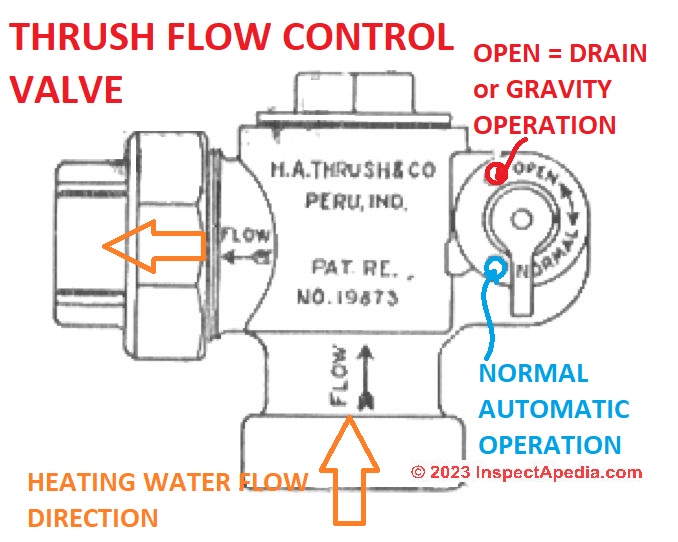
Thrush Flow Control Control Valves
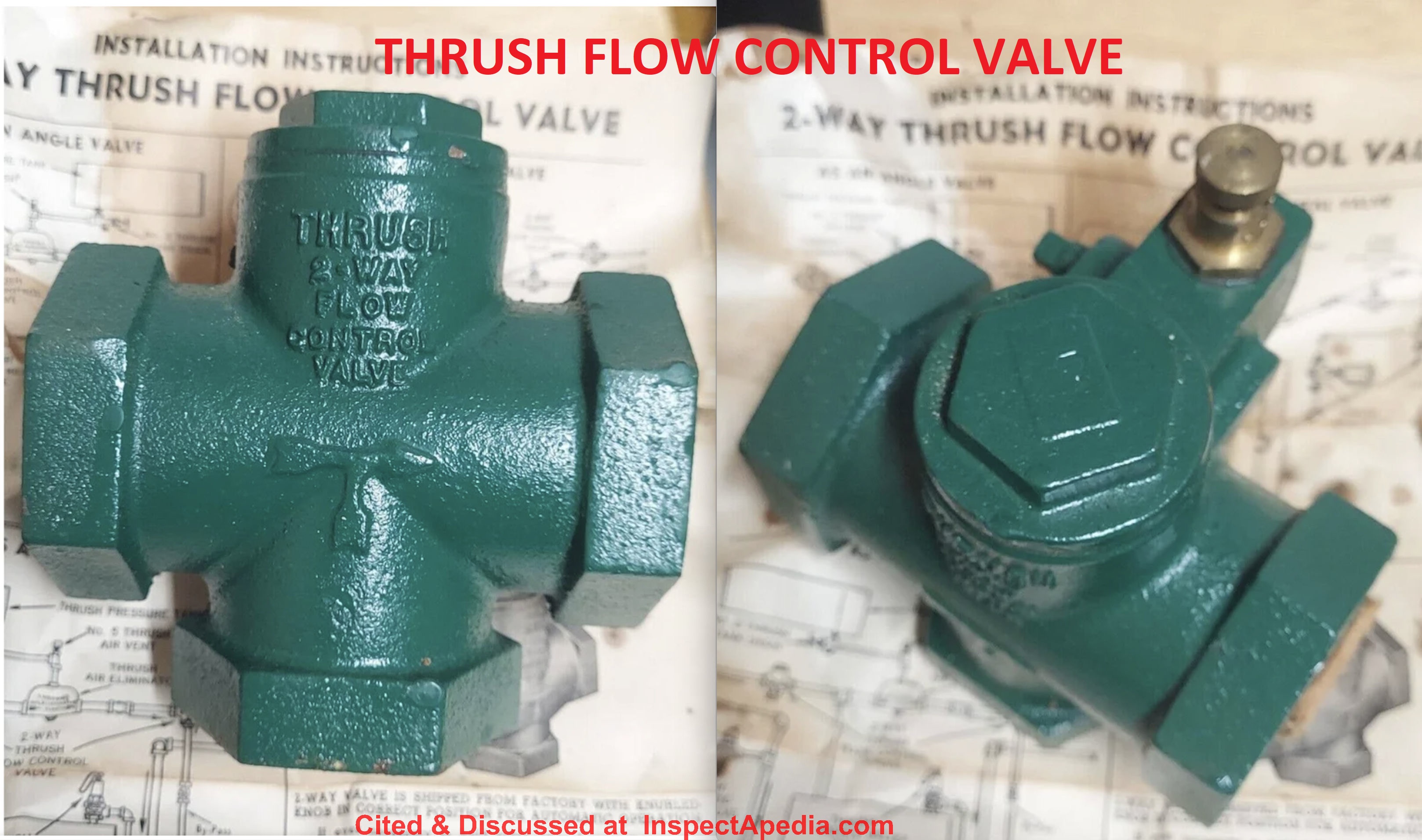
Shown above: an older style Thrush flow control valve.
Shown below: contemporary Thrush Quad-Chek Valve, described by the company as follows:
Thrush Quad-Chek valves are made from quality cast iron. They stop overheating from gravity circulation in hot water heating system by means of positive closing, precision machined, brass-to-brass seat and check weight.
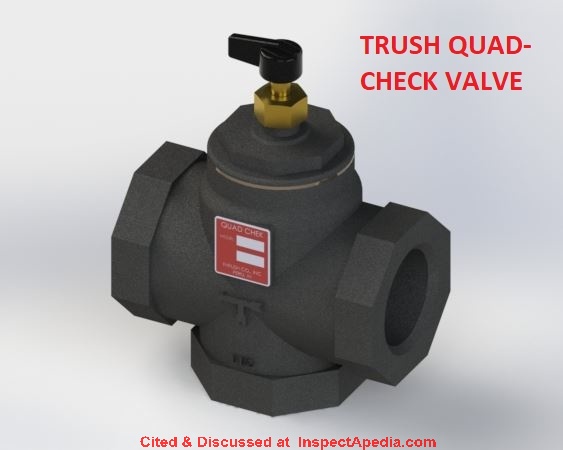
The vertical lift action of the check weight produces a smooth floating application of this unit. Thrush Quad-Chek valves can be installed as an angle, horizontally, or by-pass valve, for system loop temperature balancing.
The vertical lifting stem design permits several modes of operation including preventing overheating from gravity circulation, allowing balancing of flow in circuits, allowing gravity circulation or draining of the system, and permitting isolation of system for maintenance.
- Contact: H. A. Thrush Company, Inc., 340 W. 8th Street, Peru, IN 46970 USA, Tel: 765-472-3351. Web: www.thrushco.com/dual-control-valve
- THRUSH FLOW CONTROL VALVE INSTRUCTION SHEET [PDF]
Excerpts: [the] Thrush Flow Control Valve is designed to control circulation when used in conjunction with the Thrush Water Circulator on automatically fired hot water heating systems.
... When the valve is shipped from the factory the adjusting lever is in Normal position, which is the correct operating position.
When the system is to be completely drained, the lever should be raised to the OPEN position.
When the system has been refilled, be sure to the lever is returned to Normal position.
In the case of a power failure which would prevent operation of the circulator, or for any other reason, gravity circulation can be secured in up-feed systems by moving the lever to the OPEN position.
The lever must be returned to Normal position for automatic operation.
Internal Flow Control Valves - IFC Valves on Heating Circulator Pumps
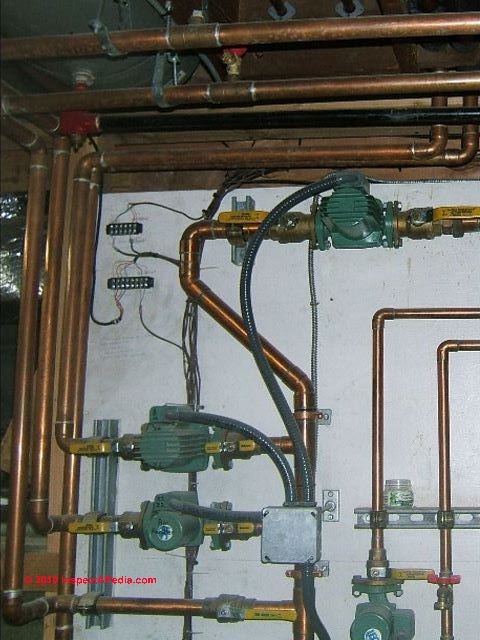
Check valves may be present on a hot water heating system (hydronic heating) but may be less easy to spot.
IFC valves or "internal flow control" check valves are built right into the circulator pump of some models, including some circulators made by Taco® such as the Taco nnn-IFC® (nnn=model number and IFC = internal flow control) circulator pumps.
Taco's product literature comments on the benefits of an IFC type circulator pump:
By locating the patented IFC® inside the pump casing, a separate in-line flow check is eliminated, reducing installation costs.
The reduced pressure drop of the IFC®, increases the 005 flow performance up to 240% over in-line check valves.
Reports are that failures of the check valve function in IFC type circulator pumps are rare.
Manually-Operated Heating Zone Flow Control Valves
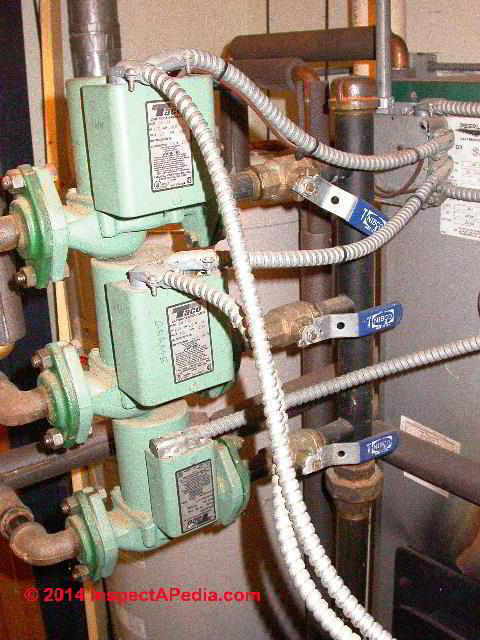
Our photograph shows three Taco hot water heating zone circulator pumps and three lever-type blue-handled heating zone flow control valves that are used to balance the flow of hot water among the three heating zones.
The two bottom valves are in the fully-open position (handle parallel to the heating water pipe) while the top valve is about half-way closed.
When all three heating zones are calling for hot water at the same time, that partly-closed valve reduces the heat flow into that zone.
Why would we do this? Well in most buildings heating zones are not all of the same length. Or zone areas may vary in their rate of heat loss - some needing more heat than others.
By using a manual heating zone balancing valve on each hot water heat zone piping we can tune the flow of heat to prevent some building areas from being too cold while others are too hot - when all of the zones are calling for heat at once.
In the installation shown above the three lever-type ball valves, one on each zone, also make it easier to swap out a circulator pump assembly - if we can close off the heat piping on either side of the circulator pump we can change it out without having to drain down the system and without having to then force air out of the heating piping.
Below is a close-up view of the manual lever that can lock a zone valve in the "OPEN" Position. In the photo the lever is NOT locked "OPEN".
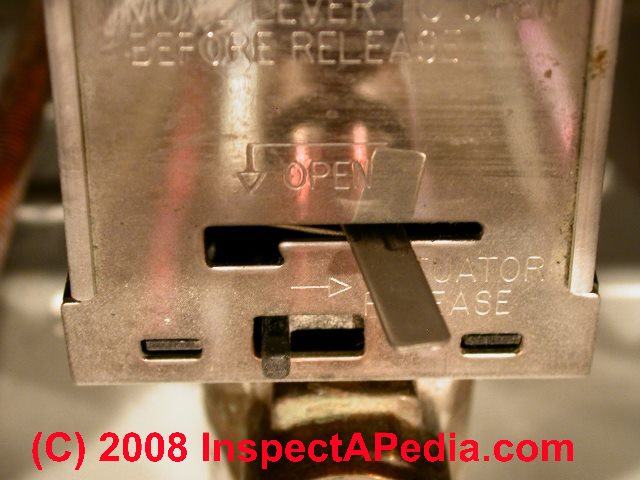
Details are at ZONE VALVES, HEATING
Below we illustrate Bell & Gossett's current heating zone circulator flow control and service valves, the company's Check_Trol valve. Quoting from the product literature:
Can be used with most circulators, including NRF/NBF/SSF wet rotors, Series PLs, 100, PR and LR, and other manufacturers’ pumps. Available sizes: 3/4”, 1”, 1-1/4”, 1-1/2” NPT and Sweat. - B&G Check-Trol Isolation Flow Control Flange, Xylem, Inc. retrieved 1/25/2014, original on file
Manually-Set Heating Zone Pipe-Mounted Heating Zone Flow Control Balancing Valves
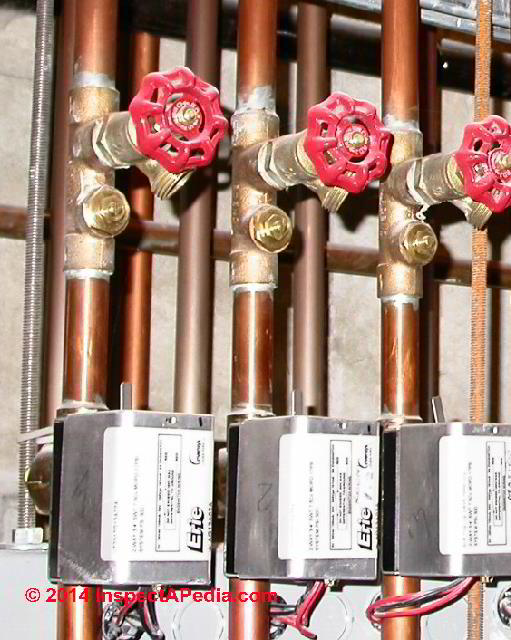
A smaller and harder-to-spot manually-set hot water heating zone flow balancing valve is installed on some hydronic heating systems, usually where heat is provided by a single circulator forcing hot water through multiple zone valves.
Because heating zone piping and zone size or zone area heat loss may vary widely within an individual building, if we cannot regulate the hot water flow in individual zones we may find that when more than one of the thermostats are calling for heat at once, some building areas may be too cold while others may be too warm.
The heating system installer or service technician addresses this heat imbalance by fine-tuning the volume or the rate at which heating water is delivered to different building areas.
Notice our blue arrows pointing to those bronze & brass fittings just below each of the red-handled zone drains in our photograph?
By loosening the lock-nut and using a flat-bladed screwdriver to open (CCW) or close (turn clockwise) these little valves, the service technician can balance the heating flow among multiple hot water heating zones.
Also see ZONE VALVES, HEATING.
Radiant Heat Flow Control Valves
Radiant floor heating systems provide water flow controls for individual heating zones or even tubing loops within zones. For example see the controls provided by
-
Roth Industries North America,
US
268 Bellew Ave South
Watertown, NY 13601
Phone: (888) 266
-
7684
Fax: (315) 475
-
0200, Website:
Www.roth
-
usa.com, Email:
info@roth
-
usa.com
or
Roth Canada 1607 rue de l’Industrie Beloeil, Canada J3G 4S5 Phone: (800) 969 - 7684 Fax: (450) 464 - 7950 Www.roth - canada.com service@roth - canada.com
Variable Speed Circulator Motors Offer Heating Zone Flow Balancing Alternative
Below we show an UpStart hot water heating zone circulator pump produced by B&G (Bell & Gossett). This circulator pump includes a variable-speed circulator motor (see that gold knob on the electrical box atop the motor?). This was a four-speed motor whose output rate could be set by the consumer or heating service technician.
By slowing or speeding the motor we could slow or speed the flow rate of hot water through the zone managed by this circulator. The result: this control provided another way to balance heat flow among multiple zones (and circulators) in a building.
This circulator, the Bell & Gossett SLC-25 Upstart Circulator was sold during the 1980's and is not currently available. Control are also obsolete, but B&G offers similar replacements (such as the NRF-22). At below right is a newer but also obsolete product, the B&G NRF-VS variable speed circulator is shown.
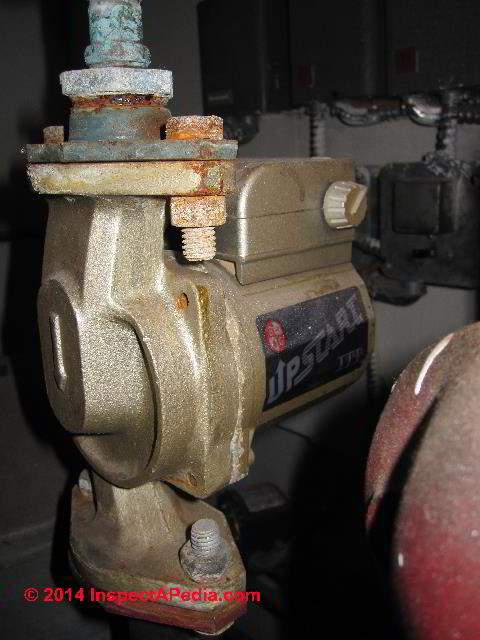
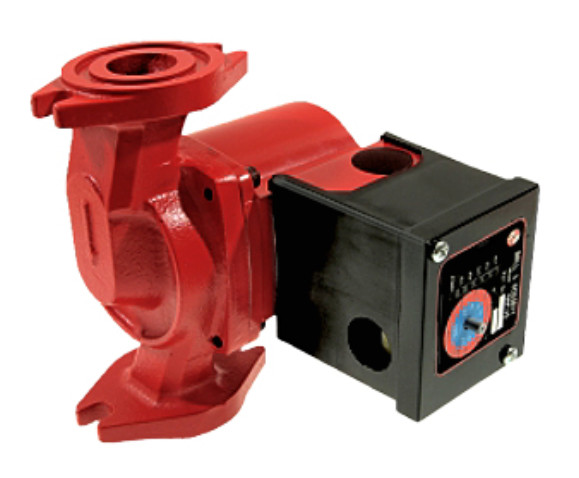
Contemporary as well as obsolete variable speed circulator pumps from B&G, Taco & Grundfoss are detailed
at CIRCULATOR PUMP RELAYS & OTHER CONTROLS.
Backflow Preventer Valves on Heating System Piping - A Different Check Valve
Heating System Backflow Preventer Valves Protect Public Water Mains / Private Water Piping from Heating System Water Contaminants
Because a building potable water supply piping cold water line is used to deliver water to hydronic or steam heating boilers, we need to prevent heating system water from back-contaminating the building water supply piping.
At a hot water heating system a heating system backflow preventer check valve is used to keep hot, high pressure water in the hydronic heating system from flowing backwards through a boiler water feed line into the building water supply - a sanitation concern.
Details about heating boiler back flow preventer valves BBFP (green arrow in the photo above) are
at BACKFLOW PREVENTER VALVE, HEATING SYS. There we discuss BBFP installation position, leaks, troubleshooting, and product sources.
Information about automatic water feeders (red arrow in the photo above) (that may also contain a built-in backflow preventer) are
at WATER FEEDER VALVES, HYDRONIC
Water Feeder Valves on Hot Water and Steam Heating Systems - as check valves
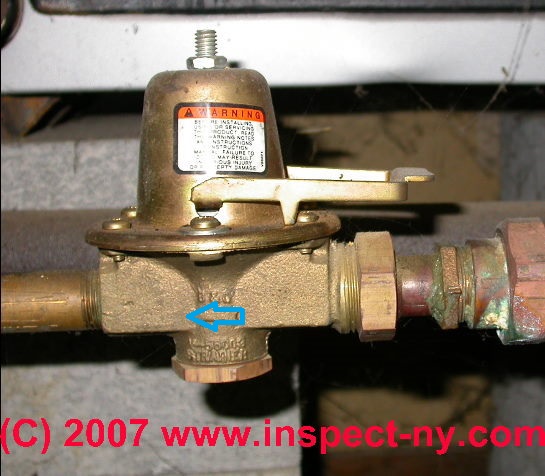
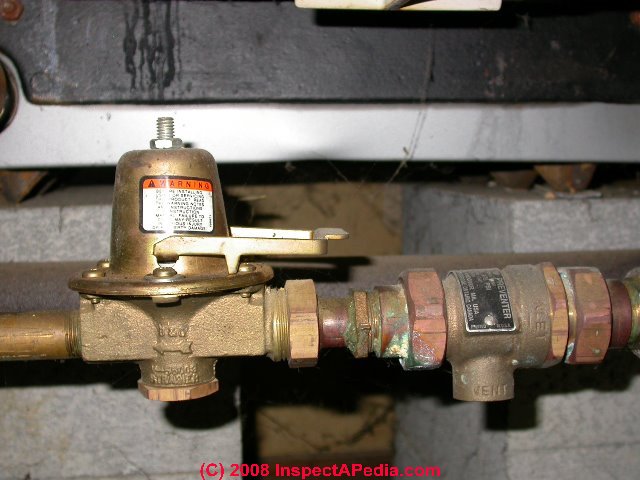
On older hydronic or steam heating boilers the expansion tank and water feeder valve are separate physical units (photo at left). This automatic pressure-reducing water feeder combines a check valve and boiler water feeder.
Like the separate backflow preventer described just above, the check-valve function, internal to the automatic water feeder device, prevents back-flow of heating system water into the building water supply piping.
This bell-shaped device opens and sends makeup water into the heating boiler and its piping whenever the heating system's internal water pressure falls below a normal level.
The feed-pressure is typically factor-set to 12 psi when the boiler is cold, but adjustable where higher starting water pressure is needed for taller buildings.
Some older heating systems may not have an automatic
water feeder and may only provide a manually operated valve to add water to the boiler. Systems without an automatic water feeder are
less safe and risk serious boiler damage should boiler water be lost and should there be no low water cutoff installed on the system.
See WATER FEEDER VALVES for details about water feed valves for hydronic boilers. Steam boiler automatic water feed valves are discussed
While going through the detailed sequence in the operation of the heating boiler, watch for and inspect the condition of the heating boiler controls and safety devices (as required by ASHI 9.1.A.3 automatic safety controls).
Reader Comments, Questions & Answers About The Article Above
Below you will find questions and answers previously posted on this page at its page bottom reader comment box.
Reader Q&A - also see RECOMMENDED ARTICLES & FAQs
On 2023-02-26 by InspectApedia Publisher
@Tony M,
I noted earlier that there is a drain procedure for expansion tanks connected to the Thrush flow control valve - take a look at the instruction sheet PDF I cited - given also above on this page.
Separately, yes any hot water heating system will need several automatic air purgers, usually at the boiler and, depending on how the hot water is distributed, also at baseboards (can be automatic) or radiators or convector units.
On 2023-02-26 by Tony M
@InspectApedia Editor , thanks for the reply! Sounds like I need to explore another spot to put in an air purge for the system. The valve flows vertically with the tank teeing off to the side. I appreciate the resources.
Here's a better picture in case a different angle changes anything.
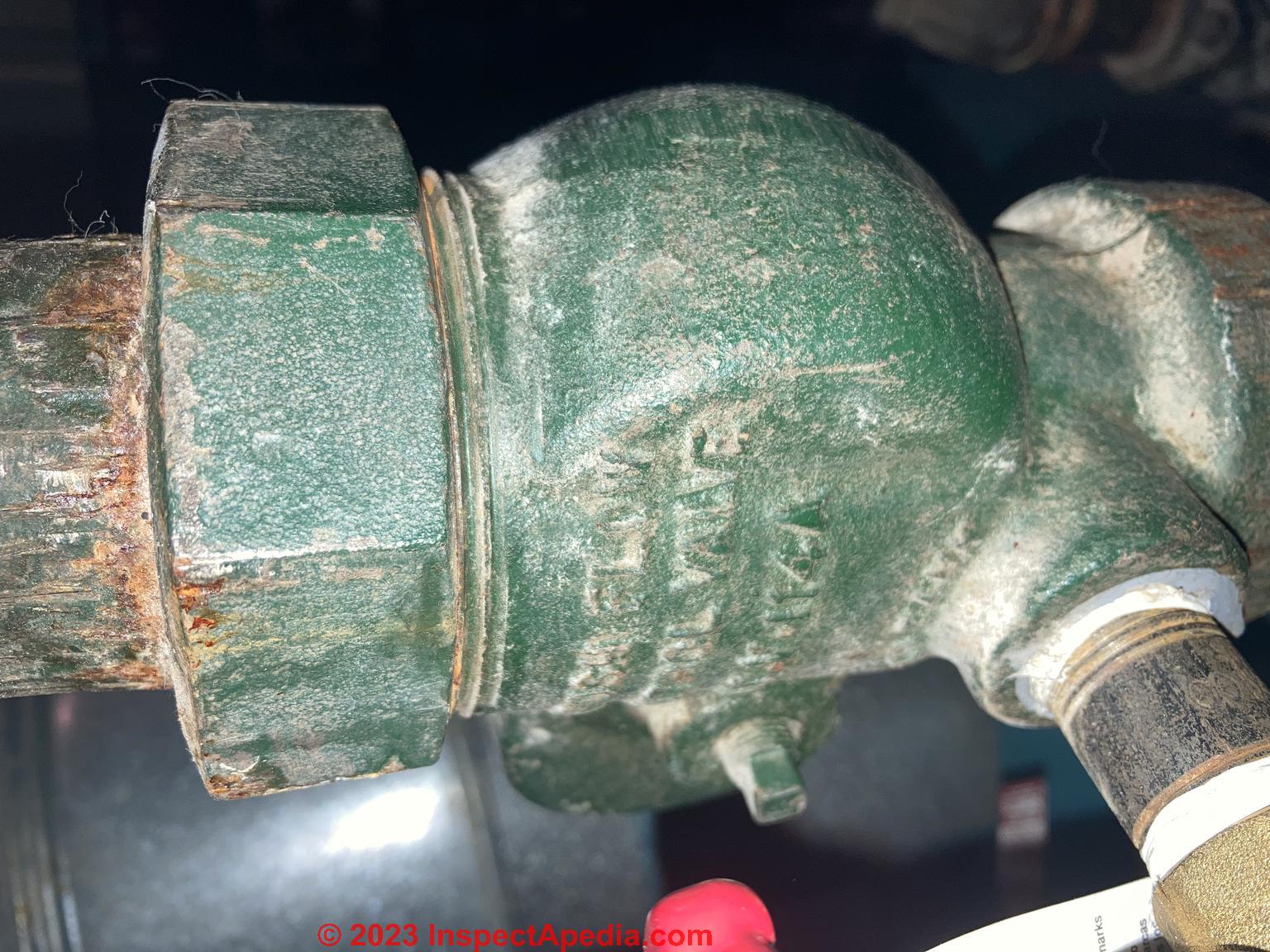
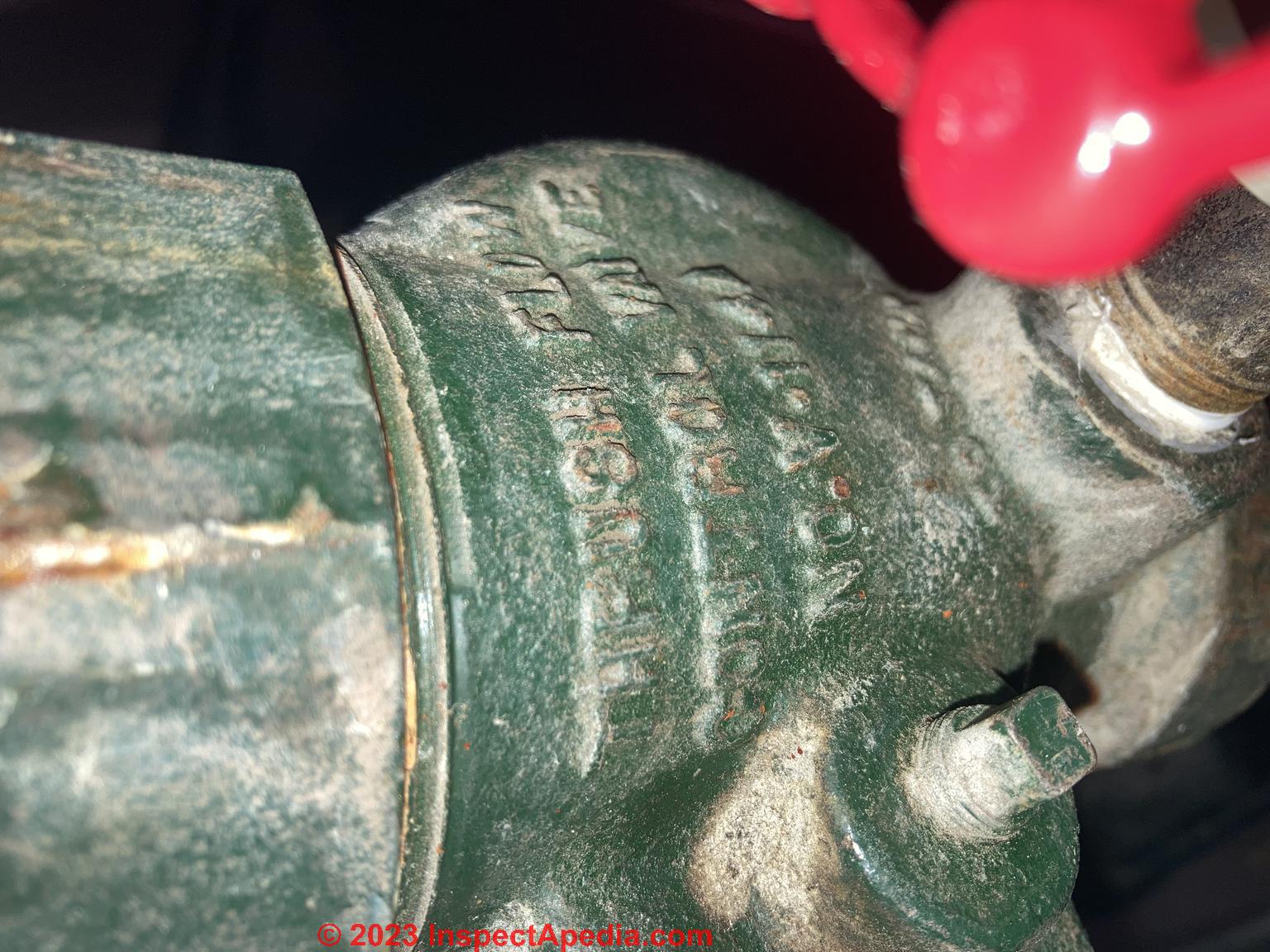
On 2023-02-26 by InspectApedia Editor - 1979 Burnham boiler Thrush Flow Control valve
@Tony M,
I would not call that small plug an "air purge" - we don't normally need to nor try to purge air from an expansion tank.
Rather, we need to drain water from a water-logged expansion tank and thereby to let air into (not out of) the tank.
Above on this page we include instructions for draining the expansion tank through a thrush valve.
The small plug is a drain.
See this THRUSH FLOW CONTROL VALVE INSTRUCTION SHEET [PDF]
inspectapedia.com/heat/https://inspectapedia.com/heat/Thrush-Flow-Control-Valve-Manual.pdf
See also these details on how to drain an expansion tank:
inspectapedia.com/heat/Boiler_Expansion_Tank_Drain_Procedure.php
EXPANSION TANK DRAIN & AIR RE-CHARGE
Contact: Thrush Company, Inc., 340 W. 8th Street, Peru, IN 46970 USA, Tel: 765-472-3351. Web: https://www.thrushco.com/dual-control-valve
On 2023-02-24 by Tony M
Slowly giving my '79 Burnham boiler some TLC and I noticed it has a Thrush Flow Control valve connected to the expansion tank. I do not currently have an air purge valve of any sort (except the baseboards): is the plug pictured the right place for the air purge? Thanks!
On 2022-09-29 by InspectApedia-911 (mod) - How do I stop hot water from passing flow valve?
@Steven Jury,
If you actually are talking about a flow adjustment valve and not a check valve then turning the valve so that it is at right angles across the pipe will either substantially reduce or totally stop the water flow.
On 2022-09-29 by Steven Jury
How do I stop hot water from passing flow valve?
On 2022-05-09 by Inspectapedia Com Moderator - adding another check valve won't add protection against water leakage
@Dean backus,
Thank you for the discussion. Apologies but I am still a bit confused by your idea.
There is a presumption that a leak on the outlet side of the zone valve will be prevented by a check valve that acts to close the line.
The zone valve is in the open position when there is a call for heat.
When there is a call for heat the circulator is running and water is being circulated through the heating zone piping and your check valve will be open.
When the call for heat is satisfied the zone valve stops and (if no other zone is calling for heat) the circulator stops.
At that point the water pressure in the heating zone is sitting somewhere between 12 psi and just under 30 psi.
If there is a leak anywhere in the zone piping that pressure will cause water to exit at that point - independent of whether or not there is a check valve.
There is already a check valve at the heating boiler - intended to keep hot water from circulating through the zone by convection when the circulator is off and there is no call for heat. (Photo at the top of this page).
Adding another check valve won't add protection against water leakage.
Have you read through the article above?
Have I misunderstood something?
On 2022-05-09 by Dean backus
I was intending on adding a thermostat that will close the supply zone valve of water is detected by a censor.If I added a 3/4 back flow valve will it act as an isolation preventing flow coming in from the return end of the zone loop without turning the manual ball valve to the closed position?
Any thoughts
On 2022-05-09 by Inspectapedia Com Moderator
@Dean backus,
That's an interesting idea but I don't understand how it would work.
Wherever you put a check valve or backflow preventer on a hydronic heating line it wouldn't protect you from leaks anywhere upstream of that point.
On 2022-05-08 by Dean backus
Can a 3/4 “ back flow preventer be installed on the return end of a radiant zone to act as an isolation if system leaks
On 2021-11-04 by Inspectapedia Com Moderator - relief valve leaks diagnosis and repairs
@JD,
Please see the diagnostic and repair advice at
RELIEF VALVE LEAKS
and keep me posted on your diagnosis
On 2021-11-04 by JD
I have a hot water boiler for my baseboard heat, with a separate circulator pump for hot water. The hot water goes into a large storage tank. My pressure relief valve started dripping (not blowing), so I replaced it. The new one is also dripping.
My oil company referred a plumber who told me the problem was the expansion tank, although the pressure gauge was not functioning and he couldn't measure the pressure. So, he replaced the expansion tank (it was over 10 years old) for $225 and said I needed a new temp/pressure gauge which he didn't have.
Later found the expansion tank was $55 at Home Depot and I could have done it myself. The PRV STILL DRIPS, a lot - half a bucketful/day. Now I think the excess pressure in the system is due to a failed check valve in the return line from the HW storage tank. When I turn off the valve feeding cold H2O into the HW tank, the PRV stops dripping.
Am I right? It's a Taco 220 1" Flo-Chek. I think I will need a plumber b/c there are no knife valves to isolate the check valve and no union, so removing/replacing will be a b***h. Any advice? Thanks in advance, JD
On 2021-03-12 by danjoefriedman (mod) - can I just replace the check valve on the piping?
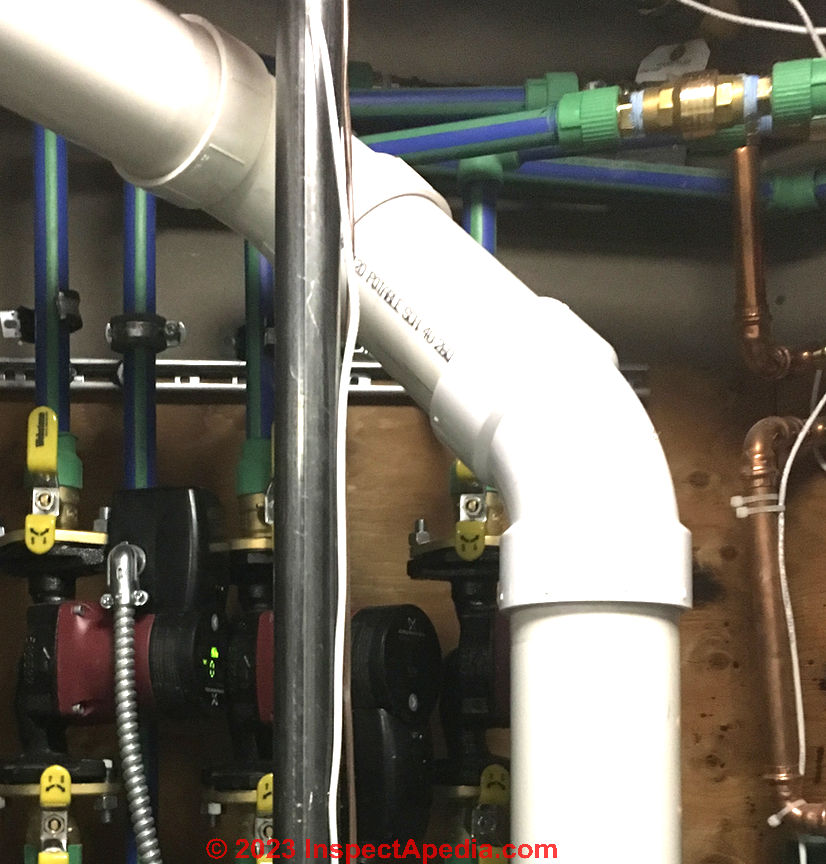
@JanW, the check valve can be replaced. The knurled green plastic fittings are almost certainly threaded to accept the brass fittings that then connect the check valve.
On 2021-03-11 by JanW
I have a hot water heating multi-zone system. The piping is Aquatherm. A check valve has failed. It is a brass body spring check valve, with big nuts on it. The heating company doesn't work with Aquatherm so they want to replace the whole piping with copper.
Here's a picture. The circulators (red, Grundfos) are to the left. The piping goes up and takes a right. You can see the check valve near the top right. I'm wondering why the valve itself couldn't be replaced with ordinary plumbing wrenches. Thank you for any help.
On 2020-11-25 by Kristina
Thank you for all your help!
On 2020-11-25 - by (mod) -
If so you can certainly install flow balancing valves to adjust which zone gets how much hot water
On 2020-11-25 by Kristina
Great, thank you, that's what I suspected. Now my other issue is that even if we install the flow-control valve, we only have one circulator pump and three zone valves (one for each apartment).
Based on your article above, I believe this will still cause a temperature imbalance in the building since the flow-control valve opening to allow one apartment to receive heat will also allow it into the other two apartments, even if they're not calling for heat, and will result in overheating.
To prevent this, I'm assuming we would also have to install a flow balancing valve inside each apartment on the same pipe where the zone valve is (as shown in one of my pervious photos)?
Additionally, the circulator pump is running nonstop, even if the boiler is off and no thermostat is calling for heat. Is this set correctly?
On 2020-11-24 - by (mod) -
 Thanks - I couldn't see those details in the earlier photo.
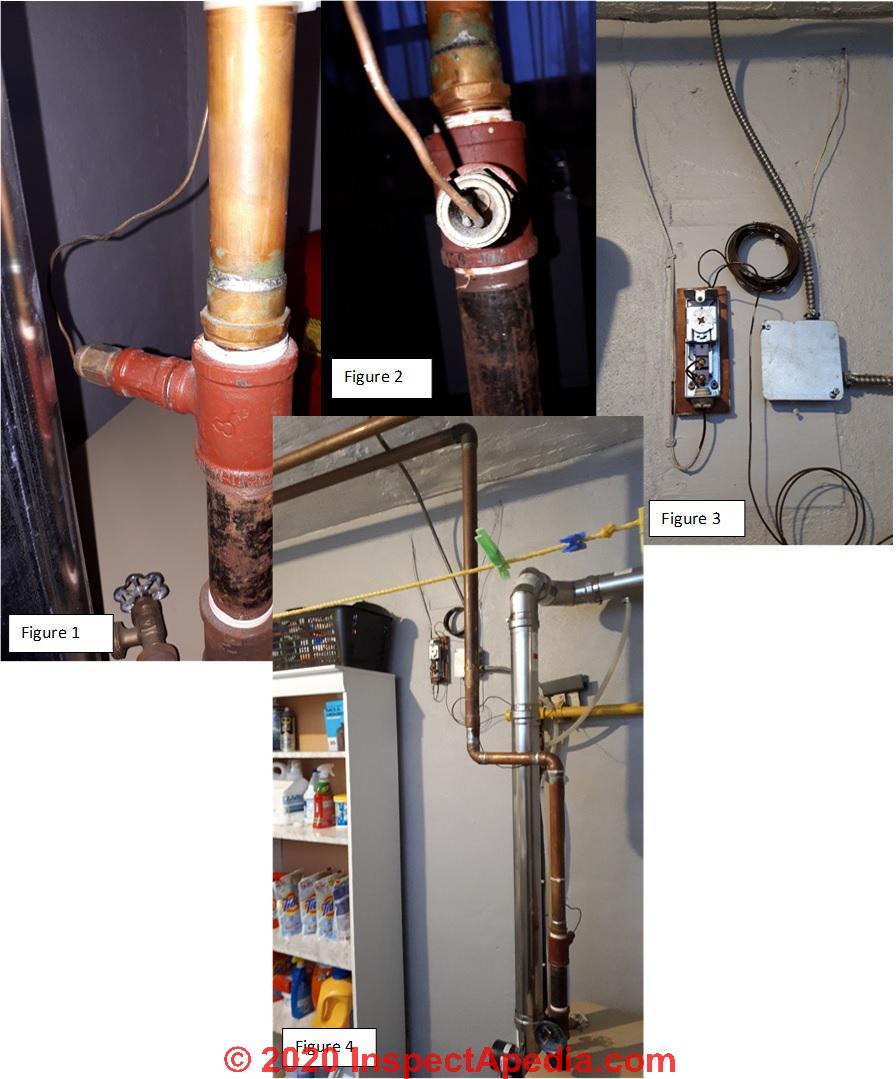
I don't see any check valve or Flo-Control valve in your photos. If none is provided, hot water may indeed circulate out of the boiler even when no thermostat is calling for heat.
On 2020-11-24 by Kristina
Oh yes, I think I know what you're referring to (figure 1). I think it's called the outdoor reset control, if I'm not mistaken? I took a picture of it from the front as well (figure 2).
It has a copper wire attached from the boiler to the thermostat and from the thermostat to the outside (figure 3). There isn't anything else on the riser pipe (figure 4) so I guess that could be our issue.
Thank you so much for all your help. I've been having trouble finding someone who understands and works with hydronic systems so this website has been a great resource.
On 2020-11-24 - by (mod) -
The flow control valve will pretty much always be on the hot water heating Riser pipe at the top of the boiler.
I couldn't see one in your photo but I did see a red device that I couldn't make out.
On 2020-11-24 by Kristina
Perfect, thank you. In terms of the flow-control valve, I think the issue might be that it's missing. Is this possible? I have taken a picture of the heating system at the boiler (see attached) and the only valves
I see are the safety relief valve (bottom left photo, near the black fan) and pressure regulator (top photo, against the wall on the right side of the picture) as well as some shut-off/service valves. Am I just not recognizing it?
On 2020-11-24 - by (mod) -
Kristina
If there is UN-WANTED HEAT or the thermostat is not turning off heat in a hydronic zone I suspect that either the local zone's zone valve is stuck open OR a flow-control valve at the boiler is either mis-set or stuck open.
The flow-control valve is intended to prevent hot water from circulating up through a heating zone by natural convection - as will occur even if a circulator is "off" unless we have a type of check valve to prevent it.
More detailed help is at
HEAT WON'T TURN OFF
conversely
IF there is NO-HEAT When the zone valve opens you should, within a minute or so (depending on building size and thus piping lengths to the boiler) feel the piping on the outlet side of the zone valve get hot.
If it doesn't then either a circulator isn't being turned-on or the zone is air-bound. Search InspectApedia.com using the on-page search box for AIR BOUND HEATING SYSTEMS if you need to sort that out.
On 2020-11-24 by Kristina
Thank you so much for the reply. You are right, it is ridged copper tube coming out of the top. We will replace it with a zone valve and install a new thermostat as well.
One more question. The other two apartments in the triplex (located on the ground and second floor, respectively) have zone valves and thermostats (picture attached of zone valve on ground floor apartment). Both seem to be working (i.e., when the thermostat is turned up or down, the zone valves "click" and move to open and close).
However, the temperature never actually adjusts. Setting the thermostat to 21 degrees C or even turning it off completely does nothing to bring down the temperature in apartments #2 and #3, which stay at 25 degrees C.
When I touch the piping in the photo, is is scorching hot, even when I turn the heating off at the thermostat and manually check the lever at the zone vale to confirm that it is indeed closed.
The only way to lower the temperature in those two apartments is to go down to the furnace room and turn down the main thermostat that's attached to the gas furnace.
The problem with this is that it's then too cold in the basement apartment, so we always have apartments #2 and #3 overheating so that apartment #1 (basement) can be at a comfortable temperature.
Could this be because of that possibly faulty valve in the basement apartment that we're going to replace with a new zone valve and thermostat, or could it be some other issue? Perhaps something wrong with the zone valves in the overheating apartments that I'm just not aware of?
Or could I be missing something else - like a flow control valve (which I haven't been able to locate anywhere on the hydronic system)? Or perhaps I need a pressure control valve installed (like the ones Danfoss offers)?
On 2020-11-24 - by (mod) -
Kristina
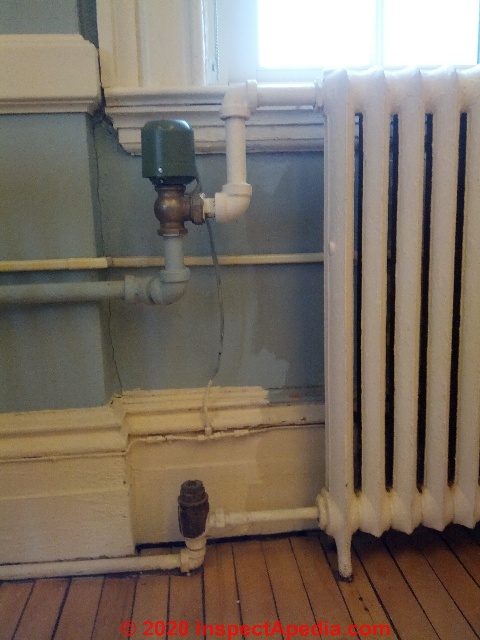
I think that is either an electrical (low voltage) OR a pneumatically-controlled (air-operated or in some models, vacuum-operated) steam valve (or hot water control) that was connected to a room thermostat or other temperature sensor.
Is it possible that your building's heat was originally a steam heating system later converted to forced hot water ? If so this control could be a left-over.
Look closely: is that metal "wire" coming out of the top of the valve actually a wire or is it a rigid copper tube?
Both types of controls have been used on both hydronic (hot water) and on steam heating systems (wires and pneumatic or copper tubing).
Shown below is one of the earliest air-controlled steam valve patents that give insight into the history of this device.
inspectapedia.com/heat/GM-Davis-Air-Valve-Patent-No-404963-1889.pdf
If my guess is right or "sort-of" right, the control in your photo is a cousin to the pneumatic/vacuum operated steam control shown in my photo of a steam radiator installed in Rockefeller Hall on the Vassar College campus in Poughkeepsie NY.
If your heater control no longer responds the valve itself may be jammed (in which case it will need to be removed entirely or replaced perhaps with a zone valve) or the thermostat or wire controlling it needs to be found and repaired or replaced.
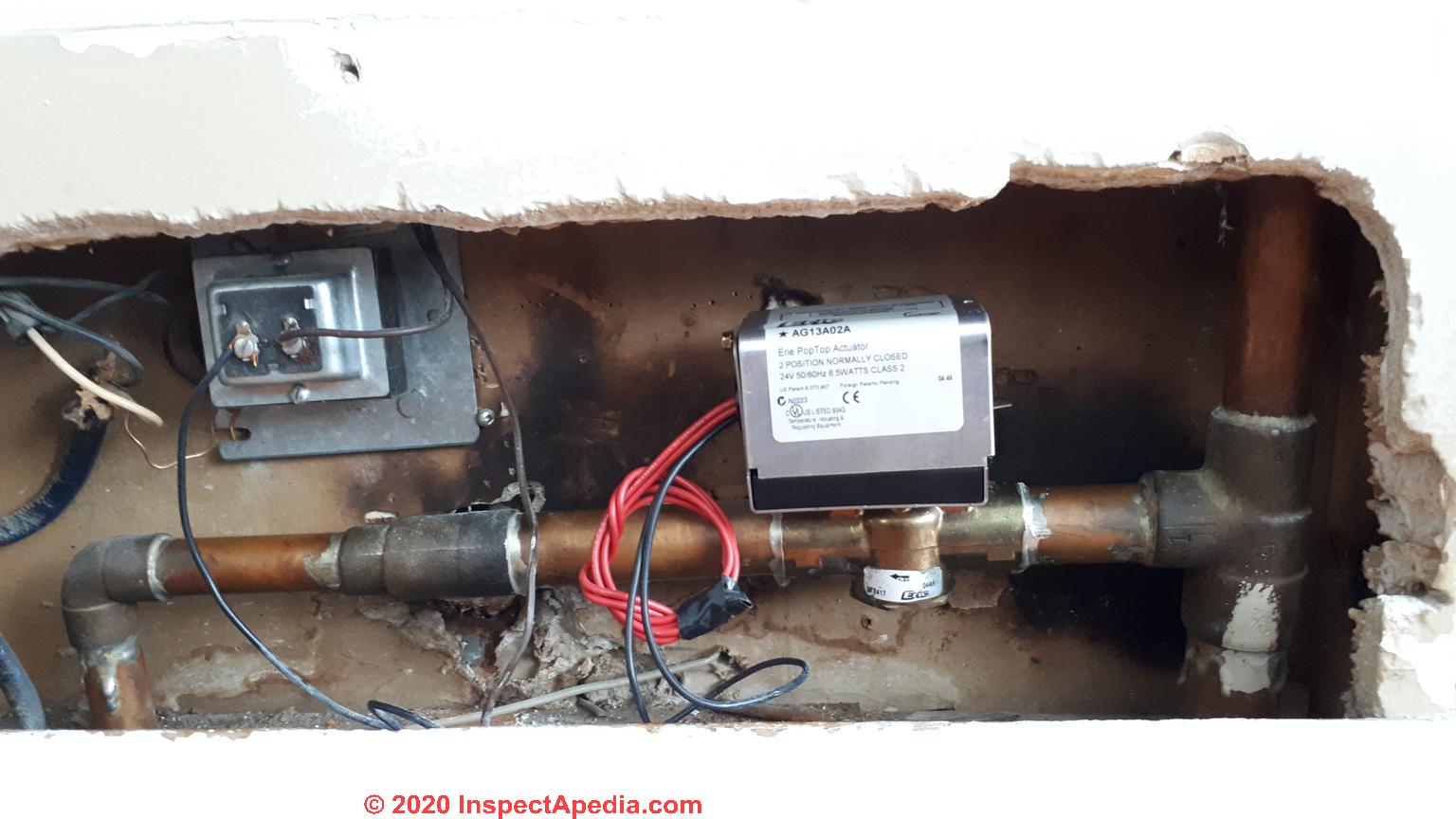
Question: identify this hot water heating control valve
2020/11/24 Kristina said:
Hello, Could someone help me identify what kind of valve this is?
It is part of a 1957 hydronic heating system. It is in one of the bottom kitchen cupboards in the basement apartment of a triplex.
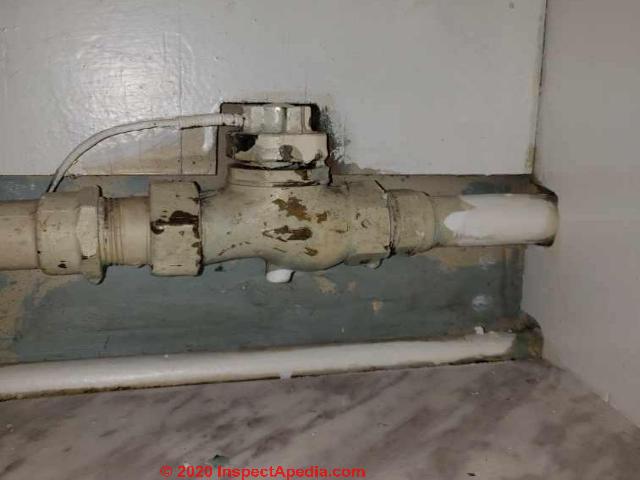
The metal wire coming out of the top is connected to a knob further down on a baseboard heater that doesn't seem to work in adjusting the temperature.
Moderator reply:
Kristina
I think that is either an electrical (low voltage) OR a pneumatically-controlled (air-operated or in some models, vacuum-operated) steam valve (or hot water control) that was connected to a room thermostat or other temperature sensor.
Is it possible that your building's heat was originally a steam heating system later converted to forced hot water ?
If so this control could be a left-over.
Look closely: is that metal "wire" coming out of the top of the valve actually a wire or is it a rigid copper tube?
[Click to enlarge any image]
See my detailed reply to your question at IN-LINE HYDRONIC HEAT CONTROL VALVES, PNEUMATIC OR VACUUM OR ELECTRIC where we include the Davis patented air valve, one of the earliest air-controlled valve patents that give insight into the history of this device.
Question:
(Feb 19, 2020) Erica said:
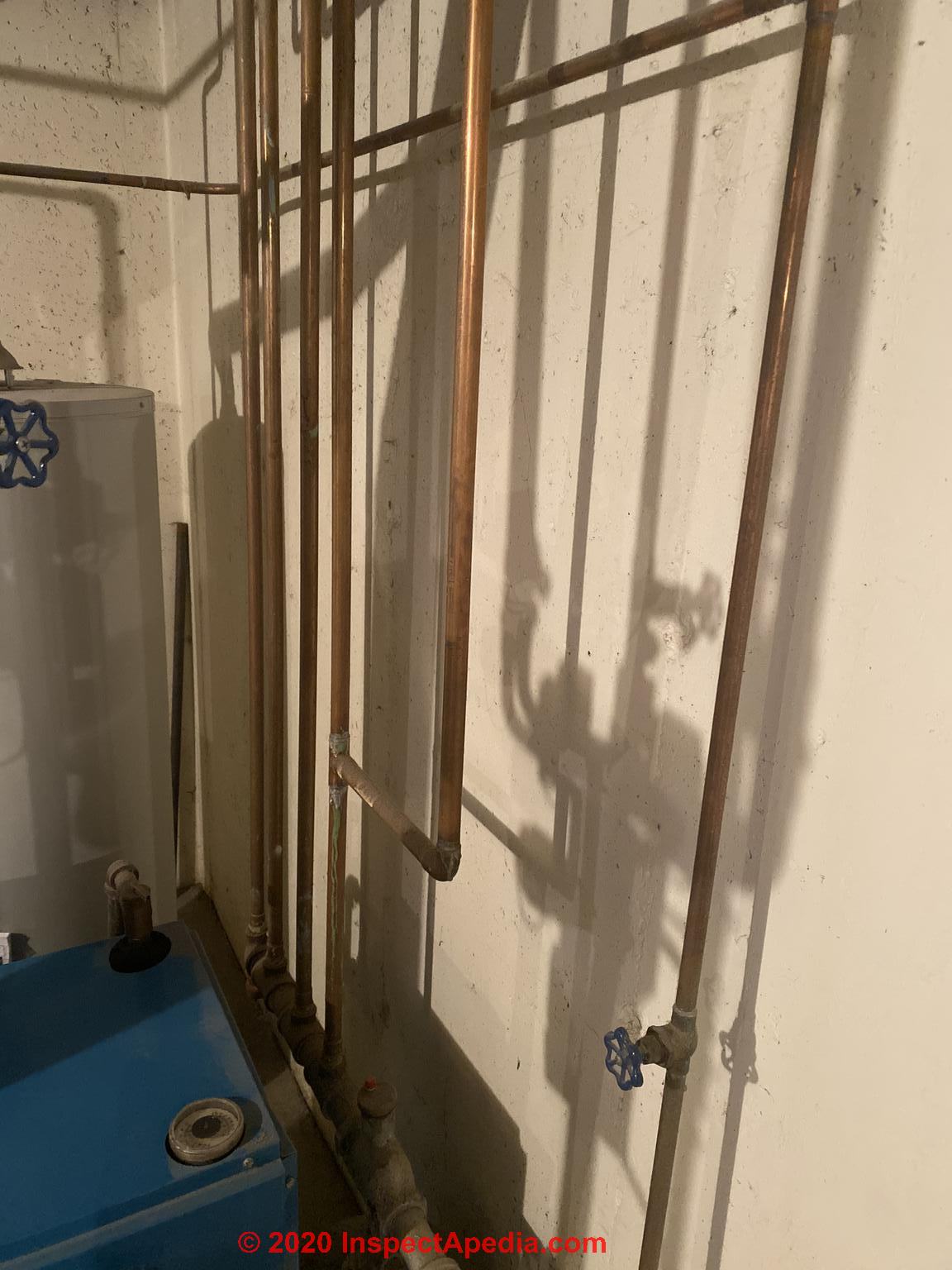
Hi- I recently moved into a new home with 5 zone heating, I am by no means a pro.
After changing to a programable thermostat for one of the heat zones, I noticed at least one of the zones get what I think is “ghost flow” and maintains a higher temperature than its setting overnight.
It seems to get hot when some of the other zones are on.
I am wondering if having someone install a control flow valve near the returns would solve my issue? Any thoughts are appreciated, I added pictures below.
Moderator reply:
Erica
You should not need an additional valve to solve the "un-asked-for heat" problem.
Rather, the heating service tech should be looking for a check valve or flow control valve that is either stuck open or improperly set.
That might be a zone control valve or a Flow-Control valve like the red B&G Flow-Control valve shown on this page.
...
Continue reading at WATER FEEDER VALVE, HYDRONIC BOILER or select a topic from the closely-related articles below, or see the complete ARTICLE INDEX.
Or see CHECK VALVES, HEATING SYSTEM FAQs - questions and answers posted originally at the end of this article.
Or see these
Recommended Articles
- BACKFLOW PREVENTER VALVE, HEATING SYS
- BOILER CONTROLS & SWITCHES - master list
- CHECK VALVES, HEATING SYSTEM
- OIL SUPPLY LINE CHECK VALVES
- PRESSURE REDUCING VALVE WATER FEEDER INSTALLATION
- RADIATOR VALVES & HEAT CONTROLS - key hot water & steam heat controls
- WATER FEEDER VALVE, STEAM
- WATER SUPPLY SYSTEM CHECK VALVES
- ZONE VALVES, HEATING - key hot water heat controls
Suggested citation for this web page
CHECK VALVES, HEATING SYSTEM at InspectApedia.com - online encyclopedia of building & environmental inspection, testing, diagnosis, repair, & problem prevention advice.
Or see this
INDEX to RELATED ARTICLES: ARTICLE INDEX to HEATING BOILERS
Or use the SEARCH BOX found below to Ask a Question or Search InspectApedia
Ask a Question or Search InspectApedia
Questions & answers or comments about check valves and flow control valves on heating systems
Try the search box just below, or if you prefer, post a question or comment in the Comments box below and we will respond promptly.
Search the InspectApedia website
Note: appearance of your Comment below may be delayed: if your comment contains an image, photograph, web link, or text that looks to the software as if it might be a web link, your posting will appear after it has been approved by a moderator. Apologies for the delay.
Only one image can be added per comment but you can post as many comments, and therefore images, as you like.
You will not receive a notification when a response to your question has been posted.
Please bookmark this page to make it easy for you to check back for our response.
Our Comment Box is provided by Countable Web Productions countable.ca
Citations & References
In addition to any citations in the article above, a full list is available on request.
- BELL & GOSSETT (Xylem) FLO- CONTROL VALVES INSTRUCTION MANUAL V51842E [PDF] retrieved 2017/10/29, original source: http://bellgossett.com/hydronic-plumbing-accessories/flow-control-valves/hydrotrol-flow-control-valves/?tab=literature
- Bell & Gossett "Flo-Control Valves Instruction Manual, B&G V51842E", [PDF] older version of the above manual, Bell & Gossett, Xylem Brand, retrieved 20 Dec 2014, original source: http://documentlibrary.xylemappliedwater.com/wp-content/blogs.dir/22/files/2012/08/V51842E.pdf
- BELL & GOSSETT (Xylem) Hydronic Heating & Plumbing Equipment, Controls, Pumps, CATALOG [PDF] A-505 retrieved 2017/10/29, original source: http://bellgossett.com
- B&G HYDROTROL FLOW CONTROL VALVE MANUAL A-411A [PDF] retrieved 2017/10/29, original source: http://bellgossett.com/hydronic-plumbing-accessories/flow-control-valves/hydrotrol-flow-control-valves/?tab=literature
- Bell & Gossett HYDROTROL FLOW CONTROL VALVE INSTALLATION A07177B [PDF] retrieved 2017/10/29, original source: http://bellgossett.com/hydronic-plumbing-accessories/flow-control-valves/hydrotrol-flow-control-valves/?tab=literature
- [1] Thanks to reader WJP for careful editing and reading about the relationship between room temperature and thermostat settings 1/1/2012
- [2] "Water Circulation Pumps & Circulators", TACO (PDF)
- [3] B&G Flo-Control Valves - installation, operation, and service instructions manual - original source Bell & Gossett, 8200 N. Austin Ave., Morton Grove IL 60053, USA - Tel 847 966-3700 Fax 847 965-8379 . www.bellgossett.com/BG-Literature-Detail.asp?LiteratureID=607
- [4] Bell & Gossett Air Separators and other heating system components, Bell & Gossett, 8200 N. Austin Ave., Morton Grove IL 60053, USA - Tel 847 966-3700 Fax 847 965-8379. Air separators are discussed by B&G at http://www.bellgossett.com/homeowners/BG-airseparator.asp
- [5] Taco air scoops and other heating system components & controls: Taco Inc., 1160 Cranston Street, Cranston, RI 02920 / (401) 942-8000 / Fax (401) 942-2360 Taco (Canada) Ltd., 6180 Ordan Drive, Mississauga, Ontario L5T 2B3 / (905) 564-9422 / Fax (905) 564-9436 www.taco-hvac.com
Taco also has some helpful FAQs that are useful in diagnosing circulator problems - see http://www.taco-hvac.com/en/faq.html# - [14] "Warm Air Heating Systems". Instructional Technologies Institute, Inc., 145 "D" Grassy Plain St., Bethel, CT 06801 800/227-1663 [home inspection training material] 1987
- [15] Heating, Ventilating, and Air Conditioning Volume I, Heating Fundamentals,
- [16] Boilers, Boiler Conversions, James E. Brumbaugh, ISBN 0-672-23389-4 (v. 1) Volume II, Oil, Gas, and Coal Burners, Controls, Ducts, Piping, Valves, James E. Brumbaugh, ISBN 0-672-23390-7 (v. 2) Volume III, Radiant Heating, Water Heaters, Ventilation, Air Conditioning, Heat Pumps, Air Cleaners, James E. Brumbaugh, ISBN 0-672-23383-5 (v. 3) or ISBN 0-672-23380-0 (set) Special Sales Director, Macmillan Publishing Co., 866 Third Ave., New York, NY 10022. Macmillan Publishing Co., NY
- [17] Installation Guide for Residential Hydronic Heating Systems
- "Residential Hydronic (circulating hot water) Heating Systems", Instructional Technologies Institute, Inc., 145 "D" Grassy Plain St., Bethel, CT 06801 800/227-1663 [home inspection training material] 1987
- Installation Guide for Residential Hydronic Heating Systems and Installation Guide #200, The Hydronics Institute, 35 Russo Place, Berkeley Heights, NJ 07922
- In addition to citations & references found in this article, see the research citations given at the end of the related articles found at our suggested
CONTINUE READING or RECOMMENDED ARTICLES.
- Carson, Dunlop & Associates Ltd., 120 Carlton Street Suite 407, Toronto ON M5A 4K2. Tel: (416) 964-9415 1-800-268-7070 Email: info@carsondunlop.com. Alan Carson is a past president of ASHI, the American Society of Home Inspectors.
Thanks to Alan Carson and Bob Dunlop, for permission for InspectAPedia to use text excerpts from The HOME REFERENCE BOOK - the Encyclopedia of Homes and to use illustrations from The ILLUSTRATED HOME .
Carson Dunlop Associates provides extensive home inspection education and report writing material. In gratitude we provide links to tsome Carson Dunlop Associates products and services.
 | HOME | ABOUT | ASK a QUESTION | CONTACT | CONTENT USE POLICY | DESCRIPTION | POLICIES | PRIVACY | |
| © 2024 - 1985 Publisher InspectApedia.com - Daniel Friedman | |||||||||