
InspectAPedia® FREE Encyclopedia of Building & Environmental Construction, Diagnosis, Maintenance & Repair |
Question? Just ask us! InspectAPedia
|
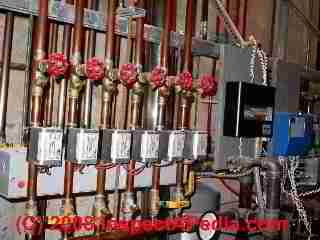 Checks for Circulator Pump & Circulator Relay Operation
- POST a QUESTION or COMMENT about heating circulator pump relays and about testing circulator pumps that don't seem to be working
Here we explain simple procedures for determining whether the circulator pump is working on a heating system.
This article series discusses Circulator Pumps: how to find, inspect, diagnose, and repair problems with Hot Water Heating System Circulator Pumps or circulator pump relay switches and controls.
This article series answers most questions about Heating System Boiler Controls on central heating systems to aid in troubleshooting, inspection, diagnosis, and repairs.
InspectAPedia tolerates no conflicts of interest. We have no relationship with advertisers, products, or services discussed at this website.
How to tell if the circulator pump is working - some circulators are quiet - which pipes to feel
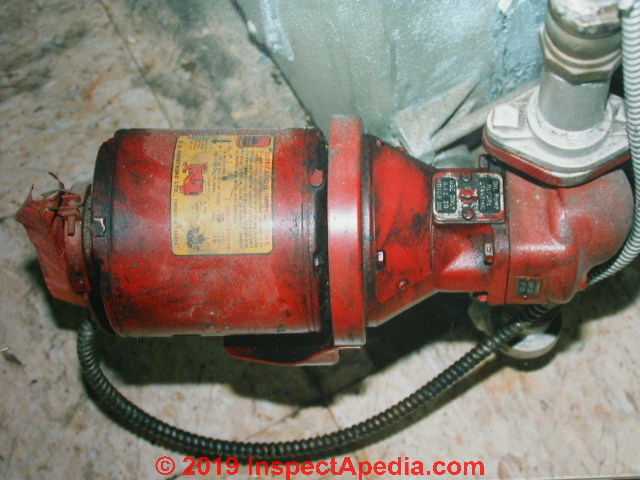 Hot Water Heating System Circulator Troubleshooting & Repair Guide: we discuss circulator pumps, circulator pump relay switches & controls on heating systems to describe how to tell if a heating circulator pump is working.
Some examples of questions and problems that show up first as a symptom:
Why do some heating zones work and others not?
Why does heat come out of zones where thermostats are not calling for heat?
How to fix an air-bound heating system and blocked circulator pump.
Is the circulator pump running? If the motor runs that doesn't mean that the pump is actually moving hot water through the system.
Article contents
- CIRCULATOR OPERATION CHECKS
- SINGLE ZONE SINGLE CIRCULATOR TESTS
- MULTIPLE ZONE SINGLE CIRCULATOR TESTS
- MULTIPLE ZONE MULTIPLE CIRCULATOR TESTS
- INDIVIDUAL HEAT ZONE CIRCULATOR TESTS
- CIRCULATOR PUMP WON'T START
First Things to Check in Diagnosing a Bad Circulator Pump
First, before checking the circulator pump for proper operation, we need to be sure that the heating system controls are calling for heat:
1. The heating boiler must be turned on and able to run
2. The thermostat must be set up to call for heat
3. In response to the thermostat you should hear the heating boiler turn on and run;
4. You can then examine the heating system distribution piping leaving and returning to the heating boiler, identify the circulator pump (or pumps if there is more than one), and feel the heating water piping at the pump(s).
5. Identify the circulator for the heat zone where you have turned up the thermostat:
Check the Operation of a Single Hot Water Heat Circulator Pump - a Single Heating Zone
If there is only one thermostat, one heating zone, and one circulator pump it's simple, there is nothing to sort out, continue
with INDIVIDUAL HEAT ZONE CHECK.
There will be no zone valves, just a single pump and its controls to turn the circulator pump on and off.
The heating distribution piping in a one-zone building may still be divided into multiple "branches" or sub-loops. If that is the case, you might be able to convert this system to individual zone controls by adding zone valves at the individual heating water piping loops - provided that the loops are arranged in parallel, not in series.
Check the Operation of a Multi-zone Heating System Using a Single Circulator Pump
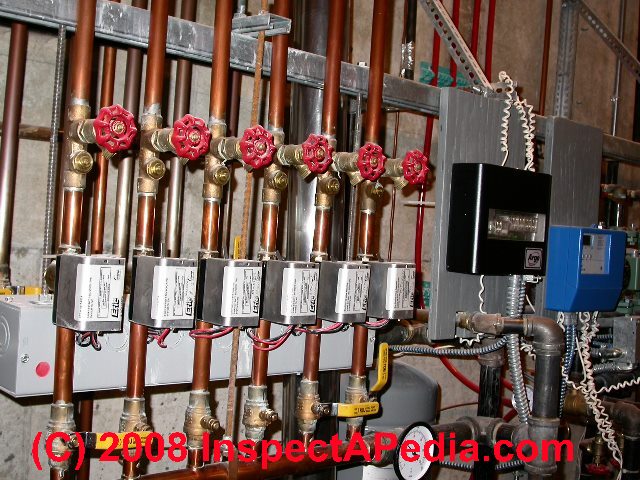
Multiple thermostats, multiple heating zones, one circulator, multiple Zone Valves:
[Click to enlarge any image]
If there are multiple thermostats there may still be only one circulator (if zone valves are installed) and individual heat zones are controlled by motorized zone valves that open or close to let heating water flow through that heating pipe loop.
In that case the same procedure as below for "feeling the circulator piping" is used but you feel the piping at the zone valve as well - since if a zone valve is not opening no hot water will flow.
Our photo (left) shows a 6-zone hot water heating system using six individual zone control valves and a single circulator pump.
See ZONE VALVES, HEATING for details about how these devices work and how they are inspected and repaired.
Check the Operation of a Multi-zone Heating System Using Multiple CIrculator Pumps
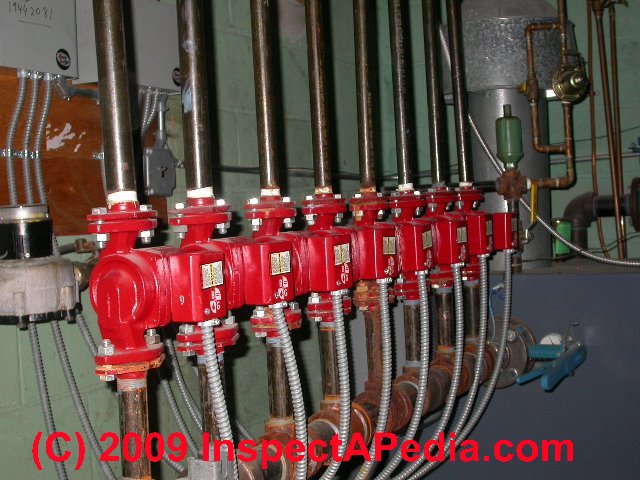
Some buildings use one circulator pump (and controlling circulator relay switch) to control each individual heating zone (instead of "zone valves" as above).
In this case if you don't know which circulator pump and pipe loop supplies the zone for which you turned up the thermostat, just go
to INDIVIDUAL HEAT ZONE CHECK just below, but feel the piping at each circulator pump.
Our photo (left) shows an 8-zone hot water heating system using eight individual Bell & Gossett™ circulator pumps. Notice those rust marks at the bottom pump flange at some of these units?
All eight pumps had been installed in the previous two years - at a previous inspection we found the predecessor pumps leaking so badly that the floor of the boiler room was puddled with heating water. The installer needs to inspect, clean, and re-make the leaky connections on these new circulator pumps to avoid a repetition of the same problem.
Individual Heating Zone Operation Checks
How to know if a particular hot water heating zone is working or calling for heat:
Listen to the circulator pump: is it running? Bell & Gossett circulators are generally audible, making some electrical motor noise. Grundfoss circulator pumps are quieter but should be audible. Taco circulator pumps are often so quiet that you cannot rely on sound (or I can't), but it's easy to go on to the next step: feeling piping temperatures.
Incidentally if a heating zone circulator pump is very noisy or has become more noisy than when it was installed, there may be a problem with a failing motor bearing, pump assembly bearing, or pump impeller.
Feel the Hot Water Heat Piping at the Circulator Pump: You can feel the pipe at the circulator pump - doesn't matter which side - in or out flow - since if the pump is running the pipe will get warm, then hot.
If the circulator is on the pipes that are LEAVING the boiler and sending heat into the building (not the best location) it's better to feel the pipe on the outlet side of the circulator since the pipe at the inlet side might be hot just by convection heat rising from the boiler.
If the circulator pump is on the RETURN side of the heating piping loop (the usual and better location) then you can feel the pipe at the circulator pump - doesn't matter which side - in or out flow - since if the pump is running the pipe will get warm, then hot if it is successfully moving hot water out of the boiler and through the heating pipes.
Why Might Multiple Heating Zones All Run at Once When Only One Thermostat is Calling for Heat?
If all of the heating system's valves stopped working some time ago, someone may have latched them in the "open" position - so if any of the thermostats called for heat, every heating zone would receive heat even though only one thermostat is calling for heat.
See ZONE VALVES, HEATING for details about zone valve operation, inspection, diagnosis, repair. There we include photos including a zone valve control lever on the side of a Honeywell valve - in the auto position.
If you see that the manual zone valve control lever is "latched" into the "on" position, try un-latching it and then watch to see if the valve operates (and the lever moves) in response to a call for heat at that zone.
See HEATING LOSS DIAGNOSIS-BOILERS diagnostic links if this is the case.
Watch out: hot water may be circulating in a hydronic heating system even if no thermostat is calling for heat, for example if a Flow-Control check valve has stuck in the open position or has been left manually open.
See CIRCULATOR PUMP WON'T STOP RUNNING for details.
Reader Comments, Questions & Answers About The Article Above
Below you will find questions and answers previously posted on this page at its page bottom reader comment box.
Reader Q&A - also see RECOMMENDED ARTICLES & FAQs
On 2022-01-12 by Inspectapedia Com Moderator
@Mary,
Apologies but I'm confused by the question.
The room thermostat is essentially a call for heat that turns on a circulator pump in what I take to be your case.
Other temperature controls such as on the boiler or at a compensator for outdoor temp control when the boiler runs.
On 2022-01-11 by Mary
Does the TACO baseboard heater system require a 'ground' & where would that be found? Can the system generate static electricity if the 'ground' is not functioning normally. i'm concerned about excess static electricity & 'hot' de-humidified heat which is very uncomfortably drying to skin.
This system is connected to another heating system (I think) controlled by a wall thermostat. Temperatures set do not seem to synchronize with thermostat set temperature or temperature output at Honey Well temperature which does not synchronize with actual room temperature, or outside temperature as stimulus for running baseboard at a high temperature.
Do you think there is a major problem? The TACO begins to heat at the 'activator' at very high outer thermostat settings. (Big white outer ring thermostat around a small HoneyWell supposed room temperature thermostat which is almost always 69-70 degrees.)
On 2021-12-09 by Bob
@Inspectapedia Com Moderator, very helpful! Thank you again for your time and knowledge. It's greatly appreciated.
On 2021-12-09 by Inspectapedia Com Moderator
@Bob,
You'll want to see the diagnostics and repairs starting at
ZONE VALVES, HEATING (link given in earlier response)
that's more complete than if I try to make it up de-novo off the cuff here
On 2021-12-09 by Inspectapedia Com Moderator
@Bob,
You've got it right; if you live in the U.S., the usual way boiler - hot water- heat using zone valves is wired, the thermostat opens the zone valve and when fully open the zone valve turns on the circulator.
But if a zone valve is stuck it won't open so the circ won't turn on.
On 2021-12-09 by Bob
@Inspectapedia Com Moderator, I believe I'm mistaken. The thermostat calls for heat, but will only kick on if the zone valve is in the "open" position. This has just happened this afternoon.
What would cause the valve to stop working in the auto postion?
Sorry for my mistake as I know nothing about this topic. Any info is greatly appreciated. Thanks again
On 2021-12-09 by Inspectapedia Com Moderator
@Bob,
I'm worried about running amok here: are you sure you're talking about a circulator pump (discussed on this page) ?
Your question sounds as if you're fooling with a zone valve - discussed at
ZONE VALVES, HEATING
I ask because I'm not aware of an "open position" on a circulator pump but I am aware of an open position on zone valves.
In a zone valve multiple heating zones can each be controlled by individual zone valves: the thermostat calls for heat, the zone valve opens, and AFTER the zone valve is fully-open an end-switch in the zone valve turns on the circulator pump.
Some zone valves can be manually latched in their "open" position - so hot water can always flow if the circulator runs.
So if your zone valve motor is broken and won't open the valve in response to the thermostat you can force the valve open and the circulator will run and you'll have heat. (Until your heating service tech can get to your place to fix or replace the zone valve)
If I've misunderstood please set me straight.
On 2021-12-09 by Bob
My thermostat calls for heat, but boiler won't kick on. However if the circulator is set in the "open" position the heat works. Will not work in the "AUTO" position. Your thoughts would greatly be appreciated. Thanks
On 2021-11-27 by Inspectapedia Com Moderator
@William F McGinnes,
If there are multiple heating zones being served by one circulator, then the return temperature might indeed very depending on whether one or more than one zone valve is open.
On 2021-11-27 by William F McGinnes
The return water temperature on my floor heat varies 15 to 20 degrees. The thermostat is calling for heat, so the circulator is running. Is it possible that the circulator is slowing down sometimes? When the return temp. is between 110 and 115 degrees enerything is great, but it drops to around 100 degrees and the rooms stay cool.
On 2021-03-14 by danjoefriedman (mod)
@Missy Tracy,
How is your hot water made?
The heating boiler circulator pump (discussed above on this page) is used to send hot water out of a home heating boiler for space heating - heating the occupied space through radiators or baseboards.
**IF** your domestic hot water (for washing and bathing) is produced by a tankless coil on your home heating boiler
**THEN** the aquastat contrl on your boiler will lock out that circulator if the boiler is not hot enough (if the aquastat controls are set properly)
Those details are at AQUASTAT HI LO DIFF SETTINGS
**ELSE** your boiler circulator has no relationship with domestic hot water being delivered to tubs, sinks, showers.
On 2021-03-14 by Missy Tracy
When taking a shower my water is hot instantly and then gets cold quickly. Could it be the circulation pump? Just installed a new water heater but it did the same thing with the old one.
On 2020-12-28 by danjoefriedman (mod)
John
Possibly, yes; easy enough to check by wiring the circulator directly to run full time;
But
Watch out: if you don't know how to do proper and safe electrical wiring you could be shocked or killed - so get help as needed from an electrician.
Keep in mind that your system could be AIR BOUND - find that diagnosis and repair in the ARTICLE INDEX
On 2020-12-27 by John
I have a single zone (1) circulator that isn't working so I manually opened the flow control to use gravity to heat the house. The main stack is the ONLY thing that gets hot which is my living room. No heat goes any where else. Could it be the circulator relay in the Aquastat that isn't working instead of the circulator not working?
On 2020-11-21 - by (mod) -
Apoliges Ron but I don't quite understand the question.
What do you think should be moving or have to be moved at the circulator pump in order to lubricate it?
On 2020-11-20 by Ron
In lubing zone pump the lube tub goes into pump with out moving anything
On 2020-09-14 - by (mod) -
Great first steps in diagnosis, Randy; When we have heat on one zone and not others I look for:
1. air bound heating zone
2. a circulator that's not turning on or a zone valve that's not opening.
Yeah see if you can free up the circulator, and if so still that says we need a new one.
On 2020-09-14 by Randy Emmons
Weil Mclain boiler with 2 zones and 1 circulation pump. I turned boiler off during summer. Today I went to re-start and it all seemed OK: ignition control module started, exhaust fan ran, glow plug worked and fired the flames.
1 zone pipe was heating up but the 2nd one never really did.
It ran for approx. 3 mins and everything shut down including control module.
I felt circulating pump and seemed fairly warm. Last spring I was told this could happen and to gently tap the pump to "unstick" it from being off.
Do you have any thoughts/opinions of what I could do now?
Thank you for any ideas as this boiler is costing me a small fortune.
On 2020-01-18 - by (mod) -
Susan
When I encounter the problem you describe my first pass is to bleed air from the affected zone at each air bleeder on the system.
On 2020-01-17 by Susan
When the temp outside goes down into the teens, my heating system (3 zones) is not working properly in only one zone. The fins of the hot water baseboard are warm to the touch and stay that way and never get co ld and they don't throw heat out into the room .
The thermostat is set at 72* yet actual temp won't go above 67*. Now when the outside temp is in the thirties the heat seems fine. The heater fins get cold like they are supposed to and the heater runs normally. I can't help but think the furnace runs all the time.
On 2019-11-05 - by (mod) -
When the heat has been shut off and all of the piping and baseboards or radiators in a building or cold it can take a while for the return line at the boiler to warm up. Let it run for a while. Certainly by the time the thermostat is satisfied you would expect that return line to be quite warm. If it's not the system may be airbound. .
On 2019-11-03 by Dan
I just turned my furnace on today. The return from outdoor furnace is not getting the copper pipe too hot to the touch despite the furnace being at the right temperature. Could this be a circulator pump, or something else?
On 2018-02-06 - by (mod) -
On 2018-02-04 by W.Sharpe
Circulator Pump Will Not Shut Off
Three Taco zone valves on one Taco circulator pump. All getting proper voltage and confirmed working. Boiler hi-lo set& working properly.
Regardless of zone demand for heat or satisfied & regardless of boiler temp, and confirmed 110V across C1 & C2 terminals, C1 ( Honeywell L7224) indicator & pump stay on! This is a new behavior, and was not the case before.
Even when I power down the system, wait 30 seconds or even 2hrs, when reenergized, 10 seconds of silence, C1 indicator light goes on, followed by a relay click, and circulator turns on. This is with no TT demand and BT above limit.
Absolutely frustrating as to why the Aquastat is now turning on the relay/circulator for no need or reason.
The MAJOR CONCERN is, the pump is on the return side, in-between closed zone valves and boiler. A total distance of <2'. not much room for relief to the impeller, sucking away like someone trying to suck a just served wendy's shake through a straw! the motor is very hot.
then i've seen on a couple of discussion sites, "no harm will come to the circulator". sounds like b.s. from a taco sales rep to me.
question is, what happened? why is the circulator suddenly running non-stop? is there a fix? btw, it is rather cold, 15 - 20 outside, & no, this doesn't have an outside sensor, and we've had colder days.
for now i'm running heat, and when up to temp, manually turning off boiler power at top of stairs, sleeping in recliner for 2hrs, waking up to turn on the heat for another warming. lather, rinse and repeat.
your valued advise?>
...
Continue reading at CIRCULATOR PUMP LEAKS or select a topic from the closely-related articles below, or see the complete ARTICLE INDEX.
Or see CIRCULATOR OPERATION CHECK FAQs - questions & answers about simple diagnostics for the hot water heating circulator, posted originally at the end of this page.
Or see these
Hot Water (Hydronic) Heating Boiler Circulator Articles
- AIR-BOUND HEATING SYSTEMS
- CHECK VALVES, HEATING SYSTEM
- CIRCULATOR PUMPS & RELAYS
- BELL & GOSSETT B&G EQUIPMENT MANUALS & CONTACT
- CIRCULATOR DIAGNOSTICS
- BYPASS a BAD CIRCULATOR
- CIRCULATOR COSTS
- CIRCULATOR NOISES
- CIRCULATOR OPERATION CHECKS
- CIRCULATOR PUMP LEAKS
- CIRCULATOR PUMP MANUALS
- CIRCULATOR PUMP MOTOR or BEARING FAILURE
- CIRCULATOR PUMP RELAY CHATTERING
- CIRCULATOR PUMP WON'T START
- CIRCULATOR PUMP WON'T STOP RUNNING
- CIRCULATOR PUMP RUNS INTERMITTENTLY
- CIRCULATOR PUMP SPEED SELECTION & ADJUSTMENT
- CIRCULATORS VARIABLE SPEED
- WEAK HEAT, WEAK CIRCULATOR, TOO COOL
- COLD HEATING BASEBOARD / RADIATOR REPAIR e not getting any heat at all out of a cold baseboard or radiator
Suggested citation for this web page
CIRCULATOR OPERATION CHECKS at InspectApedia.com - online encyclopedia of building & environmental inspection, testing, diagnosis, repair, & problem prevention advice.
Or see this
INDEX to RELATED ARTICLES: ARTICLE INDEX to HEATING BOILERS
Or use the SEARCH BOX found below to Ask a Question or Search InspectApedia
Ask a Question or Search InspectApedia
Try the search box just below, or if you prefer, post a question or comment in the Comments box below and we will respond promptly.
Search the InspectApedia website
Note: appearance of your Comment below may be delayed: if your comment contains an image, photograph, web link, or text that looks to the software as if it might be a web link, your posting will appear after it has been approved by a moderator. Apologies for the delay.
Only one image can be added per comment but you can post as many comments, and therefore images, as you like.
You will not receive a notification when a response to your question has been posted.
Please bookmark this page to make it easy for you to check back for our response.
Our Comment Box is provided by Countable Web Productions countable.ca
Citations & References
In addition to any citations in the article above, a full list is available on request.
- "Installation and Operation Instructions, Raytherm Residential Boilers," courtesy of Raypak®, and technical advisor Wayne Hoffman, personal communication 5/11/2009. Mr. Hoffman is a technical advisor with more than 30 years experience in the heating field. Raypak is a Rheem company that provides hydronic heating boilers for residential, pool, and commercial use. Raypak can be contacted at 866-583-0664 for technical support or for assistance in selecting the proper heating equipment for a specific application. Rheem Corporation is a manufacturer of water heaters and heating equipment including Ruud heating and cooling products.
- In addition to citations & references found in this article, see the research citations given at the end of the related articles found at our suggested
CONTINUE READING or RECOMMENDED ARTICLES.
- Carson, Dunlop & Associates Ltd., 120 Carlton Street Suite 407, Toronto ON M5A 4K2. Tel: (416) 964-9415 1-800-268-7070 Email: info@carsondunlop.com. Alan Carson is a past president of ASHI, the American Society of Home Inspectors.
Thanks to Alan Carson and Bob Dunlop, for permission for InspectAPedia to use text excerpts from The HOME REFERENCE BOOK - the Encyclopedia of Homes and to use illustrations from The ILLUSTRATED HOME .
Carson Dunlop Associates provides extensive home inspection education and report writing material. In gratitude we provide links to tsome Carson Dunlop Associates products and services.
 | HOME | ABOUT | ASK a QUESTION | CONTACT | CONTENT USE POLICY | DESCRIPTION | POLICIES | PRIVACY | |
| © 2024 - 1985 Publisher InspectApedia.com - Daniel Friedman | |||||||||