
InspectAPedia® FREE Encyclopedia of Building & Environmental Construction, Diagnosis, Maintenance & Repair |
Question? Just ask us! InspectAPedia
|
 Electric Heating Baseboard Requirements
How Many Feet of Baseboard? Compare Baseboard vs FanHeaters
- POST a QUESTION or COMMENT about proper electrical wiring for electric baseboard heat
Electric baseboard heat linear feet neeed: how to detrmine how many feet of electric baseboard are needed to heat a building, space, or area.
Electric baseboard heat installation, calculations, wiring: in this article series we explain how to install and wire electric heating baseboards.
Here we also compare the features of a portable or permanently-installed electric fan heater with electric baseboard heat.
This article series answers most questions about all types of heating systems and gives important inspection, safety, and repair advice.
InspectAPedia tolerates no conflicts of interest. We have no relationship with advertisers, products, or services discussed at this website.
How Many Linear Feet of Electric Baseboard Heat do we Need in a Building?
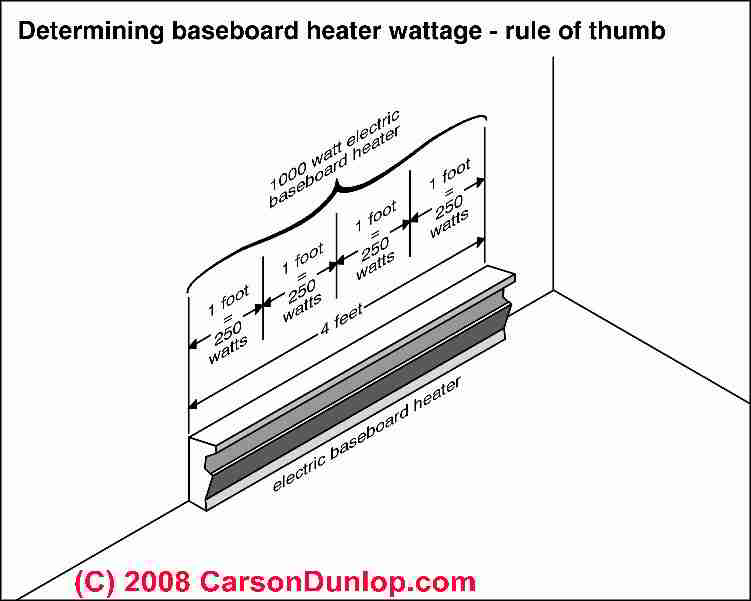
Here are some electric heat rules of thumb that will help you see if the electric baseboard already installed in your building will be sufficient. These guesstimates presume your building is located in a climate where there are real winters, not in southern states.
A larger room or a poorly-insulated building will need more watts of electric heat (and pay higher electrical bills).
[Click to enlarge any image]
- You need about 5-8 watts of electric heat per square foot of the room being heated.
- Each linear foot of a typical electric heat baseboard provides 250 Watts of energy or electric heat output.
As Carson Dunlop Associates' sketch shows, you can figure that your electric baseboard is providing about 250 watts of electric heat per foot of baseboard length.
If you don't know what kind of heat your building uses, we explain how to figure out the answer
at HEATING SYSTEM TYPES.
Below is a table of typical electrical heater wattage requirements or heater size based on room area in square feet.
Electrical Baseboard Watts, Length, Circuit Size Chart1 |
||||
| Room Area | Electric Heat Needed | Baseboard Length | Baseboard Watts | Circuit Size |
| 8 x 8 = 64 sq.ft. | 320 - 512 Watts | 2 ft. | 500 W | 15 A / 120V or 240V |
| 8 x 10 = 80 sq.ft. | 400 - 640 Watts | 2.5 ft. | 640 W | 15 A / 120 V or 240V |
| 10 x 10 = 100 sq.ft. | 500 - 800 Watts | 3 ft. | 800 W | 15 A / 120 V or 240V |
| 10 x 12 = 120 sq.ft. | 600 - 960 Watts | 4 ft. | 1000 W | 15 A / 120 V or 240V |
| 15 x 20 = 300 sq.ft. | 1,500 - 2,400 Watts | 6 - 10 ft. | 2,500 W | 15 A 240V |
| 20 x 24 = 480 sq.ft. | 2,400 - 3,840 Watts | 10 - 16 ft. | 2,500 - 4,000 W | 20 A 240V - 30 A 240V |
| 20 x 30 = 600 sq.ft. | 3,000 - 4,800 Watts | 12 - 20 ft. | 3,000 - 5000 W | 30 A 240V |
| 20 x 30 = 600 sq.ft. | 5,000 - 7,600 Watts | 20 - 30 ft. | 5,000 - 7,600 W | 30 A 240V - 40 A 240V |
1. Watch out: These room sizes and heater sizes are approximate; important additional factors such as the temperature difference between indoors and outdoors, the building air leakage rate, and building insulation will of course affect the amount of heat needed to keep occupants comfortable in cold weather. 2. Watch out: when selecting the electrical circuit size you must consider the total wattage of all of the electric heaters that will be used on the circuit. Do not exceed the total wattage permitted for the wire and circuit breaker size. If you need more heat in an area than a single circuit can provide in watts, run additional circuits to the area to permit dividing the electric heater load among circuits. Separately at ELECTRIC BASEBOARD HEAT INSTALL we give details of electric heat circuit requirements such as wire and circuit breaker size based on electric heater size in total watts. |
||||
Comparison of Features of a Portable Or Installed Electric Fan Heater versus Electric Baseboard Heaters
Electric Baseboard Heat vs. Electric Fan Heaters |
||
| Feature | Electric Baseboard Heat | Electric Fan Heat |
| Heat Use Type | Suitable for primary heat source Permanently installed |
Use steel element heater if primary heat source Also may be permanently installed Open coil elements suitable for supplemental or occasional use |
| Room Heat Speed | 30-40 minutes | Less than 10 minutes |
| Room Temperature Variation | Heat is concentrated at baseboards | Fan circulates room air, heats more evenly |
| Heater Efficiency | ||
| Heater Operating Cost1 | Slower room heating increases operating cost. | Circulating air may speeds room heating and reduces operating cost. |
| Heater Noise | Nearly silent; some thermal expansion noises | Varies by fan type2 & speed, very quiet to audible blower fan noise. |
| Heater Space Needed | Consumes wall space, don't block by anything | Smaller space occupied by heater; don't block by anything |
| Heater Life Expectancy | 20+ years3 | 8-12 Years3 |
Notes to the Table Above Comparing Baseboard Heaters with Electric Fan Heaters
1. Electric baseboard heat is the least expensive to install but is the most-expensive (per BTUh of heat output) for most areas in North America.
Electric heat is 100% efficient in that virtually all of the energy consumed is being delivered as heat.
Electrical circuit voltage (120 vs. 240 VAC) choice will not change the operating cost of the electric heater, but electrical circuit installation costs may be less with a 240 VAC circuit where multiple heaters are required, because more heaters can be installed on the circuit.
For example a 20A 120V electrical circuit can support a baseboard heater with maximum heat output of 1920 Watts while a 20A 240V circuit can support a total electric baseboard heat output of twice that amount, or 3840 Watts.
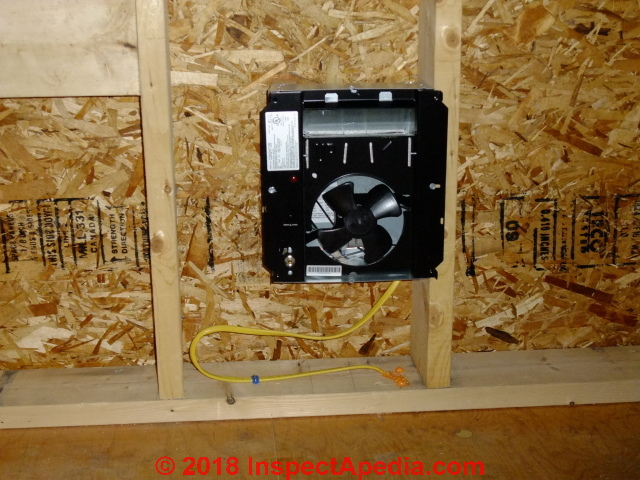
2. For the same CFM output, propeller type heater fans are noisier than squirrel cage type heater fans. Two small fan heaters in a rooom will produce less total noise than a large heater specified to heat the same area.
Above: our photo shows a propeller-type fan heater being installed in the exterior wall of a bathroom in a New York study.
3. Source: Suarez, Paul, "Which is right for your room, a baseboard or wall heater?" Cadet Heat, 2500 West 4th Plain Blvd. Vancouver, WA 98660 USA, Website: cadetheat.com, Email: customerservice@cadetheat.com Tel: 855-223-3878 / International: 1-360-693-2505, retrieved 2018/09/09, original source: http://cadetheat.com/blog/baseboard-or-wall-heater/
Adapted from King Electric, ELECTRIC HEAT WIRING CIRCUIT SIZING CHART [PDF] King Electrical Manufacturing Co., cited in detail below, retrieved 2018/09/10, original source: https://www.king-electric.com/pdfs/helpful-hints-sizing-chart.pdf
At ELECTRIC BASEBOARD HEAT INSTALL we give electric heat circuit requirements based on electric heater size in total watts.
Example of Cord-and-Plug Electric Fan Heater Sizes & Circuits
- a 120V 1440-Watt King electric fan type heater using a cord-and-plug connector will draw 12A and can be connected through a 15A-rated receptacle to a 15-A 120V circuit
- a 120V 1920-Watt King electric fan type heater using a cord-and-plug connector will draw 16A and must be connected through a 20A receptacle onto a 20A electrical circuit
See details at ELECTRIC BASEBOARD HEAT INSTALL
Portions of this article are adapted from KING ELECTRIC CB-SERIES ELECTRIC BASEBOARD HEAT INSTALLATION [PDF] King Electrical Mfg. Co., 9131 10th Avenue South, Seattle, WA 98108 USA Tel: 206.762.0400 Website www.king-electric.com
U.S. Electrical Code Guidance on Electrical Current Load vs Wire Size for Cord-and-Plug-Connected Electric Heaters
NEC 210.21 (B) Receptacles.
(1) Single Receptacle on an Individual Branch Circuit.
A single receptacle installed on an individual branch circuit shall have an ampere rating of not less than that of the branch circuit.
Exception No. 1: A receptacle installed in accordance with 430.81(B)/
Exception No. 2: A receptacle installed exclusively for the use of a cord-and-plug-connected arc welder shall be permitted to have an ampere rating of not less than the minimum branch-circuit conductor ampacity determined by 630.11(A) for arc welders.
NEC 210.21 (B) Receptacles. (continued)
(2) Total Cord-and-Plug-Connected Load.
Where connected to a branch circuit supplying two or more receptacles or outlets, a receptacle shall not supply a total cord-and-plug-connected load in excess of the maximum specified in Table 210.21(B)(2).
That table specifies the following:
Circuit Rating (Amperes) 15 or 20, Receptacle Rating (Amperes) 15, Maximum Load (Amperes) 12
Circuit Rating (Amperes) 20, Receptacle Rating (Amperes) 20, Maximum Load (Amperes) 16
Circuit Rating (Amperes) 30, Receptacle Rating (Amperes) 30, Maximum Load (Amperes) 24
See ELECTRICAL CODES to download copies of various electrical codes and standards.
Also see ELECTRICAL RECEPTACLE HEIGHT & CLEARANCES for a discussion of avoiding fire hazards of electrical receptacles installed above electric baseboard heaters.
Electric Heater Locations in Buildings
This discussion has been promoted! It has its own page now found at ELECTRIC HEATER LOCATIONS.
(Nov 14, 2012) Louis Bernardini said: I need a wiring diagram for a Singer model 7165B electric baseboard unit.
...
Continue reading at ELECTRIC BASEBOARD HEAT INSTALL or select a topic from the closely-related articles below, or see the complete ARTICLE INDEX.
Or see these
Articles on Electric Heat
- ELECTRIC HEAT - home
- COMMON WIRE at THERMOSTATS
- CONVERT LINE to LOW VOLTAGE THERMOSTAT
- ELECTRIC BASEBOARD FEET NEEDED
- ELECTRIC BASEBOARD HEAT INSPECTION
- ELECTRIC BASEBOARD HEAT INSTALL
- ELECTRIC BASEBOARD HEAT SAFETY
- ELECTRIC HEAT DEFECTS LIST
- ELECTRIC HEAT BASEBOARD DIAGNOSE REPAIR
- ELECTRIC HEATER LOCATIONS
- ELECTRIC HEAT TYPES
- ELECTRIC HEATER RECALLS CADET & ENCORE
- NIGHT STORAGE HEATERS & HEAT SINK RADIATORS
- PORTABLE ELECTRIC HEATER FAILURES
- PORTABLE ELECTRIC HEATER SAFETY
- THERMOSTAT WIRING ELECTRIC HEAT
- ELECTRICAL POWER SWITCH FOR HEAT
Suggested citation for this web page
ELECTRIC BASEBOARD FEET NEEDED at InspectApedia.com - online encyclopedia of building & environmental inspection, testing, diagnosis, repair, & problem prevention advice.
Or see this
INDEX to RELATED ARTICLES: ARTICLE INDEX to ELECTRIC HEAT
Or use the SEARCH BOX found below to Ask a Question or Search InspectApedia
Ask a Question or Search InspectApedia
Questions & answers about proper electrical wiring for electric baseboard heat
Try the search box just below, or if you prefer, post a question or comment in the Comments box below and we will respond promptly.
Search the InspectApedia website
Note: appearance of your Comment below may be delayed: if your comment contains an image, photograph, web link, or text that looks to the software as if it might be a web link, your posting will appear after it has been approved by a moderator. Apologies for the delay.
Only one image can be added per comment but you can post as many comments, and therefore images, as you like.
You will not receive a notification when a response to your question has been posted.
Please bookmark this page to make it easy for you to check back for our response.
Our Comment Box is provided by Countable Web Productions countable.ca
Citations & References
In addition to any citations in the article above, a full list is available on request.
- Domestic and Commercial Oil Burners, Charles H. Burkhardt, McGraw Hill Book Company, New York 3rd Ed 1969.
- National Fuel Gas Code (Z223.1) $16.00 and National Fuel Gas Code Handbook (Z223.2) $47.00 American Gas Association (A.G.A.), 1515 Wilson Boulevard, Arlington, VA 22209 also available from National Fire Protection Association, Batterymarch Park, Quincy, MA 02269. Fundamentals of Gas Appliance Venting and Ventilation, 1985, American Gas Association Laboratories, Engineering Services Department. American Gas Association, 1515 Wilson Boulevard, Arlington, VA 22209. Catalog #XHO585. Reprinted 1989.
- The Steam Book, 1984, Training and Education Department, Fluid Handling Division, ITT [probably out of print, possibly available from several home inspection supply companies] Fuel Oil and Oil Heat Magazine, October 1990, offers an update,
- Principles of Steam Heating, $13.25 includes postage. Fuel oil & Oil Heat Magazine, 389 Passaic Ave., Fairfield, NJ 07004.
- The Lost Art of Steam Heating, Dan Holohan, 516-579-3046 FAX
- Principles of Steam Heating, Dan Holohan, technical editor of Fuel Oil and Oil Heat magazine, 389 Passaic Ave., Fairfield, NJ 07004 ($12.+1.25 postage/handling).
- "Residential Steam Heating Systems", Instructional Technologies Institute, Inc., 145 "D" Grassy Plain St., Bethel, CT 06801 800/227-1663 [home inspection training material] 1987
- "Residential Hydronic (circulating hot water) Heating Systems", Instructional Technologies Institute, Inc., 145 "D" Grassy Plain St., Bethel, CT 06801 800/227-1663 [home inspection training material] 1987
- "Warm Air Heating Systems". Instructional Technologies Institute, Inc., 145 "D" Grassy Plain St., Bethel, CT 06801 800/227-1663 [home inspection training material] 1987
- Heating, Ventilating, and Air Conditioning Volume I, Heating Fundamentals,
- Boilers, Boiler Conversions, James E. Brumbaugh, ISBN 0-672-23389-4 (v. 1) Volume II, Oil, Gas, and Coal Burners, Controls, Ducts, Piping, Valves, James E. Brumbaugh, ISBN 0-672-23390-7 (v. 2) Volume III, Radiant Heating, Water Heaters, Ventilation, Air Conditioning, Heat Pumps, Air Cleaners, James E. Brumbaugh, ISBN 0-672-23383-5 (v. 3) or ISBN 0-672-23380-0 (set) Special Sales Director, Macmillan Publishing Co., 866 Third Ave., New York, NY 10022. Macmillan Publishing Co., NY
- Installation Guide for Residential Hydronic Heating Systems
- Installation Guide #200, The Hydronics Institute, 35 Russo Place, Berkeley Heights, NJ 07922
- The ABC's of Retention Head Oil Burners, National Association of Oil Heat Service Managers, TM 115, National Old Timers' Association of the Energy Industry, PO Box 168, Mineola, NY 11501. (Excellent tips on spotting problems on oil-fired heating equipment. Booklet.)
- In addition to citations & references found in this article, see the research citations given at the end of the related articles found at our suggested
CONTINUE READING or RECOMMENDED ARTICLES.
- Carson, Dunlop & Associates Ltd., 120 Carlton Street Suite 407, Toronto ON M5A 4K2. Tel: (416) 964-9415 1-800-268-7070 Email: info@carsondunlop.com. Alan Carson is a past president of ASHI, the American Society of Home Inspectors.
Thanks to Alan Carson and Bob Dunlop, for permission for InspectAPedia to use text excerpts from The HOME REFERENCE BOOK - the Encyclopedia of Homes and to use illustrations from The ILLUSTRATED HOME .
Carson Dunlop Associates provides extensive home inspection education and report writing material. In gratitude we provide links to tsome Carson Dunlop Associates products and services.
 | HOME | ABOUT | ASK a QUESTION | CONTACT | CONTENT USE POLICY | DESCRIPTION | POLICIES | PRIVACY | |
| © 2024 - 1985 Publisher InspectApedia.com - Daniel Friedman | |||||||||