
InspectAPedia® FREE Encyclopedia of Building & Environmental Construction, Diagnosis, Maintenance & Repair |
Question? Just ask us! InspectAPedia
|
 How to Repair Electric Heat, Staged Electric Furnaces, Backup Heat & Other Electric Heater Problems
- POST a QUESTION or COMMENT about electric heating systems: buying, installing, diagnosing & repairing electric heat and electric backup heat systems
Electric heat diagnosis & repair; here we explain how to diagnose & repair electric heat that has stopped working - testing the heating elements in an electric furnace or electric boiler.
We describe how to troubleshoot electric furnaces, boilers, or electric backup heat staged furnaces. We define the operating sequence & test procedures for staged electric furnaces that use sequencers to turn on and off individual heating elements.
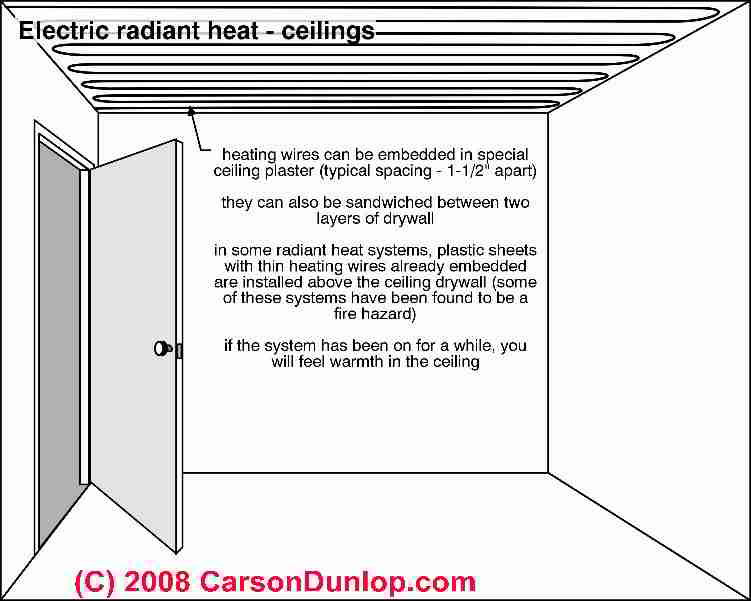
We include simple inspection & test procedures for these & other electric heaters such as electric furnaces, boilers, electric baseboards & wall or floor mounted electric heaters. This article series answers most questions about all types of heating systems and gives important inspection, safety, and repair advice. Sketch at page top courtesy of Carson Dunlop Associates, a Toronto home inspection, education & report writing tool company [ carsondunlop.com ].
InspectAPedia tolerates no conflicts of interest. We have no relationship with advertisers, products, or services discussed at this website.
How to Diagnose & Repair Electric Heat that Has Stopped Working or is Not Hot Enough
Explanation of Staged Electric Furnaces Using Sequencers to Control Heat or backup heat for heat pump systems
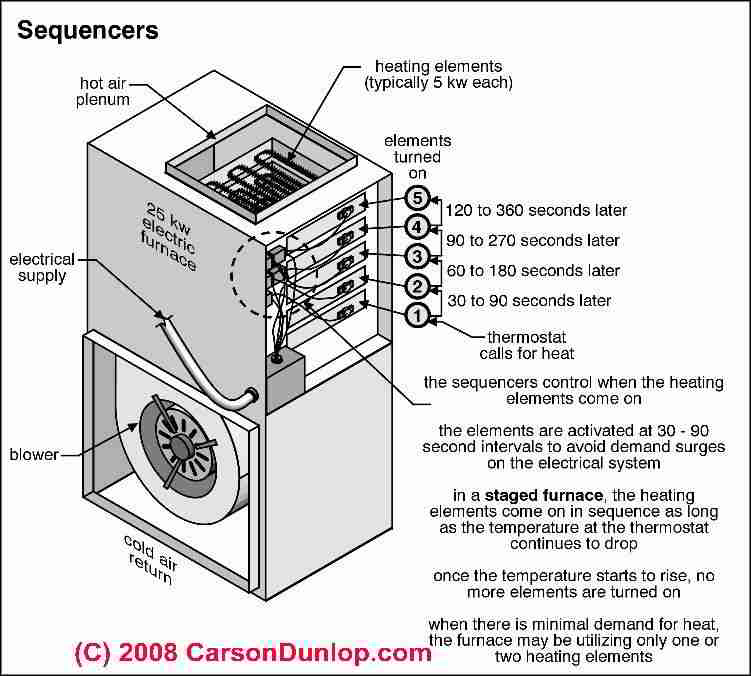
For economy, as Carson Dunlop Associates' sketch shows, electric furnaces often use a gang of electric heating elements that are turned on in stages rather than all at once.
As temperatures fall and more heat is needed in the building, more heating stages turn on.
By leaving individual heating elements (heating stages) turned off when not needed, we reduce electrical consumption and thus we cut the building's heating cost.
On a staged electric heating furnace each heating stage typically provides about 5,000 watts (5KW) of heating energy.
[Click to enlarge any image]
The fan limit switch [Image] that controls an electric furnace may have a built-in delay so that on a call for heat the blower fan won't turn on until the heating element(s) have warmed up.

We discuss fan limit switches in more detail
at FAN LIMIT SWITCH
If you don't know what kind of heat your building uses, we explain how to figure out the answer
at HEATING SYSTEM TYPES.
Test & Diagnose Procedure for Electric Furnace Heating Elements
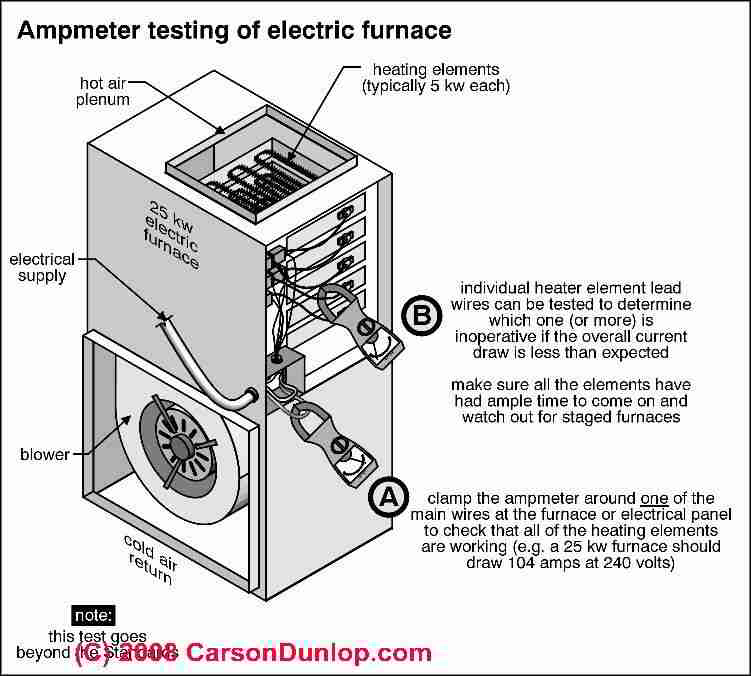
What do we check if our electric heat is not working? There are a few basic things to check yourself. Other steps require an expert. Sketches courtesy of Carson Dunlop.
- Is the thermostat asking for heat? Be sure you know where all of the thermostats for your electric heat are located. Some heaters such as flush-in-floor electric heaters may use a wall-mounted thermostat while other electric baseboard heaters may have individual thermostats on each baseboard unit.
In a bathroom with electric radiant heat in the floor, Carson Dunlop suggests finding that hidden thermostat [PHOTO] perhaps inside the sink vanity. - Is electrical power on to the heater? Check the fuses or circuit breakers that supply each electric heater.
![finding that hidden thermostat [PHOTO]](1152ss.jpg)
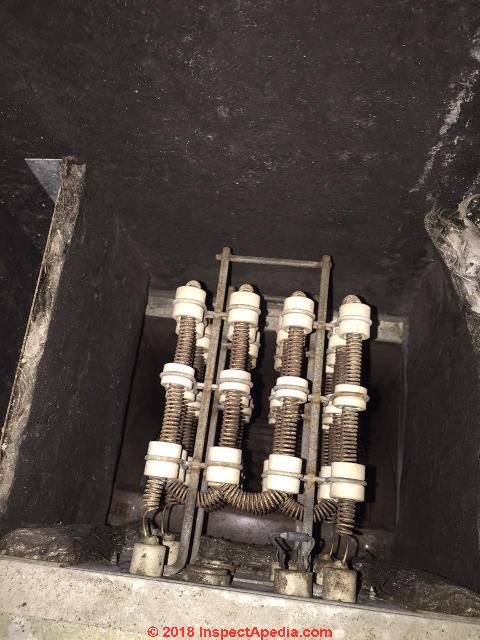
Photo above: the electric heating elements in an electric furnace, courtesy of InspectApedia.com reader Obersee. [Click to enlarge any image]
- If the electric furnace does not seem to be making heat, the electrician or heating technician will use an ammeter to test each of the heating elements to see if one or more of them is not working.
She will also check first to confirm that electrical power is on to the unit. If one or more of the staged electric heaters in the furnace has failed, the furnace may make warm air, but not enough warm air in very cold conditions.
See DMM DIGITAL MULTIMETER HOW TO USE and
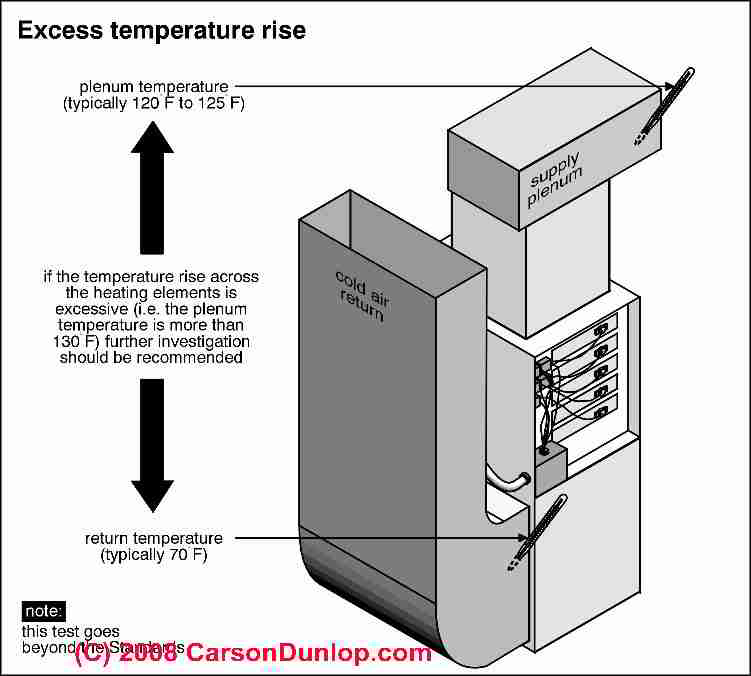
see AMPS MEASUREMENT METHODS. - Check the air temperature rise across the electric furnace.
When the furnace has been operating for 20 minutes or longer, typically the temperature at the return plenum (the lower thermometer in the sketch) will show about 70 °F. and the supply plenum temperature will be between 120 °F. and 125 °F. If the supply plenum temperature is too high (over 130 °F.) something's wrong and you should call a heating service technician. - Check radiant heat ceiling panels for wire interruptions. If someone drove an nail into a radiant panel heat ceiling or in the attic above they damaged a wire or heating panel, you may find that that room no longer has heat.
We use an Exergen™ hand-held infra-red thermometer scanner to quickly check radiant heat floors and ceilings. - Check the electric furnace filter (is it blocked or crushed) condition, location, and check the return air to the furnace to be sure it's nto blocked.
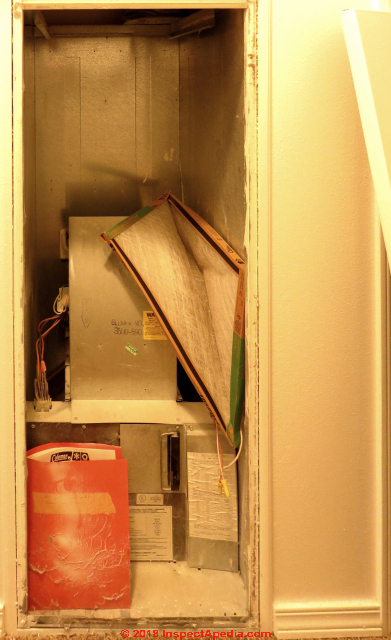
Below: a Coleman Electric Furnace installed in a home in Port Angeles, Washington, USA. The air filter installation was not impressive and could become a fire hazard when the filter is sucked into the blower assembly.
[Click to enlarge any image]
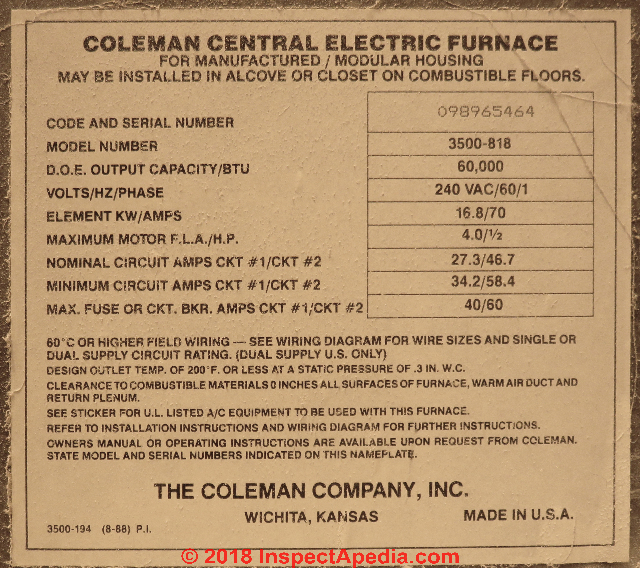
The data tag for this furnace, shown just below, tells us that this heater is designed for manufactured or modular housing and that it can be installed in an alcove or closet and on a combustible floor. Manuals and contact information for Coleman are at COLEMAN HVAC.
Simple Field Test of Electric Wall or Floor Heater Operation
A simple test procedure if an electric floor or wall heater appears not to be working.
Watch Out: : shock and electrocution hazards are present. Do not attempt to work on live electrical equipment unless you are trained and qualified to do so.
Check the electrical connections for the electric heater first, visually looking for signs of overheating. Then with a VOM and power on (if you are qualified and thus won't get electrocuted)
- Check in the fuse or circuit breaker panel to confirm that electrical power is on and supplied to the electric heater.
- Using a voltage tester or a VOM, test the heating element for continuity between its two electrical connection terminals. See tests for electric hot water heaters for details.
- Using a voltage tester or a VOM, test for voltage on the circuit wires entering the heater enclosure. If no voltage is detected, work backwards from the heater through junction boxes to trace and find a problem with the electrical circuit supplying the device.
Reader Comments, Questions & Answers About The Article Above
Below you will find questions and answers previously posted on this page at its page bottom reader comment box.
Reader Q&A - also see RECOMMENDED ARTICLES & FAQs
On 2018-01-02 by (mod) - heat can't reach thermostat setting
Are all of your heaters on and hot?
If so, look for drafts, air leaks, leaky windows or storm windows
On 2018-01-02 by Gloria
I have an electric furnace. It is 30 below outside. Thermostat is set on 72 but only reaches 69.
On 2017-12-22 by Josh
How do u know if a limit is bad on an electric furnace?
On 2017-12-11 by Terry Morris
Need more heat
On 2017-10-26 by Anonymous
Replaced the sequencer and when I turned the breaker on I went to push on the wires and got a shock
On 2016-10-20 by (mod) - second stage electric heat doesn't work
I would test the heating elements themselves.
Watch out: if you are not trained in safe electrical work you could be shocked or killed.
On 2016-10-19 by Chris W
I have a mobile home. Electric heat. Just replaced sequencer but second stsge still doesn't work. What could be the problem?
On 2016-09-12 by Ashvin Senta
I know about electrical Furnace
In this Furnace one Phase B was hot in running condition of Furnace
On 2016-03-05 by (mod) - main breaker on-off switch activates electric heater
Paul:
The MAIN BREAKER? Really?
If so it sounds to me as if you have a very dangerous situation - as normally an overcurrent or electrical problem on an individual circuit should trip off the breaker protecting that individual circuit. If switching off the main breaker in the panel is affecting your electric heat controls I worry that your system is not working properly and that you may have two unsafe conditions:
1. electric heat that is not working and is turning off under a safety or overheat or over-current control in the heater
2. an unsafe circuit breaker or unsafe electrical wiring
Both of these conditions risk a building fire and related losses or safety hazards.
Tell me
- the brand of electric heater
- the brand of electrical panel and circuit breaker
-whether or not there is aluminum electrical wire in your building
It's also possible that you're losing power on half of your electrical panel.
Watch out: these are dangerous conditions risking fire or death from electrical shock.
An electrican will check for panel damage, breaker damage, aluminum wiring, etc.
On 2016-03-04 by Paul
Electric furnace seems to have a dead spot won't start up but when I go to main breaker and switch it off for a while it than turn it back on ,than it starts up again on its own .tried new thermostate ,and tried different hot wiring to trouble shoot but still same thing.
On 2016-01-09 by (mod) - air filter is drawn into the blower fan assembly
Watch out: if an air filter is drawn into the blower fan assembly it can overheat and start a fire.
Check for an improper filter type or size or = less likely - fan motor set to wrong speed (too fast)
On 2016-01-09 by arlene
oil furnace is sucking the filters in and there is the bad odor of the oil and black is getting on the walls in the house.
Question: electric baseboard heat wiring troubles
(Nov 3, 2014) Troy said:
I have purchased a home and it has the Lennox E10 Electric Furnace, the blower fan will not shut off. I am looking for the owners manual, wiring diagrams, anything I can get ahold of telling me about this furnace.
(Dec 17, 2014) tammy said:
in my bedroom i got 110v going to thermostat that runs to a electric baseboard heater. from there it connects to another one. i put it in new 3 year ago and worked good. but now having problem not heating. this is what i got. 110v going to thermostate. when turned on pushes out 110. goes to first heater 110v.
comes out 110v goes to other heater at 110v but then when i connected the second heater the volts drops to 40v. i took the heater and hooked it up straight to 110v power and it works. not sure whats going on. any advice.
Reply:
Tammy it is a bit too dangerous to pretend to diagnose unsafe electrical wiring or unsafe electric heating hook-ups just from a limited e-text and when we don't know a thing about your system, wiring, installatin; thus it's too easy to give you the safe advice: you need an onsite licensed electrician.
Perhaps your wiring hookup is incorrect or at least there sounds as if there is a bad connection or short circuit or burned heating element.
For safety I'd suggest you leave the bad-behaving heaters OFF until an expert has taken a look at your wiring.
Question: outdoor unit runs, no heat comes out
(Feb 18, 2015) Lynn said:
My outdoor unit is running but inside there is no heat coming out. I wondered if it could be the thermostat? I can turn it down and the unit will go off and turn it up and it will come on but no air or heat come from the registers.
Reply:
Lynn if your heating equipment is running outdoors bu tno heat is appearing indoors that sounds like a control board problem or an indoor electric backup heat air handler problem. Your comment suggests that the thermostat works as the system tries to run when your thermostat calls fo rheat.
...
Continue reading at ELECTRIC HEATER RECALLS CADET & ENCORE or select a topic from the closely-related articles below, or see the complete ARTICLE INDEX.
Or see these
Recommended Articles
- ELECTRIC HEAT - home diagnose & repair all types of electric heating systems
- ELECTRIC HEAT CONTROLS
- ELECTRIC HEAT MANUALS
- LINE VOLTAGE THERMOSTATS
- NIGHT STORAGE HEATERS & HEAT SINK RADIATORS
- VOLTS / AMPS MEASUREMENT EQUIP - and DMMs VOMs SAFE USE OF - how to use VOMs and similar test equipment safely
Suggested citation for this web page
ELECTRIC HEAT BASEBOARD DIAGNOSE REPAIR at InspectApedia.com - online encyclopedia of building & environmental inspection, testing, diagnosis, repair, & problem prevention advice.
Or see this
INDEX to RELATED ARTICLES: ARTICLE INDEX to ELECTRIC HEAT
Or use the SEARCH BOX found below to Ask a Question or Search InspectApedia
Ask a Question or Search InspectApedia
Try the search box just below, or if you prefer, post a question or comment in the Comments box below and we will respond promptly.
Search the InspectApedia website
Note: appearance of your Comment below may be delayed: if your comment contains an image, photograph, web link, or text that looks to the software as if it might be a web link, your posting will appear after it has been approved by a moderator. Apologies for the delay.
Only one image can be added per comment but you can post as many comments, and therefore images, as you like.
You will not receive a notification when a response to your question has been posted.
Please bookmark this page to make it easy for you to check back for our response.
Our Comment Box is provided by Countable Web Productions countable.ca
Citations & References
In addition to any citations in the article above, a full list is available on request.
- Domestic and Commercial Oil Burners, Charles H. Burkhardt, McGraw Hill Book Company, New York 3rd Ed 1969.
- National Fuel Gas Code (Z223.1) $16.00 and National Fuel Gas Code Handbook (Z223.2) $47.00 American Gas Association (A.G.A.), 1515 Wilson Boulevard, Arlington, VA 22209 also available from National Fire Protection Association, Batterymarch Park, Quincy, MA 02269. Fundamentals of Gas Appliance Venting and Ventilation, 1985, American Gas Association Laboratories, Engineering Services Department. American Gas Association, 1515 Wilson Boulevard, Arlington, VA 22209. Catalog #XHO585. Reprinted 1989.
- The Steam Book, 1984, Training and Education Department, Fluid Handling Division, ITT [probably out of print, possibly available from several home inspection supply companies] Fuel Oil and Oil Heat Magazine, October 1990, offers an update,
- Principles of Steam Heating, $13.25 includes postage. Fuel oil & Oil Heat Magazine, 389 Passaic Ave., Fairfield, NJ 07004.
- The Lost Art of Steam Heating, Dan Holohan, 516-579-3046 FAX
- Principles of Steam Heating, Dan Holohan, technical editor of Fuel Oil and Oil Heat magazine, 389 Passaic Ave., Fairfield, NJ 07004 ($12.+1.25 postage/handling).
- "Residential Steam Heating Systems", Instructional Technologies Institute, Inc., 145 "D" Grassy Plain St., Bethel, CT 06801 800/227-1663 [home inspection training material] 1987
- "Residential Hydronic (circulating hot water) Heating Systems", Instructional Technologies Institute, Inc., 145 "D" Grassy Plain St., Bethel, CT 06801 800/227-1663 [home inspection training material] 1987
- "Warm Air Heating Systems". Instructional Technologies Institute, Inc., 145 "D" Grassy Plain St., Bethel, CT 06801 800/227-1663 [home inspection training material] 1987
- Heating, Ventilating, and Air Conditioning Volume I, Heating Fundamentals,
- Boilers, Boiler Conversions, James E. Brumbaugh, ISBN 0-672-23389-4 (v. 1) Volume II, Oil, Gas, and Coal Burners, Controls, Ducts, Piping, Valves, James E. Brumbaugh, ISBN 0-672-23390-7 (v. 2) Volume III, Radiant Heating, Water Heaters, Ventilation, Air Conditioning, Heat Pumps, Air Cleaners, James E. Brumbaugh, ISBN 0-672-23383-5 (v. 3) or ISBN 0-672-23380-0 (set) Special Sales Director, Macmillan Publishing Co., 866 Third Ave., New York, NY 10022. Macmillan Publishing Co., NY
- Installation Guide for Residential Hydronic Heating Systems
- Installation Guide #200, The Hydronics Institute, 35 Russo Place, Berkeley Heights, NJ 07922
- The ABC's of Retention Head Oil Burners, National Association of Oil Heat Service Managers, TM 115, National Old Timers' Association of the Energy Industry, PO Box 168, Mineola, NY 11501. (Excellent tips on spotting problems on oil-fired heating equipment. Booklet.)
- In addition to citations & references found in this article, see the research citations given at the end of the related articles found at our suggested
CONTINUE READING or RECOMMENDED ARTICLES.
- Carson, Dunlop & Associates Ltd., 120 Carlton Street Suite 407, Toronto ON M5A 4K2. Tel: (416) 964-9415 1-800-268-7070 Email: info@carsondunlop.com. Alan Carson is a past president of ASHI, the American Society of Home Inspectors.
Thanks to Alan Carson and Bob Dunlop, for permission for InspectAPedia to use text excerpts from The HOME REFERENCE BOOK - the Encyclopedia of Homes and to use illustrations from The ILLUSTRATED HOME .
Carson Dunlop Associates provides extensive home inspection education and report writing material. In gratitude we provide links to tsome Carson Dunlop Associates products and services.
 | HOME | ABOUT | ASK a QUESTION | CONTACT | CONTENT USE POLICY | DESCRIPTION | POLICIES | PRIVACY | |
| © 2024 - 1985 Publisher InspectApedia.com - Daniel Friedman | |||||||||