
InspectAPedia® FREE Encyclopedia of Building & Environmental Construction, Diagnosis, Maintenance & Repair |
Question? Just ask us! InspectAPedia
|
 Dictionary of Heating Boiler Components - Boiler Parts Guide
- POST a QUESTION or COMMENT about components & controls on hydronic (water) heating boiler systems
Dictionary of heating boiler terms:
How to identify & name all of the parts & components of Hot Water Heating Boilers and hot water heating systems including oil burners and their parts, boiler parts, hot water baseboard and its parts, hot water radiators, and hot water convector units and their parts and controls.
InspectAPedia tolerates no conflicts of interest. We have no relationship with advertisers, products, or services discussed at this website.
A List & Dictionary of Oil Fired Heating Boiler Parts & Components
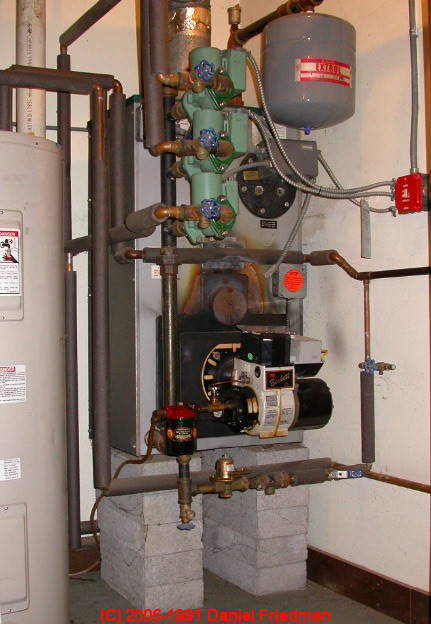
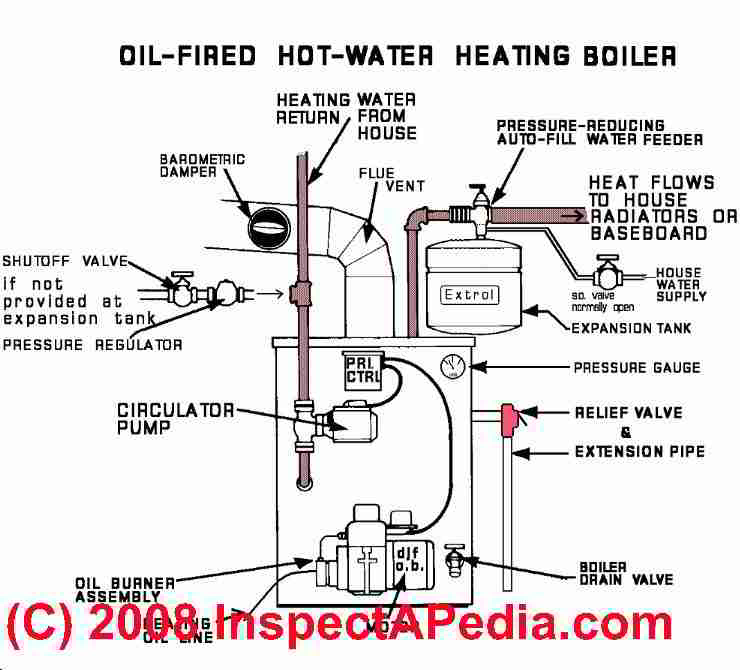 Each simple definition includes links to detailed articles discussing how to identify, inspect, diagnose, and repair each component of the heating system.
This article series answers most questions about central hot water heating system troubleshooting, inspection, diagnosis, and repairs. We describe how to inspect, troubleshoot and repair heating and air conditioning systems to inform home owners, buyers, and home inspectors of common heating system defects.
[Click to enlarge any image]
Below we list and describe the parts and controls on heating boilers.
The articles at this website describe the basic components of a home heating system, how to find the rated heating capacity of an heating system by examining various data tags and components, how to recognize common heating system operating or safety defects, and how to save money on home heating costs.
- HEATING BOILER - Definition: an enclosed steel or cast iron container that uses an energy source to heat water (or make steam) that is sent through heat radiating devices in the occupied space to heat a building.
HYDRONIC HEATING BOILERS use hot water to distribute heat through piping and baseboards or radiators.
STEAM HEATING BOILERS produce steam to distribute heat through one pipe or two pipe steam heat systems and steam heat radiators.
Some heating systems use a hydronic boiler to heat water that is circulated thorough a heating coil inserted in the plenum of a WARM AIR FURNACE heating system, using a water-to-air heating method. - AIR BLEEDER VALVES and AIR PURGE DEVICES vent out un-wanted air from hydronic (hot water) heating systems. Air in heating distribution piping, boilers, radiators, can prevent hot water circulation and thus stop heat from being delivered to the occupied space.
- AIR SCOOPS SEPARATORS PURGERS - automatic air purging devices referred to as air scoops, air purgers, or air separators vary in internal design, but all are intended to capture air in hot water piping, sending it either to an expansion tank or to an air bleeder/air vent.
- AUTOMATIC WATER FEEDER to provide makeup water in the system; note that different water feeder valves are
used on
a HYDRONIC HEATING BOILER (hot water circulates in pipes, radiators, baseboards, convectors) or on a STEAM BOILER (steam circulates in pipes and radiators to deliver heat to the occupied space) - BASEBOARDS - electric or hot water heat radiating devices transmit heat from hot water or steam into the occupied space; Leak stains, repairs indicating history of freeze-ups?
Also see - BOILER FLUE VENT CONNECTOR "stack pipe"
or "flue"
see FLUE VENT CONNECTORS, HEATING EQUIPMENT
and see the draft regulator
or BAROMETRIC DAMPER - used to regulate draft seen by the oil burner - CHIMNEY & CHIMNEY FLUE - the flue vent connector sends gases into the chimney whose job is to vent these combustion products safely outdoors, above the building.
- CIRCULATOR PUMPSforce hot water through heating baseboards, radiators, or convector units
- COMBINATION CONTROL - combining High Limit and "Low Limit" (which may or may not be in use depending on presence of a tankless coil)
Also referred to as an AQUASTAT CONTROLS - DRAFT HOODassures proper exhaust gas venting on gas-fired heating boilers
- ELECTRIC POWER SWITCH turning the heating system electrical power on and off
- EXPANSION TANK to absorb initial system pressure increase
- Flame sensing device:
AQUASTAT - CAD CELL
or STACK RELAY SWITCH (watch for sensitive relays and learn about the re-stepping lever) - HIGH LIIMIT & LOW LIMIT SWITCHES (if tankless coil) separate controls on older equipment
- LOW WATER CUTOFF CONTROL LWCO, a safety device used on steam boilers and some hydronic heating systems to shut down the heating boiler if its water is lost.
- MIXING VALVE To temper outgoing domestic hot water from
a TANKLESS COIL or to control radiant floor heat temperature - OIL BURNER & oil burner parts: oil pump (fuel unit), blower, nozzle, electrodes, transformer, electric motor, air shutter, oil delay valve
- Oil Burner reset switch & oil burner motor reset switch (these are two separate controls); a reset switch may be on
the CAD CELL RELAY or on
the STACK RELAY SWITCH of the oil burner as well as
a RESET SWITCH on the oil burner electric motor - OIL STORAGE TANK and OIL PIPING, and OIL CONTROL VALVES, and oil tank gauges
- OIL BURNER CONTROLS
- Piping on heating systems: Hot water (or steam) distribution piping and on steam systems, condensate return piping
- Piping valves on heating systems: Hot water distribution piping drain and balancing valves
- PRESSURE RELIEF VALVE safety device prevents boiler explosions by releasing temperature and pressure if other safety controls fail
- PRESSURE & TEMPERATURE GAUGE-12 psi cold, less than 30 psi hot. Over 30 psi dumps relief valve.
(Typical operating temperature settings LO-120-160 HI-180-200 °F. Typical operating temperature observed at the gauge will be below the high, and can be as low as nighttime room temperature in non-heating season if no tankless coil is in use.
The temperature/pressure gauge may help in checking for normal conditions before and during boiler operation. However the gauge can be wrong!) - RADIATORS - hot water or steam. Steam: observe steam valves on each radiator and identify one pipe vs two-pipe distribution system. radiating devices transmit heat from hot water or steam into the occupied space; Leak stains, repairs indicating history of freeze-ups? Hot water radiators and baseboards may have a manually-operated air bleeder valve. Each steam radiator has a
STEAM VENT to permit steam to rise into the radiator. - RESET BUTTON, ELECTRIC MOTOR On electric motors used on heating systems may require a manual reset
- RESET SWITCH, CAD CELL RELAY On the cad cell or other primary control - press only once if the system is off on reset and does not keep runnining when you try this step
- SIGHT GLASS: a glass tube used on steam boilers to give a visible indication of the boiler's water level
- FLUE GAS SPILL SWITCH TRIPPING & RESET are used to sense flue gas spillage at gas-fired equipment at the combustion gas exhaust venting systems and will turn off the heating appliance if gas spillage is detected.
- TANKLESS COIL or a side-arm coil or other
ALTERNATIVE HOT WATER SOURCES using the heating boiler; tips about leaks, missing mixing/tempering valve, relief valve (some jurisdictions). Risk of scalding water at the house sinks/tubs if there is no mixing valve. - ZONE VALVES which control hot water circulation through multiple heating zones
Reader Comments, Questions & Answers About The Article Above
Below you will find questions and answers previously posted on this page at its page bottom reader comment box.
Reader Q&A - also see RECOMMENDED ARTICLES & FAQs
On 2018-01-17 - by (mod) -
Joyce
This sounds like a gas fired boiler that is not igniting properly - perhaps you ignited a collected bolus of gas that caused an explosion.
Watch out: DO NOT DO THAT again as someone could be injured or you could start a fire.
It is not usually necessary to replace a whole heating boiler just because a gas regulator, valve, igniter, thermocouple or other control has failed. Those are pretty standard and can usually be replaced.
Call someone else.
On 2018-01-17 by Joyce
My friend's elderly hot water boiler stopped working. Upon inspection we realized the flame had gone out.
When attempting to relight flame it lit but was immediately blown out when the cover blew off and flames shot out for about a foot.
When she called the gas c0mpany out for an inspection she was told that although the boiler appeared to be in good condition without any leaks old parts were expensive and repairs costly so she sould purchase an entirely new sysyem or switch to a forced air furnace.
Her home is more than a hundred years old with plaster walls. When she had central,air installed they put the air handler in the attic with small, circular vents in the ceiling of both floors.
Obviously she doesn't want to deal with the expense or ruined aesthetics of having her plaster walls torn out to have duct work installed for forced air. However, the quotes she got for a new boiler system were astronomical. Is there a way to order a part to repair the system? If not what would you recommend?
On 2017-11-06 by Kevin Kendrick
I need a part for my house steam boiler. 2672074988
On 2017-04-14 - by (mod) -
Dorothy
Your plumber or heating contractor will of course see a lot more than I can from my hideout in Mexico, but I think what's needed is
1. Shut down the boiler and drain off pressure and temperature
2. Turn off the circulator or zone valve for the zone to be removed
3. If there are no manual control valves that will isolate the supply and return lines to the zone to be removed, have the plumber cut and install those valves, then close them along with a zone drain.
That will let you return the boiler to service.
Drain the zone to be cut and disabled.
Then you can remove and later replace the baseboards.
Include air bleeders when the baseboards are restored.
On 2017-04-14 by Dorothy
I have a baseboard oil hot water burner, with no separate hot water heater. I have 4 zones and need to remove the baseboards in one zone then 2 weeks later replace them with new. I need to restart the burner to get hot water for the 2 werks. Can I just leave the loop open, close off the water to that zone and restart the burner? Or do I have to connect the pipes by a temporary straight run of copper and then restart. I dont need the heat only hot water. Thanks for any advice
On 2017-03-22 - by (mod) -
LaNell
Try first disconnecting the thermostat at the heating system furnace or boiler. If the unit turns off then the either the thermostat isn't really OK or perhaps the thermostat wires are shorted together.
More diagnostic details and step by step recommendations can be found by using the search box just above to find, at InspectApedia, this article
HEAT WON'T TURN OFF
On 2017-03-22 by LaNell Mimmack
Our heating system will not turn off automatically. There is nothing wrong with the thermostat.
On 2016-12-20 by shaun
My water heater which comes with an attached vissle is not heating water properly.
On 2016-10-20 - by (mod) -
Jamie, I need clarification. A gas boiler used for central heating would not be a domestic hot water source unless it's using a tankless coil or an indirect fired water heater.
And if you have hot water at some fixtures but not others, the problem is definitely not at your water heater.
On 2016-10-20 by Jamie Windemiller
I have a Burnham Independence gas boiler that seems to work but I do not seem to get even water or any steady hot water to one of my bathrooms...
(Mar 10, 2012) David Harris said:
This is the very article I needed. Not only does it explain what each part does in a hotwater/boiler system it shows pictures as well to identify these componants
(Dec 15, 2012) Shuttering Oil said:
Each simple definition includes links to detailed articles discussing how to identify, inspect, diagnose, and repair each component of the heating system.
Reply:
Thanks so much for the nice note, Mr. Harris. If specific questions arise when you read information at InspecAPedia, we'd be glad to hear them - that feedback helps us see where more research is needed.
InspectAPedia is an independent publisher of building, environmental, and forensic inspection, diagnosis, and repair information provided free to the public - we have no business nor financial connection with any manufacturer or service provider discussed at our website.
Question: how to replace or re-line a boiler combustion chamber
(Nov 4, 2012) Anonymous said:
my utica boiler model# sf-3100wt needs a chamber kit is this something a homeowner can replace? how do I know if it needs a wet or dry chamber kit?
Reply:
Anon,
A wet pack chamber liner kit is usually a replacement alternative to the factory liner that is often in one larger piece.
The wet pack can with care be installed through the oil burner opening - less labor.
The rub for a do it yourself has 2 parts
If you do not install the liner correctlynthe system can be damage, unsafe, even start a fire
Also because the burner is removed for this job youdnneed knowledge and simple tools to bleed air out of the fuel lines on reassembly.
Question: safety switch trips itself
(Jan 12, 2013) c.p. said:
Is there any malfunction that would cause the service safety switch on our oil fired boiler to trip itself?
Reply:
Possibly a wiring error, but generally 98% of the time if a boiler is off on reset there is a flame problem sensed by the cad cell or stack relay.
Question: replacing an old boiler, large pipes
(May 28, 2014) Alex said:
Replacing an old boiler.
This is a open loop system.
Want to turn it to closed system.
Pipes are huge, because the original had no pump.
What could be any difficulty?
Reply:
Alex, for an unseen system I'm nervous about predicting the difficulties involved, but I can offer that I've certainly seen many older hot water heating systems whose large diameter piping, installed to heat by gravity-convection, was left in place successfully when changing to a new boiler with circulator pump(s). The main effect is that there is a greater volume of water in the large-diameter pipe system, more thermal mass.
Question: boiler won't come on
3 Dec 2014 Anonymous said:
why when i turn heating on it wont come on
Reply:
Anon try the simple diagnostic steps at HEAT WON'T TURN ON
Question: pre 1975 did boilers have asbestos around them?
(Jan 21, 2015) rob said:
pre 1975 did boilers have asbestos around them
Reply:
Rob
Certainly some models did.
For photos and examples of asbestos on heating boilers see
ASBESTOS INSULATION ON HEATING BOILERS
Asbestos was also used in some furnaces including in the air path.
...
Continue reading at BOILER CONTROLS & SWITCHES or select a topic from the closely-related articles below, or see the complete ARTICLE INDEX.
Or see these
Recommended Articles
- STEAM HEATING SYSTEMS & CONTROLS
- FURNACE CONTROLS & SWITCHES if your building is heated by warm air
Suggested citation for this web page
BOILER COMPONENTS & PARTS at InspectApedia.com - online encyclopedia of building & environmental inspection, testing, diagnosis, repair, & problem prevention advice.
Or see this
INDEX to RELATED ARTICLES: ARTICLE INDEX to HEATING BOILERS
Or use the SEARCH BOX found below to Ask a Question or Search InspectApedia
Ask a Question or Search InspectApedia
Try the search box just below, or if you prefer, post a question or comment in the Comments box below and we will respond promptly.
Search the InspectApedia website
Note: appearance of your Comment below may be delayed: if your comment contains an image, photograph, web link, or text that looks to the software as if it might be a web link, your posting will appear after it has been approved by a moderator. Apologies for the delay.
Only one image can be added per comment but you can post as many comments, and therefore images, as you like.
You will not receive a notification when a response to your question has been posted.
Please bookmark this page to make it easy for you to check back for our response.
Our Comment Box is provided by Countable Web Productions countable.ca
Citations & References
In addition to any citations in the article above, a full list is available on request.
- Roger Hankey is principal of Hankey and Brown Inspections, Winter Park, CO. Mr. Hankey is a past chairman of the ASHI Standards Committee and served in other ASHI chapter and national leadership roles. Mr. Hankey is a National Radon Proficiency Program certified measurement professional and a Level II infrared thermographer. Contact Roger Hankey at: 970-393-6604 - rogerhankey47@gmail.com . Website: www.HankeyandBrown.com Mr. Hankey is a frequent contributor to InspectAPedia.com.
- In addition to citations & references found in this article, see the research citations given at the end of the related articles found at our suggested
CONTINUE READING or RECOMMENDED ARTICLES. - Our recommended books about building & mechanical systems design, inspection, problem diagnosis, and repair, and about indoor environment and IAQ testing, diagnosis, and cleanup are at the InspectAPedia Bookstore. Also see our Book Reviews - InspectAPedia.
- In addition to citations & references found in this article, see the research citations given at the end of the related articles found at our suggested
CONTINUE READING or RECOMMENDED ARTICLES.
- Carson, Dunlop & Associates Ltd., 120 Carlton Street Suite 407, Toronto ON M5A 4K2. Tel: (416) 964-9415 1-800-268-7070 Email: info@carsondunlop.com. Alan Carson is a past president of ASHI, the American Society of Home Inspectors.
Thanks to Alan Carson and Bob Dunlop, for permission for InspectAPedia to use text excerpts from The HOME REFERENCE BOOK - the Encyclopedia of Homes and to use illustrations from The ILLUSTRATED HOME .
Carson Dunlop Associates provides extensive home inspection education and report writing material. In gratitude we provide links to tsome Carson Dunlop Associates products and services.
 | HOME | ABOUT | ASK a QUESTION | CONTACT | CONTENT USE POLICY | DESCRIPTION | POLICIES | PRIVACY | |
| © 2024 - 1985 Publisher InspectApedia.com - Daniel Friedman | |||||||||