
InspectAPedia® FREE Encyclopedia of Building & Environmental Construction, Diagnosis, Maintenance & Repair |
Question? Just ask us! InspectAPedia
|
 Heating Boiler Troubleshooting
Complete List of Heating Boiler Operating Defects
- POST a QUESTION or COMMENT about diagnosing problems with residential hot water heating systems: the heating boiler
Heating boiler defects & operating problem troubleshooting:
Here we explain how to recognize & diagnose problems with residential heating boilers, including loss of heat, heating boiler noises, leaks, odors, or smoke, and high heating costs.
We identify different types of building heating systems and outline how to diagnose and repair heating system problems.
This article series answers most questions about central hot water heating system troubleshooting, inspection, diagnosis, and repairs.
InspectAPedia tolerates no conflicts of interest. We have no relationship with advertisers, products, or services discussed at this website.
How To Recognize Heating System Defects: the Heating System Inspector Must Know the Equipment
 If you have no heat and need help diagnosing the cause,
see HEATING LOSS DIAGNOSIS-BOILERS - forced hot water heating baseboard, radiators, convectors, radiant heat
or HEATING LOSS DIAGNOSIS-FURNACES - forced warm air heat
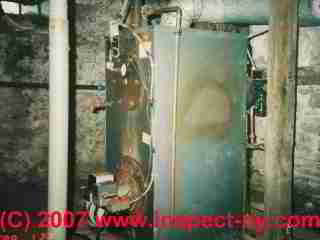
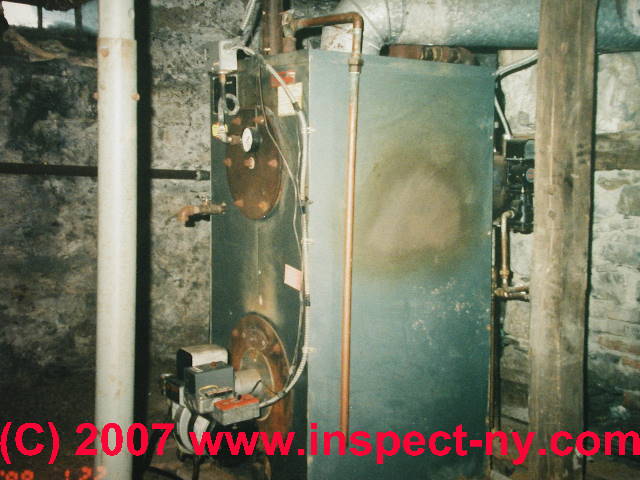
The photograph at page top shows a heating boiler which is burning through it's steel outer jacket - this condition is a potential fire hazard and requires immediate inspection and repair.
There is probably a combustion gas leak at this heater. Contact us to suggest text changes and additions and, if you wish, to receive online listing and credit for that contribution.
If you don't know whether your heat is provided by a furnace (hot air) or boiler (hot water)
Article Series Contents:
- BOILER OPERATING PROBLEMS
- TYPES of BOILER DEFECTS
- AIR-BOUND BASEBOARDS, RADIATORS, PIPING - separate article
- DIAGNOSE LOSS OF HEAT
- DIAGNOSE OIL HEAT NOISES
- EVALUATE HEATING BOILER LEAKS
- COMBUSTION AIR DEFECTS
- COMBUSTION AIR DEFECT EFFECTS
- HEAT WON'T TURN OFF - separate article
- HEAT WON'T TURN ON - separate article
- HEATING MALFUNCTIONS & Implications
- HEATING DEFECTS & Implications
Types of Defects and Problems with Hot Water Heating Boilers - Hydronic Heating Systems, Loss of Heat, Noises, Leaks
What sort of defects should you look for when inspecting a heating system?
- Unsafe conditions on the heating system such as signs of burn-out of the combustion chamber liner, unsafe relief valves, unsafe flue gas venting, fuel leaks, combustion gas leaks. Burn marks on boilers or furnaces, evidence of leaky or stuck pressure relief valves, evidence of tampering with the safety controls, abnormal heater control settings, evidence of chimney, flue, or flue gas venting defects, are all safety concerns.
- Loss of heat - boiler or furnace won't operate, or system operates but heat is not produced in the living area - we provide a guide to diagnosing the reasons for "no heat" beginning
at NO HEAT - BOILER / FURNACE DIAGNOSIS.
If your hot water heating system is running (the steam or hot water boiler is making noise and seems to get hot) but some of your radiators or baseboards are cold,
see RADIATORS
and AIRBOUND HEAT SYSTEM REPAIR by WATER FEED VALVE. - Watch out: Improper Heating System Function: OIL BURNER NOISES, burn marks on the furnace or boiler, unreliability, inadequate heat distribution. Soot production by gas fired heating equipment is an immediate, serious hazard that risks potentially fatal carbon monoxide poisoning.
Turn such equipment off and call for expert advice.
Severe smoking and soot puffback from oil fired heating equipment is also dangerous and requires immediate action. - Improper heating system maintenance, such as failure to adequately clean and inspect the heating flue, furnace, or boiler, unsafe heating safety devices (e.g. relief valves), evidence of sooty, noisy operation, leaks in fuel, air, water. An example of an easy-to-spot clue that an oil fired heating system needs service and cleaning is illustrated
at DRAFT REGULATORS, DAMPERS, BOOSTERS - Improper Heating System Construction/Installation
- Leaks in the hot water heating system -
see BOILER LEAKS CORROSION STAINS
and LEAKS at BASEBOARD, CONVECTOR, RADIATOR. - Loss of heat - no heat - is discussed just below
at DIAGNOSE LOSS OF HEAT With Oil-Fired Hot Water Heating Systems - Missing HEATING SYSTEM COMPONENTS or missing or damaged heater
also
See BOILER SAFETY CONTROLS operating aids - Noises in heating systems are discussed at DIAGNOSE NOISES DURING BOILER OPERATION
- Heat won't turn off:
see HEAT WON'T TURN OFF - Stop Unwanted Heat for an explanation of why heat may continue to come out of radiators or baseboards even though you have turned down the thermostat - Heating system operating pressure or temperature are abnormal -
see BOILER PRESSURE & TEMPERATURE SETTINGS - Heating system reliability - Unreliable heating systems or heating systems at or near the end of their useful life. Home inspectors and qualified heating inspectors should not give a heating system a passing grade just because heat is entering the building.
The heating system needs to be safe, and sufficiently reliable that the owner can reasonably expect to leave the building without a likely loss of heat and related building damage. If a heating system has less than a year of remaining reliable and safe operating life, it is in unacceptable condition. - Heating System Damage: leaks, mechanical damage, combustion chamber damage [Photo]
- Heating System oil burner noise, smoke odors are discussed at OIL BURNER NOISE SMOKE ODORS - Diagnosis & Cure
- Clues of potential other heating system defects:
LEAKS CORROSION STAINS, abnormal temperature or pressure,
or
HIGH HEATING BILLS
How to Diagnose Loss of Heat With Oil-Fired Hot Water Heating Systems
- Does the heating equipment have electric power?
make sure that electrical power is on for all of the heating system components.
Check local switches at the boiler, wall mounted boiler switches at the stairwell down to the basement or utility room or in other areas, and check the circuit breakers or fuses in the electrical panel. - Is there fuel for the boiler
?
check the oil tank gauge; if the boiler or furnace is fired by natural or LP gas check that no one has shut the supply valves.
If a system has been "shut down" and you don't know when or by whom this step was taken, beware of turning the heating system back on without an inspection and safety check by an expert technician. If you're out of oil call your oil company and request an emergency delivery.
Usually the delivery person will also need to enter the building to bleed air from the oil lines in order to get the oil burner operating again. - Does the oil burner start but then shut off?
Is the system "off on reset"? if so the red "reset" button will have popped up on the oil burner control (or possibly on an electric motor operating the oil burner) and the system has an operating problem and needs service.
It may be possible to re-start an oil burner that has turned itself off by pressing the red reset button ONCE. - If the system re-starts and runs acceptably
, you can have heat while waiting for the service technician but the system still needs inspection, service, and possibly other repairs before it can operate safely and reliably.
Watch out: If you push the reset button and the burner does not start and keep running for five minutes or more, DO NOT try again as you may flood the system with oil and make restarting difficult and dangerous. Also
see OIL BURNER INSPECTION & REPAIR - Boilers-Hydronic Heat: Is hot water water circulating?
- Check the hot water circulator: Test to see if the circulator is operating Feeling the hot water distribution piping (Watch out it should be HOT!).
Feeling the piping can indicate if circulator is running or not -- a quick change in temperature means the circulator works; slow change in temperature may occur if the circulator does not work but hot water is circulating by convection. - Check hot water baseboards: if some baseboards are hot and others cold, are they all on the same heating zone?
If not, are all of the thermostats turned up? If some heating baseboards are hot and others cold and we're sure that they're on the same zone, then the system is probably air-blocked.
A heating circulator pump is capable of pushing water around in the loop of heating baseboard but is often not capable of overcoming a section of baseboard that contains a large bubble of air. It's necessary to remove such air blocks. If air blocking has been recurrent a previous owner may have installed air bleeders at strategic points.
The bleeder can be opened slightly and carefully, to permit air to escape.
As soon as water starts coming out of an air bleeder valve it can be closed.
Automatic air purge devices are available and are usually installed right at the heating boiler but sometimes additional ones are needed at higher levels in the building. - Check hot water radiators or convectors: if some radiators or wall convectors are hot and others are cold, and provided that the individual
feed valves located at each of these devices is open (turned counterclockwise) the radiator or convector may be air blocked.
Usually an individual air bleed valve is located on each of these devices. As we suggested above, if your hot water heating system is running (the steam or hot water boiler is making noise and seems to get hot) but some of your radiators or baseboards are cold,
see RADIATORS
and AIRBOUND HEAT SYSTEM REPAIR by WATER FEED VALVE.
How to Diagnose Noises during Heating System & Oil Burner Operation
Complete details about all types of heating system noises, causes, cures, are found
at HEATING SYSTEM NOISE DIAGNOSIS.
Noises specific to an oil burner used at heating boilers or water heaters are discussed
at OIL BURNER NOISE SMOKE ODORS. Excerpts below focus on some of the most common heating system noises.
- Noises during oil burner startup - a "bang"
or uffback which blows soot into the room through the barometric damper or through other equipment openings: the oil pump may not be shutting down properly at the end of an oil burn cycle, leaking incompletely burned oil into the combustion chamber. That oil ignites at startup causing a potentially dangerous puffback. Immediate service and repair are needed.
See OIL BURNER SOOT & PUFFBACKS - Noises during oil burner startup - a "rumbling" sound
(which usually continues all during operation" or a "stumbling" sound in the combustion chamber probably indicates that the system needs inspection and cleaning very soon. Some noise is normal however, but the normal sounds tend to be more smooth and continuous.
See OIL BURNER NOISE SMOKE ODORS - Noises during oil burner shut-down
- a stumbling or rumbling after the oil burner motor has stopped, indicate that oil is continuing to leak into the combustion chamber and risks a dangerous puffback - see "Noises during oil burner startup" above. Immediate service is recommended.
See OIL BURNER NOISE SMOKE ODORS
and see OIL BURNER RUMBLING NOISE - Noises of shrieks or grinding
coming from the electric motor or oil pump on the oil burner or more rarely at a circulator pump mean that prompt service is needed - probably a bearing is failing. - Startup problems: noises and clues of puff back
if you see flapping at the barometric damper or if you see or hear vibrations in the system, prompt service is needed -
see OIL BURNER SOOT & PUFFBACKS. - Noisy hot water heating system piping or circulator pumps: can be caused by air in the piping
See AIRBOUND HEAT SYSTEM REPAIR by WATER FEED VALVE
or by (more rarely) a defect in the circulator pump itself
See CIRCULATOR PUMPS & RELAYS - Noises from radiators or heating baseboards:
- Clanking heating system pipes or sharp snapping noises may be heard as a normal consequence of expansion of metals during the heating cycle.
These noises can often be eliminated or reduced by careful routing of piping and by allowing room around heating pipes for expansion, but probably not eliminated in the case of hot water baseboards.
Also see OIL BURNER CLANKING NOISE - Bubbling or rumbling heating system noises in hot water heating piping can be caused by air in the heating lines. If the amount of air becomes excessive the heating system may be unable to circulate hot water and extra steps to bleed unwanted air will be required.
See OIL BURNER RUMBLING NOISE
See AIRBOUND HEAT SYSTEM REPAIR by WATER FEED VALVE
See OIL BURNER GURGLING - Hissing heating system sounds such as air escaping from
radiators or the piping where air bleeder valves are installed are normal but should be brief and uncommon.
If you constantly hear air hissing from radiator bleed valves double check that you understand what kind of heat you have - hissing from bleeder valves on steam heat radiators as heat is coming up in the building is normal.
See RADIATORS.
- Clanking heating system pipes or sharp snapping noises may be heard as a normal consequence of expansion of metals during the heating cycle.
- Also see OIL BURNER INSPECTION & REPAIR
Evaluate Heating Boiler Leaks & Corrosion
When observing evidence of leaks on a heating boiler, keep these points in mind:
- Even serious leaks may never show up as "wet" spots:
A boiler may be leaking but you may see no actual water: during the heating season the boiler may always be hot, causing small leaks on the boiler or on heating piping to simply evaporate.
But such leaks will usually be visually very evident: look for a build-up of corrosion, green or white or other colored mineral salts, or look for rust or water stains on the equipment. - Internal heating boiler leaks:
Some critical boiler leaks may be internal and not visible by simple inspection, such as a leak inside the boiler heat exchanger which may pass water into the combustion chamber.
A service technician or a skilled home inspector should be able to spot evidence of these leaks. - Surface rust, light, superficial rusting,
is generally repairable. Clean the area and fix the leak when the boiler is next serviced and monitor for any future leaks. - Exfoliation, or thick flaking rust
on any boiler but particularly on a steel heating boiler is very serious, possibly not repairable, and risks loss of the boiler as well as sudden loss of heat in the building. - Leaks related to temperature or pressure:
Some leaks occur only at peak operating temperature - e.g. at relief valve.
On some heating boilers such as some cast-iron units, leaks may occur between boiler sections when the system is cold - on these models some technicians prefer to keep a little heat in the boiler year-round to avoid this problem. Leaks between boiler sections may be repairable but if left unattended can destroy the equipment.
See RELIEF VALVE LEAKS
See BOILER LEAKS CORROSION STAINS
and LEAKS at BASEBOARD, CONVECTOR, RADIATOR for details.
A Catalog of Common Heating System Leak Points - Where to Watch for Heating System Leaks
- Tankless Coil mounting plate - see rust stains below and around plate
- Leaky Pipe fittings at face of coil plate - mineral salts
- Leaky tankless coil internally in the boiler won't show up as water on the floor but rather as continual creep up of boiler water pressure to abnormally high levels (or as flooding in a steam boiler)
- Leaks around bolt openings - suspect hidden damage at the tankless coil or other bolt locations
- Leaks between sections of a cast iron boiler
- Leaks at the circulating pump mounting flanges - usually repairable - the gasket is very inexpensive but the labor is not.
- Leaks at the boiler temperature/pressure relief valve. This leak may be very dangerous as corrosion from water passing through the valve may prevent its safe operation in an emergency. Prompt expert inspection and repair are needed.
Watch for leaks below the valve's mouth or discharge pipe (a pipe should extend from the relief valve to a few inches from the floor) or watch for corrosion at the tip of the discharge pipe. Gently feel inside the tip of this pipe to see if it's wet.
Watch out: DO NOT TRY TO TEST or open or operate the relief valve itself. Not only might you get scalded - burned - but there is a risk that the valve may open but not close again - in which case you'll have to shut the heating system down. - Leaks at air bleeder valves - at the boiler or remote where such bleeders are placed on heating piping or baseboards or radiators
- Leaks at radiator control valves or worse, rust-through perforation or seam leaks at radiators or convector heaters
- Leaks at poorly-soldered copper pipe fittings on finned copper baseboard heating systems
- Leaks due to frozen and burst piping or in extreme cases, frozen and burst heating boilers themselves
- Condensate return pipe leaks at steam boiler systems
How to Recognize & Diagnose Inadequate Combustion Air, Sooting, or Burn Marks at Oil-Fired Heating Systems
Lack of adequate combustion aircan be indicated by or can result in these heating system operating and heating system safety worries:
See COMBUSTION AIR REQUIREMENTS
- Improper oil burner system operation such as noises, rumbling, etc. discussed above.
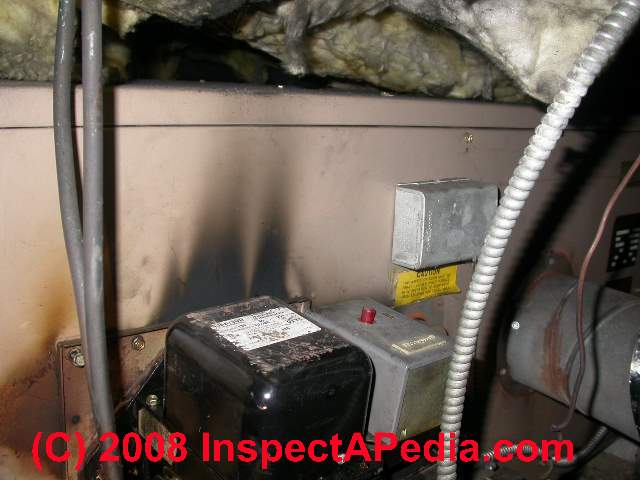
See BOILER NOISE SMOKE ODORS for the conditions listed here. - Oil burner sooting or dirty operation (the photo above ) may be due to improper adjustment of the oil burner or draft, a blocked chimney, or other problems. Also
see DRAFT INDUCER FANS as their use may indicate a chimney, draft, or venting problem.
- Burn marks on the boiler
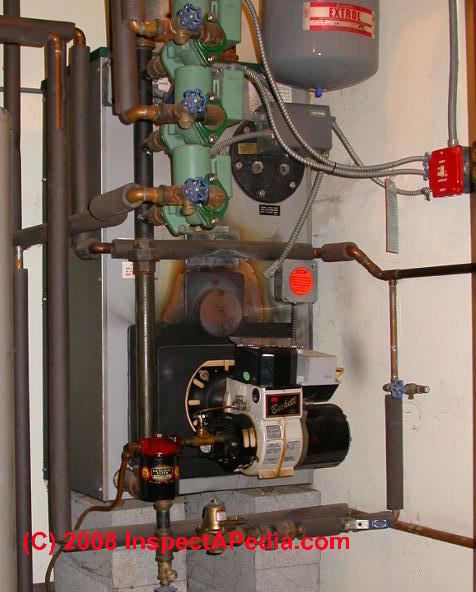
(photo above), furnace, or water heater, (these conditions may be caused by a blocked exhaust flue and inadequate venting).
Safety Warning: burn marks on a heating boiler or furnace (shown in our page top photo) can also be due to collapse or damage to the combustion chamber liner - a serious fire hazard needing immediate attention.
Notice that in our photo at right, the brown burn marks around the oil boiler combustion chamber inspection port (that rusty round door above the oil burner) have been cleaned-off.
The presence of these burn marks does not necessarily mean that the oil burner backpressure problem remains - in this case the system has been cleaned and adjusted, but no one has re-painted the front of the boiler. But if you see fresh peeling paint or soot in such an area further investigation is needed.
That's why we recommend that after repairing a back-pressure problem at heating equipment the service technician should clean the boiler or furnace exterior - to remove confusing debris and to make it easier to see if the problem recurs. - Not enough combustion air
Heating equipment located in a small utility room with no provision for combustion air intake.
When the service technician adjusts the system she probably worked with the utility room door open, but when the service tech left the job he may have closed the door - completely changing the availability of combustion air for the equipment. We need about one square inch of un-louvered (unobstructed) combustion air intake per 1000 btuh of the oil fired heating boiler, furnace, or water heater.
See COMBUSTION AIR REQUIREMENTS and
also COMBUSTION AIR for TIGHT BUILDINGS - Increased heating system operating cost, -
see HEATING COST SAVINGS METHODS - Damage to oil burner components (backpressure heat can destroy an ignition transformer),
- Loss of building heat - the heating system stops working,
see HEATING LOSS DIAGNOSIS-BOILERS
and HEATING LOSS DIAGNOSIS-FURNACES - Noises at the heating system when the boiler, furnace, or water heater starts, is operating, or is shutting down.
See DIAGNOISE HEATING BOILER / BURNER NOISES - Smoke indoors,coming out of the heating equipment or its draft regulator.
See BOILER NOISE SMOKE ODORS for the conditions listed here. - Carbon monoxide or combustion gas and flue gas leaks: potentially, the production of carbon monoxide or other flue or combustion gases which escape into the building - potentially dangerous.
See CARBON MONOXIDE - CO
and CARBON MONOXIDE WARNINGS: HOME HEATERS as well
as CHIMNEY INSPECTION DIAGNOSIS REPAIR.
Also see UNSAFE DUCT OPENINGS which describes the risks of reduced combustion air on hot air heating systems when certain return air duct defects are present,
and also see CARBON MONOXIDE - CO
and CHIMNEY INSPECTION DIAGNOSIS REPAIR
A Guide to Heating Equipment Malfunctions & Their Implications
- Noises & soot buildup
can lead to a potentially dangerous puffback which can damage the heating equipment and blow soot and smoke throughout the building. - Leaks on hot water heating systems are never acceptable, anywhere.
- Leaking pressure/temperature relief valves need immediate attention and repair (Leaking relief valve could be due to water-logged expansion tank, improper control settings (temperature too high), improper automatic water feeder operation (pressure too high), or defective valve (leaky). True, you only have to report the valve.
- Did you miss problems at the other components?)
- Corroded relief valves also need to be test by a service technician and repaired or replaced as they may be unsafe and may fail to open when necessary
- Relief Valves
Do not touch the heating boiler or water heater temperature or pressure relief valve - it may open and fail to shut down. A relief valve which does not work is dangerous since the system is missing an important safety device. Should an over pressure or over temperature condition develop for other reasons, the boiler could explode. - Corrosion on heating system parts
Watch out: Do not pick at corrosion as you may start a catastrophic, un-stoppable leak requiring total system shut-down. Leaks left un repaired can destroy heating equipment. - Tankless coils for making hot water:
- If there is different water pressure/flow observed in the kitchen in which the hot water pressure is significantly less than cold, even before examining the building's mechanical systems you may speculate that a tankless coil installed may be installed.
- What other clues suggest that the local water supply may be hard in minerals and that there may be a risk of clogged piping?
- When the water supply is high in minerals, the hot water pipes or tankless coils clog up before cold water piping. Is a water softener installed? Is there known "hard" water--have mineral deposits clogged the coil?
- Are there "cleanout" plumbing fittings on the tankless coil piping? Does this suggest a history of clogging and acid-flush treatments?
- A clogged tankless coil can be repaired or replaced.
- How severe was that rust you observed at the tankless coil mounting plate? Severe rust may mean that the boiler must be replaced.
Examples of Heating System Defects with Important Implications
- Lack of adequate combustion air
can result in improper system operation, sooting, loss of heat, noises, smoke, and potentially, the production of carbon monoxide or other flue or combustion gases which escape into the building - potentially dangerous
Particularly with gas fired equipment, inadequate combustion air can cause dangerous, even fatal carbon monoxide leaks in the building. - Leaky oil at an oil burner ignition transformer
watch for back pressure in combustion chamber--watch out for blocked heating flue or blocked chimney
- these would be unsafe, or the heater may be unreliable. An unreliable heater can lead to frozen burst pipes and costly building damage. A blocked chimney could lead to a potentially fatal carbon monoxide hazard. - Leaks in hot water or steam
(condensate piping) heating systems risk- Loss of heat, frozen pipes, related damage
- Water damage to the building including rot or costly mold contamination
- Unusual interior moisture conditions,
noises, smoke, or odors during heating season--watch for blocked chimney or poor flue vent connections - Equipment recalls & Specific Heating System Hazards
Specific heating system problem brands Repco, Blueray etc.
[Do not confuse Repco™ heating boilers, which had fire chamber and other failures, with other products (REPCO pumps, REPCO controls, REPCO water conditioners, or water treatment that carry the Repco name.
Those products are distinct from REPCO heating boilers and are produced/distributed by the R.E. Prescott Company. Further, we are unaware of any remaining warranty or replacement support for failed or antiquated Repco heating boilers.] - BLUE vs YELLOW COMBUSTION FLAMES - the Blueray history and blue flame vs. yellow flame combustion, flame color & combustion efficiency, & how oil competes with gas as a heating fuel.
- BLUERAY Heating Boilers/Furnaces Safety Recall by the US CPSC, with additional history, photos, and technical details; Blue Flame Blue Ray
- CARBON MONOXIDE Gas Toxicity, exposure limits, building inspection for CO hazards - greater risk with gas-fired boilers
- DUST, HVAC CONTAMINATION STUDY An Investigation of Indoor Dust Debris Blamed on a Heating/Cooling System Reveals Carpet Dust
- GOODMAN FURNACE High Temperature Plastic Vent HTPV safety recall US CPSC notice
- CHECK for CO - Home Heating System Should Be Checked [for proper venting and for CO Carbon Monoxide Hazards - DJF]
- OIL FIRED HEATING SYSTEM INSPECTION STEPS Detailed step by step approaches for inspecting complex systems]
- LENNOX PULSE FURNACE Safety Inspection/Warranty Program: Carbon Monoxide Warning
- OIL TANKS & OIL TANK LEAKS - The Oil Storage Tank Information Website: Buried or Above Ground Oil Tank Inspection, Testing, Cleanup, Abandonment of Oil Tanks
- HOME INSPECTION REPORT LANGUAGE : Gas Fuel Piping or Tank Faults Basic advice - home inspection report language suggestions
- HOME INSPECTION REPORT LANGUAGE : Buried Oil Tanks, Basic home buyer advice - home inspection report language suggestions
- HOME INSPECTION REPORT LANGUAGE : Defects in Oil Tank Installations, Tanks, and Heating Oil Piping
- PLASTIC HEATING VENT PIPE & Other Heating Safety Recall Notices
- WEIL McLAIN Model GV Gas Boiler/gas valve CPSC recall/repair
Reader Comments, Questions & Answers About The Article Above
Below you will find questions and answers previously posted on this page at its page bottom reader comment box.
Reader Q&A - also see RECOMMENDED ARTICLES & FAQs
Question: Boiler failure - cause & cure, replacement done without a permit: what do I do now?
Hello I have a question regarding a recent replacement boiler installation in my sons house just across the Delaware river in PA.
Being a person that is big on my insistence on getting quality installation both with the code compliance and overall professional workmanship of an install, there are a few concerns I have on this one that perhaps you can give me your opinion on.
1) Boiler failed: - cracked heat exchanger
The fact that the boiler failed due to crack in the heat exchanger in the middle of January it had to be replaced immediately.
The the plumber was one that I used a few times which I was happy with the results. The install required a few modification in the electrical, gas piping and to the exhaust piping to the unit (SlantFin Victory II cast iron HE boiler).
2) Boiler replacement work done without proper plumbing permits:
However after inquiring about the permits for the job the plumber initially response was him asking my son will be living in the house for the next 10-20 years. To me, that sounded like he was looking to get around the permitting procurement which he was successful since he filed no permits. Your opinion and suggestion to remedy. Anonymous by private email 2022/09/07
Moderator reply:
A new boiler failed from heat exchanger crack? Unusual; I'd want to understand why that failure occurred and exactly where the crack was found, and whether the heat exchanger was covered by warranty.
E.g. improper venting, or adjustment can cause overheating?
If work was done without permits, and provided that your local authorities (we don't know your country and city) require a pemit for a boiler replacement, and you want that base covered, I think you'll find - as I usually do - that if you call the building department and ask for an inspection and are willing to pay any now-late permit fees, the building inspector will be so thrilled that you want to do what's right that s/he is likely to be helpful and cooperative - keep me posted.
...
Continue reading at DIAGNOSE & FIX HEATING PROBLEMS-BOILER or select a topic from the closely-related articles below, or see the complete ARTICLE INDEX.
Or see BOILER OPERATING PROBLEM FAQs questions & answers about our list of boiler operating problems that help troubleshoot hot water or steam heat
Or see these
Recommended Articles
- AIR-BOUND HEATING SYSTEMS
- BOILER INSPECTION GUIDE
- BOILER NOISE SMOKE ODORS
- BOILER OPERATING PROBLEMS
- BOILER OPERATING STEPS
- CIRCULATOR PUMPS & RELAYS
- GAS BURNER FLAME & NOISE DEFECTS
- GAS BURNER SOOT CAUSE & CURE
- GAS BURNER PILOT LIGHT PROCEDURE
- GAS FIRED HEATING BOILER PROBLEMS
- HEAT WON'T TURN OFF
- HEAT WON'T TURN ON
- NO HEAT - BOILER
- NOISE, HEATING SYSTEMS
- OIL BURNER INSPECTION & REPAIR
- PRESSURE & TEMPERATURE SETTINGS, CONTROLS
- RADIATORS
- RELIEF VALVES, BOILERS
- RESET SWITCH, CAD CELL RELAY
- STACK RELAY SWITCH
- THERMOSTATS, HEATING / COOLING
- WATER FEEDER VALVE, HYDRONIC BOILER
- ZONE VALVES, HEATING
Suggested citation for this web page
BOILER OPERATING PROBLEMS at InspectApedia.com - online encyclopedia of building & environmental inspection, testing, diagnosis, repair, & problem prevention advice.
Or see this
INDEX to RELATED ARTICLES: ARTICLE INDEX to HEATING BOILERS
Or use the SEARCH BOX found below to Ask a Question or Search InspectApedia
Ask a Question or Search InspectApedia
Questions & answers or comments about diagnosing problems with residential hot water heating systems: the heating boiler
Try the search box just below, or if you prefer, post a question or comment in the Comments box below and we will respond promptly.
Search the InspectApedia website
Note: appearance of your Comment below may be delayed: if your comment contains an image, photograph, web link, or text that looks to the software as if it might be a web link, your posting will appear after it has been approved by a moderator. Apologies for the delay.
Only one image can be added per comment but you can post as many comments, and therefore images, as you like.
You will not receive a notification when a response to your question has been posted.
Please bookmark this page to make it easy for you to check back for our response.
Our Comment Box is provided by Countable Web Productions countable.ca
Citations & References
In addition to any citations in the article above, a full list is available on request.
- R.E. Prescott Company, a producer of other REPCO™ residential and industrial products as well as a provider of design-build engineering services is at 10 Railroad Avenue, Exeter, NH 03833. Tel: 603-722-04321 or 888-786-7482. Trish O'Keefe from Prescott informed us (10/7/2009) that their company had nothing to do with the failed Repco heating boilers discussed at InspectAPedia.com.
- Our recommended books about building & mechanical systems design, inspection, problem diagnosis, and repair, and about indoor environment and IAQ testing, diagnosis, and cleanup are at the InspectAPedia Bookstore. Also see our Book Reviews - InspectAPedia.
- Principles of Steam Heating, $13.25 includes postage. Fuel oil & Oil Heat Magazine, 389 Passaic Ave., Fairfield, NJ 07004.
- The Lost Art of Steam Heating, Dan Holohan, 516-579-3046 FAX
- Principles of Steam Heating, Dan Holohan, technical editor of Fuel Oil and Oil Heat magazine, 389 Passaic Ave., Fairfield, NJ 07004 ($12.+1.25 postage/handling).
- "Residential Steam Heating Systems", Instructional Technologies Institute, Inc., 145 "D" Grassy Plain St., Bethel, CT 06801 800/227-1663 [home inspection training material] 1987
- "Residential Hydronic (circulating hot water) Heating Systems", Instructional Technologies Institute, Inc., 145 "D" Grassy Plain St., Bethel, CT 06801 800/227-1663 [home inspection training material] 1987
- "Warm Air Heating Systems". Instructional Technologies Institute, Inc., 145 "D" Grassy Plain St., Bethel, CT 06801 800/227-1663 [home inspection training material] 1987
- Heating, Ventilating, and Air Conditioning Volume I, Heating Fundamentals,
- Boilers, Boiler Conversions, James E. Brumbaugh, ISBN 0-672-23389-4 (v. 1) Volume II, Oil, Gas, and Coal Burners, Controls, Ducts, Piping, Valves, James E. Brumbaugh, ISBN 0-672-23390-7 (v. 2) Volume III, Radiant Heating, Water Heaters, Ventilation, Air Conditioning, Heat Pumps, Air Cleaners, James E. Brumbaugh, ISBN 0-672-23383-5 (v. 3) or ISBN 0-672-23380-0 (set) Special Sales Director, Macmillan Publishing Co., 866 Third Ave., New York, NY 10022. Macmillan Publishing Co., NY
- Installation Guide for Residential Hydronic Heating Systems
- Installation Guide #200, The Hydronics Institute, 35 Russo Place, Berkeley Heights, NJ 07922
- The ABC's of Retention Head Oil Burners, National Association of Oil Heat Service Managers, TM 115, National Old Timers' Association of the Energy Industry, PO Box 168, Mineola, NY 11501. (Excellent tips on spotting problems on oil-fired heating equipment. Booklet.)
- In addition to citations & references found in this article, see the research citations given at the end of the related articles found at our suggested
CONTINUE READING or RECOMMENDED ARTICLES.
- Carson, Dunlop & Associates Ltd., 120 Carlton Street Suite 407, Toronto ON M5A 4K2. Tel: (416) 964-9415 1-800-268-7070 Email: info@carsondunlop.com. Alan Carson is a past president of ASHI, the American Society of Home Inspectors.
Thanks to Alan Carson and Bob Dunlop, for permission for InspectAPedia to use text excerpts from The HOME REFERENCE BOOK - the Encyclopedia of Homes and to use illustrations from The ILLUSTRATED HOME .
Carson Dunlop Associates provides extensive home inspection education and report writing material. In gratitude we provide links to tsome Carson Dunlop Associates products and services.
 | HOME | ABOUT | ASK a QUESTION | CONTACT | CONTENT USE POLICY | DESCRIPTION | POLICIES | PRIVACY | |
| © 2024 - 1985 Publisher InspectApedia.com - Daniel Friedman | |||||||||