
InspectAPedia® FREE Encyclopedia of Building & Environmental Construction, Diagnosis, Maintenance & Repair |
Question? Just ask us! InspectAPedia
|
 Heating Boiler Operation Details
39 Steps sequence in the operation of hydronic heating systems
- POST a QUESTION or COMMENT about how a heating boiler or hydronic heating system works and about the sequence of steps in its operation
How does a heating boiler work - what are the steps in its operating sequence?
This article describes how a hot water heating system (hydronic heat) actually works, step by step, to heat a building.
An understanding of the sequence of steps in the operation of a heating system, from the moment that a thermostat calls for heat until the moment that the thermostat stops calling for heat, can help us diagnose and fix many heating system problems.
InspectAPedia tolerates no conflicts of interest. We have no relationship with advertisers, products, or services discussed at this website.
How Heating Boilers Work & are Diagnosed: Heating Boiler Inspection by Sequence of Operation
 Training in proper operation sequence of heating system equipment and in the function of its controls is a step towards technical correctness. If you do not understand how a mechanical system works, you cannot
reliably expect to observe missing or defective components.
Training in proper operation sequence of heating system equipment and in the function of its controls is a step towards technical correctness. If you do not understand how a mechanical system works, you cannot
reliably expect to observe missing or defective components.
This discussion is an exercise using sequence of operation to work for completeness. It is not technically exhaustive, it focuses on a specific example: oil-fired hot water, zoned, heating system.
Examine the accessible parts of the heating system. Let your eye travel from component to component in the sequence of operation.
Apply the inspection logic discussed
at HEATING INSPECTION CONCEPTS
at each step. Consider the implications should any component be missing, damaged, inoperative, leaky, noisy, sooty, repaired by an amateur, etc.
Think through the operating sequence as you examine each component in that order. The following are the steps in one common set-up. This list is lengthy and detailed. The actual visual examination may take only a few minutes.
How a Heating System Works - 39 Steps in the Operation of a Heating System
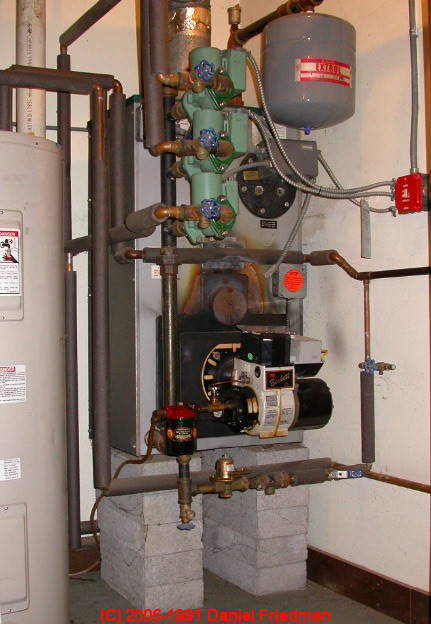
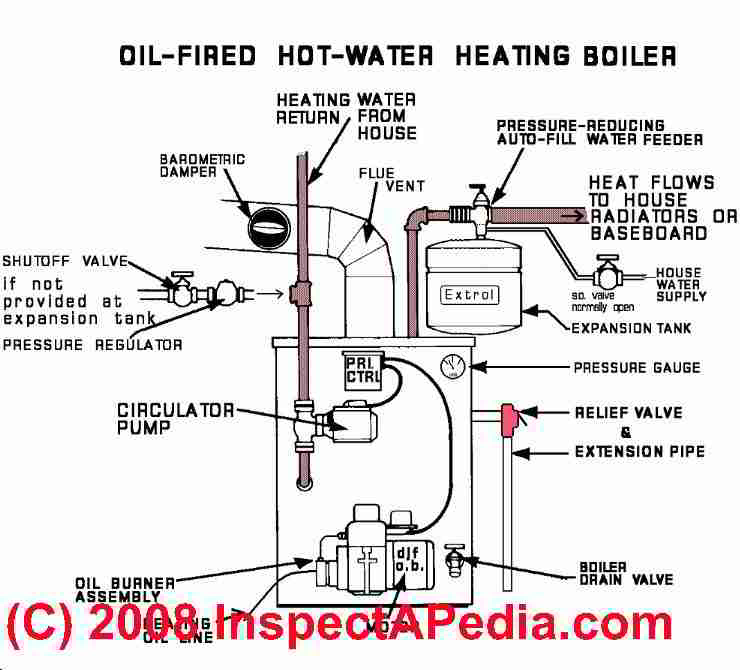
What follows is a detailed, step by step description of how a heating boiler works. We name each heating system component and what it does, in the order that heating system components operate during the heating cycle.
Items shown in [brackets] are ones which may not be present on some heating systems. We include links to technical articles that explain the operation of various heating system components and parts.
The following steps in a heating boiler operating sequence are discussed as part of a complete heating system inspection procedure for hydronic or hot water heat beginning
at HEATING BOILER INSPECTION GUIDE.
For steam heating systems, details are
Similar information is provided for warm air heating systems
- Room temperature drops, a condition sensed by one or more thermostats installed to control building temperature.
See HEAT LOSS in BUILDINGS for more details. - Room thermostat senses the temperature drop and switches on - the thermostat is basically an "on-off" switch that calls for heat.
See THERMOSTATS - If Zone valves are installed, each is controlled by an individual thermostat; the zone valve opens
or If no zone valves are installed, each thermostat controls and turns-on one (or more) hot water circulators.
In response to the thermostat (or zone valve end switch,) the hot water circulator starts,
except in Canada where circulators may be set up to run continuously and where the thermostat directly turns on the boiler itself.
Note: the heating water circulator is usually located on cooler return-side of the distribution piping loop where the returning heating water re-enters the boiler.
This is a cooler location that gives the circulator and its motor a longer life.
See ZONE VALVES, HEATING - Boiler temperature and pressure are indicated on the Temperature/Pressure gauge and should show an increase in the boiler water, not to exceed normal operating limits (200 deg F or less and less than 30 psi)
See Gauges on Heating Equipment - Hot heating water leaves boiler, heading towards the heat-radiating devices in the occupied building space, passing by the ...
- Air scoop, air separator, air purger (not always present; this component removes air in the hot water heat piping to stop hot water heating system noise and to avoid air-bound heating baseboards or radiators)
See AIR SCOOPS SEPARATORS PURGERS - Air vent or purge valve (mounted on top of the air scoop, a brass fitting with a Schrader valve which permits any air in the boiler or piping in this area to escape.
This component is not always present; these are often leaky or sealed off). Air purge valves, manual or automatic, may also be located at other spots on piping, baseboards, or hot water radiators themselves.
See AIR BLEEDER VALVES - Automatic water feeder (normally the manual valve for water supply to boiler is "on", the automatic valve is closed unless the boiler pressure drops below 12-15 psi. This valve is often also a backflow preventer.)
This device might add water to the boiler as needed.
See WATER FEEDER VALVES, HYDRONIC BOILER - Expansion tank (if waterlogged, this tank will cause hot water dumping at the relief valve). This device absorbs the initial pressure increase in the system - preventing unnecessary spillage at the pressure-relief valve.
If don't see an expansion tank check: is there an old expansion tank in the attic?
If so, the boiler system may have no relief valve and may rely on this attic tank and an overflow pipe which itself may flow outside or to a building drain.
Modern systems, which have a smaller expansion tank right at the boiler, will also include a relief valve on (best) or close to the heating boiler itself and won't rely on a remote attic expansion tank.
See EXPANSION TANKS - Zone valve (not always used, shorter life if installed on the "hot" supply side of the heating water loop piping)
See ZONE VALVES, HEATING - Hot water from the boiler enters the heating distribution piping (watch for mineral salts indicating small clogged leaks) where it continues towards the occupied space in the building.
- Hot water then passes through heating baseboards or radiators or wall convectors - which warm the room air by air convection and by heat radiation, and thus the...
See RADIATORS
and AIR BLEEDER VALVES - Room thermostat senses the heat increase as hot water from the boiler passes through and radiates heat from heating devices nearby.
When the room temperature reaches the thermostat setting the thermostat will STOP calling for heat.
See THERMOSTATS - Hot water continues passing through more distribution piping as it returns to heating boiler, flowing past
- A Zone service drain (drain valves installed on each heating zone piping, usually at or close to the boiler) and also past any flow balancing valves - if present - usually installed right at the zone drains to continue through the
- Circulator pump (if it's not a convection system or "gravity hot water heating system" used on older houses) and then the
See CIRCULATOR PUMPS & RELAYS - The cooler hot water finally passes back into the boiler itself, having given up much of its heat to the occupied space in the building.
- Temperature in the boiler drops as cooler water returns and lowers temperature therein.
- Temperature sensor inserted into the boiler water and connected to the heating boiler aquastat or primary control switch feels the temp drop and tells the ...
- Primary control or high-limit control that the temperature is falling inside the boiler, but nothing happens (in the U.S.) until ...
- Temperature drops about 15 deg F below the HI setting on the heating boiler Primary Control (such as a Honeywell R8182D boiler control). Then the
- Primary control turns on the oil burner (watch for drip/leak damage onto the control from above as that will damage this costly component)
(Canadian systems: thermostat may activate burner directly.)
See AQUASTAT CONTROL FUNCTIONS or
See STACK RELAY SWITCH
OR
for LP or natural gas systems the gas valve opens and the pilot or intermittent ignitiion ignites the gas burner
See GAS REGULATORS & APPLIANCE / HEATER CONTROLS
See GAS BURNER & GAS VALVE CONTROLS - The oil fired Oil Burner pumps oil from the tank through ... (did we see the oill tank? is there an oil filter, preferably just ahead of the oil burner?)
See OIL BURNER INSPECTION & REPAIR or
OR
the gas gas valve on gas-fueled boilers opens to feed LP gas or natural gas to the burner
See GAS REGULATORS & APPLIANCE / HEATER CONTROLS
and GAS BURNER & GAS VALVE CONTROLS
- The copper (oil or LP gas) or black iron pipe (natural gas) fuel line continues to send fuel towards the burner.
(Some oil burners use a 2-line piping system returns excess oil back to the tank.)
See OIL TANK PIPING & PIPING DEFECTS or
OR
See GAS PIPING, VALVES, CONTROLS depending on type of heating system fuel used.
Fuel continues from the supply towards the burner - Fuel flow is controlled by a safety device: If the fuel is heating oil the oil continues past one or more Fire-o-Matic safety valves (for oil fuel) (this valve contains fusible link to shut off fuel in case of a fire) through the oil pump unit,
and through an oil filter canister,
OR
if the fuel is LP gas or natural gas fuel is metered through the gas regulator,
See GAS REGULATORS & APPLIANCE / HEATER CONTROLS
sending ... - Fuel to the burner
If the fuel is heating oil, oil is sent at high pressure (100 to 120 psi) heating oil to burner nozzle for spray atomization into fire chamber (are the combustion chamber and chamber liner ok?)
If the fuel is LP or natural gas fuel flows into the gas burner assembly - Fuel is ignited
If the fuel is heating oil the oil burner Ignition Transformer (on oil burner systems) makes high voltage which is sent as a spark to ignite oil
(tar ooze at transformer means the unit is failing, maybe from backpressure and overheating) (or on gas fired equipment, the pilot light (or electrical igniter) permits a gas valve to open and a gas burner ignites)
OR
For LP or Natural Gas systems the gas valve has opened and either the gas fuel is ingnited by the standing pilot light or it is ignited by a spark generated by an igniter mechanism.
see GAS BURNER FLAME & NOISE DEFECTS
and ... - Combustion air flows in to the burner
Oil burner's air intake blowerunit sends combustion air into the fire chamber...
OR
the gas burner air intake or power burner blower feeds air to the gas flame.
(Is there adequate combustion air? how about when the boiler room door is closed?) - Heating fuel begins to burn:
Oil (or LP or natural gas) begins to burn (watch out for rough noisy or smoky start or stumbling noisy poor shut-down of the burner, smoke, soot, odor, noise mean improper system operation)
Safety controls such as a cad cell on oil burners or a thermocouople flame sensor on gas burners assure successful combustion and will shut down the system if the burner is not operating properly.
See CAD CELL RELAY SWITCH or
See STACK RELAY SWITCH for oil burners
OR
See GAS BURNER & GAS VALVE CONTROLS and
See THERMOCOUPLE REPAIR / REPLACEMENT - Hot combustion gases from burning heating fuel (oil for oil burners or LP or natural gas for gas burners) pass through tubes (in steel boilers) or between sections (in cast iron boilers), heating that metal,
thus sending heat back into the heating water through the heat exchanger. (Soot acts as insulation, slows heat transfer, increases temperatures in the flue, and increases heating costs -- was the boiler cleaned recently?) - Hot combustion gases are collected at top of boiler and sent out through exhaust flue (metal pipe connecting the boiler to the chimney) ...
- Combustion gas exhaust draft is regulated
Where the barometric damper (on oil burners - a draft regulator located on the flue pipe usually just above or close to the boiler) OR (on gas burners a draft hood located on the gas flue vent connector just above the boiler)
See DRAFT REGULATORS - barometric dampers) - for oil fired heating equipment
or a draft hood on gas-fired heating equipment
See FLUE GAS SPILL SWITCH TRIPPING & RESET assures proper and even draft; hot gases continue ... - Combustion gases are vented up the chimney where combustion gases are vented safely outdoors
OR for direct-vent or sidewall-vented heating equipment
Combustion gases are vented outside through a building side-wall
See CHIMNEY INSPECTION DIAGNOSIS REPAIR - Boiler temperature rises up to the "HI" limit as the burner continues to operate.
(Thinking of the HIGH limit, this is a good time to take a look for a pressure relief valve and look for defects there: leaking, corroded, not piped to floor, reduced diameter piping.)
See RELIEF VALVE, TP VALVE, BOILER - A boiler water temperature sensor mounted inside the boiler water monitors temperature there and informs
Primary Control when the "HI" limit is reached, causing the control to turn off the burner (is there a noisy, rough, stumbling sloppy burner shut down? If so, service is needed).
(Circulator is continuing to run all during the time that the wall thermostat calls for heat)
See AQUASTAT CONTROL FUNCTIONS or
See LIMIT CONTROL, SINGLE - The room temperature reaches the room thermostat set temperature - according to the thermostat so the ...
- Thermostat senses the temperature rise and opens its switch thus stopping or turning off the call for heat.
(Special thermostat sophistication and functions such as heat anticipators and short cycle detectors are excluded here)
See THERMOSTATS - Circulator pump stops (except in parts of Canada or other areas where for comfort and temperature evenness, circulators are left running continuously).
See CIRCULATOR PUMPS & RELAYS - The burner is turned off
The Oil Burner (or gas burner) will either stop, or even if the call for heat continues, the burner will turn OFF if HI limit is reached inside the boiler.
See AQUASTAT CONTROL FUNCTIONS
See also OIL BURNERS
and OIL BURNER NOISE SMOKE ODORS.
If a LOW WATER CUTOFF CONTROL is installed, the boiler will be shut down if water drops to an unsafe level.
Compare Operation of Heating Boilers in Canada and the U.S.
Continuous vs. Intermittent Hot Water Circulation
On a typical oil fired heating boiler in the U.S., the wall thermostat is controlling the hot water circulator, turning it on or off. It is the temperature of the water circulating through the system (sensed at the primary control on the heating boiler) that actually turns the oil burner on or off to reheat the water.
That's why the wall thermostat is not an "accelerator" and that's why, if the thermostat has been set to 60 °F., and the room temperature is at 60 °F., and we want to warm up to 68 deg.F., we just need to set the wall thermostat up to 68 deg.F.
Setting the thermostat higher than that will not warm the room faster.
On a typical oil fired heating boiler in Canada, where temperatures are cooler for more of the year, the circulator pump may be wired to run continuously all during the heating season, whenever power is turned on at the boiler. On these systems, the wall thermostat turns the oil burner on or off directly in response to room temperature.
This design tends to produce more even temperatures in the home, and it has an advantage which should be considered by anyone who owns an older home where drafts or poor insulation mean that there is a high risk of freezing heating pipes (freezing can occur in a heating distribution pipe, baseboard, or radiator when heat temperatures are set low and some corner or elbow or location of piping is exposed to very low temperatures).
If heating pipes freeze, the result is loss of heat even if the boiler and circulator try to turn on, which in turn means there is risk of burst piping, water damage, mold contamination, or other costly problems. By forcing the water in the heating system to circulate continuously, the risk of this freeze-up is greatly reduced.
Additional reading on home heating systems:
This heating boiler operation article series answers most questions about central heating system troubleshooting, inspection, diagnosis, and repairs.
We describe how to inspect, troubleshoot and repair heating and air conditioning systems to inform home owners, buyers, and home inspectors of common heating system defects.
The articles at this website also describe the components of a home heating system, how to find the rated heating capacity of an heating system by examining various data tags and components, how to recognize common heating system operating or safety defects, and how to save money on home heating costs.
We include product safety recall and other heating system hazards.
The limitations of visual inspection of heating systems are described. We continue to add to and update this text as new details are provided.
Contact us to suggest text changes and additions and, if you wish, to receive online listing and credit for that contribution.
Reader Comments, Questions & Answers About The Article Above
Below you will find questions and answers previously posted on this page at its page bottom reader comment box.
Reader Q&A - also see RECOMMENDED ARTICLES & FAQs
On 2022-09-16 by InspectApedia-911 (mod) - Weil Mclain WTGO-4 tankless oil boiler settings
@David,
Remember that a short oil burner firing cycle can be a very inefficient way to use your heating equipment.
That's because on a typical oil fired heating system it can take as much as 5 minutes for it to reach normal operating temperature.
If you're frequently running it in short on-cycles the oil burner efficiency drops and heating cost increases. That's the reason people downfire the nozzle size.
On 2022-09-16 by David
@InspectApedia , thanks again for replying. If the digital thermostat i used is accurate, then that would mean my stack temperature was around 442 F when considering the room temperature at the time of measurement
I could also downsize the nozzle firing rate but i’d rather not have to play with the air band on the Carlin EZ1 burner & just use what the last tech i ever paid for had set.
The unit was installed back in 1999 so i‘m just keeping it clean & running as best i can with the tools & DIY skills i’ve learned.
On 2022-09-15 by InspectApedia (mod)
@David,
Those numbers sound reasonable although the stack temperature might be slightly high. I'm not familiar with the specific brand soot removing flare that you used- I used bushes and a vacuum.
On 2022-09-15 by David
@InspectApedia-911, thanks for your inquiry. I finished running tests & here are my stats. Using the Bacharach Draft-Rite, i measured the draft over the fire at about -0.02 WC & the draft in the breech at about -0.04 WC. I measured the stack temperature at 520 F with room temperature at 78 F since the boiler was running over 10 minutes (2 zones circulating) by the time i took the reading.
Note that the heat exchanger was already cleaned using a soot saber before i replaced the combustion chamber.
Please let me know your thoughts & suggestions as time allows. Thanks muchly for your time.
On 2022-09-14 by InspectApedia-911 (mod)
@David,
What are the draft over the fire and in the breech?
What is the stacked temperature after 5 minutes or longer?
On 2022-09-14 by David
 @InspectApedia, thanks for your thoughts. I wanted to give an update for future search users. My DHW (Domestic Hot Water) cycle only (off-season; not winter) seems to have stabilized & it is now taking on average 2 minutes to heat the boiler from 160 (LO) to 180 (HI) (New gauge installed too).
I believe the new combustion chamber has now “cured”. Hope this helps future DIY’ers who are mechanically inclined & well researched & don’t want to spend excessive fees for ‘Pro’ jobs that can be done (at their own risk of course).
On 2022-09-12 by InspectApedia (mod)
@David,
It's possible that you're running the burner too hot which in turn can damage the heater. While I appreciate do it yourselfers and have been one myself, it's the unfortunate truth that it's pretty much impossible to correctly set and tune an oil burner without instruments.
On 2022-09-12 by David
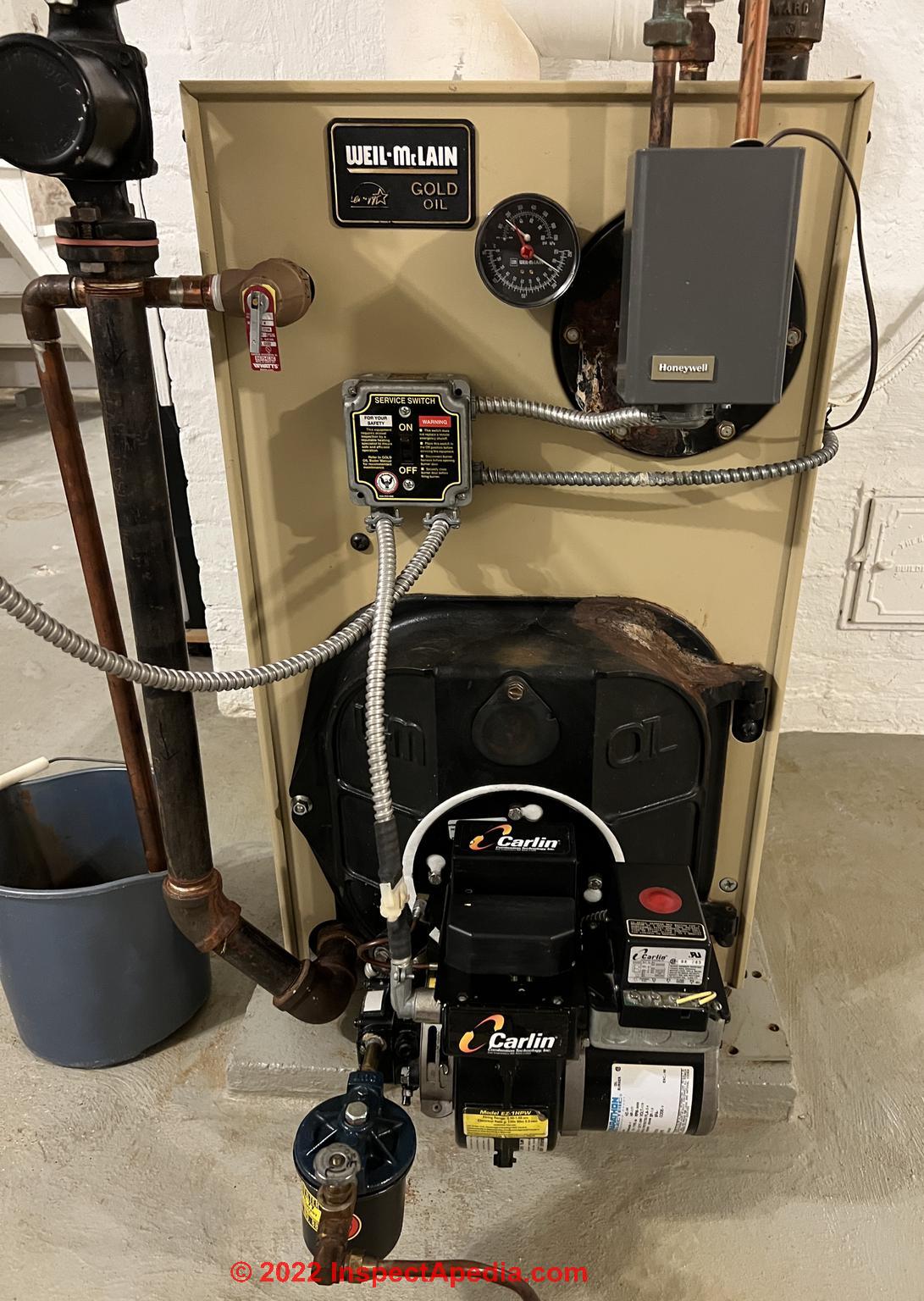
Hi, love this site as a DIY'er. I have a question that i have yet to find asked & answered directly, so here it is along with background info. I have a Weil Mclain WTGO-4 tankless oil boiler in which i recently replaced the combustion chamber lining & nozzle.
Through the peer hole the flame looks good, no flame-end sparks, no smoke & i can see the new chamber glowing hot during & after the cycle. With the new chamber, i noticed that my cycle for the domestic hot water only (DHW; tankless coil in the boiler) is fairly quick now, less than a minute, until it reaches set HI temp & cycles off.
Is this okay & efficient? I am assuming the new chamber is contributing to this quick DHW heating cycle but just want to make sure. Thanks for your feedback!
Question for search engines: How long should a oil boiler's domestic hot water (tankless heater) cycle be?
On 2022-02-16 by Inspectapedia Com Moderator (mod) - hot water heating systems are cold
@Mark,
Typically in Canada, hot water heating systems are set up so that the circulator pump(s) run continuously, 24/7 throughout the heating season. In that set-up, when the thermostat calls for heat, all it does is turn on the burner to reheat the boiler.
The fact that all 3 of your zones are cold argues against a bad zone valve or bad individual circulator pump.
Once your heating service tech has assured herself that there are not obvious embarrassments like a loose electrical connection at the primary control, circulator(s), or oil or gas burner, then she'll probably look for a burner that's turning off on re-set and being re-set by cycling its power.
The tech might also check that the boiler water temperature sensor that communicates to the aquastat is properly mounted and has good thermal contact at the boiler.
A more thorough step by step series of diagnoses is given at
NO HEAT - BOILER
If that's the case your system may simply need cleaning and adjustment of the oil or gas burner.
On 2022-02-16 by Mark
I recently bought a large older home with a hot water base board (slant fin / 3 zone) system. Twice we have a had a problem where we wake up in the morning (both times it was very cold outside) and the house was cold. The gauge showed the temp at 100 degrees, PSI about 7.
Both times I turned the breakers on the unit off (none were blown) and on and the system immediately began heating the water and warming the 3 zones. Do you have any idea what the problem might be and a solution? Thanks very much for any help you can provide. This is in Canada by the way
On 2021-12-02 by Inspectapedia Com Moderator
@April,
No, it's also common for the control to turn off the burner when the thermostat is satisfied.
On 2021-12-02 by April
@Inspectapedia Com Moderator,
That is very good to know, thank you! It never does it in succession, just randomly about 3-4 times scattered throughout day (that I notice). I was under the impression that reaching the HI-LIMIT was the only means of ending the cycle, so the whole thing seems odd to me. Boiler works flawlessly, otherwise.
On 2021-12-02 by Inspectapedia Com Moderator - boiler will shut off mid-cycle when the call for heat ends
@April,
As long as your boiler isn't short-cycling on and off repeatedly during the heating cycle,
then a short on-cycle at the last "ON" cycle before the thermostat is satisfied isn't likely to be a problem. The system is hot and we don't expect to accumulate unburned heating oil in the combustion chamber.
But in other conditions, repeated short ON cycles that don't run the burner long enough to get the combustion chamber up to full operating temperature can lead to trouble. By that I mean that there are many short 5-10 second ON cycles in succession.
If the total "on" time for an oil burner is quite brief in any cycle AND if the combustion chamber isn't quite hot from prior burner operation, there's concern that we leave some un-burned or incompletely-burned oil in the combustion chamber. In extreme cases that can accumulate as soot by causing rough starts at the next burner on cycle. If that happens too much we could have an oil burner puffback.
On 2021-12-01 by April
Hello! During the heating season, my boiler will shut off mid-cycle when the call for heat ends (for example, only running 5-10 seconds). This started when we replaced our aquastat with a different model. Is this going to be problematic in the long run?
Is it a setting that can be adjusted? The previous aquastat would allow it to complete its cycle and reach the HI limit (180), even if there's no longer a call for heat.
On 2021-11-27 by Inspectapedia Com Moderator - circulator stays off unless the red lever is pushed
@TJ,
The aquastat may be wired and set to run the burner and keep the boiler hot for a tankless coil on the boiler.
On 2021-11-27 by TJ
@Inspectapedia Com Moderator, Thank you for replying. I reside in the U.S. (North East to be specific) and I still didn't understand why the thermostat would normally cycle the oil burner on and off, but the circulator stays off unless the red lever is pushed beyond 74 degrees Fahrenheit.
Why would the circulator stay off even though the oil burner seems to cycle during a call for heat? I noticed this has occurred with variations in the ambient room temperature which was why I became concerned since oil was being burned without the then heated water being transferred into the radiators.
On 2021-11-26 by Inspectapedia Com Moderator
@TJ,
That's very strange in my view as well.
If you think about it, a room thermostat is not something that works like an accelerator, producing more heat when set to higher temperatures.
Rather it is simply an on-off switch that calls for heat or turns on when the room temperature is below the set temperature on the thermostat
We don't know the country in which you were living and so your heating system may be wired differently.
Although wiring can be different in farther northern countries like Canada, in the US most hydronic heating systems are wired such fit the thermostat turns on the circulator and the aquastat control on the heating boiler turns the burner on when the temperature in the boiler drops.
So you might need to look at the settings on your aquastat to be sure that they are correct.
In the article index on this page you will find an article explaining how to set the aquastat correctly.
On 2021-11-26 by TJ
Hello. I have a hydronic oil fired system with a mechanical thermostat and a circulator. I would have liked to know why the oil burner cycles on and off, but once the red lever is pushed beyond 74 degrees Fahrenheit, both the burner and circulator start.
Otherwise, the burner cycles on and off according to the ambient temperature, but the circulator NEVER starts to deliver the hot water to the radiators. What would cause this problem? Why is 74 degrees the only point where both the circulator and oil burner run simultaneously?
On 2021-02-18 by danjoefriedman (mod)
Mary
I don't understand the question.
A standard oil-fired heating boiler or furnace uses a barometric damper that operates by air movement
discussed at
DAMPERS & DRAFT REGULATOR TYPES
for a complete list that includes draft regulation on wood, coal, oil, and combination wood-oil fueled boiler and furnaces.
Some, but certainly not al,l gas or oil fired heating equipment makes use of power-vents or draft inducer fans.
for example see
DRAFT REGULATOR, DAMPER, BOOSTER
On 2021-02-18 by Mary K
Is there a fan or motor in the damper that leads to the chimney?
On 2020-12-16 - by (mod) -
Rod
presuming that we're talking about a hot water or hydronic heating system, normally the same physical volume of water stays in the boiler and the loop of piping through radiators or baseboards.
That water is heated and circulates through the radiating devices. You don't normally have to add cold water to the system. If your system is frequently adding cold water then it's probably got a leak somewhere that needs to be found and fixed
On 2020-12-15 by Rod
Hello, thank you for info. Does the incoming cold water from the well supply stay on or is this closed once the system is filled with water? I was not sure if the same water would recirculate. Thanks
On 2020-11-22 - by (mod) -
Not exactly, Barbara.
For example two or more heating zones or "loops" of piping might merge somewhere before the boiler and then send a single line from that point back to the boiler.
On 2020-11-21 by barbara
we have a four zone oil boiler. do the return pipes need to match up.with the feed (hot) zone pipes?
On 2020-10-31 - by (mod) -
Great question, Joseph, thank you.
Causes of hot water coming out of cold water faucet:
I see this phenomenon of hot water coming out of the cold water tap initially quite often when the cold water piping in part of it's routing it was close to a heat source. For example at our lab and office on the second floor of a building the water pipes to a small bathroom originate in the boiler room. With no water has been run for a time sheet from the boiler has warmed both hot and cold water pipes and the water contents. Once we have run the water for a minute or less we have flushed out the hot water and the water is again cold as normal.
On 2020-10-31 by Joseph Phillips
I get extremely hot water out of the cold water tap for several minutes, is this normal ?
On 2019-12-18 - by (mod) -
I would look for an air blockage in the heat distribution lines, and I would look at insulating the distribution pipes where they are not running through areas where you want heat to be released such as in a crawlspace and basement.
On 2019-12-18 by David
Oil fired range running constantly, only a pipe stat fitted to regulate the heat. The radiators get warm 35 to 40 degrees but no hotter "pipe stat set to 60 degrees,any ideas on how to get the radiators hotter? The circulation pump is on the return side, i have noticed on previous systems that location of the pump can make a significant difference to the heat from the radiators, im wondering if moving the pump to the feed side of the system would make a difference
On 2019-01-31 - by (mod) -
See the NO HEAT diagnosis and repair steps starting at NO HEAT - BOILER https://inspectapedia.com/heat/Heating-Boiler-Diagnosis.php
On 2019-01-31 by J
I have oil heat and hot water have oil in tank
Have hot water
No heat
...
Continue reading at BOILER CONTROLS & SWITCHES or select a topic from the closely-related articles below, or see the complete ARTICLE INDEX.
Or see BOILER OPERATING STEPS FAQs - questions and answers about the operating steps in hydronic or hot water heating systems & boilers, posted originally at this page.
Or see these
Recommended Articles
- BOILERS, HEATING - home
- BOILER OPERATING PROBLEMS
- DIAGNOSE & FIX HEATING PROBLEMS-BOILER
- HEATING SYSTEM INSPECTION - home - free online course in how to inspect heating systems
- HEATING INSPECTION CONCEPTS - home
- HEATING INSPECTION PROCEDURE-GENERAL
- HEATING SYSTEM INSPECTION DETAILS
- INDOOR INSPECTION of HEATING SYSTEM
- HEATING BOILER INSPECTION GUIDE
- HEATING FURNACE INSPECTION GUIDE
- FINAL BOILER/FURNACE ROOM INSPECTION CHECKS
- GAS BURNER FLAME & NOISE DEFECTS
- GAS BURNER SOOT CAUSE & CURE
- GAS BURNER PILOT LIGHT PROCEDURE
- OIL BURNER INSPECTION & REPAIR
- HEATING SYSTEM SAFETY INSPECTION
- SAFETY RECALLS CHIMNEYS VENTS HEATERS
- NO HEAT - BOILER
- OIL BURNER WONT RUN
- GAS BURNER FLAME & NOISE DEFECTS
- GAS BURNER SOOT CAUSE & CURE
- GAS BURNER PILOT LIGHT PROCEDURE
- HEAT WON'T TURN ON or if needed, HEAT WON'T TURN OFF
- RADIATORS - cold radiator or baseboard diagnosis and repair
Suggested citation for this web page
BOILER OPERATING STEPS at InspectApedia.com - online encyclopedia of building & environmental inspection, testing, diagnosis, repair, & problem prevention advice.
Or see this
INDEX to RELATED ARTICLES: ARTICLE INDEX to HEATING BOILERS
Or use the SEARCH BOX found below to Ask a Question or Search InspectApedia
Ask a Question or Search InspectApedia
Try the search box just below, or if you prefer, post a question or comment in the Comments box below and we will respond promptly.
Search the InspectApedia website
Note: appearance of your Comment below may be delayed: if your comment contains an image, photograph, web link, or text that looks to the software as if it might be a web link, your posting will appear after it has been approved by a moderator. Apologies for the delay.
Only one image can be added per comment but you can post as many comments, and therefore images, as you like.
You will not receive a notification when a response to your question has been posted.
Please bookmark this page to make it easy for you to check back for our response.
Our Comment Box is provided by Countable Web Productions countable.ca
Citations & References
In addition to any citations in the article above, a full list is available on request.
- ...
- Our recommended books about building & mechanical systems design, inspection, problem diagnosis, and repair, and about indoor environment and IAQ testing, diagnosis, and cleanup are at the InspectAPedia Bookstore. Also see our Book Reviews - InspectAPedia.
- Domestic and Commercial Oil Burners, Charles H. Burkhardt, McGraw Hill Book Company, New York 3rd Ed 1969.
- National Fuel Gas Code (Z223.1) $16.00 and National Fuel Gas Code Handbook (Z223.2) $47.00 American Gas Association (A.G.A.), 1515 Wilson Boulevard, Arlington, VA 22209 also available from National Fire Protection Association, Batterymarch Park, Quincy, MA 02269. Fundamentals of Gas Appliance Venting and Ventilation, 1985, American Gas Association Laboratories, Engineering Services Department. American Gas Association, 1515 Wilson Boulevard, Arlington, VA 22209. Catalog #XHO585. Reprinted 1989.
- The Steam Book, 1984, Training and Education Department, Fluid Handling Division, ITT [probably out of print, possibly available from several home inspection supply companies] Fuel Oil and Oil Heat Magazine, October 1990, offers an update,
- Principles of Steam Heating, $13.25 includes postage. Fuel oil & Oil Heat Magazine, 389 Passaic Ave., Fairfield, NJ 07004.
- The Lost Art of Steam Heating, Dan Holohan, 516-579-3046 FAX
- Principles of Steam Heating, Dan Holohan, technical editor of Fuel Oil and Oil Heat magazine, 389 Passaic Ave., Fairfield, NJ 07004 ($12.+1.25 postage/handling).
- "Residential Steam Heating Systems", Instructional Technologies Institute, Inc., 145 "D" Grassy Plain St., Bethel, CT 06801 800/227-1663 [home inspection training material] 1987
- "Residential Hydronic (circulating hot water) Heating Systems", Instructional Technologies Institute, Inc., 145 "D" Grassy Plain St., Bethel, CT 06801 800/227-1663 [home inspection training material] 1987
- "Warm Air Heating Systems". Instructional Technologies Institute, Inc., 145 "D" Grassy Plain St., Bethel, CT 06801 800/227-1663 [home inspection training material] 1987
- Heating, Ventilating, and Air Conditioning Volume I, Heating Fundamentals,
- Boilers, Boiler Conversions, James E. Brumbaugh, ISBN 0-672-23389-4 (v. 1) Volume II, Oil, Gas, and Coal Burners, Controls, Ducts, Piping, Valves, James E. Brumbaugh, ISBN 0-672-23390-7 (v. 2) Volume III, Radiant Heating, Water Heaters, Ventilation, Air Conditioning, Heat Pumps, Air Cleaners, James E. Brumbaugh, ISBN 0-672-23383-5 (v. 3) or ISBN 0-672-23380-0 (set) Special Sales Director, Macmillan Publishing Co., 866 Third Ave., New York, NY 10022. Macmillan Publishing Co., NY
- Installation Guide for Residential Hydronic Heating Systems
- Installation Guide #200, The Hydronics Institute, 35 Russo Place, Berkeley Heights, NJ 07922
- The ABC's of Retention Head Oil Burners, National Association of Oil Heat Service Managers, TM 115, National Old Timers' Association of the Energy Industry, PO Box 168, Mineola, NY 11501. (Excellent tips on spotting problems on oil-fired heating equipment. Booklet.)
- In addition to citations & references found in this article, see the research citations given at the end of the related articles found at our suggested
CONTINUE READING or RECOMMENDED ARTICLES.
- Carson, Dunlop & Associates Ltd., 120 Carlton Street Suite 407, Toronto ON M5A 4K2. Tel: (416) 964-9415 1-800-268-7070 Email: info@carsondunlop.com. Alan Carson is a past president of ASHI, the American Society of Home Inspectors.
Thanks to Alan Carson and Bob Dunlop, for permission for InspectAPedia to use text excerpts from The HOME REFERENCE BOOK - the Encyclopedia of Homes and to use illustrations from The ILLUSTRATED HOME .
Carson Dunlop Associates provides extensive home inspection education and report writing material. In gratitude we provide links to tsome Carson Dunlop Associates products and services.
 | HOME | ABOUT | ASK a QUESTION | CONTACT | CONTENT USE POLICY | DESCRIPTION | POLICIES | PRIVACY | |
| © 2024 - 1985 Publisher InspectApedia.com - Daniel Friedman | |||||||||