
InspectAPedia® FREE Encyclopedia of Building & Environmental Construction, Diagnosis, Maintenance & Repair |
Question? Just ask us! InspectAPedia
|
 Hot Air Heating Furnace Basic Operating Steps
Troubleshooting warm air heating systems
- POST a QUESTION or COMMENT about the operating sequence of warm air heating systems
Heating furnace operation:
This article lists the sequence of steps in the operation of a modern warm air heating furnace as well as older heating furnaces such as the "octopus" furnace that may have little or no duct work.
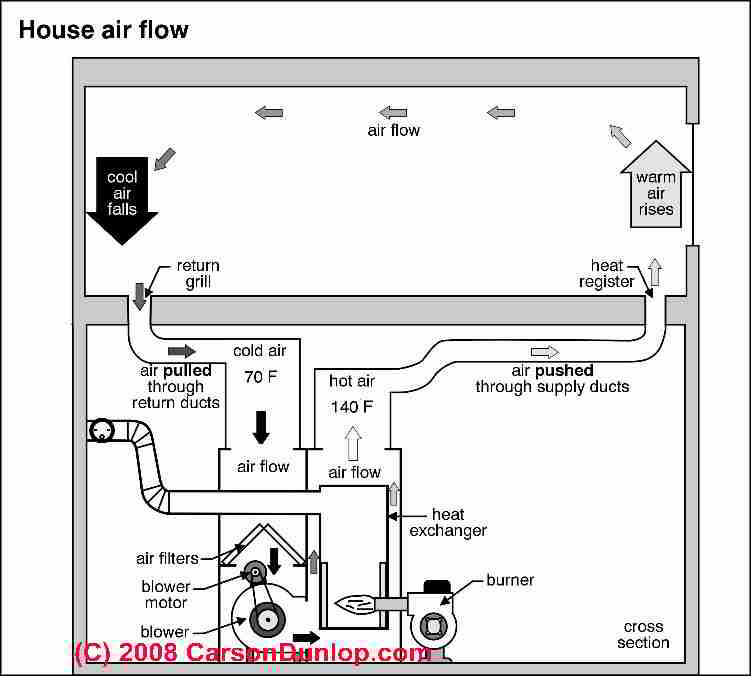
Understanding exactly what happens from the moment that the room thermostat calls for heat until the call for heat is satisfied can help troubleshoot a heating furnace that is not working properly. Sketch at page top courtesy of Carson Dunlop Associates, a Toronto home inspection, education & report writing tool company [ carsondunlop.com ].
InspectAPedia tolerates no conflicts of interest. We have no relationship with advertisers, products, or services discussed at this website.
How does a Warm Air Heating Furnace work? Sequence of Operating Steps
This article series answers most questions about central heating system troubleshooting, inspection, diagnosis, and repairs.
We describe how to inspect, troubleshoot and repair heating and air conditioning systems to inform home owners, buyers, and home inspectors of common heating system defects. Sketch at page top courtesy of Carson Dunlop Associates, a Toronto home inspection, education & report writing tool company [ carsondunlop.com ].
1. The Building Thermostat
senses temperature, turns on the furnace burner:
As building temperatures drop a wall-mounted thermostat in the occupied space senses the temperature drop and in response, calls for heat at the furnace, causing the furnace oil or gas burner to turn "on". Details are
at THERMOSTATS.
Sketch at left courtesy of Carson Dunlop Associates, a Toronto home inspection, education & report writing tool company [ carsondunlop.com ].
2. The Gas or oil burner:
The heat source such as a gas or oil-fired burner will turn on in response to the thermostat, and it will continue to run until either the high temperature or "FAN LIMIT" temperature is reached inside the warm air plenum or until the building thermostat inside the occupied space senses that the desired temperature there has been reached.
At that time the burner is turned off but the blower will usually continue to run for a bit longer for reasons we'll explain in more detail below.
See OIL BURNERS
or GAS BURNER FLAME & NOISE DEFECTS
or
3. Heat exchanger:
Hot combustion gases produced by the oil or gas burner circulate inside of the furnace's metal heat exchanger causing it to get hot. Combustion gases leave the inside of the heat exchanger and flow through a flue vent connector to a building chimney where they are vented safely outside.
4. The furnace blower
inside the furnace blower compartment draws returning cool air from the living area and blows it across the outside of a steel "box" called the heat exchanger, sending the now-warmed air onwards into the furnace's output side or "supply air" plenum where it is sent into the building warm air duct system for delivery to the occupied space.
 5. Air ducts connect and permit movement of cool air from occupied space through furnace and deliver warm air back to occupied space: The building air duct system includes return or cool air ducts and warm air ducts.
Cool air ducts carry air from the occupied space into the furnace return air plenum, possibly through an air filter, and into the furnace blower compartment.
Warm air supply ducts connect to the supply air plenum and carry warm air into the occupied space where it flows out of floor, wall, or ceiling warm air registers or diffusers.
See DUCT SYSTEMS
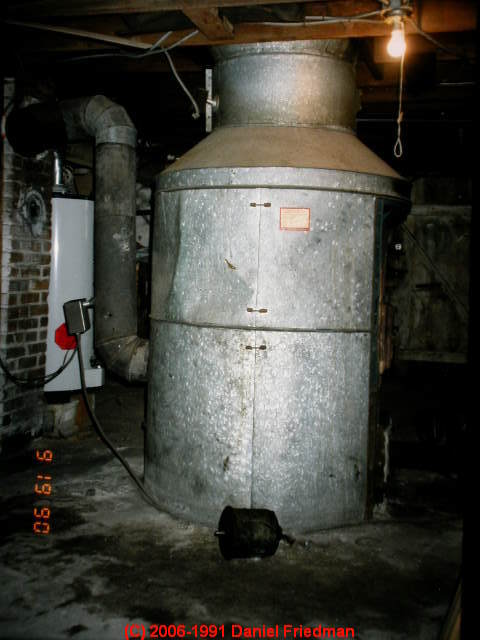
The Octopus furnace shown at left delivered heat to the building with no ductwork whatsoever.
Warm air rose into the first floor of the building through a floor grid mounted at the top of the furnace. Warm air rose to upper floors through stairwells or by ceiling-cut air registers.
6. Combination Fan & Limit Control:
This control turns the furnace blower on and off at the proper times.
The FAN ON setting on this control makes sure that the blower fan does not turn on (even though the building thermostat has asked for heat) so that the furnace wont' blow cool air into the occupied space.
Furnace FAN ON: When an adequate warm temperature has been reached inside of the furnace warm air plenum chamber the FAN ON switch turns on the furnace blower to deliver warm air to the occupied space.
Furnace FAN OFF: The furnace combination fan and limit control FAN OFF setting lets the furnace blower continue to run for an interval after the furnace burner has turned off, but will shut the blower off after the heat exchanger has been cooled down and the heat it contained has been sent to the occupied space.
Furnace LIMIT: The LIMIT indicator setting is a safety control that will turn off the oil or gas burner if temperatures inside the warm air plenum exceed a safe level.
See FAN LIMIT SWITCH for details.
When does the furnace Blower Fan turn OFF in normal operation?
When the thermostat has been satisfied and turns off the oil or gas burner at the furnace, the fan limit switch will cause the blower or fan unit to continue to operate until the temperature at the supply plenum has reached or dropped below the "cut-in" or "fan-on" lower limit on the switch.
When does the furnace oil Burner, gas Burner, or other heat source turn OFF in normal operation:
On most heating systems the burner or heat source will continue to run all of the time that the building thermostat is asking for heat, and will stop running as soon as the thermostat is satisfied.
If the furnace oil or gas burner is very high capacity, or if the furnace fan/limit controls have been set to cause this effect, the burner may on some systems cycle on and off periodically while the warm air blower continues to run.
How is heating furnace efficiency or economy measured? What does Furnace AFUE mean?
Each furnace model is assigned an AFUE number. AFUE is an abbreviation for Annual Fuel Utilization Efficiency. In short, the AFUE tells you, for each dollar you spend on energy for heating by gas, oil, or another fuel, just how much of your dollar shows up inside the occupied space of your building as heat.
Higher AFUE is better. If your furnace has an AFUE rating of 90, that means that for every dollar you spend on fuel, 90 cents worth of heat is delivered into your building. The remaining 10 cents is lost in inefficiency such as heat that escapes up the chimney along with the products of combustion.
AFUE is not the whole story of heating cost efficiency. A high-efficiency heating system that has not been cleaned and serviced may be running poorly and wasting money. In fact, an 85% AFUE heating furnace that has not been cleaned might be running at an efficiency much lower, perhaps 65%.
Furthermore, if your building is drafty or poorly insulated, you may be delivering heat at high efficiency but losing it from the building much faster than necessary. These articles can help with a more complete approach to saving money on heat:
First
see HEATING COST SAVINGS METHODS
then for more detail check out our articles
at HEAT LOSS RATE CALCULATIONS - R, U, & K VALUES
and INSULATION IDENTIFICATION GUIDE
What are the Typical Air Temperatures Supplied by Warm Air Heating Furnaces?
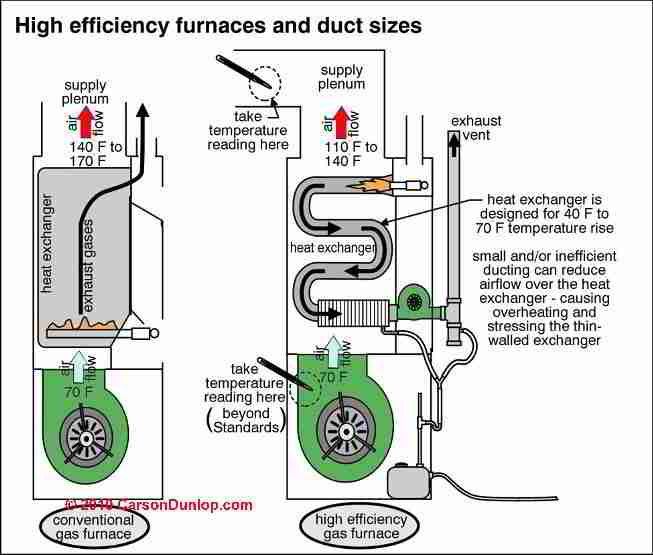 A conventional gas fired warm air furnace will provide heated air at 140 to 170 °F at the supply plenum. Naturally the temperature of this air drops as it moves through the ductwork system and will be cooler exiting the air supply registers.
A high efficiency gas fired furnace will provide heated air at lower temperatures, typically at 110 F to 140F at the supply plenum.
Watch out: as Carson Dunlop Associates warn (sketch at left), under-sized or restricted ductwork will reduce airflow over the furnace heat exchanger and can thus overheat and even damage the furnace heat exchanger.
So if air temperatures at the supply plenum (or even at supply ducts) are abnormally high don't think that's a great heating system - instead you may need the system checked by an HVAC expert technician.
See FAN LIMIT SWITCH for details on the temperature operating limits and controls for warm air heating systems.
Signs of Improper Warm Air Heating Furnace Operation
Furnace Oil or Gas Burner Cycling On and Off Frequently
If a furnace oil or gas burner cycles on and off frequently while the furnace blower continues to run, the heating system probably needs service, inspecting, testing, or adjustment.
- An over-sized or gas burner that is putting heat energy into the furnace too fast for the blower to extract it can cause this symptom.
- A dirty or blocked air filter or a dirty or blocked blower fan can cause this symptom because it is reducing the rate of air flow across the heat exchanger. If you want to save money on heating costs be sure the warm air flow is not reduced or obstructed by dirty or improper air filters.
- Improper furnace control settings can cause furnace oil or gas burners to cycle on and off too often; check with your heating service technician.
Reduced or no Air Flow at Heating Supply Registers
If you are getting some but not much air flow out of heat supply registers there is probably a problem with:
- the air filter(s) - dirty or damaged -
see AIR FILTERS for HVAC SYSTEMS - the blower fan is dirty or has a loose fan belt -
see DIRTY A/C BLOWERS - the duct system itself, such as collapsed, blocked, or disconnected duct work
see DUCT SYSTEMS - if the system is a combined heating and air conditioning system, the cooling coil may be blocked by dirt -
see DIRTY COOLING COIL / EVAPORATOR COIL - if the system has always delivered only poor air flow at the supply registers, the blower may be dirty or defective, or the return air supply may be inadequate -
see RETURN AIR, INCREASE
If you are getting no air flow whatsoever but the furnace burner seems to be running there is probably a problem with:
- the blower fan motor or fan itself has failed
- the duct system has become totally blocked or disconnected -
see DUCT SYSTEMS - the furnace is not running at all -
see NO HEAT - BOILER / FURNACE DIAGNOSIS
A Guide to Hot Air Heating Furnace Inspections - Troubleshooting
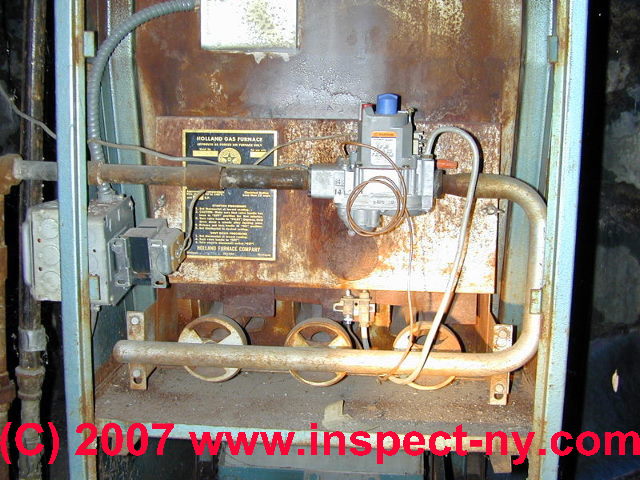
- Furnaces follow a simpler operating sequence than hot water boilers and steam boilers which we discussed above.
- Hot air heating furnaces use different controls than hot water boilers since the furnace distributes heat by warm air. For example, a fan/limit switch is normally used to turn the blower on and off.
- A Working Definition of a hot air furnace can aid explaining the system to clients and owners:
A furnace is a steel or cast iron "box" connected to a series of duct work which runs through the house bringing hot air to grilles (registers).
A fan, usually at the furnace, circulates air from cold-air return grilles through duct work to the furnace where the air is heated and then returned through "supply ducts" to the living area.
- Operating sequence of a hot air heating furnace:
The building or building room cools,
as temperature drops the thermostat switch closes (calls for heat),
oil (or gas or electric) burner is turned on, oil is pumped from tank to burner, ignited, burned,
Hot gases pass through a fire chamber (steel can)
Hot gases pass through a heat exchanger (steel separating building air from combustion chamber gases)
and out an exhaust flue,
past a barometric damper to a chimney to outdoors.
- ASHI 9.2.C. The inspector shall open readily open-able access panels provided by the manufacturer or installer for routine homeowner maintenance
- Understanding functions=understanding implications: E.g. : wet basement, steel furnace, high CO risks from rusted heat exchanger.
Heating System Operating Sequence Inspection Tips
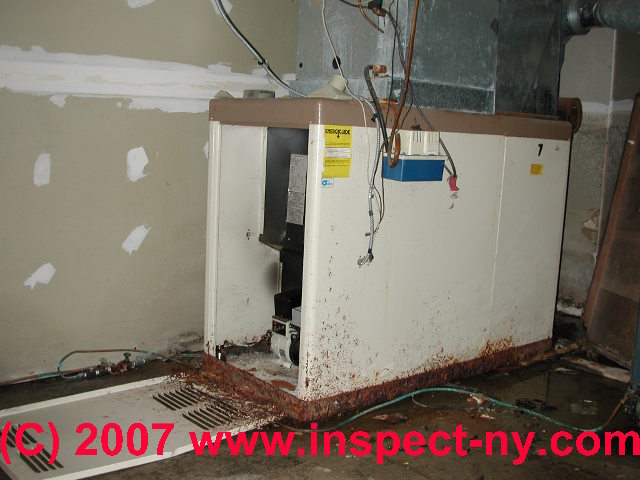
The rust on the exterior around the gas burners of this gas fired furnace could be due to improper and unsafe operation.
Expert inspection should be ordered to assure that this system is safe and functional.
If the furnace turns on immediately when the thermostat is turned-on or up from the living area what does this mean? Normally a hot air furnace oil or gas burner will turn on immediately when the thermostat calls for heat.
However the blower or fan unit that delivers warm air to the living area will not turn on until the fan limit switch in the hot air supply plenum or furnace top senses that the air in that area is warm. This prevents blowing cold air on building occupants.
Similarly, when the thermostat is satisfied (the room has reached the thermostat set temperature), the thermostat will "turn off" the furnace.
What actually happens is that the oil or gas burner will turn off immediately, but on most hot air furnace systems, the blower will continue to run, perhaps even for several minutes, as it extracts the remaining heat from the furnace heat exchanger and hot air supply plenum.
Two reasons for this continued operation of the furnace blower fan past burner shutdown include:
- Cooling down the heat exchanger avoids cracks or damage that could occur if the furnace heat exchanger gets too hot.
- The cool down cycle of the blower avoids wasting heat by failing to distribute it to the living area from the furnace.
Make a thorough visual inspection for signs of damage or improper operation, missing parts, water damage, rust, mechanical damage, soot, smoke, improper venting, missing or damaged safety controls, etc. We detail these topics in articles listed below. Thanks to reader Cyrus for editing suggestions.
List of Heating System Controls and Switches on Most Furnaces
For details about the setting, re-setting, or function of the controls and switches commonly found on hot air heating systems see these articles:
- BLOWER DOOR SAFETY SWITCH - shuts down the system if the blower compartment door is opened
- CAD CELL RELAY SWITCH On oil fired furnaces or boilers as flame sensors & safety devices
- DRAFT REGULATORS / HOODS GAS HEATERS On gas fired heating equipment, function and safety
- DRAFT REGULATOR, DAMPER, BOOSTER & barometric dampers on oil fired heating equipment
- ELECTRIC MOTOR OVERLOAD RESET SWITCH
- ELECTRICAL POWER SWITCH FOR HEAT
- FAN LIMIT SWITCH On hot air furnace heating systems (gas or oil fired)
- FLUE GAS SPILL SWITCH On gas fired heating equipment sense combustion and protect from blocked flues
- GAS BURNER FLAME & NOISE DEFECTS
- GAS BURNER SOOT CAUSE & CURE
- GAS BURNER PILOT LIGHT PROCEDURE
- OIL BURNERS - oil fired furnaces
- RESET BUTTON, ELECTRIC MOTOR - on some blower fans or oil burner motors
- RESET SWITCH - HEAT CONTROL - on modern oil fired furnaces
- STACK RELAY SWITCH - on older oil fired furnaces
- FLUE GAS SPILL SWITCH TRIPPING & RESET - on gas fired furnaces
- STACK RELAY SWITCH Explained on oil fired furnaces or boilers as flame sensors & safety devices
- THERMOSTATS, HEATING / COOLING On all heating systems & cooling systems
- ZONE DAMPERS - on some forced air systems, for additional cooling or heating zone control
How to Improve the Warm Air Supply
Reader Question: Heating Furnace Runs but Air that is Not Warm Enough
This discussion has been moved to a separate article
at WARM AIR SUPPLY TEMPERATURE & IMPROVEMENT
Types & Combinations of Water (hydronic heating boilers) and Air (warm air furnaces) Heating Systems
Definition of Water to Air Heat Exchanger Heating Systems
A technical note is necessary about determining what kind of heat or what type of heating system is installed: some heating systems combine both hot water and hot air to heat a building, such as water to air systems which use a heating boiler (oil, gas, or electric) to heat water which circulates through (and inside of) a heat exchanger (that looks like a car radiator).
The heat exchanger in a water to air heating system is then placed inside of an air handler or blower compartment where a blower fan circulates building air from return ducts to a plenum where air is blown across the heat exchanger and then the warmed air is delivered to the occupied space through additional warm air ducts or radiators.
More about Water to Air Heat Exchanger Heating Systems
Some heating systems combine both hot water and hot air to heat a building, such as water to air systems which use a heating boiler (oil, gas, or electric) to heat water which circulates through (and inside of) a heat exchanger (that looks like a car radiator).
The heat exchanger in a water to air heating system is then placed inside of an air handler or blower compartment where a blower fan circulates building air from return ducts to a plenum where air is blown across the heat exchanger and then the warmed air is delivered to the occupied space through additional warm air ducts or radiators.
Water-to-air heating systems will use both a separate water heating boiler and a blower or air handler system.
Watch out for corrosion on water to air heat exchanger heating coils, as we explain just below.
Corrosion on Heating & Air Conditioning Heat Exchanger Coils & Condenser Coils
Corrosion on heat exchanging coils in heat pumps, air conditioners, or water-to-air heating coils eventually leads to leaks and costly repairs that require replacement of the coil and re-charging of the HVAC system refrigerant.
Corrosion may occur as a function of age and use and failure to keep the coil clean, but there are some special sources of corrosion in HVAC systems that you should watch for:
- Corrosion of HVAC equipment coils due to their use at indoor swimming pools: chlorine used in pools is very volatile and rapidly leaves the pool water as chlorine gas.
While the chlorine levels may be below a health hazard to humans at indoor pools, the operation of indoor HVAC systems that condition swimming pool room air exposes the coil to high volumes of possibly corrosive chlorine, reducing the equipment life. - Corrosion of HVAC equipment coils due to presence of Chinese Drywall in the building.
See CHINESE DRYWALL HAZARDS for details.
Definition of Dual Water and Air Heating Systems
Some buildings are heated by a combination of separate hot water systems (circulating hot water through radiating devices like baseboards or radiators in some areas) and hot air systems (circulating warm air through ductwork into the occupied space in other areas).
These buildings will have both a hot air furnace and a completely separate hot water heating boiler installed. In this case these are completely separate heating systems and usually each serves different building areas.
Reader Comments, Questions & Answers About The Article Above
Below you will find questions and answers previously posted on this page at its page bottom reader comment box.
Reader Q&A - also see RECOMMENDED ARTICLES & FAQs
Question: source of heating oil odors when furnace starts
(Dec 5, 2014) Anonymous said:
Every time the furnace starts up I get a fume smell?
Reply:
See the diagnostics and suggestions at OIL BURNER NOISE SMOKE ODORS
Also check out oil leak smell sources at OIL ODOR SOURCES
Question: furnace does not turn on when thermostat calls for heat
7 Feb 2015 Frank said
When the thermostat calls for heat the furnace won't come on.
Reply:
Frank
In the ARTICLE INDEX found among the Continue Reading links at the end of this article select the article titled NO HEAT - FURNACE for some help diagnosing your no heat problem.
...
Continue reading at FURNACE OPERATING TEMPERATURES or select a topic from the closely-related articles below, or see the complete ARTICLE INDEX.
Or see FURNACE OPERATING FAQs - questions and answers about furnace operation that were posted originally on this page
Or see these
Recommended Articles
- FURNACE OPERATING TEMPERATURES
- GAS BURNER PILOT LIGHT PROCEDURE
- NO HEAT - FURNACE
- OIL BURNER NOISE SMOKE ODORS
Suggested citation for this web page
FURNACE OPERATION DETAILS at InspectApedia.com - online encyclopedia of building & environmental inspection, testing, diagnosis, repair, & problem prevention advice.
Or see this
INDEX to RELATED ARTICLES: ARTICLE INDEX to HEATING FURNACES
Or use the SEARCH BOX found below to Ask a Question or Search InspectApedia
Ask a Question or Search InspectApedia
Try the search box just below, or if you prefer, post a question or comment in the Comments box below and we will respond promptly.
Search the InspectApedia website
Note: appearance of your Comment below may be delayed: if your comment contains an image, photograph, web link, or text that looks to the software as if it might be a web link, your posting will appear after it has been approved by a moderator. Apologies for the delay.
Only one image can be added per comment but you can post as many comments, and therefore images, as you like.
You will not receive a notification when a response to your question has been posted.
Please bookmark this page to make it easy for you to check back for our response.
Our Comment Box is provided by Countable Web Productions countable.ca
Citations & References
In addition to any citations in the article above, a full list is available on request.
- Thanks to our reader Cyrus for editing help and critique 2/1/2009
- Mark Cramer Inspection Services Mark Cramer, Tampa Florida, Mr. Cramer is a past president of ASHI, the American Society of Home Inspectors and is a Florida home inspector and home inspection educator. Mr. Cramer serves on the ASHI Home Inspection Standards. Contact Mark Cramer at: 727-595-4211 mark@BestTampaInspector.com
- John Cranor [Website: /www.house-whisperer.com ] is an ASHI member and a home inspector (The House Whisperer) is located in Glen Allen, VA 23060. He is also a contributor to InspectApedia.com in several technical areas such as plumbing and appliances (dryer vents). Contact Mr. Cranor at 804-873-8534 or by Email: johncranor@verizon.net
- Our recommended books about building & mechanical systems design, inspection, problem diagnosis, and repair, and about indoor environment and IAQ testing, diagnosis, and cleanup are at the InspectAPedia Bookstore. Also see our Book Reviews - InspectAPedia.
- In addition to citations & references found in this article, see the research citations given at the end of the related articles found at our suggested
CONTINUE READING or RECOMMENDED ARTICLES.
- Carson, Dunlop & Associates Ltd., 120 Carlton Street Suite 407, Toronto ON M5A 4K2. Tel: (416) 964-9415 1-800-268-7070 Email: info@carsondunlop.com. Alan Carson is a past president of ASHI, the American Society of Home Inspectors.
Thanks to Alan Carson and Bob Dunlop, for permission for InspectAPedia to use text excerpts from The HOME REFERENCE BOOK - the Encyclopedia of Homes and to use illustrations from The ILLUSTRATED HOME .
Carson Dunlop Associates provides extensive home inspection education and report writing material. In gratitude we provide links to tsome Carson Dunlop Associates products and services.
 | HOME | ABOUT | ASK a QUESTION | CONTACT | CONTENT USE POLICY | DESCRIPTION | POLICIES | PRIVACY | |
| © 2024 - 1985 Publisher InspectApedia.com - Daniel Friedman | |||||||||