
InspectAPedia® FREE Encyclopedia of Building & Environmental Construction, Diagnosis, Maintenance & Repair |
Question? Just ask us! InspectAPedia
|
 Inspecting Heating Systems, Final Checks
Heating system inspection procedure
- POST a QUESTION or COMMENT about how to inspect a heating system: final checks to make before leaving the boiler or furnace area
Heating system inspection procedure: final details.
This document presents the final inspection steps and operating suggestions when inspecting residential heating systems . The heating system inspection methodology involved is intended to be generalized to the forensic diagnostic inspection of any complex system in order to have the highest probability of detecting important safety or operating defects.
This sounds fancier than intended. Our object is to use an organized procedure for inspecting for defects, without losing the ability to discover unexpected problems as well. The methodology discussed includes both details specific to heating boilers (the full outline at "Contents") and more general complex-system inspection methods (listed immediately below).
InspectAPedia tolerates no conflicts of interest. We have no relationship with advertisers, products, or services discussed at this website.
Final heating system inspection checks in the boiler or furnace room
 Article Contents
© Copyright Daniel Friedman 2008-2015 all rights reserved -- Tri-State ASHI Seminar -- Last update 08/03/2010 - first presentation November 6-7, 1993
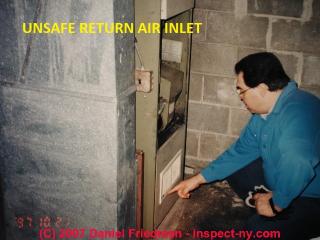
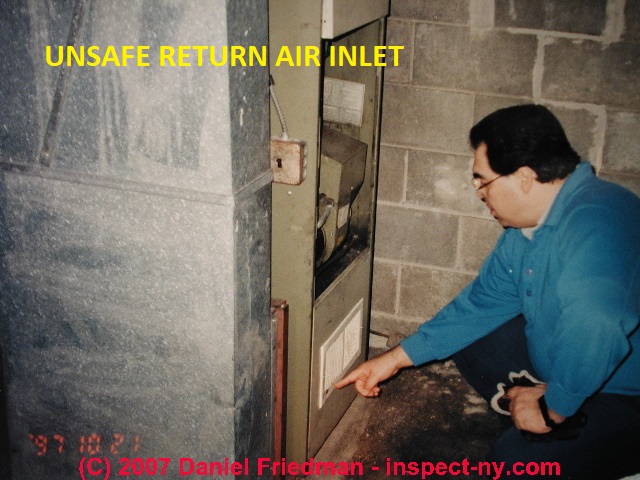
Watch out: locating a return air inlet close to a heating furnace, particularly a gas or oil fired heater may be unsafe - as shown in our photo above. See UNSAFE DUCT OPENINGS
and also see BACKDRAFTING HEATING EQUIPMENT and also COMBUSTION AIR for TIGHT BUILDINGS for additional details.Operate the Heating Equipment
After all visual inspection turn on the heating system and observe its operation.
Watch out: if you think the heating system is unsafe for any reason, do not turn it on. Warn the parties involved orally and in writing right away and explain the hazards you observed.
Operating the heating system permits observations of operation anomalies such as noises, odors, leaks, or failure to deliver heat to the occupied space.
Turn the room thermostat(s) well above the current room temperature.
Watch the heating system start and operate.
Complete your observations and return the room thermostat(s) to their original setting.
Make a written note in your observations that you followed this procedure.
ASHI 9.2.B. The inspector shall operate the system using normal operating controls such as using the thermostat -
see THERMOSTATS, HEATING / COOLING.
Heating System Operating Defects Observed During Operation
- Noises, smoke, soot, back pressure at inspection port (watch out for burns and fires if this port is opened), sloppy startup, rumbling, sloppy or delayed shutdown-flame lingers (very dangerous).
- Feeling supply air ducts or hot water heating system piping (hot!) that on a hot water system can indicate if circulator is running--quick change in temperature vs convection.
- Some water leaks occur only at peak operating temperature--eg at relief valve.
- Some furnace duct work air leaks are observed only when the blower is up to full speed.
- Oil or gas burner startup problems: noises, puff back, flapping barometric damper, vibrations, odors, visible sooting.
- Particularly in cold weather, if the system was on and running, observe and note that it was running normally when you last touched it. Witnessed. (Frost damage issues lurk here.)
Heating Equipment Malfunction & Implications
What are the Implications of the Clues of Heating System Defects that You Observed?
- Leaks are never acceptable, anywhere. Leaking relief valves need immediate attention and repair (Leaking relief valve could be due to water-logged expansion tank, improper control settings (temperature too high), improper automatic water feeder operation (pressure too high), or defective valve (leaky). True, you only have to report the valve. Did you miss problems at the other components?) Corroded relief valves also need test and repair/replacement
- Relief Valves: Do not touch the heating boiler or water heater temperature or pressure relief valve - it may open and fail to shut down.
- Corrosion on heating system parts: Do not pick at corrosion as you may start a catastrophic, un-stoppable leak requiring total system shut-down.
- Tankless coils for making hot water: If there is different water pressure/flow observed in the kitchen in which the
hot water pressure is significantly less than cold, even before examining the building's mechanical systems you may
speculate that a tankless
coil installed may be installed. What other clues suggest that the local water supply may be hard in
minerals and that there may be a risk of clogged piping?
When the water supply is high in minerals, the hot water pipes or tankless coils clog up before cold water piping. Is a water softener installed? Is there known "hard" water--have mineral deposits clogged the coil? Are there "cleanout" plumbing fittings on the tankless coil piping?
Does this suggest a history of clogging and acid-flush treatments?
Can a clogged coil be repaired or replaced?
How severe was that rust you observed at the tankless coil mounting plate?
Remember that even a subtle clue like drips at the bottom of a relief valve discharge tube can have profound implications for the condition of the heating system. Clues make more sense when you understand how the equipment works, its operating cycle, and the function of each component.
See DIAGNOSE & FIX HEATING PROBLEMS-BOILER or see BOILER OPERATING PROBLEMS for an extensive list of heating system clues and what they mean for the safety, adequacy, or reliability of hot water heating systems
See DIAGNOSE & FIX HEATING PROBLEMS-FURNACE for forced warm air heating system problem diagnosis.
See ELECTRIC HEAT if you are inspecting an electric heating system
See STEAM HEATING SYSTEMS & CONTROLS if you are inspecting a steam boiler.
Thought Sequences for Final Heating System Check
- Hot heating water movement from house supply into boiler, through circulating equipment.
- Fuel movement from tank through burner up flue and chimney.
- Air movement into house and to burner and up flue and chimney.
- Air movement inside duct work (for furnaces)
- Complete operation sequence reviewed?
- Other building conditions observed which raise questions?
wet basement, poor housekeeping, poor maintenance, extensive building additions may stretch boiler capacity, ... - What's missing ?
- Did we leave the system operating normally?
Heating Inspections: Safety Concerns for the Home Inspector
This section contains examples of steps to protect the inspector. It does not address safety concerns for the client/occupant.ASHI 9.3.A. The inspector is not required to operate equipment when weather conditions or other circumstances may cause equipment damage [or in the opinion of the inspector, may cause any sort of unsafe condition (added by DJF, NOT ASHI Standards)- Do not turn on equipment which has been "shut down" - Possible open piping, unsafe wiring, leaks, unsafe chimney, fire risks.
- Do not turn on equipment which has been switched off without explicit permission/instruction from a responsible party
- Examine gauges (not entirely reliable) for unusual pressure or temperature conditions and do not permit such equipment to continue to operate
- Do not operate equipment which does not appear to be vented properly; shut down equipment if, on operating it, you observe an apparently blocked flue
- Do not operate equipment if the chimney is suspect--e.g. old single wythe unlined brick with visible damage in the attic or outside
- Watch for flashback at inspection ports
- Watch for electric shock at controls
- Do not pick at corrosion
- Do not test relief valve levers nor catch your sleeve on one
ASHI 9.3.B. The inspector is not required to operate automatic safety controls - Do not light fires in coal or wood stoves to check draft, etc
ASHI 9.3.C. The inspector is not required to ignite or extinguish solid fuel fires - Do not disassemble flue vent piping - risks of filth, unable to reassemble, etc.
ASHI 9.3.D.1 The inspector is not required to observe the interior of flues [However often you can detect a blocked flue by looking through the barometric damper or by use of a mirror at the chimney cleanout. We recommend this step. -DJF]
ASHI 9.3.D.2 The inspector is not required to observe fireplace insert flue connections [Normally not visible. Caution: there is frequently a hidden problem there.] - Be careful about disconnecting humidifiers to obtain access to furnace plenums: you may cut yourself on sheet metal, cause leaks in humidifier piping, cause spills.
ASHI 9.3.D.3 The inspector is not required to observe humidifiers - But watch for humidifiers which leaked into and damaged duct work or onto and damaged a heat exchanger.
- Avoid electric shock from the static charge at electronic air filters.
ASHI 9.3.D.4 The inspector is not required to observe electronic air filters
...
Continue reading at INDOOR INSPECTION of HEATING SYSTEM or select a topic from the closely-related articles below, or see the complete ARTICLE INDEX.
Or see
Or see these
Heating System Inspection Procedure Articles
- HEATING SYSTEM INSPECTION - home
- HEATING INSPECTION CONCEPTS
- HEATING INSPECTION PROCEDURE-GENERAL
- HEATING SYSTEM INSPECTION DETAILS
- INDOOR INSPECTION of HEATING SYSTEM
- HEATING BOILER INSPECTION GUIDE
- HEATING FURNACE INSPECTION GUIDE
- FINAL BOILER/FURNACE ROOM INSPECTION CHECKS
- GAS BURNER FLAME & NOISE DEFECTS
- GAS BURNER SOOT CAUSE & CURE
- GAS BURNER PILOT LIGHT PROCEDURE
- OIL BURNER INSPECTION & REPAIR
- HEATING SYSTEM SAFETY INSPECTION
- SAFETY RECALLS CHIMNEYS VENTS HEATERS
Suggested citation for this web page
FINAL BOILER/FURNACE ROOM INSPECTION CHECKS at InspectApedia.com - online encyclopedia of building & environmental inspection, testing, diagnosis, repair, & problem prevention advice.
Or see this
INDEX to RELATED ARTICLES: ARTICLE INDEX to HEATING SYSTEMS
Or use the SEARCH BOX found below to Ask a Question or Search InspectApedia
Ask a Question or Search InspectApedia
Try the search box just below, or if you prefer, post a question or comment in the Comments box below and we will respond promptly.
Search the InspectApedia website
Note: appearance of your Comment below may be delayed: if your comment contains an image, photograph, web link, or text that looks to the software as if it might be a web link, your posting will appear after it has been approved by a moderator. Apologies for the delay.
Only one image can be added per comment but you can post as many comments, and therefore images, as you like.
You will not receive a notification when a response to your question has been posted.
Please bookmark this page to make it easy for you to check back for our response.
Our Comment Box is provided by Countable Web Productions countable.ca
Citations & References
In addition to any citations in the article above, a full list is available on request.
- Domestic and Commercial Oil Burners, Charles H. Burkhardt, McGraw Hill Book Company, New York 3rd Ed 1969.
- National Fuel Gas Code (Z223.1) $16.00 and National Fuel Gas Code Handbook (Z223.2) $47.00 American Gas Association (A.G.A.), 1515 Wilson Boulevard, Arlington, VA 22209 also available from National Fire Protection Association, Batterymarch Park, Quincy, MA 02269. Fundamentals of Gas Appliance Venting and Ventilation, 1985, American Gas Association Laboratories, Engineering Services Department. American Gas Association, 1515 Wilson Boulevard, Arlington, VA 22209. Catalog #XHO585. Reprinted 1989.
- The Steam Book, 1984, Training and Education Department, Fluid Handling Division, ITT [probably out of print, possibly available from several home inspection supply companies] Fuel Oil and Oil Heat Magazine, October 1990, offers an update,
- Principles of Steam Heating, $13.25 includes postage. Fuel oil & Oil Heat Magazine, 389 Passaic Ave., Fairfield, NJ 07004.
- The Lost Art of Steam Heating, Dan Holohan, 516-579-3046 FAX
- Principles of Steam Heating, Dan Holohan, technical editor of Fuel Oil and Oil Heat magazine, 389 Passaic Ave., Fairfield, NJ 07004 ($12.+1.25 postage/handling).
- "Residential Steam Heating Systems", Instructional Technologies Institute, Inc., 145 "D" Grassy Plain St., Bethel, CT 06801 800/227-1663 [home inspection training material] 1987
- "Residential Hydronic (circulating hot water) Heating Systems", Instructional Technologies Institute, Inc., 145 "D" Grassy Plain St., Bethel, CT 06801 800/227-1663 [home inspection training material] 1987
- "Warm Air Heating Systems". Instructional Technologies Institute, Inc., 145 "D" Grassy Plain St., Bethel, CT 06801 800/227-1663 [home inspection training material] 1987
- Heating, Ventilating, and Air Conditioning Volume I, Heating Fundamentals,
- Boilers, Boiler Conversions, James E. Brumbaugh, ISBN 0-672-23389-4 (v. 1) Volume II, Oil, Gas, and Coal Burners, Controls, Ducts, Piping, Valves, James E. Brumbaugh, ISBN 0-672-23390-7 (v. 2) Volume III, Radiant Heating, Water Heaters, Ventilation, Air Conditioning, Heat Pumps, Air Cleaners, James E. Brumbaugh, ISBN 0-672-23383-5 (v. 3) or ISBN 0-672-23380-0 (set) Special Sales Director, Macmillan Publishing Co., 866 Third Ave., New York, NY 10022. Macmillan Publishing Co., NY
- Installation Guide for Residential Hydronic Heating Systems
- Installation Guide #200, The Hydronics Institute, 35 Russo Place, Berkeley Heights, NJ 07922
- The ABC's of Retention Head Oil Burners, National Association of Oil Heat Service Managers, TM 115, National Old Timers' Association of the Energy Industry, PO Box 168, Mineola, NY 11501. (Excellent tips on spotting problems on oil-fired heating equipment. Booklet.)
- Our recommended books about building & mechanical systems design, inspection, problem diagnosis, and repair, and about indoor environment and IAQ testing, diagnosis, and cleanup are at the InspectAPedia Bookstore. Also see our Book Reviews - InspectAPedia.
- In addition to citations & references found in this article, see the research citations given at the end of the related articles found at our suggested
CONTINUE READING or RECOMMENDED ARTICLES.
- Carson, Dunlop & Associates Ltd., 120 Carlton Street Suite 407, Toronto ON M5A 4K2. Tel: (416) 964-9415 1-800-268-7070 Email: info@carsondunlop.com. Alan Carson is a past president of ASHI, the American Society of Home Inspectors.
Thanks to Alan Carson and Bob Dunlop, for permission for InspectAPedia to use text excerpts from The HOME REFERENCE BOOK - the Encyclopedia of Homes and to use illustrations from The ILLUSTRATED HOME .
Carson Dunlop Associates provides extensive home inspection education and report writing material. In gratitude we provide links to tsome Carson Dunlop Associates products and services.
 | HOME | ABOUT | ASK a QUESTION | CONTACT | CONTENT USE POLICY | DESCRIPTION | POLICIES | PRIVACY | |
| © 2024 - 1985 Publisher InspectApedia.com - Daniel Friedman | |||||||||