
InspectAPedia® FREE Encyclopedia of Building & Environmental Construction, Diagnosis, Maintenance & Repair |
Question? Just ask us! InspectAPedia
|
 Heating System Pressure & Temperature Gauges
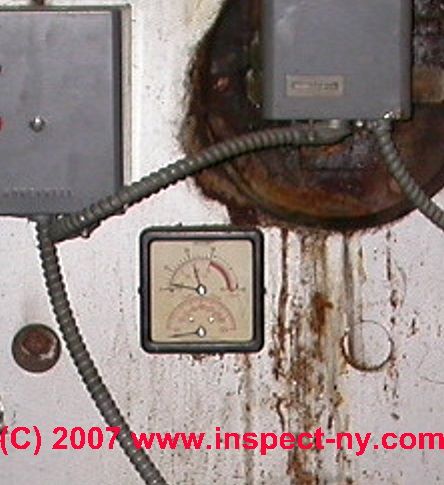
- POST a QUESTION or COMMENT about heating boiler gauges; how to read heating system pressure and temperature, what are the normal system pressure and temperature? boiler gauge leaks, replacement, repair.
Heating boiler pressure & temperature gauges:
Here we provide an inspection and repair guide to Heating System Gauges: Pressure and Temperature Gauges on Heating Boilers. We also describe the normal operating pressures for hot water hydronic heating boilers and for residential steam boilers.
You will also see that this article series answers most questions about Heating System Boiler Controls on central heating systems to aid in troubleshooting, inspection, diagnosis, and repairs.
InspectAPedia tolerates no conflicts of interest. We have no relationship with advertisers, products, or services discussed at this website.
Hydronic (hot water) Heater Pressure Gauge and Normal Pressure Ranges
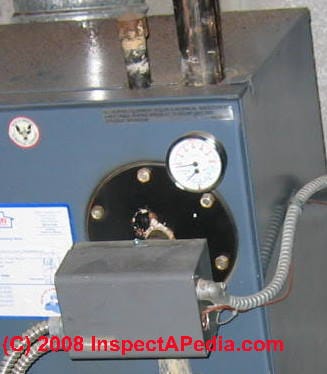
Pressure and Temperature gauge on hot water or hydronic heating boilers: this gauge displays the heating boiler internal pressure and temperature.
[Click to enlarge any image]Hydronic boiler pressure: Typical pressure for a residential boiler serving a two story home would show 12 psi cold, and less than 30 psi hot. Over 30 psi boiler pressure will cause the pressure relief valve to open.
Hydronic boiler temperatures: When there is no call for heat and if the boiler does not make hot water for a tankless coil, the boiler temperature will fall to room ambient temperature.
Typical operating temperature settings on a boiler call for a Low temperature (boiler cut-in) between 120 and 160 °F.
Typical operating temperatures on a hydronic boiler call for a high temperature (boiler cuts off) of 180-200 °F.
Over 200 degrees F. we're at risk of spilling at the pressure temperature relief valve.
Typical operating temperature observed at the gauge will be below the high, and can be as low as nighttime room temperature in non-heating season if no tankless coil is in use.
The temperature/pressure gauge may help in checking for normal conditions before and during boiler operation.
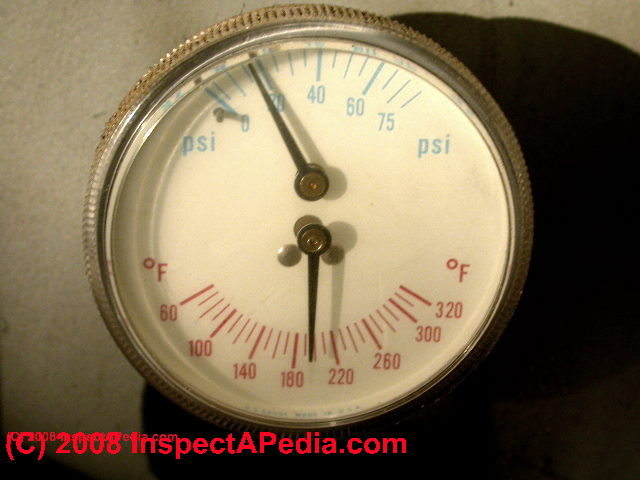
However the boiler pressure or temperature gauge can be wrong!
This boiler pressure and temperature gauge shows a typical in-boiler pressure of under 20 psi, and a temperature of about 190 °F. (The boiler had just cut off on a heating cycle.)
What Are the Normal Hot and Cold Operating Pressures of Residential Hydronic (hot water) Heating Boilers?
On a residential heating boiler the automatic water-feeder/pressure reducing valve that automatically provides makeup water to the heating boiler if pressure drops below 12 psi. So 12 psi is the typical "cold" pressure for residential boilers.
If your building is taller than two floors, the installer may have needed to boost the starting "cold" water pressure for your boiler to overcome the hot water distribution piping head pressure - otherwise your heating circulators may not be able to circulate hot water.
At PUMP, WATER PRESSURE BOOSTING we explain the relationship between building height and water pressure, and we illustrate the water pressure decrease in building water supply piping with building height. But a look at the basement water pressures in this illustration also explains the pressures that a basement located hot water heating circulator pump has to overcome.
12 psi is for typical U.S. / Canadian residential heating systems normal cold temperature starting pressure. U.K. and european heating systems should be pressurized to between 1 and 1.5 bar - cold.
20 psi is typical for U.S. / Canadian residential heating systems normal hot operating temperature, up to just under 30 psi, depending on the high-limit temperature setting on the boiler limit control. If we set the boiler high-limit much over 210, on many residential systems the system pressure will exceed 30 psi and we'll see water leaking from the pressure/temperature relief valve - ultimately an unsafe condition.
Where & How do I Set Boiler or Furnace Temperature?
Remember that the building THERMOSTATS set the desired temperature in the occupied spaces in building, not the actual temperature in the heating boiler or furnace itself.
In most heating systems, turning up the thermostat simply causes the boiler or furnace to turn on. The temperature at the boiler or furnace is controlled by local safety devices mounted right at that equipment.
- Hot Water Heating (hydronic) Boiler temperature, pressure setting controls: For details how, to what number, and on what controls the hydronic heating boiler temperatures are set,
see AQUASTAT CONTROL FUNCTIONS,
and LIMIT CONTROL, SINGLE. - Steam boiler temperature, pressure setting controls: For details how, to what number, and on what controls the steam boiler Pressure settings and pressure readings are set
see STEAM BOILER PRESSURE GAUGE - Furnace (forced or gravity fed warm air) temperature setting controls: Warm air furnace temperatures are controlled at
the FAN LIMIT SWITCH
For more diagnostic aid on finding the cause and executing the cure of abnormal heating boiler pressures see
- LEAKS at BASEBOARD, CONVECTOR, RADIATOR - how to find leaks at baseboards, radiators, etc.
- BOILER LEAKS CORROSION STAINS - how to diagnose & evaluate leaks on or in heating boilers
- BOILER LEAKS, HOW TO LOCATE - how to determine that a boiler or hot water system is leaking and how to find hidden leaks
- EXPANSION TANKS - if the expansion tank is waterlogged, the boiler and hot water heating system pressures will become excessive and spillage may be found at the pressure/temperature relief valve.
- PRESURE / TEMPERATURE RELIEF VALVES - can also leak on their own - an unsafe condition.
Steam Boiler Pressure Gauge and Normal Pressure Ranges
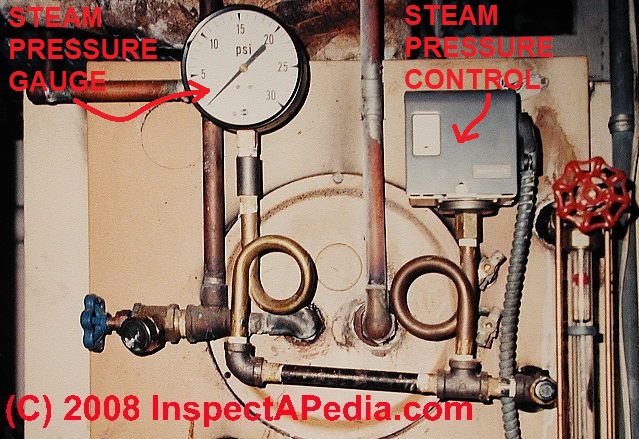
Pressure and Temperature gauge on steam heating boilers:
[Click to enlarge any image
Steam heating boiler pressures:
- Residential steam heating systemsoperate at very low pressures, perhaps around .5 psi - that' s 1/2 of one psi while commercial steam boilers may operate at higher pressures.
For this reason residential steam heating systems are usually designated as low pressure steam boilers.
You should see similar settings on the pressure gauge (at left in our photograph) and on the steam pressure control switch (the gray box at right in our photo) on your boiler - we provide additional examples and details of steam boiler pressure below.
- Commercial high pressure steam boilers operate in higher pressures and temperature ranges depending on the boiler purpose and design. The reason for operating steam boilers at higher pressures is that the efficiency of a steam engine is significantly increased at higher pressures (Sadi-Carnot 1824).
For example the high pressure steam boiler in a locomotive may operate at pressures of 200-250 psi (1.38-1.72 MPa) or even higher. Specially constructed very high pressure steam boilers may operate at pressures over 1,500 psi. - Wikipedia 4/14/14
Watch out: You won't find high pressure steam boilers being used for residential building heating. In fact if you see a residential boiler whose steam pressure has been set over about 0.5 psi most likely there is a problem with the steam distribution system piping or radiators that needs to be addressed.
Steam heating boiler temperatures:
- Residential low pressure steam heating boilers, because they produce steam, boil water. So the boiler operating temperatures if measured at the boiler will range between ambient room temperature (no heat is being called for and the boiler has cooled off completely) and boiling temperature which at sea level is 212°F.
- Commercial high pressure steam boiler temperatures: because the vaporization point of water at sea level is 212°F that's the normal temperature you'd expect in a steam boiler.
- Definition of saturated steam: Saturated steam is steam that is at the same temperature as that of the water from which it is emanating, that is, the stem has not been heated past the boiling point of water that produces it -212°F if we are at sea level and at a normal low heating boiler pressure operating range.
The steam produced by a residential steam heating boiler is normally saturated steam.
Watch out: See BLEVE EXPLOSIONS. - Definition of superheated steam: But steam can also become superheated, meaning that it has reached a temperature higher than the boilering point, for example if steam contacts a surface at a temperature higher than its own. Superheated steam becomes more dry, changing its properties as a result.
- Definition of dry steam: Steam that has slightly superheated enough to prevent condensation problems (a desired condition in steam engines) is called dry steam.
- Definition of saturated steam: Saturated steam is steam that is at the same temperature as that of the water from which it is emanating, that is, the stem has not been heated past the boiling point of water that produces it -212°F if we are at sea level and at a normal low heating boiler pressure operating range.
The controls in this photo are discussed in detail
at STEAM HEATING SYSTEMS and in
detail STEAM PRESSURE CONTROL
and at STEAM PRESSURE GAUGE
What Are the Normal Hot and Cold Operating Pressures of Low Pressure Residential Steam Heating Boilers?
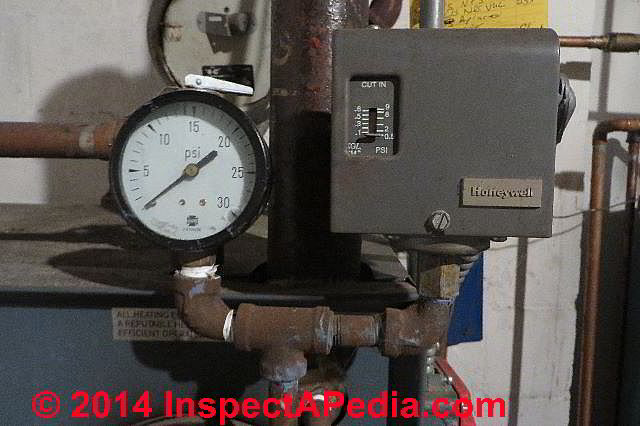
Low pressure steam boiler pressure: Low Pressure Residential steam heating systems are almost always designed to operate at very low pressures, typically around .5 psi - that' s 1/2 of one psi or a bit less.
At left if you enlarge the image you'll see that the steam pressure gauge on this Weil McLain Model 68 steam boiler reads about 0.5 psi - a setting consistent with the pressure set and shown on the scale on the steam pressure control to the right of the gauge.
If your residential steam boiler is operating at higher pressures (take a look at the dial setting on your steam boiler pressure control switch - that gray box in the photo above) , that may be an indication that a service technician or owner was having trouble getting heat distributed through the building.
Rather than finding and fixing the problem, someone is trying to "force" the steam around the system.
Details are at PRESSURE CONTROL, STEAM BOILERS
An experienced steam heat service technician will look at the operating pressure of your steam heating boiler and if it is not set to a normal level, the technician will look for the reason. Examples of problems that can affect the flow of steam heat through the system, leading to attempts to over pressurized the system include
- Blocked condensate returns at individual steam radiators
- Steam radiators tipped the wrong way
- Improperly relocated steam piping that has the incorrect slope
- Radiator valves that are not operating,
- Radiator steam vents that are not operating properly
See details at STEAM VENTS
For details about radiator problems
see RADIATORS and
see LEAKS at BASEBOARD, CONVECTOR, RADIATOR.
Also see HEATING LOSS DIAGNOSIS-BOILERS.
More about steam boiler gauges is
Do You Need to Replace a Heating Boiler Pressure & Temperature Gauge
Reader Question: How to replace a leaky pressure/temperature gauge on a boiler
... How to I safely drain and refill the water in the boiler to effect this repair? B - J. Wojciechowski
Reply:
Please see BOILER GAUGE REPLACEMENT for details on how to replace a hot water or steam boiler pressure or temperature gauge.
Hot Water Heating System Controls Inspection, Peripherals, Key Components
How to determine what type of heating system is installed:
Warm Air Heating Systems - Furnaces:
If the heat in your building is provided by warm air that flows out of ceiling, wall, or floor air supply registers into the occupied space, or if your heating system uses a water-to-air heating system then the air which warms the living space is probably being delivered through large or small diameter ducts, registers, air filters, and a furnace blower, and the air is being heated by a gas, oil, or electric furnace, or perhaps by a heat pump or a geo-thermal system.
See FURNACE CONTROLS & SWITCHES and for details
see FURNACE OPERATION DETAILS.
Hot Water or Steam Heating Systems - Boilers:
If the heat in your building is provided by warm or hot metal radiators, heating baseboards containing finned copper tubing, or wall convectors that look like a radiator but contain finned copper tubing, or if heat is provided by flexible rubber, plastic, or metal tubing run in building floors or ceilings, then the warm or hot water circulating in those devices is probably being delivered by piping circulating water heated by a heating boiler, or possibly by a steam boiler or a heat pump or geo-thermal system.
See BOILERS, HEATING
and RADIANT HEAT FLOOR MISTAKES.
If your heating radiators have valves which hiss and let air escape as heat is coming on your heat is probably being delivered in pipes which circulate steam from the steam boiler up through radiators in the occupied space.
See STEAM HEATING SYSTEMS .
This website provides description of all of the major components of hot water or steam heating systems, how to recognize or find each component, what it looks like, what goes wrong, and how to maintain, repair or adjust the component.
...
Continue reading at BOILER GAUGE REPLACEMENT or select a topic from the closely-related articles below, or see the complete ARTICLE INDEX.
Or see BOILER GAUGE FAQs questions & answers about boiler gauges posted originally at the end of this page.
Or see these
Heating System Gauge Articles
- BOILER CONTROLS & SWITCHES
- BOILERS, HEATING - home
- EXPANSION TANKS
- GAUGES ON HEATING EQUIPMENT
- PRESSURE & TEMPERATURE SETTINGS, CONTROLS
- STEAM BOILER PRESSURE
- STEAM BOILER TEMPERATURE
- STEAM BOILER SIGHT GLASS
- STEAM HEATING SYSTEMS & CONTROLS
Suggested citation for this web page
GAUGES ON HEATING EQUIPMENT at InspectApedia.com - online encyclopedia of building & environmental inspection, testing, diagnosis, repair, & problem prevention advice.
Or see this
INDEX to RELATED ARTICLES: ARTICLE INDEX to HEATING BOILERS
Or use the SEARCH BOX found below to Ask a Question or Search InspectApedia
Ask a Question or Search InspectApedia
Try the search box just below, or if you prefer, post a question or comment in the Comments box below and we will respond promptly.
Search the InspectApedia website
Note: appearance of your Comment below may be delayed: if your comment contains an image, photograph, web link, or text that looks to the software as if it might be a web link, your posting will appear after it has been approved by a moderator. Apologies for the delay.
Only one image can be added per comment but you can post as many comments, and therefore images, as you like.
You will not receive a notification when a response to your question has been posted.
Please bookmark this page to make it easy for you to check back for our response.
Our Comment Box is provided by Countable Web Productions countable.ca
Citations & References
In addition to any citations in the article above, a full list is available on request.
- [1] Power Technology and Engineering (formerly Hydrotechnical Construction), Volume 43, Number 4, 247-250, DOI: 10.1007/s10749-010-0105-4 - Thermal Power Stations, Temperature regime for damaged steam superheater coils, V. A. Bogachev (this is a PDF file - if you can't find contact SpringerLeak)
- [2] "Deaerator", Wikipedia, web search 12/18/11. Quoting:
The deaerators in the steam generating systems of most thermal power plants use low pressure steam obtained from an extraction point in their steam turbine system. However, the steam generators in many large industrial facilities such as petroleum refineries may use whatever low-pressure steam is available. - [3] Babcock & Wilcox Co. (2005). Steam: Its Generation and Use (41st ed.).
- [4] Thomas C. Elliott, Kao Chen, Robert Swanekamp (coauthors) (1997). Standard Handbook of Powerplant Engineering (2nd edition ed.). McGraw-Hill Professional. ISBN: 0-07-019435-1.
- Fuel Oil & Oil Heating Magazine, 3621 Hill Rd., Parsippany, NJ 07054, 973-331-9545
- Inspection Procedures for Oil-Fired Heating Systems Detailed step by step approaches for inspecting complex systems]
- Domestic and Commercial Oil Burners, Charles H. Burkhardt, McGraw Hill Book Company, New York 3rd Ed 1969.
- National Fuel Gas Code (Z223.1) $16.00 and National Fuel Gas Code Handbook (Z223.2) $47.00 American Gas Association (A.G.A.), 1515 Wilson Boulevard, Arlington, VA 22209 also available from National Fire Protection Association, Batterymarch Park, Quincy, MA 02269. Fundamentals of Gas Appliance Venting and Ventilation, 1985, American Gas Association Laboratories, Engineering Services Department. American Gas Association, 1515 Wilson Boulevard, Arlington, VA 22209. Catalog #XHO585. Reprinted 1989.
- The Steam Book, 1984, Training and Education Department, Fluid Handling Division, ITT [probably out of print, possibly available from several home inspection supply companies] Fuel Oil and Oil Heat Magazine, October 1990, offers an update,
- Principles of Steam Heating, $13.25 includes postage. Fuel oil & Oil Heat Magazine, 389 Passaic Ave., Fairfield, NJ 07004.
- The Lost Art of Steam Heating, Dan Holohan, 516-579-3046 FAX
- Principles of Steam Heating, Dan Holohan, technical editor of Fuel Oil and Oil Heat magazine, 389 Passaic Ave., Fairfield, NJ 07004 ($12.+1.25 postage/handling).
- "Residential Steam Heating Systems", Instructional Technologies Institute, Inc., 145 "D" Grassy Plain St., Bethel, CT 06801 800/227-1663 [home inspection training material] 1987
- "Residential Hydronic (circulating hot water) Heating Systems", Instructional Technologies Institute, Inc., 145 "D" Grassy Plain St., Bethel, CT 06801 800/227-1663 [home inspection training material] 1987
- "Warm Air Heating Systems". Instructional Technologies Institute, Inc., 145 "D" Grassy Plain St., Bethel, CT 06801 800/227-1663 [home inspection training material] 1987
- Heating, Ventilating, and Air Conditioning Volume I, Heating Fundamentals,
- Boilers, Boiler Conversions, James E. Brumbaugh, ISBN 0-672-23389-4 (v. 1) Volume II, Oil, Gas, and Coal Burners, Controls, Ducts, Piping, Valves, James E. Brumbaugh, ISBN 0-672-23390-7 (v. 2) Volume III, Radiant Heating, Water Heaters, Ventilation, Air Conditioning, Heat Pumps, Air Cleaners, James E. Brumbaugh, ISBN 0-672-23383-5 (v. 3) or ISBN 0-672-23380-0 (set) Special Sales Director, Macmillan Publishing Co., 866 Third Ave., New York, NY 10022. Macmillan Publishing Co., NY
- Installation Guide for Residential Hydronic Heating Systems
- Installation Guide #200, The Hydronics Institute, 35 Russo Place, Berkeley Heights, NJ 07922
- The ABC's of Retention Head Oil Burners, National Association of Oil Heat Service Managers, TM 115, National Old Timers' Association of the Energy Industry, PO Box 168, Mineola, NY 11501. (Excellent tips on spotting problems on oil-fired heating equipment. Booklet.)
- Hills, Richard L. (1989). Power From Steam. Cambridge University Press. p. 203. ISBN 0-521-45834-X.
- Roy, G.J. (1975). Steam Turbines and Gearing. Kandy Marine Engineering Series. Stanford Maritime. pp. 36–37. ISBN 0-540-07338-5.
- Wikipedia Web: https://www.wikipedia.org/ provided background information about some topics discussed at this website provided this citation is also found in the same article along with a " retrieved on" date. NOTE: because Wikipedia entries are fluid and can be amended in real time, we cite the retrieval date of Wikipedia citations and we do not assert that the information found there is necessarily authoritative. High-Pressure steam locomotive, retrieved 4/14/2014 original source: http://en.wikipedia.org/wiki/High-pressure_steam_locomotive
- Our recommended books about building & mechanical systems design, inspection, problem diagnosis, and repair, and about indoor environment and IAQ testing, diagnosis, and cleanup are at the InspectAPedia Bookstore. Also see our Book Reviews - InspectAPedia.
- In addition to citations & references found in this article, see the research citations given at the end of the related articles found at our suggested
CONTINUE READING or RECOMMENDED ARTICLES.
- Carson, Dunlop & Associates Ltd., 120 Carlton Street Suite 407, Toronto ON M5A 4K2. Tel: (416) 964-9415 1-800-268-7070 Email: info@carsondunlop.com. Alan Carson is a past president of ASHI, the American Society of Home Inspectors.
Thanks to Alan Carson and Bob Dunlop, for permission for InspectAPedia to use text excerpts from The HOME REFERENCE BOOK - the Encyclopedia of Homes and to use illustrations from The ILLUSTRATED HOME .
Carson Dunlop Associates provides extensive home inspection education and report writing material. In gratitude we provide links to tsome Carson Dunlop Associates products and services.
 | HOME | ABOUT | ASK a QUESTION | CONTACT | CONTENT USE POLICY | DESCRIPTION | POLICIES | PRIVACY | |
| © 2024 - 1985 Publisher InspectApedia.com - Daniel Friedman | |||||||||