
InspectAPedia® FREE Encyclopedia of Building & Environmental Construction, Diagnosis, Maintenance & Repair |
Question? Just ask us! InspectAPedia
|
 What Kind of Heat do I Have?
Heating System Type Identification
- POST a QUESTION or COMMENT about how to identify heating systems and how to inspect their condition
How to identify the type of heating equipment & system in a building:
This article explains how to tell what kind of heating system you have installed. We illustrate and describe every type of residential & light commercial building heating system, including boilers, furnaces, steam boilers, and high efficiency units.
We compare hot water heating systems (hydronic heat or hot water boilers), warm air furnaces, and steam systems. We explain AFUE or heating system efficiency ratings and numbers.
The articles at this website describe the basic components of a home heating system, how to find the rated heating capacity of an heating system by examining various data tags and components, how to recognize common heating system operating or safety defects, and how to save money on home heating costs.
InspectAPedia tolerates no conflicts of interest. We have no relationship with advertisers, products, or services discussed at this website.
How to determine what type of heating equipment or is installed: boilers vs furnaces, hydronic, steam, hot air (or forced warm air), etc.
 If your heating system is not working properly,
see NO HEAT - BOILER
or NO HEAT - FURNACE.
Don't confuse the type of heating system you have installed since their means of making and distributing heat, their controls, and their equipment are mostly different. We illustrate the basic types of residential heating systems just below.
There are of course more sophisticated versions of furnaces and boilers such as high efficiency furnaces or boilers and condensing boilers.
[Click to enlarge any image]
Those systems too are described at this website - see article links listed at the ARTICLE INDEX the bottom of this article or just search InspectAPedia using the search box at page top or bottom.
Each of the following basic types of heating system is illustrated and described in this article:
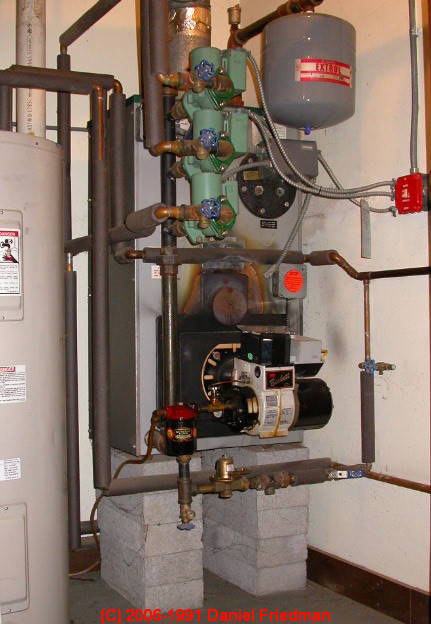
- A "heating boiler" (also called hydronic heating) heats the building using hot water. A hot water heating boiler is shown in our photo at left and in a sketch provided later in this article.
See BOILERS, HEATING - home
or
See BOILER OPERATING STEPS for both gas and oil fired hot water heating boiler sequence of operations and key parts. - A steam heating boiler actually boils water and sends steam through building heating pipes, steam radiators or convectors to deliver heat.
See STEAM HEATING SYSTEMS & CONTROLS - topic home, for details - A "furnace" heats a building using hot air or "warm air".
See FURNACES, HEATING - home - Heat pumps use the same equipment that serves for cooling or air conditioning, but in a reverse operating direction the heat pump extracts heat from outside air and sends it into the building.
See HEAT PUMPS, DIAGNOSIS, REPAIR - home
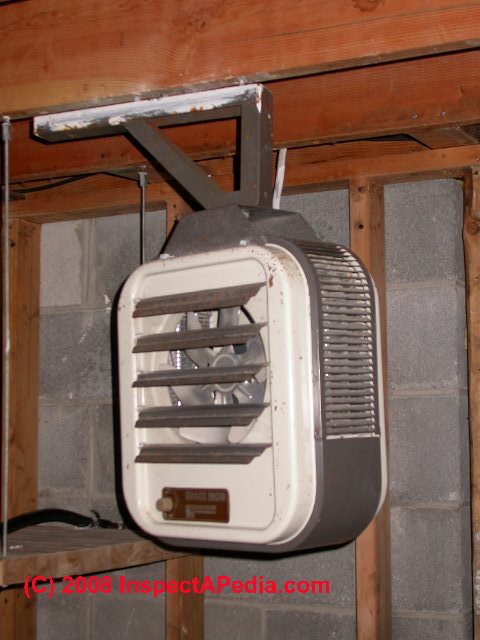
Above: A fan coil heater hung from a garage ceiling. This heater type is discussed at FAN COIL & FAN CONVECTOR HEATERS & HYDRONIC COILS and may use electricity as a heat source or it may obtain heat from piping from a hydronic (hot water) heating boiler.
- Hybrid or mixed heating systems: Some heating systems combine both hot water and hot air to heat a building, such as
water to air systems which use a heating boiler (oil, gas, or electric) to heat water which circulates through (and inside of) a heat exchanger
(that looks like a car radiator).
The heat exchanger in a water to air heating system is then placed inside of an air handler or blower compartment where a blower fan circulates building air from return ducts to a plenum where air is blown across the heat exchanger and then the warmed air is delivered to the occupied space through additional warm air ducts or radiators.
See FAN COIL & FAN CONVECTOR HEATERS & HYDRONIC COILS
Details and sketches of different types of heating systems are provided below.
Types Heating System Fuels: oil, gas, electricity, solar, etc
Heating furnaces, boilers, and steam boilers may make use of different energy sources. Your heating system may use
- Gas heating fuel (LP or bottled gas or piped-in natural gas)
See GAS PIPING, VALVES, CONTROLS - Oil heating fuel (typically No. 2 home heating oil or a kerosene and oil mix),
See HEATING OIL TYPES & PROPERTIES - home
also
see OIL TANKS and OIL TANK PIPING & PIPING DEFECT - Electric heating systems may use electric baseboards along walls of rooms or an electric furnace to heat forced warm air, or an electric boiler to circulate hot water through baseboards or radiators.
See ELECTRIC HEAT - home - Geothermal heat source (ground water)
See GEOTHERMAL HEATING SYSTEMS - Solar home heating systems and solar hot water systems as well as solar pool heaters usually use roof-mounted panels of tubing through which water or a water-antifreeze mix is circulated. The panel of tubing is heated by sunlight; heated water may in turn be used in hot water heating system, in a water-to-air system, or in a hot water supply system.
See SOLAR HEATING SYSTEM DESIGNS - Or a combination of these systems may be used at your property.
Types of Heat Distribution Methods in buildings: air, hot water, radiant heating
Before we go on to illustrate the types of equipment that actually produce the heat to be used in a building we list the basic methods of heat distribution within a building
- Air heat distribution by air ducts: for warm air or hot air heating systems, a modern air duct system includes one or more return ducts that bring cool air from the occupied space back tothe furnace, and one or more supply ducts and registers that deliver warm air to the occuped space. Air heat, also referred to as warm air heat, forced warm air heat, gravity warm air heat, or hot air heat, is provided by a heater referred to as a furnace.
Most buildings use conventionally sized ducts and a blower unit to move air through the heating system. Some buildings may use smaller high-velocity air ducts and supply registers. These are explained in detail
at DUCT SYSTEM DESIGN SIZE & DEFECTS. - Hot water heat distribution is made by hot water baseboards, convectors, radiators, or radiant heating. Cool water returns from the radiating devices to the boiler where it is heated and then circulated (by convection or by one or more circulator pumps) back to the radiating devices. Hot water heating systems are also called hydronic heating systems and with few exceptions the hot water heater is referred to as a boiler.
See BASEBOARD HEAT
Additional levels of heat distribution control to different building areas may be obtained by individual heat piping loops and individual circulator pumps or zone valves that control each heating loop. These are explained in detail
at RADIATORS - Radiant heating distributes heat to the occupied space using electric or hydronic in-floor or in-ceiling radiant heating panels or tubing. The heat source for radiant heat may be electric, a gas or oil fired boiler, or solar or even geothermal.
See RADIANT HEAT. - Water to air heating systems use hot water to heat coils through which building air is heated; some water to air systems heat just part of a building while other building areas are heated by hot water baseboards or radiators.
See FAN COIL & FAN CONVECTOR HEATERS & HYDRONIC COILS
Air heating systems blow warm air into the room to warm the room and its occupants. Hot water heating systems radiate warmth into the room by both radiant heating from hot radiators or baseboards and by warming air that circulates through the radiator, convector, or baseboard by convection. Radiant heating systems warm room surfaces and occupants without directly warming the room air itself.
Heating System Types: Boilers, Steam Boilers, Furnaces, Mixed Systems
Warm Air or hot air heating Furnaces
 Warm Air Heating Systems - Furnaces:
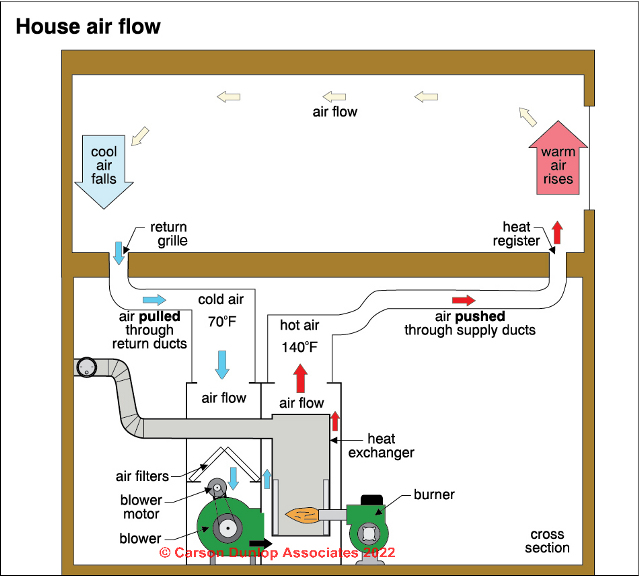
If the heat in your building is provided by warm air that flows out of ceiling, wall, or floor air supply registers into the occupied space, or if your heating system uses a water-to-air heating system then the air which warms the living space is probably being delivered through large or small diameter ducts, registers, air filters, and a furnace blower, and the air is being heated by a gas, oil, or electric furnace, or perhaps by a heat pump or a geo-thermal system.
Modern warm air heat furnaces use "forced air" - that is, a blower that circulates building air from return air registers through the heating furnace and pushes it into the occupied space through ductwork and supply registers.
In modern furnaces the heating air flow direction may be "upflow" (cool air enters at the bottom of the furnace and warm air exits at the top, or "downflow" (cool air enters at the top and flows out of the furnace side or bottom such as in our sketch at left).
Older warm air heating systems used gravity (warm air rises by convection) to deliver heat to the occupied space without a blower fan. See AGE of HEATERS, BOILERS, FURNACES for an illustration of a gravity furnace.
For a detailed guide to inspecting and maintaining warm air heating systems or furnaces,
see FURNACES, HEATING
and FURNACE CONTROLS & SWITCHES
and FURNACE OPERATION DETAILS
Sketch of a typical warm air heating system (above left) is provided courtesy of Carson Dunlop Associates Associates.
Hot Water "hydronic" Heating Boilers
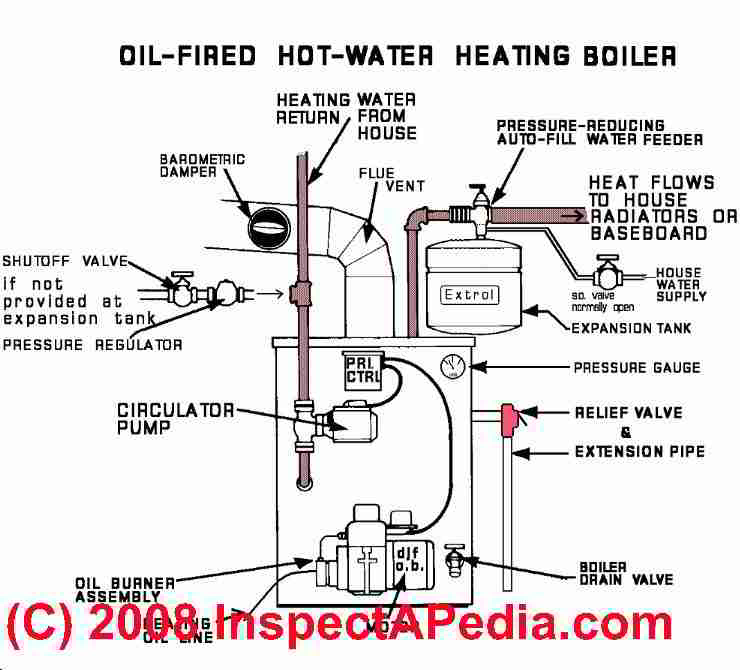
If the heat in your building is provided by warm or hot metal radiators, heating baseboards containing finned copper tubing, or wall convectors that look like a radiator but contain finned copper tubing, or if heat is provided by flexible rubber, plastic, or metal tubing run in building floors or ceilings, then the warm or hot water circulating in those devices is probably being delivered by piping circulating water heated by a heating boiler, or possibly by a steam boiler or a heat pump or geo-thermal system.
Modern hydronic heating systems use one or more circulator pumps to move hot water from the boiler through radiators or baseboards that deliver heat to the occupied space. Cooler water returns to the boiler for re-heating.
Older hot water heating systems may have omitted the circulator pump(s), relying simply on gravity (warm water rises in the pipes by convection) to move hot water through the building.
See BOILERS, HEATING
and RADIANT HEAT FLOOR MISTAKES.
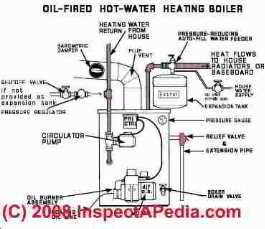
A sketch of a typical hydronic heating system is shown at left. (Hot water radiators or baseboards are not shown in this sketch.)
What is a Hydronic or "hot water" Heating System?
What are we looking at when we're talking about oil-fired hot water heat? It's helpful to form a simple working definition that helps understand the system. An oil-fired forced hot water or "hydronic" heating system is a collection of components which heats a building by heating and then circulating hot water through heat-radiating devices located in the occupied space.
A "heating boiler" is a steel, copper, or cast iron "box" of hot water, connected to a loop of pipe (and radiators or baseboards) which runs around through the living area.
The same physical water stays in the boiler and is circulated by a pump so that heat is delivered to the living area. Burning oil makes hot gases which are used to heat the water before being exhausted outside. Pumps move fluids through the system. Safety controls of various types are installed at various points protect against a number of potential hazards.
How does a "hot water" Heating Boiler Work?
We discuss how heating boilers work in step-by-step detail
at BOILER OPERATION DETAILS
What's the difference between a hydronic (hot water) boiler and a steam boiler?
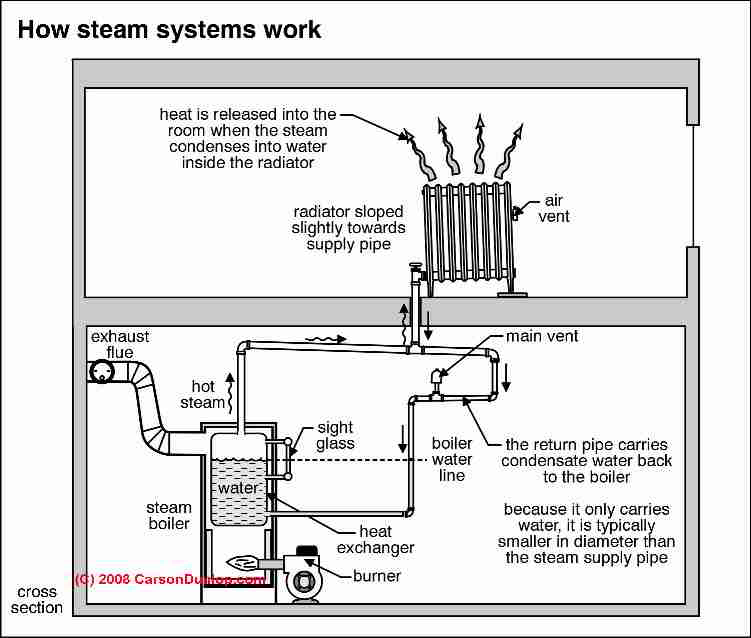 A "steam boiler" delivers heat to the occupied space in the form of steam: the boiler literally "boils" water and sends steam rising up through steam riser pipes (steam, hotter and less dense than air, rises by convection in the piping system) and through steam radiators in the occupied space.
If your heating radiators have valves which hiss and let air escape as heat is coming on your heat is probably being delivered in pipes which circulate steam from the steam boiler up through radiators in the occupied space.
At the steam boiler controls monitor the boiler pressure (less than 0.5 psi in most residential steam boilers), the boiler water level, and the burner operation (gas or oil).
Additional heating controls unique to steam heat include the air vent or "steam vent" found on each radiator (see sketch at left) allows steam to enter and air to escape from the radiator.
For a detailed guide to inspecting, diagnosing, maintaining & repairing steam heat systems
Hybrid or Mixed Heating Systems: Water to Air combination systems & Dual Hot Water & Warm Air Heating Systems
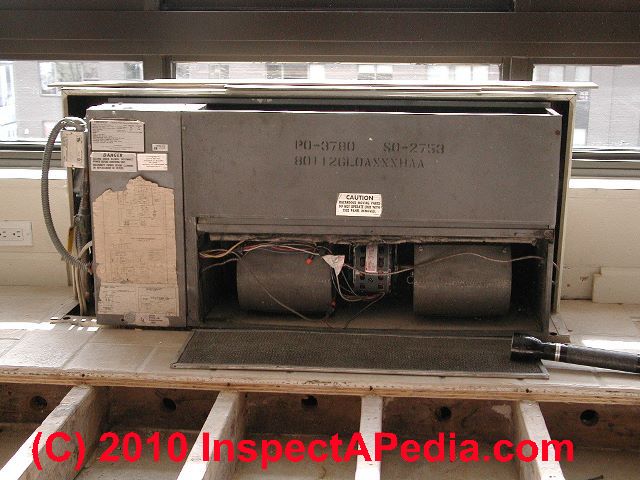 Mixed heating systems typically convert hot water to warm air heat by using a heating boiler to produce the hot water and a fan coil unit that blows room air across that hot water as it circulates through the coil.
Mixed heating systems are used both in individual residential homes, often as backup heat or to make use of air ducts and blowers, or they may be used in a large apartment building or office building to permit installation of a large commercial boiler to provide heat to multiple rooms where both heating and cooling will be provided by the same in-room unit.
The fan coil heating unit shown at left is in a New York City apartment. This unit also provides cooling in summer months.
This mixed heating system has had its cover removed and the floor below opened during a mold remediation project: the unit's A/C component had leaked condensate into the floor structure.
The heating boiler for the apartment building serves all of the units.
Finally, water to air heat is often used to provide concentrated or spot heat to areas of a building that is otherwise heated with hot water radiators or baseboards.
An example of "spot heat", illustrated in our fan convector article cited below is the provision of heat for a garage work area using an overhead water to air fan convector unit.
For a detailed guide to inspecting, diagnosing, maintaining & repairing mixed, hybrid, water to air heating systems
see FAN COIL & FAN CONVECTOR HEATERS & HYDRONIC COILS
Definition of Water to Air Heat Exchanger Heating Systems
Some heating systems combine both hot water and hot air to heat a building, such as water to air systems which use a heating boiler (oil, gas, or electric) to heat water which circulates through (and inside of) a heat exchanger (that looks like a car radiator).
The heat exchanger in a water to air heating system is then placed inside of an air handler or blower compartment where a blower fan circulates building air from return ducts to a plenum where air is blown across the heat exchanger and then the warmed air is delivered to the occupied space through additional warm air ducts or radiators .Water-to-air heating systems will use both a separate water heating boiler and a blower or air handler system.
Comparing large vs. small Warm Air Heating Duct Systems: direct air vs. water-to-air heating designs
 If the heat in your building is provided by warm air that flows out of ceiling, wall, or floor air supply registers into the
occupied space, or if your heating system uses a water-to-air heating system then the air which warms the living space is probably being
delivered through large or small diameter ducts, registers, air filters, and a furnace blower, and the air is being
heated by a gas, oil, or electric furnace, or perhaps by a heat pump or a geo-thermal system.
If the heat in your building is provided by warm air that flows out of ceiling, wall, or floor air supply registers into the
occupied space, or if your heating system uses a water-to-air heating system then the air which warms the living space is probably being
delivered through large or small diameter ducts, registers, air filters, and a furnace blower, and the air is being
heated by a gas, oil, or electric furnace, or perhaps by a heat pump or a geo-thermal system.
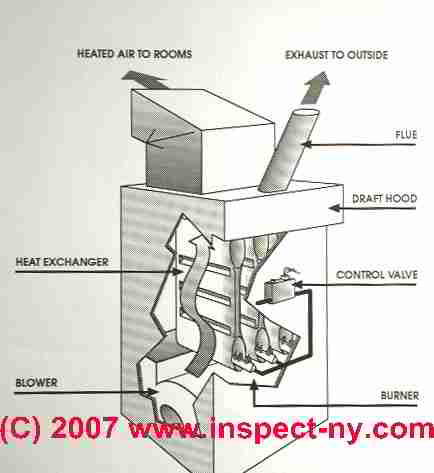
But in a direct warm air heating system the air being circulated through the building ductwork is itself directly heated by a heat exchanger located inside of the furnace.
Building air enters the furnace air intake, flows through the heat exchanger interior, enters the warm air plenum, and flows from the plenum into the building air duct system.
In a water to air heating system, a heating boiler (oil, gas, electric, solar, other) heats water that is then circulated through a heating coil (it looks a lot like a car radiator). Building air is warmed by being blown across the heating coil. The air heating coil can be quite distant from the heating boiler, connected to it by hot water piping.
Definition of Dual Water and Air Heating Systems
Some buildings are heated by a combination of separate hot water systems (circulating hot water through radiating devices like baseboards or radiators in some areas) and hot air systems (circulating warm air through ductwork into the occupied space in other areas).
These buildings will have both a hot air furnace and a completely separate hot water heating boiler installed. In this case these are completely separate heating systems and usually each serves different building areas.
Reader Question: how does a Gas fired boiler- PTAC unit work?
(Oct 23, 2014) Bob said:
We have a gas fired boiler which sends heat through the ptac unit - what is the mechanics of how it works?
Reply:
For other readers, the definition of PTAC "Packaged Terminal Air Conditioner" for which PTAC is an abbreviation that can be misleading since PTAC systems also are used to provide heat.
PTAC units are individual, self-contained heating or cooling systems or heat pumps typically used in large multi-occupant buildings such as hotels, hospitals, apartments, and condominiums. PTACs may also be installed to bring heating or cooling to an add-on or addition to a single family home, particularly where an A/C or heat pump s needed for the addition for which extending the building's existing heating or cooling system is not feasible.
For Bob's PTAC system we are seeing a combination system: a gas fired hot water (hydronic) heating boiler, probably already installed to heat the primary building areas, includes an additional hot water heating loop or zone whose piping, instead of running through hot water baseboards or radiators, sends hot water through a heat-exchanging coil inside of a small packaged air handler or blower unit.
Such heaters (or air conditioners in similar designs) may be built into a wall, wall-mounted, ceiling-mounted, or may be suspenced as a ceiling-hung fan convector unit.
Details are at FAN COIL & FAN CONVECTOR HEATERS & HYDRONIC COILS
Reader Question: what if my heating system is not like the ones on this page?
(Nov 11, 2012) HH said:
I have read over your page, yet none of these systems are like the one we have, we have a hot water boiler that stands alone, next to it is a cupboard that house's copper pipes, it has two different setting for summer and winter, in the summer we switch it so it just proved hot water.
In the winter when we put it to provide heat it does great on the heating side but alas we don't get any hot water. It seem that boiler sends all the heat to the heating system and none to keep the water hot. Its been like this 6 years and no one seems to know how to fix it, the house is ten years old and the first two owners sold within two years of purchase.
I would dearly love to figure out why we can't have heating and hot water.
Reply:
We'd like to description does not give us enough information to identify your heating system try sending us a sketch or some photos using the Contact Us link found at page top or page bottom. We will research and document your system for you at no charge.
(Jan 23, 2013) MechFIX said:
There a several things this could be. It sounds like it is a hot water cogeneration or combination boiler.
There is one boiler, through which your heating water is circulated. This water is then either used to heat the house and/or used to heat your domestic hot water, usually in an on-demand way via a water-to-water heat exchanger (unless you still have a hot water tank with the heater loop running through it). Typically these systems have two circulation pumps on the heater loop, a small one for the domestic hot water heat exchanger and a large one for the house system.
These systems also rely on valves being set properly such that flow is allowed to go where it is required, which is adjusted by season.
And finally, these systems sometimes work as modulating boilers, meaning they run somewhere between full on and off as required to keep a steady heat. So the issues could be that your domestic hot water heat exchanger circulation pump is not working and so this section is getting very little heat when the house is using most of the capacity, the valves are being closed off or not correctly balanced to ensure sufficient flow to the heat exchanger, or the modulated boiler temperature is staying too low to keep your domestic hot water heat output high enough, which may be correctable by throttling down the house heat valve or by electronic control settings
- Thanks MecFix - Ed.
Make sure your heating inspection is complete: how to Inspect any Heating System using Physical Location of Components
This approach broadens the scope of the heating system inspection and it may aid in heating system defect recognition or problem diagnosis, for example by observing that a heating boiler is located in a small, air-tight room (possible combustion air problems), or that the furnace is quite close to the oil storage tank.
Below we give the basics of heating system inspection using the physical location "map" of components to assure completeness. See full details of heating system inspection procedures provided
at HEATING SYSTEM INSPECT DIAGNOSE REPAIR
- Heating components: Identify the heating system components in each building area.
- Heating fuel & fuel delivery: At the heating boiler or furnace, identify the fuel source and follow fuel supply piping to its source (an oil tank, LP gas tank, or gas meter, or electricity for example).
- Heat distribution: At the boiler or furnace, identify the heat distribution method and follow the delivery of heat (warm air or hot water) leaving the furnace or boiler, and returning to it. Failure to consider this whole path logically risks failing to notice potential problems such as return air taken at a furnace itself or the absence of adequate return air.
- Heating controls: At the boiler or furnace identify each of the controls and safety devices and observe their condition. Those devices that are intended for normal operation by the home owner are usually also operated and tested by the inspector. Other devices such as temperature/pressure relief valves are not normally operated but are visually inspected for evidence of a problem.
Reader Comments, Questions & Answers About The Article Above
Below you will find questions and answers previously posted on this page at its page bottom reader comment box.
Reader Q&A - also see RECOMMENDED ARTICLES & FAQs
On 2020-07-20 - by (mod) -
Nigel, is there a question other than inaccessibility, lack of service and so maybe some serious safety worriers?
On 2020-07-27 by nigel duffin
the heating system is installed behind a wall and blows out through ducts in the walls and does the hot water as well i would say 60 years old in the house when built. plus checking for carbon monixide
On 2020-07-20 - by (mod) -
Madelyn
I confess I have trouble making much sense out of the explanation you were giveb, but I acknowledge that it's possible that some of the information may have been Lost in Translation.
In no case would you heat a building by simply releasing Steam from vents in a ceiling. Steam is a hot gas produced by boiling water and is used to transport energy or heat through Steam pipes in a building where steam is used to heat a radiator work in vector or other heat emitting device. You wouldn't simply release steam into a room as a means of providing Heat.
Since you mention that we are using a venting or duct system is also going to be used for air conditioning I am guessing that the system involves a heating convector or small steam finned radiator located in the duct sealing system that intern Peach air blown through it and onwards into the room. So it would be heated air that's released into the room.
Clean the pipes will never freezes a bit of a broad promise that is not what I would make. If a building loses heat water anywhere in the building piping system can certainly freeze. Even in a steam system, at which the salesman is showing you that steam, being a gas not a liquid, can't freeze, never the less. Method of heating produces a condensate which in turn must flow back to the steam boiler. So if we lost heat and there were traps anywhere in the system that held condensate those could also fries. And of course the boiler itself contains water and that can freeze if, for example the building loses electrical power. And that case the steam boiler is not going to run, the building has no heat, and water anywhere in the building in any system can freeze if the building has to go long enough without heat.
If your son loves the steam radiators that are already in the building they can be used to continue to provide Steam Heat and the air conditioning system would simply be different from or separate from the heating system.
If the radiators in the present building are being used for hot water heat it may not be feasible to convert them to steam without replacing the piping as well as other fittings. And not all hot water radiators are big enough to provide Steam Heat.
Bottom line is we don't know enough about what's installed presently and it sounds as if the installer is attempting to suggest you a combined system which could work well, but may not be necessary and maybe over promised with regards to the fries risk problem.
On 2020-07-20 by Madelyn S Smallberg
My son is in the process of adding on to an 1890s farm house with steam radiators. He has been advised to add a system that puts out steam though ceiling vents while retaining his old radiators. These vents will also be used for the air conditioning addition. Just how does this work? Is it efficient ? He was also told that his pipes will never freeze if he loses electricity or the boiler fails. Is this a good idea? How does it work exactly? H e loves his radiators and would like to keep the ones that are in place. Is this cost efficient? Any suggestions?.
On 2020-02-05 - by (mod) -
Shelly
There are several safety devices that might keep turning off a gas-fired heater, pretty much ALL of them important Life-Safety features. Here are some examples of what your service tech may check:
- spillage at the exhaust flue
- excessive plenum temperature
- flame sensor doesn't sense proper gas flame
- blower fan is not turning on
Do you hear the blower fan run?
Watch the fan limit switch dial as the heater warms up - if it is reaching the FAN OFF HIGH LIMIT then we know the problem is with a blocked heat exchanger, dirty filter, blocked ductwork etc. -
On 2020-02-05 by Shelly
My warm air gas powered with electric ignition won’t stay on. It starts and regardless of the thermostat setting it turns off in a couple of minutes. I changed the circuit breaker associated with it in troubleshooting this issue. That’s not the problem. Any useful advice would be very welcome...
On 2019-05-14 - by (mod) -
I can't hazard a guess.
Perhaps you can give me a bit more information.
Take a look: where does heat "come out" - what gets warm or hot? What does it look like? Where is it found: on the floor, wall, ceiling?
In the article above review the "Types of Heat Distribution Methods in buildings: air, hot water, radiant heating" as when we know that we can guess at what kind of heat your system has.
Then perhaps if you describe the weird noises we can comment usefully on that: hissing, popping, crackling, humming, banging.
OR if you don't feel like bothering with all that description, just click right over to HEATING SYSTEM NOISE DIAGNOSIS https://inspectapedia.com/heat/Heating_Noise_Diagnosis.php
and we can get right into diagnosing what's going on (probably) by what the noise sounds-like.
On 2019-05-14 by Anonymous
What. Kind of heating system is built inside of the ceiling of my apartment, i live on the top floor and it makes weird noises
On 2018-01-08 - by (mod) -
Stacey,
This does not sound like a safe heating system to me: the chimney normally extends well above the roof line, and actual smoke from a gas flue can indicate a combustion air, burner, or chimney problem that is unsafe, producing dangerous carbon monoxide gas.
In my OPINION you should before going to sleep tonight,
1. Be sure there are working CO (Carbon monoxide) and smoke detectors in your daughter's bedroom as well as at other appropriate locations in your home
2. Keep the window shut
3. Notify the building operator of what sounds like a dangerous condition - orally and in writing, and notify others who may be affected
On 2018-01-08 by Stacey
My building uses a gas boiler and hot water baseboards for heating. We have a chimney that ends half way the height of the building on the side of the building (not on top). The chimney is constantly blowing white smoke which enters through my daughter's room window. My question is what is in that white smoke and is it harmful to the health (gas boiler/baseboard water type of heating system).
Thank you very much for any response!
On 2017-12-30 - by (mod) -
Mike,
Our article series beginning with
FAN LIMIT SWITCH
And that can be found by searching for that title using the on Page search box above, will give you the typical fan limit switch settings. However you definitely want to pick up a copy of the installation and operation manual for your specific furnace to see what the factory settings should be.
On 2017-12-28 by Mike
I have a Lennox G8 and the limit switch I think it’s a camstat and it has 2 dials one on top says fan off and the bottom says Diff I need to know what the factory settings are. Thank you
On 2016-03-19 - by (mod) -
A "water heater" is a system used to produce domestic hot water for washing and bathing.
A "boiler" is a building heating system (keeping the rooms and occupants warm) using hot water and radiators or baseboards or other heat-radiating devices.
On 2016-03-10 by Rahman
Hello Sir/Madam,
I am still confuse, when we are talking about (Water heater and Boiler) tow different names,
but what is the differents between these tow.
I will appreciate for answer my question
Question: need info on a pilot for a Briant gas boiler 234-4PW, series D. ser 16B 46339.
(Nov 5, 2014) Dave D said:
I have a Bryant gas boiler, hot water heat. the model is 234-4PW, series D. ser 16B 46339. I am trying to find a place where i can get a pilot assembly.
Reply:
Dave
Just contact Bryant - www.bryant.com -- with the model and serial number of hour boiler (as below) and they can tell you what OEM part or replacement part will be proper for your Bryant gas fired boiler.
More contact information is at MANUALS & PARTS GUIDES - HVAC
...
Continue reading at DIAGNOSE & FIX HEATING PROBLEMS-BOILER or select a topic from the closely-related articles below, or see the complete ARTICLE INDEX.
Or see
DIAGNOSE & FIX HEATING PROBLEMS-FURNACE
DIAGNOSTIC GUIDE A/C or HEAT PUMP
Suggested citation for this web page
HEATING SYSTEM TYPES at InspectApedia.com - online encyclopedia of building & environmental inspection, testing, diagnosis, repair, & problem prevention advice.
Or see this
INDEX to RELATED ARTICLES: ARTICLE INDEX to HEATING SYSTEMS
Or use the SEARCH BOX found below to Ask a Question or Search InspectApedia
Ask a Question or Search InspectApedia
Try the search box just below, or if you prefer, post a question or comment in the Comments box below and we will respond promptly.
Search the InspectApedia website
Note: appearance of your Comment below may be delayed: if your comment contains an image, photograph, web link, or text that looks to the software as if it might be a web link, your posting will appear after it has been approved by a moderator. Apologies for the delay.
Only one image can be added per comment but you can post as many comments, and therefore images, as you like.
You will not receive a notification when a response to your question has been posted.
Please bookmark this page to make it easy for you to check back for our response.
Our Comment Box is provided by Countable Web Productions countable.ca
Citations & References
In addition to any citations in the article above, a full list is available on request.
- Our recommended books about building & mechanical systems design, inspection, problem diagnosis, and repair, and about indoor environment and IAQ testing, diagnosis, and cleanup are at the InspectAPedia Bookstore. Also see our Book Reviews - InspectAPedia.
- Domestic and Commercial Oil Burners, Charles H. Burkhardt, McGraw Hill Book Company, New York 3rd Ed 1969.
- National Fuel Gas Code (Z223.1) $16.00 and National Fuel Gas Code Handbook (Z223.2) $47.00 American Gas Association (A.G.A.), 1515 Wilson Boulevard, Arlington, VA 22209 also available from National Fire Protection Association, Batterymarch Park, Quincy, MA 02269. Fundamentals of Gas Appliance Venting and Ventilation, 1985, American Gas Association Laboratories, Engineering Services Department. American Gas Association, 1515 Wilson Boulevard, Arlington, VA 22209. Catalog #XHO585. Reprinted 1989.
- The Steam Book, 1984, Training and Education Department, Fluid Handling Division, ITT [probably out of print, possibly available from several home inspection supply companies] Fuel Oil and Oil Heat Magazine, October 1990, offers an update,
- Principles of Steam Heating, $13.25 includes postage. Fuel oil & Oil Heat Magazine, 389 Passaic Ave., Fairfield, NJ 07004.
- The Lost Art of Steam Heating, Dan Holohan, 516-579-3046 FAX
- Principles of Steam Heating, Dan Holohan, technical editor of Fuel Oil and Oil Heat magazine, 389 Passaic Ave., Fairfield, NJ 07004 ($12.+1.25 postage/handling).
- "Residential Steam Heating Systems", Instructional Technologies Institute, Inc., 145 "D" Grassy Plain St., Bethel, CT 06801 800/227-1663 [home inspection training material] 1987
- "Residential Hydronic (circulating hot water) Heating Systems", Instructional Technologies Institute, Inc., 145 "D" Grassy Plain St., Bethel, CT 06801 800/227-1663 [home inspection training material] 1987
- "Warm Air Heating Systems". Instructional Technologies Institute, Inc., 145 "D" Grassy Plain St., Bethel, CT 06801 800/227-1663 [home inspection training material] 1987
- Heating, Ventilating, and Air Conditioning Volume I, Heating Fundamentals,
- Boilers, Boiler Conversions, James E. Brumbaugh, ISBN 0-672-23389-4 (v. 1) Volume II, Oil, Gas, and Coal Burners, Controls, Ducts, Piping, Valves, James E. Brumbaugh, ISBN 0-672-23390-7 (v. 2) Volume III, Radiant Heating, Water Heaters, Ventilation, Air Conditioning, Heat Pumps, Air Cleaners, James E. Brumbaugh, ISBN 0-672-23383-5 (v. 3) or ISBN 0-672-23380-0 (set) Special Sales Director, Macmillan Publishing Co., 866 Third Ave., New York, NY 10022. Macmillan Publishing Co., NY
- Installation Guide for Residential Hydronic Heating Systems
- Installation Guide #200, The Hydronics Institute, 35 Russo Place, Berkeley Heights, NJ 07922
- The ABC's of Retention Head Oil Burners, National Association of Oil Heat Service Managers, TM 115, National Old Timers' Association of the Energy Industry, PO Box 168, Mineola, NY 11501. (Excellent tips on spotting problems on oil-fired heating equipment. Booklet.)
- In addition to citations & references found in this article, see the research citations given at the end of the related articles found at our suggested
CONTINUE READING or RECOMMENDED ARTICLES.
- Carson, Dunlop & Associates Ltd., 120 Carlton Street Suite 407, Toronto ON M5A 4K2. Tel: (416) 964-9415 1-800-268-7070 Email: info@carsondunlop.com. Alan Carson is a past president of ASHI, the American Society of Home Inspectors.
Thanks to Alan Carson and Bob Dunlop, for permission for InspectAPedia to use text excerpts from The HOME REFERENCE BOOK - the Encyclopedia of Homes and to use illustrations from The ILLUSTRATED HOME .
Carson Dunlop Associates provides extensive home inspection education and report writing material. In gratitude we provide links to tsome Carson Dunlop Associates products and services.
 | HOME | ABOUT | ASK a QUESTION | CONTACT | CONTENT USE POLICY | DESCRIPTION | POLICIES | PRIVACY | |
| © 2024 - 1985 Publisher InspectApedia.com - Daniel Friedman | |||||||||