
InspectAPedia® FREE Encyclopedia of Building & Environmental Construction, Diagnosis, Maintenance & Repair |
Question? Just ask us! InspectAPedia
|
 No Heat Diagnosis for Warm Air Furnace
- POST a QUESTION or COMMENT about how to fix a warm air heating furnace that is not working
Warm air heating furnace troubleshooting:
How to diagnose & fix hot air furnace heating system problems: hot air or warm air heating system troubleshooting, inspection, diagnosis, and repair.
Diagnosis and correction of NO HEAT or NOT ENOUGH HEAT conditions for warm air or hot air furnace and air duct heating systems. We explain how to recognize and fix common heating system operating or safety defects and how to save money on home heating costs.
InspectAPedia tolerates no conflicts of interest. We have no relationship with advertisers, products, or services discussed at this website.
How to Diagnose & Fix Loss of Heat from Hot Air Furnace Systems
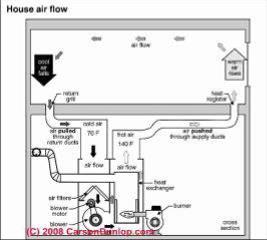 If your furnace isn't working, what can you fix yourself and what should you check before you call a heating service company? Carson Dunlop Associates ' sketch hows the main layout of a basic warm air heating system.
[Click to enlarge any image]
If you don't know whether your heat is provided by a furnace (hot air) or boiler (hot water), or whether your fuel is oil, gas, or electric,
and whether your heat is hot water, steam, or warm air,
see HEATING SYSTEM TYPES.
If your heating system uses water or hydronic or hot water or radiator or baseboard hot water
heating systems, instead of the article found here you should
see NO HEAT - BOILER
Note: some hybrid or mixed heating systems combine both hot water and hot air to heat a building, such as
water to air systems which use a heating boiler (oil, gas, or electric) to heat water which circulates through (and inside of) a heat exchanger
(that looks like a car radiator) - described
Check These Items to Diagnose Loss of Warm-Air Heat:
Step 1: If the furnace oil burner or gas burner is not turning on at all check these points
- Electrical power to circuits powering the heater (or air conditioner or heat pump) may be turned off:
at the main electrical panel and sub panels, check the circuit breaker or fuse supplying power to the unit;
check the service switch at the furnace or air handler,
and if the system is air conditioning or a heat pump, check the service switch outside at the compressor/condenser unit to be sure it is "on".
Don't forget to check for loose or corroded electrical connections.
A bad connection at power or at a control connector can cause total loss of heat or intermittent or on-off heater operation. - Check Furnace Electrical Switches and Live Power
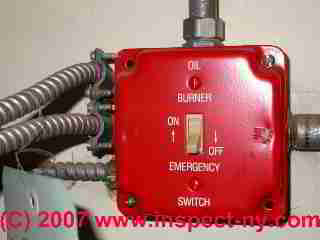
Is the furnace turned on? Check the electrical service switch at the furnace as well as others that may be present in the home. Is there electric power to all of the heating system components such as an oil burner at the furnace and power to the blower fan?
Watch out: emember to check all of the On-Off switches for your heater - there are often at least two, sometimes more. See details
at HEAT ON-OFF SWITCH LOCATIONS - hidden? extra?
Watch out: check the air handler blower door interlock switches:
Has someone left an inspection or furnace access door open on the furnace? Or has an interlock switch itself been knocked loose?
(Modern furnaces have a switch which forces the furnace to turn off if the inspection door is opened - to avoid injury to someone working on the blower assembly.)
Be sure the access covers are properly-closed, seated, and latched and that the switches themselves are secured in place. - Oil Burner safety reset switch is off: the heating or air conditioning system may have been turned off on reset - see our "off on reset" and other advice
at CAD CELL RELAY SWITCH (modern equipment) and
also STACK RELAY SWITCH (older oil fired furnaces and boilers). - Cad cell control or stack relay buzzing or jamming trouble: if you hear or have ever heard buzzing from any heating system control that includes a relay switch, watch out for a control cover that is in contact with a relay switch in the unit. If the cover is lightly touching the relay switch the control may simply buzz when the relay is trying to move.
But a too-tight control cover can also prevent a relay from operating, leading to loss of heat. Simply pulling off the cover to let the relay move freely can immediately discover and "fix" this problem. Details and an explanation are
at HEATING SYSTEM NOISE DIAGNOSIS.
Where are all the heating system reset buttons? If you are looking for the main reset button on oil fired heating equipment you'll want to see:
CAD CELL RELAY SWITCH or
On older oil fired furnaces,
STACK RELAY SWITCH On older oil fired boilers and furnaces.
For gas fired furnaces
see GAS REGULATORS & APPLIANCE / HEATER CONTROLS
and FLUE GAS SPILL SWITCH TRIPPING & RESET (gas fired equipment),
At ELECTRIC MOTOR OVERLOAD RESET SWITCH we discuss the thermal overload switch and reset button that is found on many electric motors including those operating air conditioning fans, heating system oil burners, and furnace blowers and motors.
Step 2: Check the heating fuel supply for the furnace
- If it is a gas furnace, is the gas turned on? If your gas is from bottled or LP gas, is the tank empty? Check that no one has shut the gas supply valves.
- If it is an oil fired heating furnace, check the gauge on the oil tank. Are you out of oil?
See OIL TANK GAUGES for details
An oil or gas fired heating furnace may go off on safety reset even if there is a good fuel supply. And at an oil furnace, even if there is plenty of heating oil in the tank if the oil filter has become blocked the system will try to start but won't run - this will require a service call.
Check for a broken or slipping coupling (or a frozen coupling) between the oil burner motor and the fuel unit. In this case the burner starts in response to a call for heat, but there will be no ignition whatsoever because no oil is being delivered to the nozzle assembly.
Check these additional causes of no oil flow to the oil burner: an oil safety valve that has been "closed" (someone turned it the wrong way), low oil or no oil in the heating oil tank (the tank may not be completely empty but oil may be below the oil pickup line if the oil lines are exiting at the top of the tank), a clogged oil filter or fuel unit strainer, a clogged oil burner nozzle, a air leak in the heating oil supply piping, or a crimp or clog or restriction in the oil piping.
If you recently ran out of oil and then got a delivery, and if your system uses a single oil line between tank and burner, the line or fuel unit may be air bound and needs to be bled. [8]
Step 3: Once you have assured that you have heating fuel and that electrical power is turned on
If you have power and fuel to the heater, next check these controls
- Heating Thermostat is in the "OFF" position or is set to a temperature that does not call for heating (or cooling) - either of these is using the thermostat to say "do not run the heat"
See FAN AUTO ON THERMOSTAT SWITCH for details about what turns the blower fan on and off.
Condensate tray overflow switch: If the fan blower unit combines heating and air conditioning, an air conditioning condensate pan float switch could be in the "shut off" position due to water in the condensate overflow pan or because the switch has been damaged or moved.
See CONDENSATE DRIP TRAY DEFECTS
Fan limit switch may be damaged or inoperable.
See FAN LIMIT SWITCH the flue gas spillage switch:
If your furnace is gas-fired, a flue gas spillage switch may have shut the system down after sensing possibly dangerous flue gases (that can contain fatal carbon monoxide).
See FLUE GAS SPILL SWITCH TRIPPING & RESET to check the flue gas spillage sensor found at gas fired heating equipment draft hoods or near gas burners - Stack relay switch may be installed on the flue connector of an oil fired furnace and may be in the "safety - off" position. To identify and reset this control see STACK RELAY SWITCH
- Loose electrical connections: Here is an example:
Then the furnace draft fan began to pulse several times upon starting. After making sure the control module showed a steady green, I asked a friend and he suggested that I wiggle all the spade connectors to be sure there is good contact between the copper and aluminum. It seems that there only needs to be a little corrosion to cause problems. That seems to have done the trick. . - M.F. 12/24/2014
- No heat or not enough heat or not enough warm air volume from the Furnace: is any air coming out of the supply registers? Is it warm or cool?
No warm air comes out: If no air is coming out of supply registers, is this true throughout the building (the blower is blocked or not running) or just in some areas (some registers or duct sections are closed or blocked)?
Heating air comes out but it is too weak or slow: check for a dirty clogged air filter.
See AIR FILTERS for HVAC SYSTEMS , a dirty-clogged blower fan, blocked, disconnected ductwork. - Check the warm air heat thermostats: is the thermostat(s) turned up above ambient air temperature in the occupied space? Is the thermostat set to "heat" position (if a heating/cooling/off switch is present on the thermostat). See the discussion of thermostat switches.
See FAN AUTO ON CONTROLS. - Check furnace blower operation: Does the furnace cycle on, the oil burner or gas burner runs, but the blower never comes on?
If so the fan limit switch will turn off the oil burner when the heating supply plenum temperature limit is reached. Normally the blower fan comes on when the fan limit switch senses that supply plenum temperature has reached the "cut on" point, and the moving air keeps the plenum from getting much hotter. This sounds like a problem with the blower fan assembly.
See FAN LIMIT SWITCH.
Check the blower compartment. If the blower motor is running and the system uses a fan belt to drive the blower fan, perhaps the belt is loose or broken. If the blower fan motor just won't start on its own but the fan will start and continue to run if given a manual "spin",
also see FAN MOTOR START CAPACITORS.
An open blower compartment door or bad blower compartment door switch will also keep the blower from running.
Watch out: working in the blower compartment is dangerous - if power is on you can lose a finger if the fan starts! Modern air handlers have a safety switch in the blower compartment door that should turn the blower off when you open the door. - On gas fired heaters check for flue gas spillage at the heater or for a bad flue gas spillage switch: If your furnace is gas-fired, a flue gas spillage switch may have shut the system down after sensing possibly dangerous flue gases (that can contain fatal carbon monoxide).
See FLUE GAS SPILL SWITCH TRIPPING & RESET for details. - On oil fired boilers or furnaces check for a bad automatic draft damper switch. If the draft damper does not open in response to a thermostat's call for heat the heating appliance will not start.
- Not enough warm air volume from the furnace and duct system: check for a dirty air filter at the return register or furnace. Check for blocked, crimped, leaky, or disconnected air ducts.
See AIR FILTERS for HVAC SYSTEMS and
see DUCT SYSTEM DESIGN SIZE & DEFECTS
Details of Hot Air Heat Furnace Controls and Switches
For details about the setting, re-setting, or function of the controls and switches commonly found on hot air heating systems
see FURNACE CONTROLS & SWITCHES and
also FURNACE OPERATION DETAILS
Definition of Water to Air Heat Exchanger Heating Systems
Some heating systems combine both hot water and hot air to heat a building, such as water to air systems which use a heating boiler (oil, gas, or electric) to heat water which circulates through (and inside of) a heat exchanger (that looks like a car radiator).
For a detailed guide to inspecting, diagnosing, maintaining & repairing mixed, hybrid, water to air heating systems
see FAN COIL & FAN CONVECTOR HEATERS & HYDRONIC COILS
at HEATING SYSTEM TYPES, some buildings are heated by a combination of separate hot water systems (circulating hot water through radiating devices like baseboards or radiators in some areas) and hot air systems (circulating warm air through ductwork into the occupied space in other areas).
These buildings will have both a hot air furnace and a completely separate hot water heating boiler installed. In this case these are completely separate heating systems and usually each serves different building areas.
Reader Comments, Questions & Answers About The Article Above
Below you will find questions and answers previously posted on this page at its page bottom reader comment box.
Reader Q&A - also see RECOMMENDED ARTICLES & FAQs
On 2021-03-15 by (mod) - diagnose "getting no heat"
@Steve,
Your comment is on a page for furnaces - forced warm air heat
If your hot water (for washing and bathing) is made by a separate device, see if the furnace runs on a call for heat.
If the same boiler that heats your house (by forced hot water baseboards or radiators) is making your hot water then that suggests that the problem isn't that the boiler itself won't run.
Or start by stepping through the diagnostics at
HEAT WON'T TURN ON
On 2021-03-15 by Steve
Oil tank very low. Getting no heat but water still hot ?
On 2020-11-18 - by (mod) -
I agree that when the tank is an empty string up the bottom slow just less likely but still possible. Consider that the oil tank is usually filled under pressure from the oil truck
On 2020-11-17 by Anonymous
Thank you for the response. Do you think sludge is likely even though I wasn’t out of oil? I was only having it topped off. It only took 89 gallons
On 2020-11-17 - by (mod) -
Manny
I don't know why overfilling an oil tank would cause your oil burner "furnace" to lock out; more likely the fill-up stirred up sludge and debris that caused oil burner malfunction that clogged the nozzle causing a sooty flame and then caused the burner primary control to turn off the burner.
You can press the RESET button on the primary control on your oil burner ONCE - if the burner starts and keeps running you're in business while you wait for the still-needed service and cleaning;
If the oil burner won't run or won't keep running do not keep pushing the reset button lest you cause an oil burner puffback explosion.
On 2020-11-17 by Manny
Hi, oil tank slightly overfilled today. Furnace in lock out. Is there some other reset for overfill?
On 2020-11-10 - by (mod) -
An easy test that your service tech might perform is to Simply disconnect the thermostat at the control board or furnace and then to jump those two thermostat wires together. That's exactly the same functionally as turning the thermostat up above the room temperature. If making the connection doesn't start the furnace in the problem is not the thermostat or it's wiring but the control.
On 2020-11-09 by Gary Grogan
pilot working fine but heater wont come on thermostat doesn't click or due anything even if I turn it up all the way
On 2020-11-09 by Gary Grogan
pilot working but when turn on thermostat heater wont come on
On 2019-02-23 by (mod) - Furnace won’t stop running.
Yoop
In the ARTICLE INDEX found at the end of this article please see FAN WONT STOP RUNNING
for diagnosis and repsir procedures
On 2019-02-21 by Yooper
Furnace won’t stop running. The blower is on constantly, and the burner comes on in a cycle with being on for approximately 30 seconds, then off for a few minutes and then back on again.
On 2018-12-29 by (mod) -
Elliott
I'd check first for open thermostat wires or a bad thermostat wiring connection.
Then I'd check for a zone valve stuck closed.
On 2018-12-29 by Elliott
I have a zoning system. One thermostat for upstairs and one for downstairs. Upstairs comes on and downstairs doesn’t. The furnace will not turn on for the downstairs thermostat. What can the problem be?
On 2018-12-10 6 by Anonymous
sometimes it will heat but when it is cold just cold air comes out
On 2018-12-10 by Anonymous
my furnance heats to about 68 but after that it just blows cold air.
On 2018-11-14 by (mod) - oil burner that is going off on safety reset
Larry,
It sounds to me as if you are describing an oil burner that is going off on safety reset. Typically that's because of inadequate combustion. You don't want to keep resetting because ultimately you risque puffback explosion. Most likely your system needs cleaning and adjustment. Be sure to ask for help from a trade heating service technician.
On 2018-11-14 by larry
my oil furnace will blow hot air for awhile [could be 2 to 4 hours] then blows cold air. while its blowing cold I push and hold [reset] button and the red light goes out and I can hear the burner come on and I get hot air. hours later it starts blowing cold air again.
On 2017-12-26 by (mod) - heat off on lockout
Jake,
"Lockout" usually means that a safety control has shut down the system after detecting an unsafe condition such as when the burner tries to run but there is no successful ignition of the oil burner flame.
Holding the RESET button in is not quite correct; after the safety control has tripped the reset button is "popped up" or is protruding. You might have to wait 10 minutes or more for the system to cool down. Then pressing the button ONCE and releasing it should re-set the system and the burner will try to run again.
See details at RESET SWITCH, CAD CELL RELAY - https://inspectapedia.com/heat/Cad_Cell_Relay_Reset_Button.php
If you can't reset the button after waiting a time, or if the burner motor run but there is no ignition, leave the system off - it's time to call for repair.
In a heating emergency, while waiting for a trained service technician you could look at the suggestions at OIL BURNER WONT RUN https://inspectapedia.com/heat/Oil_Burner_Wont_Run.php where we give a series of diagnostic steps to follow.
Keep me posted.
On 2017-12-26 by Jake
My hot air oil burner furnace won't come on.it was working fine and when we came home from Christmas dinner it was cold in here. I have oil and I put a new oil line filter and nozzle in it but it's not coming on. It does nothing at all after holding The reset button in .The flashing little green light says it's in lockout. What does that mean? Any help would be greatly appreciated. Thanks
On 2017-11-01 by (mod) -
I would start by checking to see that the furnace is running in a response to a call for heat.
And I would confirm that since the blower fan is running air is coming out of The supply registers.
If it's not I would look for a problem in the blower unit such as a broken pulley or fan belt. If the blower is running correctly then you may have disconnected or collapsed ductwork.
in the ARTICLE INDEX found at the more reading section just above you will find a list of diagnostic articles describing the air handler, and limit switch, and duct system.
On 2017-11-01 by Anonymous
no heat coming out of my vents.....
Question: furnace burners don't ignite
Furnace fan powers up, ignitor coil heats up, but burners don't ignite. I have four (4) limit switches on the furnace. If I flick the switch on each one to reset them and restart the furnace, it works fine again for about half a day. However, when the furnace attempts to power up for a second cycle, the same thing happens again (burner don't ignite) unless I reset the switches again. Any help? (This is getting old and I'm not looking forward to the trip to the basement to reset the limit switches every 12 hours.)
Thanks - Jerry 1/31/12
Reply:
Jerry,
Check the control wiring connections first; As you are describing a gas furnace, it sounds as if the gas valve is not opening.
Question: electric heating elements in our Lennox Elite Series 29 Furnace are not coming on
have a lennox elite series 29, blower comes on but heater doesnt and i have continuity on all four heating elements. any idea whats wrong - Mark 10.28/12
Reply:
Search InspectAPedia for "Electric Backup Heat Repair, or go to Diagnose & Repair Electric Heat and you'll see our diagnostic procedure. The home page for that topic is at ELECTRIC HEAT.
Question:
I HAVE A LUXAIRE TWO VENT PIPE 90%afue downflow/horizontal gas furnace HI EFFICIENCY HEATER.The intake sucked in a leaf or leaves during the hurricane into the burner box, or they leaves are either stuck in the intake pipe or somehow is blocking the proper flow of vent air thru the system.My diagnosis view port is showing a 3 flash led pattern.The secondarary vent blower continues to run but will not allow system to start.Is their anyway to clear the debris and restart the system - Tom 10/29/12
Reply:
For safety you need service by a trained technician.
Question: Kerr furnace keeps going off on reset
Hello my friend (a newly graduated hvac technician) and I have been trying to help a local woman with heating troubles. She has a 'Kerr' Oil Fired Warm Air Furnace.
We have tried on several occasions to help by troubleshooting in order to make it/ keep it functional. It seems to work for a heat cycle or two and even though it starts, each time the system has needed to be reset. The things that have been done so far include cad cell tested and cleaned, air flow adjusted, tested/ adjusted limit settings and changed over to new thermostat.
Can you direct us as to what could be the source of the problem? We really can not afford to hire a technician...and would sincerely appreciate any assistance you can provide. - M.D. 12/28/2013
Reply:
A competent onsite inspection by an expert usually finds additional clues that would permit a more accurate, complete, and authoritative answer than we can give by email alone. You will find additional depth and detail in articles at our website. That said I offer these comments: Hi Mary, I'd like to help diagnose the Kerr furnace you discuss, but with so little information I'm not confident about what specific details I can recommend by email. I'll make a few suggestions, then you may be able to tell me more and I may be able to comment further.
While there is nothing harmful in the steps you've taken so far, they sound a bit random to me. I'm doubtful, for example, that changing a thermostat would have much to do with a furnace going off on reset - except for a very odd case of a furnace that kept switching the call for heat on and off very rapidly.
And your cleaning the cad cell is a fine idea, but doesn't consider that if the cad sell was dirty then the flame is probably running smoky and there is an adjustment or fuel or nozzle problem, nor does it consider the possibility of a bad cad cell that needs replacement.
When a heating system keeps going off on reset usually there is a problem with fuel or combustion: dirty oil filter, defective fuel unit, air in oil lines, cracked or improperly set electrodes etc. You can take a look at two diagnostic pathways at InspectApedia, one for furnaces and the second focused on oil burners. See
- DIAGNOSE & FIX HEATING PROBLEMS-FURNACE
- OIL BURNERS - or perhaps better for you
- OIL BURNER INSPECTION & REPAIR
where we include diagnostic flowcharts and very thorough debugging steps.
You should also have at hand the installation and set-up instructions for the Kerr oil fired furnace you mention - though you didn't give me a model and serial.
Kerr oil furnaces are produced by Granby Industries, of which Kerr Energy Systems produces both forced warm air heating furnaces and heating boilers. Contact information: http://www.granbyindustries.com - for furnaces is Granby Furances Inc., 12118 Hwy 209, PO Box 637 Parrsboro NS B0M 1S0 Phone: 902-254-2543 Fax: 902-254-3863 gfisales@GranbyIndustries.com
I would contact the company with the furnace model and serial number to obtain installation instructions if you don't already have them. There are several Kerr furnace models: Gemini, Eclipse, Compact, Paradigm (High efficiency), Summit, Scotty, & Scotsman - so you can see that you'll need your model and serial number to obtain the right installation and maintenance instructions.
But most often a problem with an oil fired furnace that keeps going off on reset will be traced to a fuel, electrode, cleaning, or adjustment problem that is more generic to oil burners rather than to the specific furnace model.
Question: buzzing furnace control
(Feb 17, 2014) sandy said:
I have a Chrysler air temp gas heater that won't heat the house has a new thermostat but need to move it way up and then there is buzzing and never enough heat. please help it is 15 degress here
Reply:
Sandy, what is buzzing? If it is a control on the heater the control may replacement; if it is the low voltage thermostat that's buzzing that may need to be replaced; Have you called for service?
Question: not enough warm air delivered
(May 21, 2014) Marty said:
I recently finished a basement. The customer is complaining that they are not getting any warm air in the basement. We confirmed that air flow to the basement was low and complete a camera assessment of the trunk lines that were installed. They are free of obstruction and there are no misaligned trunks. Outside of normal degree variation of below grade space, do you have any ideas on root cause? Would you agree that the issue is most likely in the furnace and/or blower versus the trunks we installed? What solutions might you suggest? x
Reply:
Marty
Let's look at things that would obstruct air flow. Don't forget to include
- dirty air filter
- dirt, even a little dirt, on those blades of the squirrell cage fan
- inadequate return air
- defective fan, blower drive belt, blower assembly, voltage
Question: DIY limit switch snafus
(Jan 7, 2015) jimmy said:
I installed a limit switch with the bypass tab on.now nothing works.what would be the most
Likely thing that I burned up .I replaced the switch and still nothing.
Reply:
Sorry to read that aggravation Jimmy. Check fuses at the furnace and also check to see if the blower motor has a reset button tripped.
Question: controlling the thermostat from a cellphone
(Jan 23, 2015) Tom said:
Hello, I recently installed a new T-stat for a customer who wanted to control their T-Stat with their cell phone. They have hot water radiant heat along with forced air that works in conjunction with the boiler. They have several zones that are just two wire stats. They had one upstairs that controlled the ac unit and the furnace.
They had your normal R,W,Y,G wires all hooked up to the appropriate terminals. They had an additional wire that I hooked up for the common so the T-Stat could be powered up. Everything seemed fine when I was there but I received a call from the customer stating that their heat hadn't shut off and it was 94 degrees when they got home...yikes.
Not sure what happened here so any thoughts would help. I had taken apart one of their two wire stats so maybe that thing wasn't working right...although it was just an old mercury stat so not sure what can go wrong with that. When I hooked up the common I followed what I believed to be the common side of the transformer and followed the wire to a group of wires nutted together.
It powered up the stat so I thought it was correct. My thoughts are its maybe the old stat downstairs, as that is a heat only. I have to find out what stat is keeping it on first. Not too familiar with these systems working with a furnace so I'm not sure what I did but maybe it will be apparent once I look at it. Thanks
Reply:
Hi Tom
Just last weekend in Chicago we helped a brother-in-law install another Nest thermostat. Nest has a website and cellphone app that gives nice remote control of the thermostat as well as providing data on house temperature when you're away.
We lucked-out: the thermostat wires (there were four, two cooling, two heating) plugged right into where we thought they should by following the color codes.
In your case I'm not sure what that additional wire was; some thermostat models require an additional power or voltage wire to operate or power the thermostat. You might check that with your DMM or VOM. But it does sound as if something is calling for heat.
Don't forget to check for shorted or crossed thermostat wires (or an un-wanted jumper) anywhere in the circuit. That can leave you permanently calling for heat.
Tom
More details on thermostat wiring are in our article series on that topic - see
inspectapedia.com/heat/Thermostat_Diagrams.php
Question: Trane gas furnace not igniting
12 Feb 2015 Hoodoo said:
I have a Trane model bld080e936b1 gas furnace that is not igniting. The thermostat seems fine and if I jumper the R and W wires together I get nothing. It has a standing pilot light that stays lit just fine. The thermocoupler seems to be ok. When I tested the R to G with a multimeter I get 27 volts. Same with R to Y but R to W gives only 2.4 volts. I checked the R and C connections on the transformer and I have 27 there too. Any thoughts?
marc santora said:
my garage heater. it was clicking on but not firing up.i made sure i bled system,i replaced tip and adjusted the electrode,replaced transformer, cad eye too.i got it fierd up and ran it for few hrs. then turned off power because it was 30* out and thermostat only went down to 50*. next day went to start up and nothing. reset button won`t reset when pushed in.
i checked rest button on motor and wasn`t popped. i replaced relay switch brand new. and it wont even kick engine over. i have electric which i test witha testergoing to every thin including thermostst . scratching my head and cold can u help me
Reply:
If wiring is correct and nothing is inadvertently grounded I usually suspect a bad igniter or a bad igniter control module.
Question:
(Oct 8, 2015) Lance Cundiff said:
I have a 1987 Goodman furnace with no AC change thermostat and now the furnace won't do nothing but the limit switch will turn on blower on manual but will not light when thermostat is on Auto pilot light is lit very confused
Reply:
x
Question: forced draft on heat pump unit?
(Oct 17, 2015) Jon said:
Do I have forced draft on my mobile home unit it is a heat pump and why do I need it
Reply:
John if your mobile home heat pump is working then there is an indoor air handler that is blowing cool or warm air into your home. You would not need forced draft unless your backup heat uses a gas or oil fired heater that operates in that manner.
Question: gas furnace blower stuck in manual ON
(Dec 28, 2015) Jasongutman said:
I have a gas furnace the blower is stuck to manual and i cant get the burners to fire. I installed a new thermostat but cant figure out how to make the burners fire but the pilot is lit
Reply:
Jason
Some thermostats include a FAN -ON switch that will keep the fan on. Others don't. Check to see if you have that switch.
But to me it sounds as if you have a wiring error; Search InspectApedia.com for FAN LIMIT SWITCH to read about how to turn off the manual -on switch on your blower; also check the thermostat settings; that's where I'd start.
Question: oil burner goes off on reset - thermostat problem?
(Feb 19, 2016) jose said:
I replaced nozzle, oil filter, air filter, and cad cell. my forced air furnace runs for 3 to 4 hours and wont start again only cold air comes out. I reset it and it starts again no problem until hours later the same thing. could it be my thermostat?
Reply: no
I don't think so. A bad thermostat only calls for heat ir doesn't. That's not going to explain a heater tripping the rest button.
(Feb 19, 2016) jose said:
Thanks, could it be the relay even though it runs for hours
(mod) said:
If the furnace is going off on rest its safety device is telling you that the oil burner is not producing a proper flame - an ignition problem. That can show up under varying conditions, can be intermittent, and basically merits a visit from a trained hvac tech. You wouldn't normally need to replace a cad cell though on occasion they do go bad. Check the new cell for evidence of soot on its face or for a loose connection
Watch what happens when the burner tries to start. No flame? Should go off on reset
Question: no flame at the burner
(Dec 14, 2016) Anonymous said:
I have no flame
Reply:
Check fuel supply, then ignition - or primary control or its wiring.
(Dec 25, 2016) Arch Stanton said:
Thanks for the info,the problem was corroded electrical connections.
Question: furnace blowing cold air
(Dec 16, 2016) deanna said:
my heater is blowing cold air
Reply:
see FAN WONT STOP - LIMIT SWITCH
...
Continue reading at FAN LIMIT SWITCH - topic home, or select a topic from the closely-related articles below, or see the complete ARTICLE INDEX.
Or see these
Recommended Articles
- AIR HANDLER / BLOWER UNITS - home
- FURNACE CLEARANCE DISTANCES if you are installing a new gas furnace
- FURNACE CONTROLS & SWITCHES
- FURNACE DIAGNOSTIC CHECKS, GAS for a gas furnace homeowner checklist
- HEAT WON'T TURN ON
- THERMOSTATS, HEATING / COOLING - home
Suggested citation for this web page
DIAGNOSE & FIX FURNACE PROBLEMS at InspectApedia.com - online encyclopedia of building & environmental inspection, testing, diagnosis, repair, & problem prevention advice.
Or see this
INDEX to RELATED ARTICLES: ARTICLE INDEX to HEATING FURNACES
Or use the SEARCH BOX found below to Ask a Question or Search InspectApedia
Ask a Question or Search InspectApedia
Try the search box just below, or if you prefer, post a question or comment in the Comments box below and we will respond promptly.
Search the InspectApedia website
Note: appearance of your Comment below may be delayed: if your comment contains an image, photograph, web link, or text that looks to the software as if it might be a web link, your posting will appear after it has been approved by a moderator. Apologies for the delay.
Only one image can be added per comment but you can post as many comments, and therefore images, as you like.
You will not receive a notification when a response to your question has been posted.
Please bookmark this page to make it easy for you to check back for our response.
Our Comment Box is provided by Countable Web Productions countable.ca
Citations & References
In addition to any citations in the article above, a full list is available on request.
- [8] Suntec Model A-7400 Fuel Unit Solenoid Dumping Pump,
Suntec Industries Inc., 60 Aberdeen Drive - PO Box 5000 Glasgow, KY 42142-5000 - USA Tel : 270 651 7116 - Fax : 270 651 9276 e-Mail : info@suntecpumps.com and
Suntec Industries France, 1 Rue Lavoisier - B.P. 102 F-21603 LONGVIC Cedex - FRANCE Tel : +33 (0)3 80 70 60 70 - Fax : +33 (0)3 80 70 61 11 e-Mail : information@suntec.fr, [copy on file as /heating/Oil pumps fuel units/Sunted_Solenoid_DumpingPPump.pdf] ,
Also /Suntech_Solonoid_Safety_Valves.pdf (brochure)
web search 4/19/12, original source: http://www.suntecpumps.com/Suntecus/PDFs/Form%202740%20
-%20Solenoid%20Dumping%20Pump.pdf - Domestic and Commercial Oil Burners, Charles H. Burkhardt, McGraw Hill Book Company, New York 3rd Ed 1969.
- National Fuel Gas Code (Z223.1) $16.00 and National Fuel Gas Code Handbook (Z223.2) $47.00 American Gas Association (A.G.A.), 1515 Wilson Boulevard, Arlington, VA 22209 also available from National Fire Protection Association, Batterymarch Park, Quincy, MA 02269. Fundamentals of Gas Appliance Venting and Ventilation, 1985, American Gas Association Laboratories, Engineering Services Department. American Gas Association, 1515 Wilson Boulevard, Arlington, VA 22209. Catalog #XHO585. Reprinted 1989.
- "Warm Air Heating Systems". Instructional Technologies Institute, Inc., 145 "D" Grassy Plain St., Bethel, CT 06801 800/227-1663 [home inspection training material] 1987
- Heating, Ventilating, and Air Conditioning Volume I, Heating Fundamentals,
- The ABC's of Retention Head Oil Burners, National Association of Oil Heat Service Managers, TM 115, National Old Timers' Association of the Energy Industry, PO Box 168, Mineola, NY 11501. (Excellent tips on spotting problems on oil-fired heating equipment. Booklet.)
- In addition to citations & references found in this article, see the research citations given at the end of the related articles found at our suggested
CONTINUE READING or RECOMMENDED ARTICLES.
- Carson, Dunlop & Associates Ltd., 120 Carlton Street Suite 407, Toronto ON M5A 4K2. Tel: (416) 964-9415 1-800-268-7070 Email: info@carsondunlop.com. Alan Carson is a past president of ASHI, the American Society of Home Inspectors.
Thanks to Alan Carson and Bob Dunlop, for permission for InspectAPedia to use text excerpts from The HOME REFERENCE BOOK - the Encyclopedia of Homes and to use illustrations from The ILLUSTRATED HOME .
Carson Dunlop Associates provides extensive home inspection education and report writing material. In gratitude we provide links to tsome Carson Dunlop Associates products and services.
 | HOME | ABOUT | ASK a QUESTION | CONTACT | CONTENT USE POLICY | DESCRIPTION | POLICIES | PRIVACY | |
| © 2024 - 1985 Publisher InspectApedia.com - Daniel Friedman | |||||||||