
InspectAPedia® FREE Encyclopedia of Building & Environmental Construction, Diagnosis, Maintenance & Repair |
Question? Just ask us! InspectAPedia
|
 Heating System Oil Burners
Inspection, Tuning & Repair Guide
- POST a QUESTION or COMMENT about oil burners on home heating equipment
Oil burner installation, troubleshooting, diagnosis & repair guide: here we provide a detailed guide to oil burners used on heating systems, boilers & furnaces: basic parts, operation, maintenance, repair, performance and heating cost money-saving tips.
We also discuss: How oil burners work: sequence of operation, oil burner safety controls. How to inspect & repair or replace/upgrade oil burners - homeowner basics, service technician basics, diagnosis, repair. Cleaning & maintenance guide for heating system.
This article series answers most questions about central heating and water heating systems and provides guides for troubleshooting, inspection, diagnosis, and repairs.
InspectAPedia tolerates no conflicts of interest. We have no relationship with advertisers, products, or services discussed at this website.
Installation & Diagnostic Guide to Oil Burners for Boilers, Furnaces, & Water Heaters
 Oil fired heating equipment such as hydronic (hot water) boilers, steam boilers, warm air furnaces, and water heaters, have used heating oil, usually No. 2 heating oil, and various types of oil burners to burn the fuel, thus providing a heat source for nearly 100 years.
This article describes the basics of how oil burners work, and we provide a guide to their inspection and problem diagnosis and repair.
Oil Burner Manuals - go directly to OIL BURNER MANUALS
Boiler Controls - go directly to BOILER CONTROLS & SWITCHES - controls used on all brands of heating boilers
Furnace controls - go directly to FURNACE CONTROLS & SWITCHES
How Oil Burners Work
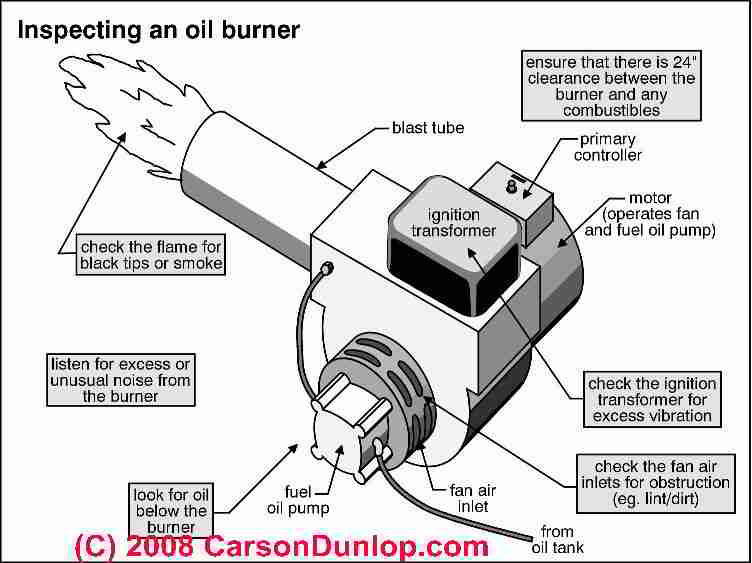
Refer to the schematic of a conventional oil burner shown below, where we list the major parts parts of a modern oil burner. The sketch at above left is courtesy of Carson Dunlop Associates, a Toronto home inspection, education & report writing tool company [ carsondunlop.com ].
If you need to diagnose and fix an oil fired heating equipment problem with your oil burner, read the text below but also be sure to check out the detailed oil burner articles listed at the ARTICLE INDEX at the bottom of this article
or at OIL BURNERS
Sequence of steps in home heating or hot water heater oil burner operation:
- Electric power on:
In response to an aquastat or other heating boiler, furnace, or water heater control, electrical power to the oil burner is switched "on".
See ELECTRICAL POWER SWITCH FOR HEAT
Electricity is connected through a safety control such as the Cad Cell relay labeled "primary controller" in the sketch.
Details: AQUASTAT CONTROLS, Cad Cell Relay,
or STACK RELAY SWITCH - Oil burner electric motor starts: The primary controller permits electrical power to flow to the electric motor shown on the right side of the oil burner, causing the motor shaft (not shown) to rotate.
See OIL BURNER NOISE SMOKE ODORS. - Oil burner's Electric Motor shaft rotates, driving other parts through a coupling:
the spinning shaft of the electric motor extends horizontally through the inside of the oil burner motor where it is coupled first to a rotating squirrel cage fan - the oil burner's air blower (providing combustion air), and second to the the air blower and oil pump (fuel unit).
High speed oil burner motors spin at 3450 RPM. Older "low speed" (and quieter) oil burners use an electric motor rotating at 1725 rpm. - Combustion air:
Oil burner blower fan spins, drawing combustion air through adjustable air intake slots on the left side of the oil burner, and simultaneously, - Heating oil delivery:
the electric motor shaft extension drives the oil pump (fuel unit) shown on the left-most side of the oil burner in the sketch. The oil pump (oil burner fuel unit such as a Sunstrand™ fuel unit) draws heating oil from the oil tank through a fuel line connected to the oil tank (hopefully through an external oil filter and an internal filter screen) and pressurizes the heating oil to 100 psi or more.
Pressurized heating oil flows out of the oil pump thorough a high pressure oil line into the oil burner tube where it is converted to a fine spray by an oil nozzle attached to the end of the nozzle assembly. Problems with the heating oil fuel unit can lead to loss of heat, noisy operation, and other oil burner operating troubles.
Details about fuel units (heating oil pumps) and their installation, diagnosis, or repair are
at OIL BURNER FUEL UNIT.
Also see OIL TANKS, OIL TANK PIPING & PIPING DEFECTS - Heating oil ignition:
electricity is also delivered to an ignition transformer (the black box on top of the back of the oil burner).
The ignition transformer converts the incoming 120V electrical power to very high voltage which is fed to two electrodes attached to the nozzle assembly.
The oil burner nozzle electrodes, separated by a small gap, produce an electrical spark (usually continuous or "continuous ignition oil burner operation" vs. "intermittent ignition" on some older systems) which is right in the path of the oil being sprayed by the oil burner nozzle, causing the oil to ignite.
Safety controls will turn off the oil burner if flame ignition is not successful. This feature prevents continuing pumping un-burned heating oil into the system.
See CAD CELL RELAY SWITCH
and STACK RELAY SWITCH - Heating oil combustion:
the sprayed, burning heating oil heats the interior of the furnace, boiler, or water heater combustion chamber which is normally lined with a material whose surface will get very hot but won't burn.
The combustion chamber liner prevents the oil burner from damaging the cast iron or steel boiler itself, while the hot surface of the combustion chamber liner helps make sure that all of the fine droplets of oil sprayed into the combustion chamber do in fact ignite.
Also see COMPLETE COMBUSTION, STOICHIOMETRIC for an explanation of complete fuel combustion and boiler or furnace maximum efficiency. - Heat transfer:
hot combustion gases from the burning heating oil flow (usually upwards) through the furnace, boiler, or water heater heat exchanger where they transfer heat to that appliance before continuing to flow through a flue vent connector (stack pipe) and then outside through a chimney.
See: BOILERS,
CHIMNEYS,
FURNACES,
STEAM HEATING,
WATER HEATERS - Electric power and oil burner off:
when the aquastat, thermostat, or other primary control senses that the desired temperature has been reached, electric power to the oil burner is turned off, stopping the electric motor from spinning, thus stopping the combustion air blower, oil pump, and turning off the ignition transformer.
See AQUASTAT CONTROL FUNCTIONS
and THERMOSTATS
Installing a New Oil Burner
Reader Question: We want to install a new oil burner but we don't want to get "robbed"
We have an oil burner that is in the house since 1966. I want to buy a new one that will save us money each month on oil and at the same time be effective, as well as heat up our house
. Do you know some names or dealers? I also do not want to get taken or robbed.

We also want to have the sludge taken out of our oil tank, can you recommend someone for both these services.
We live on long island and are seniors. - M.P., Rockville Centre, Long Island
Our photo above shows an antiquated cast iron Arco™ boiler that was converted from coal to oil.
The oil burner on this unit was itself an antique, low-speed unit - though not the system named above nor the upgraded oil burner system described below.
Reply: here are some things to check before upgrading an oil burner
A competent onsite inspection of your entire heating system and chimney, performed by an expert usually finds additional clues that help accurately diagnose a problem or might make clear if upgrading the oil burner on your heating system makes sense. That said, here are some things to consider:
Before even considering a new oil burner, you will want a thorough inspection of your boiler or furnace to be sure it's in good enough condition to be worth the investment.
For example if the heater is badly rusted or cracked, it needs to be replaced.
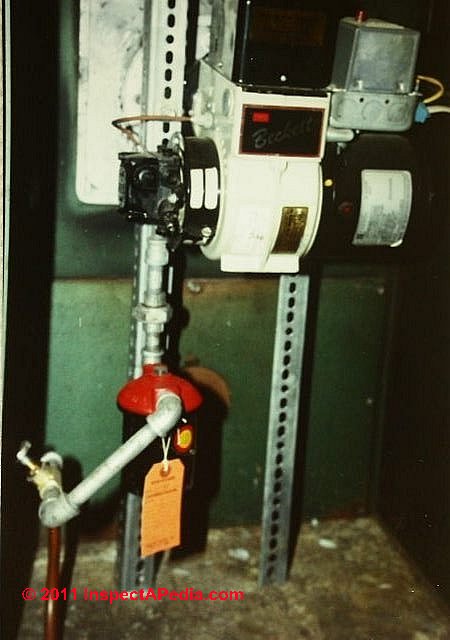
If the heater itself is in good condition, the replacement burner can improve its efficiency and save you money. Our photo (left) shows a modification we [DF] performed to a large cast-iron heating boiler in New York.
The original low-speed oil burner was fired into the very bottom of a quite large, 1930's vintage cast iron boiler that was in good condition but running at the low 70% efficiency range. Originally this had been a coal-fired boiler, converted to burn oil. The original oil burner fired into the bottom of a large combustion chamber.
After inspecting the boiler to confirm that it was not damaged, we installed a new Beckett™ oil burner, firing it up through a higher door on the heating boiler.
The system efficiency increased from around 71% (after cleaning and tuning) to 82% efficiency (also after cleaning and tuning) - a heating fuel cost savings improvement of 11 percentage points, but actually a15% reduction in heating oil cost.
We can't make specific contractor referrals for oil burner upgrades nor service. But you can make these efforts to steer clear of a bad experience:
- Start by asking for advice from the folks from whom you buy heating oil - you are already their customer. Also ask the oil company to evaluate the level of sludge and water in your heating oil tank and to remove it if that step is required and provided that the tank remains in usable condition. More about oil tank sludge is
at OIL TANK SLUDGE. - Check with your local better business bureau for complaints against contractors in your area
- Get two or more bids for the oil burner replacement work, and be sure they are bidding on the same type of job and that the scope of work is the same in each bid so you can make a fair comparison
- The specific oil burner model needs to be chosen to work well with your heater design
For example, we might like a Beckett high speed oil burner in many applications, but where a specific furnace or boiler has to operate with some risk of backpressure in the combustion chamber we might choose a Carlin™ burner that is designed for that condition.
- Don't make final payment for the work until you are happy with the results
Oil Burner Manuals & Guides for Boilers, Furnaces, Water Heaters
The manuals previously listed alphabetically on this page got promoted!
See OIL BURNER MANUALS OIL BURNER MANUALS - free download manuals for oil burners, controls, fuel units, etc.
...
Oil Burner Primary / Safety Control Manuals
- BOILER CONTROLS & SWITCHES - controls used on all brands of heating boilers and
- FURNACE CONTROLS & SWITCHES - controls used on all brands of heating furnaces
- MANUALS & PARTS GUIDES - HVAC - home - Master Index to All Brand Names & HVAC manuals, wiring diagrams, installation and repair guides
- OIL BURNER MANUALS
- BECKETT GeniSys™ Model 7505 ADVANCED BURNER CONTROL MANUAL [PDF] Beckett Corporation,
USA: P.O. Box 1289 Elyria, OH 44036
Canada: R.W. Beckett Canada, Ltd. Unit #3, 430 Laird Road Guelph, Ontario N1G 3X7 www.beckettcorp.com
Excerpt: The Beckett GeniSysTM Advanced Burner Control is a 120 Vac primary safety control for residential and light commercial oil burners used in boiler, furnace, and water heater applications having firing rates less than 20 GPH.
The GeniSys is used with a suitable cad cell flame sensor to control the oil burner motor, igniter, and optional solenoid valve. It has 24 Vac thermostat terminals (if applicable) compatible with both mechanical and many power stealing thermostats. It can also provide interrupted or intermittent duty ignition. - BECKETT GeniSys® 120V Model 7575 ADVANCED BURNER CONTROL MANUAL [PDF], Beckett Corporation, op. cit. retrieved 2017/12/31, original source: https://www.beckettcorp.com/wordpress/wp-content/uploads/2016/03/61910-7575-GeniSys-120v-Control-Manual.pdf
- HONEYWELL R7284B,P,U,G ELECTRONIC OIL PRIMARY ENVIRACOM™ ENABLED MANUAL [PDF] Honeywell International Inc. 1985 Douglas Drive North Golden Valley, MN 55422 customer.honeywell.com
- HONEYWELL R7284U Product Overview [PDF]
- HONEYWELL R7284U TRAINING MANUAL [Power Point] https://customer.honeywell.com/Documents/R7284U1004UniversalOilPrimaryTrainingModule.ppt
- HONEYWELL R7795A,B,C,D Flame Safeguard Primary Controls MANUAL [PDF]
Excerpt: The R7795 Flame Safeguard Primary Control provides flameout protection plus automatic control of commercial and industrial gas and oil burners. Models provide intermittent pilot or interrupted pilot with delayed main valve. - HONEYWELL RA890F / G Flame Safeguard Primary Control Manual [PDF]
Excerpt: The [Honeywell] RA890F Protectorelay™ is a nonprogramming, amplifying relay that provides solid state electronic flame safeguard protection for industrial and commercial gas, oil, or combination gas-oil burners.
...
Continue reading at OIL BURNER INSPECTION & REPAIR or select a topic from the closely-related articles below, or see the complete ARTICLE INDEX.
Or see OIL BURNER FAQs - questions & answers posted originally on this page
Or see these
Recommended Articles
- OIL BURNERS - home
- OIL BURNER DELAY VALVE
- OIL BURNER ELECTRODES
- OIL BURNER FUEL UNIT
- OIL BURNER FUEL UNIT AIR BLEED PROCEDURE
- OIL BURNER INSPECTION & REPAIR
- BUILDING EXTERIOR Oil Burner Trouble
- BUILDING INTERIOR Oil Burner Trouble
- OIL TANK EFFECTS on OIL BURNER
- BOILER / FURNACE ROOM TROUBLE SIGNS
- OIL BURNER VISUAL INSPECTION
- OIL BURNER OPERATING TROUBLE
- OIL BURNER INSIDE TROUBLE
- OIL BURNER SMOKE TEST
- OIL BURNER CO2 TEST
- OIL BURNER WONT RUN
- OIL BURNER MANUALS
- OIL BURNER MOTOR NOISE
- OIL BURNER NOISE SMOKE ODORS - home
- OIL BURNER NOISE DIAGNOSTIC INDEX
- OIL LINE BUZZ & VIBRATION CURE
- OIL BURNER NOZZLE GUIDE
- OIL BURNER NOZZLE SUBSTITUTIONS
- OIL BURNER PUFFBACK EXPLOSION
- OIL BURNERS, RETENTION HEAD
- OIL BURNER SOOT & PUFFBACKS
- OIL FILTERS on HEATING EQUIPMENT
Suggested citation for this web page
OIL BURNERS at InspectApedia.com - online encyclopedia of building & environmental inspection, testing, diagnosis, repair, & problem prevention advice.
Or see this
INDEX to RELATED ARTICLES: ARTICLE INDEX to HEATING OIL, OIL BURNERS, OIL FIRED HEATERS, OIL TANKS
Or use the SEARCH BOX found below to Ask a Question or Search InspectApedia
Ask a Question or Search InspectApedia
Try the search box just below, or if you prefer, post a question or comment in the Comments box below and we will respond promptly.
Search the InspectApedia website
Note: appearance of your Comment below may be delayed: if your comment contains an image, photograph, web link, or text that looks to the software as if it might be a web link, your posting will appear after it has been approved by a moderator. Apologies for the delay.
Only one image can be added per comment but you can post as many comments, and therefore images, as you like.
You will not receive a notification when a response to your question has been posted.
Please bookmark this page to make it easy for you to check back for our response.
Our Comment Box is provided by Countable Web Productions countable.ca
Citations & References
In addition to any citations in the article above, a full list is available on request.
- [1] Brumbaugh, James E., Audel HVAC Fundamentals, Volume 2: Heating, Audel [J Wiley]; All New 4th Edition edition (July 2, 2004)
ISBN-10: 0764542079
ISBN-13: 978-0764542077, quoting from the product description,
This fully revised guidebook covers everything you need to know to install, maintain, and repair the components that run, regulate, and fuel both old and new systems. From oil burners and steam line controls to the newest chip-based technology and environmental regulations, Volume 2 helps you keep the heat on.
* Install and repair thermostats, humidistats, automatic controls, and oil or gas burner controls
* Review pipes, pipe fittings, piping details, valve installation, and duct systems
* Find new calculations and environmental guidelines
* Learn the best ways to handle hydronics and steam line controls
* Deal with solid fuels and understand coal firing methods
* Refer to data tables with conversions, formula cross-references, and manufacturers' lists
The Audel HVAC Library
Vol. 1: Heating Systems, Furnaces, and Boilers
Vol. 2: Heating System Components, Gas and Oil Burners, and Automatic Controls
Vol. 3: Air Conditioning, Heat Pumps, and Distribution Systems - [2] Beckett Corporation, 38251 Center Ridge Rd., North Ridgeville, OH 44039 440-327-1060 Email: sales@beckettcorp.com supplies residential and commercial oil burners for boilers, furnaces, and water heaters - see www.beckettcorp.com/
 [3] Audels Oil Burner Guide, Installation, Servicing, Repairing, Frank D. Graham, 1947 edition (obsolete, out of print). See Brumbaugh, James E. Audel HVAC Fundamentals, Volume 2: Heating or see various versions of this guide available in editions from 1947, 1950, 1955, 1958, 1959, 1962, 1965, 1967, and at prices from around $3.00 to nearly $70.00 - useful for simple, clear, but not current, explanation of how heating equipment works. The original retail price was $1.00. Used copies are available
- [4] A Total Look at Oil Burner Nozzles, available from Delavan Fuel Metering Products, a reference guide for oil burner service technicians, Delavan Spray Technologies, Fuel Metering Products Division, PO Box 969, Bamberg SC 29003, Tel: 800-982-6943 or 803-245-4347, ( Delavan is a division of BF Goodrich); web search 12/30/2010, original source: http://www.delavaninc.com/pdf/total_look.pdf
Note & disclosure: when we (DF) were servicing oil burner equipment, Delavan nozzles gave us such excellent results, especially using hollow cone spray patterns in solving combustion problems, that this brand was our standard stock-item on our truck. Other brands of oil burner nozzles are of course also of excellent quality. It is the proper matching of nozzle size and type and spray pattern to the equipment that is critical. - [5] Fuel Nozzles for Oil Burners, Technical Aspects of Applications, E. O. Olson, Chief Engineer (deceased)
Delavan Fuel Metering Products Operation, Bamberg, South Carolina, Delavan Fuel Metering Products, a reference guide for oil burner service technicians, Delavan Spray Technologies, Fuel Metering Products Division, PO Box 969, Bamberg SC 29003, Tel: 800-982-6943 or 803-245-4347, ( Delavan is a division of BF Goodrich); web search 12/30/2010, original source: http://www.delavaninc.com/pdf/Fuel_Nozzles_for_Burners.PDF - [6] Domestic and Commercial Oil Burners, Charles H. Burkhardt, McGraw Hill Book Company, New York 3rd Ed 1969.
- National Fuel Gas Code (Z223.1) $16.00 and National Fuel Gas Code Handbook (Z223.2) $47.00 American Gas Association (A.G.A.), 1515 Wilson Boulevard, Arlington, VA 22209 also available from National Fire Protection Association, Batterymarch Park, Quincy, MA 02269. Fundamentals of Gas Appliance Venting and Ventilation, 1985, American Gas Association Laboratories, Engineering Services Department. American Gas Association, 1515 Wilson Boulevard, Arlington, VA 22209. Catalog #XHO585. Reprinted 1989.
- [7] The Steam Book, 1984, Training and Education Department, Fluid Handling Division, ITT [probably out of print, possibly available from several home inspection supply companies] Fuel Oil and Oil Heat Magazine, October 1990, offers an update,
- [8] Principles of Steam Heating, $13.25 includes postage. Fuel oil & Oil Heat Magazine, 389 Passaic Ave., Fairfield, NJ 07004.
- [9] The Lost Art of Steam Heating, John Doe [Dan Holohan], 516-579-3046 FAX, at Amazon.com>
- [10] Principles of Steam Heating, Dan Holohan, technical editor of Fuel Oil and Oil Heat magazine, 389 Passaic Ave., Fairfield, NJ 07004 ($12.+1.25 postage/handling).
- [11] Principles of Home Inspection: Steam, Electric & Wall/Floor Heating, Carson Dunlop Associates, at Amazon.com>
- [12] "Residential Steam Heating Systems", Instructional Technologies Institute, Inc., 145 "D" Grassy Plain St., Bethel, CT 06801 800/227-1663 [home inspection training material] 1987
- [13] "Residential Hydronic (circulating hot water) Heating Systems", Instructional Technologies Institute, Inc., 145 "D" Grassy Plain St., Bethel, CT 06801 800/227-1663 [home inspection training material] 1987
- [14] "Warm Air Heating Systems". Instructional Technologies Institute, Inc., 145 "D" Grassy Plain St., Bethel, CT 06801 800/227-1663 [home inspection training material] 1987
- [15] Heating, Ventilating, and Air Conditioning Volume I, Heating Fundamentals,
- [16] Boilers, Boiler Conversions, James E. Brumbaugh, ISBN 0-672-23389-4 (v. 1) Volume II, Oil, Gas, and Coal Burners, Controls, Ducts, Piping, Valves, James E. Brumbaugh, ISBN 0-672-23390-7 (v. 2) Volume III, Radiant Heating, Water Heaters, Ventilation, Air Conditioning, Heat Pumps, Air Cleaners, James E. Brumbaugh, ISBN 0-672-23383-5 (v. 3) or ISBN 0-672-23380-0 (set) Special Sales Director, Macmillan Publishing Co., 866 Third Ave., New York, NY 10022. Macmillan Publishing Co., NY
- [17] Installation Guide for Residential Hydronic Heating Systems
- [18] Installation Guide #200, The Hydronics Institute, 35 Russo Place, Berkeley Heights, NJ 07922
- The ABC's of Retention Head Oil Burners, National Association of Oil Heat Service Managers, TM 115, National Old Timers' Association of the Energy Industry, PO Box 168, Mineola, NY 11501. (Excellent tips on spotting problems on oil-fired heating equipment. Booklet.)
- [19] Crown Serviceman's Handbook: Ignition Electrode Assemblies, Terminals and Cable, Tools and Accessories, Crown Engineering Corporation, Marlboro, NJ 07746 [1986]. This publication includes oil burner troubleshooting diagnostic suggestions reprinted with permission of Fuel Oil & Oil Heat Magazine.
- [21] The Wholesaler's & Installer's Guide to OEM Oil Specifications, R.W. Beckett Corporation, PO Box 1289, Elyria, OH 44036, 216-327-1060 [1988] This publication gives the model, burner type, air tube combination, head type, static plat dimensions, blower wheel dimensions, and oil burner nozzle type for just about ever manufacturer and model of oil fired heating equipment including Addison Products, Axeman-Anderson, Bard Manufacturing, BDP, Borg-Warner, Boyertown Furnace, Burnham, Carrier Corp., Clare Brothers, Columbia Boiler Co., Crown Industries, Dornback Furnace, Ducane, Dunkirk Radiator, Duo-Matic/Olsen, Electric Furnace-Man, Ener Royal Technology, Energy Kinetics, Everhot All-Corporation, F.P. Industry, Fraser-Johnston, Heat Controller, Hydrotherm Inc., Johnson Corp., Lochinvar, Logwood-Marathon Heater, Inc., Longwood Furnace Corp., Luxaire, Magic Chef, Melvin Manufacturing Corp., Metromatic Mfg. Co., Miller Heating & A/C, Modine Manufacturing, Newmac Manufacturing, New Yorker, Oneida Heater, Peerless Heater, Perfection Products, Pow-R-Matic, Inc., Reznor, Rheem Manufacturing, Ruud, Slant/Fin, H.B. Smith, State Industries, Tekton Corp., Teledyne Laars, Thermo Dynamics, Thermo Products, Trianco, Inc., Ultimate Eng., Utica Boiler, Vallant, Van Wert Manufacturing, Weil-Mclain, Williamson Co., Wise, Inc., XXth Century. But believe it or not this is not the whole list of manufacturers from the 1970's and 1980's. Reference [22] below includes a still longer list.
- [22] Steinen's [Oil Burner] Nozzle Guide, Oil burner nozzle specifications, draft regulators, nozzle filters, flame mirrors, oil burner nozzle kits, nozzle racks, nozzle extractors, nozzle adapters. Wm. Steinen Mfg. Co., 29 East Halsey Rd., Parsippany NJ 07054, Tel: 201-887-6400 [1970].
- [22] Burnham Heating Helper, [heating system design & layout in a mini booklet], Burnham Corporation, PO Box 3089, Lancaster PA 17603, Tel: 717-481-8400, 9th printing, 7/01
- Fuel Oil & Oil Heating Magazine, 3621 Hill Rd., Parsippany, NJ 07054, 973-331-9545
- Domestic and Commercial Oil Burners, Charles H. Burkhardt, McGraw Hill Book Company, New York 3rd Ed 1969.
- National Fuel Gas Code (Z223.1) $16.00 and National Fuel Gas Code Handbook (Z223.2) $47.00 American Gas Association (A.G.A.), 1515 Wilson Boulevard, Arlington, VA 22209 also available from National Fire Protection Association, Batterymarch Park, Quincy, MA 02269. Fundamentals of Gas Appliance Venting and Ventilation, 1985, American Gas Association Laboratories, Engineering Services Department. American Gas Association, 1515 Wilson Boulevard, Arlington, VA 22209. Catalog #XHO585. Reprinted 1989.
- The Steam Book, 1984, Training and Education Department, Fluid Handling Division, ITT [probably out of print, possibly available from several home inspection supply companies] Fuel Oil and Oil Heat Magazine, October 1990, offers an update,
- Principles of Steam Heating, $13.25 includes postage. Fuel oil & Oil Heat Magazine, 389 Passaic Ave., Fairfield, NJ 07004.
- The Lost Art of Steam Heating, Dan Holohan, 516-579-3046 FAX
- Principles of Steam Heating, Dan Holohan, technical editor of Fuel Oil and Oil Heat magazine, 389 Passaic Ave., Fairfield, NJ 07004 ($12.+1.25 postage/handling).
- "Residential Steam Heating Systems", Instructional Technologies Institute, Inc., 145 "D" Grassy Plain St., Bethel, CT 06801 800/227-1663 [home inspection training material] 1987
- "Residential Hydronic (circulating hot water) Heating Systems", Instructional Technologies Institute, Inc., 145 "D" Grassy Plain St., Bethel, CT 06801 800/227-1663 [home inspection training material] 1987
- "Warm Air Heating Systems". Instructional Technologies Institute, Inc., 145 "D" Grassy Plain St., Bethel, CT 06801 800/227-1663 [home inspection training material] 1987
- Heating, Ventilating, and Air Conditioning Volume I, Heating Fundamentals,
- Boilers, Boiler Conversions, James E. Brumbaugh, ISBN 0-672-23389-4 (v. 1) Volume II, Oil, Gas, and Coal Burners, Controls, Ducts, Piping, Valves, James E. Brumbaugh, ISBN 0-672-23390-7 (v. 2) Volume III, Radiant Heating, Water Heaters, Ventilation, Air Conditioning, Heat Pumps, Air Cleaners, James E. Brumbaugh, ISBN 0-672-23383-5 (v. 3) or ISBN 0-672-23380-0 (set) Special Sales Director, Macmillan Publishing Co., 866 Third Ave., New York, NY 10022. Macmillan Publishing Co., NY
- Installation Guide for Residential Hydronic Heating Systems
- Installation Guide #200, The Hydronics Institute, 35 Russo Place, Berkeley Heights, NJ 07922
- The ABC's of Retention Head Oil Burners, National Association of Oil Heat Service Managers, TM 115, National Old Timers' Association of the Energy Industry, PO Box 168, Mineola, NY 11501. (Excellent tips on spotting problems on oil-fired heating equipment. Booklet.)
- In addition to citations & references found in this article, see the research citations given at the end of the related articles found at our suggested
CONTINUE READING or RECOMMENDED ARTICLES.
- Carson, Dunlop & Associates Ltd., 120 Carlton Street Suite 407, Toronto ON M5A 4K2. Tel: (416) 964-9415 1-800-268-7070 Email: info@carsondunlop.com. Alan Carson is a past president of ASHI, the American Society of Home Inspectors.
Thanks to Alan Carson and Bob Dunlop, for permission for InspectAPedia to use text excerpts from The HOME REFERENCE BOOK - the Encyclopedia of Homes and to use illustrations from The ILLUSTRATED HOME .
Carson Dunlop Associates provides extensive home inspection education and report writing material. In gratitude we provide links to tsome Carson Dunlop Associates products and services.
 | HOME | ABOUT | ASK a QUESTION | CONTACT | CONTENT USE POLICY | DESCRIPTION | POLICIES | PRIVACY | |
| © 2024 - 1985 Publisher InspectApedia.com - Daniel Friedman | |||||||||