
InspectAPedia® FREE Encyclopedia of Building & Environmental Construction, Diagnosis, Maintenance & Repair |
Question? Just ask us! InspectAPedia
|
 Oil Burner Electrodes
Assembly: Inspection, Cleaning, Adjustment
- POST a QUESTION or COMMENT about oil burner electrode function, adjustment, & repair
Oil Burner Electrodes:
Here we explain how to diagnose oil burner electrodes problems, how to inspect, clean, and adjust oil burner electrodes, and air turbulators used on heating oil burners found on residential & light commercial oil burners.
InspectAPedia tolerates no conflicts of interest. We have no relationship with advertisers, products, or services discussed at this website.
Oil Burner Electrode Setting & Adjustment Procedures
 Article Contents
- OIL BURNER ELECTRODES - Inspection, Adjustment
- OIL BURNER ELECTRODE SETTINGS - Guide & Measurements: Oil Burner Ignition Electrode Gap & Positions
- OIL BURNER SETTING SNAFUs to watch out for when cleaning & adjusting the oil burner nozzle assembly
[Click to enlarge any image]
This article series answers most questions about central hot water heating system troubleshooting, inspection, diagnosis, and repairs. We describe how to inspect, troubleshoot and repair heating and air conditioning systems to inform home owners, buyers, and home inspectors of common heating system defects.
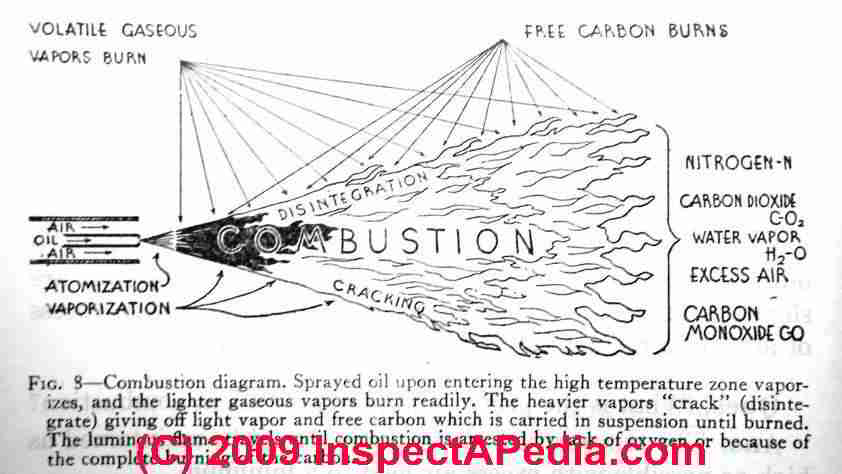
Our sketch (above) shows how an oil burner gun atomizes and sprays heating oil into the combustion chamber - Audel Oil Burner Guide.
Also see OIL BURNER INSPECTION & REPAIR.
Oil Burner Electrode Settings Guide & Measurements: Oil Burner Ignition Electrode Gap & Positions
An oil burner adjustment template provided by Beckett Corporation and shown just below summarizes the adjustment of the ignition electrodes & their positioning for Beckett oil burners.
And for eight oil burner head designs the template recommends oil burner nozzle firing rates (in gallons per hour or gph) and spray pattern or style.
As you will read below, there is a very large array of oil burner nozzles and spray patterns provided by a variety of manufacturers.
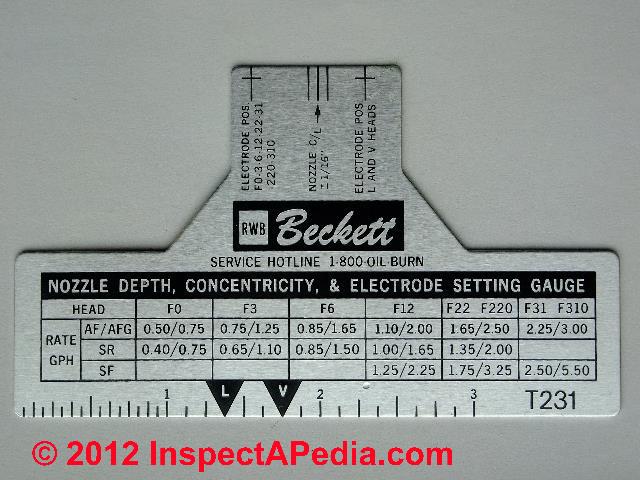 ...
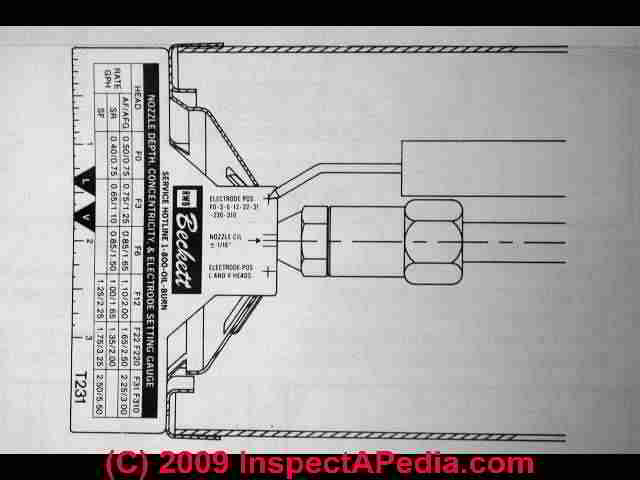
... 
SNAFUs to watch out for when cleaning & adjusting the oil burner nozzle assembly
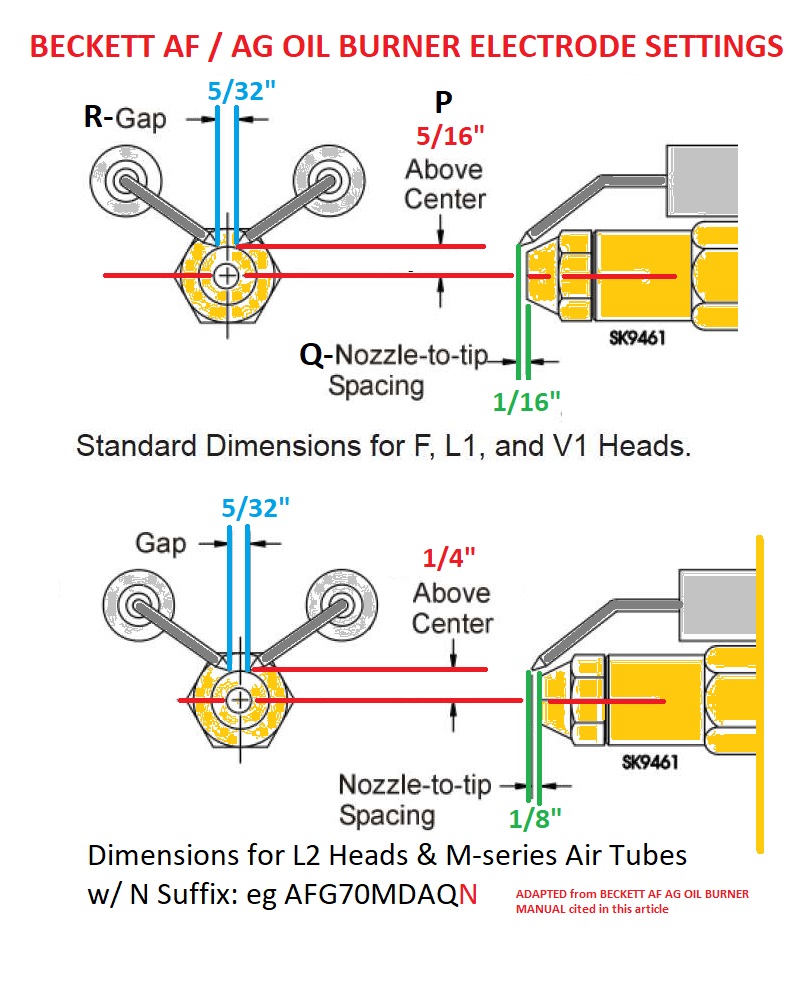
Illustration: oil burner electrode settings for the Beckett AF / AG oil burner series, adapted from the AF/AG manual cited below.
Watch out: check the electrode settings specified by your specific oil burner as those shown here will often be different.
For example, when setting the electrodes on a a Beckett CF500/800 oil burner, the Gap or R-dimension is 3/16, the P-dimension or height above centerline of the nozzle opening is 3/16" and the Q-dimension or distance from tip of electrode to nozzle face is 1/4".
On a Carlin EZ-123 oil burner the Gap or R-dimension is set 1/8" to 5/32" wide, the P-dimension or height is set to 5/16", and the Q-dimension or distance of electrode tip ahead of the nozzle face is set from Flush to 1/16".
On a Carlin 201 oil burner the Gap or R-dimension is set 1/8", the P-dimension or height is set to 1/4", and the Q-dimension or distance of electrode tip ahead of the nozzle face is set from 1/4" to 5/16".
On a Remko SLV 11-33 oil burner the Gap or R-dimension is set 2.5mm, the P-dimension or height is set to7mm, and the Q-dimension or distance of electrode tip ahead of the nozzle face is set to 2-4mm. The nozzle face must be 4-6mm behind the inner face of the turbulator surface.
For other models of oil burners and their adjustments
see OIL BURNER MANUALS .
- Loose, damaged, misaligned oil burner electrodes (use a simple oil burner nozzle gauge or a small steel rule to see that the position of the oil burner electrodes in their gap apart, their distance above the oil burner nozzle orifice, and their distance forward or backwards relative to the face of the oil burner nozzle are according to the manufacturer's specification.
Often that data is imprinted on a tag right on the oil burner itself.
Our photos and illustrations show how a stainless steel oil burner nozzle and electrode adjustment gauge is used to align the oil burner electrodes, courtesy of Beckett Corporation, a supplier of oil burners including the model shown at the top of this page.
The nozzle and nozzle adapter and oil delivery tube are to the right of the gauge face and you can see an electrode in line with the upper + mark in the sketch at right. - If you try to adjust or replace the oil burner nozzle, electrodes, or electrode ceramics (this is a job for a trained service technician, but an amateur can clean the outside of these parts if working with care not to disturb the adjustment).
We also discuss oil burner nozzles and heating oil delivery rates and pressures
at HEATING OIL USAGE RATE. - Be careful not to over-tighten or damage the brass nozzle-end fittings - the connection between the oil burner nozzle itself and the brass oil burner adapter. Early in our oil burner service experience we thought it was great to make these parts as tight as possible. T
The result was damaged threads on the oil line to which the nozzle adapter was mounted, or damaged threads between the nozzle adapter and the nozzle itself - leading to oil spray leaks, improper firing, and having to replace these parts damaged by heavy handedness. - Be careful not to break the ceramic insulators on the oil electrodes
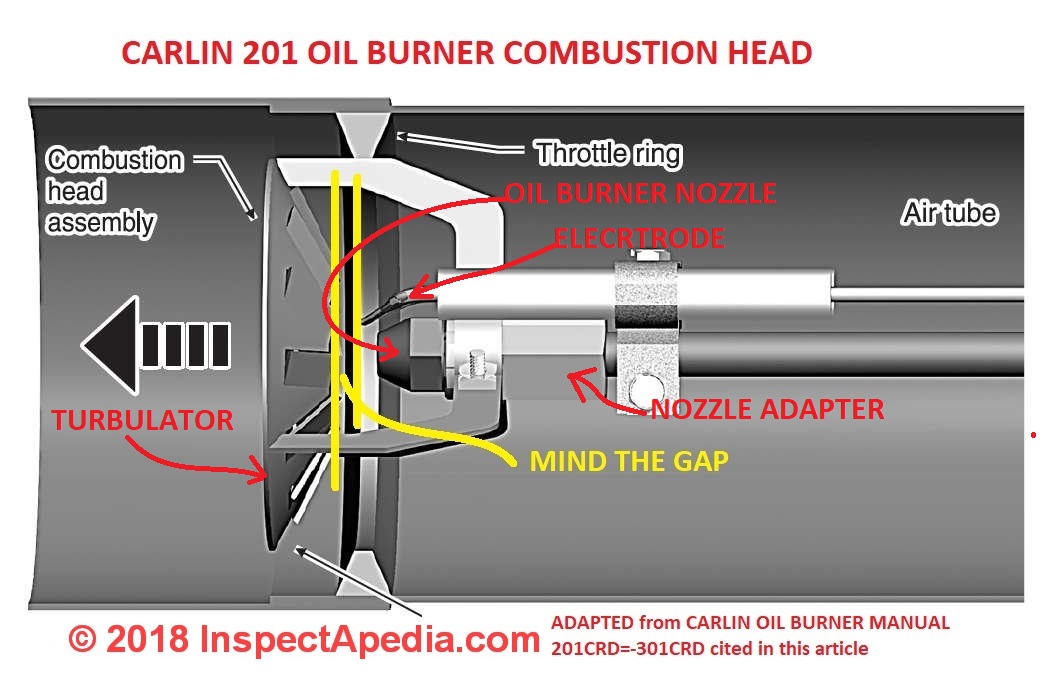
- Check the Combustion Head or Turbulator or Heat Shield Position Settings as well. Many oil burners include a heat shield mounted on the end of the burner tube OR multi-bladed turbulator assembly, often held in place by a collar tightened over the oil burner nozzle.
Shown above: the combustion head assembly for a Carlin 201 oil burner - excerpted from the manual cited below.
The turbulator holding bracket and its mounting position on the nozzle adapter may be fixed to assure good clearance distance ahead of the electrode tips. In that case the manufacturer won't specify an adjustment for the gap shown by the yellow lines in our illustration.
The turbulator improves the oil dispersion in the combustion chamber. There will be a spacing specified between the turbulator's inner face and the electrodes.
Watch out: if you set the turbulator too close to the electrodes an elecrical arc between electrodes and turbulator will short the system and prevent proper ignition. Always check and clean oil and soot accumulated from the turbulator both to permit proper air and oil dispersion and to remove whiskers of soot that will short between the turbulator and the electrodes.
The articles at this website describe how to recognize common oil-fired heating appliance operating or safety defects, and how to save money on home heating costs.
Oil Burner Nozzle Electrode Sources & Manuals
- Check first with your local oil burner parts supplier or local plumbing and heating parts supplier as well as at nearby building supply outlets such as Home Depot and Lowes
- Check second with the manufacturer of your oil burner (if they are still in business) such as Beckett,or Carlin.
- There are dozens of online vendors selling oil burner electrodes and parts, in addition to some major repair parts sources we list just below.
- R.W. Beckett Corporation 38251 Center Ridge Rd, North Ridgeville, OH 44039 USA, Toll Free: (800) 645-2876 Local: (440) 327-1060 Fax: (440) 327-1064 , Website: https://www.beckettcorp.com/
- R.W. Beckett Canada Ltd. 430 Laird Rd Unit #3, Guelph, ON N1G 3X7, Canada Toll Free: (800) 665-6972 Fax: (519) 763-5656
- Carlin Combustion Technology, 126 Bailey Road, North Haven, CT 06473 USA, Phone: (203) 680-9401 Email: info@carlincombustion.com Website: https://carlincombustion.com/
- Cleaver Brooks OEM Oil Burner Parts including oil burner transformers. [Good luck trying to find a telephonenumber or physical address for CleaverBrooks - Ed.] Website: https://parts.cleaverbrooks.com/Catalog/burner Tel: 1-800-250-5883
- Crown Boiler Co. 3633 I Street, Philadelphia, PA 19134 USA, oil burner electrodes & other oil burner parts. Website: https://www.crownboiler.com/
- Grainger oil burner electrodes and other oil burner parts. Tel: 800-GRAINGER Website: https://www.grainger.com
- ICPT Tempstar Parts has many parts for the DRC10A Ducane oil burner. Tel: 888-828-8317 Website: https://icptempstarparts.com/model/icp-tempstar-heil-drc10a-parts/
- Radwell oil burner electrodes & other oil burner parts: Radwell, Tel: 800.884.5500 Tel international: +1 609.288.9393 Tel EU: +44 1782 576800
- Westwood oil burner electrodes & other parts: Westwood Products Inc. 330 William St. PO Box 610 South River, NJ 08882-0610 Phone: (732) 651-7700 Toll-Free: (800) 442-1630 Fax: (732) 651-7798 Toll-Free Fax: (888) 651-7798 emailwestwoodproducts.com Website: http://www.westwoodproducts.com/
- A TOTAL LOOK at OIL BURNER NOZZLES [PDF] courtesy of Delavan Fuel Metering Products [Website] a reference guide for oil burner service technicians, Delavan Spray Technologies, Fuel Metering Products Division, PO Box 969, Bamberg SC 29003, Tel: 800-982-6943 or 803-245-4347, ( Delavan is a division of BF Goodrich); web search 12/30/2010, original source: http://www.delavaninc.com/pdf/total_look.pdf
- BECKETT AF AG OIL BURNER MANUAL [PDF] # 610BAFG Beckett Corporation, 38251 Center Ridge Rd., North Ridgeville, OH 44039 440-327-1060 Email: sales@beckettcorp.com supplies residential and commercial oil burners for boilers, furnaces, and water heaters - see www.beckettcorp.com/
- BECKETT AF/AFG GOLD OIL BURNER SERIES MANUAL [PDF] retrieved 2017/12/31 original source: https://www.weil-mclain.com/sites/default/files/field-file/wgo-beckett-afg-burner-manual_1.pdf
- CARLIN EZ-1/2/3 OIL BURNERS INSTRUCTION MANUAL [PDF] retrieved 2017/12/31, original source: http://carlincombustion.com/wp-content/uploads/MNEZ123-010515.pdf
- CARLIN OIL BURNER MANUAL Models 201CRD 301 CRD [PDF] Carlin Combustion Technology, Inc., 126 Bailey Road, North Haven, CT 06473 USA Phone: (203) 680-9401 Email: info@carlincombustion.com, retrieved 2017/12/31, original source: http://carlincombustion.com/wp-content/uploads/MN2301-100815-Final.pdf
- Ducane Inc., 215 Metropolitan Drive, West Columbia, SC 29170 USA Tel: 1-800-448-5872 - Ducane oil burners
- FUEL NOZZLES FOR OIL BURNERS, TECHNICAL ASPECTS OF APPLICATIONS [PDF], E. O. Olson, Chief Engineer (deceased) Delavan Fuel Metering Products Operation, Bamberg, South Carolina, Delavan Fuel Metering Products, a reference guide for oil burner service technicians, Delavan Spray Technologies, Fuel Metering Products Division, PO Box 969, Bamberg SC 29003, Tel: 800-982-6943 or 803-245-4347, ( Delavan is a division of BF Goodrich); web search 12/30/2010, original source: http://www.delavaninc.com/pdf/Fuel_Nozzles_for_Burners.PDF
- OIL BURNER NOZZLE GUIDE - at InspectApedia.com
- OIL BURNER MANUALS provides links to manuals for oil burners, controls, fuel units, etc.
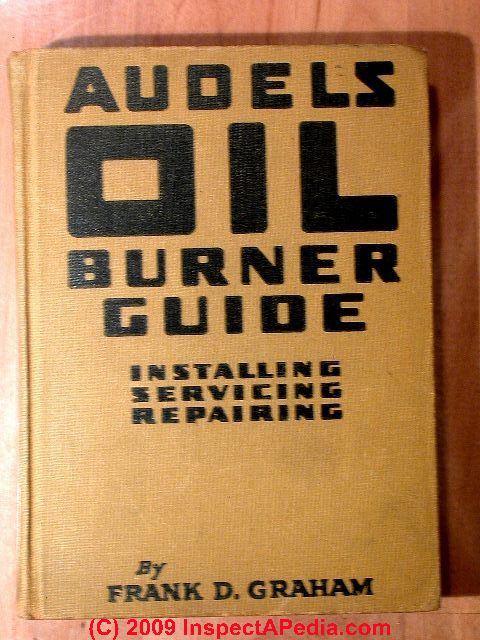
- OIL HEAT TEXTBOOK, Audel's OIL BURNER GUIDE, INSTALLATION, SEVICING, REPAIRING re-published here free, on-line, as a series of web pages is the original Audels Oil Burner Guide Installation, Servicing, Repairing, Frank D. Graham, 1940's edition (obsolete).
Updated versions of this guide are available in various editions, 1947, 1950, 1955, 1958, 1959, 1962, 1965, 1967, and at prices from around $3.00 to nearly $70.00 - useful for simple, clear, but not current, explanation of how heating equipment works. The original retail price was $1.00. Used copies are available
Also see
- BOILER CONTROLS & SWITCHES - controls used on all brands of heating boilers and
- FURNACE CONTROLS & SWITCHES - controls used on all brands of heating furnaces
Reader Comments, Questions & Answers About The Article Above
Below you will find questions and answers previously posted on this page at its page bottom reader comment box.
Reader Q&A - also see RECOMMENDED ARTICLES & FAQs
On 2020-11-12 by (mod) - Replace Ducane cracked ceramic oil burner electrode assembly not the whole boiler or furnace?
 Marie
Marie
What is the worst that can happen if an oil burner electrode is damaged or cracked?
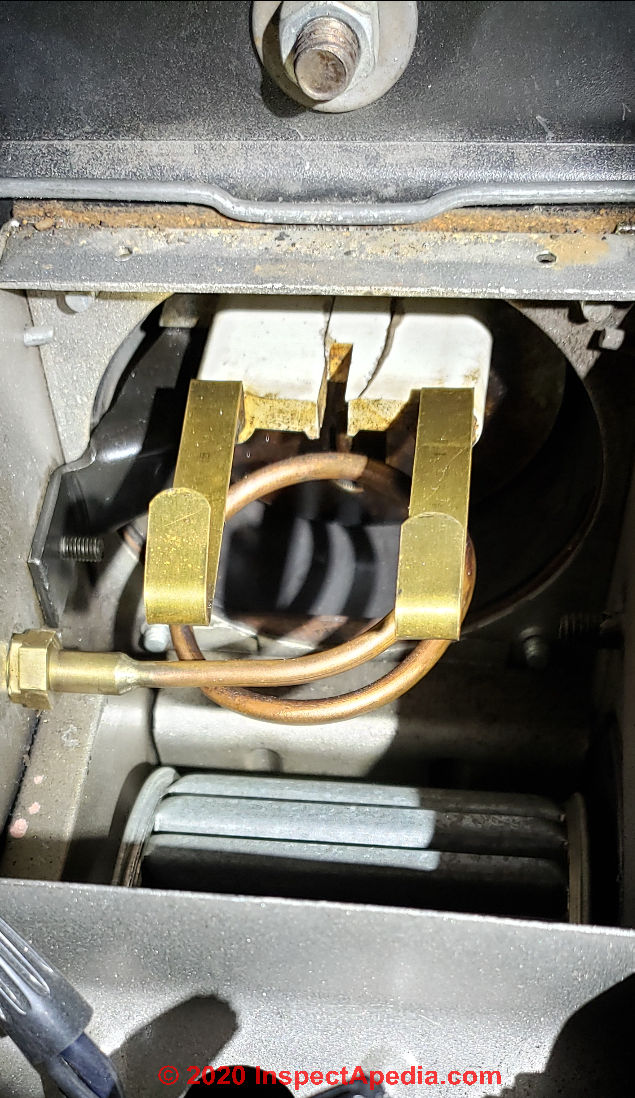
When the ceramic insulator on an oil burner electrode assembly is cracked the oil burner will not work properly nor reliably because the high voltage generated by the transformer and that is intended to create a good ignition spark will instead leak, short circuit, and interfere with good combustion.
Watch out: The result of a damaged oil burner electrode can be a sooty flame, oil burner malfunction, loss of heat, even an oil burner puffback explosion.
For that reason, the electrode ceramic should be replaced. That is a trivial and easy repair well within the scope of an oil burner service technician.
The argument that an entire heating system needs replacement because a ceramic electrode in the oil burner gun is cracked is, by itself, complete nonsense.
Would you buy a new car because one of the tires had a leak valve stem?
On the other hand, if your heater is actually a furnace (hot air heat) and if it also has a major defect like a cracked heat exchanger (dangerously unsafe) then that would be a reason for buying a new furnace.
In looking for replacement electrode ceramic insulators or an electrode assembly itself, the service tech might check with the big suppliers of these parts as those sources may still have what's needed.
ICPT Tempstar Parts has many parts for the DRC10A Ducane oil burner. Tel: 888-828-8317 Website: icptempstarparts.com/model/icp-tempstar-heil-drc10a-parts/
Ask about their part no.: ICP 1150294 ELECTRODE DUCANE or its replacement by Part # ICP B0811114 ELECTRODE DUCANE (about $100. U.S.)
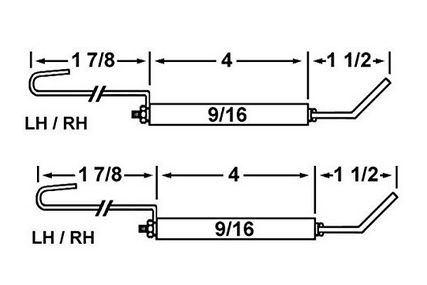
Crown also supplies oil burner electrodes and parts: for a Ducane oil burner the Crown # 21182-02 or a 21190-02 electrode set (shown below as a measurement schematic) may fit.
Westwood supplies oil burner electrodes and parts
and some oil burner parts suppliers like Cleaver-Brooks may also be able to help (Cleaver-Brooks at 1-800-250-5883 or at https://parts.cleaverbrooks.com/Catalog/burner )
and some of the oil burner manufacturers such as Carlin and Beckett offer top quality replacement oil burners.
In the very worst case I can imagine, of an oil burner that is so old that the exact electrode replacement parts can't be found, you'd still have the option of replacing the oil burner itself.
You might also have your repair tech contact the present Ducane Co. directly at
Ducane Inc., 215 Metropolitan Drive, West Columbia, SC 29170 USA Tel: 1-800-448-5872
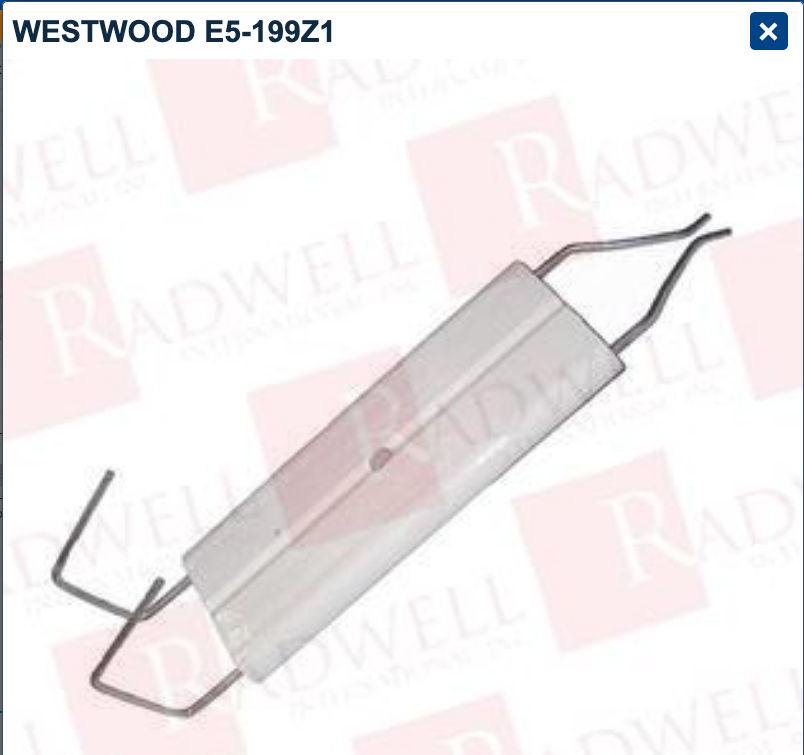
Also see the example of an electrode that fits some Ducane burners (shown above) the Westwood-E5-199Z1-Oil-Burner-Electrode
Another option, if your particular Ducane oil burner electrode assembly is truly not available, would be to simply replace the oil burner air tube combination on your existing Ducane burner with one that is the proper length, diameter, and thus can fit the proper electrodes and oil burner nozzle for your boiler or furnace.
Grainger (1-800-GRAINGER) supplies replacement oil burner tubes from Beckett that *might* be usable.
How to get the right oil burner electrode
To get the right oil burner replacement electrode assembly the technician needs to know the oil burner brand (Ducane) and model number.
Or
she needs to get the exact measurements of and shape of the original oil burner electrode assembly. The typical measurements include insulator length and diameter and the metal metal electrode shape and length as you can see in the sketch of the Crown replacement example I have already given.
Below is the Westwood electrode assembly that may be close to what your oil burner wants.
This squared-ceramic electrode set for Ducane burners is offered by Radwell,
Order toll free: 800.884.5500
Order international: +1 609.288.9393 EUl: +44 1782 576800
Other OEM replacements for Ducane oil burner electrodes include the
Crown 21182-02 Set Of Replacement Electrodes For Ducane DMR-15A With 7" Blast Tube
Crown 21182-02 Set Of Replacement Electrodes For Ducane DMR-15A With 7" Blast Tube Fits Ducane DMR15A, DMR-15A, DMR15A1, DMR-15A-1 Oil Burners
widely sold by HVACR suppliers, Sears, Amazon, etc.
Finally, if you don't have the manual for your Ducane heater
see DUCANE, bought by Lennox 1999 - also see LENNOX HVAC MANUALS & PARTS GUIDES
On 2020-11-12 by Marie - we need a new furnace because the Ducane oil burner electrode assembly is cracked
Hello,
The electrode (ceramic) part is cracked on our 1993 Ducane oil burner. See image [photo shown at the start of this discussin].
The system works however twice last week there was a strong smell of burnt oil in our home when the furnace kicked. We don't know how long the crack has been there, it was not found in the last maintenance 10 months ago.
We are trying to get more information on how soon we should replace our system. We need a full furnace replacement as those parts are not available anymore.
What is the worst thing that can happen from this crack ?
thanks
On 2018-04-09 by (mod)
One could braze an electrode end to another but such a design is very likely to be improper and result in improper and unsafe oil burner operation.
The right repair for a damaged oil burner electrode is to replace the pair with an OEM matched set.
On 2018-04-09 by John Kennedy
@JOE,
can two electrode be placed end to end and brazed? the current going through be the same? we just had one done like so .
...
Continue reading at OIL BURNER NOZZLE GUIDE or select a topic from the closely-related articles below, or see the complete ARTICLE INDEX.
Or see OIL BURNER ELECTRODES FAQs - questions and answers posted originally on this page.
Or see these
Recommended Articles
- OIL BURNER INSPECTION & REPAIR - home
- OIL BURNER NOZZLE GUIDE - how to install, replace, choose the oil burner nozzle
- AUDELS OIL BURNER GUIDE, INSTALLING, SERVICING, REPAIRING
Suggested citation for this web page
OIL BURNER ELECTRODES at InspectApedia.com - online encyclopedia of building & environmental inspection, testing, diagnosis, repair, & problem prevention advice.
Or see this
INDEX to RELATED ARTICLES: ARTICLE INDEX to HEATING OIL, OIL BURNERS, OIL FIRED HEATERS, OIL TANKS
Or use the SEARCH BOX found below to Ask a Question or Search InspectApedia
Ask a Question or Search InspectApedia
Try the search box just below, or if you prefer, post a question or comment in the Comments box below and we will respond promptly.
Search the InspectApedia website
Note: appearance of your Comment below may be delayed: if your comment contains an image, photograph, web link, or text that looks to the software as if it might be a web link, your posting will appear after it has been approved by a moderator. Apologies for the delay.
Only one image can be added per comment but you can post as many comments, and therefore images, as you like.
You will not receive a notification when a response to your question has been posted.
Please bookmark this page to make it easy for you to check back for our response.
Our Comment Box is provided by Countable Web Productions countable.ca
Citations & References
In addition to any citations in the article above, a full list is available on request.
- "Residential Steam Heating Systems", Instructional Technologies Institute, Inc., 145 "D" Grassy Plain St., Bethel, CT 06801 800/227-1663 [home inspection training material] 1987
- "Residential Hydronic (circulating hot water) Heating Systems", Instructional Technologies Institute, Inc., 145 "D" Grassy Plain St., Bethel, CT 06801 800/227-1663 [home inspection training material] 1987
- "Warm Air Heating Systems". Instructional Technologies Institute, Inc., 145 "D" Grassy Plain St., Bethel, CT 06801 800/227-1663 [home inspection training material] 1987
- Heating, Ventilating, and Air Conditioning Volume I, Heating Fundamentals,
- Boilers, Boiler Conversions, James E. Brumbaugh, ISBN 0-672-23389-4 (v. 1) Volume II, Oil, Gas, and Coal Burners, Controls, Ducts, Piping, Valves, James E. Brumbaugh, ISBN 0-672-23390-7 (v. 2) Volume III, Radiant Heating, Water Heaters, Ventilation, Air Conditioning, Heat Pumps, Air Cleaners, James E. Brumbaugh, ISBN 0-672-23383-5 (v. 3) or ISBN 0-672-23380-0 (set) Special Sales Director, Macmillan Publishing Co., 866 Third Ave., New York, NY 10022. Macmillan Publishing Co., NY
- In addition to citations & references found in this article, see the research citations given at the end of the related articles found at our suggested
CONTINUE READING or RECOMMENDED ARTICLES.
- Carson, Dunlop & Associates Ltd., 120 Carlton Street Suite 407, Toronto ON M5A 4K2. Tel: (416) 964-9415 1-800-268-7070 Email: info@carsondunlop.com. Alan Carson is a past president of ASHI, the American Society of Home Inspectors.
Thanks to Alan Carson and Bob Dunlop, for permission for InspectAPedia to use text excerpts from The HOME REFERENCE BOOK - the Encyclopedia of Homes and to use illustrations from The ILLUSTRATED HOME .
Carson Dunlop Associates provides extensive home inspection education and report writing material. In gratitude we provide links to tsome Carson Dunlop Associates products and services.
 | HOME | ABOUT | ASK a QUESTION | CONTACT | CONTENT USE POLICY | DESCRIPTION | POLICIES | PRIVACY | |
| © 2024 - 1985 Publisher InspectApedia.com - Daniel Friedman | |||||||||