
InspectAPedia® FREE Encyclopedia of Building & Environmental Construction, Diagnosis, Maintenance & Repair |
Question? Just ask us! InspectAPedia
|
 Inspect, Diagnose & Repair Oil Burners
- POST a QUESTION or COMMENT about oil burner inspection, diagnosis, & repair, troubleshooting procedure, how to get the oil burner running again, best order of diagnostic steps.
How to inspect, diagnose & repair oil burners used on oil-fired heating boilers or furnaces using a visual inspection approach as well as (optional) simple test equipment.
We include a description of common oil burner adjustment and operating problems and we illustrate some of the basic oil burner tests and measurements made in servicing and adjusting the equipment for safe, efficient operation.
We illustrate oil burner smoke testing and oil burner carbon dioxide level measurement.
This article series answers most questions about all types of heating system troubleshooting, inspection, diagnosis, and repairs. We describe how to inspect, troubleshoot and repair heating and air conditioning systems to inform home owners, buyers, and home inspectors and students of heating service methods about common heating system defects.
The articles at this website describe how to recognize common oil-fired heating appliance operating or safety defects, and how to save money on home heating costs
InspectAPedia tolerates no conflicts of interest. We have no relationship with advertisers, products, or services discussed at this website.
How to Troubleshoot Problems at Oil Burners Found on Heating Boilers, Water Heaters, Furnaces
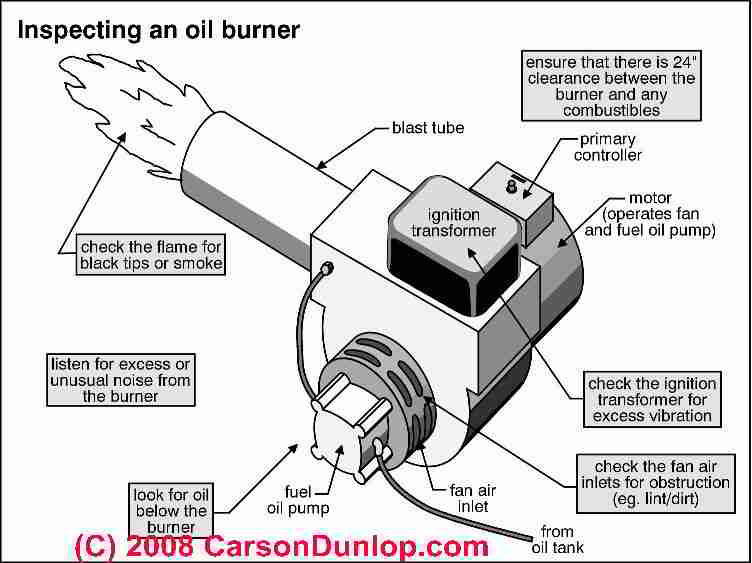 This article explains the inspection, diagnosis, & repair of oil burners used in heating appliances such as hot water boilers, steam boilers, & water heaters.
In the oil burner inspection article provided here we explain visual and other clues of oil burner problems.
To find what you need quickly, if you don't want to scroll through this index you are welcome to use the page top or bottom SEARCH BOX to search InspectApedia for specific articles and information.
Article Series Contents:
- OIL BURNER INSPECTION & REPAIR
- BUILDING EXTERIOR Oil Burner Trouble
- BUILDING INTERIOR Oil Burner Trouble
- OIL TANK EFFECTS on OIL BURNER
- BOILER / FURNACE ROOM TROUBLE SIGNS
- OIL BURNER VISUAL INSPECTION
- OIL BURNER OPERATING TROUBLE
- OIL BURNER INSIDE TROUBLE
- OIL BURNER WONT RUN - Diagnostic Steps - what to check in what order
- HEAT WON'T TURN ON
An expert inspection of an oil burner begins either with having made note of building owner/occupant concerns (noises, odors, no heat, high fuel costs), or with having made some basic visual observations outside: a sooty chimney top, for example. The sketch shown just above is provided courtesy of Carson Dunlop Associates, a Toronto home inspection, report writing tool, & home inspection education company. [Click to enlarge any image]
The oil burner inspection continues indoors, even before entering the utility room where the oil burner (or often more than one of them if oil fuel is used for both heating and a separate water heater) is located: look at the building interior as you enter: are there odors, soot deposits, noises associated with the heating system?
The oil burner inspection becomes detailed, and diagnostic, when you can actually see the equipment. It's obvious that you should notice oil leaks, soot in the boiler or furnace room, noises, odors, signs of repeated repairs, piles of junked parts, signs of unprofessional work (covers off of controls, sloppy wiring or plumbing).
But just what each of these clues might mean bears some additional explanation that we offer below.
Outdoor Clues of Heating Equipment Oil Burner Troubles
Question: smell and white smoke from the flue
(Sept 2, 2017) Randy said:
When starting our boiler this season we get a smell and white smoke from the flue like poor/too cool combustion. Any ideas?
Reply:
Here are some questions to ask about a smoky or poorly-operating oil burner, starting with stuff you might observe outdoors or at the chimney top.
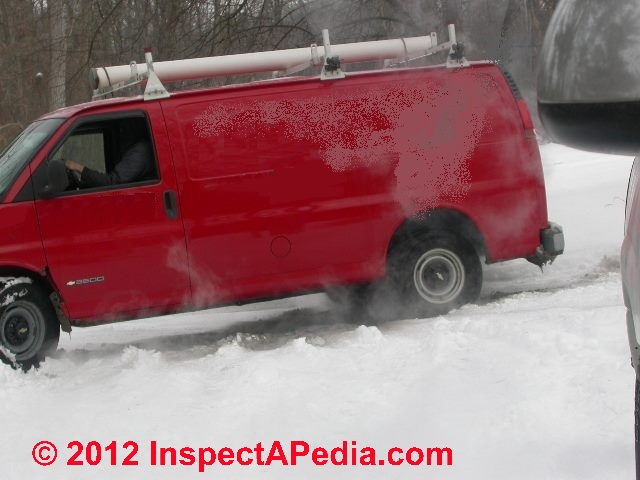
- Was your heating service technician in a rush to leave? We took this photo of a heating service tech who was in a very big rush to leave the job, after his disastrous service call. We figured he was in over his head, or maybe had some personal troubles.
Fortunately the heating service company manager had other, excellent service technicians on staff who were able to un-botch this guy's job. The heating service tech really was smoking the tires of his service van
Note: the driver knew he had behaved like a dope and later contacted us to complain about this photo of him smoking the tires of his employer's oil heat service truck.
The photo was edited to remove the company name as the heating company actually provides excellent service, and except for this oddball who left a failed service call and ruts in the driveway. - How old is the building? Is it likely that older oil fired heating equipment is or was installed?
- Where is the oil storage tank? Is it outdoors, subject to water, condensation, gelling? Let's not just blame the oil burner for problems if there are other issues at the property that can impact oil burner operation.
Also see OIL TANKS and
see OIL TANK PIPING & PIPING DEFECTS. - Soot at the chimney top of the flue used to vent oil fired equipment almost always indicates that the oil burner is or was operating poorly, producing smoky sooty exhaust. You might even see smoky exhaust if the oil burner is running while you are approaching the building. So take a look at the chimney(s) before you go indoors.
Other trouble signs: short chimneys, missing chimney caps, or in the case of our heating service truck above, ruts in the yard and tire smoke in the air. - Signs of general poor home maintenance, or financial difficulties, can be clues that previous owners or occupants were just unable to tend to ordering and paying for regular heating system maintenance.
If the chimney top is sooty we don't yet know the cause of poor oil burner operation but we know there is a problem.
If your inspection of the chimney top, even from ground level, perhaps with binoculars, shows water, frost, or mechanical damage to the chimney itself, or a missing chimney cap, these conditions may not only affect the operation of the oil burner, but they may be very unsafe.
See CHIMNEY INSPECTION DIAGNOSIS REPAIR.
Indoor Clues of Oil Burner Troubles
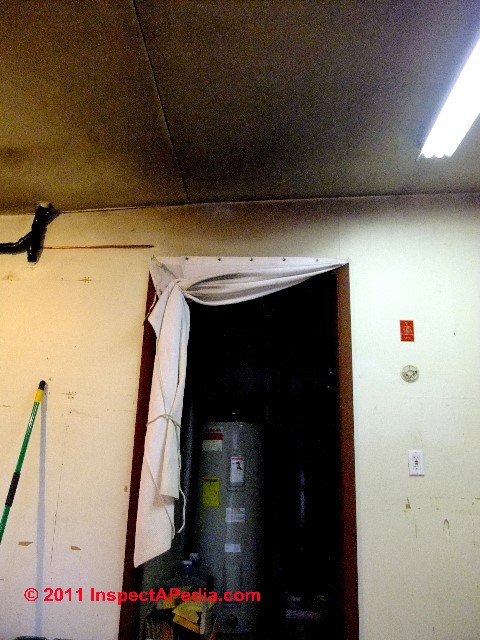 On entering the building or by customer interview, start with a check for these signs of improper oil burner operation, regardless of whether the burner is powering a boiler, furnace, or water heater:
- Are there noises when the oil burner is operating? Oil burner noises could be normal motor noise or could be a sign of serious and even dangerous heating system conditions - see both OIL BURNER NOISE SMOKE ODORS
and OIL BURNER INSPECTION & REPAIR for details.
Additional noises at the oil burner fuel unit (oil pump) are detailed
at OIL BURNER FUEL UNIT. - Are there odors blamed on the oil burner or oil fired equipment? Odors may be from an oil leak, flue gas spillage, etc.
See ODORS FROM HEATING SYSTEMS and
see OIL BURNER NOISE SMOKE ODORS. - Is there soot visible in the living area or around the boiler or furnace room? Our photo at left makes clear that the oil burner has not been working properly and is blowing soot into the building.
See STAIN DIAGNOSIS on BUILDING INTERIORS, how to diagnose stains on walls, floors, carpets, and how to determine the stain source, be sure to
see OIL BURNER SOOT & PUFFBACKS (photo at left),
and OIL BURNER NOISE SMOKE ODORS, but also
see THERMAL TRACKING & HEAT LOSS - because apparent "soot" on indoor surfaces may be simple house dust deposits caused by thermal tracking or thermal telegraphing.
More clues of trouble you can spot before getting close to the heating equipment itself are in our photos below.
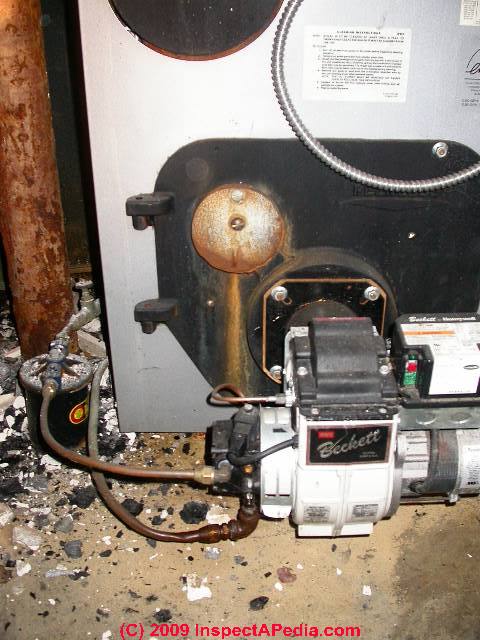

- Are there signs of water leaks onto or into the oil burner, boiler, or furnace?
As our house fire investigation photographs show (two photographs above), water passage down a chimney (say from a missing chimney cap) easily continue into the heating boiler or furnace where they may cause damage to the oil burner, boiler, furnace, or its controls.
Oil burner and boiler damaged from building fire: Notice those rust stains below the oil burner inspection port above and to the left of the burner tube? This oil fired heating boiler has been flooded.
The photo above with the rusty oil burner flue shows the probable passage of water entry, down the flue.
While the basement of this building was reported not to have contained substantial water (notice there are no flood lines on the outside of the heating boiler itself), water from above during extinguishment of a house fire ran down the chimney and flooded the boiler itself. Inspection and possibly repairs are needed before this equipment can be safely used. - Are there signs of heating oil leaks? an oil leak out of heating equipment also means air leaks into the oil system which almost certainly leads to improper operation and can lead to loss of heat
or OIL BURNER SOOT & PUFFBACKS. Leaks can be anywhere from the oil tank to the oil burner, including the oil piping, fittings, filter, check valves, etc.
See OIL TANK PIPING & PIPING DEFECTS.
Heating oil leaks around the oil filter itself are detailed
at OIL FILTERS on HEATING EQUIPMENT.
Signs of Trouble at the Oil Tank that Cause Oil Burner Problems
We mentioned outdoor oil tank problems above, but even indoors you may spot signs of trouble that affect oil burner operation.
- An oil leak anywhere in the oil piping, are a problem, as we explained just above.
A leak between the oil storage tank and the oil burner will usually cause improper oil burner operation - leaks of oil out of the oil piping become air leaks into the oil piping system when the oil burner is running and trying to draw oil from the oil storage tank, because during burner operation the oil piping is under vacuum.
Air leaks into the oil piping and burner cause improper oil burner shutdown, spewing unburned or only partially burned oil at oil burner shut-down, and risking dangerous (and sooty) puffbacks as well as telltale noises at oil burner start-up. - A leak into the oil tank itself or water accumulation from a bad oil delivery,or condensation can in the short run send water into the heating system piping and oil burner, leading to loss of heat and equipment damage.
See OIL TANK PIPING & PIPING DEFECTS. - A leaking heating oil tank, one that is leaking oil out, can lead to a costly oil spill cleanup.
See OIL TANK LEAKS & SMELLS. But oil leaking out of the tank, if the leak is only in the out direction, won't cause oil burner problems. Instead it will increase your heating bill and contaminate the environment.
But watch out: depending on the location and nature of the leak, an oil tank leak out of the tank can, as oil levels in the tank drop, lead to water leaks into the oil tank - so you could have both problems.
Boiler or Furnace Room Clues of Oil Burner Troubles
We have moved this topic to BOILER / FURNACE ROOM TROUBLE SIGNS - please continue reading there.
Signs of Trouble at the Oil Burner Itself - Visual Inspection
We've moved this discussion to OIL BURNER VISUAL INSPECTION
Signs of Trouble at the Oil Burner - During Operation
We moved this to OIL BURNER OPERATING TROUBLE
Also see OIL BURNER NOISE SMOKE ODORS.
Signs of Trouble Inside the Oil Burner - Simple Disassembly, Inspection, Testing
We moved this topic to OIL BURNER INSIDE TROUBLE
Oil Burner Won't Run: Diagnostic Steps - what to check in what order
At OIL BURNER WONT RUN we have collected oil burner diagnostic procedures from several texts, [1] - [22] adapted, expanded, and generally re-ordered steps in order of most likely to be successful and easiest to perform.
Readers needing an approach to heating system inspections that assures thoroughness, should also
see HEATING SYSTEM INSPECTION PROCEDURE
where we explain an organized approach to inspecting the entire heating system, beginning outdoors, continuing indoors, and ultimately in most detail in the boiler or furnace room.
...
Continue reading at OIL BURNER SMOKE TEST or select a topic from the closely-related articles below, or see the complete ARTICLE INDEX.
Or see OIL BURNER INSPECTION & REPAIR FAQs - questions & answers posted at this article
Or see these
Recommended Articles
- AFUE DEFINITION, RATINGS
- CHIMNEY INSPECTION DIAGNOSIS REPAIR including backdrafting or blocked flue
- COMBUSTION AIR REQUIREMENTS
- COMPLETE COMBUSTION, STOICHIOMETRIC
- DRAFT MEASUREMENT, CHIMNEYS & FLUES
- DRAFT REGULATOR, DAMPER, BOOSTER
- OIL BURNER INSPECTION & REPAIR - home
- BOILER / FURNACE ROOM TROUBLE SIGNS
- OIL BURNER VISUAL INSPECTION
- OIL BURNER OPERATING TROUBLE
- OIL BURNER INSIDE TROUBLE
- OIL BURNER CO2 TEST
- OIL BURNER DELAY VALVE
- OIL BURNER ELECTRODES
- OIL BURNER FUEL UNIT
- OIL BURNER MANUALS
- OIL BURNER MOTOR NOISE
- OIL BURNER NOISE SMOKE ODORS - home
- OIL BURNER NOISE / ODOR DIAGNOSTIC INDEX
- OIL BURNER NOZZLE GUIDE
- OIL BURNER SMOKE TEST
- OIL BURNER WONT RUN - Diagnostic Steps - what to check in what order
- OIL BURNERS - home
- OIL BURNERS, RETENTION HEAD
- OIL BURNER SOOT & PUFFBACKS
- AUDELS OIL BURNER GUIDE, INSTALLING, SERVICING, REPAIRING - an online PDF
- OIL LINE BUZZ & VIBRATION CURE
- PRESSURE & TEMPERATURE SETTINGS, CONTROLS
Suggested citation for this web page
OIL BURNER INSPECTION & REPAIR at InspectApedia.com - online encyclopedia of building & environmental inspection, testing, diagnosis, repair, & problem prevention advice.
Or see this
INDEX to RELATED ARTICLES: ARTICLE INDEX to HEATING OIL, OIL BURNERS, OIL FIRED HEATERS, OIL TANKS
Or use the SEARCH BOX found below to Ask a Question or Search InspectApedia
Ask a Question or Search InspectApedia
Try the search box just below, or if you prefer, post a question or comment in the Comments box below and we will respond promptly.
Search the InspectApedia website
Note: appearance of your Comment below may be delayed: if your comment contains an image, photograph, web link, or text that looks to the software as if it might be a web link, your posting will appear after it has been approved by a moderator. Apologies for the delay.
Only one image can be added per comment but you can post as many comments, and therefore images, as you like.
You will not receive a notification when a response to your question has been posted.
Please bookmark this page to make it easy for you to check back for our response.
Our Comment Box is provided by Countable Web Productions countable.ca
Citations & References
In addition to any citations in the article above, a full list is available on request.
- Anthony Alaggio can be contacted through Bottini Fuel (Hudson Valley, NY) or directly for HVAC service at 914-489-0632. Email: crackin95vtec@yahoo.com Special thanks to Mr. Alaggio, an HVAC service technician for technical suggestions regarding oil heat troubleshooting & more causes of oil burner short-cycling 4/12/2013.
- [2] Beckett Corporation, 38251 Center Ridge Rd., North Ridgeville, OH 44039 440-327-1060 Email: sales@beckettcorp.com supplies residential and commercial oil burners for boilers, furnaces, and water heaters - see www.beckettcorp.com/
- [3] Audels Oil Burner Guide, Installation, Servicing, Repairing, Frank D. Graham, 1947 edition (obsolete, out of print). See Brumbaugh, James E. Audel HVAC Fundamentals, Volume 2: Heating or see various versions of this guide available in editions from 1947, 1950, 1955, 1958, 1959, 1962, 1965, 1967, and at prices from around $3.00 to nearly $70.00 - useful for simple, clear, but not current, explanation of how heating equipment works. The original retail price was $1.00. Used copies are available
- [3a] Brumbaugh, James E., Audel HVAC Fundamentals, Volume 2: Heating, Audel [J Wiley]; All New 4th Edition edition (July 2, 2004) ISBN-10: 0764542079 ISBN-13: 978-0764542077
- [4] A Total Look at Oil Burner Nozzles, available from Delavan Fuel Metering Products, a reference guide for oil burner service technicians, Delavan Spray Technologies, Fuel Metering Products Division, PO Box 969, Bamberg SC 29003, Tel: 800-982-6943 or 803-245-4347, ( Delavan is a division of BF Goodrich); web search 12/30/2010, original source: http://www.delavaninc.com/pdf/total_look.pdf
Note & disclosure: when we (DF) were servicing oil burner equipment, Delavan nozzles gave us such excellent results, especially using hollow cone spray patterns in solving combustion problems, that this brand was our standard stock-item on our truck. Other brands of oil burner nozzles are of course also of excellent quality. It is the proper matching of nozzle size and type and spray pattern to the equipment that is critical. - [5] Fuel Nozzles for Oil Burners, Technical Aspects of Applications, E. O. Olson, Chief Engineer (deceased)
Delavan Fuel Metering Products Operation, Bamberg, South Carolina, Delavan Fuel Metering Products, a reference guide for oil burner service technicians, Delavan Spray Technologies, Fuel Metering Products Division, PO Box 969, Bamberg SC 29003, Tel: 800-982-6943 or 803-245-4347, ( Delavan is a division of BF Goodrich); web search 12/30/2010, original source: http://www.delavaninc.com/pdf/Fuel_Nozzles_for_Burners.PDF - [6] Domestic and Commercial Oil Burners, Charles H. Burkhardt, McGraw Hill Book Company, New York 3rd Ed 1969.
- National Fuel Gas Code (Z223.1) $16.00 and National Fuel Gas Code Handbook (Z223.2) $47.00 American Gas Association (A.G.A.), 1515 Wilson Boulevard, Arlington, VA 22209 also available from National Fire Protection Association, Batterymarch Park, Quincy, MA 02269. Fundamentals of Gas Appliance Venting and Ventilation, 1985, American Gas Association Laboratories, Engineering Services Department. American Gas Association, 1515 Wilson Boulevard, Arlington, VA 22209. Catalog #XHO585. Reprinted 1989.
- [7] The Steam Book, 1984, Training and Education Department, Fluid Handling Division, ITT [probably out of print, possibly available from several home inspection supply companies] Fuel Oil and Oil Heat Magazine, October 1990, offers an update,
- [8] Principles of Steam Heating, $13.25 includes postage. Fuel oil & Oil Heat Magazine, 389 Passaic Ave., Fairfield, NJ 07004.
- [12] "Residential Steam Heating Systems", Instructional Technologies Institute, Inc., 145 "D" Grassy Plain St., Bethel, CT 06801 800/227-1663 [home inspection training material] 1987
- [13] "Residential Hydronic (circulating hot water) Heating Systems", Instructional Technologies Institute, Inc., 145 "D" Grassy Plain St., Bethel, CT 06801 800/227-1663 [home inspection training material] 1987
- [14] "Warm Air Heating Systems". Instructional Technologies Institute, Inc., 145 "D" Grassy Plain St., Bethel, CT 06801 800/227-1663 [home inspection training material] 1987
- [15] Heating, Ventilating, and Air Conditioning Volume I, Heating Fundamentals,
- [16] Boilers, Boiler Conversions, James E. Brumbaugh, ISBN 0-672-23389-4 (v. 1) Volume II, Oil, Gas, and Coal Burners, Controls, Ducts, Piping, Valves, James E. Brumbaugh, ISBN 0-672-23390-7 (v. 2) Volume III, Radiant Heating, Water Heaters, Ventilation, Air Conditioning, Heat Pumps, Air Cleaners, James E. Brumbaugh, ISBN 0-672-23383-5 (v. 3) or ISBN 0-672-23380-0 (set) Special Sales Director, Macmillan Publishing Co., 866 Third Ave., New York, NY 10022. Macmillan Publishing Co., NY
- [17] Installation Guide for Residential Hydronic Heating Systems
- [18] Installation Guide #200, The Hydronics Institute, 35 Russo Place, Berkeley Heights, NJ 07922
- The ABC's of Retention Head Oil Burners, National Association of Oil Heat Service Managers, TM 115, National Old Timers' Association of the Energy Industry, PO Box 168, Mineola, NY 11501. (Excellent tips on spotting problems on oil-fired heating equipment. Booklet.)
- [19] Crown Serviceman's Handbook: Ignition Electrode Assemblies, Terminals and Cable, Tools and Accessories, Crown Engineering Corporation, Marlboro, NJ 07746 [1986]. This publication includes oil burner troubleshooting diagnostic suggestions reprinted with permission of Fuel Oil & Oil Heat Magazine.
- [21] The Wholesaler's & Installer's Guide to OEM Oil Specifications, R.W. Beckett Corporation, PO Box 1289, Elyria, OH 44036, 216-327-1060 [1988] This publication gives the model, burner type, air tube combination, head type, static plat dimensions, blower wheel dimensions, and oil burner nozzle type for just about ever manufacturer and model of oil fired heating equipment including Addison Products, Axeman-Anderson, Bard Manufacturing, BDP, Borg-Warner, Boyertown Furnace, Burnham, Carrier Corp., Clare Brothers, Columbia Boiler Co., Crown Industries, Dornback Furnace, Ducane, Dunkirk Radiator, Duo-Matic/Olsen, Electric Furnace-Man, Ener Royal Technology, Energy Kinetics, Everhot All-Corporation, F.P. Industry, Fraser-Johnston, Heat Controller, Hydrotherm Inc., Johnson Corp., Lochinvar, Logwood-Marathon Heater, Inc., Longwood Furnace Corp., Luxaire, Magic Chef, Melvin Manufacturing Corp., Metromatic Mfg. Co., Miller Heating & A/C, Modine Manufacturing, Newmac Manufacturing, New Yorker, Oneida Heater, Peerless Heater, Perfection Products, Pow-R-Matic, Inc., Reznor, Rheem Manufacturing, Ruud, Slant/Fin, H.B. Smith, State Industries, Tekton Corp., Teledyne Laars, Thermo Dynamics, Thermo Products, Trianco, Inc., Ultimate Eng., Utica Boiler, Vallant, Van Wert Manufacturing, Weil-Mclain, Williamson Co., Wise, Inc., XXth Century. But believe it or not this is not the whole list of manufacturers from the 1970's and 1980's. Reference [22] below includes a still longer list.
- [22] Steinen's [Oil Burner] Nozzle Guide, Oil burner nozzle specifications, draft regulators, nozzle filters, flame mirrors, oil burner nozzle kits, nozzle racks, nozzle extractors, nozzle adapters. Wm. Steinen Mfg. Co., 29 East Halsey Rd., Parsippany NJ 07054, Tel: 201-887-6400 [1970].
- [22] Burnham Heating Helper, [heating system design & layout in a mini booklet], Burnham Corporation, PO Box 3089, Lancaster PA 17603, Tel: 717-481-8400, 9th printing, 7/01
- Our recommended books about building & mechanical systems design, inspection, problem diagnosis, and repair, and about indoor environment and IAQ testing, diagnosis, and cleanup are at the InspectAPedia Bookstore. Also see our Book Reviews - InspectAPedia.
- Audels Oil Burner Guide, Installation, Servicing, Repairing, Frank D. Graham, 1940's edition (obsolete). Updated versions of this guide are available in various editions, 1947, 1950, 1955, 1958, 1959, 1962, 1965, 1967, and at prices from around $3.00 to nearly $70.00 - useful for simple, clear, but not current, explanation of how heating equipment works. The original retail price was $1.00. Used copies are available
- Domestic and Commercial Oil Burners, Charles H. Burkhardt, McGraw Hill Book Company, New York 3rd Ed 1969.
- National Fuel Gas Code (Z223.1) $16.00 and National Fuel Gas Code Handbook (Z223.2) $47.00 American Gas Association (A.G.A.), 1515 Wilson Boulevard, Arlington, VA 22209 also available from National Fire Protection Association, Batterymarch Park, Quincy, MA 02269. Fundamentals of Gas Appliance Venting and Ventilation, 1985, American Gas Association Laboratories, Engineering Services Department. American Gas Association, 1515 Wilson Boulevard, Arlington, VA 22209. Catalog #XHO585. Reprinted 1989.
- The Steam Book, 1984, Training and Education Department, Fluid Handling Division, ITT [probably out of print, possibly available from several home inspection supply companies] Fuel Oil and Oil Heat Magazine, October 1990, offers an update,
- Principles of Steam Heating, $13.25 includes postage. Fuel oil & Oil Heat Magazine, 389 Passaic Ave., Fairfield, NJ 07004.
- The Lost Art of Steam Heating, John Doe [Dan Holohan], 516-579-3046 FAX, at Amazon.com>
- Principles of Steam Heating, Dan Holohan, technical editor of Fuel Oil and Oil Heat magazine, 389 Passaic Ave., Fairfield, NJ 07004 ($12.+1.25 postage/handling).
- Principles of Home Inspection: Steam, Electric & Wall/Floor Heating, Carson Dunlop Associates, at Amazon.com>
- "Residential Steam Heating Systems", Instructional Technologies Institute, Inc., 145 "D" Grassy Plain St., Bethel, CT 06801 800/227-1663 [home inspection training material] 1987
- "Residential Hydronic (circulating hot water) Heating Systems", Instructional Technologies Institute, Inc., 145 "D" Grassy Plain St., Bethel, CT 06801 800/227-1663 [home inspection training material] 1987
- "Warm Air Heating Systems". Instructional Technologies Institute, Inc., 145 "D" Grassy Plain St., Bethel, CT 06801 800/227-1663 [home inspection training material] 1987
- Heating, Ventilating, and Air Conditioning Volume I, Heating Fundamentals,
- Boilers, Boiler Conversions, James E. Brumbaugh, ISBN 0-672-23389-4 (v. 1) Volume II, Oil, Gas, and Coal Burners, Controls, Ducts, Piping, Valves, James E. Brumbaugh, ISBN 0-672-23390-7 (v. 2) Volume III, Radiant Heating, Water Heaters, Ventilation, Air Conditioning, Heat Pumps, Air Cleaners, James E. Brumbaugh, ISBN 0-672-23383-5 (v. 3) or ISBN 0-672-23380-0 (set) Special Sales Director, Macmillan Publishing Co., 866 Third Ave., New York, NY 10022. Macmillan Publishing Co., NY
- Installation Guide for Residential Hydronic Heating Systems
- Installation Guide #200, The Hydronics Institute, 35 Russo Place, Berkeley Heights, NJ 07922
- The ABC's of Retention Head Oil Burners, National Association of Oil Heat Service Managers, TM 115, National Old Timers' Association of the Energy Industry, PO Box 168, Mineola, NY 11501. (Excellent tips on spotting problems on oil-fired heating equipment. Booklet.)
- In addition to citations & references found in this article, see the research citations given at the end of the related articles found at our suggested
CONTINUE READING or RECOMMENDED ARTICLES.
- Carson, Dunlop & Associates Ltd., 120 Carlton Street Suite 407, Toronto ON M5A 4K2. Tel: (416) 964-9415 1-800-268-7070 Email: info@carsondunlop.com. Alan Carson is a past president of ASHI, the American Society of Home Inspectors.
Thanks to Alan Carson and Bob Dunlop, for permission for InspectAPedia to use text excerpts from The HOME REFERENCE BOOK - the Encyclopedia of Homes and to use illustrations from The ILLUSTRATED HOME .
Carson Dunlop Associates provides extensive home inspection education and report writing material. In gratitude we provide links to tsome Carson Dunlop Associates products and services.
 | HOME | ABOUT | ASK a QUESTION | CONTACT | CONTENT USE POLICY | DESCRIPTION | POLICIES | PRIVACY | |
| © 2024 - 1985 Publisher InspectApedia.com - Daniel Friedman | |||||||||