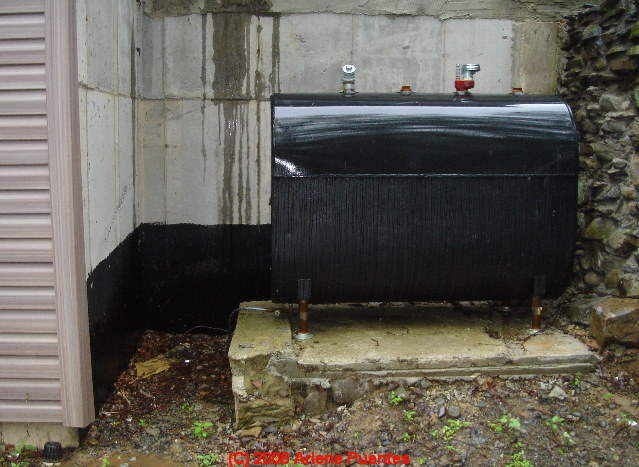
 Heating Oil Tank & Piping Sludge Problems & Cures
- POST a QUESTION or COMMENT about heating oil tank sludge, clogs, and relating heating equipment malfunctions
Sludge & crud or contaminants in heating oil storage tanks:
This article explains the causes and cures for heating system problems due to sludge in home heating oil tanks, including problems of clogged oil piping, clogged oil filters, oil burner malfunctions, and loss of heat due to sludge in the oil tank.
We explain why sludge is a problem in home heating oil & why it leads to loss of heat.
We give first aid advice for what to do if you ran out of heating oil and want to avoid stirring up sludge when oil is delivered.
We continue with all of the methods used to avoid sludge problems in heating oil storage tanks: blowing out a clogged oil line, using additives to break up oil tank sludge, installing a Scully Snorkel® to avoid picking up oil tank sludge & water, improvements in oil line filter capacity, steam cleaning oil tanks & lines, & oil tank replacement options.
InspectAPedia tolerates no conflicts of interest. We have no relationship with advertisers, products, or services discussed at this website.
- Daniel Friedman, Publisher/Editor/Author - See WHO ARE WE?
Heat System Failure (heat loss) due to Sludge
Clogging of Heating Oil Lines, Filters, Nozzles, or Dirty / Debris-Loaded Heating Oil Storage Tanks: whyis that a problem? What do we do about it?
Article Contents
- WHY is SLUDGE in the OIL STORAGE TANK A PROBLEM?
- HEATING OIL TANK SLUDGE CAUSES
- OIL TANK SLUDGE CAUSES LOSS of HEAT
- OIL TANK SLOPE to AVOID SLUDGE PROBLEMS
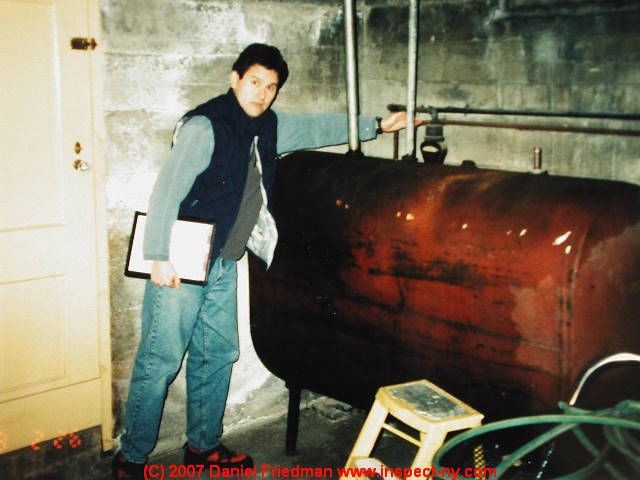
Photo above: our client points to an old oil storage tank in a New York home. Years of accumulated sludge in the bottom of this oil tank led to loss of heat after an oil tank fill-up stirred up so much sludge that it clogged the oil burner filter and nozzle.
Watch out: loss of heat in freezing weather risks more than discomfort. Frozen, burst pipes can cause expensive water damage or mold contamination in a building.
...
Why is Modern Heating Oil Showing a Sludge Problem?
When we serviced heating equipment in the early 1970's, we often found oil fired heating boilers or furnaces that had worked ok for years without any oil filter installed whatsoever!
We were amazed until we learned the history of heating oil cleanliness. We're not talking about the number of BTU's per gallon of heating oil, just how clean or dirty it is.
Before the 1970's oil crisis when much of the heating oil sold in the U.S. was from the middle east, if you put some heating oil in a bottle and examined it, it was a lovely clear yellow color, much like cooking oil.
Since that time, heating oil in much of the U.S. is black goopy stuff with lots of large molecules that tend to settle out as black sludge in an oil tank, heating oil line, or oil filter.
Heating oil companies are not to blame for this messy stuff. Heating oil is being produced by "cold cracking" - it is chilled and centrifuged rather than distilled into clear oil as in the "old days".
A result of this change in heating oil manufacture is that even overnight in a heating oil delivery truck, a driver may see evidence that some components of heating oil in the tank are settling out as sludge material.
The same thing happens in a home heating oil tank. What problems does sludge in an oil tank cause?
Financial Aid for Converting from No. 4 or No. 6 Heating Oil to Cleaner Fuels
The Times article also noted that beginning in 2011 New York instituted the "NYC Clean Heat" program by adopting new regulations to phase out the use of No. 4 and No. 6 heating oils that emit soot and reduce air quality.
The NYC Clean Heat program coordinates oil companies, banks, environmental groups and property owners to provide financing intended to help property owners switch to use of cleaner heating fuels like natural gas or low sulfur No. 2 heating oil or biodiesel. [17]
...
What Causes of Sludge in Oil Tanks?
Before the U.S. was mad at Iran (and vice versa) on the East Coast at least, much heating oil came from that part of the world and was stunningly clean - it looked like yellow cooking oil. Currently a lot of No. 2 home heating oil is being refined from other oil sources and the oil looks ugly even when fresh in a jar - more black, containing more
... well I dunno, "crud" or more properly "residual hydrocarbon waste" ... even if it has about the same BTU value per gallon.
Oil tank sludge (for home heating oil) is comprised of about 90% hydrocarbon waste, 1% sediment, and 9% water. The water component varies as I note in a moment. More sophisticated analyses of hydrocarbon waste can give a more precise breakdown but I"m skipping that.
So sludge in an oil tank may be settled out solids from your oil as delivered, and/or it may include rust from the oil tank interior, particularly if there has been a fair bit of water in the tank or if (as sometimes happens) water was delivered mixed in with the fuel.
In ARTICLE INDEX see the article titled OIL TANK WATER CONTAMINATION
Here is a nice quote from a 2010 US EPA article "Category Assessment Document for Reclaimed Petroleum Hydrocarbons: Residual Hydrocarbon Waste from Petroleum Refining" [copy on file or avail. from the US EPA.
Petroleum crude is a complex substance containing thousands of different organic hydrocarbon molecules. It contains 83-87% carbon, 11-15% hydrogen, and 1-6% sulfur.
Three types of hydrocarbons predominate: paraffins (saturated chains), naphthenes (saturated rings), and aromatics (unsaturated rings).
In many respects, the chemical composition of waste oils and sludges provides a snapshot of individual crude oil components at any particular stage of the refining process.
Other Causes of Dirty Home Heating Oil - deliberate mix of waste or recycled oil with heating oil
In some locations it may be possible to have received a delivery of contaminated home heating oil.
For example, in 2013 the New York Times reported on an investigation of New York heating oil businesses who had "... cheated tens of thousands of customers for years, selling fuel diluted with recycled or waste oil ..."
The report described raids on at least five heating oil companies located in and around New York City. Named in the article were Statewide and County Oil and several related or subordinate companies. [17]
Separately (not part of the raids, commercial and residential building owners filed class-action lawsuits against Castle Oil Corporation and Hess Corporation, making a similar claim - that waste oil had been mixed in with home heating fuel.
The mixed, contaminated oil may have been delivered by independent trucking companies hired to deliver oil according to the article, and the report made clear that neither Castle nor Hess had come under scrutiny in the criminal inquiry. [17]
Watch out: on a much smaller scale, we also have occasionally encountered home or business owners who thought that it was a great idea to dispose of waste motor oil by dumping it into their heating oil tank.
Such mixing is not only illegal and stupid, risking loss of heat and related building damage, it also contaminates the environment by releasing toxic pollutants such as benzene, toluene, and xylene along with heavy metals such as mercury, lead, arsenic, cadmium, antimony lead, and zinc (all known carcinogens) in flue gases emitted by the heating appliances burning such an oil mix.
Don't do this.
...
How does Oil Tank Sludge Cause Loss of Heat?

Above: thick heating oil sludge being removed from an oil tank that was replaced after decades of service.
See details at OIL TANK REPLACEMENT PROCEDURE
- Bad effects of sludge in a home heating oil tank:
Sludge settles to the bottom of an oil tank where, if the oil line to the oil burner exits at the tank bottom, it readily enters the oil line and over time can clog that piping system.
Other points in the heating oil system can become clogged too: oil safety valves (OSVs), filters, the screen in the fuel unit, the fuel unit check valve and stop valve, and the oil burner nozzle itself. Any of these clogs can quickly mean loss of heat in the building. - Oil tank sludge leads to loss of heat:
sludge, even suspended in heating oil, can clog an oil burner filter, resulting in oil burner shut down if the filter is not changed frequently enough.
Heat Doctors, in Poughkeepsie, NY convinced us to install a "System 2000" High Efficiency oil fired heating boiler in a rental house. From the time of new installation we never made it through a heating season without a no-heat call for this new system.
Eventually we traced the problem to sludge in the oil tank which was clogging the new, high-efficiency filter on our oil burner. Our installer suggested the solution was to install a new heating oil tank.
Since the oil tank was not leaking and was otherwise in good condition, and because removing the old and installing the new tank would cost thousands of dollars we were not happy with this "advice".
We asked instead for a new, larger capacity oil filter to be installed to keep oil flowing between annual service calls. That step seems to have helped.
...
Tip the Oil Tank to Avoid Sludge Clogging at the Oil Burner
Which way should the oil tank be sloped to reduce oil line or oil burner clogging from slugde in the oil tank? Or should the oil tank be installed in a dead level position?
InspectApedia readers report that their oil heat service or tank installers have offered contradictory advice.
One person says to keep it tilted back away from the hole on the bottom so that any sludge goes to the back side of the tank. Someone elses says tip it the other way to make sure all oil can be used. Which is correct?
What's the proper oil tank slope position?
Oil tank installation procedures require that the tank be tipped 1/4" per foot away from the tank bottom tapping - this is so even with tanks whose oil lines exit the tank top.
Details are at OIL TANK REPLACEMENT PROCEDURE
If the oil supply piping is taken off of the bottom of the oil tank, many installers tilt the tank away from that outlet - that is the low end of the tank is opposite the end to which the supply pipe is connected, in an effort to reduce the pick up of sludge by the oil piping.
If oil piping is taken off of the top of the oil storage tank then the pick-up end of oil piping will be stopped above the tank bottom to avoid picking up water or sludge, making the tank tilt not significant.
The suggestion that we want to "use all the oil" is a bad one. Most oil tanks will accumulate some sludge in the tank bottom over even just a few years of use. Sending that crud through the oil piping and into the oil filter or oil burner can lead to a costly loss of heat problem in the building.
My opinion [DF] is that the financial cost of leaving a few gallons of oil (and often water and sludge) in the bottom of the oil tank is considerably less than the potential damage and repair costs of a loss of heat problem in a building during freezing weather.
...
Continue reading at EMERGENCY MEASURES for OIL TANK SLUDGE or select a topic from the closely-related articles below, or see the complete ARTICLE INDEX.
Or see OIL TANK SLUDGE FAQs - questions & answers posted originally on this page.
Or see these
Recommended Articles
- HEATING OIL CLOUD WAX GEL POINT
- OIL TANK SLUDGE
- OIL TANK REPLACE due to SLUDGE?
- OIL TANK REPLACEMENT PROCEDURE
- OIL TANK TREATMENTS, ADDITIVES
- OIL TANK WATER REMOVAL
- SCULLY SNORKEL® or OIL PIPING CHANGES to AVOID SLUDGE
- STEAM CLEANING OIL TANKS & OIL PIPING
Suggested citation for this web page
OIL TANK SLUDGE at InspectApedia.com - online encyclopedia of building & environmental inspection, testing, diagnosis, repair, & problem prevention advice.
Or see this
INDEX to RELATED ARTICLES: ARTICLE INDEX to HEATING OIL, OIL BURNERS, OIL FIRED HEATERS, OIL TANKS
Or use the SEARCH BOX found below to Ask a Question or Search InspectApedia
Ask a Question or Search InspectApedia
Share this article:Ask a Question or Search the InspectApedia website using the box just below.
Need to make a private comment? Email editor@inspectApedia.com. We welcome email with your website content critique, corrections, suggestions or questions. Email is monitored daily but our workload may prevent an immediate reply. For immediate results, we hope you'll first try asking your question using the search box just above.
Citations & Reviewers
In addition to any citations in the article above, a full list is available on request.
- [2] Domestic and Commercial Oil Burners, Charles H. Burkhardt, McGraw Hill Book Company, New York 3rd Ed 1969.
- [10] "Warm Air Heating Systems". Instructional Technologies Institute, Inc., 145 "D" Grassy Plain St., Bethel, CT 06801 800/227-1663 [home inspection training material] 1987
- [10] Heating, Ventilating, and Air Conditioning Volume I, Heating Fundamentals, Boilers, Boiler Conversions, James E. Brumbaugh, ISBN 0-672-23389-4 (v. 1) Volume II, Oil, Gas, and Coal Burners, Controls, Ducts, Piping, Valves, James E. Brumbaugh, ISBN 0-672-23390-7 (v. 2) Volume III, Radiant Heating, Water Heaters, Ventilation, Air Conditioning, Heat Pumps, Air Cleaners, James E. Brumbaugh, ISBN 0-672-23383-5 (v. 3) or ISBN 0-672-23380-0 (set) Special Sales Director, Macmillan Publishing Co., 866 Third Ave., New York, NY 10022. Macmillan Publishing Co., NY
- [13] Installation Guide #200, The Hydronics Institute, 35 Russo Place, Berkeley Heights, NJ 07922
- [14] The ABC's of Retention Head Oil Burners, National Association of Oil Heat Service Managers, TM 115, National Old Timers' Association of the Energy Industry, PO Box 168, Mineola, NY 11501. (Excellent tips on spotting problems on oil-fired heating equipment. Booklet.
- [15] AGA, Redfyre, or Rayburn directly at AGA, Station Road, Ketley, Telford, Shropshire, TF1 5AQ, UK, Tel: 08457 626 147, or 08458 152 020, Website: rayburn-web.co.uk
- [16] "Scully Oil Delivery Systems", Scully Signal Company, 70 Industrial Way, Wilmington MA 01887, Tel: 800-272-8559, email: sales@scully.com, website: scully.com, retrieved 3/14/13, copy on file as Scully_Delivery Systems Catalogue.pdf.
- [17] William K. Rashbaum, "Heating Oil Companies Face Inquiry on Purity of Fuel", The New York Times, 21 March 2013 p. A22.
- In addition to citations & references found in this article, see the research citations given at the end of the related articles found at our suggested
CONTINUE READING or RECOMMENDED ARTICLES.
- Carson, Dunlop & Associates Ltd., 120 Carlton Street Suite 407, Toronto ON M5A 4K2. Tel: (416) 964-9415 1-800-268-7070 Email: info@carsondunlop.com. Alan Carson is a past president of ASHI, the American Society of Home Inspectors.
Thanks to Alan Carson and Bob Dunlop, for permission for InspectAPedia to use text excerpts from The HOME REFERENCE BOOK - the Encyclopedia of Homes and to use illustrations from The ILLUSTRATED HOME .
Carson Dunlop Associates provides extensive home inspection education and report writing material. In gratitude we provide links to tsome Carson Dunlop Associates products and services.
 |
HOME | ABOUT | ASK a QUESTION | CONTACT | CONTENT USE POLICY | DESCRIPTION | POLICIES | PRIVACY | |
| © 2026 - 1985 Publisher InspectApedia.com - Daniel Friedman | |||||||||