
InspectAPedia® FREE Encyclopedia of Building & Environmental Construction, Diagnosis, Maintenance & Repair |
Question? Just ask us! InspectAPedia
|
 Fix Cold Steam Heating Radiators & Convectors
- POST a QUESTION or COMMENT about how to troubleshoot cold steam radiators, baseboards, or convector heaters
How to diagnose & fix a too-cold steam radiator?
No steam system heat in some or all building areas? What to check first. Troubleshooting cold steam radiators: this article describes the diagnosis & repair of cold steam heating convectors or steam radiators.
We also describe how to fix a steam radiator that is too hot and we include warnings about other radiator or baseboard types that are too hot or that overheat.
And we list less common causes of cold steam radiators in buildings and we describe how to fix these conditions.
InspectAPedia tolerates no conflicts of interest. We have no relationship with advertisers, products, or services discussed at this website.
How to Troubleshoot & Fix Cold Steam Radiators in 5 Steps
 First let's be sure we're reading the best cold-radiator diagnostic advice for your situation.
This article will help you fix a steam heating system radiator that is not heating up as it should.
If your heating system uses steam radiators or steam convectors then you are on the right page to get help in diagnosing and fixing steam radiators that won't get hot. Continue reading below.
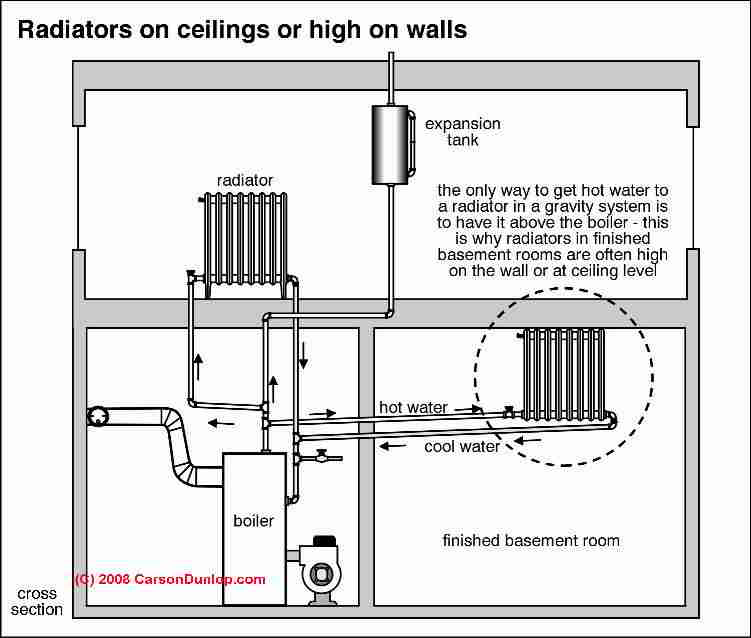
If your heating system runs on hot water (it's a hydronic heating system) but it uses those skinny horizontal baseboards instead of radiators, you will be happier if you
see BASEBOARD HEAT for cold baseboard diagnosis and repair.
Our page top heating system illustration and the sketch at left were provided compliments of Carson Dunlop Associates, a Toronto home inspection, education & report writing tool company [ carsondunlop.com ].
Article Contents
- STEP 1: Check the thermostat & the steam boiler
- STEP 2: Check the radiator CONTROL VALVE at the steam heat radiator
- STEP 3: Check the steam VENT On the radiator
- STEP 4: Check which radiators are not getting hot - check radiator slope
- STEP 5: Check these other causes of cold steam radiators
Internal leaks in the steam boiler can also cause cold radiators - STEP 6: Check these STEAM BOILER OPERATING PROBLEMS that can lead to inadequate heat - radiators not hot enough or distant radiators not heating up - diagnostic checks
- STEP 7: RADIATORS that are TOO HOT Troubleshooting
Cold Steam Radiator Diagnosis Step 1: Check the thermostat & the steam boiler
Make sure that your room thermostat is set to a temperature higher than the temperature in the room - so that it is calling for heat.
Make sure that your heating boiler is working, that is that the heating boiler turns on and off normally. A steam boiler will usually turn on right away in response to the thermostat being turned up or on a call for heat.
Step 2: Check the radiator control valve
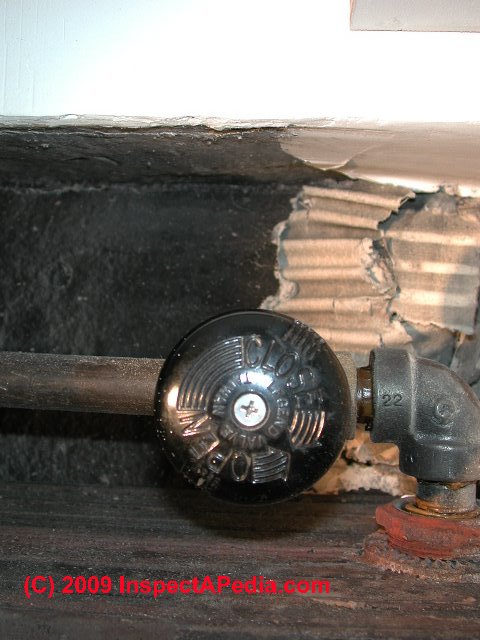
Make sure that the control valve at the heating radiator is "open" or "on" as we describe just below.
First check the radiator valve itself.
At COLD HEATING BASEBOARD / RADIATOR REPAIR we illustrated different types of heating radiator control valves and explained their operation.
Details are at RADIATOR VALVES & HEAT CONTROLS.
It's standard to ask first "is the radiator valve turned on or "open" (fully counter-clockwise)?
Experts warn that a radiator slow to heat could have a supply valve that is too small (the problem would always have been observed since date of installation) or a supply valve that is partly closed (the problem would have originated when the valve was closed and would go away when the valve is fully opened, provided the valve is undamaged and really opens internally when its handle is turned.)
We also see both radiators and other forms of steam or hot water heat that are not hot enough if the supply piping is undersized, a valve is partly closed, piping is clogged or blocked, or the hot water flow rate or for steam heat the rise of steam is too slow.
Other problems can cause a steam heat radiator to stay cold when you want heat as we explain next where after the above digression we continue our diagnostic and repair advice for cold radiators or convectors in steam heating systems.
Step 3: check the steam vent on the radiator

If some of your steam heat radiators are not getting hot, the steam vent may not be working, may not be venting at all (radiator stays cold) or may be venting too slowly (radiator heats to proper temperature but too slowly)[2]
If a steam radiator valve is open but the radiator is still cold, the steam vent may not be working.
Our photo at left shows a typical steam radiator vent.
When steam is first rising in the heating system, the steam heating radiator will be cool as will be the steam vent. The vent opens, allowing rising steam to enter the radiator by pushing air out through the vent.
When the steam radiator and steam vent are warm or hot, the vent closes. If a steam vent stops working, rising steam cannot enter the radiator and it will be slow to heat or may not heat at all.
See STEAM VENTS and
also STEAM HEATING SYSTEMS for details about the choice, installation, diagnosis & repair of steam radiator vents - a common source of cold steam radiators, slow to heat steam radiators, even overheating steam radiators and that incessant hissssssss or spitting condensate when a steam vent doesn't close as it should.
A cold upper part of the radiator may indicate the
vent is plugged with scale or is malfunctioning.
Vapor or slight moisture from the vent is normal.
Steam continuously passing through the vent
indicates a malfunction. Replace the vent as
needed or every 10 years.
Source: ITT Hoffman Specialty STEAM VENTS for RADIATORS MODEL 1A 1B AIR VALVE INSTALLATION INSTRUCTIONS [PDF] (2007), ITT 8200 N. Austin Ave. Morton Grove, IL 60053 tel: 847-966-3700 fax: 847-966-9052 www.hoffmanspecialty.com
Wait a minute: what if the steam heat radiators don't have a steam vent at all? How does that work?
If there are no steam vents on your steam heat radiators don't despair: your steam heat is probably a two-pipe steam heating system that uses
STEAM TRAPS - take a look at that article: steam traps are used on two pipe steam heating systems to release air and condensate while keeping hot steam in the radiator.
Step 4: Check which radiators are not getting hot - check radiator slope
Steam radiator sloped the wrong way - steam condensate blockage
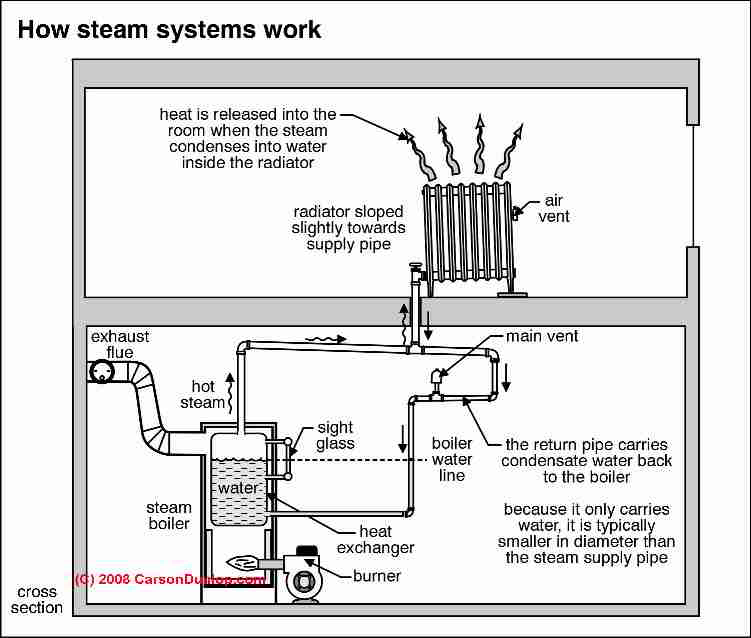
As our Carson Dunlop Associates sketch shows (above, left), steam radiators can be sensitive to exactly how they are installed and pitched or sloped.
You'll want to learn if your steam heating system is a "one pipe" or a "two pipe" design, but in either case, if the steam supply or condensate return piping have been moved or settled so as to have lost the proper slope, correcting those conditions may be needed.
That's because condensate, produced by cooling steam in the radiator, has to be able to drain back out of the radiator.
A steam radiator that is sloped the wrong way, perhaps due to building floor settlement or a change made by an inexperienced re modeler, will become partly or even completely blocked by accumulated condensate, leading to loss of heat.
Steam heating system controls, inspection, diagnosis, and repair are discussed beginning
Step 5: Check these other causes of cold steam radiators
Internal leaks in the steam boiler can cause cold radiators - diagnosis:
- Small boiler leaks
can be hidden from view: As reader Robert discovered and kindly explained in our FAQs section below, several clues can point to an internal leak in the steam boiler.
A relatively small leak in the steam boiler may never show up as water on the floor around the boiler - the leaking water may just evaporate on boiler internal surfaces.
A larger steam boiler leak will probably show up as water on the floor, boiler running continuously, or if the leak is fast enough, a low-water cutoff switch will shut down the boiler.
Watch out: as Robert points out below, leaks in the condensate return system increase the rate of water feeding into the steam boiler.
Abnormally high water feed rates into the boiler can in turn speed up corrosion within the boiler leading to costly or even ruinous leaks in the steam boiler itself.
The rate of corrosion will vary depending on not just the water feed rate but also other factors such as the water chemistry and the overall boiler on-time. - Check boiler steam pressure -
lower than normal steam pressure can result in heat being delivered too slowly to all radiators, slower heat or even no delivery of heat to radiators on upper floors
. If all of the lower floor radiators in a building heat up but none of the upper floor radiators do so, or if no radiators near the end of the steam risers get hot, low steam pressure could be the problem.
Don't rush to "fix" this by changing the steam pressure control switch - that's treating the symptom not the illness. - Check the steam boiler water usage rate -
an increase in water usage at the boiler can be due to a leak somewhere - in the condensate line, or in the case of cold radiators, in the boiler itself.
Steam boiler operating problems that can lead to inadequate heat
radiators not hot enough or distant radiators not heating up - diagnostic checks.
- Steam boiler problems:
An oil or gas fired steam boiler may fail to deliver enough heat for a number of reasons pointed out by ITT [2], including:- Inadequate draft
- Poor fuel quality
- Improper attention or firing (lack of maintenance, burner not firing properly)
- Boiler is undersized - if this is the case the heat inadequacy would always have been present but may not be noticed until very cold windy weather
- Improper steam piping - as above, if this is the case the heat inadequacy would always have been present or present ever since steam piping has been changed or modified.
- Improper arrangement of boiler sections
- Lack of boiler cleaning/maintenance, leaving soot in the boiler. Soot acts as an insulator, slowing heat transfer from the fire into the boiler water
- Improper firing rate of oil (nozzle size, fuel unit pressure) or gas
- See STEAM HEATING SYSTEMS for details
- One pipe steam system radiators fail to get hot - check these
- Radiator vent problems: The radiator vent is improperly sized or not working.
See RADIATOR STEAM VENTS
and
also RADIATOR STEAM VENTS, AUTOMATIC. - Steam pipe problems: The steam pipe feeding the radiator is under-sized or is not properly sloped (steam supply pipes in a one pipe system also return the condensate and must slope away from the radiator and down towards the boiler - always) - (the problem will have always been present but may not be noticed until very cold weather)
- Air vent problems: The drainage tongue on the air vent has become damaged or lost or corroded away
- Radiator vent problems: The radiator vent is improperly sized or not working.
- Two pipe steam system radiators fail to get hot - check these
- Radiator pitch problems: doesn't slope towards the steam trap - the radiator should slope away from the steam supply valve and towards the steam trap
- The radiator steam trap is clogged, damaged, or stuck closed
- The steam pipe feeding the radiator is undersized or the condensate return not pitched properly, leading to blockage
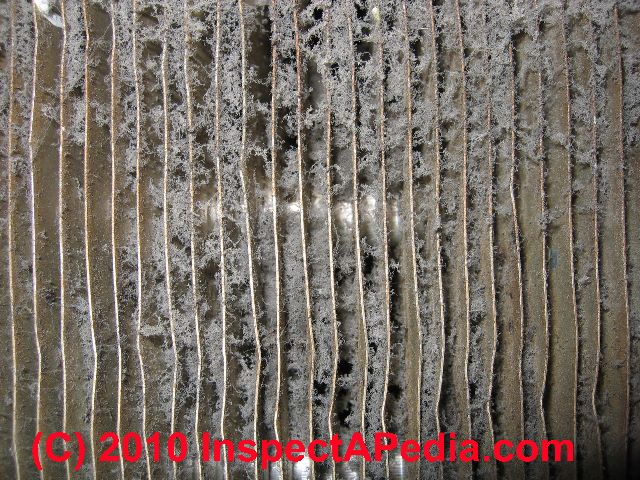
- Steam convectors or "unit heaters" are not putting out enough heat
- Dirty heater coils - check for dust or debris blocking the fins on the heater coil - see our photo at left
- Dead unit heater fan - if the unit heater such as a ceiling-mounted garage heater is driven by a blower fan (not just a convector (driven by gravity), check that the fan operates normally
- Blocked steam piping feeding the unit or within the heating coil - due to air or water blockage in the piping
- Also check these more technical problems with unit heater heat output:
- Design mistakes: the unit is too small for the heated space (the problem will not be new), or the unit has been improperly located - too far from exterior walls can leave cold areas between the heater and the exterior wall;
- Improper installation: the steam pipe supplying the unit may be inadequately insulated, improperly sloped, or routed through a cold area where it loses too much heat
- Abnormal or too-low steam pressure in the system (there may be hidden leaks in the system)
- Maintenance problems: oil and debris in the steam, coating the heat transfer surfaces of the interior surfaces of the heating coil itself
- Steam system design or building heat loss rate problems
If the steam radiators get hot but the building does not get warm enough, check these- The number of radiators is inadequate, or some radiators are turned off or not heating for other reasons - the remaining radiators can't keep up with the building heat loss rate. You'll notice this more in colder windier weather
- The building is losing heat too rapidly for the heating system to keep up. If this is a new problem look for a new draft - a window left open, an attic door or pull down stair left open, etc.
- The steam pressure is set too low - steam doesn't rise to upper floors or rises too slowly. Check with your service technician as other problems such as a boiler leak or condensate return leak can result in low steam pressure.
- Building design, such as many open stairwells, high ceilings, can make it hard to heat - this problem will have always been present.
- See HEAT LOSS in BUILDINGS
Troubleshooting Radiators that are too HOT
If your steam radiator is too hot in a two-pipe steam system, according to the U.S. DOE, check the steam traps:
In two-pipe systems, older steam traps often stick in either the open or closed position, throwing off the balance in the system.
If you seem to have problems with some radiators providing too much heat and others providing too little, this might be the cause.
The best approach is often to simply replace all the steam traps in the system.
If your electric heater is too hot or is not shutting off when you think it should
see ELECTRIC BASEBOARD HEAT INSPECTION
Watch out: an overheating electric heater is a fire hazard.
Also see HEAT WON'T TURN OFF for complete diagnosis of too much heat or heat that won't turn off.
Reader Comments, Questions & Answers About The Article Above
Below you will find questions and answers previously posted on this page at its page bottom reader comment box.
Reader Q&A - also see RECOMMENDED ARTICLES & FAQs
On 2020-11-24 by Peter Gruber - one of two radiators won't get hot
Hi I Have a Question about my Radiator. I HAVE Two Radiators One one each corner of the house one gets Hot one is cold .
On the Radiators do thE Shut off VALVES Hot and cold need to be open at the same Time Hot water does run down the pipe to Radiator.
DOES not run into Radiator. Thank you
On 2020-11-24 - by (mod) - be sure the valves are open at both radiators
Peter
Each radiator has its own control valve; both need to be open if you want both to produce heat.
I would not expect both "hot" and "cold" valves to be present at a heating radiator, just a single control valve at each radiator.
If you've got something different, perhaps you can use the "add image" button to post a photo.
On 2020-11-15 by Bob - I think my boiler pressure is too low to get heat upstairs
The psi for water pressure does not increase when furnace is running so no heat second floor
On 2020-11-15 - by (mod) - check the actual pressure and don't trust the gauge
Bob:
You are commenting on a steam heating page so I'll assume your boiler is a steam heating system.
Residential steam heating boilers operate at a very low pressure typically under one psi. So looking at the pressure gauge on your boiler is not going to be a complete diagnostic and in fact if the gate shows no change at all with the boiler heat up I suspect that the gauge itself is debris clogged and might want to be replaced.
So if you have no heat on an upper floor in your home and it's steam heat the most likely the radiator steam vent or vents are not working on the radiator valves are closed.
On 2018-01-06 by Anonymous - some steam radiators are not getting any steam at all
I have an apt block floors 2,3,4 no problems 1floor 2 front apts and 1 back apt no heat to steam radiatos all line vrnt and radiator vents replaced i took out the line vent in basement no steam comming out boilet was running for 45 min plugged main sumwhere?
On 2018-01-06 - by (mod) -
Anon if burner is operating but the boiler is not producing steam TURN IT OFF and call for service - the system may be unsafe, out of water, and risking boiler damage too.
Start by looking at the water level in the boiler.
On 2017-12-14 by Anonymous - our steam radiator doesn't have a vent and does not get hot
We moved a steam radiator in a bathroom second floor. The radiator builds pressure the system has no vents at the sources of heat.
We tried replacing the steam trap thinking it was our problem.Feed pipe coming out of the wall is pretty hot but pretty much stops at the 90 coming out of the wall
On 2017-12-14 - by (mod) -
Anon, your steam radiator won't heat if it cannot vent air in the the radiator from its cold state. Each steam radiator normally requires its own steam vent.
On 2017-10-21 by bomahony - steam boiler shuts down after just a few minutes - broken steam vent?
Boiler works for a while ( 3 mins) and then shuts down. Surrounding pipes get very hot. Just discovered my steam vent might be a problem.
Just turned the small screw on top and now is hissing steam. Is the value possibly dirty and jammed preventing the radiators to warm up
On 2017-10-21 - by (mod) -
Bom
I don't know what sort of safety equipment is installed on your steam boiler; some units may indeed use a temperature limit to shut down the boiler at unsafe heat levels. I'd also look for spillage from a pressure relief valve and I'd check the system's operating pressure against it's specifications - residential steam heat typically runs at about 0.5 psi.
As the boiler is shutting down, a review of its safety controls would indeed be diagnostic. I can't offer more, knowing not a shred of information about your particular system.
On 2016-12-24 by mike - radiators won't get hot after new boiler installed
my heat gas boiler was replaced with a new one ---now all radiators dont get hot only when its first turned on...
throughout the day when it kicks on, not all radiators get hot or sections of the radiators get hot...i also get cracking, thumping ,sounds....
it kicks on like 5minutes then turns off , only the pipes going upstairs get hot ..radiators downstairs are mostly cold
my old boiler heated up all sections of every radiator and was quiet no noises at all
On 2016-12-25 - by (mod) -
Mike
I'm flying blind here, Mike. Did a tech who knows steam install the boiler? For example a mistake with condensate return piping can cause trouble.
CHeck the pressure control switch: normally it's set between 0.2 and 0.5 psi. Not higher.
If the boiler is making steam and the steam riser at the boiler is hot but steam doesn't continue to rise, I suspect that a main steam trap or vent could hab become clogged, maybe with crud stirred during boiler replacement or from the old boiler. I'm guessing that direction because if it were steam vents on the individual radiators it'd be unusual for all of them to fail at once.
Follow the steam supply pipe to see where it changes from hot to cold - that could be diagnostic.
If you search InspectApedia for STEAM HEAT there are quite a few diagnosis and repair articles.
Also see COLD STEAM HEAT RADIATORS where we list a bunch of things to check.
...
Continue reading at RADIATOR STEAM VENTS or select a topic from the closely-related articles below, or see the complete ARTICLE INDEX.
Or see these
Heating Radiator Articles
- RADIATORS - home
- BANGING HEATING PIPES RADIATORS
- BASEBOARD HEAT - diagnose & repair
- COLD HEATING BASEBOARD / RADIATOR REPAIR - diagnose & repair
- COLD STEAM HEAT RADIATORS - diagnose & repair
- DIAGNOSE & FIX HEATING PROBLEMS-BOILER
- LEAKS at BASEBOARD, CONVECTOR, RADIATOR
- NOISE, HEATING SYSTEMS
- RADIATOR VALVES & HEAT CONTROLS
- RADIATOR VOLUME & BTUs
- STEAM RADIATOR PIPING CONNECTIONS
- RADIATOR STEAM VENTS - home
- UNEVEN HEAT DIAGNOSIS
Suggested citation for this web page
COLD STEAM HEAT RADIATORS at InspectApedia.com - online encyclopedia of building & environmental inspection, testing, diagnosis, repair, & problem prevention advice.
Or see this
INDEX to RELATED ARTICLES: ARTICLE INDEX to HEATING RADIATORS
Or use the SEARCH BOX found below to Ask a Question or Search InspectApedia
Ask a Question or Search InspectApedia
Questions & answers or comments about how to troubleshoot cold steam radiators, baseboards, or convector heaters.
Try the search box just below, or if you prefer, post a question or comment in the Comments box below and we will respond promptly.
Search the InspectApedia website
Note: appearance of your Comment below may be delayed: if your comment contains an image, photograph, web link, or text that looks to the software as if it might be a web link, your posting will appear after it has been approved by a moderator. Apologies for the delay.
Only one image can be added per comment but you can post as many comments, and therefore images, as you like.
You will not receive a notification when a response to your question has been posted.
Please bookmark this page to make it easy for you to check back for our response.
Our Comment Box is provided by Countable Web Productions countable.ca
Citations & References
In addition to any citations in the article above, a full list is available on request.
- [2] The Steam Book, 1984, Training and Education Department, Fluid Handling Division, ITT [probably out of print, possibly available from several home inspection supply companies] Fuel Oil and Oil Heat Magazine, October 1990, offers an update,
- [3] Principles of Steam Heating, $13.25 includes postage. Fuel oil & Oil Heat Magazine, 389 Passaic Ave., Fairfield, NJ 07004.
- [4] The Lost Art of Steam Heating, Dan Holohan, 516-579-3046 FAX
- [5] Principles of Steam Heating, Dan Holohan, technical editor of Fuel Oil and Oil Heat magazine, 389 Passaic Ave., Fairfield, NJ 07004 ($12.+1.25 postage/handling).
- [6] "Residential Steam Heating Systems", Instructional Technologies Institute, Inc., 145 "D" Grassy Plain St., Bethel, CT 06801 800/227-1663 [home inspection training material] 1987
- [7] "Steam Boiler Operations" (Program 4, booklet & video), Weil-McLain H.E.A.T. (Hydronics Education and Training), Blain St., Michigan City Indiana 46360 Tel: 219-879-6561
- In addition to citations & references found in this article, see the research citations given at the end of the related articles found at our suggested
CONTINUE READING or RECOMMENDED ARTICLES.
- Carson, Dunlop & Associates Ltd., 120 Carlton Street Suite 407, Toronto ON M5A 4K2. Tel: (416) 964-9415 1-800-268-7070 Email: info@carsondunlop.com. Alan Carson is a past president of ASHI, the American Society of Home Inspectors.
Thanks to Alan Carson and Bob Dunlop, for permission for InspectAPedia to use text excerpts from The HOME REFERENCE BOOK - the Encyclopedia of Homes and to use illustrations from The ILLUSTRATED HOME .
Carson Dunlop Associates provides extensive home inspection education and report writing material. In gratitude we provide links to tsome Carson Dunlop Associates products and services.
 | HOME | ABOUT | ASK a QUESTION | CONTACT | CONTENT USE POLICY | DESCRIPTION | POLICIES | PRIVACY | |
| © 2024 - 1985 Publisher InspectApedia.com - Daniel Friedman | |||||||||