
InspectAPedia® FREE Encyclopedia of Building & Environmental Construction, Diagnosis, Maintenance & Repair |
Question? Just ask us! InspectAPedia
|
 Guide to Heating System Boiler Pressure & Temperature Relief Valves
- POST a QUESTION or COMMENT about pressure or pressure & temperature safety relief valves: inspection, diagnosis, installation requirements, relief valve testing, and relief valve repair procedures.
Guide to TPR valves on hot water heating boiler:
How to install, inspect, troubleshoot, repair pressure / temperature relief valves or straight pressure relief valves used on heating boilers, steam boilers, water heaters, and even on water pressure tanks. This article explains what TP or pressure relief safety valves are, why they are needed, how they work, and what goes wrong.
We describe how to test (or when not to test) relief valves, how to know that this important safety device is in trouble, including by simple visual inspection, and we answer just about any question about these important safety devices.
InspectAPedia tolerates no conflicts of interest. We have no relationship with advertisers, products, or services discussed at this website.
A Guide to Heating Boiler Temperature & Pressure Relief Valves, Inspection, Defects, Testing, Repair
 Article Contents
This article series answers most questions about Heating System Boiler Controls on central heating systems to aid in troubleshooting, inspection, diagnosis, and repairs. Here we include a discussion of temperature and pressure relief valves used as safety devices on heating boilers and other pressurized vessels.
Lots of controls are installed on modern hot water and steam heating boilers and many of them are principally concerned with safety. The combination of these devices provide a tremendous margin of safety on home and commercial heating boilers, as evidenced by the rarity with which we read in modern times of boiler explosions.
Before these devices were in common use, and even today if the devices are improperly installed, poorly maintained, or damaged, the heating systems they are supposed to protect are in fact un-protected.
A defective relief valve is a latent safety hazard in that the valve does not by itself cause a boiler to explode, but it may fail to protect against that event should other dangerous conditions causing over temperature or over pressure arise in a heating boiler or water heater.
 Pressure and Temperature Relief Valve on heating boilers:
a TP valve is installed on all modern heating boilers to release hot water and pressure should the boiler's internal pressure or temperature rise to an unsafe level.
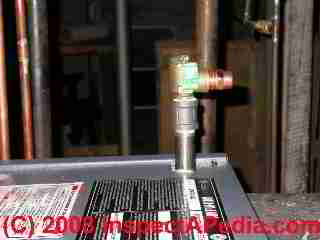
Our photo at page top shows what the typical boiler relief valve looks like. You may find this valve connected at the top of a heating boiler, at its side, or (less desirable) very nearby on boiler hot water piping.
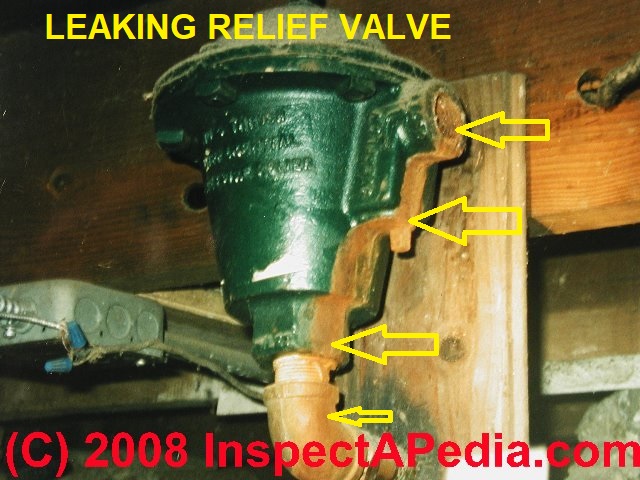
Our photo at left shows an older (obsolete) type of pressure relief safety device that may be mounted close to the boiler but not right on it.
This type of pressure relief device may not sense boiler temperature, just boiler pressure.
You can see that this pressure relief valve (shown above) has been leaking
- it may be unsafe, as we discuss further below. Both the page top relief valve and the one in this photo are missing their discharge tubes.
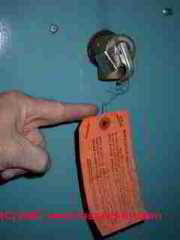
The data tag that should be found on a boiler relief valve (photo at left) gives key information and lets the owner or inspector know if the proper type of safety device has been installed.
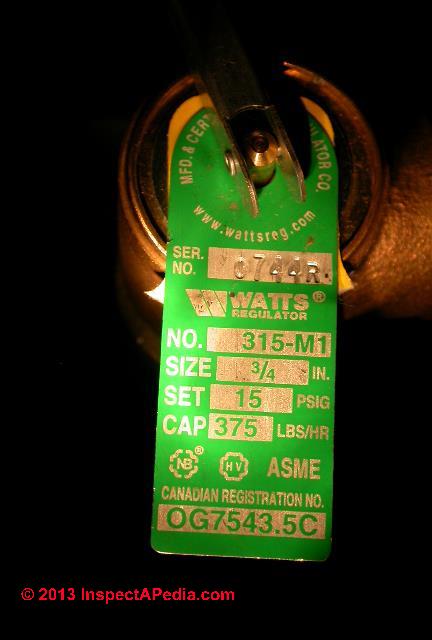 The maximum pressure and/or temperature that the relief valve will allow is marked on the valve's metal tag.
Compare this data with the boiler capacity.
At an inspection of Vassar Temple in Poughkeepsie, NY we observed that a pressure relief valve with capacity to handle 40,000 BTUs but the heating boiler was rated for 4,000,000 BTUH! The system was unsafe - it was a simple repair to install the proper valve.
We told Rabbi Steve Arnold that we were worried that if the boiler exploded it would kill all of the Reform Jewish worshippers in Poughkeepsie.
He replied, no, only during the high holy days.
List of Common Boiler Temperature/Pressure Relief Valve Defects & Hazards
Our photographs below show an older type of pressure relief valve used on hot water heating systems. Our photo at below left shows a bronze-colored pressure reducer, followed by a red pressure relief valve. That valve is unsafe because of the drain valve installed at its outlet pipe.
Our second relief valve photograph (below right, contributed by home inspector Ron Wells) shows the same combination of equipment with the pressure reducing automatic water feeder valve located to the right of the pressure relief valve.
Installed in the proper order, the pressure reducer/water feeder is installed closest to the water supply source and the pressure relief valve follows the pressure reducer/water feeder and so is installed between that device and the heating boiler.
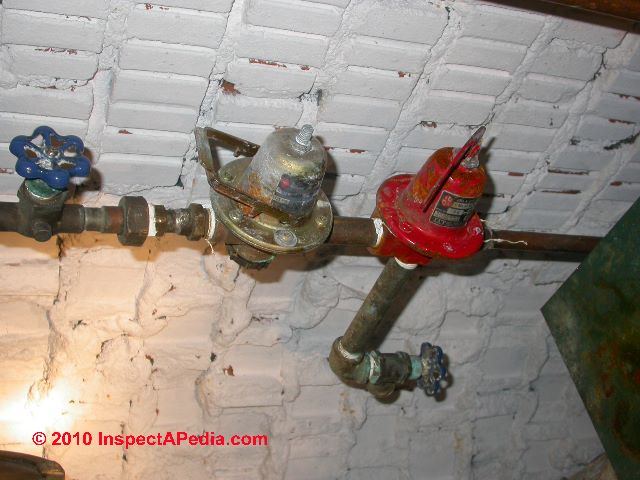

This type of relief valve responds only to water pressure and may be located at some distance from the heating boiler itself.
Watch out: this older equipment does not provide the same protection as a pressure/temperature relief valve.
Checklist of Temperature/Pressure Relief Valve Problems & Safety Hazards
Here is a list of common defects where boiler or water heater temperature/pressure relief valves are installed. All of these are unsafe conditions.

- Relief Valve Leaks at the pressure/temperature relief valve (such as the open, mineral and rust-coated and dripping TP valve in our photo at left) -
see RELIEF VALVE LEAKS for details.
Temperature/Pressure relief valves that are leaking or corroded, need to be tested or probably replaced and the cause for the leak (if not the valve itself) needs to be identified and corrected.
Watch out: if you see water dripping or squirting out of the temperature/pressure relief valve on any vessel, such as a hydronic heating boielr, the situation is unsafe. There is a risk that the valve becomes clogged by mineral deposits or crud left by the escaping water. A clogged TPR valve is no longer protecting the system from an explosion
see details at BLEVE EXPLOSIONS - Temperature/Pressure relief valve whose relief capacity is not properly matched to the heating appliance it is intended to protect.
Specifications include the valve opening diameter, its operating temperature range, its operating pressure range, and its operating BTUh range.
In our photo at above left the hydronic (hot water) heating boiler label includes the specification of the required relief valve capacity, expressed in this case as 151 LB/Hr and shows the maximum water pressure at which that that heating boiler operates (30 psi).
It also shows the boiler's input BTUh of 151,000 BTUs per hour. So the relief valve used must be able to relieve 151 Lb/Hr or MBH (or more), open at 30 psi. This heater's label does not give a temperature range for the TP valve.. - Pressure relief valve outlet has been blocked off - such as by addition of the drain valve (closed of course) in our photo shown earlier on this page. This is just asking for a catastrophic, dangerous, boiler explosion.
- Temperature/Pressure relief valve missing
See BOILER RELIEF VALVE NOT FOUND - Temperature/Pressure relief valve installed too remote (far away) from the boiler itself; modern boilers have a tapping right on the boiler where the TP valve should be installed.
- Shutoff valve installed between the heating appliance and the TP valve - potentially isolating the safety device from the equipment it is intended to protect

- Temperature Pressure relief valve discharge tube diameter is reduced (as in our photo at above left). A TP valve whose opening is 3/4" requires a 3/4" discharge tube.
The discharge tube in our photo is reduced from 3/4" to 1/2", restricting the valve's ability to spill heat, water, energy - Temperature/Pressure relief valve piped to a hidden location (making it impossible to notice that the valve is leaking and thus may be unsafe) (photo at left).
- Temperature/Pressure relief valve or its discharge tube is piped "up" rather than down.
This condition allows water and debris to remain in the valve opening and discharge tube, risking blockage - a dangerous condition that can cause the valve to fail to operate.

- Temperature/Pressure relief valve missing its discharge tube ( shown in our photo above).
See RELIEF VALVE DISCHARGE TUBE for a complete catalog of T&P valve drain line piping specifications & defects.
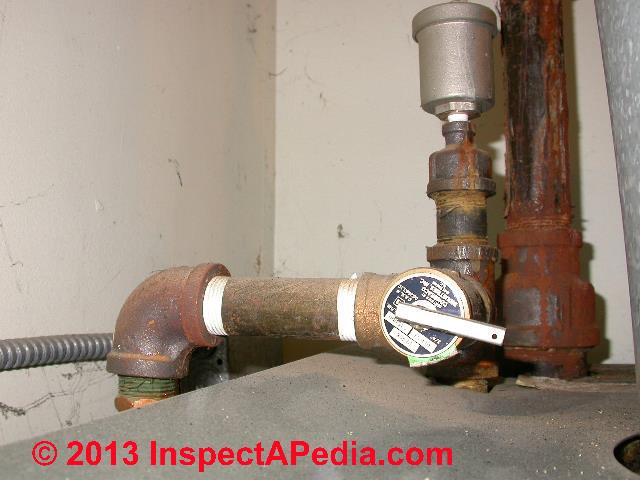
- Temperature/Pressure relief valve has been modified - such as cutting off of the temperature sensing tip in order to install the valve at an improper location.
In our photo at left the TP valve is connected to a cast iron Tee fitting at the boiler top - we'd have to check the manufacturer's TP valve model number and specifications, but if this valve had a temperature sensing tip it would have to have been cut off to install the valve in this location - an unsafe condition. - Temperature/Pressure relief valve that has been piped to a location where a leaking dripping valve is exposed to freezing conditions or to any other event that could cause the relief valve discharge tube to become blocked (such as invasion and blockage by mud-dauber wasps, insects, small animals).
As you will read at our FAQs section below, a reader has reported a boiler explosion from a leaky TP valve that froze.
The use of a tundish, not commonly installed in North America but widely used in the U.K., Australia, New Zealand, could have avoided that hazard.
See TUNDISH used in PLUMBING for that option.
Leaking or Previously Leaking Pressure/Temperature Relief Valves are Dangerous
 If a relief valve has been leaking it is unsafe. Above on this page we showed an obsolete relief valve with leak stains down its front.
We don't know if the valve has stopped leaking because a problem has been fixed (such as something else causing boiler overpressure) or if the valve has stopped leaking simply because its internals have become clogged with mineral debris which has been left behind as hot water evaporated.
The pressure temperature relief valve shown at left was dripping, but visual inspection showed that it was clogged with mineral debris left behind as boiler water leaked out and evaporated.
The mineral debris can, as you see in this photo, obstruct movement of the spring and valve internal parts, preventing it from opening when it's needed.
See RELIEF VALVE LEAKS for an explanation of all of the possible causes of a leaking TPR valve and thus of the suggested remedies.
Missing Relief Valve Extension Discharge Tube is a Safety Hazard
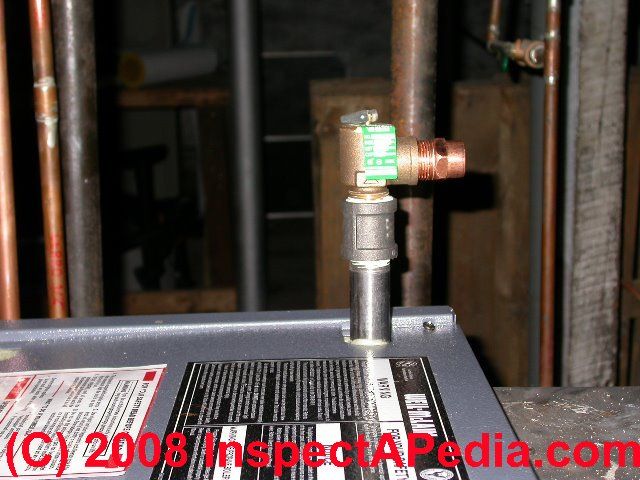 The TP valve shown in our photo at left displays the most common safety defect found with this equipment - failure to pipe the valve's potential discharge of hot water to a safe location.
The relief valve should be piped to a few inches from the floor with the end of the discharge tube always in a visible location so that if it is leaking or open the building owner or manager can observe that (unsafe) condition.
A client described finding her son and his friends in the basement playing "steam boat". They had tied a string through the little hole in the relief valve discharge lever, running the string up over a boiler pipe near the ceiling.
By pulling on the string the boys created an exciting blast of hot steamy water coming out of the boiler. Luckily none of them was scalded by this game.
But when the TP relief valve discharge extension is missing from a heating device, someone can be badly scalded.
At a home inspection in New York a real estate agent burst into tears while telling us how her son had lost an eye when he and friends played with a boiler relief valve and he was shot in the face with scalding water. A proper discharge tube could have prevented this tragedy.
Old Heating Boilers (steam or hot water) may have No Relief Valve at All - Check the Attic
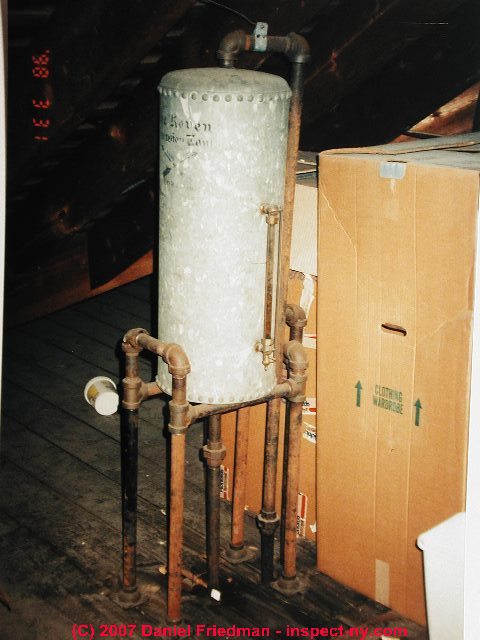
Some very old heating boilers may not have a relief valve installed.
These systems used a pressure relieving overflow tank located high in the building, above any upper floor radiators or baseboards, often in the building attic.
We illustrate an attic heating system overflow tank in our photo at left.
Hot water inside the hydronic heating system is piped from a heating boiler located in the building below, upwards through radiators or baseboards, and connected upwards still to this attic water tank.
The attic pressure tank was open to the atmosphere and often itself included an overflow pipe which would permit any excess water (or pressure) to flow out of the tank and out of the building, perhaps through a building wall to the outdoors.
While these attic systems for boiler pressure relief safety worked well for decades, placing a temperature relief valve right on or very close to the heating boiler is a safer installation.
Heating Boiler Temperature/Pressure Relief Valve Testing Advice
Watch out: While it is possible to "open" a boiler TP relief valve by lifting its "test" lever, unless you are a trained heating service technician or plumber, and unless you have a spare TP valve of the proper size in your hand, we advise against "testing" a TP relief valve by opening this lever. Just confine your check to the following steps:
- Boiler Pressure: See that the boiler pressure is at or below the rated valve-opening pressure or temperature by checking the (imprecise) boiler gauge readings against the valve tag data when the boiler has heated itself up to its "shut off" point.
- Boiler TPR Valve Modifications: Inspect the Temperature/Pressure relief valve for evidence of tampering
- Boiler TPR Valve Leak History: Inspect the Temperature/Pressure relief valve for evidence of a history of leaks by observing the following
- Boiler TPR Valve Visible Corrosion: any leak or corrosion stains around the mouth of the valve
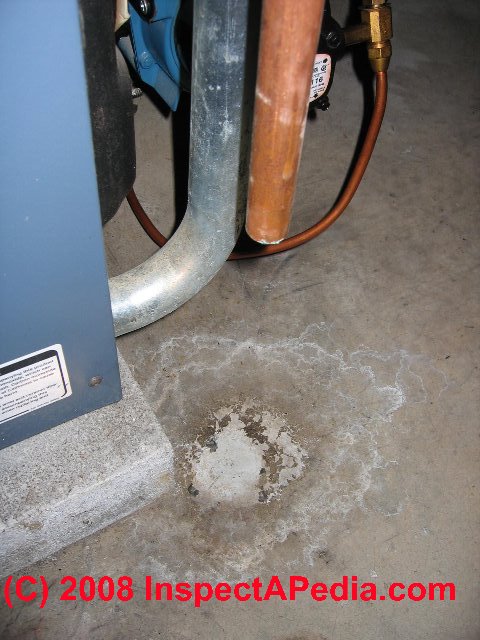
- Boiler TPR Valve Drip Marks: any drip stains on the floor below the valve discharge tube (photo at left)
- Boiler TPR Valve Wet: Using your finger, feel the inside of the tip of the discharge tube and check for water - it should be dry
- Boiler TPR Valve Mounting Leaks: Check for leaks around the valve where it is mounted on the boiler or boiler piping
- Boiler TPR Valve Discharge tube: Check that the Temperature/Pressure relief valve has a discharge tube properly installed and that the discharge is not blocked by anything whatsoever. Also see
TUNDISH used in PLUMBING - Boiler TPR Valve BTU Discharge Rating: as we explain just below, for Temperature/Pressure type relief valves the BTUh discharge capacity of the relief valve must be greater than the input BTUh rating of the heating appliance it is intended to protect.
For pressure-only relief valves such as those used on water pressure tanks, the valve must be able to discharge pressure at a rate greater than the pump or other pressure source can deliver water under pressure to the storage tank. - Boiler TPR Valve Data tag: Check that the Temperature/Pressure relief valve data tag is in place
Watch out: : use the Correct TP Valve Type & Capacity
Reader Comments, Questions & Answers About The Article Above
Below you will find questions and answers previously posted on this page at its page bottom reader comment box.
Reader Q&A - also see RECOMMENDED ARTICLES & FAQs
On 2020-10-03 by Anonymous
Apologies Ian, I saw by email your posting but as Clark Van Oyen's Comment box code is temporarly broken I can't make it show here - hopefullly he's working on the problem.
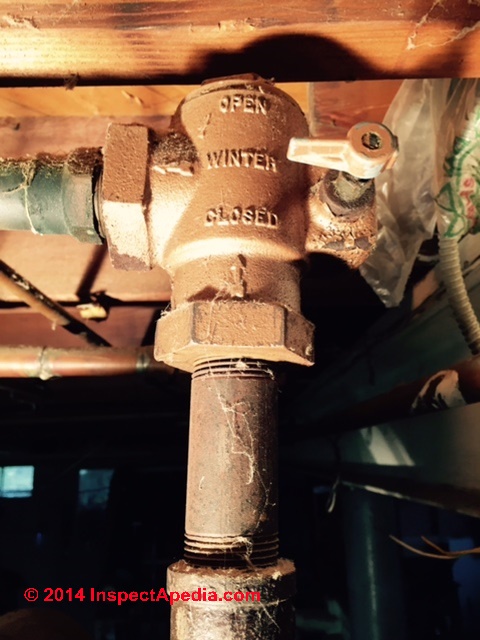 Meanwhile, what you're referring to is the flow control valve that's found at the top of heating boilers - this valve prevents hot water from circulating out of the boiler when the circulator pump is not working; it's in essence a check valve not a relief valve.
Those valves are explained and described at CHECK VALVES, HEATING SYSTEM
apologies for the [dot] nonsense - again it's a temporary problem with the Comment box software.
What you're looking for is typically a Flo-Control® valve / check valve on a boiler made by B&G or Bell & Gossett
The B&G SA-1 check valve - is very widely used on hydronic heating boilers.
On 2020-10-03 by Ian S Stirling
Here was the page https://inspectapedia.com/heat/Check_Valves_Heat.php
Image from your site uploaded
[Click to enlarge any image]
Ian
I will be glad to help but don't understand what valve you need. Searching this page ( Ctrl-F ) I don't even find the word "winter" except in your question.
Perhaps you can get me to the right place on this page and I can be of more use.
On 2020-10-03 by Ian S Stirling
On your site you show a Open-Winter-Close, right angle valve.
Can you tell me the proper name for it. I'm having no luck trying to find one on line let alone a supplier. I need to get my furnace up and running and I don't think I can without it.
On 2017-04-26 by (mod) - unsafe chimney warning
John
Watch out: A chimney that is not sound, that is one that has holes and leak to the outdoors or to the building interior is unsafe, risking a building fire as well as fatal carbon monoxide poisoning. What you describe also sounds as if the heating system is not maintained or adjusted properly: you should not see smoke out of an oil fired heating system (which it sounds to be the case from your description), nor from a gas fired heating system - which would be even more of an immediate carbon monoxide fatality risk.
If your building management is not up to addressing these problems to protect their tenants and their buildings (and probably to comply with local building codes) then you may have to ask for help from your building or fire department - promptly. Perhaps sharing that with your building manager will get immediate results. If not, if it were my building I would not hesitate to bring in local safety authorities.
Watch out: DO NOT attempt to fool with the heating boiler controls. Without proper qualification, training, equipment, inspection, cleaning, adjustment, the system is as you describe it, unsafe - you could make matters even more dangerous.
On 2017-04-26 1 by john niemela
I live in an old building 1910.last Summer the Super sent A Puffback Up The Cement Chimney Rupturing It,
Now My Sisters Apartment Has Holes In the ceiling,Never Repaired,Shes Disabled,When The PuffBack Was Sent,We Had The Apartment Fill With Boiler Fumes,Now The Furness Is Pumping Beyond Capacity,
The fumes Used to Jut Out A Foot Above The Chimney,Now,There 11 Feet In The Air,it s A Smith Boiler,And Mcdonnel Boiler Pressure Regulator,How Can I Reset The Boiler Pressure Control ?
On 2016-02-29 - by (mod) - Aztec electric boilers are distributed by Trianco
Sam,
Aztec electric boilers are distributed by Trianco - here is their UK website: http://www.trianco.co.uk/
You need the boiler model number to find the proper manual for your unit. There you'll see some diagnostics for cases where the heat is not working. Some units include diagnostic lights that help determine the trouble.
For example the Trianco CLASSIC 2, 6, 9, 11 & 12KW BOILER manual includes a diagnostic flow chart for "No Heat" where you'll see that the repair steps depend on which light is on: solid green, flashing red, permanent red, or no green. Problems range from a control board to a burned-out element.
On 2016-02-26 1 by Sam
We have an Aztec electric boiler which is working. However we have hot water but no heating. I'm pretty sure it's something to do with the tank. Not sure whether to turn the pressure tap??
Reader Question: can I use a hot water heater relief valve on an oil fired home heating boiler?
 Can I use a hot water heater pressure relief valve on a oil fired boiler? - Aaron 9/13/12
Reply: heck no, what you propose is unsafe
Aarron,
NO. The operating pressure & temperature relief range on a water heater is too high to use on a domestic or residential heating boiler.
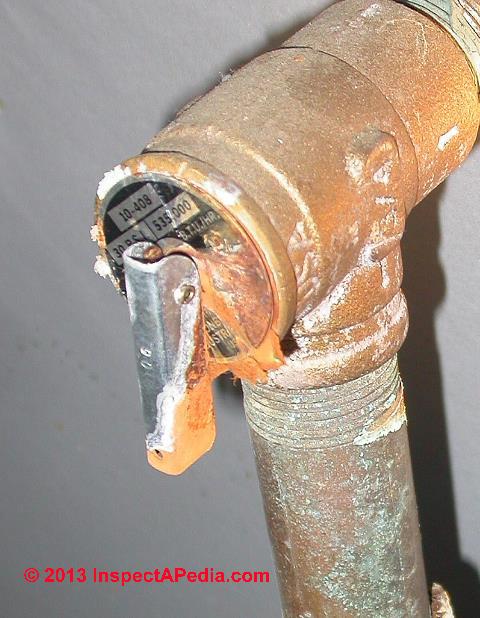
In our photo at left [click to enlarge] you can see that this heating boiler TP relief valve is rated at 30 psi (it opens if boiler pressure reaches or exceeds 30 psi) and at 535,000 BTUH (it is capable of releasing 535,000 BTUs of energy per hour) - these are matched to protect a heating boiler that normally operates at pressures below 30 psi and whose BTU input rate is below 535,000 BTUH.
A typical domestic water heater TP valve like the Watts M6 is set to open at 150psi of water pressure (five times higher than on a heating boiler) and at 210 degrees F of temperature (higher than the normal operating temperature of a heating boiler).
Watch out: Installing a water heater TP valve on a home heating boiler would be UNSAFE and risks a very catastrophic explosion should an overpressure condition occur in the boiler.
Watch out: also if you see leak stains on the pressure relief valve such as those shown in our photo. This valve is leaking around the stem that operates the TP valve test lever. This valve is unsafe and needs to be replaced.
Question water is shooting out of a valve at our well head.
Water is shooting out a valve on the well head in the front yard. What might be the problem - Sue 8/21/11
Reply:
Sue: regarding "Water is shooting out a valve on the well head in the front yard. What might be the problem"
Hard to guess intelligently with no information, but certainly yours is a well piping and pump question not a heating system pressure relief valve question (the article above on this page).
You may have a well piping leak - most likely, or on occasion a well casing leak combined with an artesian well. Take a look RELIEF VALVE, WATER TANK and also
at WELL PIPING LEAK DIAGNOSIS and call your plumber.
Question: Pressure keeps going up in my hot water boiler - how do I diagnose this?
Hot water furnace. My gauge goes up to 32 pounds then trips. Shut of furnace and still happens. My hot water tank is heated by furnace. I shut off valves on lines going to my hot water tank and problem stops. Should I suspect internal leak in hot water heating core allowing internal pressure in tank to leak back to furnace causing pressure to rise. - Will 8/22/11
Reply:
Will,
If your heating boiler pressure is going up to 32 psi, a pressure higher than normal boilers heated to 180 or even 200 °F, and high enough to open the pressure/temperature relief valve, then I suspect:
- a tankless coil leak that is sending house water pressure into the boiler
or
- a malfunctioning automatic water feeder/pressure reducer valve feeding too-high starting pressure into the boiler
You can diagnose these easily enough.
Turn off the water supply into the tankless coil or water heater.
When the boiler is COLD, and assuming you've got a typical one-family home that is one or at most two stories, drain off boiler water to drop the starting pressure - cold - at the boiler down to 12 psi.
With the hot water system still turned off and the boiler left OFF you should not see any pressure increase inside the boiler. If you do, either we've missed something, or you've got a bad water feeder valve.
Then with the boiler turned on, the boiler should heat up to a temperature at or below 200 °F and pressure in the boiler should stay below 30 psi, probably around 20 psi.
Then with the hot water system turned on and the boiler COLD AND OFF (just for simplicity of diagnosis) and a starting boiler pressure of 12 psi, if you see the boiler pressure increase, you've confirmed a hot water system leak into the boiler interior.
Question: water heater pressure goes up too high and the TP valve opens
I have a water heating system with radiators and no tank. My pressure goes to over 40 psi and the safety valve opens. I touched the pipe going to the expansion tank and it's cold so it looks like no water goes in there when it should.
If I shut off the water supply line and drain some water the pressure reduces, however after draining it seems as the amount of water is not enough to go all the way up to the 2nd floor radiator. I checked it by opening the bleed valve and nothing comes out since there is not enough water to fill it all the way up. It heats great when the supply line is open but the pressure goes way over normal. Based on the scenario below I am suspecting a bad feeder/pressure reducer valve. Do you think this might be causing the problem. Any info would be greatly appreciated. Thank you. - May0 12/4/11
Update:
I ran a test for the feeder/pressure reducer valve and it's fine. It shuts off the water exactly at 12 psi. Once the systems turns on and starts heating the water, the pressure keeps rising way over 30 psi. I watched it and it went over 40 psi when the water temperature was 150 F. I really don't know what might be causing it. I looked at the boiler unit and I can't see any signs of leaks. Shouldn't the expansion tank take care of this? Thinking logically the water should escape there and therefore reduce the pressure in the system. I don't think any water goes in that tank.
I shut off the valve on the pipe going to the expansion tank. I drained it - there was hardly any water in there. I opened the valve and I was touching the pipe to see if it will get hot once the water goes in there. All this was done while the pressure was over 40 psi. The pipe didn't get hot making me think no water went in there. After that I opened the drain valve on the tank and the water started coming out reducing the pressure immediately. What could be causing the pressure to rise so high? Is the expansion tank's job to at least partially help regulate the pressure in the system? Thanks for your advise.
Reply:
Mayo, the diagnostic procedure you need is at RELIEF VALVE LEAKS.
Also take a look at WATER PRESSURE TOO HIGH: DANGERS for some examples of causes of abnormal water pressure.
Question: the pressure valve leaks when my boiler runs for a long time
I have a 20 year old SlantFin cast iron oil boiler. I have had 3 different technicians clean and set it up and I still have the same problem.
The pressure valve leaks pressure/water when the boiler runs for a long time. When just using hot water or if only one zone calls for heat, it is fine. However, if multiple zones call for heat such as first thing in the morning when the programmable thermostats turn up, the pressure rises to about 30 PSI after about 10-15 minutes which is enough to make the valve open and trickle water. The colder it is in the house the bigger the puddle. Any help or suggestions would be appreciated. - Tom Dionne 3/28/12
Reply:
Dionne, check the temperature on your boiler when the TP valve is leaking - if it is too high that could be the problem - fixed by adjusting or repairing the aquastat control. The diagnostic procedure you need is
at RELIEF VALVE LEAKS.
Also see WATER PRESSURE TOO HIGH: DANGERS for other causes and effects of of abnormal water pressure.
Question: loud whooshing noise after we take a shower
After showers we hear a loud "ccssshhh" noise which sounds like it may be from the hot water tank. What could this be. It happens a couple of times after shower - Julia 8/21/12
Reply:
Julia, have someone standing at the water heater and other water handling equipment in the building so that first we know where the noise is coming from. That's the first step in diagnosing this problem. Otherwise an answer here would be just too-wild speculation.
Question: I keep having to change my pressure relief valve due to leakage
I regularly have to have my pressure relief valve changed after a year or so because it starts to leak. My oil company says that happens with anti-freeze. Is there a special one to use with anti-freeze? FYI: I am on city water but do not have a pressure relief valve. - Mike 10/22/12
Reply:
Balderdash. Either you're getting a series of defective TP valves installed (unlikely) or there is a cause of abnormal temperature or pressure at your heating boiler that needs to be properly diagnosed and fixed. The diagnostic procedure you need is at RELIEF VALVE LEAKS.
Question: my heating boiler shuts off at a temperature below the setting
My boiler is set at 190 degrees, but always shuts off at 170. Any ideas? - Mark 10/26/12
Reply:
Mark, your aquastat may be improperly installed (lacks temperature sensing grease or has bad contact between the aquastat temperature sensor and the sensor well sides in the boiler) or the device may be defective, or your temperature gauge may be off. See AQUASTAT CONTROLS for details.
Question: what kind of pressure relief valve do I need on my water heater?
hi i have water heater 40000 btu natural gas what kind of pressure relief valve i need ? thank you - Paul 12/11/12
Reply:
Paul, the installation instructions for your water heater will tell you exactly what temperature/pressure valve is required for your unit. The specifications will include:
- The BTU or heat release rate required - it will be a number typically above the BTUh input rate for your heater (that's probably your 40,000 BTUs, so the BTU rating of the TP valve will be above that number
- The temperature operating range required - it will be a number in °F above the normal upper or hottest temperature that your water heater operates at - for example it might be set at 200F - certainly below boiling temperature.
- The thread tapping size or diameter for the fitting into which the TP valve mounts - on residential equipment that's usually 3/4" though we see 1/2" IPT on some older units
Watch out: installing a TP valve that does not meet the water heater's specifications is dangerous and risks an explosion
Question: shouldn't I follow the manufacturer's instructions and test my boiler's TP valve every year?
I like this set of sensible and logical inspection steps. However, the Watts 374A 30PSI pressure relief valve clearly states on its paper owners/users tag atop the metal specifications tag that the homeowner should activate it yearly to ensure proper function.
I'd rather do what you are suggesting because it avoids the possibility of trapping any boiler water sediment/foreign material in the valve and preventing it from seating fully. But, wouldn't further 'flushing' of valve with more water usually rectify this? Like with Schrader valve with air in inner tube of bicycle tire or for auto tubeless tire valves? - Christopher 1/9/2013
Reply: better to ask your HVAC service tech to test the TP valve
Thanks for the good question Christopher.
Normally we always want to follow the product manufacturer's directions - they have a great interest in safe proper use of their equipment. And I agree that sometimes you can stop a leaky TP valve by repeated flushing of the valve to get debris off the valve seat. But I also have opened a TP valve to flush it and had the valve spit out part of the valve seat washer - leaving me with gushing hot boiler water at scalding temperatures.
The advice to "test" the TP valve by opening its test lever once a year is "safe" advice for the manufacturer to give. But it's not so safe for the homeowner because in my OPINION:
- If the valve opens and won't stop leaking you will have to shut off heat and wait for a heating service tech to come by to replace the valve
- If the valve is not properly piped with a discharge tube the homeowner may be scalded
- If the discharge tube just spills on the floor you're soaking your feet unnecessarily
- The homeowner does not normally stock a replacement TP valve nor know how to safely replace one that is leaking; that procedure requires shutting off the boiler, draining down some of its water content, then removing and replacing the old TP valve and reinstalling the discharge tube piping.
- Home inspectors are trained to never test the TP valve by operating the test lever because too many have opened a valve to have it fail to shut off - converting a latent problem into an immediate mess.
Therefore a safer suggestion for all homeowners is to ask their heating service tech to check the TP valve at the time of annual service. The service tech has a replacement TP valve right with him or her, in the service truck, and s/he knows how to replace the valve it if keeps on leaking.
Question - Comment: relief valve drain froze leading to an explosion at the heating boiler
One danger (I may have missed) happened to me. The T & P valve had a slow leak which drained outside building. At a persistent 4 degrees above 0 F, the water drip outside eventually froze and sealed the drain pipe at the exit point. Once sealed the pressure built until the T & P valve exploded and the final six week repair cost came in at just over $36,000. T & P valves are a real hazard to home owners! - B.T. 1/27/2013
Reply:
Excellent point; We've talked about the issues of draining to a remote or unobserved location, but not about the freeze risk. Thank goodness no one was killed.
Actually you are describing a triple fault that led to an explosion:
- The TP valve was leaking - we don't know yet if the problem is the valve (replace it) or some other operating problem with the boiler (find and fix that cause)
- The TP valve discharge was piped to a location where no one noticed the leak, so the root cause was not repaired
- The water leaking through the TP valve discharge tube was at a low-enough temperature and slow-enough rate that when exposed to freezing conditions the TP valve discharge line froze, completely blocking the valve, preventing it from reducing boiler temperature or pressure
Had your boiler had a different weakest-link than the TP valve itself, the whole boiler could have exploded, causing still more damage and risking injury or even death to building occupants. For example, had your device been draining a water heater the unit would become a rocket, shooting up through the building - details are
at BLEVE EXPLOSIONS.
Question: The boiler does not have a pressure relief valve
(Jan 24, 2014) Rene said:
First of all this site is amazing. The writing, pictures, and diagrams are everything I have tried to find online. My question is about an old hydrotherm gas boiler for a hydronic hot water system.
The boiler does not have a pressure relief valve and I could not a pressure overflow tank in the attic. It is a 700sq ft. unit in a 4 unit house and the psi goes up to 50psi when the thermostat is raised above 80 degrees. I am obviously worried about this high psi. I have been lowering the temperature and releasing water to bring the psi down.
My questions are:
1. Can a pressure release valve be installed, if so where would it be installed?
2. A year ago one of the radiators busted and was replaced with a baseboard heater and that only heats up when the temperature is set high. One plumber said I should swap it out and that could fix the high psi issue, is there any truth to that statement? Does baseboard heat require more psi to heat up?
Reply:
Rene,
Watch out: It would be unusual (and unsafe) for a heating boiler to have no means of safety release of excess pressure. If there is no attic overflow or expansion tank (or if not attic, in some other upper building location) and no temperature/pressure relief valve connected directly to the boiler, typically there would have been a red B&G or equivalent pressure relief valve installed on piping near the boiler.
See BLEVE EXPLOSIONS
Take a look at the pair of photos 9th down from the page top photo - where text below the pair of photos showing a red pressure relief valve reads
"This type of relief valve responds only to water pressure and may be located at some distance from the heating boiler itself."
You may find an equivalent installed on your system. That approach was common on older systems and was permitted then, though it offers less safety protection than a modern TP valve connected right on the boiler.
You can ask your plumber or heating tech to install a TP valve directly on the boiler only if the boiler includes an available tapping that would fit the valve, at a suitable location such that the valve's sensor is immersed in boiler water, and where the tapping is big enough (typically 3/4" dia NPT) to accept the device.
Send along some photos of your system and I may be able to comment further, but basically this is a safety topic to discuss with your heating service tech and the service manager.
No one in their right mind would leave a heating boiler with no pressure relief protection - the risk is a BLEVE explosion.
Regarding cold baseboard, perhaps the system is partly air-bound and could be corrected by strategic installation of air bleeder valves at the two ends of the baseboard run or at another suitable location.
(Jan 27, 2014) renetruj said:
Thank you DanJoeFriedman. How would I send you photos so you can see if I have a tapping to place a TP valve on this old hydrotherm boiler? Do you know of any sites that have a full listing of hydrotherm models, my boiler's plates and information are all missing or eroded?
Reply:
Renetruj
Use the CONTACT us link found at the top or bottom of any InspectApedia page.
About model identification, without the unit data tags you may be able to speak directly with Hydrotherm to ask for help - I would not want to guess based on just a box photo - since some boiler models may look alike externally.
...
Continue reading at RELIEF VALVE LEAKS or select a topic from the closely-related articles below, or see the complete ARTICLE INDEX.
Or see
BOILER PRESSURE & TEMPERATURE SETTINGS
RELIEF VALVES - TP VALVES - home
Suggested citation for this web page
RELIEF VALVE, TP VALVE, BOILER at InspectApedia.com - online encyclopedia of building & environmental inspection, testing, diagnosis, repair, & problem prevention advice.
Or see this
INDEX to RELATED ARTICLES: ARTICLE INDEX to T&P RELIEF VALVES
Or use the SEARCH BOX found below to Ask a Question or Search InspectApedia
Or see
INDEX to RELATED ARTICLES: ARTICLE INDEX to PLUMBING SYSTEMS
Or use the SEARCH BOX found below to Ask a Question or Search InspectApedia
Ask a Question or Search InspectApedia
Try the search box just below, or if you prefer, post a question or comment in the Comments box below and we will respond promptly.
Search the InspectApedia website
Note: appearance of your Comment below may be delayed: if your comment contains an image, photograph, web link, or text that looks to the software as if it might be a web link, your posting will appear after it has been approved by a moderator. Apologies for the delay.
Only one image can be added per comment but you can post as many comments, and therefore images, as you like.
You will not receive a notification when a response to your question has been posted.
Please bookmark this page to make it easy for you to check back for our response.
Our Comment Box is provided by Countable Web Productions countable.ca
Citations & References
In addition to any citations in the article above, a full list is available on request.
- [1] Thanks to Henry Torres (Boiler Inspector), for calling to our attention an error in our BTU rating statement about relief valves.
- [2] Thanks to Ron Wells, Wells Inspection Services, Inc., Chapel Hill, NC 27515, Tel: 919-968-4981, Cell: 919-302-2652 License Number: 75 - Mr. Wells is a professional home inspector and a member of ASHI, the American Society of Home Inspectors. He can be reached at Ron@weelsinspections.com
- [3] Thanks to reader B.T. for pointing out the hazards of relief valves that drain to a remote location where freezing may occur, 1/27/2013
- [5] Boiler Chemicals 101, NCDENR, - Retrieved 12/24/2010, original source http://www.p2pays.org/ref/32/31321.pdf
Quoting from the North Carolina Division of Pollution Prevention and Environmental Assistance: The N.C. Division of Pollution Prevention and Environmental Assistance provides free, non-regulatory technical assistance and education on methods to eliminate, reduce, or recycle wastes before they become pollutants or require disposal. Contact DPPEA at (919) 715-6500 or (800) 763-0136 for assistance with issues in this fact sheet or any of your waste reduction concerns. - [8] National Fuel Gas Code (Z223.1) $16.00 and National Fuel Gas Code Handbook (Z223.2) $47.00 American Gas Association (A.G.A.), 1515 Wilson Boulevard, Arlington, VA 22209 also available from National Fire Protection Association, Batterymarch Park, Quincy, MA 02269. Fundamentals of Gas Appliance Venting and Ventilation, 1985, American Gas Association Laboratories, Engineering Services Department. American Gas Association, 1515 Wilson Boulevard, Arlington, VA 22209. Catalog #XHO585. Reprinted 1989.
- [9] The Steam Book, 1984, Training and Education Department, Fluid Handling Division, ITT [probably out of print, possibly available from several home inspection supply companies] Fuel Oil and Oil Heat Magazine, October 1990, offers an update,
- [16] Boilers, Boiler Conversions, James E. Brumbaugh, ISBN 0-672-23389-4 (v. 1) Volume II, Oil, Gas, and Coal Burners, Controls, Ducts, Piping, Valves, James E. Brumbaugh, ISBN 0-672-23390-7 (v. 2) Volume III, Radiant Heating, Water Heaters, Ventilation, Air Conditioning, Heat Pumps, Air Cleaners, James E. Brumbaugh, ISBN 0-672-23383-5 (v. 3) or ISBN 0-672-23380-0 (set) Special Sales Director, Macmillan Publishing Co., 866 Third Ave., New York, NY 10022. Macmillan Publishing Co., NY
- [81] Installation Guide #200, The Hydronics Institute, 35 Russo Place, Berkeley Heights, NJ 07922
- [20] SCALE FORMATION in WATER HEATERS and METHODS of PREVENTION free download as [PDF] Krappe,
Justus Maximilian, Engineering experiment station. Gas engineering bulletin; no. 6; Research series; no. 74; On cover: Engineering bulletin, Purdue university. Vol. xxiv, no. 3a. June, 1940 (Layfayette Indiana) commonly referred to in some references as "Purdue University Bulletin No. 74" - thanks to researcher Robyn Goldstein for the full citation. LCCN: 40028844 & OCLC: 1038544 - Water analysis, water softening, hot-water supply. 27pages.
You can also obtain this document through your local library. (full copy file at InspectAPedia 3/31/2010) Purdue B074 can be hard to locate online.
Also Bradford White Corporation (a manufacturer of water heaters) previously published
SCALE FORMATION in WATER HEATERS - EXCERPTS [PDF] from that document made available by Purdue University. - Domestic and Commercial Oil Burners, Charles H. Burkhardt, McGraw Hill Book Company, New York 3rd Ed 1969.
- National Fuel Gas Code (Z223.1) $16.00 and National Fuel Gas Code Handbook (Z223.2) $47.00 American Gas Association (A.G.A.), 1515 Wilson Boulevard, Arlington, VA 22209 also available from National Fire Protection Association, Batterymarch Park, Quincy, MA 02269. Fundamentals of Gas Appliance Venting and Ventilation, 1985, American Gas Association Laboratories, Engineering Services Department. American Gas Association, 1515 Wilson Boulevard, Arlington, VA 22209. Catalog #XHO585. Reprinted 1989.
- The Steam Book, 1984, Training and Education Department, Fluid Handling Division, ITT [probably out of print, possibly available from several home inspection supply companies] Fuel Oil and Oil Heat Magazine, October 1990, offers an update,
- Principles of Steam Heating, $13.25 includes postage. Fuel oil & Oil Heat Magazine, 389 Passaic Ave., Fairfield, NJ 07004.
- The Lost Art of Steam Heating, Dan Holohan, 516-579-3046 FAX
- Principles of Steam Heating, Dan Holohan, technical editor of Fuel Oil and Oil Heat magazine, 389 Passaic Ave., Fairfield, NJ 07004 ($12.+1.25 postage/handling).
- Boilers, Boiler Conversions, James E. Brumbaugh, ISBN 0-672-23389-4 (v. 1) Volume II, Oil, Gas, and Coal Burners, Controls, Ducts, Piping, Valves, James E. Brumbaugh, ISBN 0-672-23390-7 (v. 2) Volume III, Radiant Heating, Water Heaters, Ventilation, Air Conditioning, Heat Pumps, Air Cleaners, James E. Brumbaugh, ISBN 0-672-23383-5 (v. 3) or ISBN 0-672-23380-0 (set) Special Sales Director, Macmillan Publishing Co., 866 Third Ave., New York, NY 10022. Macmillan Publishing Co., NY
- Installation Guide for Residential Hydronic Heating Systems
- Installation Guide #200, The Hydronics Institute, 35 Russo Place, Berkeley Heights, NJ 07922
- The ABC's of Retention Head Oil Burners, National Association of Oil Heat Service Managers, TM 115, National Old Timers' Association of the Energy Industry, PO Box 168, Mineola, NY 11501. (Excellent tips on spotting problems on oil-fired heating equipment. Booklet.)
- In addition to citations & references found in this article, see the research citations given at the end of the related articles found at our suggested
CONTINUE READING or RECOMMENDED ARTICLES.
- Carson, Dunlop & Associates Ltd., 120 Carlton Street Suite 407, Toronto ON M5A 4K2. Tel: (416) 964-9415 1-800-268-7070 Email: info@carsondunlop.com. Alan Carson is a past president of ASHI, the American Society of Home Inspectors.
Thanks to Alan Carson and Bob Dunlop, for permission for InspectAPedia to use text excerpts from The HOME REFERENCE BOOK - the Encyclopedia of Homes and to use illustrations from The ILLUSTRATED HOME .
Carson Dunlop Associates provides extensive home inspection education and report writing material. In gratitude we provide links to tsome Carson Dunlop Associates products and services.
 | HOME | ABOUT | ASK a QUESTION | CONTACT | CONTENT USE POLICY | DESCRIPTION | POLICIES | PRIVACY | |
| © 2024 - 1985 Publisher InspectApedia.com - Daniel Friedman | |||||||||