
InspectAPedia® FREE Encyclopedia of Building & Environmental Construction, Diagnosis, Maintenance & Repair |
Question? Just ask us! InspectAPedia
|
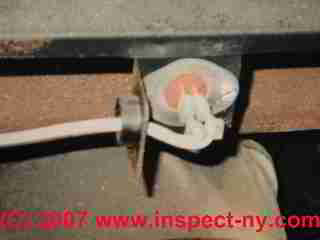 Flue Gas Spillage Switches on Gas or Oil Fired Equipment
Spill switch choices, installation, inspection, repair
- POST a QUESTION or COMMENT about gas fired heating equipment spill switches: diagnosis, repair, replacement, function, safety features
Guide to flue gas spill switches on gas or oil fired heating equipment:
What is a flue gas spill switch or gas spillage detector? How do flue gas or draft hood spill switches work? Where should spill switches be installed? How are spill switches tested?
What causes nuisance or legitimate flue gas spill switches to trip? How do we correct un-wanted loss of heat due to flue gas spill detector switch operation or nuisance tripping?
Here we explain the installation, function, & troubleshooting Flue Gas Spill Switches and we provide a Guide to inspecting Furnace or Boiler Flue Gas Spill Switches on gas fired equipment such as heating boilers, warm air furnaces, water heaters.
We describe the Purpose, Inspection, Repair Troubleshooting Guide for flue gas spill switches which are installed at dampers or burners on gas fired equipment.
InspectAPedia tolerates no conflicts of interest. We have no relationship with advertisers, products, or services discussed at this website.
Guide to Furnace or Boiler Flue Gas Spill Switches on gas fired equipment - Purpose, Inspection, Repair
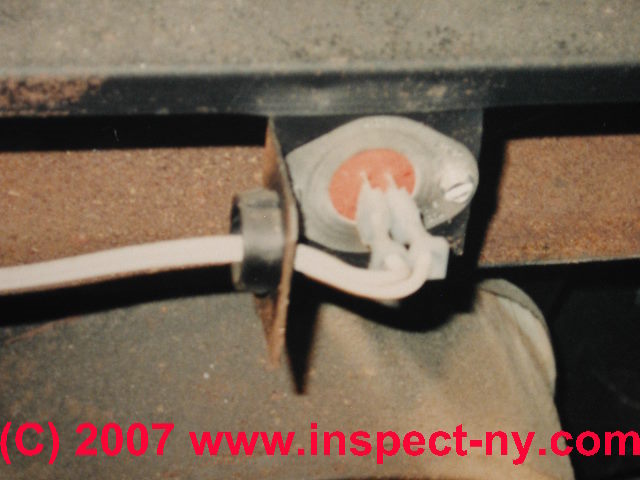
[Click to enlarge any image]
Article Contents:
- FLUE GAS SPILL SWITCH TRIPPING & RESET
- DEFINITION of FLUE GAS SPILL SWITCH
- CAUSES of FLUE GAS SPILLAGE
- FLUE GAS SPILL SWITCH LOCATION
- FLUE GAS SPILL DETECTOR MALFUNCTIONS
- FLUE GAS SPILLAGE SWITCH RESET BUTTON
- FLUE GAS SPILL SWITCH SOURCES & SELECTION
- OIL BURNER FLUE GAS SPILLAGE SWITCHES
- SPILL SWITCH & COMBUSTION AIR TESTS - separate article
- LOCATION of RESET SWITCHES on HEATING SYSTEMS
- Research Citations for Flue Gas Spillage Causes, Effects, Detection & Flue Gas Spill Switches and their patents is provided atReferences or Citations
What is a furnace, boiler, or water heater flue gas spill switch?
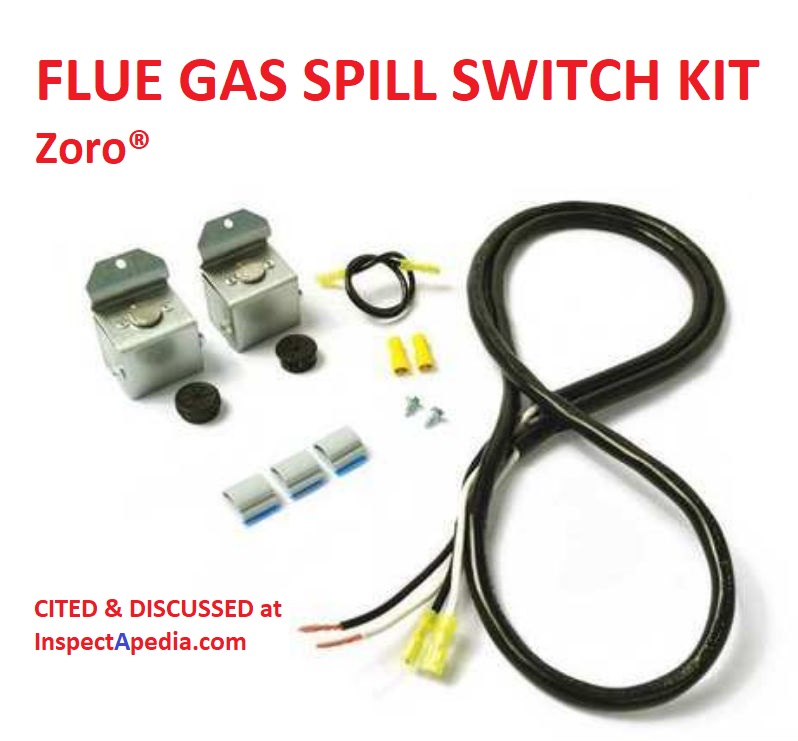 This article discusses flue gas spillage detectors used on gas or oil fired heating equipment found in buildings.
Spillage detector switches monitor temperature or actual gas content of flue gases that might spill from the vent or draft hood or burner area of a gas fired heating appliance.
When unsafe spillage occurs the switch operates to turn off the heating appliance using one of several methods. Most flue gas spillage or thermal safety switches must be re-set manually though a few models include an automatic reset feature.
Synonyms for flue gas spill switch include thermal sensor switch, thermal safety switch, and blocked vent safety switch.
Since escaping combustion gases in a building are dangerous (forming a potentially fatal carbon monoxide hazard), if the sensor gets hot from flue gases flowing past its surface, it is designed to turn off the fuel supply to the gas burner. Some flue gas spillage detectors operate to close the gas supply to the heating appliance.
A spill switch may be found at the draft hood on any modern gas fired appliance, such as a heating furnace (hot air heat), a heating boiler (hot water heat or steam heat), or a water heater.
Similar gas detection or safety device are also used on gas log fireplaces and on coal fired heating systems as well as in industrial applications.
Some flue gas spill detectors actively detect flue gases or carbon monoxide but the simplest models respond to temperature by detecting the hot gases associated with flue gases on gas fired heating equipment. This little flue gas spillage sensor sensor, or two or more of them, form an important safety device that feels the heat of escaping combustion gases that ought to be going up the flue or chimney.
What causes unsafe flue gas spillage:
- Heater startup spillage
: Initial combustion of a gas fired appliance can cause brief flue gas spillage at the draft hood because the appliance as well as the flue and chimney may need time to warm up and start a good draft in a cold chimney into which it is venting.
This is normal and the spillage should stop in less than three minutes as the flue and chimney are warmed.
Flue gas spill sensor switches are designed to avoid false-tripping due to this condition. If flue gas spillage continues after the initial "burp" of combustion products we just described, then the system is unsafe. - Improper chimney installation:
such as venting a small BTUH appliance (a water heater) into a large masonry flue.
Especially in cold weather the appliance may never develop adequate draft. We see this occurring when a building converts a heating boiler or furnace to a direct-vent system, no longer venting into the chimney, but where the water heater is left trying to vent into the old chimney flue.
In fact any defect that causes inadequate draft can cause detectable flue gas spillage. Chimney leaks, an improper or missing chimney cap, chimney blockage, or similar problems may be the underlying cause of heating system shut down by the flue gas spillage detector.
See CHIMNEY INSPECTION CHECKLIST - Inadequate combustion air supply
to the heating appliance - located in a room too small with no outside air supply; located in a too-small utility room with a solid door that when closed, blocks air.
If your building has this problem
see COMBUSTION AIR DEFECTS - Building depressurization - turning on fans in the building depressurizes the utility room or area around the heating appliance, overcoming the natural draft in the appliance's chimney, causing back-drafting.
See BACKDRAFTING HEATING EQUIPMENT
This condition might also occur also with power-vented equipment in some conditions.
See VENTILATION, BALANCED for building ventilation approaches that avoid dangerous building depressurization,
and
See COMBUSTION AIR for TIGHT BUILDINGS for immediate solutions to inadequate combustion air caused by tight or depressurized buildings. - Other reasons for flue gas spillage:
Other reasons that a gas flame may be lost or a gas fired appliance shut off on safety may have nothing to do with bad flame or bad combustion air.
For example a common part failure on gas fired heating equipment is the thermocouple that senses the pilot flame. If we can't keep a flame lit we suspect the thermocouple first.
CONTACT US with suggestions.
Bachrach Corporation, a manufacturer of heating system test equipment opines that gas fired equipment is more likely to have flue gas spillage from a blocked chimney than from building depressurization due to inadequate combustion air supply.
We're not sure what data supports that view but more details are atReferences or Citations where the effects on flue gas spillage due to building depressurization are discussed.
One author warns that even where CO was not detected in some building depressurization studies other harmful flue gases such as NOX may be present.
Certainly home inspectors find many heating appliances installed in tiny closets with no outside combustion air and a door that, when shut, blocks off air to the appliance.
We have also observed that gas fired heating equipment operated just fine in a building until a new owner installed a whole house ventilation fan system.
Where are combustion gas spillage switches installed?
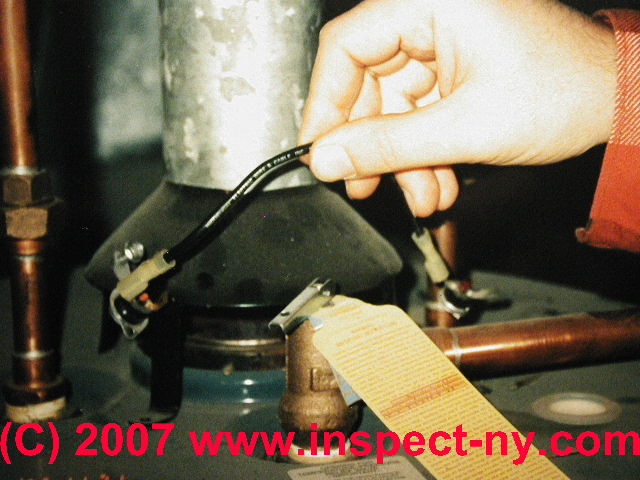
Combustion gas or flue gas spill switches are usually installed at the edge of the gas fired appliance draft hood. Some appliances may also have a spill switch installed at the gas burner opening itself.
This photo shows a spill switch at a gas fired water heater draft hood. In the somewhat blurry photo of dog hair blocking a heater draft hood (above) you can also make out the spill switch and its wire at the right edge of the draft hood in that photo.
In the photo at left, a spill switch was not installed but had been simply left loose, disconnected, atop the water heater.
Watch out: as we explain in more detail just below
at FLUE GAS SPILL DETECTOR MALFUNCTIONS,
an improperly installed or improperly-located spillage switch detector can cause either nuisance tripping (spill switch shuts off heat when it should not) or unsafe operation (spill switch fails to detect dangerous flue gas spillage).
Watch out: also to be sure to select the proper spillage switch for the type of heater you are protecting. For example, Tjernlund's spillage switch instructions include additional details for spillage switch use on water heaters and on furnaces and boilers, from which we excerpt:
Gas fired water heaters: Millivolt water heaters require the Tjernlund Model JA-1 (P/N 950-0470), Thermocouple Junction Adapter (ordered separately). Connect ends of six foot cable to spade connections on Thermocouple Adapter.
Gas fired boilers & furnaces: Splice ends of six foot cable in a series circuit between the thermostat and gas valve or burner control.
Using cable routing tabs from wire routing packet, attach 6’ cable to appliance maintaining a safe distance from hot surfaces, e.g. appliance vent pipe and hot water pipes. - Tjernlund's,
retrieved 12/10/1997, original source cited in detail
at FLUE GAS SPILL SWITCH SOURCES & SELECTION
Oil fired boilers & furnaces: select the proper thermal switch for the heating equipment you are protecting, then see the instructions for the specific switch;
See OIL BURNER FLUE GAS SPILLAGE SWITCHES
What goes wrong with flue gas spillage detection switches
Missing flue gas spill switches: we've seen these switches removed from modern water heaters, gas boilers, or gas furnaces when they were originally installed.
If you see holes drilled into the edge of a draft hood or other marks indicating that a device has been removed, or if you see the devices themselves lying loose, perhaps on or near the equipment, an expert service technician should examine the heater promptly as it may be unsafe.
Improperly-installed flue gas spill switch:
if the spillage switch sensing area is in contact with metal surfaces such as the flue or the draft hood, the heat of that metal may cause the switch to malfunction.
The flue spillage switch sensor should be mounted so that it monitors the temperature of gases spilling out of the heating appliance such as at the draft hood, vent, or chimney or on some systems near the gas burners.
Misplaced flue spillage switches:
similarly to the improperly installed spill switches whose temperature sensor should not touch metal surfaces of the heating system, the spill switch needs to be installed in the proper location so that if a chimney blockage or some other operating problem causes combustion gases to spill out of the appliance into the building, the flow of flue gases, while still warm, will pass over the switch sensor.
There may be other flue spillage switches which sense carbon monoxide (CO) or other gases directly and without depending on the gas temperature.
Older heaters with no flue spill switch:
On older heating systems these safety switches may not be installed at all. A
spill switch or a set of them can be added to almost any gas fired appliance, but it is likely that the gas control valve/regulator will need to be replaced too, since the old regulator may not have a point to which the spill switch's sensor wire can be connected to tell the valve to close.
Flue gas spill switch operating failure:
While a spill switch could simply fail to sense passing hot gases and thus not perform its safety function of turning off the heater, or while such as switch might simply fail internally, forcing the heater to turn off when it should not, in our experience these are rare events.
We do not have at hand industry failure rates for this device but we suspect that installation errors or omissions are far more common.
Flue Gas Spillage Switch or Thermal Switches Available for Oil Fired Heating Equipment
Reader Question: Can and or should spill switches be installed on a oil fired furnace barometirc damper?
12 Sept 2015 shell@scrantonlink.com said:
Can and or should spill switches be installed on a oil fired furnace barometirc damper?
This question was posted originally at OIL BURNER INSPECTION & REPAIR
Reply: yes thermal switches can be selected to protect various types of oil fired heating equipment including furnaces, boilers, steam boilers, and water heaters
Yes, there are flue gas spillage switches designed for the (usually higher) temperature range produced by oil fired heating equipment and that can be mounted at a barometric damper on an oil fired heating flue.
Most thermal safety switches operate by being wired in series with the electrical power circuit supplying the burner (gas or oil). When the thermal safety switch has been exposed to a specific temperature for a specific time the switch "opens" to turn off the burner.
The spill switches discussed at the article series beginning
at FLUE GAS SPILL SWITCH TRIPPING & RESET
discuss both oil and gas fired heating equipment flue gas spillage devices.
Watch out: Because most flue spillage sensors detect heat rather than the specific gases that might be emitted from the heating equipment the safety switch must be matched to
- The proper operating temperature range
of the heating equipment, based on temperatures that will be found in gases passing through the heating flue in the area where spillage is to be sensed.
Typical thermal safety switch operating temperature ranges (varying by model) open to turn off the heating equipment at temperatures of 140 degF up to 250 degF depending on the sensor model and its application.
For example a draft-induced heating furnace may use a switch activating (opening) at 160 degF while a steam boiler may use a thermal switch that does not activate until 250 degF. - The typical flue vent connectors or draft controls:
different mounting locations and hardware may be required on different types of equipment - The time duration over which the thermal sensor safety switch
(used to detect flue gas spillage) should operate; you don't want a switch that opens (turns off the heater) too soon in a spillage cycle as some spillage is normal at heater start-up in some system designs; nor do you want a thermal safety switch that waits too long to turn off the heater. - The operating voltage or amperage range
of the erquipment to be controlled: 12 Amps / 120VAC, 6 Amps 240VAC, or 24VA on 24AC millivolt equipment
Field Controls, for example, offers such devices. The term usually used is "thermal switch" or "thermal switches for oil fired heating equipment".
These flue gas spillage devices sense heat, must be selected for the proper fuel and application (or else your system would be unsafe as it'd not be properly protected), and are sold in both manual reset and automatic reset spill switch sensor switch forms.
Flue gas spillage or thermal switches also vary by their response time. You may have trouble with a too-fast-acting switch if in normal operation there is a brief burst of heat from a barometric damper - as happens on some oil fired heating equipment.
Field Controls Thermal switch models include FTS-4, FTS-6, GSK250-M (for steam boilers), GSJ0160-M for draft-induced furnaces, and about eight other models. You'll see that it is essential to choose the proper thermals sensor switch.
Contact Field Controls at Field Controls, 2630 Airport Road, Kinston, NC 28504 USA, Phone: 252.522.3031 Fax: 252.522.0214 sales@fieldcontrols.com Website: fieldcontrols.com Thermal safety switch specifications source: http://www.fieldcontrols.com/thermal-safety-switches retrieved 12 Sept 2015
Reader Comments, Questions & Answers About The Article Above
Below you will find questions and answers previously posted on this page at its page bottom reader comment box.
Reader Q&A - also see RECOMMENDED ARTICLES & FAQs
On 2018-04-29 by (mod) -
That sounds like a reasonable diagnosis.
On 2018-04-29 by ColdinNewJersey
I had done some spray painting in the cellar, where my gas-fired boiler is located, I opened a cellar window, and activated the whole-house fan to draw the unpleasant smell out of the cellar upstairs and out of the house. There wasn't enough air flow through the small window, and the spillage detector was activated. No problems after reset after several days.
On 2018-01-31 by (mod) -
with the apology that for a system about which I have almost no information I can only guess at the most common or likely problem causes, I agree that there could be problems other than the lack of combustion air, including improper adjustment at the burner.
In any event I would be very reluctant to change a spill switch away from the manufacturer's specifications. And my opinion that would be unsafe. It sounds like it's time to get a trained service tech on site
On 2018-01-30 by Lazar
Thank you for quick reply (I thought I've posted a reply to you but I don't see it here). The boiler shuts down by spill switch (when I press reset button it turns back on). If the issue was lack of combustion air, would it raise temperature in the draft hood? Also, there is a supplemental horizontal pipe into outside (besides a pipe into chimney).
On 2018-01-30 by (mod) -
Lazar
What you describe may be more dangerous than is immediately apparent. If your gas burner is shutting off with your Boiler Room closed, it's quite possible that the system lacks adequate combustion air. That in turn risks potentially fatal carbon monoxide spillage in the building.
So there may not be a chimney problem but there may be a problem that the boiler room is not providing enough combustion air.
If my guess is correct changing the spill switch would be a dangerous mistake. The correct action would be to provide adequate combustion air.
On 2018-01-30 by Lazar
I got a new Williamson gas-fired steam boiler GSA-150 with 210 oF spill switch Weil-Mclain 510-300-013WT. This cut off temperature seems to be borderline in my case since when I close the door in boiler room the switch trips in few hours. With open door it does not trip.
I had chimney checked- it's OK. My question is, is it worth changing the spill switch to a higher cut off temperature (which would be 240 oF from same product line)? My concern is 240 oF is above water boiling point- will it ever reach it in case of chimney blockage?
On 2017-11-07 by (mod) -
Steve
You don't give the brand and model flue gas spill switch: some of these devices are deliberately designed to require a manual re-set, for life safety issues are involved.
The remedy is to
1. diagnose the problem: is there a flue gas spill that's tripping the switch?
2. Act on the diagnosis: if an expert monitoring the system at start-up, operating at full temperature, and at shut down finds on flue gas spillage then she'll probably recommend replacing the switch.
Watch out: you don't want to force the switch on as that could cause a fatal carbon monoxide spillage in the building.
Anon:
The Dunkirk Boiler, as well as most heating equipment, will sport no special manufacturer, model, brand-specific "on-off" switch. Rather the on-off switch will be a standard electrical on-off switch mounted in two or more locations: at the boiler or even on it, and a second safety off-switch mounted outside of the boiler room typically near its entrance.
See ELECTRICAL POWER SWITCH FOR HEAT
On 2017-11-07 by Steve
My flue gas spill switch needs to be reset after each cycle. What's the remedy?
On 2016-12-19 by Anonymous
show image of on and off swith for dunkirk boiler
On 2016-02-28 by Eric
Very helpful site!
Reader comments:
(Oct 31, 2011) bill the plumber said: great,got me started
(Feb 10, 2012) VERY GOOD INFO REGARDING SAFETY said: You would be surprised the number of homeowners who try to replace this without consulting and or using proffessional. When i sell one i suggest that they do.
Miguel / sales hvac
Question:
(Aug 14, 2012) paul burns said:
Had my CO2 levels checked in my gas boiler. My flue CO2 level was 2,266 ppm, and zero ppm ambient
Question: I checked and didn't find a carbon monoxide hazard
12/7/2014 Marge said:
I have checked for carbon monoxide and there doesn't seem to be any according to meter. I smell an unusual smell especially during heating season and very cold weather.
We have some symptoms of possible gases and also have heard of alderhydes that don't seem to have a smell, they are just there and can make you sick.
Do I call a chimney expert or a furnace man. Furnace seems to be working well, but will furnace guy help us with flue and draft problems. What do I ask for?
Reply:
Watch out: as we warn in more detail at GAS DETECTOR WARNINGS you can have no confidence that just because your gas detector did not detect carbon monoxide that that dangerous gas was not previously present nor can you have confidence that it is not going to be produced and relased into the building again.
Changes such as in wind velocity, outdoor temperature, snow cover, doors or windows open or shut, fans on or off, can significantly change the way gas burning appliances are operated unless careful provisions were made for adequate combustion air and proper flue gas venting.
IF YOU SUSPECT CARBON MONOXIDE POISONING GO INTO FRESH AIR IMMEDIATELY and get others out of the building, then call your fire department or emergency services for help. Links on this page also direct the reader to carbon dioxide gas information in a separate document.
Once you are convinced that no emergency exists, I recommend asking for help by a senior gas heat service technician.
Question: whom do I ask for help with flue gases given that my check for carbon monoxide didn't find any problem?
(Dec 7, 2014) Marge said:
I have checked for carbon monoxide and there doesn't seem to be any according to meter. I smell an unusual smell especially during heating season and very cold weather.
We have some symptoms of possible gases and also have heard of alderhydes that don't seem to have a smell, they are just there and can make you sick. Do I call a chimney expert or a furnace man. Furnace seems to be working well, but will furnace guy help us with flue and draft problems. What do I ask for?
Reply:
Watch out: as we warn in more detail at GAS DETECTOR WARNINGS you can have no confidence that just because your gas detector did not detect carbon monoxide that that dangerous gas was not previously present nor can you have confidence that it is not going to be produced and relased into the building again.
Changes such as in wind velocity, outdoor temperature, snow cover, doors or windows open or shut, fans on or off, can significantly change the way gas burning appliances are operated unless careful provisions were made for adequate combustion air and proper flue gas venting.
Watch Out IF YOU SUSPECT CARBON MONOXIDE POISONING GO INTO FRESH AIR IMMEDIATELY and get others out of the building, then call your fire department or emergency services for help. Links on this page also direct the reader to carbon dioxide gas information in a separate document.
Once you are convinced that no emergency exists, I recommend asking for help by a senior gas heat service technician.
Question: can keeping the heat set to a high temperature cause flue gas spillage?
Editor:
The flue gas sensor on our has fired steam boiler keeps tripping off every few days. We installed a new 6-inch chimney liner and a new GSK-3 180 degree flue gas spill sensor at the draft hood as well as a new thermocouple at the gas burner. The pilot light on this steam boiler is always on.
The building occupant wants to keep the heat set rather high, at nearly 80 degrees F because of current cold weather here in the Northeastern U.S.
Will this high temperature setting (and long boiler-on cycles) make the steam boiler overheat or cause flue gas spillage?
Could the flue gas spillage still be caused by the chimney? - Anonymous by request, 26 January 2015
Reply:
Watch out: No user control setting should be tripping off a flue gas spill sensor.
In fact longer boiler-on cycles should improve the draft at the chimney as the flue becomes heated.
It sounds to me as if there is a potentially dangerous, even fatal hazard in the building.
The problem could be in the heater or in the flue or in site conditions that are causing a downdraft.
I'd have the chimney inspected by a certified chimney sweep. Check that the flue size and height are properly matched to the steam boilers input BTUh rating as well as checking that the chimney is not blocked, has a proper cap, is routed properly, has no openings, leaks, nor improper flue sharing etc.
I'd be sure that my heating service company had made a careful inspection of the system's draft, combustion air supply etc.
Meanwhile, immediately, be certain that carbon monoxide detectors and smoke detectors are properly installed, located, and working in the building.
Reader Question: spill switch tripped and we have no hot water
(Nov 14, 2012) B said:
I have recently had two GSK-3 Thermal Safety Devices attached to my Rheem Guardian Fury hot water heater. I have not had hot water since the installation. The HVAC company is unable to get to my home for some time.
They are not from my gas provider. How do the devices work? The little tab is able to be pushed in. It sounds as if that should not occur. Any info is appreciated. I have found your other info very helpful. Thanks
This question was originally posted at COMBUSTION AIR REQUIREMENTS
Reply:
B:
The flue gas spillage switch you cite includes a manually-resettable feature that is probably the "little tab" that you describe. When the switch has cooled the button or "tab" is pressed in to re-set the switch.
Watch out: because flue gas spillage can kill building occupants due fatal carbon monoxide gas, if a heating appliance has shut down for any reason during normal operation (as opposed to during testing) the cause of the failure must be investigated and corrected before resetting the safety-switch and turning the heating equipment back on.
Here are more details:
The Field Controls 46086400 GSK3 Gas Spillage Switch is a detector mounted on the draft hood of a gas or oil fired heating appliance such as a boiler or furnace and used to detect flue gas spillage. The switch is wired in series with the burner so that in the event that it detects flue gas spillage it will turn off the burner.
This gas spillage switch is actually a thermal sensor - it is detecting heat, not flue gases. Field Controls notes:
Installation of a spillage SAFETY Switch is recommended for LP and Natural gas fired systems with draft hoods, draft diverter, or gas barometric draft controls.
This device is installed to detect flue gas spillage caused by a blocked flue system and/or inadequate draft. This device MUST be installed by a qualified installer in accordance with the manufacturer's installation instructions. Wiring MUST be in accordance with the National Electrical Code and applicable local codes.
Before and after adding this safety control on existing appliances, an installation inspection in accordance with the National Fuel Gas Code 54, Z223.1 Appendix H should be performed and a combustion analysis is recommended to determine the operating condition of the appliance.
CAUTION: Disconnect Electrical Power When Wiring Spillage Switch
This thermal switch can be re-set after it has tripped. The reset may be accomplished (on some switches) by pressing down a popped-up "button" component of the swtich. You have to wait 2-3 minutes for the switch to cool down, then re-set it.
Contact the manufacturer of the Field Controls GSK-3 / GSK-4, GSK-250M Flue Gas Spillage Sensing Kit at the address below, or click the link we provide to see the manual for this control.
- Field Controls, 2630 Airport Road, Kingston NC 28504, Tel: 001-252-522-3031 or at the company's website: www.fieldcontrols.com
- Field Controls Field Controls GSK-3 / GSK-4, GSK-250M Flue Gas Spillage Sensing Kit Manual [PDF] free online.
Flue Gas Spill Detector History & Patent Research
- Barth, James T. "Damper construction for a gas fired combustion apparatus." U.S. Patent 4,289,271, issued September 15, 1981.
Abstract:
A thermally controlled damper construction for a gas fired combustion apparatus such as a furnace or the like is described. A damper is pivotally mounted within the stack or flue of the combustion apparatus for pivotal movement from a closed position, wherein the damper is located at an acute angle with respect to the axis of the stack, to a full open position.
One edge of the damper is recessed to provide a vent opening between the damper and the stack to permit the venting of gases generated by operation of the pilot light during periods when the furnace is not operating. The damper is pivotally moved between its closed and open positions by a bi-metallic thermally responsive element which is located upstream of the damper and which is connected to the damper by means of a linkage.
The linkage includes means for permitting the unrestrained rotational movement of the bi-metallic element after the damper is in its position thereby preventing stressing of the thermally responsive element at high temperatures. An opening is formed in the stack upstream of the damper and substantially immediately below the recessed portion.
A temperature responsive safety switch is positioned at the outside surface of the stack outwardly of the opening formed therein and is operably connected to the gas supply of the furnace. In the event the damper does not open when the furnace is operated or an improper draft is present, the products of combustion spill outwardly through the stack opening onto the temperature responsive safety switch thereby activating the same to terminate the gas supply to the furnace. - Berkhof, Hendrikus. "Control system for a gas heated water or air heater." U.S. Patent 4,436,506, issued March 13, 1984.
Abstract:
In a control system for a gas heated water or air heater, the use of the supplied fuel gas is to be improved by automatically determining and supplying the amount of air which is required for obtaining complete combustion.
A gas control valve feeds a burner with the required amount of gas dependent on the demand of heat.
A sensor responding to the content of oxygen or carbon dioxide within the flue gases is located in the stack and the output signal of this sensor is compared with a set point within an electric controller. In case of a control deviation, the output signal of the controller controls an adjustable source of air under pressure formed by a fan with subsequent air control valve in such a manner that the required amount of air for reaching optimum combustion is supplied. - Birtch, Susan Leslie, and Donald Reginald Jamieson. "Draft hood locating device for combustion apparatus." U.S. Patent 5,752,500, issued May 19, 1998.
- Bourke, Brendan Vincent, Zoran Valcic, and Geoffrey Mervyn Whitford. "Ignition inhibiting gas water heater." U.S. Patent 6,138,613, issued October 31, 2000.
- Bourke, Brendan Vincent, Zoran Valcic, and Geoffrey Mervyn Whitford. "Ignition inhibiting gas water heater." U.S. Patent 5,797,355, issued August 25, 1998.
Abstract: A gas water heater including a water container adapted to be heated by a gas burner; and an enclosure surrounding the burner, the enclosure having at least one entryway adapted to allow air and fumes to enter the enclosure without igniting flammable gases or vapors outside of the enclosure. - Brandt, John H., Randall T. Meyer, and Bradley N. Plank. "Control system for a water heater." U.S. Patent RE37,745, issued June 18, 2002.
- Brandt, John H., Randall T. Meyer, and Bradley N. Plank. "Control system for a water heater." U.S. Patent 5,797,358, issued August 25, 1998.
Abstract:
A multi-function controller for a water heater is advanced comprising a control panel and a plurality of sensors that monitor a variety of functions that impact the operation of a water heater.
A flammable gas sensor, placed in proximity to the air intake, detects the presence of an unsafe concentration of gas and issues a signal to the control panel, which subsequently discontinues the operation of the burners.
Detection of a blocked vent pipe is achieved by a carbon monoxide sensor placed near the draft hood. The control panel is equipped with circuitry which monitors usage of the heater for a specified time period to develop a pattern of use. Subsequent to the monitoring period, the controller will activate the burners a predetermined time prior to an anticipated period of high use.
During periods of low use, the controller will decrease the temperature to which the water is to be heated, thereby resulting in a more efficient heater. Non-volatile memory records data from the sensors so that the operation status of the heater may be ascertained subsequent to a power outage.
The control panel contains a plurality of visual alarms, each of which corresponds to a sensor. Consequently, repair and maintenance are simplified because the cause of a malfunction is quickly recognized. - Comuzie Jr, Franklin J. "Gas appliance detection apparatus." U.S. Patent 5,280,802, issued January 25, 1994.
Abstract: A first and second sensor and alarm member is mounted relative to a gas appliance, and more particularly to the diverter housing and adjacent a lower portion of the gas appliance for detection of spillage in the form of flue restriction relative to the first sensor or roll-out sensing relative to gas fumes backed up relative to the flame portion of the gas appliance. - DePalma, Thomas M. "Gas log fireplace system." U.S. Patent 5,575,274, issued November 19, 1996.
Abstract:
A gas-fired, simulated log fireplace insert incorporating an automatic flue damper for controlling the operational state of a chimney vent (open/closed) in response to gas combustion, an externally mounted carbon monoxide detector for terminating or inhibiting gas combustion in response to an unsafe level of detected carbon monoxide and a temperature actuated switch, disposed within the firebox area of the fireplace proximate the flue, for terminating gas combustion in response to excessive fireplace temperatures caused by a malfunctioning damper. - DePalma, Thomas M. "Gas log fireplace system." U.S. Patent 5,503,550, issued April 2, 1996.
- Dolan, Pat. "Gas fired appliance safety device." (2002),
Abstract:
A flammable vapor detector is used to detect flammable vapors in the event of a volatile organic liquid spill near a gas fired appliance, such as a hot water heater.
The appliance is mounted at an elevation above the floor while the detector is mounted at or near the floor where the spill may occur.
The detector is connected electrically to a safety gas cut-off solenoid valve in the appliance to urge the valve to cut-off the flow of gas to the appliance in the event that the detector detects flammable vapor.
Because the detector is below elevation of the appliance, the detector reacts to higher concentrations of flammable vapors than the concentrations of flammable vapors at the higher elevation of the appliance to turn off the gas to the appliance before the combustion air to the appliance reaches a lower flammability limit. The appliance used to describe the invention is a gas fired hot water heater. - Guzorek, Steven E. "Apparatus and method for controlling a damper in a gas-fired appliance." U.S. Patent 8,113,823, issued February 14, 2012.
Abstract:
A damper mechanism for a gas-fired appliance is disclosed. The damper mechanism is mechanically operated in response to changes in pressure within a portion of the appliance.
Changes in gas pressure operate to displace a diaphragm, thereby moving a linkage attached to a flue damper, such that the damper can be moved between open and closed positions.
An interim damper control activation arm can pivot in response to movement of the linkage to actuate electrical switches, which act to close a magnetic pilot valve when the damper is in a partially-opened or partially-closed position. - Guzorek, Steven. "Water heater with mechanical damper." U.S. Patent Application 10/672,401, filed September 26, 2003.
Abstract:
A hot water heater comprises a valve control unit having a gas inlet, a pilot burner, a main burner and a damper assembly. The damper assembly has a pressure diaphragm, a gearing mechanism and a movable damper.
The control unit being coupled to operatively supply gas to the pilot burner, the main burner and the damper assembly whereby when gas is supplied to the damper assembly, the pressure diaphragm is moved to thereby cause the gearing mechanism to move the damper from a first position to a second position. - Habegger, Millard A. "Method and apparatus for regulating flue draft." U.S. Patent 4,406,396, issued September 27, 1983.
Abstract:
Method and apparatus for regulating the flue draft in heating systems including a combustion volume, a flue communicating with the combustion volume, and a vent opening between heated ambient air and the flue, the regulation being accomplished by sensing the flow of air through the vent into the flue, and modulating the setting of a downstream damper to maintain such flow at a predetermined, positive but minimal value
A particularly preferred embodiment includes a temperature sensor positioned at the flue side of the vent and connected to a control system to maintain the damper at such a position that the temperature at such location is at a predetermined value above that of the ambient air temperature, and thus indicative of flow of ambient air into the flue at minimal values approaching incipient spillage of combustion gases at the vent. - Hu, Ke Ren. "Automatic security gas holding device fitted in an igniter." U.S. Patent 6,135,762, issued October 24, 2000.
- Joumas, George E., and Edward R. Kmetz. "Safety control for furnace burner." U.S. Patent 4,204,833, issued May 27, 1980.
Abstract:
A burner cut-out safety control for a combustion heating device having an automatic exhaust flue damper. The safety controls act to discontinue burner operation in the event the damper actuator device or controls fail, or other flue blockage causes products of combustion to be exhausted through the draft diverter inlet opening.
The control is integrated with an existing burner pilot safety circuit and pilot valve to cause the pilot valve to be closed in the event combustion gases begin to pass out of the flue through the draft diverter inlet opening, this condition being detected by a lineal temperature sensor extending about the draft diverter inlet opening, which senses combustion gas spillage by the resultant heating of any portion of the lineal temperature sensor.
The lineal temperature sensor is placed in series with the pilot burner ignition temperature sensor to cause closing of the pilot valve, located ahead of the main gas valve activated by the burner controls during normal automatic operation of the burner. The fuel supply is thus cut off even if the main gas valve fails.
A second temperature sensor is located in the plenum of the warm air ducting as a secondary safety control feature also acting to cause the pilot valve to close in the event of an excessive temperature being sensed in the warm air plenum. - Meeker, John. "Atmospheric gas burner and control system." U.S. Patent 5,391,074, issued February 21, 1995.
Abstract:
A gas and solid fuel burning chamber is provided with a control system for the safe and efficient operation of a gas burner. The simple control system uses multiple thermocouples in series to permit the safe operation of the gas burner in a vented device without the need for a draft hood.
A combination of gas and solid fuel is demonstrated where gas can be used to start the solid or as an independent source of heat. The control system comprises generally of thermocouples for measuring the flame temperature, the combusted gas temperature and the overall chamber internal temperature and producing signals to regulate the flow of fuel to the gas burner in response thereto. - Monette, Michael. "Detection of exhaust gas spillage from naturally aspirated gas furnaces and naturally aspirated gas hot water heaters." U.S. Patent 4,751,912, issued June 21, 1988.
Abstract:
A device for detecting the diversion of gas furnace or gas hot water heater exhaust into a dwelling due to chimney backdrafting detects a sustained rise in the temperature of the gases passing through the draft-diverter orifice. A significant rise in temperature indicates that the above condition has occurred. This temperature rise is recorded only after the condition has persisted for a sufficiently long period of time, thereby avoiding the recording of temporary backdrafting conditions which are not required to be recorded.
The device consists of a high temperature resistant plastic strip or other material with similar conductivity and specific heat qualities with a temperature sensitive color-change material mounted on the surface of the plastic strip at one end of the strip.
This strip is attached to the furnace or gas hot water heater in a preferred location with the color-change material facing away from the normal flow of backdrafting exhaust gases. Heat from the backdrafting flow causes the color-change material to change color once the heat in the gas flow has penetrated through the underlying plastic strip. An aerodynamic stagnation zone on the front face of the plastic strip during a backdraft condition prevents the color-change material from changing color prematurely. - Penrose, William R., Joseph R. Stetter, and Solomon Zaromb. "Sensor array for toxic gas detection." U.S. Patent 4,670,405, issued June 2, 1987.
Abstract:
A portable instrument for use in the field in detecting and identifying a hazardous component in air or other gas including an array of small sensors which upon exposure to the gas from a pattern of electrical responses, a source of standard response patterns characteristic of various components, and microprocessor means for comparing the sensor-formed response pattern with one or more standard patterns to thereby identify the component on a display.
The number of responses may be increased beyond the number of sensors by changing the operating voltage, temperature or other condition associated with one or more sensors to provide a plurality of responses from each of one or more of the sensors. In one embodiment, the instrument is capable of identifying anyone of over 50-100 hazardous components. - Silverton, Ernest G. "Safety control for gas stoves." U.S. Patent 2,563,944, issued August 14, 1951.
Abstract:
The object of the invention is to provide electrically operated means operable in response to failure of any gas burner or pilot light for such burner to shut off the main supply valve to the gas stove to which the device is fitted.
In gas stoves where pilot lights are'provided, it has occurred that a liquid from a pan has been spilled or has boiled over the pan onto the burner immediately below and said liquid has plugged many' of the gas burner' jets within the range of the pilot, preventing said pilot from igniting the burner with the result that gas continues to flow from the orifices unaiiected by the-over, flowing liquid and a dangerous explosion has followed, being set off by the pilot light or another lighted burner. With the device as now proposed, the gas is shut off almost immediately after the spilling had taken place and continued gas flow is prevented. - Smith, Donald L. "Venting system for oil or gas-fired appliances." U.S. Patent 4,373,510, issued February 15, 1983.
Abstract:
A venting system for the combustion chamber of an oil or gas-fired heating appliance has an elongate diverter box arranged vertically exteriorly of the heating appliance. Such diverter box has an upper end tightly closed off by an insulated imperforate cover and a relief open lower end closed for safety by a perforate grill in which a safety spill switch is mounted.
The interior of the diverter box houses a vertically disposed centrally arranged insulated baffle having an upper end in fume tight engagement with cover and a lower free end terminating substantially above the grill.
The baffle divides the box into a flue gas inlet section that is connected at the upper portion of the box to the appliance and a vent gas outlet section that is connected at the upper portion of the box to the chimney flue.
The inlet section has a turning vane provided on the end wall just below the lower free end of the center baffle. During the burn cycle, the flue gases from the flue outlet of the appliance enter into the upper end portion of the inlet section on one side of the center baffle and travel downward to the lower free end of the baffle before entering the vent outlet section to travel on out the chimney flue. - Smith, Donald Leon. "Venting system for a gas-fired heating plant." U.S. Patent 4,079,727, issued March 21, 1978.
Abstract:
A venting system for the combustion chamber of a gas-fired heating plant has an elongate diverter box arranged vertically of the heating plant exteriorly thereof and having an upper portion and a lower portion with the latter having a bottom provided with a substantial opening disposed well above the base of the heating plant for the free admission of atmospheric air surrounding the heating plant into the diverter box and with the upper portion having selected openings for the reception of horizontally disposed pipings from the flue outlet for the combustion chamber
and for the chimney flue with a vertical baffle depending from the closed top of the upper portion a substantial vertical extent into the diverter box and dividing it into a flue outlet section and a chimney flue section with said sections having thermostat means to indicate exteriorly of the sections the temperature of the gases therein and with a safety limit switch housed in the flue outlet section below the lower free end of the baffle and being protected by a barrier plate from cold down drafts from the chimney flue. - Smith, Donald L. "Venting system for a gas-fired heating plant." U.S. Patent 4,009,705, issued March 1, 1977.
Research on Flue Gas Spillage Sensors
- Andersson, Mike, Ruth Pearce, and Anita Lloyd Spetz. "New generation SiC based field effect transistor gas sensors." Sensors and Actuators B: Chemical 179 (2013): 95-106.
Abstract:
With the advances in SiC processing and high temperature packaging technology over the past few years as well as the accumulation of knowledge regarding the sensing characteristics of different gate metal/insulator material combinations for different gaseous substances SiC based field effect high temperature sensors are moving towards commercial maturity. The route towards commercialization has, however, also led to the necessity of making new considerations regarding the basic transducer design and operation.
The focus of this paper is thus the investigation of some basic transducer related parameters’ influence on sensor device performance, e.g. sensitivity and long-term stability, and characteristics to exemplify the importance of taking design, processing and operation parameters into account when developing field effect sensor devices for commercial applications.
Two different types of devices, enhancement and depletion type MISFET sensors, with different gate dimensions and two different gate metallisations, Pt and Ir, have been processed. I/V-characteristics have been obtained under exposure to various concentrations of H2, NH3, CO and O2 and different bias conditions and the influence of gate dimensions and bias conditions on the sensitivity and dynamic range investigated.
The long-term stability has also been studied and compared between different devices and bias conditions for conceptually different gas compositions.
The results show that the type of basic transducer device, its design and mode of operation has a large influence on sensor performance. Depletion type devices offer better possibilities for tuning of sensitivity and dynamic range as well as improved long-term stability properties, whereas enhancement type devices require much less control of the processing to ensure good repeatability and yield.
Some results have also been verified for two possible applications of SiC based field effect sensors, ammonia slip monitoring for the control of SCR/SNCR and combustion control in domestic/district heating facilities. - Andersson, Mike, and Anita Lloyd Spetz. "Detecting non-hydrogen containing species with field effect devices." In Sensors, 2008 IEEE, pp. 1320-1323. IEEE, 2008.
- Andersson, Mike, Helena Wingbrant, and A. Lloyd Spetz. "Study of the CO response of SiC based field effect gas sensors." In Sensors, 2005 IEEE, pp. 4-pp. IEEE, 2005.
Abstract:
The response characteristics of SiC based field effect gas sensors towards varying CO and O2 concentrations over a wide temperature range and at atmospheric pressure has been studied in detail.
Both thin, discontinuous as well as dense, homogeneous Pt films as the catalytic gate material in field effect transistor devices have been investigated and the results compared to CO oxidation characteristics over Pt/SiO2 catalysts as reported in literature.
Based on the results a hypothesis regarding the mechanism behind CO sensitivity of field effect devices is put forward, also emphasizing the importance of increased sensitivity to background hydrogen - Carn, K. K., and P. C. Chatwin. "Variability and heavy gas dispersion." Journal of Hazardous Materials 11 (1985): 281-300.
- Eklund, Bart M., W. David Balfour, and Charles E. Schmidt. "Measurement of fugitive volatile organic emission rates." Environmental progress 4, no. 3 (1985): 199-202.
- Fukuchi, Tetsuo, and Tatsuo Shiina, eds. Industrial Applications of Laser Remote Sensing. Bentham Science, 2012.
- Hübner, Michael, Dorota Koziej, Jan-Dierk Grunwaldt, Udo Weimar, and Nicolae Barsan. "An Au clusters related spill-over sensitization mechanism in SnO 2-based gas sensors identified by operando HERFD-XAS, work function changes, DC resistance and catalytic conversion studies." Physical Chemistry Chemical Physics 14, no. 38 (2012): 13249-13254.
- Lundström, Ingemar, Hans Sundgren, Fredrik Winquist, Mats Eriksson, Christina Krantz-Rülcker, and Anita Lloyd-Spetz. "Twenty-five years of field effect gas sensor research in Linköping." Sensors and Actuators B: Chemical 121, no. 1 (2007): 247-262.
- Morgan, J. M., and J. D. Andrews. "Assessment of safety systems using fault tree analysis." (1984).
- Nagda, Niren L., Michael D. Koontz, Irwin H. Billick, Neil P. Leslie, and David W. Behrens. "Causes and consequences of backdrafting of vented gas appliances." Journal of the Air & Waste Management Association 46, no. 9 (1996): 838-846.
Abstract:
House depressurization occurs when household equipment such as a kitchen or bathroom fan or a fireplace exhausts air from the house and lowers the pressure indoors with respect to the outside.
The operation of air handlers for forced-air heating or cooling systems also can have a depressurization effect. This depressurization can hinder the natural draft from vented combustion appliances and lead to backdrafting, which in turn can result in combustion gases spilling into the indoor airspace. Extensive spillage can cause elevated indoor levels of combustion products such as carbon dioxide (CO2) and water vapor, as well as contaminants such as carbon monoxide (CO) and nitrogen dioxide (NO2).
The focus of this paper is to review studies on depressurization- induced backdrafting and spillage from gas-fired, drafthood equipped furnaces and domestic hot water heaters.
Qualitative and quantitative techniques that were used in depressurization and backdrafting studies conducted in Canada, Europe, and the United States are analyzed. These studies have shown that exhaust fans operated simultaneously with fireplaces depressurize houses by 3 to 8 Pa on average. The CO indoor concentrations due to spillage, as reported in these studies, generally have been lower than 5 ppm.
However, such low CO concentrations do not necessarily imply that a potential problem associated with backdrafting does not exist. Other combustion products, such as NO2, rarely have been measured in prior backdrafting studies.
It can be concluded from the literature review that causes of house depressurization are well understood. However, more comprehensive research is needed to better understand the frequency, duration, and severity of depressurization-induced spillage in a broad cross section of houses.
Efforts in this direction have begun recently in the United States through a workshop to define research issues, pilot studies to develop comprehensive measurement protocols, and consensus standard development activities to prepare standardized methods and protocols. - Tooley, J. J., and Neil Moyer. "Mechanical air distribution and interacting relationships." In Symposium on Improving Building Systems in Hot and Humid Climates. Dallas, TX. 1989.
Some Spill Switches on Gas or OIL Fired Equipment Include a Reset Switch or Button
This information is now found at FLUE GAS SPILL SWITCH SOURCES & SELECTION
Flue Gas Spill Detector Switch Brands, Choices & Selection Guides
This information is now found at FLUE GAS SPILL SWITCH SOURCES & SELECTION
Test the Flue Gas Spillage Switch Detector or Die Inadequate Combustion Air
This topic has moved to a separate article at SPILL SWITCH & COMBUSTION AIR TESTS
Where are all the heating system reset buttons?
If you are looking for the main reset button on heating equipment you'll want to see
- AQUASTAT CONTROL FUNCTIONS
- CAD CELL RELAY SWITCH (hot water boilers and some water heaters)
- ELECTRIC MOTOR OVERLOAD RESET SWITCH thermal overload switch and reset button that is found on many electric motors
- ELECTRIC PANEL INSPECTION - circuit breakers or fuses for heating equipment may be tripped or blown here
- LOW WATER CUTOFF CONTROLS On steam heating systems.
- STACK RELAY SWITCH On older oil fired boilers and furnaces
- FLUE GAS SPILL SWITCH TRIPPING & RESET (gas fired equipment
This article series answers most questions about central heating system troubleshooting, inspection, diagnosis, and repairs.
We describe how to inspect, troubleshoot and repair heating and air conditioning systems to inform home owners, buyers, and home inspectors of common heating system defects.
We include product safety recall and other heating system hazards.
Also see GAS PIPING, VALVES, CONTROLS for more details on how to inspect and test LP and natural gas piping, controls, valves, and tanks.
We continue to add to and update this text as new details are provided.
...
Continue reading at SPILL SWITCH & COMBUSTION AIR TESTS or select a topic from the closely-related articles below, or see the complete ARTICLE INDEX.
Or see these
Recommended Articles
- BACKDRAFTING HEATING EQUIPMENT
- COMBUSTION AIR DEFECTS
- COMBUSTION AIR REQUIREMENTS
- CARBON MONOXIDE - CO
- CARBON MONOXIDE WARNINGS: HOME HEATERS
- GAS DETECTOR WARNINGS
- FLUE GAS SWITCH INSTALLATION & WIRING
- FLUE GAS SPILL SWITCH SOURCES & SELECTION
- FLUE GAS SPILL SWITCH TRIPPING & RESET
- FLUE SPILL SWITCH & COMBUSTION AIR TESTS
- THERMOCOUPLE REPAIR / REPLACEMENT
Suggested citation for this web page
FLUE GAS SPILL SWITCH TRIPPING & RESET at InspectApedia.com - online encyclopedia of building & environmental inspection, testing, diagnosis, repair, & problem prevention advice.
Or see this
INDEX to RELATED ARTICLES: ARTICLE INDEX to HEATING SYSTEMS
Or use the SEARCH BOX found below to Ask a Question or Search InspectApedia
Ask a Question or Search InspectApedia
Try the search box just below, or if you prefer, post a question or comment in the Comments box below and we will respond promptly.
Search the InspectApedia website
Note: appearance of your Comment below may be delayed: if your comment contains an image, photograph, web link, or text that looks to the software as if it might be a web link, your posting will appear after it has been approved by a moderator. Apologies for the delay.
Only one image can be added per comment but you can post as many comments, and therefore images, as you like.
You will not receive a notification when a response to your question has been posted.
Please bookmark this page to make it easy for you to check back for our response.
Our Comment Box is provided by Countable Web Productions countable.ca
Citations & References
In addition to any citations in the article above, a full list is available on request.
- NFPA 54: National Fuel Gas Code (2015), addresses heating appliance combstion air ventilation specifications. NFPA 54, ANSI Z223.1 provides minimum safety requirements for the design and installation of fuel gas piping systems in homes and other buildings.
- NFPA 85: Boiler and Combustion Systems Hazards Code: NFPA 85 contributes to operating safety and prevents explosions and implosions in boilers with greater than 12.5 MMBTUH, pulverized fuel systems, and heat recovery steam generators.
- NFPA 87: Recommended Practice for Fluid Heaters, This recommended practice provides safety guidance for fluid heaters and related equipment to minimize fire and explosion hazards that can endanger the fluid heater, the building, or personnel
- National Fuel Gas Code (Z223.1) $16.00 and National Fuel Gas Code Handbook (Z223.2) $47.00 American Gas Association (A.G.A.), 1515 Wilson Boulevard, Arlington, VA 22209 also available from National Fire Protection Association, Batterymarch Park, Quincy, MA 02269. Fundamentals of Gas Appliance Venting and Ventilation, 1985, American Gas Association Laboratories, Engineering Services Department. American Gas Association, 1515 Wilson Boulevard, Arlington, VA 22209. Catalog #XHO585. Reprinted 1989.
- In addition to citations & references found in this article, see the research citations given at the end of the related articles found at our suggested
CONTINUE READING or RECOMMENDED ARTICLES.
- Carson, Dunlop & Associates Ltd., 120 Carlton Street Suite 407, Toronto ON M5A 4K2. Tel: (416) 964-9415 1-800-268-7070 Email: info@carsondunlop.com. Alan Carson is a past president of ASHI, the American Society of Home Inspectors.
Thanks to Alan Carson and Bob Dunlop, for permission for InspectAPedia to use text excerpts from The HOME REFERENCE BOOK - the Encyclopedia of Homes and to use illustrations from The ILLUSTRATED HOME .
Carson Dunlop Associates provides extensive home inspection education and report writing material. In gratitude we provide links to tsome Carson Dunlop Associates products and services.
 | HOME | ABOUT | ASK a QUESTION | CONTACT | CONTENT USE POLICY | DESCRIPTION | POLICIES | PRIVACY | |
| © 2024 - 1985 Publisher InspectApedia.com - Daniel Friedman | |||||||||