
InspectAPedia® FREE Encyclopedia of Building & Environmental Construction, Diagnosis, Maintenance & Repair |
Question? Just ask us! InspectAPedia
|
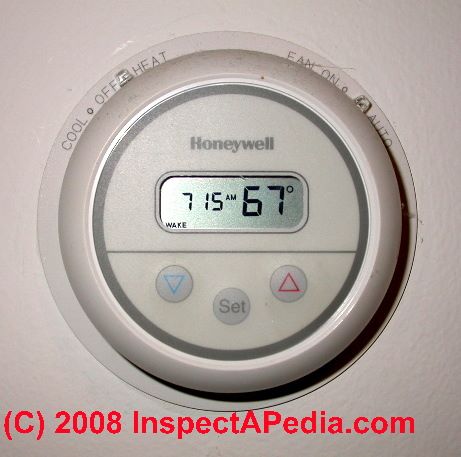
 Thermostat Switch Settings
How to Set the AUTO ON & COOL OFF HEAT Switches on a Room Thermostat
- POST a QUESTION or COMMENT about switch settings on room wall thermostats, continuous fan operation, & low voltage transformer diagnosis & repair
How to set the room thermostat switches: this article explains the use, setting, and adjustment of the FAN On-Off and MAN-AUTO switches on room thermostats.
We explain why you might want to leave the fan ON continuously, and we review use of the MODE switch to change between COOL, OFF or HEAT.
We also explain what to do if your air handler blower fan won't turn off and keeps running continuously.
InspectAPedia tolerates no conflicts of interest. We have no relationship with advertisers, products, or services discussed at this website.
Switches on Room Thermostats: what they do, how they work, how to set them
 Article Contents
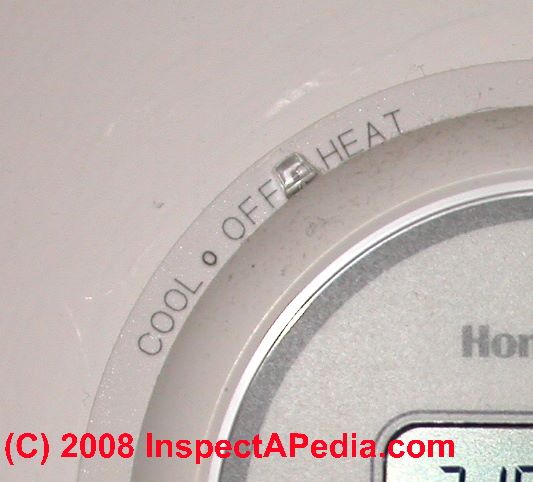
MODE SWITCH: Guide to Air Conditioning, Heat Pump, or Heating System COOL-OFF-HEAT Settings on Room Thermostat Switches
How does the COOL-OFF-HEAT Switch work on a heating or cooling thermostat? Details are just below.
The thing that confuses some building owners is that a thermostat that is used to control air conditioning as well as heating may have a "mode" switch that allows the occupant to change the thermostat between "Cooling" or "Air" or "Air Conditioning" mode and "Heat" or "Heating" mode.
There may be a third position labeled "Off" which instructs the heating or air conditioning system not to run at all.
How to Use the "COOL" thermostat switch setting position
During the cooling season when you need air conditioning, set this switch to the "COOL" position. This tells the thermostat what to do as temperature rises above the thermostat's setting (turn on the air conditioning system) or when room temperature falls below the thermostat's set temperature (turn off the air conditioner).
It's a good idea not to turn your air conditioning system on in cooling mode when it has been cold outside in the last 24hours. Unless your system is a heat pump designed to switch back and forth in all seasons, or unless a special heater has been installed on your air conditioning compressor, suddenly turning the air conditioning system (and the compressor component of it) on when it has been cold can damage the compressor.
How to Use the "HEAT" thermostat switch setting position
During the heating season, when you will need warmth, set this switch to the "HEAT" position. This tells the thermostat what to do when temperatures fall (turn on the heating system) or when temperatures rise to the thermostat setting (turn off the heating system).
How to Use the "OFF" Switch Position on a Room Thermostat
"OFF" switch on the thermostat or on the fan switch, if there is one, will tell the thermostat to keep the equipment it is controlling turned off regardless of whether we're in heating or cooling season. On thermostats usually the "OFF" position is in the middle between "COOL" and "HEAT" positions.
Why do you think this might be? It's not smart to switch a heat pump or a combination heating and cooling system right from "COOL" over quickly to "HEAT" or vice-versa.
Watch out: Imagine driving down the highway with the automatic transmission on your car set to the "D" for "drive" - would you switch the transmission into "R" for "Reverse" at 60 MPH? (No "R" does not stand for "Race"). Well you would only do it once - after which your transmission would perhaps be in the road behind the car.
DON'T keep switching your air conditioner, heat pump, or heating system on and off rapidly.
Taking photos for these articles I kept switching my digital thermostat between OFF HEAT COOL AUTO - which led to having no heat at all.
I screwed up the control. The "fix": I turned everything off at the service switch at my heater for five minutes to reset the system, turned things back on, and re-set the thermostat to MODE=AUTO and FAN=AUTO.
MODE BUTTON: Guide to Air Conditioning, Heat Pump, or Heating System
COOL-OFF-HEAT-AUTO Settings on Room Thermostat Switches that use a MODE Button
Unlike the round or square wall thermostat shown above, your room thermostat might look like this Carrier wall thermostat shown below (photo at left). Notice the buttons in the closeup (below right)?
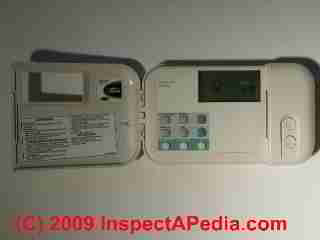
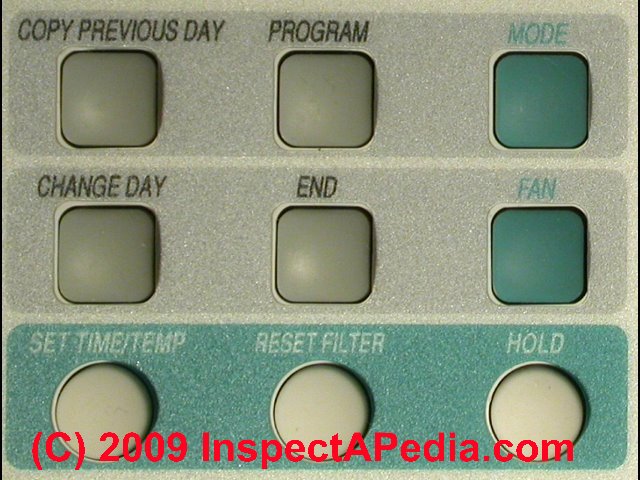
The MODE button is at the upper right on this Carrier programmable digital thermostat. Pressing the MODE button repeatedly will cycle the thermostat among these overall thermostat control settings:
OFF - turn everything off - no heating, no cooling, no fan, no nothing. Also
see
HEAT WON'T TURN OFF - Stop Unwanted Heat explanation of why heat may continue to come out of radiators or baseboards even though you have turned down the thermostat. Stop wasted heat by making sure you are not delivering heat when it is not needed or not wanted.
HEAT - put the thermostat in HEATING mode
COOL - put the thermostat in COOLING mode
AUTO - put the thermostat into AUTOMATIC mode - the thermostat will call for the heat to turn on or the air conditioning to come on depending on the temperature set on the thermostat.
For example if your thermostat is set to 68 °F and the room temperature drops below 68 °F the heat will come on. If temperature rises above 68 °F the cooling system will come on - presuming your building HVAC system includes both heating and cooling.
In our lab we leave this thermostat MODE set to AUTO.
WARNING: as we explained just above, don't keep cycling among these modes - you might make your thermostat get nauseous.
FAN SWITCH: Guide to Air Conditioning, Heat Pump, or Heating System Blower FAN ON-AUTO or FAN ON-MAN Settings on Wall Thermostats
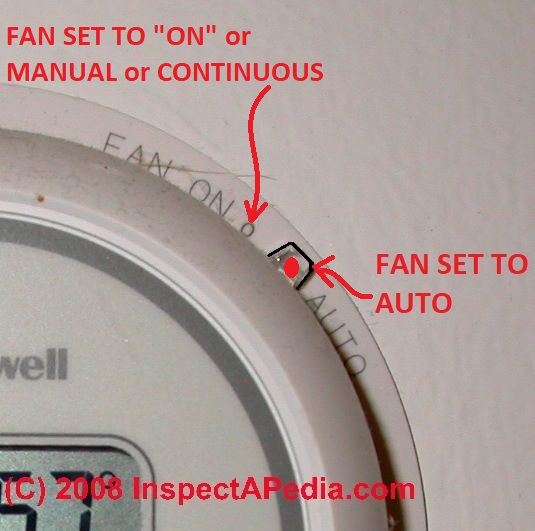 How does the FAN switch work on a heating or cooling thermostat and how should I use the FAN switch?
Details about this switch are
at FAN ON AUTO MAN Thermostat Switch
Here we explain how to use it and how to determine how the switch has been set on a digital thermostat. The basics are just below.
The air conditioning or heating wall-mounted thermostat may have a fan or blower control switch with (usually) two set positions "ON" and "AUTO" or sometimes "MAN" or "AUTO"
On these switches located usually on the top, side, or bottom of air conditioning or heating thermostats, the "ON" position is not what you might think. But it's simple, as you'll see.
"ON" on the fan switch will cause the heating or air conditioning fan or blower to run continuously. "MAN" or "manual" is the same as "ON" in this situation. There are advantages of running an air conditioning or heating blower fan continuously - which we discuss
at CONTINUOUS BLOWER FAN OPERATION.
"AUTO" on the fan switch on your thermostat is the normal switch position for the fan control. Setting the fan control to "AUTO" will allow the fan to turn on when the air conditioning system (or heating system) are ready to blow cool (or warm) air into the building, and to turn off automatically when cooling or heating are not needed.
Why Run an Air Conditioner or Heating Blower Fan Continuously?
There are reasons to leave the fan in the ON position on a heating or cooling system, such as for more even indoor temperature distribution or improved indoor air filtration. But we do not recommend that you do this without first asking for advice from your heating and service technician. Not all blower fan motors are designed for continuous operation.
Details about continuous operation of heating or air conditioning blower fans are
at CONTINUOUS BLOWER FAN OPERATION .
What to do if the Air Conditioning or Heating System Blower Fan Runs Continuously and Won't Shut Off?
Some readers have written to say that their air conditioning blower was running continuously and they didn't know why.
If the blower or fan switch on the Room Thermostat is set to MAN or ON, It could be that the FAN switch had simply been set to force the fan to run all of the time. Change the setting to AUTO and see what happens. Details about this switch are
at FAN ON AUTO MAN Thermostat Switch
Other causes for an air conditioning blower fan that does not turn off could be a problem with the control circuit board for the air conditioning system, or there could be other operating system problems that are preventing the system from cooling air to the desired temperature.
If the blower or fan switch at the Limit Switch in the Air Handler Unit is set to MAN or ON, that switch will cause the air handler unit's blower to operate continuously.
More details about the fan control on the limit switch in the air handler are |
at FAN WONT STOP - LIMIT SWITCH.
At CONTINUOUS BLOWER FAN OPERATION we explain how at either the wall thermostat or at the switch in the air handler switches can be set to keep the blower fan on. Sometimes we want to do this for improved air filtration or more even temperature control in a building.
Is it Time to Call the HVAC Repairman to fix a Fan Stuck On problem?
If after checking the switches above the blower or FAN switch is set to AUTO and the fan never turns off, call your air conditioning or heating repair company for diagnostic help, or if you've checked the switches we describe above and you want to diagnose the fan yourself, go to our blower fan diagnostic home page
at FAN, AIR HANDLER BLOWER UNIT.
Other snafus such as a shorted thermostat wire can also cause the A/C or warm air furnace fan to run continuously. Those problems are explained
For hot water heat or steam heat that won't stop,
see HEAT WON'T TURN OFF for an explanation of why heat may continue to come out of radiators or baseboards even though you have turned down the thermostat. Stop wasted heat by making sure you are not delivering heat when it is not needed or not wanted.
Reader Comments, Questions & Answers About The Article Above
Below you will find questions and answers previously posted on this page at its page bottom reader comment box.
Reader Q&A - also see RECOMMENDED ARTICLES & FAQs
On 2021-05-26 by (mod) - Furnace or Air Conditioner Blower Fan Runs Intermittently - why?
@Sandee,
Thank you that's a very helpful question about the causes of the blower fan running intermittently during the day when there is no call and has been no call for heat and no call for air conditioning for a quarter of an hour or longer.
You say no air is coming out of the vents but your blower fan is running. That's quite odd if you do see air flow when there is a call for heating or cooling.
To have room for a detailed reply I repeat your question and make some diagnostic suggestions
at BLOWER FAN CYCLES ON INTERMITTENTLY
Please take a look at that article and let me know what you find or ask further questions as needed.
On 2021-05-26 by Sandee
I didn't see anything about when a fan sporadically turns on and off when the heating and a/c are off. My thermostat does not have an off selection for the fan, just on/auto. I have turned the heat and a/c to off but the fan still cuts on several times a day. I want to have my windows open to enjoy the good weather but I'm nervous to with the fan coming on. I've checked the vents, nothing is coming out of them. Any ideas?
On 2020-12-07 - by (mod) -
Stu
It is normal and proper for the blower fan to run for a minute or two after the heat shut's off; that's a safety feature to avoid overheating and cracking the heat exchanger - such a crack would be unsafe.
On 2020-12-07 by Stu
My furnace blower will keep running even after heat shuts off however this only happens when the furnace is set at 68 degrees what do you think is bad? relay,limit swtch,or thermostat. thanks
On 2020-11-06 - by (mod) -
Andrew
I've seen this door interlock switch problem before; often a very slight adjustment of the position of the switch in the door jamb or a slight bending out of the contacting edge of the door to be sure the switch is fully depressed when the door is in place will be all that's needed.
If you're certain that the switch is properly placed and has good door contact but it still fails then I'd replace the switch.
On 2020-11-06 by Andrew Pgher
Furnace Heat cycle works fine ... when I have interlock taped to "close", and the door off. But, when I put door back on, with the interlock still taped "closed", the blower slows down to a stop. I discovered this by accident. I replaced the Primary Limit, (2) Roll Outs, the blower housing Secondary Limits. It is a Lennox Elite w 2 phase Heat, with an ECM 2.3 variable speed fan, 1 HP, 1075 RPM.
On 2013-01-19 by carol
My auto fan won't start but my fan blows is it harmful to blow the fan?
On 2013-01-15 by unknown
i have braeburn but my heat is not working automatic.. is working when i turn temp to high 80. when i turn 75 temp for heat to be auto but wont work. do i set the day and night and eve time to make the heat work. when i change my air fuel and i accident hit the wire. did you think cause of the wire that wont make my heater work
On 2013-01-14 by Abraham
If anyone can help I would appreciate it. my kids the big temperature change.
On 2013-01-09 by tony
my home heater dont come on in auto mode, but come on in manual mode why? (fan)
On 2013-01-02 by chris
I have a question the fan on my furnace come on and off all the time even when i have both my thermastates cool, off , heat switches to off and the fan swictch setting on there is only on and auto and they are both set to auto
On 2012-12-29 by Glenn Crowe
I have a new Goodman heating and air conditioning unit. When running the heat the thermostat says heat running but it operates intermittently. I have tried two thermostats and get the same problem.
On 2012-10-12 - by (mod) -
Doug
Check for a bad blower compartmen door safety switch.
On 2012-10-11 by Doug Kline
I have a thermostat that is set to kick the fan on and off for heat. (heat comes in from an outdoor wood burner) When the thermostat calls for heat, it clicks to turn on but the fan does not kick on. I can go down to the furnace and take the panel off, and put it back on and most of the time the fan will kick on. any suggestions.
On 2020-12-07 - by (mod) -
Stu
It is normal and proper for the blower fan to run for a minute or two after the heat shut's off; that's a safety feature to avoid overheating and cracking the heat exchanger - such a crack would be unsafe.
On 2020-12-07 by Stu
My furnace blower will keep running even after heat shuts off however this only happens when the furnace is set at 68 degrees what do you think is bad? relay,limit swtch,or thermostat. thanks
On 2020-11-06 - by (mod) -
Andrew
I've seen this door interlock switch problem before; often a very slight adjustment of the position of the switch in the door jamb or a slight bending out of the contacting edge of the door to be sure the switch is fully depressed when the door is in place will be all that's needed.
If you're certain that the switch is properly placed and has good door contact but it still fails then I'd replace the switch.
On 2020-11-06 by Andrew Pgher
Furnace Heat cycle works fine ... when I have interlock taped to "close", and the door off. But, when I put door back on, with the interlock still taped "closed", the blower slows down to a stop. I discovered this by accident. I replaced the Primary Limit, (2) Roll Outs, the blower housing Secondary Limits. It is a Lennox Elite w 2 phase Heat, with an ECM 2.3 variable speed fan, 1 HP, 1075 RPM.
On 2020-09-21 - by (mod) -
How can I get the fan to hook up to come on when I turn on my heat or air ?Michael:
A wall thermostat is chosen that can control both heating and cooling modes, and the appropriate wires are run between the thermostat and the control board in the air handler and/or heat pump.
Starting at THERMOSTAT WIRE CONNECTIONS we give detailed as well as generic wiring instructions for most thermostats and thermostat applications.
On 2020-09-21 by Michael Trent
I purchased and had installed a Goodman heat/ac pump . It connects to a mobile home , in which is a furnace with a single speed blower fan . The furnace coils are unhooked and the blower fan has to be turned on/off from the fan switch at the base of the housing in the furnace . How can I get the fan to hook up to come on when I turn on my heat or air ?
I’ve tried a couple of different ways I saw in online diagrams but neither were successful . The last attempt I tried to do it using a 4 prong relay and that failed as well . I have no idea how or were to hook up the green fan wire so my fan works accordingly ? Please help if you can .
On 2020-08-16 by Jay
My blower motor inside the furnace works with the heat and if I just turn it to on. But when I turn on the cooling it shorts out or won't start. Please help.
On 2020-05-08 - by (mod) -
THat sounds like a failed or stuck sensor or fan control relay.
If powering the system off, waiting a minute or two, and powering back on doesn't stop the snafu,
check that the thermostat wires are not shorted together (disconnect the TT wires at the air handler end)
and if that makes no difference the problem is most likely an actual relay or controller in the air handler.
On 2020-05-08 by Scott
Blower motor cycles every 4 minutes the turns off after running for 30 seconds. Then repeats constantly regardless if calling or not calling for heat or air. It cycles the same even when thermostat is off. Very discombobulated and pissed can't figure it out!!!!!
On 2019-11-09 - by (mod) -
Sure Paul, though take care
1. don't blow dust into your eyes
2. don't blow so close and hard as to blow off any small components
Show us a photo of the dust-clogged thermostat before you try blowing it out
On 2019-11-09 by Paul
Can I take the cover off the thermostat and blow it out with caned air
On 2019-11-02 - by (mod) -
Sun
Check the diagnostic steps starting at FAN WONT STOP - THERMOSTAT SWITCH inspectapedia.com/heat/Thermostat_Switch_Settings.php#FanStuckOn
and
Check to see if there is a manual FAN-ON switch on the fan limit control right in the air handler discussed at FAN WONT STOP - LIMIT SWITCH inspectapedia.com/heat/Furnace_Fan_Wont_Stop.php
If you've checked and there IS no manual-ON switch on your fan limit control at (or in) the air handler or furnace itself,
and
if you're dead certain that your thermostat is not calling for heat
and
you made sure that there is no manual FAN-ON switch set on the thermostat itself to force the fan to run
Then there may be shorted thermostat wires (happens but not common) or a defective thermostat (happens but not common) or a defective fan relay in the air handler
You can turn the entire furnace or air handler OFF but you'll have no heat; so you might want to let the fan run so you can continue to have heat (or cooling) but call for repair immediately as whenever a control isn't working, before it's diagnosed we can't be sure the system is safe.
On 2019-11-02 by Sunshine
I've tried everything n still Blower fan won't shut off..do I disconnect it n leave it alone?
On 2019-06-20 - by (mod) -
Joel
Please try the search box just above and search for
thermostat control for window air conditioner
and you'll find our article dedicated to just the question you posed
On 2019-06-20 by Joel Thompson
My old 3 ton a.c. home unit love the bid an I took it out but left the blower and heat coils on the inside unit with the wall thermostat how can i wire the thermostat to work automatically on and off with a 24000 but window unit
On 2019-06-18 (mod)
In the ARTICLE INDEX you'll find an article titled blower fan won't stop that lists all of the causes for that problem. That would be a good place to start. Let me know if you have further questions and we'll take it from there.
On 2019-06-16 by Anonymous
@Tom,
The switch is set to auto, the furnace and air are completely separate units not sharing anything but thermostat
Reader Question: Blower Fan Only Works on AUTO: proper control wiring depends on heat pump vs. A/C unit
A friend's a/c unit has the blower fan that will only work in auto, it will not work on manual. On the other hand, even when you turn the unit from cool to off, the blower still remains on.
The only way the blower will turn off, is to turn the fan to manual.
He changed the thermostat, and the unit will cool to the desired temp and kick off, but you can't turn the fan off on your own unless you turn it to manual. Anyone ran into this before? - John 8/17/11
Reply from reader Bryan:
The wiring to the unit depends on if you have a heat pump, or straight a/c unit. It also depends on how the installer has wired the thermostat. With the heat pump, the red is power, the yellow is for cooling, the white is for heat, the green is for the fan, the orange is for the reversing valve, and the blue is usually always common.
Again, you will have to check to see how the installer has ran the wires from the thermostat. If you have a a/c only unit outside, you will only have a red wire, and a white wire coming form the inside unit, to the outside unit. These will go on the contactor to send 24 volts to the coil to pull the contactor in. These are the traditional wiring schematics, again, check the thermostat to see if this is the case with yours.
Bryan thanks for that succinct summary of usual thermostat wiring details and color codes. As it will help other readers I'll add it at "INSTALL & WIRE Thermostats" - if you want to be credited along with contact information let me know by using our website CONTACT link that displays our email addresses. Best, Dan. Also, readers with thermostat wiring questions should
see THERMOSTAT WIRE CONNECTIONS - Ed.
On 2013-01-19 by carol
My auto fan won't start but my fan blows is it harmful to blow the fan?
On 2013-01-15 by unknown
i have braeburn but my heat is not working automatic.. is working when i turn temp to high 80. when i turn 75 temp for heat to be auto but wont work. do i set the day and night and eve time to make the heat work. when i change my air fuel and i accident hit the wire. did you think cause of the wire that wont make my heater work
On 2013-01-14 by Abraham
If anyone can help I would appreciate it. my kids the big temperature change.
On 2013-01-09 by tony
my home heater dont come on in auto mode, but come on in manual mode why? (fan)
On 2013-01-02 by chris
I have a question the fan on my furnace come on and off all the time even when i have both my thermastates cool, off , heat switches to off and the fan swictch setting on there is only on and auto and they are both set to auto
On 2012-12-29 by Glenn Crowe
I have a new Goodman heating and air conditioning unit. When running the heat the thermostat says heat running but it operates intermittently. I have tried two thermostats and get the same problem.
On 2012-10-12 - by (mod) -
Doug
Check for a bad blower compartmen door safety switch.
On 2012-10-11 by Doug Kline
I have a thermostat that is set to kick the fan on and off for heat. (heat comes in from an outdoor wood burner) When the thermostat calls for heat, it clicks to turn on but the fan does not kick on. I can go down to the furnace and take the panel off, and put it back on and most of the time the fan will kick on. any suggestions.
...
Continue reading at COOL OFF HEAT, THERMOSTAT SWITCH or select a topic from the closely-related articles below, or see the complete ARTICLE INDEX.
Or see THERMOSTAT SWITCH FAQs - questions and answers posted originally on this page.
Or see these
Recommended Articles
- BACKUP HEAT for HEAT PUMPS - back up heat for a heat pump system
- BLOWER FAN SPEED SETTINGS - how to set the air handler fan speed
- CONTINUOUS BLOWER FAN OPERATION
- COOL OFF HEAT, THERMOSTAT SWITCH
- FAN ON AUTO MAN THERMOSTAT SWITCH
- FAN ON SWITCH ADDITION
- NO HEAT - BOILER - hot water heat, baseboards, radiators, steam heat, hot water radiant heat
- NO HEAT - FURNACE - forced hot air heat
- NO HEAT - HEAT PUMP
- THERMOSTAT SETBACK ADVICE
- THERMOSTAT SWITCHES, INTERNAL
- THERMOSTAT SWITCHES, EXTERNAL
- THERMOSTAT WON'T TURN OFF
- THERMOSTAT WON'T TURN ON
Suggested citation for this web page
THERMOSTAT SWITCHES, EXTERNAL at InspectApedia.com - online encyclopedia of building & environmental inspection, testing, diagnosis, repair, & problem prevention advice.
Or see this
INDEX to RELATED ARTICLES: ARTICLE INDEX to HVAC THERMOSTATS
Or use the SEARCH BOX found below to Ask a Question or Search InspectApedia
Ask a Question or Search InspectApedia
Questions & answers or comments about finding, using, diagnosing, repairing, or replacing water pressure gauges on private well systems.
Try the search box just below, or if you prefer, post a question or comment in the Comments box below and we will respond promptly.
Search the InspectApedia website
Note: appearance of your Comment below may be delayed: if your comment contains an image, photograph, web link, or text that looks to the software as if it might be a web link, your posting will appear after it has been approved by a moderator. Apologies for the delay.
Only one image can be added per comment but you can post as many comments, and therefore images, as you like.
You will not receive a notification when a response to your question has been posted.
Please bookmark this page to make it easy for you to check back for our response.
Our Comment Box is provided by Countable Web Productions countable.ca
Citations & References
In addition to any citations in the article above, a full list is available on request.
- Domestic and Commercial Oil Burners, Charles H. Burkhardt, McGraw Hill Book Company, New York 3rd Ed 1969.
- National Fuel Gas Code (Z223.1) $16.00 and National Fuel Gas Code Handbook (Z223.2) $47.00 American Gas Association (A.G.A.), 1515 Wilson Boulevard, Arlington, VA 22209 also available from National Fire Protection Association, Batterymarch Park, Quincy, MA 02269. Fundamentals of Gas Appliance Venting and Ventilation, 1985, American Gas Association Laboratories, Engineering Services Department. American Gas Association, 1515 Wilson Boulevard, Arlington, VA 22209. Catalog #XHO585. Reprinted 1989.
- The Steam Book, 1984, Training and Education Department, Fluid Handling Division, ITT [probably out of print, possibly available from several home inspection supply companies] Fuel Oil and Oil Heat Magazine, October 1990, offers an update,
- Principles of Steam Heating, $13.25 includes postage. Fuel oil & Oil Heat Magazine, 389 Passaic Ave., Fairfield, NJ 07004.
- The Lost Art of Steam Heating, Dan Holohan, 516-579-3046 FAX
- Principles of Steam Heating, Dan Holohan, technical editor of Fuel Oil and Oil Heat magazine, 389 Passaic Ave., Fairfield, NJ 07004 ($12.+1.25 postage/handling).
- "Residential Steam Heating Systems", Instructional Technologies Institute, Inc., 145 "D" Grassy Plain St., Bethel, CT 06801 800/227-1663 [home inspection training material] 1987
- "Residential Hydronic (circulating hot water) Heating Systems", Instructional Technologies Institute, Inc., 145 "D" Grassy Plain St., Bethel, CT 06801 800/227-1663 [home inspection training material] 1987
- "Warm Air Heating Systems". Instructional Technologies Institute, Inc., 145 "D" Grassy Plain St., Bethel, CT 06801 800/227-1663 [home inspection training material] 1987
- Heating, Ventilating, and Air Conditioning Volume I, Heating Fundamentals,
- Boilers, Boiler Conversions, James E. Brumbaugh, ISBN 0-672-23389-4 (v. 1) Volume II, Oil, Gas, and Coal Burners, Controls, Ducts, Piping, Valves, James E. Brumbaugh, ISBN 0-672-23390-7 (v. 2) Volume III, Radiant Heating, Water Heaters, Ventilation, Air Conditioning, Heat Pumps, Air Cleaners, James E. Brumbaugh, ISBN 0-672-23383-5 (v. 3) or ISBN 0-672-23380-0 (set) Special Sales Director, Macmillan Publishing Co., 866 Third Ave., New York, NY 10022. Macmillan Publishing Co., NY
- Installation Guide for Residential Hydronic Heating Systems
- Installation Guide #200, The Hydronics Institute, 35 Russo Place, Berkeley Heights, NJ 07922
- The ABC's of Retention Head Oil Burners, National Association of Oil Heat Service Managers, TM 115, National Old Timers' Association of the Energy Industry, PO Box 168, Mineola, NY 11501. (Excellent tips on spotting problems on oil-fired heating equipment. Booklet.)
- Our recommended books about building & mechanical systems design, inspection, problem diagnosis, and repair, and about indoor environment and IAQ testing, diagnosis, and cleanup are at the InspectAPedia Bookstore. Also see our Book Reviews - InspectAPedia.
- Carson Dunlop, Associates, Toronto, have provided us with (and we recommend) Carson Dunlop Weldon & Associates'Technical Reference Guide to manufacturer's model and serial number information for heating and cooling equipment
Special Offer: Carson Dunlop Associates offers InspectAPedia readers in the U.S.A. a 5% discount on any number of copies of the Technical Reference Guide purchased as a single order. Just enter INSPECTATRG in the order payment page "Promo/Redemption" space. - In addition to citations & references found in this article, see the research citations given at the end of the related articles found at our suggested
CONTINUE READING or RECOMMENDED ARTICLES.
- Carson, Dunlop & Associates Ltd., 120 Carlton Street Suite 407, Toronto ON M5A 4K2. Tel: (416) 964-9415 1-800-268-7070 Email: info@carsondunlop.com. Alan Carson is a past president of ASHI, the American Society of Home Inspectors.
Thanks to Alan Carson and Bob Dunlop, for permission for InspectAPedia to use text excerpts from The HOME REFERENCE BOOK - the Encyclopedia of Homes and to use illustrations from The ILLUSTRATED HOME .
Carson Dunlop Associates provides extensive home inspection education and report writing material. In gratitude we provide links to tsome Carson Dunlop Associates products and services.
 | HOME | ABOUT | ASK a QUESTION | CONTACT | CONTENT USE POLICY | DESCRIPTION | POLICIES | PRIVACY | |
| © 2024 - 1985 Publisher InspectApedia.com - Daniel Friedman | |||||||||