
InspectAPedia® FREE Encyclopedia of Building & Environmental Construction, Diagnosis, Maintenance & Repair |
Question? Just ask us! InspectAPedia
|
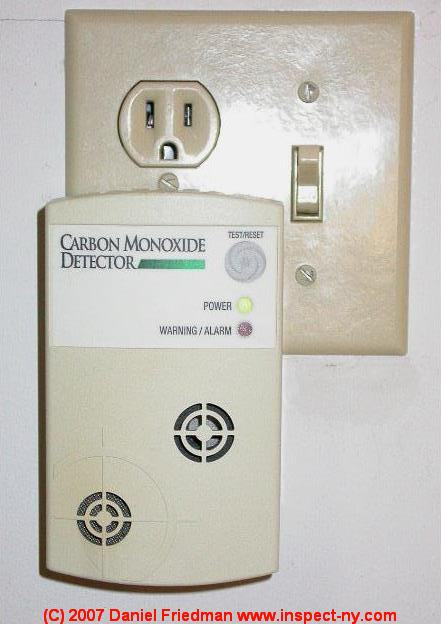
 Heating System Check Recommended for Carbon Monoxide
CPSC Release 88-92
- POST a QUESTION or COMMENT about Carbon Dioxide CO2 gas levels indoors, CO2outside, CO2testing, CO2poisoning symptoms, & CO2 exposure limits and toxicity for humans
Check your heating system for carbon monoxide hazards:
This US CPSC document describes a brief heating system safety warning for homeowners. The CPSC reminds owners to be sure that their heating service contractor also checks the chimney, flue, and flue vent connector as part of annual service (or when a problem is suspected). Unsafe chimneys and flues present a carbon monoxide hazard risk which can be fatal, as well as fire risks in buildings.
InspectAPedia tolerates no conflicts of interest. We have no relationship with advertisers, products, or services discussed at this website.
CPSC Carbon Monoxide Warning
We advise that special care be taken to inspect older buildings with large masonry flues into which gas-fired appliances have been vented, dead-end chimneys which are easily blocked by falling debris, chimneys with no caps (easily invaded by birds or animals), single-wythe brick flues (a fire and gas leak hazard), and chimneys which have been damaged by leaks or movement. - Ed.
FOR IMMEDIATE RELEASE
November 3, 1988
Release # 88-92
Home Heating System Should Be Checked Now
[for proper venting and for CO Carbon Monoxide Hazards - DJF]
WASHINGTON - Government safety experts are urging consumers to have central heating systems inspected this fall even though the heat may have already been turned on.
The U.S. Consumer Product Safety Commission recommends that central heating equipment be inspected annually by a qualified heating contractor. The furnace or boiler as well as electrical and mechanical components, valves, thermostat controls and automatic safety switches should be tested for proper operation to protect against possible overheating or fuel leaks which may result in fire or explosion.
Although heating contractors do not routinely inspect venting systems as part of the checkup, consumers should ask the contractor to examine the flue and chimney for possible problems. Blockages may be caused by mortar and other material loosened from chimney walls, bird nests or debris. Chimneys and flues should be clear at all times so exhaust gases, including carbon monoxide (CO), are properly vented outside the home. Flues and flue connectors should be checked for tight, secure fitting, and for signs of rust or corrosion, which could allow exhaust gases to enter the house.
CPSC cautioned homeowners to beware of carbon monoxide fumes (CO) in the home. CO is colorless, odorless, and is sometimes called "the silent killer."
People exposed to harmful levels of CO often show symptoms similar to flu-type illnesses, including dizziness, fatigue, headaches, irregular breathing and nausea. In the most recent year for which statistics are available, CPSC estimates that almost 60 deaths could be attributed to carbon monoxide gas emitted from central heating equipment.
The federal agency also stressed the importance of chimney inspections where oil or solid fuel heating systems have recently been converted to gas.
After the conversion, accumulated soot and debris on the chimney may loosen and fall. If enough debris collects inside the chimney, it could block the chimney and cause a buildup of dangerous levels of carbon monoxide in the home.
If the fall checkup of the heating system shows an accumulation of soot in the chimney, a chimney sweep should be called to clean the chimney and flue; annual chimney inspections should be made until no more soot is found.
CPSC said homeowners planing on converting to gas heat should have the chimney inspected when the conversion is made, then annually thereafter.
Dangerous Product Reports to the US CPSC: To report a dangerous product or a product-related injury, call CPSC's hotline at (800) 638-2772 or CPSC's teletypewriter at (800) 638-8270, or visit CPSC's web site at SaferProducts.gov.
...
Continue reading at CARBON MONOXIDE INSPECTION or select a topic from the closely-related articles below, or see the complete ARTICLE INDEX.
Or see these
Carbon Monoxide Hazard Articles
- CARBON MONOXIDE
- CARBON MONOXIDE HEATING SYSTEM CHECK
- CARBON MONOXIDE INSPECTION
- CO ALARM CAUSES
- CO DETECTION OPTIONS
- CO EXPOSURE LIMITS
- HEAT EXCHANGER LEAK ALLOWED
- HEAT EXCHANGER LEAK TEST STANDARDS
- HEAT EXCHANGER CORROSION
- HEAT EXCHANGER LEAK TEST
- HEAT EXCHANGER LEAK ALLOWED
- HEAT EXCHANGER LEAK TEST STANDARDS
- MEDICAL EFFECTS of CO
- POISONING SYMPTOMS - CO
- CARBON MONOXIDE WARNINGS: HOME HEATERS
- COMBUSTION AIR REQUIREMENTS
Suggested citation for this web page
CARBON MONOXIDE HEATING SYSTEM CHECK at InspectApedia.com - online encyclopedia of building & environmental inspection, testing, diagnosis, repair, & problem prevention advice.
Or see this
INDEX to RELATED ARTICLES: ARTICLE INDEX to HEATING SYSTEMS
Or use the SEARCH BOX found below to Ask a Question or Search InspectApedia
Ask a Question or Search InspectApedia
Try the search box just below, or if you prefer, post a question or comment in the Comments box below and we will respond promptly.
Search the InspectApedia website
Note: appearance of your Comment below may be delayed: if your comment contains an image, photograph, web link, or text that looks to the software as if it might be a web link, your posting will appear after it has been approved by a moderator. Apologies for the delay.
Only one image can be added per comment but you can post as many comments, and therefore images, as you like.
You will not receive a notification when a response to your question has been posted.
Please bookmark this page to make it easy for you to check back for our response.
Our Comment Box is provided by Countable Web Productions countable.ca
Citations & References
In addition to any citations in the article above, a full list is available on request.
- This article text is in public domain. Website design © 2010 - 1988 Copyright InspectAPedia.com All Rights Reserved - InspectAPedia® is a Registered U.S. Trademark
- Our recommended books about building & mechanical systems design, inspection, problem diagnosis, and repair, and about indoor environment and IAQ testing, diagnosis, and cleanup are at the InspectAPedia Bookstore. Also see our Book Reviews - InspectAPedia.
- Domestic and Commercial Oil Burners, Charles H. Burkhardt, McGraw Hill Book Company, New York 3rd Ed 1969.
- National Fuel Gas Code (Z223.1) $16.00 and National Fuel Gas Code Handbook (Z223.2) $47.00 American Gas Association (A.G.A.), 1515 Wilson Boulevard, Arlington, VA 22209 also available from National Fire Protection Association, Batterymarch Park, Quincy, MA 02269. Fundamentals of Gas Appliance Venting and Ventilation, 1985, American Gas Association Laboratories, Engineering Services Department. American Gas Association, 1515 Wilson Boulevard, Arlington, VA 22209. Catalog #XHO585. Reprinted 1989.
- The Steam Book, 1984, Training and Education Department, Fluid Handling Division, ITT [probably out of print, possibly available from several home inspection supply companies] Fuel Oil and Oil Heat Magazine, October 1990, offers an update,
- Principles of Steam Heating, $13.25 includes postage. Fuel oil & Oil Heat Magazine, 389 Passaic Ave., Fairfield, NJ 07004.
- The Lost Art of Steam Heating, Dan Holohan, 516-579-3046 FAX
- Principles of Steam Heating, Dan Holohan, technical editor of Fuel Oil and Oil Heat magazine, 389 Passaic Ave., Fairfield, NJ 07004 ($12.+1.25 postage/handling).
- "Residential Steam Heating Systems", Instructional Technologies Institute, Inc., 145 "D" Grassy Plain St., Bethel, CT 06801 800/227-1663 [home inspection training material] 1987
- "Residential Hydronic (circulating hot water) Heating Systems", Instructional Technologies Institute, Inc., 145 "D" Grassy Plain St., Bethel, CT 06801 800/227-1663 [home inspection training material] 1987
- "Warm Air Heating Systems". Instructional Technologies Institute, Inc., 145 "D" Grassy Plain St., Bethel, CT 06801 800/227-1663 [home inspection training material] 1987
- Heating, Ventilating, and Air Conditioning Volume I, Heating Fundamentals,
- Boilers, Boiler Conversions, James E. Brumbaugh, ISBN 0-672-23389-4 (v. 1) Volume II, Oil, Gas, and Coal Burners, Controls, Ducts, Piping, Valves, James E. Brumbaugh, ISBN 0-672-23390-7 (v. 2) Volume III, Radiant Heating, Water Heaters, Ventilation, Air Conditioning, Heat Pumps, Air Cleaners, James E. Brumbaugh, ISBN 0-672-23383-5 (v. 3) or ISBN 0-672-23380-0 (set) Special Sales Director, Macmillan Publishing Co., 866 Third Ave., New York, NY 10022. Macmillan Publishing Co., NY
- Installation Guide for Residential Hydronic Heating Systems
- Installation Guide #200, The Hydronics Institute, 35 Russo Place, Berkeley Heights, NJ 07922
- The ABC's of Retention Head Oil Burners, National Association of Oil Heat Service Managers, TM 115, National Old Timers' Association of the Energy Industry, PO Box 168, Mineola, NY 11501. (Excellent tips on spotting problems on oil-fired heating equipment. Booklet.)
- In addition to citations & references found in this article, see the research citations given at the end of the related articles found at our suggested
CONTINUE READING or RECOMMENDED ARTICLES.
- Carson, Dunlop & Associates Ltd., 120 Carlton Street Suite 407, Toronto ON M5A 4K2. Tel: (416) 964-9415 1-800-268-7070 Email: info@carsondunlop.com. Alan Carson is a past president of ASHI, the American Society of Home Inspectors.
Thanks to Alan Carson and Bob Dunlop, for permission for InspectAPedia to use text excerpts from The HOME REFERENCE BOOK - the Encyclopedia of Homes and to use illustrations from The ILLUSTRATED HOME .
Carson Dunlop Associates provides extensive home inspection education and report writing material. In gratitude we provide links to tsome Carson Dunlop Associates products and services.
 | HOME | ABOUT | ASK a QUESTION | CONTACT | CONTENT USE POLICY | DESCRIPTION | POLICIES | PRIVACY | |
| © 2024 - 1985 Publisher InspectApedia.com - Daniel Friedman | |||||||||