
InspectAPedia® FREE Encyclopedia of Building & Environmental Construction, Diagnosis, Maintenance & Repair |
Question? Just ask us! InspectAPedia
|
 Heating System Inspect, Diagnose, Repair
Home Page & Article Index
- POST a QUESTION or COMMENT about heating systems: how to inspect, diagnose, & repair heaters, determine heating capacity, recognize unsafe conditions, and how to reduce heating costs.
Here you will find step by step articles describing how to inspect, diagnose & repair residential heating systems: these heating system articles answer questions about all types of building heating systems and describe how to inspect, diagnose, and repair heating system problems, how to cut heating bills, and heating system safety, heating system efficiency and heating trouble-shooting advice.
InspectAPedia tolerates no conflicts of interest. We have no relationship with advertisers, products, or services discussed at this website.
Heating System Inspection Methods, Diagnosis, Safety, Repairs
 In these heating system articles we explain how to inspect and detect all defects and hazards on heating systems, boilers, furnaces, and other equipment. Methods for saving on heating cost and on improving heating safety are included.
Heating safety hazards such as carbon monoxide gas leaks, unsafe furnaces, furnace and boiler recalls are addressed.
[Click to enlarge any image]
What kind of heat have I got?
Start here if you don't know whether your heat is provided by a furnace (hot air) or boiler (hot water), whether your fuel is oil, gas, or electric, and whether your heat is hot water, steam, or warm air:
How do I fix the heating system?
If your heating system is not working properly, choose one of the following diagnostic procedures:
- NO HEAT - DIAGNOSE & FIX HEATING PROBLEMS - BOILER
- NO HEAT - DIAGNOSE & FIX HEATING PROBLEMS - FURNACE
- DIAGNOSTIC GUIDES for A/C / HEAT PUMP
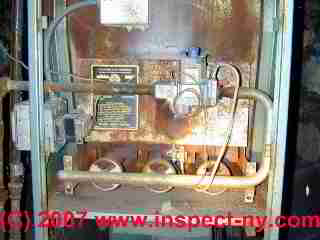
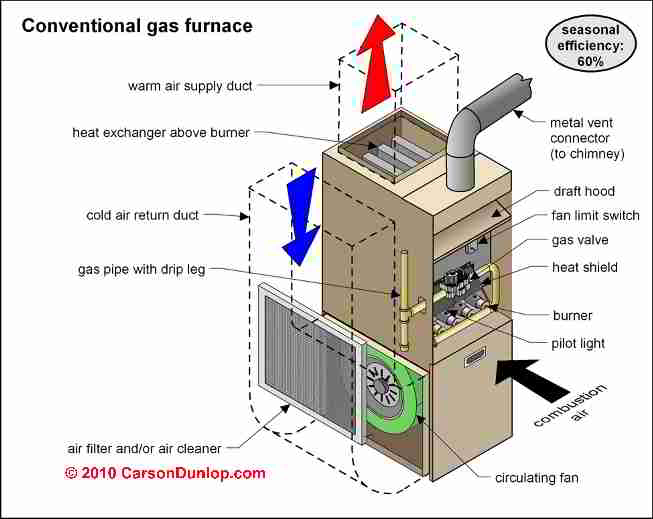
Our page top photo illustrates an oil fired hot water heating boiler. The sketch at above left illustrates basic parts of a conventional gas fired warm air heating furnace; image courtesy of Carson Dunlop Associates, a Toronto home inspection, education & report writing tool company [ carsondunlop.com ].
The heating system inspection, diagnosis and repair articles listed at the MORE READING links at the bottom of this article:
- give the components of a heating system
- describe how to find the rated heating capacity of an heating system by examining various data tags and components
- explain how to recognize common heating system operating or safety defects
- illustrate how to save money on home heating costs
We include product safety recall and other heating system hazards.
Potentially very costly environmental hazards such as leaky oil tanks are explained in depth. Other environmental and indoor air quality topics affected by residential and light commercial heating systems are explored.
To find what you need quickly, if you don't want to scroll through this index, you are welcome to use the page top or bottom SEARCH BOX to search InspectApedia for specific articles and information.
How to Inspect Heating Systems
 Building HVAC (Heating, Ventilating, and Air Conditioning) systems have three tasks: control indoor temperature and humidity at comfortable levels, provide adequate fresh air from outdoors, and the removal of indoor air odors and pollutants by a combination of air pressure control, filtration, and exhaust ventilation systems.
But not all HVAC systems are designed to perform all three of these jobs, and in typical residential buildings, separate and un-coordinated systems may be installed to heat, ventilate, and perhaps cool the building interior.
Start a heating system inspection with basic "distant" visual observations
A proper heating system inspection begins outside with taking notice of the chimneys, flues, and vents, and for the type and location of heating equipment fuel that is used: oil tanks, LP gas, piped in natural gas, solar, etc.
Similarly inside, before attempting a close inspection of the heating equipment itself, take note of and record defects in the heating distribution system (is there even heat present in every room?), and in the location of the heating equipment: is the boiler in a closet where it lacks combustion air, fire clearances etc.
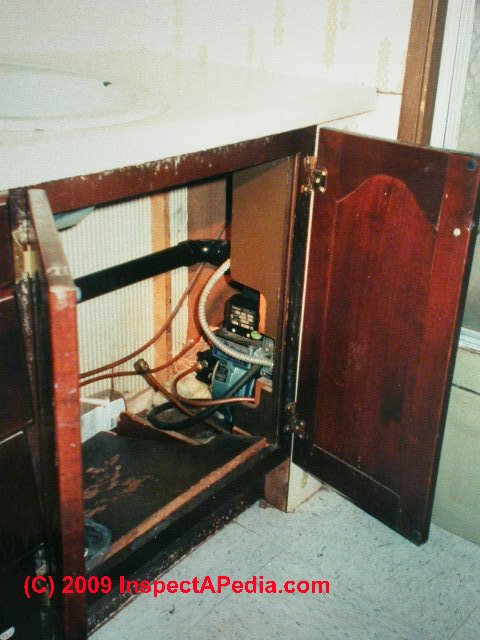
Take a look at the oil burner shown at above left - observed during a mobile home inspection.
From just opening the bathroom sink vanity, we see that an oil burner has been shoe-horned into a space where it does not belong, is unsafe, and is extremely difficult to access and service properly.
See MOBILE HOME HEATING SYSTEMS and
Watch out: From the moment of observing work such as the system shown in our photo, the inspector, owner, or heating service technician needs to be on red alert for amateur, unsafe workmanship.
Below and at the links listed at the ARTICLE INDEX the bottom of this article, we provide articles on just about any question you might have about installing, inspecting, troubleshooting, & repairing residential heating systems. Use the Website Search box at page top or the Comments Box at the end of each InspectApedia article to contact us if you cannot find information you need.
For a step by step procedure that can be used to inspect the condition of a heating system, see
HEATING SYSTEM INSPECT DIAGNOSE REPAIR - where we suggest detailed step by step approaches for inspecting complex systems - a free, online, detailed heating system inspection course
Critical Defects in Heating Systems
Critical defects which an inspector should not fail to detect when examining any building component or system are defects which form an immediate, significant safety hazard or defects which are quite likely to involve significant repair or replacement cost, and which involve components or systems which are necessary to occupy and use the building.
Methods for detection and diagnosis of these defects are discussed in this document and in its references. Suggestions for inclusion or exclusion of items in this list are invited - see the link "Contact Us".
 Because the heating system inspection and related topics discussed here cover a rather broad range, I have not attempted (yet) to list specific critical defects on this summary page.
However any inspection of the condition of heating equipment in buildings must include careful attention to:
Life Safety Hazards:
Such as evidence of unsafe chimneys, missing or damaged safety devices (relief valves, emergency shutoffs), and visual evidence of dangerous overheating or leaks.
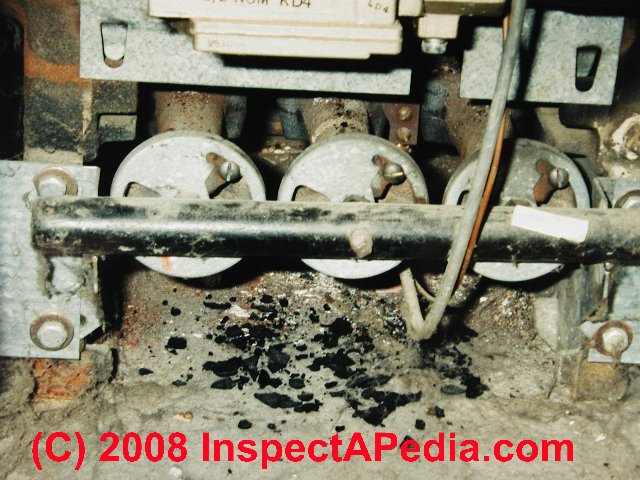
Responsibly conducted, an inspection of a gas-fired furnace, for example, might discover that the furnace has been exposed to severe rust-producing conditions which risk an unsafe heat exchanger and a carbon monoxide hazard which could be fatal to building occupants.
Even though the heat exchanger may not be visible, the contextual clues around the furnace, if they are visually obvious, should be translated into a level of concern by the inspector, and where appropriate, translated into a recommendation for action.
This does not mean "failing" every furnace to be on the "safe side", it means responsible inspecting and reporting.
See EXPLODING RADIATOR for a reader's question about a possible example of a dangerous condition that may not have been recognized.
Costly defects:
Such as evidence of a heating system at or near the end of its life of safe, reliable operation, or evidence of a buried oil tank which is likely to be old and for which there is no record of leak testing, should be reported.
Heating System Inspection & Diagnosis Detailed Articles & Education Curriculum Suggestions
See key heating system inspection, troubleshooting, installation or repair articles at the MORE READING article recommendations found at the end of any article at this website.
Defect Lists & Education Curriculum suggestions: for heating system inspection, troubleshooting, repair
- CONDENSING BOILERS/FURNACES
- CONDENSING BOILERS/FURNACES DAMAGE
- CONDENSING GAS FURNACE INSPECTION & TESTS
- DIRECT VENTS / SIDE WALL VENTS
- HEAT BOILER GAS DEFECTS LIST
- HEAT BOILER OIL DEFECTS LIST
- HEAT, ELECTRIC DEFECTS LIST
- HEAT PUMP DEFECTS LIST
- HEAT PUMP SUBSYS DEFECTS LIST
- HEAT RADIANT DEFECTS LIST
- HEAT FURNACE GAS DEFECTS LIST
- HEAT FURNACE OIL DEFECTS LIST
- HEAT SPACE & FIREPLACE, GAS DEFECTS LIST
- HEAT STEAM DEFECTS LIST
- HEAT, WOOD APPLIANCE DEFECTS LIST
How to Reduce Home Heating Costs
- AFUE DEFINITION, RATINGS - buy high efficiency heating equipment
- AIR & HEAT LEAK FIXES - find and fix air leaks
- BASEMENT HEAT LOSS - energy efficient basements: insulation, air leaks, other steps to cut heating costs
- BTU MONITORS & HEATING COST APPORTIONMENT - monitor heat usage, apportion heating costs
- CALCULATE BUILDING HEAT LOSS RATE - guide to calculating the rate of heat loss for different areas, insulation, materials
- COMBUSTION AIR for TIGHT BUILDINGS - explains how to provide outside combustion air for tight buildings
- DESIGN GUIDE for HEATING, VENTILATING, and AIR CONDITIONING SYSTEMS [PDF] (2006) U.S. Department of the Interior Bureau of Reclamation Denver, Colorado, retrieved 2021/12/27 original source: https://www.usbr.gov/tsc/techreferences/mands/mands-pdfs/HVACManl.pdf
- DUCT SYSTEM DESIGN SIZE & DEFECTS - make sure your warm air ducts are properly installed, not crimped, leaky, missing insulation, or contaminated
- ELECTRIC HEAT - home page for electric heating system installation, troubleshooting, inspection & repair
- ENERGY SAVINGS in BUILDINGS - home page for a plethora of ways to save on home heating and cooling costs
- HEATING FUEL COSTS COMPARISON: Current Energy Costs: Heating Oil, Natural Gas, Firewood - for a table comparing the cost per BTU of different heating fuels
- HEAT LOSS in BUILDINGS - topic home page - how to find and fix places where a building is wasting heat or energy
- HEAT PUMP STRATEGY - Indoors? - locating a heat pump or heat pump water heater indoors in a sunspace to scavenge heat
- HEAT WON'T TURN OFF - Stop Unwanted Heat - how to be sure the heat is completely "off" when it is not wanted or needed
- HEATING COST SAVINGS METHODS - how to adjust heating equipment for maximum efficiency
- INSULATION INSPECTION & IMPROVEMENT - where & how to improve building insulation to save on heating cost
- RADIANT HEAT FLOOR MISTAKES - don't let these foolish installation errors ruin your radiant heat floor system
- HEATING COST REDUCTION ADVICE - How to Save on Home Heating Costs - book review & heating and energy savings tips for homeowners and service technicians, gas & oil heat money saving tips, thermostat tips, tuneup tips
- HEATING SYSTEM INSPECT DIAGNOSE REPAIR - detailed step by step approaches for inspecting, servicing, repairing, and tuning up heating systems for economical performance
- NO HEAT - Boiler & Furnace Diagnosis Guide - where to start in figuring out why the heating system is not working; how to diagnose loss of heat, when the oil burner, boiler, or furnace won't run, or when the system runs but heat is not delivered to the living area
- RADIANT HEAT FLOOR MISTAKES - don't let these foolish installation errors ruin your radiant heat floor system
- SOLAR ENERGY SYSTEMS - renewable energy design and equipment for electrical, heating, and hot water; building designs for energy efficiency and reduction of heating and cooling costs
- SOLAR HEATING SYSTEMS
- SOLAR HOT WATER HEATERS
- SOOT on OIL FIRED HEATING EQUIPMENT - discusses soot on or inside oil fired heating equipment and its effect on heating costs and heater operating problems. Also
see OIL BURNER NOISE SMOKE ODORS. - STEAM HEATING SYSTEMS & CONTROLS - install, inspect, troubleshoot & repair steam boilers, steam radiators, & steam controls
- THERMAL IMAGING, THERMOGRAPHY - how to find the leak points or poorly insulated areas of a structure
- THERMAL TRACKING & STAINS - SIGNS OF HEAT LOSS - how to recognize thermal tracking or thermal bridging & how to diagnose stains on ceilings & walls, building air leaks & insulation defects, as well as other indoor air quality or building concerns
Reader Comments, Questions & Answers About The Article Above
Below you will find questions and answers previously posted on this page at its page bottom reader comment box.
Reader Q&A - also see RECOMMENDED ARTICLES & FAQs
On 2022-12-27 by Z11542
I have steam heat on two floors. The 2nd floor gets too hot and has 6 one pipe radiators with angled steam valves attached. The first floor has 3 radiators. They are all two pipe radiators and they all have angled steam valves like the ones on the second floor.
The smallest radiator on the first floor gets hot and so does the farthest large radiator. The radiator closest to the boiler on the first floor, which is large, does not get heat. Up to its supply valve i get close to 100 degrees while the rest of the radiator is cold.
Upstairs the one pipe radiators are all too hot and avery about 150 degrees at the same time. In the basement not far from the boiler the main return has a Gorton main steam valve.
Why can't i get heat to the large radiator on the first floor? Can i use TRVs to regulate the heat on the second floor?
On 2022-12-27 by InspectApedia Publisher - Why can't i get heat to the large radiator on the first floor?
@Z11542,
When some steam radiators on a piping loop get hot and others don't, I suspect a closed or jammed radiator valve, a clogged or defective steam vent, or on occasion a problem with blocked condensate return.
The fact that one of your rads gets hot on one end suggests that it's having trouble returning condensate. An experienced plumber or heating service tech may be able to dis-assemble and clean the rad bottom or pipe connections, but that's a bit inconvenient in the middle of cold weather.
And yes, for more-careful control of individual radiator heat output you can certainly install thermostatic radiator valves (TRVs) on any of your radiators. Again, not so convenient to do during the heating season, but if you've got enough work to make the job interesting to a heating service company they might be willing to send enough experienced technicians to first survey for what's needed, then return to do the job quickly enough that you don't freeze.
Details of heating radiator troubleshooting and repair are given starting at
RADIATORS - home
and be sure to see (among the plethora of radiator repair articles there)
COLD STEAM HEAT RADIATORS - diagnose & repair
and
AUTOMATIC RADIATOR VALVES - Automatic or Thermostatically Controlled Radiator Valves
On 2022-12-22 by Jamie
@InspectApedia (Editor), As far as I can tell, its working. I hold it in when i'm inspecting things and everything appears to work except the blower. Gas blower and system seems to start but won't continue because blower isn't running. Have 2 green lights on the control board that come on.
On 2022-12-22 by InspectApedia (Editor) - check that voltage is being delivered to the blower
@Jamie,
You checked that voltage is being delivered to the blower, right? With all that new stuff I'd then suspect that either we've missed a control that's keeping the blower off or a wiring error.
The fan limit switch has to be wired right and working
If the fuel is gas and there's a spill switch that has to be working and not tripped, etc.
You can leave the thermostat out of the equation by removing the tt wires at the air handler and jumpering the 2 T T terminals - that's what the thermostat does on a call for heat.
Then step through all of the diagnostic checkpoints at
NO HEAT - FURNACE. https://inspectapedia.com/heat/Furnace-Diagnosis-Repair.php
On 2022-12-22 by Jamie
I have a Rheem Centurion II AC/Heat split unit and my blower wont run. I replace 24V power supply about 3 months ago because thermostat quit working, fixed that. Now that blower stopped running, I've replaced blower motor, capacitor, and control board and it still wont run. What else is there to check/replace?
On 2022-12-22 by InspectApedia (Editor) - Rheem Centurion II AC/Heat split unit blower won't run
@Jamie,
Check the air handler access cover door interlock switch.
On 2022-12-07 by LORI
I purchased a home back in early september. November was cooler, december is -26c tonite. I checked the furnace for a filter, to which I cannot find. I am asking if anyone knows if this furnace has a filter and where it might bt located. It is not near the blower or anywhere.
The make of the furnace is a keeprite, model cdgi125ah01. Thank you.
On 2022-12-07 by InspectApedia (Editor)
@LORI,
If there is no air filter at the furnace air handler return air plenum then it may be located in a ceiling or wall central air return inlet.
On 2022-11-30 by Ep
Would anyone out there happen to have access to a manual for an old sears furnace model 867.762130? Any help greatly appreciated.
On 2022-11-30 by InspectApedia (Editor) - old sears furnace manuals
@Ep,
Check
our SEARS HVAC MANUALS page of PDF downloads at
https://inspectapedia.com/heat/Sears-Kenmore-HVAC-Manuals-Air-Conditioners-Boiler-Furnaces.php
On 2022-11-17 by Susana
@InspectApedia (Editor), thank you - service co adjusted the dip switches to lower air flow settings. Dampers are working properly per tech, and they suggested adjusting lower level zone damper's closed position to let some pressure off of system if the adjustment didn't do enough.
Our 23 year old furnace was propabably bogged down, too. Thank you again for the help and web link!
On 2022-11-19 by InspectApedia (Editor) - AIr handler blower speed too high - air flow "too strong" at supply registers?
@Susana,
Thanks back to you for following-up with what worked. That will help other readers:
AIr handler blower speed too high - air flow "too strong" at supply registers?
Check fan speed settings on dip switches or jumpers on the air handler control board
Check/adjust position of duct dampers to be sure you've got the right balance of air flow among different duct zones.
On 2022-11-13 by Susana
@InspectApedia, Thank you for the suggestions. Is there any reason to believe the damper vane's failing - can it show closed but be letting a lot of air through? We could swap the damper inserts to see if the added heat shows up in corresponding zone.
On 2022-11-15 by InspectApedia (Editor) - duct damper failure causes abnormal air flow at some air supply registers?
@Susana,
Thanks that's an interesting question - duct damper failure causes abnormal air flow at some air supply registers?
Duct damper vanes never close off a duct completely since making them that air-tight would either jam the moving baffle in the duct or would make the product more expensive than the manufacturers think they can sell.
Let's try a simple test: for an HVAC system air supply register that is downstream from the duct damper, try the duct damper in it's OPEN position and then in its CLOSED position with, of course, the air handler blower running. You should feel a significant drop in airflow when the damper closes.
See details at ZONE DAMPER CONTROLS https://inspectapedia.com/heat/Ductwork_Zone_Dampers.php
And let us know what you find.
On 2022-11-13 by Susana
We had a new 100,000btu furnace installed. Our heating system is controlled by our original Carrier Comfort zone thermostat and control board (5zones) with electric 3 wire dampers.
After installation of new furnace heat is pushing through closed dampers - tabs indicate in closed position but air is being forced through. Some whistle. Basement set at 65, but is 69 degrees.
Can the new furnace be too powerful for the 22 year old dampers? Does the furnace have settings to adjust? Never had this issue prior to new furnace install, zone temps always maintained, never more than 1 degree warmer than setting.
Afraid service company will try to tell me i need to spend 1,000s in new equipment when in fact they did not match my existing components with furnace. Thank you for the help!
On 2022-11-13 by InspectApedia (Editor) - Carrier Comfort zone thermostat and control board
@Susana,
Heating and air conditioning Air Supply registers are never absolutely airtight. It's normal for there to be some air leakage through them when the fan and the air handler is running.
However if you think that the airflow is stronger than you like and noticeably stronger than it was with the previous air handler there are two explanations that should be understood:
First, it's possible that the squirrel cage fan in the blower of your old air handler was dirty.
Dirt on those fan blades can cut the air flow output by 60 or more percent. So a new blower with a clean fan will definitely move much more air.
Second, many air handlers have a fan speed setting that can be adjusted. It may be on a control board.
Often the air handler uses a different speed when cooling then when heating.
So you want to review those settings with your installer to be sure they are correct.
On 2022-10-25 by haley
For a wood burning furnace, what is the minimum size allowed to reduce a flue pipe from an 8 inch exhaust to an outside chimney? Thanks in advance for any response.
On 2022-10-25 by InspectApedia (Editor) - minimum size allowed to reduce a flue pipe
@haley,
You would not normally make ANY reduction in the exhaust flue or vent piping lest you create a draft or safety problem for your furnace. So before squeezing down the vent connector between the wood-fueled furnace and the chimney itself, check with the furnace manufacturer.
At the very least I suspect they'll tell you about a requirement to measure/assure adequate draft.
On 2022-10-15 by Tom
I have an old Fraser-Johnston furnace with a typewritten tag taped on it that says it was new in 1960, Model 45-CJDS, Serial 295438. The unit dimensions are Height: 60 inches, Width: 8 inches, and Depth: 27-3/4 inches.
There is no manufacturer’s tag on the unit. I would welcome any comments or information.
On 2022-10-15 by InspectApedia (Editor) - old Fraser-Johnston furnace
@Tom,
Please see your question re-posted along with our reply now at
FRASER JOHNSTON HVAC
On 2022-10-12 by Richard Garcia
If oil furnace combustion chamber gases and the air passing over the heat-exchanger are separate, assuming NO cracks in combustion chamber or exchanger, why should there be any soot on the heat-exchanger?
I'm having trouble visualizing the actual physical relationship between these two oil furnace components.
Thank you.
On 2022-10-12 by InspectApedia-911 (mod) - soot is a natural product of oil burner combustion
@Richard Garcia,
Thank you that's a helpful question.
To be more clear, we should understand that the soot is a natural product of oil burner combustion, and forms or collects inside the heat exchanger and thus in the passages through which combustion gases are passing.
You wouldn't expect so formation on the exterior of the heat exchanger over which building air is passing.
On 2022-09-04 by aw
@InspectApedia-911, I don’t have a model. I am needing the wiring from boiler to ac for the relay. This is where I’m stumped. Hardy h6. Needing to make sure it is wired from thermostat to relays. I know one goes to 7 and 8 on the relay. I have a 3 wire thermostat.
all hardy wood boilers are the same. They have a 3 wire that needs to be connected to relays. I have spent hours looking for diagrams on this. Hardy manufacturer diagram does not have what I am needing. I need to know how the relays need to be wired on a 90340 relay for the ac part without using an aqua stat.
On 2022-09-04 by InspectApedia-911 (mod) - wire a hardy wood boiler to the ac and furnace
@aw,
I think the reason you may be having trouble with this wiring setup, and the reason that the manufacturers may be not providing you the detail that you ask, is that there are some serious safety and control issues in trying to coordinate multiple, different fueled heating systems.
I understand that you want to reduce the question to something very simple such as 'just tell me where to put the wires'.
But the fact is we have no information about the various pieces of equipment, fuels, and venting or even nearby construction materials for your installation.
Some very basic questions such as whether or not a flue is shared involves major safety and fire hazard questions.
So just answering someone's question who, understandably impatient, says "never mind all that, just tell me where to put the wires" leaves people who are sitting far away nervous about the safety of the installation.So what I would do in this case is to call the manufacturers technical support people directly, they can ask you questions about your installation and then offer a more technically correct and safe answer.
On 2022-09-04 by aw
I am needing to wire a hardy wood boiler to the ac and furnace. There are 3 wires on a hardy that need to be connected through relays. Any suggestions?
On 2022-09-04 by InspectApedia-911 (mod)
@aw,
Let's start with the specific model and it's manual.
Can you tell us or better, post a photo of the heater's data tag.
Proper safety control setup is critical,l too.
On 2022-02-02 by Dylan
New Lennox furnace installed January 2022 - over the last week I've noticed a rattling or popping sound within the unit when the burners ignite. We're getting heat in the house, but don't want it to be another heat exchanger issue.
On 2022-02-02 by Inspectapedia Com Moderator - rattling or popping sound in the Lennox furnace
@Dylan,
Nor do we.
Take a look at the diagnostics at
GAS BURNER POPPING NOISES
and let me know what you find on your system.
...
Continue reading at BOILER CONTROLS & SWITCHES or select a topic from the closely-related articles below, or see the complete ARTICLE INDEX.
Or see HEATING SYSTEM FAQs - questions & answers posted originally in this article
Or see these
Recommended Articles
- HEATING SYSTEMS - home
- AIR HANDLER / BLOWER UNITS - home
- BOILERS, HEATING - home
- BOILER / FURNACE AGE GUESSER
- COMBUSTION AIR REQUIREMENTS
- DUCT SYSTEM DESIGN SIZE & DEFECTS - home
- ELECTRIC HEAT - home
- FAN, AIR HANDLER BLOWER UNIT - home
- FURNACES, HEATING - home
- HEATING SYSTEM INSPECT DIAGNOSE REPAIR - home
- DIAGNOSE & FIX HEATING PROBLEMS-BOILER - home
- DIAGNOSE & FIX HEATING PROBLEMS-FURNACE - home
- DIAGNOSE & FIX HEATING SYSTEMS - home
- DIAGNOSTIC GUIDES A/C / HEAT PUMP
- HEAT BOILER GAS DEFECTS LIST
- HEAT BOILER OIL DEFECTS LIST
- HEAT, ELECTRIC DEFECTS LIST
- HEAT PUMP DEFECTS LIST
- HEAT PUMP SUBSYS DEFECTS LIST
- HEAT RADIANT DEFECTS LIST
- HEAT FURNACE GAS DEFECTS LIST
- HEAT FURNACE OIL DEFECTS LIST
- HEAT SPACE & FIREPLACE, GAS DEFECTS LIST
- HEAT STEAM DEFECTS LIST
- HEAT, WOOD APPLIANCE DEFECTS LIST
- HEAT WON'T TURN OFF
- HEAT WON'T TURN ON
- HEATING SYSTEM NOISE DIAGNOSIS
- HEATING SYSTEM SAFETY INSPECTION
- HEATING SYSTEM TYPES
- NO HEAT - BOILER
- NO HEAT - FURNACE
- HEATING SYSTEM NOISE DIAGNOSIS
- MANUALS & PARTS GUIDES - HVAC - home - Master Index to All Brand Names & HVAC manuals, wiring diagrams, installation and repair guides
- THERMOSTATS, HEATING / COOLING - home
- ZONE VALVES, HEATING
Suggested citation for this web page
HEATING SYSTEMS at InspectApedia.com - online encyclopedia of building & environmental inspection, testing, diagnosis, repair, & problem prevention advice.
Or see this
INDEX to RELATED ARTICLES: ARTICLE INDEX to HEATING SYSTEMS
Or use the SEARCH BOX found below to Ask a Question or Search InspectApedia
...
Ask a Question or Search InspectApedia
Try the search box just below, or if you prefer, post a question or comment in the Comments box below and we will respond promptly.
Search the InspectApedia website
Note: appearance of your Comment below may be delayed: if your comment contains an image, photograph, web link, or text that looks to the software as if it might be a web link, your posting will appear after it has been approved by a moderator. Apologies for the delay.
Only one image can be added per comment but you can post as many comments, and therefore images, as you like.
You will not receive a notification when a response to your question has been posted.
Please bookmark this page to make it easy for you to check back for our response.
Our Comment Box is provided by Countable Web Productions countable.ca
Citations & References
In addition to any citations in the article above, a full list is available on request.
- AUDELS OIL BURNER GUIDE, INSTALLING, SERVICING, REPAIRING, [PDF online copy of this book] Frank D. Graham, Theo. Audel & Co., New York 1946, 1947, 1955 (out of print, copies occasionally available from antique book dealers and on EBay). Use THIS LINK to read a free online copy of this helpful classic textbook.
- Brumbaigh, James E., Audel HVAC FUNDAMENTALS Vol. 1: HEATING SYSTEMS, FURNACES & BOILERS 4th Ed., [PDF] (2004) Wiley Publishing, - retrieved 2022/09/17 original source: http://arco-hvac.ir/wp-content/uploads/2015/11/Engineering-Audel-Hvac-Fundamentals-Heating-Systems-Furnaces-And-Boilers.pdf
- Boiler Chemicals 101, NCDENR, - Retrieved 12/24/2010, original source http://www.p2pays.org/ref/32/31321.pdf
Quoting from the North Carolina Division of Pollution Prevention and Environmental Assistance: The N.C. Division of Pollution Prevention and Environmental Assistance provides free, non-regulatory technical assistance and education on methods to eliminate, reduce, or recycle wastes before they become pollutants or require disposal. Contact DPPEA at (919) 715-6500 or (800) 763-0136 for assistance with issues in this fact sheet or any of your waste reduction concerns. - Thanks to Scott C. LeMarr, for sharing his file of keys to decode Furnace and Water Heater Age from the data provided on the manufacturer's equipment labels. Mr. LeMarr is a professional home inspector, Certified Professional Inspector/President, MASTER Indoor Environmental Specialist (MIES). Vice President of Wisconsin NACHI. He and his company, Honest Home Inspections [ Website: www.HonestHomeInspections.com ], LLC. can be reached at 262-424-5587 or by email to scott@honesthomeinspections.com
- Fuel Oil & Oil Heating Magazine, 3621 Hill Rd., Parsippany, NJ 07054, 973-331-9545
- OIL TANK PIPING & PIPING DEFECTS - how to pipe oil tank fill, vent, and oil supply lines, common defects, leaks, safety concerns
- Domestic and Commercial Oil Burners, Charles H. Burkhardt, McGraw Hill Book Company, New York 3rd Ed 1969.
- National Fuel Gas Code (Z223.1) $16.00 and National Fuel Gas Code Handbook (Z223.2) $47.00 American Gas Association (A.G.A.), 1515 Wilson Boulevard, Arlington, VA 22209 also available from National Fire Protection Association, Batterymarch Park, Quincy, MA 02269. Fundamentals of Gas Appliance Venting and Ventilation, 1985, American Gas Association Laboratories, Engineering Services Department. American Gas Association, 1515 Wilson Boulevard, Arlington, VA 22209. Catalog #XHO585. Reprinted 1989.
- The Steam Book, 1984, Training and Education Department, Fluid Handling Division, ITT [probably out of print, possibly available from several home inspection supply companies] Fuel Oil and Oil Heat Magazine, October 1990, offers an update,
- Principles of Steam Heating, $13.25 includes postage. Fuel oil & Oil Heat Magazine, 389 Passaic Ave., Fairfield, NJ 07004.
- The Lost Art of Steam Heating, Dan Holohan, 516-579-3046 FAX
- Principles of Steam Heating, Dan Holohan, technical editor of Fuel Oil and Oil Heat magazine, 389 Passaic Ave., Fairfield, NJ 07004 ($12.+1.25 postage/handling).
- "Residential Steam Heating Systems", Instructional Technologies Institute, Inc., 145 "D" Grassy Plain St., Bethel, CT 06801 800/227-1663 [home inspection training material] 1987
- "Residential Hydronic (circulating hot water) Heating Systems", Instructional Technologies Institute, Inc., 145 "D" Grassy Plain St., Bethel, CT 06801 800/227-1663 [home inspection training material] 1987
- "Warm Air Heating Systems". Instructional Technologies Institute, Inc., 145 "D" Grassy Plain St., Bethel, CT 06801 800/227-1663 [home inspection training material] 1987
- Heating, Ventilating, and Air Conditioning Volume I, Heating Fundamentals,
- Boilers, Boiler Conversions, James E. Brumbaugh, ISBN 0-672-23389-4 (v. 1) Volume II, Oil, Gas, and Coal Burners, Controls, Ducts, Piping, Valves, James E. Brumbaugh, ISBN 0-672-23390-7 (v. 2) Volume III, Radiant Heating, Water Heaters, Ventilation, Air Conditioning, Heat Pumps, Air Cleaners, James E. Brumbaugh, ISBN 0-672-23383-5 (v. 3) or ISBN 0-672-23380-0 (set) Special Sales Director, Macmillan Publishing Co., 866 Third Ave., New York, NY 10022. Macmillan Publishing Co., NY
- Installation Guide for Residential Hydronic Heating Systems
- Installation Guide #200, The Hydronics Institute, 35 Russo Place, Berkeley Heights, NJ 07922
- The ABC's of Retention Head Oil Burners, National Association of Oil Heat Service Managers, TM 115, National Old Timers' Association of the Energy Industry, PO Box 168, Mineola, NY 11501. (Excellent tips on spotting problems on oil-fired heating equipment. Booklet.)
- [20] SCALE FORMATION in WATER HEATERS and METHODS of PREVENTION free download as [PDF] Krappe,
Justus Maximilian, Engineering experiment station. Gas engineering bulletin; no. 6; Research series; no. 74; On cover: Engineering bulletin, Purdue university. Vol. xxiv, no. 3a. June, 1940 (Layfayette Indiana) commonly referred to in some references as "Purdue University Bulletin No. 74" - thanks to researcher Robyn Goldstein for the full citation. LCCN: 40028844 & OCLC: 1038544 - Water analysis, water softening, hot-water supply. 27pages.
You can also obtain this document through your local library. (full copy file at InspectAPedia 3/31/2010) Purdue B074 can be hard to locate online.
Also Bradford White Corporation (a manufacturer of water heaters) previously published
SCALE FORMATION in WATER HEATERS - EXCERPTS [PDF] from that document made available by Purdue University. - In addition to citations & references found in this article, see the research citations given at the end of the related articles found at our suggested
CONTINUE READING or RECOMMENDED ARTICLES.
- Carson, Dunlop & Associates Ltd., 120 Carlton Street Suite 407, Toronto ON M5A 4K2. Tel: (416) 964-9415 1-800-268-7070 Email: info@carsondunlop.com. Alan Carson is a past president of ASHI, the American Society of Home Inspectors.
Thanks to Alan Carson and Bob Dunlop, for permission for InspectAPedia to use text excerpts from The HOME REFERENCE BOOK - the Encyclopedia of Homes and to use illustrations from The ILLUSTRATED HOME .
Carson Dunlop Associates provides extensive home inspection education and report writing material. In gratitude we provide links to tsome Carson Dunlop Associates products and services.
 | HOME | ABOUT | ASK a QUESTION | CONTACT | CONTENT USE POLICY | DESCRIPTION | POLICIES | PRIVACY | |
| © 2024 - 1985 Publisher InspectApedia.com - Daniel Friedman | |||||||||