
InspectAPedia® FREE Encyclopedia of Building & Environmental Construction, Diagnosis, Maintenance & Repair |
Question? Just ask us! InspectAPedia
|
 The Dink Factor
When to stop improving your work

This article provides prose, poetry, photographs by DJF.
Have I told you about the "Dink Factor" - it's a way to head off the requirement for a reset button.
Let me explain:
Back in the late 1980's Carol Schneirer was an IBM engineer with whom I had joined in the business of servicing heating systems. She had taken the BOCES courses and was trained as an HVAC repairman before I was.
We both had plenty of work and our own lists of customers. Soon we found that there was a big advantage working together - we knew more together than apart, and we someone else to blame when things didn't go right.
Carol was sharp as a tack (maybe still is).
For example, Carol built her own car, her own house, made her own solar hot water heater, even her own solar system.
Understandably, Carol does not think much of men, but she agreed that we could work together on boilers and furnaces despite this shortcoming on my part.
She was incredibly straight (aside from her disaffection with the pendulous male set) and she would never ever utter even the slightest off-color word. This rule made Carol's language boring. I admired her immensely.
Anyhow, where you might say "well I sure fucked that up", Carol would say "Well I sure dinked that up". She dinked up, she didn't fuck up. Working together I tried not to fuck up either.
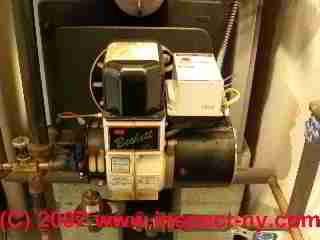
Once in the middle of an oil burner re-build we had to replace the fuel unit, a part we didn't have on the truck.
One of us, I'm not saying who, had turned a bolt too far and it snapped. We decided to break for lunch, but only after stopping by Arlington Plumbing to pick up the new pump we needed.
We pulled into the back parking lot of APS and entered the plumbing and heating supply house through the loading door - that's where all of the professionals go in.
Arlington's real customers were repair people like us (more or less) and everyone figured that anyone entering through the front door would be a homeowner, or worse, a do-it-yourself IBM'er - persona non grata at APS. We went in the back way.
Just inside the the loading dock door there were a few soiled men sitting on upturned packing crates reading thumb-worn issues of Hustler, grinning and slobbering over the already-wet heating parts on display.
We walked past the readers. Carol gave a few interested looks at the wet parts herself. We didn't say anything as we passed the crowd of idlers and sauntered up to the parts counter.
As ex IBM'ers we knew that we talked funny and that we could be facing some hostility at the counter.
The entire place fell silent as the readers, parts guys, and plumbers waiting at the counter watched us walk up.
Me they could figure - a dirty fellow with dirty hands needing some heating or plumbing part.
But Carol they couldn't figure.
Not once in the 48 years since Arlington Plumbing Supply had opened its doors had a woman, a recognizable woman (Carol is very recognizable), ever, even once, approached the parts counter, much less entered through the professional's entrance at the loading dock. The only women in this area, ever, were those on the wrinkled pages of Hustler.
But while the fellows could recognize Carol as a WOMAN, they couldn't parse just what she really was. Not entirely.
See, Carol was dirty like me - we both had hands stained with soot and oil burner crud.
And she was wearing men's workman's overalls that fit her a bit snug in the hips and chest. There was more.
The boiler room where we had been working was a small closet-like area. It was impossible to move around without parts of your body brushing up against sooty surfaces. Large in the chest department, Carol's jump suit had developed two large black orbs, one over each breast, where she had squeezed past sooty heating boiler parts. I'd noticed these, but noticing them and saying anything about them were two different sets of rules in our association. I hadn't said a word and I wasn't going to.
The man-crowd stared at us - at Carol. She was a woman, that was clear from the orbs alone.
But women don't work on oil burners.
But Carol was obviously working on an oil burner.
But women don't know anything about oil burners.
But Carol and I had entered APS through the professional's back door.
But she had these strange black orbs.
But what the hell? Maybe, they figured, she was just my girlfriend. (Wrong, she was Susan's girl friend.)
We walked up to the parts counter.
The parts guy pushed himself off of the shelving where he'd been half-leaning, goggle-eyed, and approached me.
I was the "man", obviously the one who was going to ask for parts.
She was ... well they didn't know what.
This particular job was for one of Carol's clients, not mine. It was her job. She was the boss on this one. It was her place to get the oil burner parts we needed.
Carol pushed past the slobberers and starers and stomped up to the counter.
In her low and most manly voice, she said to the parts man who was still looking mostly over at me:
"Gimme a Sunstrand J-pump 43A, left-hand rotation, with the internal bypass factory set, and a 23-A pump strainer" she
rumbled in a blast of heating technospeak that left on doubt about who was the expert repairman.
The parts man started, eyes bugged wider than orbs.
In a sort of squeaky voice he chirped: "Yes Ma'am!" He ran off to get our parts.
We paid. We left. Still in silence.
On the way back from lunch Carol, discussing our busted bolt, explained the "dink factor" to me.
It goes like this.
The dink factor is sort of like a pre-reset button. Instead of needing to do something all over because you've dinked up the job, the dink factor is a measure, a ratio, that tells you when to stop. When to stop tightening a bolt, for example, just before you bust it off.
Imagine you're putting up wallpaper. You've put a piece of wall paper on the wall and it's nearly perfect - maybe a millimeter off. No one but you will ever ever notice that millimeter. But the millimeter bothers you. So you start pushing the wallpaper, trying to make it perfectly straight. As you push the wallpaper into place, you're testing the dink-factor ratio.
The dink factor ratio is the ratio of improvement to harm.
DINK = HARM / IMPROVEMENT
As you push and push, the ratio of improvement to harm approaches ONE. If you keep pushing, the whole section of wallpaper will suddenly rip and be destroyed.
When you get the dink factor ratio close to ONE you have to STOP IMMEDIATELY.
IF you keep pushing, the amount of HARM will become greater than the amount of IMPROVEMENT - the DINK ratio will exceed ONE.
When DINK is greater than ONE, the wallpaper tears and is ruined, or the bolt snaps off, or you slip and cut off a finger.
You should have stopped dinking around with it.
Daniel Friedman
17 July 2008 San Miguel de Allende, Guanajuato, Mexico - Daniel Friedman
...
-->
...
Continue reading POETRY & SHORT FICTION, Daniel Friedman or select a topic from the closely-related articles below, or see the complete ARTICLE INDEX.
Suggested citation for this web page
Dink Factor at InspectApedia.com - online encyclopedia of building & environmental inspection, testing, diagnosis, repair, & problem prevention advice.
Or see this
INDEX to RELATED ARTICLES: POETRY & SHORT FICTION, Daniel Friedman
Or use the SEARCH BOX found below to Ask a Question or Search InspectApedia
Ask a Question or Search InspectApedia
Try the search box just below, or if you prefer, post a question or comment in the Comments box below and we will respond promptly.
Search the InspectApedia website
Note: appearance of your Comment below may be delayed: if your comment contains an image, photograph, web link, or text that looks to the software as if it might be a web link, your posting will appear after it has been approved by a moderator. Apologies for the delay.
Only one image can be added per comment but you can post as many comments, and therefore images, as you like.
You will not receive a notification when a response to your question has been posted.
Please bookmark this page to make it easy for you to check back for our response.
Our Comment Box is provided by Countable Web Productions countable.ca
Citations & References
In addition to any citations in the article above, a full list is available on request.
- In addition to citations & references found in this article, see the research citations given at the end of the related articles found at our suggested
CONTINUE READING or RECOMMENDED ARTICLES.
- Carson, Dunlop & Associates Ltd., 120 Carlton Street Suite 407, Toronto ON M5A 4K2. Tel: (416) 964-9415 1-800-268-7070 Email: info@carsondunlop.com. Alan Carson is a past president of ASHI, the American Society of Home Inspectors.
Thanks to Alan Carson and Bob Dunlop, for permission for InspectAPedia to use text excerpts from The HOME REFERENCE BOOK - the Encyclopedia of Homes and to use illustrations from The ILLUSTRATED HOME .
Carson Dunlop Associates provides extensive home inspection education and report writing material. In gratitude we provide links to tsome Carson Dunlop Associates products and services.
