
InspectAPedia® FREE Encyclopedia of Building & Environmental Construction, Diagnosis, Maintenance & Repair |
Question? Just ask us! InspectAPedia
|
 Attic Stairway Codes
Guide to Stair, Railing, Landing Construction & Safety Inspection
- POST a QUESTION or COMMENT about attic stairs and railings & attic folding stairs or pull down stair hazards
Attic stair & pull-down or folding stairway construction, installation, inspection, hazards & repairs:
This article explains how to inspect the condition and safety of attic stairs, folding or pull-down attic stairs and ladders, and attic stairway railings, landings, & treads, and related conditions for safety and proper construction.
We include references to key documents on building codes and stair and railing safety.
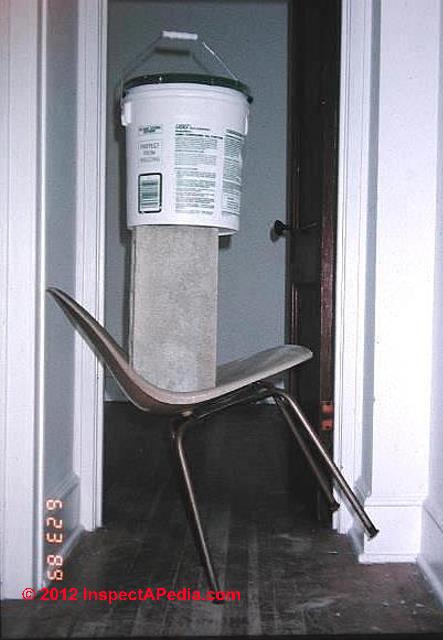
Our page top photo shows a remarkable attic access method encountered by the author.
InspectAPedia tolerates no conflicts of interest. We have no relationship with advertisers, products, or services discussed at this website.
attic Stair Inspection & Safety Concerns
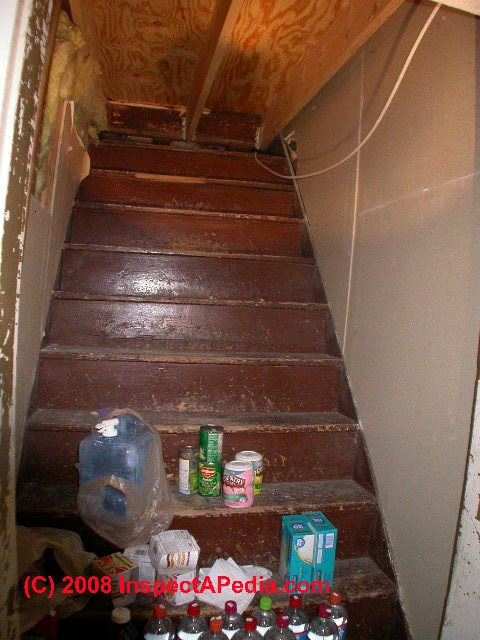 We've had several reports of severe injury involving collapsing attic stairs, including involving home inspectors as well as occupants. Attic & Basement stair defects can be grouped by the stair type:
Conventional or home-made attic stairways - hazards and defects
Watch out for attic stairs that do not meet recommended standards for
- Attic Stair Step riser height - often limited space led attic stair builders to construct very steep stairs with very shallow treads, and as in our photo at left, no handrails since the railings were in the way of carrying stuff in and out of the attic.
- Step tread depth
- Missing railings
- Stair top landing guardrails missing - often omitted around the top of an attic stair that emerges into the attic floor - easy for someone to step backwards and fall right into the stairwell.
- Worn, damaged stair treads
- Basement walkout stair cover rotted or loose - a serious child hazard such as shown in our photo at the top of this page.
- Debris, toys, or stored items stored on steps - a serious trip and fall hazard (Photo at left).
Defective & Unsafe Attic Folding Stairs or Pull-Down Attic Stairs
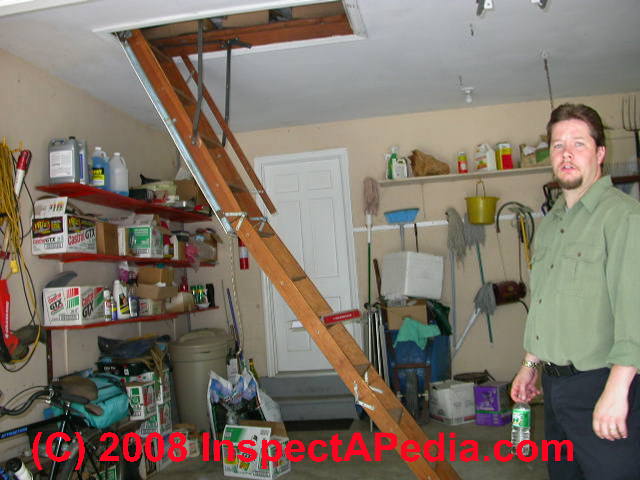
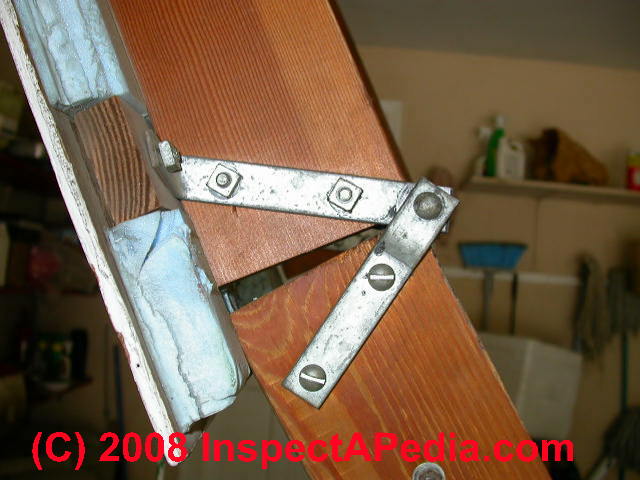
Watch for these common folding attic stair or ladder defects:
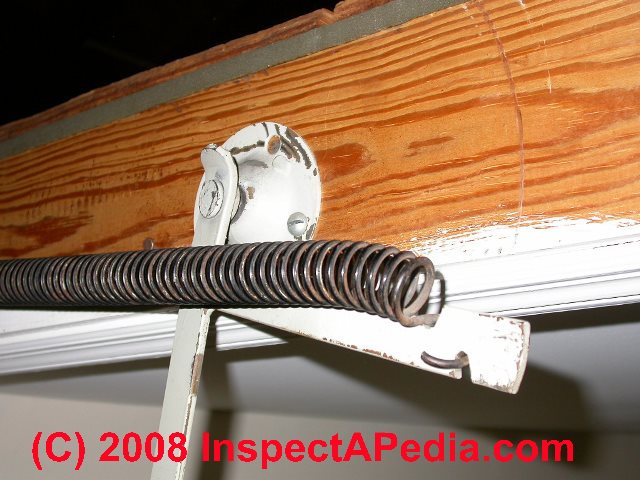

- Attic pull down stair spring and hinge bent, loose, broken - risk breaking spring or hinge parts striking users pulling down the stairs (See photo at left). Check the pull down stair arm and hinge parts for
- Bent stair arm parts
- Loose rivets securing the hinged pull-down attic stair ladder to the hinge point on the stair frame (photo at left)
- Spring popping off of top of the spring carrier (photo at left)
- Spring arm loose, not remaining parallel to its hinge mount (photo at above right)
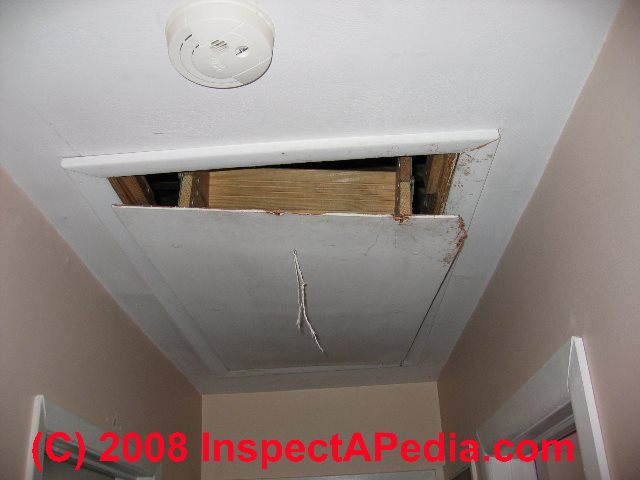
- Attic pull down stair that does not close property - air leaks, heat loss, and risk of mechanical damage may leave a stair like this unsafe. (Photo at left).
- Loose or missing bolts or hardware securing the attic folding stair hinges
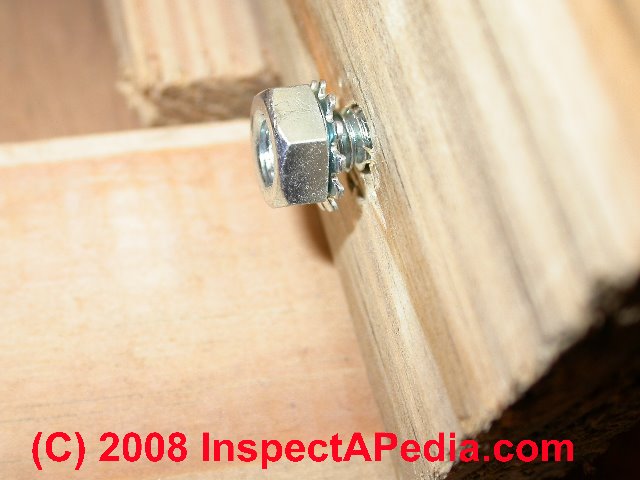
- Loose or missing bolts securing the stair or ladder treads to the attic stair stringers or sides
The hardware used on most attic folding stair kits is not redundant. If a nut or bolt falls out of a hinge because it was not kept tight there is serious risk of stair collapse.
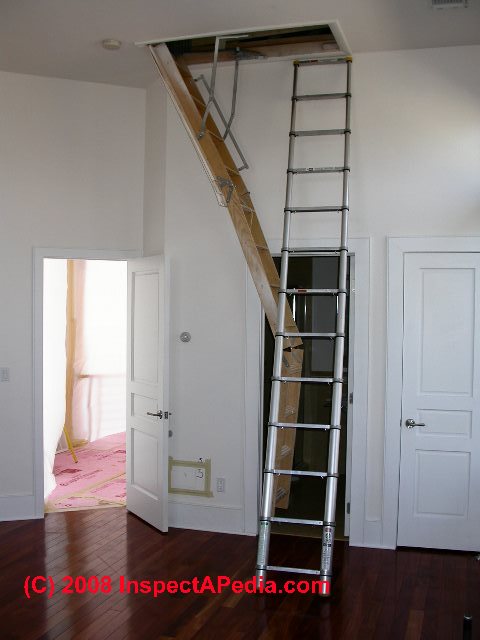
- Attic pull-down or folding stairs cut too short, perhaps not reaching the floor, leading to an unsafe and ridiculous "hanging" attic stair (Photo at left)
- Attic folding stairs cut too long, causing a pressure point at the folding hinge, leading to split or broken attic folding stair stringers or sides (See photo at the top of this page)
- Attic folding stairs installed over an existing building stairway such as to a lower floor, attic folding stairs folding down onto or into the lower stairwell (unsafe to enter or exit)
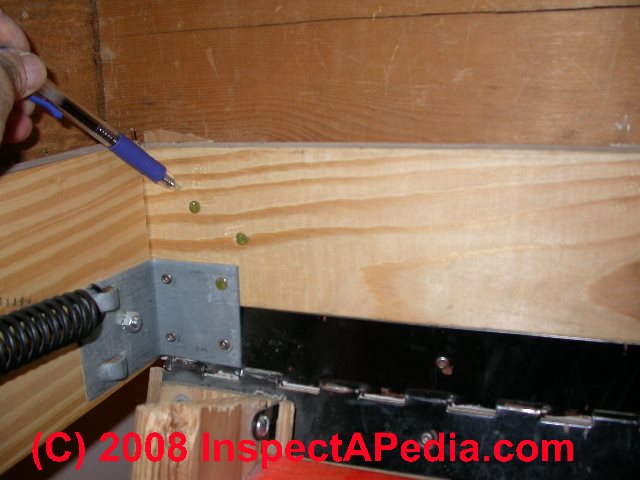
- Attic stair frame not properly secured to the ceiling rough opening
As you can see in our photo, this attic pull down stair frame has been tacked in place using a pair of roofing nails set through a cedar shingle shim.
An ASHI home inspector was seriously hurt when descending a set of attic stairs like these when the stair set came away from the rough opening and fell to the floor below.
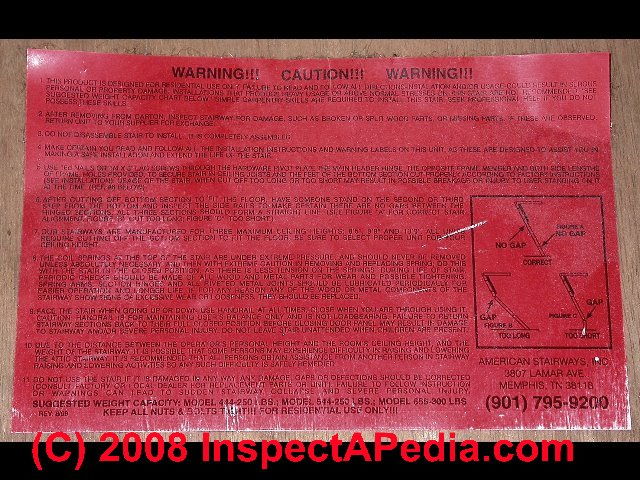
Warning labels attached by attic pull-down folding stair manufacturers list the requirements for safe attic folding stair maintenance:
This label is from a stair produced by American Stairways, Inc. and it indicates, among other things:
- The stair is for residential use only
- Use 16d nails or 1/4" x 3" lag screws (at specified locations) to secure the stair frame to the rough opening (not roofing nails as we showed above, and not drywall screws as we often encounter)
- Properly trim the bottom segment of the stairs to meet the floor (details are provided)
- The coil springs are under extreme pressure ... inspect for loose parts ... lubricate (details are provided)
- Face the stairs when going up or down; use the hand rail for balance only (it is not load bearing)
- Do not use the stair if it is damaged in any way
- Other warnings and details are provided by the manufacturer on this label and in the installation instructions
Examples of Other Bad Attic Access Stairs & Railings
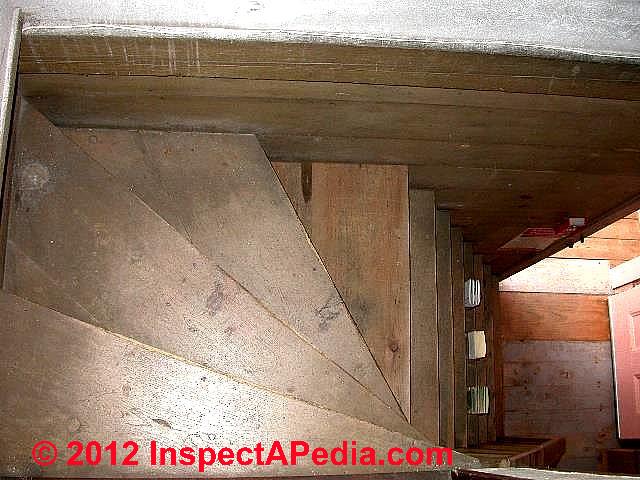
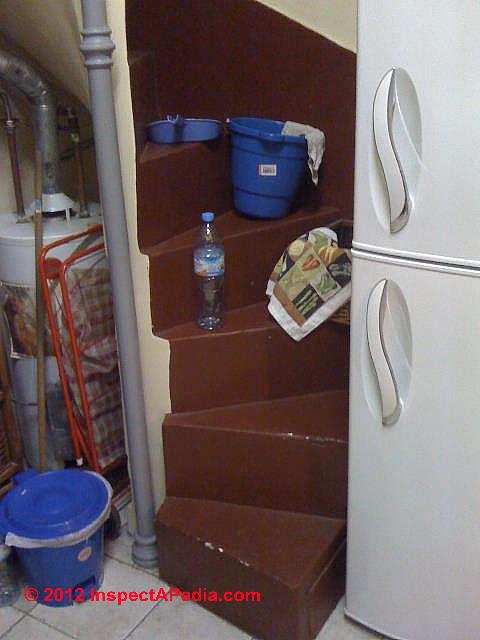
More eccenctric attic accesses: an attic pull down stair ladder that is too short (below left) and a near-vertical "stairs" with a turn, (below right).
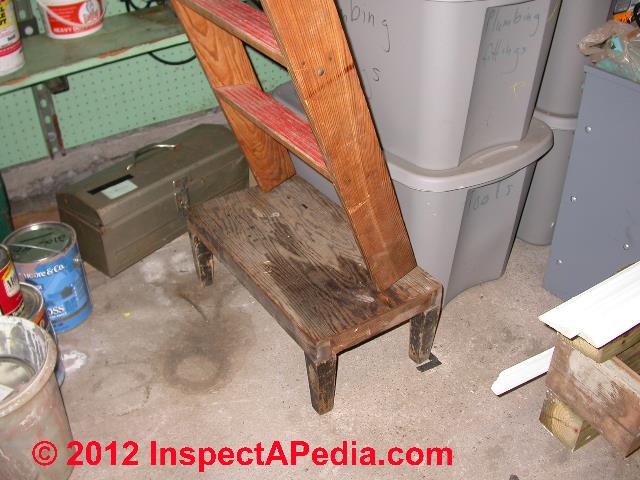
Cluttered, steep attic stair is an access hazard and possibly a fire egress hazard.
Building Codes for Attic Stairs, Attic Stair Construction Questions & Comments

- ATTIC ACCESS IECC-IRC STAIR CODE REVIEW 2012 [PDF] of Attic Access Requirements includes discussion of compliance with the 2012 IECC energy code for insulation and air sealing for attics for conditioned and unconditioned space separation.
Question: are attic pull-down stairs required by code?
I recently purchased a home in Euless Texas and had to replace the complete HVAC system located in the attic. The pull down ladder to the attic was missing but the company that did the work said by law the were required to put in a ladder.
The cost was around $1100.00.
I asked why so much and the answer we were given was the new ladder would be heavy duty 500lb capacity and the opening would have to be expanded to accommodate taking the system out if it needs to be replaced so they wouldn’t have to remove the stairs every time that might happen.
My thought was, I hope that doesn’t happen for At least twenty years, but if that is code, then I guess we should. My question is, is that really building code? - Anonymous by private email from Texas, 2018/02/03
Reply: non-habitable attic access stairs are not required by law for residential construction but might be advisable
I have not found any model or national building code that requires specific stair installations, pull-down or other designs, to provide permanent access to a a non-habitable attic regardless of whether or not an HVAC system is installed there. Non-habitable attics are not regularly accessed by building occupants and do not require stairs.
At the end of this article where we cite other building codes and guidelines for accesses to attics and lofts you will find description of the minimum requirements for ladders used to access lofts where access might be required for example to service mechanical equipment.
Regarding expanding the existing opening to your attic to accomodate a pull-down stair, that is probably quite correct if what is there now is a small rectangular hatch and if you are going to install a pull-down stair.
Standard rough openings for typical attic pull-down stairs
- 22-1/2“ x 54” for the smallest pull-down stairway
- 25” x 54” - most-common small width pull-down attic stair
- 25-1/2” x 64” - often used for a longer pull-down ladder attic access from a higher than standard ceiling
- 30” x 54” for the largest-width pull-down stairway
For residential buildings a model code you would consult might be the the
Current International Residential Code IRC–12/13 Section R807 - Attic Access.
There you'll see that an access opening is all that is specified, not stairs. You will also see that for smaller attic areas no access is required whatsoever (In my view some access to all such limited-space areas is desirable to permit visual inspection for leaks or damage, pest control, etc.)
Excerpt:
R807.1 Attic access. Buildings with combustible ceiling or roof construction shall have an attic access opening to attic areas that exceed 30 square feet (2.8 m2) and that have a vertical height of 30 inches (762 mm) or greater over an area of not less than 30 square feet.
The vertical height shall be measured from the top of the ceiling framing members or any permanent obstruction to the underside of the roof framing members or any permanent obstruction.
The rough-framed opening shall not be less than 22 inches by 30 inches (559 mm by 762 mm) and shall be located in a hallway or other readily accessible location.
When located in a wall, the opening shall be a minimum of 22 inches wide by 30 inches high (559 mm wide by 762 mm high).
When the access is located in a ceiling, minimum unobstructed headroom in the attic space shall be 30 inches (762 mm) at some point above the access measured vertically from the bottom of ceiling framing members. See Section M1305.1.3 for access requirements where mechanical equipment is located in attics. - Source: https://codes.iccsafe.org/public/document/IRC2015/chapter-8-roof-ceiling-construction retrieved 2018/02/03
Other Model Building Code Citations for Attic Access & Stairways
2009 IBC (Commercial Construction) requirement for attic space access
1209.2 Attic Spaces. An opening not less than 20 inches by 30 inches (559 mm by 762 mm) shall be provided to any attic area having a clear height of over 30 inches (762 mm).
A 30-inch (762 mm) minimum clear headroom in the attic space shall be provided at or above the access opening.
2006 IRC (Residential Construction): for access to attic spaces:
R807.1 Attic Access. Buildings with combustible ceiling or roof construction shall have an attic access opening to attic areas that exceed 30 square feet (2.8m squared) and have a vertical height of 30 inches (762 mm) or more.
The rough-framed opening shall not be less than 22 inches by 30 inches, and shall be located in a hallway or readily accessible location.
A 30-inch (762 mm) minimum unobstructed headroom in the attic space shall be provided at some point above the access opening.
Final legal authority for attic stair or access requirements:
For a non-habitable space a mere access hatch might be permitted by your local building department (give them a call as they are the final legal authority where you live).
Other Building codes discussing attic stair construction & regulations
- 2012 IECC-IRC STAIR CODE REVIEW [PDF] of Attic Access Requirements includes discussion of compliance with the 2012 IECC energy code for insulation and air sealing for attics for conditioned and unconditioned space separation.
Notes: IECC versions prior to 2009 did not specify details for attic access hatches and doors. Beginning in the 2009 IECC we have
2009 IECC 402.2.3 Access hatches and doors.
Access doors from conditioned spaces to unconditioned spaces (e.g. attics and crawl spaces) shall be weatherstripped and insulated to a level equivalent to the insulation on the surrounding surfaces.
2009 IRC N1102.2.3 Access hatches and doors. also states
Access doors from conditioned spaces to unconditioned spaces (e.g. attics and crawl spaces) shall be weatherstripped and insulated to a level equivalent to the insulation on the surrounding surfaces. - AUSTIN TEXAS STAIR & EGRESS REQUIREMENTS REVIEW [PDF] includes discussion of minimum openings for emergency egress (emergency exits) based on the 2015 International REsidential Code with local amendments for Austin Texas.
- "Code Requirements for Residential Stairs, Technical Bulletin B-9X", Sonoma County California Building Permit & Resource Management Department, Santa Rosa CA 707-565-1900, http://www.sonoma-county.org/prmd/docs/techbulletin/b-9x.pdf
Excerpt:
Attic stairs - Stairs to attics, basements, etc. are covered in the Technical Bulletin, “Application of Building Code Provisions to Partially Developed Areas in Residential Construction.
Excerpt:
"Space intended for possible future use, This section defines "uninhabitable attics with limited storage" as follows:
B. Uninhabitable attics with limited storage.
1. Unfinished walls.
2. Not more than one-third of the attic space to have a maximum 5' head height (Section 1208.2.1), or code complying egress (Section 1009).
3. Designed for a minimum 20 psf live load applied to those portions of the bottom chord where there ar e two or more adjacent trusses capable of containing a rectangle 42" high by 2' wide or greater, located within the plane of the truss.
4. Minimum ceiling lights and convenience outlets.
and in a later section we read
... If a stairway is installed the space should be considered usable and be developed accordingly.
- http://www.sonoma-county.org/prmd/docs/techbulletin/b-2.pdf - NEW YORK STATE UNIFOR CODE REQUIREMENTS for ATTIC CONVERSION TO LIVING SPACE [PDF] retrieved 2018/02/03, original source - http://www.townofmilo.com/Construction%20Guide_Attic%20Conversion%20at%20a%20Dwelling.pdf
- WASHINGTON STATE, Determination of Loft, Mezzanine, or Sloped Ceiling Floor Area& Ladder Access Restrictions [PDF] retrieved 2018/02/03 original source: San Juan County https://www.sanjuanco.com/DocumentCenter/Home/View/1665
Excerpts:
ISSUE: What area is to be included in determining the loft or mezzanine square footage when determining “floor area” and when allowing access by a ladder; pursuant to the Exception to Section R311.1 of the International Residential Code (IRC) or per the allowance of Section 1009.12 of the International Building Code (IBC)?
ANALYSIS: The IRC does not define either “Floor Area” or the “Means of Egress”. However the IBC does. Additionally, Section R201.3 of the IRC states that “Where terms are not defined in this code such terms shall have meanings ascribed to them as in other code publications of the International Code Council.
Therefore the definitions for “Floor Area” and the “Means of Egress” of the IBC apply to the IRC. The IBC defines gross “FLOOR AREA” as:
“The floor area within the inside perimeter of the exterior walls of the building under consideration, exclusive of vent shafts and courts, without deduction for corridors, stairways, closets, the thickness of interior walls, columns or other features. The floor area of a building, or portion thereof, not provided with surrounding exterior walls shall be the usable area under the horizontal projection of the roof or floor above. The gross floor area shall not include shafts with no openings or interior courts.”
The IBC defines the “MEANS OF EGRESS” as:
“A continuous and unobstructed path of vertical and horizontal egress travel from any occupied portion of a building or structure to a public way. A means of egress consists of three separate and distinct parts: the exit access, the exit and the exit discharge.”
The building code utilizes the “Floor Area” definition for determining the means of egress requirements of a building. Additionally, from the definition of “Means of Egress”, it is clear that a means of egress is only required from occupied portions of a building.
Another issue is that neither the IRC nor IBC specify minimum requirements for these “Loft Ladders”. However, guidance may be taken from other code required ladders. Sections 306.5 of both the International Mechanical Code and International Fuel Gas Code provide minimum requirements for permanent ladders provided to access and service roof top equipment. These Sections state in part:
“Permanent ladders installed to provide the required access shall comply with the following minimum design criteria:
1. The side railing shall extend above the parapet or roof edge not less than 30 inches (762 mm).
2. Ladders shall have rung spacing not to exceed 14 inches (356 mm) on center.
3. Ladders shall have a toe spacing not less than 6 inches (152 mm) deep.
4. There shall be a minimum of 18 inches (457 mm) between rails.
5. Rungs shall have a minimum 0.75-inch (19 mm) diameter and be capable of withstanding a 300- pound (136.1 kg) load.
6. Ladders over 30 feet (9144 mm) in height shall be provided with offset sections and landings capable of withstanding 100 pounds (488.2 kg/m2) per square foot.
7. Ladders shall be protected against corrosion by approved means.”
Reader Comments, Questions & Answers About The Article Above
Below you will find questions and answers previously posted on this page at its page bottom reader comment box.
Reader Q&A - also see RECOMMENDED ARTICLES & FAQs
On 2021-02-08 - by (mod) -
David
Thank you for that important and helpful update.
For homes whose hallways or other areas that provide access to attics that have traditionally been accessed by a hatchway or a pull-down folding-ladder type stairway, (an attic access that required only a small floor area below) a requirement to install a permanent stair (as opposed to a fold-down one) is in my OPINION likely to lead to some griping by people who face a significant increase in construction cost to increase the area of the floor plan where attic access is to be provided now by a permanent stair.
If you have details and/or a source citation that clarifies this point that would be helpful .
On 2021-02-08 by David Bixby
For the upcoming 2021 IRC-Mechanical code change cycle, ACCA has proposed adding a new requirement for a permanent attic stairs or ladder to be installed to access attics that will have HVAC equipment installed for servicing. There is an exception for HVAC that already exists in residential buildings, so it's for new construction or if you are moving HVAC into an attic that has never had equipment installed before.
On 2021-01-10 - by (mod) -
Michael:
First about ladder slope: a ladder base should be about 1 foot out from vertical for every four feet of elevation. So if a ladder has to ascend eight feet its base needs to be two feet out from vertical.
Second, while dimensions may vary, a typical stepladder has about 10" or 10 1/4" between the surfaces of ascending steps. I have long legs and could live with your 11.75 but that may be a bit much for other users.
Third: you might have an issue with a building code inspector or with a real estate appraiser IF the cabin loft is intended to be counted as occupied space, for example as a bedroom or sleeping area, then accessing it by ladder might be questioned. Ladders are of course permitted in buildings as are pull-down stairs, to access non-habitable spaces such as attics, storage areas, mechanical areas;
Fourth: With a three foot width for your ladder, handrails on both sides would be adequate; using actual stair codes as a reference point,
For a stairway with a handrailing along both sides, the clear stairway width is permitted to be smaller still, with a clear width of 27".
Finally, for safety you may want guardrailings around the ladder opening on the loft floor.
In the 1970s I built a loft accessed by a site-built ladder; my youngest daughter Mara was in diapers but at the point where when she woke during the night with a wet diaper she wanted a dry one. She learned to climb the ladder up to the loft, holding a dry replacement diaper in one hand, asking to be changed. But this is not a safety procedure that I would recommend to others.
On 2021-01-10 by MICHAEL DAVID PETERS
Im building a cabin iwth a loft and need advice on a permanent loft ladder verses steps. First, I have room for 30 degree ladder or stairs, however my risers will have to 11.75 inches. Should I go with a ladder which allows for 14 inch maximum or go with stairs, if allowed? Also, if I go with a ladder, is there maximum distance between rails. The minimum isn't a problem. I have 3 feet of space. But without middle support don't know how wide I can made the ladder. There will be handrails. full height landing at the top and bottom.
On 2020-11-25 - by (mod) -
Robby,
If it's not occupied space I don't think the height restriction will pertain.
But if you want to see the code take a look at STAIR PLATFORMS & LANDINGS https://inspectapedia.com/Stairs/Stair_Landings.php
where among other guidelines you'll see
Using the 2003 IRC as a stair landing code example, we obtain the requirement for landings at the top and bottom of the stairway and a maximum stair rise of 12 feet before an intermediate landing is required.
On 2020-11-25 by Robby
How many steps are allowed in a straight run from garage to attic?
On 2020-11-06 - by (mod) -
James
A safety railing around the opening in the Attic floor for the pull down stair is a good idea. However is if the attic is not being used as living space it's not likely that your local Building Code Compliance inspector is going to require that measure
On 2020-11-03 by james bogle
on pull down stairs for the atic do you need railing at top floor so it prevents a person falling back through the opening of the stairs
On 2020-10-02 - by (mod) -
Not that I've found, in codes, Alan but there is an obvious need for minimum safe access space into an attic. I've seen ladders that opened such that the direction of travel smacked the user's head into the roof deck, through which nails protruded to give a nasty laceraion; that's the going-up hazard.
The going-down hazard is horrible too as it's difficult to get onto the ladder safely.
On 2020-10-02 by Alan
Is there a minimum landing space at the top of the attic access ladder for non-livable space / attic in the direction of travel?
 On 2020-09-14 by (mod) - unsafe attic pull down stair top step riser height
Kevin
That uneven rise in the top step shown in your photo is a serious trip/fall hazard. Your local building code inspector is the final authority. She MIGHT leave you alone on this stair as it's not an access to occupied space, but the safety hazard remains
While maximum stair tread riser height and depth are specified in the stair codes cited at the end of this article, that does not pertain to pull-down attic stairs that are considered as an access to a limited-use non-occupancy area of a building. You'll see more specifics on attic stair access codes cited below in my answer to Pat.
On 2020-09-14 by kevin
Is there any specific code in Texas concerning the distance between the floor of an attic and the top step of a pull-down access ladder? It seems to be a larger than normal step from the top of the ladder into this attic.
On 2020-07-23 by Rick s
For storage attic what is the maximum riser height and minimum tread width?
On 2019-12-16 by (mod) Building Codes for Attic Access Stairs
Pat
Access to non-occupied space such as a storage attic is not generally ruled by stair codes; But attic access IS mentioned in the model codes, for example the International Residential code IRC–12/13 Section R807.1
IRC 807.1 Attic access
In buildings with combustible ceiling or roof construction, an attic access opening shall be provided to attic areas that exceed 30 square feet (2.8 m 2 ) and have a vertical height of 30 inches (762 mm) or greater. The rough-framed opening shall not be less than 22 inches by 30 inches (559 mm by 762 mm) and shall be located in a hallway or other readily accessible location.
A 30-inch (762 mm) minimum unobstructed headroom in the attic space shall be provided at some point above the access opening. See Section M1305.1.3 for access requirements where mechanical equipment is located in attics.
That paragraph simply requires that attic access be provided - depending on space and use; it might simply be a hatch; However for attics with mechanical equipment a pull-down ladder or folding stair would be required.
IRC Section M1305.1.3 sets access requirements where mechanical equipment is located in attics. Where this code applies - for example if YOUR attic contains mechanical equipment (like an air conditioner or heat pump air handler) then this code applies:
IRC M1305.1.3 Appliances in attics.
Attics containing appliances requiring access shall have with an opening and a clear and unobstructed passageway large enough to allow removal of the largest appliance, but not less than 30 inches (762 mm) high and 22 inches (559 mm) wide and not more than 20 feet (6096 mm) long when measured along the centerline of the passageway from the opening to the appliance.
The passageway shall have continuous solid flooring in accordance with Chapter 5 not less than 24 inches (610 mm) wide. A level service space at least 30 inches (762 mm) deep and 30 inches (762 mm) wide shall be present along all sides of the appliance where access is required. The clear access opening dimensions shall be a minimum of 20 inches by 30 inches (508 mm) by 762 mm), where such dimensions are large enough to allow removal of the largest appliance.
Exceptions:
1. The passageway and level service space are not required where the appliance can be serviced and removed through the required opening.
2. Where the passageway is unobstructed and not less than 6 feet (1829 mm) high and 22 inches (559 mm) wide for its entire length, the passageway shall be not more than 50 feet (15 250 mm) long.
Typically a building code compliance inspector might accept such an attic accessed through an operable hatch with no pull-down folding ladder or steps, but she would in that case most likely require that there be adequate space below the hatch to set up a ladder of sufficient size to give access.
So in sum your folding stair, if installed, needs to be usable but I don't think we'll find a provision in the model codes that say it has to be accessible without having to resort to an accessory such as a string, pull-down rod, or temporary stepladder.
(Though in my OPINION an installation that makes it difficult to use the pull-down stair is foolish.)
If your fold-up attic access ladder reaches fully from attic level to floor below so that it is, once opened and un-folded, usable by itself to access the attic, then I speculate (as I can't see your situation) that perhaps all that's needed is a longer pull-down string, or a lightweight pole with a hook on its end used to grab and pull down the stair. Continuing:
Specifically New York City attic access code specifications at -
27-375 Interior stairs - includes this text:
New York City Stair COde 27-375 Interior stairs (3)
In buildings or in building sections classified in occupancy group
J-1 or J-2 two stories in height and in occupancy group J-2 three
stories in height with not more than one dwelling unit per story with
roofs having a slope of fifteen degrees or less, access to the roof
shall be provided through a scuttle at least twenty-one inches in width
and twenty-eight inches in length and shall comply with subdivision (c)
of section 27-338 of article four of subchapter five of this chapter.
Scuttles shall be located within each stair enclosure with a stationary
iron ladder leading thereto.
And depending on building classification, a permanent iron ladder may be required by New York City code:
Title 27 / Subchapter 6 §[C26-604.8] 27-375 Interior stairs. - Interior stairs shall comply with the following requirements:
(k) Roof access. -
(3) In buildings or in building sections classified
in occupancy group J-1 or J-2 two stories in height and
in occupancy group J-2 three stories in height with not
more than one dwelling unit per story with roofs having
a slope of fifteen degrees or less, access to the roof
shall be provided through a scuttle at least twenty-one
inches in width and twenty-eight inches in length and
shall comply with subdivision (c) of section 27-338 of
article four of subchapter five of this chapter.
Scuttles
shall be located within each stair enclosure with a
stationary iron ladder leading thereto.
On 2019-12-15 by Pat
I have question regarding attic ladder in NY city. Contractor installed attic ladder but I have to use other ladder to pull down and fold attic ladder. Is it acceptable according building code safety?
Thank you .
On 2019-12-02 - by (mod) -
never pay for a job before you are satisfied that it's correct.
Ask the installer to come back to install the stair properly so that it is safe and usable.
On 2019-12-02 by Bobbie
The installer put the ladder in the opposite way the original one was because the legs were the wrong size. Now I can't get up into that attic because at the top there's just insulation not wood flooring, its also at the slant if my roof and between two rafter beams. I didn't notice how bad this was this until I went up to get my Christmas stuff. Can they do that
On 2019-11-24 - by (mod) -
Richard
As long as a spaces intended for occupancy or regular used by the building occupants then the destination of the stair does not change the standard requirements for stair tread and riser Dimensions indoor handrails are other stair construction details.
If your loft is a storage only area and it's not normally in a regularly accessed, then regular stair rules don't apply.
On 2019-11-24 by Richard
Width of stair tread going to a loft area
On 2019-03-05 - by (mod) -
Jerry
Generally the ladder manufacturers hire a label printing company or service to print the necessary labels to their specifications. I haven't seen generic ladder capacity labels for sale and I suspect that's because the detailed requirements vary among products, markets, and manufacturers.
On 2019-03-05 by Jerry
Where can I buy Attic ladder capacity label?
Reader Question: what would be the right way to provide attic access?
(Nov 26, 2012) salah said:
So, what would be the right way. Is there a link in this page that takes you to examples or recommended construction of stairs to the attic? Also, if the attic is considered a livable space, doest that change the building code of the stairs?
Reply:
Salah,
If you've got some specific questions I'll be glad to research and address them here.
There is no single "right" way to construct attic stairs, as there are so many varying circumstances.
Attic access "stairs" range from a normally pitched stairway with railings, even landings, headroom, lighting, etc. to pull-down folding stairs, to ladders, to open hatches that must be accessed by a temporary ladder.
Attic space is not livible space for purposes of bedrooms in most jurisdictions because of fire egress issues.
But I'd agree that if a finished attic floor and space were considered as habitable space, say for an office, there must be safe stairs built to normal stair codes. And your local building department may require a fire exit or other egress.
Reader Question: attic access over a basement stairway
(Dec 28, 2012) JoAnn said:
Hi,
My attic ladder was installed in the ceiling above my basement steps. It was a new home and passed inspection.
The hose is over 40 years old and the attic ladder has not been a problem. However, we are replacing the wood ladder with aluminum and I think I read somewhere, according to building code, that the ladder must land on the first step at the top of the stairs when installed over existing stairway. Are you familiar with this code? Thanks for your help.
Reply:
I've often seen pulll-down stairs to an attic that extended downwards to land on a stairway themselves. Depending on the direction of travel and considering the absence of a landing this is not an easy-to-use nor particularly safe design (in my OPINION) even where permitted.
But for spaces that are not designed for occupancy, for example spaces accessed only for inspection or to service mechanical equipment, exceptions to standard stair design are often permitted.
No I've not found a building code citing that an attic pull down stair into a stairwell is acceptable if it lands on the first step of the stairway. More likely it'd be a non-issue if the pull-down stair landed on a level walking space with at least 36" of clear landing in the direction of travel.
Reader Question: California requirements for attic stairs
5/31/2014 Maggie McGee said:
Hello, Can you tell me the CA rules - Monterey Co. in particular - for new staircases leading to storage attics? The attic will not be used for anything but storage. The stairs rise (8") and run (9") number of 17 stairs and width is 36" with railing on one side.
The building inspector says these aren't "to code" but architect says they are "to code for stairs running to un-livable space". The inspector wants us to tear out completely or will red-tag our home. We just moved back in 18 mos. after a house fire.
I feel the inspector is being ridiculous. Our old ladder access to attic is much more dangerous than these stairs. Can you offer any advice or at least tell us our architect is wrong? We have 19 days left before we need to "vacate". Thank you for any help whatsoever, Maggie
Reply:
Maggie,
The local building inspector has final legal authority and must be satisified. And often the building regulations call for on-site or plan-review judgments of design and safety.
If you want to deviate from what the Monterey County building department says you should do you might start by asking if the department will accept a plan or drawing by a licensed design professional - your architect for example.
In a pinch, to avoid code issues, you may be able to satisfy the inspector by installing a pull down attic access stair that enters the access through a scuttle opening.
I also agree with the building department that a 9" stair run depth for treads is undersized and a fall hazard. It would not be acceptable as an access to occupied space.
But many model, state and local building codes codes allow different rules for non-occupied spaces such as storage attics, lofts, and utility areas.
Where you might get into trouble about whether an attic is non-living-space is if you constructed what you are calling an "attic" but to the building inspector by size, location, and finish (e.g. drywall installed) appears to be a space that could be occupied in the future. Your inspector may also hold the view that if you build a permanent stairway then the area being accessed could b considered an additional story in the home.
- The Monterey CaliforniaBuilding Code (2010)
Section R311.7 Stairways defines stair requirements for your county.
That's the source of the minimum 10" stair tread depth.
www.co.monterey.ca.us/building/build_info/Building%20Codes/2010%20California%20Residential%20Code.pdf
...
Continue reading at STAIRS, RAILINGS, LANDINGS, RAMPS - INSPECTIONS, CODES or select a topic from the closely-related articles below, or see the complete ARTICLE INDEX.
Or see ATTIC STAIR CODE & HAZARD FAQs - questions & answers posted originally at this page
Or see these
Recommended Articles
- FIRE ESCAPES & FIRE STAIRS
- SLIP TRIP & FALL HAZARD LIST, STAIRS, FLOORS, WALKS
- STAIR CODES & STANDARDS - home
- STAIR CODE DETAILS
- STAIR DIMENSIONS, WIDTH, HEIGHT
- STAIRS, RAILINGS, LANDINGS, RAMPS - home
Suggested citation for this web page
ATTIC STAIR CODES & HAZARDS at InspectApedia.com - online encyclopedia of building & environmental inspection, testing, diagnosis, repair, & problem prevention advice.
Or see this
INDEX to RELATED ARTICLES: ARTICLE INDEX to STAIRS RAILINGS LANDINGS RAMPS
Or use the SEARCH BOX found below to Ask a Question or Search InspectApedia
Ask a Question or Search InspectApedia
Try the search box just below, or if you prefer, post a question or comment in the Comments box below and we will respond promptly.
Search the InspectApedia website
Note: appearance of your Comment below may be delayed: if your comment contains an image, photograph, web link, or text that looks to the software as if it might be a web link, your posting will appear after it has been approved by a moderator. Apologies for the delay.
Only one image can be added per comment but you can post as many comments, and therefore images, as you like.
You will not receive a notification when a response to your question has been posted.
Please bookmark this page to make it easy for you to check back for our response.
Our Comment Box is provided by Countable Web Productions countable.ca
Citations & References
In addition to any citations in the article above, a full list is available on request.
- Our recommended books about building & mechanical systems design, inspection, problem diagnosis, and repair, and about indoor environment and IAQ testing, diagnosis, and cleanup are at the InspectAPedia Bookstore. Also see our Book Reviews - InspectAPedia.
- The Stairway Manufacturers' Association, (877) 500-5759, provides a pictorial guide to the stair and railing portion of the International Residential Code. [copy on file as http://www.stairways.org/pdf/2006%20Stair%20IRC%20SCREEN.pdf ] -
- American Stairways, Inc, Memphis TN, 901-795-9200
- Stephenson, Elliott O., THE ELIMINATION OF UNSAFE GUARDRAILS, A PROGRESS REPORT [PDF] Building Standards, March-April 1993
- "Are Functional Handrails Within Our Grasp" Jake Pauls, Building Standards, January-February 1991
- Access Ramp building codes:
- UBC 1003.3.4.3
- BOCA 1016.3
- ADA 4.8.2
- IBC 1010.2
- Access Ramp Standards:
- ADA (Americans with Disabilities Act), Public Law 101-336. 7/26/90 is very often cited by other sources for good design of stairs and ramps etc. even where disabled individuals are not the design target.
- ANSI A117.4 Accessible and Usable buildings and Facilities (earlier version was incorporated into the ADA)
- ASTM F 1637, Standard Practice for Safe Walking Surfaces, (Similar to the above standard
- The Circular Staircase, Mary Roberts Rinehart
- Construction Drawings and Details, Rosemary Kilmer
- Falls and Related Injuries: Slips, Trips, Missteps, and Their Consequences, Lawyers & Judges Publishing, (June 2002), ISBN-10: 0913875430 ISBN-13: 978-0913875438
"Falls in the home and public places are the second leading cause of unintentional injury deaths in the United States, but are overlooked in most literature. This book is unique in that it is entirely devoted to falls. Of use to primary care physicians, nurses, insurance adjusters, architects, writers of building codes, attorneys, or anyone who cares for the elderly, this book will tell you how, why, and when people will likely fall, what most likely will be injured, and how such injuries come about. " - Mobile Home Inspections common defects unique to factory built housing, inspection methods
- The National Institute of Standards and Technology, NIST (nee National Bureau of Standards NBS) is a US government agency - see www.nist.gov
- "A Parametric Study of Wall Moisture Contents Using a Revised Variable Indoor Relative Humidity Version of the "Moist" Transient Heat and Moisture Transfer Model [copy on file as/interiors/MOIST_Model_NIST_b95074.pdf ] - ", George Tsongas, Doug Burch, Carolyn Roos, Malcom Cunningham; this paper describes software and the prediction of wall moisture contents. - PDF Document from NIS
- Slips, Trips, Missteps and Their Consequences, Second Edition, Gary M. Bakken, H. Harvey Cohen,A. S. Hyde, Jon R. Abele, ISBN-13: 978-1-933264-01-1 or ISBN 10: 1-933264-01-2, available from the publisher, Lawyers & Judges Publishing Company,Inc., www.lawyersandjudges.com sales@lawyersandjudges.com
- The Stairway Manufacturers' Association, (877) 500-5759, provides a pictorial guide to the stair and railing portion of the International Residential Code. [copy on file as http://www.stairways.org/pdf/2006%20Stair%20IRC%20SCREEN.pdf ] -
- How to Clean Moldy Wood Framing & Sheathing How to clean/seal mold from/on exposed lumber or plywood subfloor or roof sheathing indoors - some suggestions based on our field and laboratory research
- Mold-Resistant Building Practices, advice from an expert on how to prevent mold after a building flood and how to prevent mold growth in buildings by selection of building materials and by anti-mold construction details.
- Slips, Trips, Missteps and Their Consequences, Gary M. Bakken, H. Harvey Cohen, Jon R. Abele, Alvin S. Hyde, Cindy A. LaRue, Lawyers and Judges Publishing; ISBN-10: 1933264012 ISBN-13: 978-1933264011
- Slips, Trips, Missteps and Their Consequences, Second Edition, Gary M. Bakken, H. Harvey Cohen,A. S. Hyde, Jon R. Abele, ISBN-13: 978-1-933264-01-1 or ISBN 10: 1-933264-01-2, available from the publisher, Lawyers & Judges Publishing Company,Inc., www.lawyersandjudges.com sales@lawyersandjudges.com
- Steps and Stairways, Cleo Baldon & Ib Melchior, Rizzoli, 1989.
- The Staircase, Ann Rinaldi
- Common Sense Stairbuilding and Handrailing, Fred T. Hodgson
- The Art of Staircases, Pilar Chueca
- Building Stairs, by pros for pros, Andy Engel
- A Simplified Guide to Custom Stairbuilding, George R. Christina
- Basic Stairbuilding, Scott Schuttner
- The Staircase (two volumes), John Templar, Cambridge: the MIT Press, 1992
- The Staircase: History and Theories, John Templar, MIT Press 1995
- Steps and Stairways, Cleo Baldon & Ib Melchior, Rizzoli, 1989.
- "The Dimensions of Stairs", J. M. Fitch et al., Scientific American, October 1974.
- Our recommended books about building & mechanical systems design, inspection, problem diagnosis, and repair, and about indoor environment and IAQ testing, diagnosis, and cleanup are at the InspectAPedia Bookstore. Also see our Book Reviews - InspectAPedia.
- In addition to citations & references found in this article, see the research citations given at the end of the related articles found at our suggested
CONTINUE READING or RECOMMENDED ARTICLES.
- Carson, Dunlop & Associates Ltd., 120 Carlton Street Suite 407, Toronto ON M5A 4K2. Tel: (416) 964-9415 1-800-268-7070 Email: info@carsondunlop.com. Alan Carson is a past president of ASHI, the American Society of Home Inspectors.
Thanks to Alan Carson and Bob Dunlop, for permission for InspectAPedia to use text excerpts from The HOME REFERENCE BOOK - the Encyclopedia of Homes and to use illustrations from The ILLUSTRATED HOME .
Carson Dunlop Associates provides extensive home inspection education and report writing material. In gratitude we provide links to tsome Carson Dunlop Associates products and services.
 | HOME | ABOUT | ASK a QUESTION | CONTACT | CONTENT USE POLICY | DESCRIPTION | POLICIES | PRIVACY | |
| © 2024 - 1985 Publisher InspectApedia.com - Daniel Friedman | |||||||||