
InspectAPedia® FREE Encyclopedia of Building & Environmental Construction, Diagnosis, Maintenance & Repair |
Question? Just ask us! InspectAPedia
|
 How to Seal Basement Floors & Foundation Walls
Against Water & Moisture
- POST a QUESTION or COMMENT about using sealers to waterproof basement walls - an attempt to control basement moisture & water entry leakage
Basement sealers to control moisture & water entry:
This article discusses options for sealing basement or crawl space floors and walls, or other building foundation walls to stop water entry and to reduce interior moisture and mold risks.
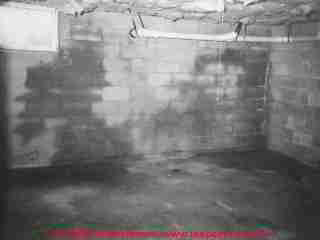
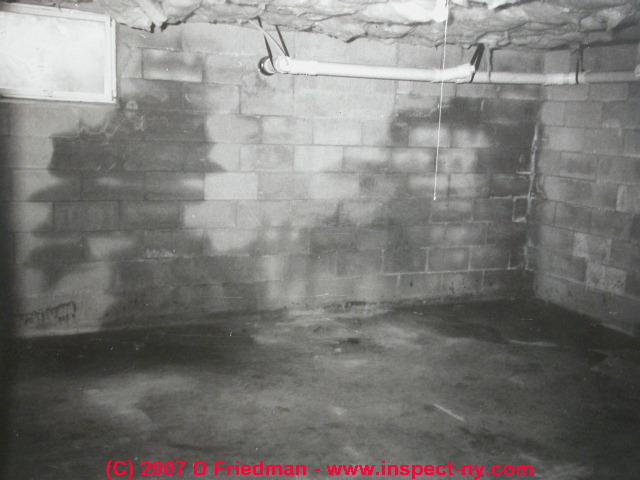
The photograph at page top shows a very wet basement foundation wall built of concrete block. The stain pattern extends high on the basement walls, down the full wall, onto the basement floor. Correcting this particular water entry problem should begin outside with roof drainage and surface runoff. This article discusses foundation wall and floor slab sealant options. .
InspectAPedia tolerates no conflicts of interest. We have no relationship with advertisers, products, or services discussed at this website.
Basement Waterproofing Using Sealers for Concrete Floors & Masonry Foundation Walls
 Aaron Kuertz, Applied Technologies, Inc.
Description of various basement waterproofing paints, coatings, sealants. How basement water may show up in a building attic.
Basement Concrete and Concrete Block Sealers for Basement Waterproofing
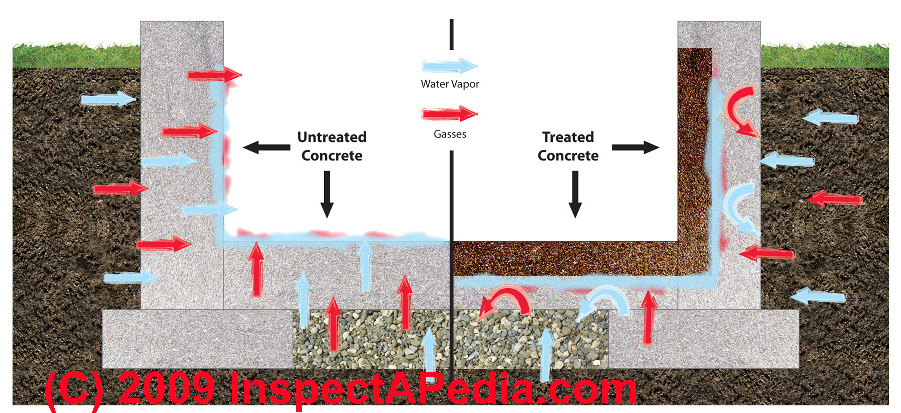
Basements are below grade and surrounded by soil. This soil absorbs water during rains and then releases it. The water can migrate through a block basement and even through solid concrete such as in walls and floors by capillary action.
This water that enters the basement can cause problems ranging from peeling paint to mold and mildew growth. Also, naturally occurring gasses that are released from soils can be transmitted into the basement.
The interior basement air quality is lessened unless the walls and floors are sealed.
It is possible to seal the concrete or concrete blocks used in basement walls and floors and stop water and gas migration into a basement. In fact, it can be done from the interior of a home. Old homes and new homes alike can be sealed.
Using Exterior Foundation Coatings to Repair Foundation Wall Cracks & Leaks
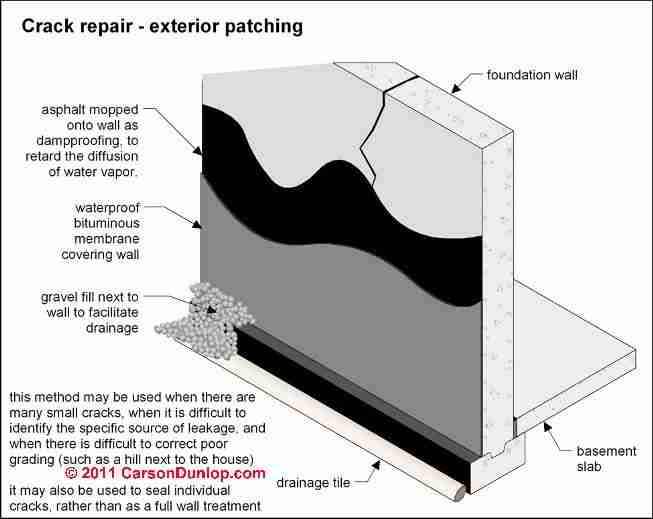 As Carson Dunlop Associates ' sketch shows, foundation crack leaks can be repaired from outside the foundation wall using a combination of asphalt-mopped damp proof coating and a waterproof bituminous membrane that is then adhered to the wall surface.
Sodium Silicate Sealers for Floor & Foundation Wall Waterproofing
Sodium silicate is used in a water-based mixture to seal the basement walls and floors.
The sodium silicate penetrates up to 4” into the substrate.
After penetrating the sodium silicate reacts with the free lime content of the concrete or masonry . Concrete, concrete block and masonry has lime as a natural component in their composition.
This reaction between the sodium silicate and free lime produces a solid crystalline structure that fills the microscopic cracks and pores of the substrate.
This hardens and densifies the concrete and masonry so that water vapor and gasses cannot migrate through by capillary action.
Also, gasses are retarded from entering a basement. After curing, the substrate looks the same as if it were not sealed. There is no surface film or sheen to it.
Benefits of Sodium Silicate for Building Waterproofing
By sealing the basement walls and floors with sodium silicate water vapor will be stopped from entering into a basement.
The basement will be dryer than before. This greatly improves the interior air quality of a home by retarding the growth of mold and mildew.
Since the surface of the walls and floors are hardened, they will have less dusting and chalking. Gas transmission will be reduced as well, further improving air quality.
Many people like to paint the floors and walls of their basements. If paint is applied to unsealed walls and floors, it is possible for the water vapor to get trapped under the paint. After a period of time the water vapor can break the bond between the paint and the substrate. This causes the paint to blister and peel.
After application of a sodium silicate the walls and floors can be painted without fear of the paint peeling and flaking. Also, adhesives for tiles or other floor coverings can be used.
Application of Sodium Silicate for Basement or Crawl Space Waterproofing
Sodium silicate is applied to bare concrete, concrete block or masonry. Anything that would prevent the sodium silicate from being absorbed must be removed. No grease, dirt, soil, adhesives, oil, sealer or paint can be on the surface to be sealed prior to application.
Application is done simply by using a garden sprayer, roller or brush. First dampen the surface with water using a mop or brush. Apply in areas 10’ x 10’ in several light coats. Apply each coat after 10-20 minutes.
Concrete takes 2-3 coats, concrete block and masonry 3-4 coats. Do not over apply the sodium silicate since if all of the product is not absorbed it may leave a white residue. Wipe up any excess product.
For several days after application loose dirt will be pushed out of the substrate. This is normal and can be swept off.
A Few Caveats about Any Foundation Sealer or Weather Barrier Product - DF OPINION
Watch out: any surface coating, even a penetrating wall sealer such as discussed here, can fail if exposed to continued or chronic water and water pressure through the foundation wall.
The pressure from water, frost, or more significantly, the formation of efflorescent saltscan exert tremendous pressure, sufficient to separate a paint or other coating from a masonry foundation surface. Efflorescence has been cited in several paint failure studies where these forces were explored.
See details at EFFLORESCENCE SALTS & WHITE DEPOSITS
Some factors that affect the durability and thus success of any foundation coating or waterproofing coating include:
- The cleanliness of the surface to which the coating is applied
- Application of the sealer according to the manufacturer's instructions, including specifications of pre-cleaning, thickness, temperature, humidity at time of application
- The degree of water intrusion or water presence on the exterior of the foundation wall
- Climate, freezing temperatures
- Chemistry of both the masonry wall and the water, affecting the formation of efflorescence
- Chemistry, composition, and in some cases fiber reinforcement of the coating
Watch out: sodium silicate is an alkaline substance that can cause burns, eye, and skin damage. Quoting from a MSDS:
Causes moderate skin irritation. Spray mist
causes irritation to respiratory tract. Due to high pH of
product, release into surface water is harmful to aquatic life.
... Causes severe irritation to the eyes. ... Causes moderate irritation to the skin. ... Spray mist irritating to respiratory tract. ... May cause irritation to mouth, esophagus, and stomach. ... No known chronic hazards. Not listed by NTP, IARC or OSHA
as a carcinogen.
... Dries to form glass film which can easily cut skin. Spilled
material is very slippery. Can etch glass if not promptly
removed.
...
Human experience indicates that skin irritation occurs, particularly,
when sodium silicates get on clothes at the collar, cuffs or other areas
where contact and abrasion may occur.
The acute oral toxicity of this product has not been tested. - MSDS for Sodium Silicate [PDF] from PQ Corporation
Also see this MSDS for Krystol Hydrostop WB [copy on file as /exterior/Krystol-hydrostop-wb.pdf ] - WB from Kryton Corporation.
Thanks to reader Stan Rosenbaum for alerting us to the need for care when working with sodium silicate.
Weather Barrier Coatings, Mastics, Sealants, Adhesives used on buildings, Building Sheathing & Building Foundation Coatings
AkroGuard, Omega Products, International, 1681 California Ave, Corona, CA 92881, Tel: 800-600-6634, 951-737-7447, Fax: 951-520-2594, Quoting from the company's product description:
AkroGuard is a field applied, non-cementitious, [acrylic] flexible coating that when used with AkroFill creates a water-resistive barrier over approved substrates.
Basic Uses:
AkroGuard is designed for use as a water-resistive barrier and air barrier over approved substrates and with the AkroFlex EIF Systems. Complies with ICC-ES Acceptance Criteria for Water-resistive Coatings (AC212).
AkroGuard may be applied to the following substrates:
- Gypsum sheathing
- Fiber-faced gypsum sheathing
- Wood-based sheathing
- CMU/Poured-in-place and/or tilt-up concrete/masonry
- Cement board
Thanks to reader J. Campbell for pointing out this product, March 2010.
Krystol Hydrostop, Kryton Corporation, "Crystalline Waterproofing" masonry sealer. MSDS for Krystol Hydrostop WB [copy on file as /exterior/Krystol-hydrostop-wb.pdf ] - WB from Kryton Corporation. Masonry sealer.
- Krystol T1 and T2 waterproofing system is brush-applied onto concrete surfaces to become an integral part of the concrete. It contains Kryton's renowned waterproofing chemicals and is durable and self-sealing.
Vi-Cryl CP-10 (Trowel Grade) & Vi-Cryl CP-11 (Spray/Brush) Weather Barrier Coatings, Childers Corporation.
We discuss the use of this coating at INSULATION LOCATION for BASEMENT WALLS. Quoting from the company's product literature [copy on file as /exterior/Vi_Cryl_cp-10-11.pdf ] - ,
VI-CRYL CP-10/11 weather barrier coating is unsurpassed for the mechanical protection and weatherproofing of thermal insulations both outdoors and indoors, in hot, cold, and dual-temperature service.
However, since it is a ‘breathing’ coating (vapors under pressure will pass through it) it should only be used over insulations in lowtemperature, or dual-temperature service when the insulations themselves are vapor barriers.
VI-CRYL CP-10/11 has also found use throughout the thermal insulation industry as a coating used over closed cell polyethylene and polyurethane foam insulations.
Industry experience has demonstrated that all weather barrier coatings may blister when applied over polystyrene board. This effect may be limited by the use of white colored coatings.
VI-CRYL CP-10/11 weather barrier coating in its Metallic Gray color is the ideal companion product to Aluminum and Stainless Steel Jacketing. VI-CRYL CP-10/11 gives superior mechanical and chemical protection to any irregular shape or surface where the application of Childers Metal Jacketing Systems is impractical.
Also see INSULATION LOCATION for BASEMENT WALLS
Reader Question: is coating my block foundation wall with tar the best approach to stop basement water entry?
I really love your website. Found very good information on installing a bathroom vent that I shared with the electrician we hired to install. Thank you for what you do.
I live in NE Ohio. Home built 1958 with basement and crawl space. We have lot of cracks in foundation walls (concrete block) and crawl area purportedly due to pressure from saturated soil/clay on exterior. There is efflorescence and seepage in some areas. No flooding though.
I have obtained a handful of waterproofing quotes wherein each company recommend exterior waterproofing down to the footers with tar application to the exterior walls and rock backfill up to 18" below surface with topsoil layer on top.
I do not see much information on your sight about this approach to drying out a basement and crawlspace. It is very expensive and I am having difficulty taking the plunge as the whole process feels like buying a used car (without the reward of a nice new car). What are your thoughts on this technique versus other means of waterproofing?
Are there are other alternatives that are potentially as effective to dry out our basement and crawl area? Our downspouts go directly to our storm drains underground and have been inspected and snaked and are clear.
Had our sewer and storm lines replaced about a year ago after identifying crushed clay pipes from settling of house was cause for backups of sewage during storms (they were so damaged the sewage would back up into storm drains during heavy storms).
Also installed a radon system about 5 years ago when we first moved in. - A.G.G. - Ohio
Reply:
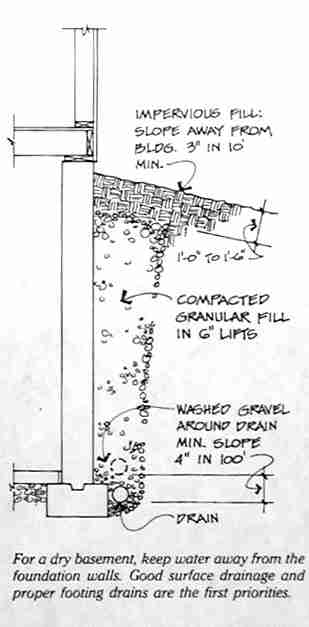 Thanks for the nice note and helpful question. I will summarize approaches to foundation waterproofing below, with the caveat that an onsite inspection by an expert - one who does not have any conflict of intererest such as making a profit from a particular solution to the problem of water entry, may well discover other important factors that we haven't mentioned here.
Your description of clay soils around your home suggest that the ground won't drain well and that water spilled close to a foundation wall will much want to enter the building.
That's because the excavation to build the original foundation creates a water-collecting trench around the building that generally slopes towards the foundation walls and that even backfilled with gravel and soil, will permit water to soak down along the foundation wall where, if there is not already good drainage, it wants to come inside.
You can not quite see in our sketch at left that there is a hidden fly in this ointment of wet basement prevention: roof runoff water spillage that happens to fall close to the foundation wall may find an easy path down along the foundation wall even though soil seems to slope away from the house.
This is why all basement de-watering jobs should start with an expert inspection of the gutters and downspouts, ideally during rainfall.
The most honest basement de-watering guy I have spoken with about the omission of this roof spillage problem argued convincingly that most homeowners simply don't maintain their roof's gutter and downpout system, so his de-watering barriers are justified as providing a failsafe system for keeping the basement dry in the "real world" of what people do (or don't do) rather than my idealized world of what we should do.
We discuss exterior (and other methods) coatings for foundation walls in the article above and
at WATER BARRIERS, EXTERIOR BUILDING
and FOUNDATION WATERPROOFING and
also GEOTEXTILES & DRAINAGE MATS.
Dampproofing a foundation is not the same as waterproofing it
Generally, I do NOT agree that tar-coating a wall is at all effective in stopping basement leakage where cracks or holes are present in a foundation wall. Tar (that is usually bituminous foundation coatings or paints) is a dampproofing coating not a waterproofing coating. Here's the difference:
Dampproofing coatings stop the movement of moisture through a block foundation wall due to capillary action - the pull of water molecules from the damp outside of a foundation wall towards the (usually) more dry interior wall surface.
But a dampproofing coating like tar or bituminous asphaltic compounds do not reliably seal cracks and other large openings. Even if you did blob on enough tar to seal such an opening, the tar coating is not flexible enough to keep that opening closed over time and across the effects of temperature variations.
Basic Components of Exterior Foundation Wall Waterproofing
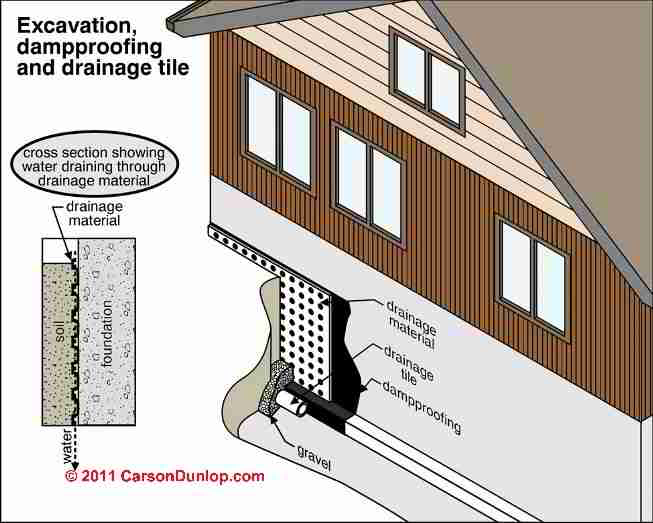
Instead, and recognizing that foundation walls are not normally built to be as waterproof as a boat hull, if we do need to waterproof (not damp proof) a foundation wall it is an expensive and more complex procedure involving:
- Excavation outside the building down to the footings
- Provision of working footing drains at the proper location and carried to daylight or to a storm drain system
See details at FOOTING & FOUNDATION DRAINS - Iinstallation of one or more layers of geotextiles
See details at GEOTEXTILES & DRAINAGE MATS
or similar waterproof barriers against the foundation wall. - Such fabrics or plastic barriers combine an absolutely waterproof surface with some means of providing a channel to drain water against the foundation down to the footing drains where it finds an easier path away from the building than into it.
Carson Dunlop Associates' sketch (above and our photos (throughout) illustrate, proper installation of a combination of damp proofing, a drainage mat, and a geotextile to keep the drainage mat from becoming clogged by soil particles can be effective in keeping roof spillage and surface runoff from penetrating the building foundation walls.
Watch out: even this approach won't prevent basement or crawl space water entry if groundwater levels are so saturated that they are rising up beneath the basement floor slab.
In the case of a building whose roof runoff is absolutely properly handled already (more often it is not), and where there is not surface runoff towards the building, but where wet soils and groundwater still are causing water entry problems, we might opt for the exterior foundation waterproofing method I describe above.
However this approach is very costly because it involves exterior excavation and also because it often disturbs existing plantings, walks, drives, etc. Therefore I'd be more likely to recommend this approach for new construction in problem soil areas than for an existing structure.
Even though it is always technically preferable to stop water outside of the foundation rather than allowing it to enter and then get rid of it, many homeowners find that an interior plastic barrier against the foundation wall and draining down to an interior trench and drain system is so much less costly that they consider this alternative.
Where would I shift thinking back to an outdoor approach for an older home? Perhaps where the cost of an interior basement waterproofing system is increased by the need to tear down some kind of expensive interior finish work. Or where for other reasons we already are employing a backhoe at a site.
Finally, field experience argues that one should take a very careful look at the roof drainage and surface runoff control topics before launching a costly interior or exterior basement waterproofing installation job.
For example, at many building inspections made in response to a wet basement problem for which owners told me that they had already corrected roof gutter problems I would find that the roof drainage system was not working as people thought - spilling, or leaking where people didn't realise it.
For a novice who won't recognize all of the clues found by an expert, it will be helpful to make a careful inspection of the building exterior during a time of heavy rainfall. Often you'll find a surprise.
Reader Comments, Questions & Answers About The Article Above
Below you will find questions and answers previously posted on this page at its page bottom reader comment box.
Reader Q&A - also see RECOMMENDED ARTICLES & FAQs
On 2020-08-23 by (mod) inject sealer into soil to waterproof a leaky foundation
Yes, Jerry, there is a very long history of use of bentonite clay injected into the soil around leaky building foundations. I don't know that bentonite will work in every soil condition or at every site but it's been used for many decades in that application as well as for sealig well bores.
On 2020-08-23 by jerry jkck33@yahoo.com
have a field stone basement wall 8 ft high built into dirt hillside can you inject a sealer down in the dirt on the outside to seal sgainst seepage
On 2019-12-25 - by (mod) -
Mark Smith said (without his advertisement)
You must know how to fix your basement especially wet or damp basements are the most frequent complaint of homeowners. To determine the source of the water. Don’t make wall repairs with standing water in the basement and Do fill cracks with hydraulic cement.
On 2019-12-12 - by (mod) -
Thanks for the helpful comment, Jack; high-portland cement coatings are indeed very water resistant, but they are typically not at all flexible; even mere thermal movement and certainly even the slightest foundation movement will crack the coating;
IMO foundations are not boats, not engineered to be waterproof, so the best approach is to keep water away from the foundation wall below grade.
On 2019-12-12 by Jack
The best product that you could use for foundation waterproofing are Concrete waterproofing coatings, these thick cement like coating once dry strictly adhere to the masonry as well as concrete walls. They must be applied with a heavy brush composed of tampico bristles
On 2017-07-26 by (mod) - water problem after installing an interior perimeter drain
It's possible that water entering at one location is being transported around the other basement perimeter areas, and perhaps if the piping is improperly installed or not draining as it should it's forming a water reservoir rather than a drain, wetting and soaking the wall.
I would want to know the layout / routing of the drain piping, how the trench was constructed, how deep, how wide, how far out from the wall, and how emptied. Of all of these the pitch uniformly at 1/8" per foot or more, to a drain point that has a sump or other means of getting rid of water are critical. Look in the sump pit: is it deep enough? is it filled? Hows the sum working.
Frank
OK point well made and taken.
On 2017-07-25 by Frank D - wet walls after perimeter drain installation
Thanks. Thing is, there was no water problem on these walls a month ago, before installation of this system. Now we have wet patches growing mold. Wet spots now extend only a few inches above most of the gaps behind the corrugated material, and their height seems to correlate to the width of the gap immediately below.
Basement air is also much more humid than before the install. Used to be able to hang clothes to dry down there; now they never dry. Guess I'm trying to determine whether these large gaps behind the corrugated material are acceptable in such an installation or whether I should insist the contractor make the material contact the wall all the way around.
On 2017-07-25 by (mod) - OK for wall water barrier to be away from the wall at a perimeter drain?
 While rising damp or capillary action can indeed bring moisture upwards in a masonry wall, the situation you describe sounds more to me as if water is coming through the basement walls from the outside.
It's just a guess since I can't see your home. If walls are wet quite high up on the foundation very often the installer will run that water channeling material all the way up to the top of the wall.
So I don't think the Gap itself is the cause of the trouble. I would investigate starting outside since it's always better to get the water away from the building then to let it come in and then try to get rid of it.
However here are a few basic considerations:
- It is always better to get water away from the building at its source outside rather than let the water come into the structure and then try to get rid of it.
- When the water barrier extends up the wall only an inch or two above a perimeter drain AND if water is running down the walls and into the drain, you've also made the walls into a moisture pump sending water or moisture into the occupied space: it'd be better if the barrier extended to near the top of the wall or at least to above outside grade level
On 2017-07-25 by Frank D - interior perimeter drain installed in our basement to relieve flooding
We recently had an interior perimeter drain installed in our basement to relieve flooding coming up through floor cracks after heavy rains.
As in many of these systems, the installer put a strip of a corrugated plastic sheeting at the base of the basement wall before pouring new concrete over the drainage trench.
This is supposed to channel any water that drips down the basement walls into the underfloor drainage pipe and on to the sump pump.
Question: Is it okay that the installer has left large gaps (sometimes in excess of 1") behind sections of this corrugated material?
The basement wall areas immediately above these gaps have quickly become soaked by the moisture evaporating up from below (install was only 3 weeks ago). These areas have become slimy, which I assume is mold growth.
 ...
... 
I had a similar system (a B-Dry system) in a previous home. In that home, the corrugated material at the base of the walls hugged the walls smoothly all the way around the perimeter.
Shouldn't this new install have similarly hugged the walls tightly, thereby limiting the entry of moisture (not to mention radon and vermin) from below into the basement? Thanks.
 ...
... 

--Frank
Here are links to some photos that may help tell the story:
[photos included above]
On 2016-11-10 by (mod) -
Thanks for the interesting specs,Hydro -though I'm not sure I can leave it as shown as it's pretty much a commercial.
What's your experience and success with this or other coatings applied to a concrete wall, below grade, subject to continued water pressure from the exterior? I find that coatings slow the movement of moisture or sometimes water indoors but that an air-tight coating like epoxy often gets simply pushed off of the wall surfaces.
On 2016-11-10 1 by Hydro-Seal 75 For Interior Below Grade Foundation Sealing
Hydro-Seal 75 Water Base Epoxy Basement Coating.
For coating basement walls and/or floors Hydro-Seal 75 is the coating to use. Here is why.
1. Hydro-Seal 75 is tested to 40 PSI, so it is very effective at stopping water compared to any other coating
2. Hydro-Seal 75 resists mold and mildew with a biocide additive, mold resistant coating is a great selling point.
3. Hydro-Seal 75 is a water based epoxy that is fast drying. Two coats applied in one day with 2 to 4 hour drying time. Applying Hydro-Seal 75 to walls in a basement is a 1 day job & a great money maker!
4. Hydro-Seal 75 is a pigmented coating, not clear, so ugly stained walls are covered up with a beautiful decorative coating, way better than an invisible clear coating for astestics
5. Hydro-Seal 75 is a low odor/no odor, solvent free(0 V.O.C.) application making it easy on the applicator and easy on your customers
6. Hydro-Seal 75 is easy to apply: Mix equal amounts of A & B together, no more than a gallon at a time and apply with paint rollers and brushes within 30 to 40 minute pot life
7. Hydro-Seal 75 is economical applied at a rate of approximately 150 square feet per gallon per coat on walls & 200 square feet per gallon per coat on floors
8. Hydro-Seal 75 can also be used for patching by adding concrete sand mix, Portland Cement or hydraulic cement to Hydro-Seal 75 to create Hydro-Seal 75 Mortar. Cracks , holes, hairline cracks and exposed aggregate can be patched and resurfaced with this.
Hydro-Seal 75 does have limitations
-Do not apply over other coatings
-Do not apply below 50 degrees surface temp.
-Do not mix more material than can be applied in 30 to 40 minutes
-Do not stop running water, damp surface OK
On 2016-07-02 by (mod) -
I would not insulate a below-ground basement wall based on a "bet" or "guess" that there is no outside water entry; I'd want to watch the walls through a wet season; in any case I'd use moisture-resistant insluation such as solid foam.
On 2016-07-02 by james
i would likr to know i have a basement if u will below ground all ten " walls water proofed exterior do i need to insulate assuming there is no moisture from outside do i need to insulate interior walls or can i plaster and paint the roof is also exposed concrete
Question:
I have a leak in my basement what do I use to seal leak thank you. - R.Y. 12/12/2012
Reply:
Before sealing a basement leak, it's important to identify the water source - else the leak will continue or will reappear nearby. Find and fix the cause.
With that step taken, depending on the leak point and building surfaces involved (which you haven't yet described) we can recommend some solutions. The choice of best sealant or coating depends in part on what kind of surface is to be sealed and second the nature of the moisture, dampness, or water entry trouble.
see
- BASEMENT LEAKS, INSPECT FOR
- BASEMENT WATERPROOFING - that is the article just above on this page
- BASEMENT WATER ENTRY PREVENTION
for complete guidance on finding, fixing, and preventing basement water entry. You might also want to take a look at
- HUMIDITY CONTROL & TARGETS INDOORS What indoor humidity should we maintain in order to avoid a mold problem?
On 2014-10-05 by L. Godbe
Thanks very much for the information.
On 2014-10-04 - by (mod) -
Sure L.G.
Check out
Alphachem Limited Mississauga, ON
Products: Sodium silicate; acetone; acid: acetic; barium sulphate; benzene; calcium carbonate; calcium chloride;
and
National Silicates Partnership Whitecourt, AB
Products: Sodium silicate; chemicals: agricultural; chemicals: inorganic
On 2014-10-04 by L. Godbe
Thanks for the information on sodium silicate. Do you know of sources for this product? And perhaps a source in Canada where I live?
On 2014-03-23 - by (mod) -
Chuck, a masonry sealer paint may improve the look and weather resistance, but read the label as some may not adhere well to fresh masonry patch. Try Thoroseal or an equivalent
On 2014-03-23 by chuck
I recently repaired Spalding damage on my concrete foundation about ten inches below brick line the length of the house . What should I use to seal the new masonry work before I put the dirt back.
On 2014-02-03 - by (mod) -
Nathan, If you use our on-page search box to search InspectApedia for
Basement Ceiling/Wall Moisture Barrier Material Choices & Placement Guide
and for
Insulation Location & Quantity for Basement Foundation Walls
you will see two detailed articles that address your question.
Thanks
On 2014-02-01 by Nathan
With a french drain installed in my basement what is the best way to insulate the walls? Dimple board comes up from the floor about 2' and this runs down to the drainage tile to a sump.
...
Continue reading at WET BASEMENT PREVENTION or select a topic from the closely-related articles below, or see the complete ARTICLE INDEX.
Or see these
Recommended Articles
- BASEMENT DE-WATERING SYSTEMS
- BASEMENT LEAKS, INSPECT FOR
- BASEMENT WATERPROOFING
- CRAWL SPACE DRYOUT
- EFFLORESCENCE SALTS & WHITE DEPOSITS
- FLOOD DAMAGE ASSESSMENT, SAFETY & CLEANUP
- FOUNDATION WATERPROOFING
- FOUNDATION WATERPROOFING: CRACK SEALANTS
- FOUNDATION WATERPROOFING SEALANTS
- GEOTEXTILES & DRAINAGE MATS
- GRADING, DRAINAGE & SITE WORK
- WATER BARRIERS, EXTERIOR BUILDING
- WATER ENTRY FROM BURIED TANKS
- WATER ENTRY in BUILDINGS - home
- WATER ENTRY/DAMAGE PREVENTION WITHOUT GUTTERS
- WET BASEMENT PREVENTION
- WET, DEFINITION OF
Suggested citation for this web page
BASEMENT WATERPROOFING at InspectApedia.com - online encyclopedia of building & environmental inspection, testing, diagnosis, repair, & problem prevention advice.
Or see this
INDEX to RELATED ARTICLES: ARTICLE INDEX to BUILDING LEAKS & WATER ENTRY
Or use the SEARCH BOX found below to Ask a Question or Search InspectApedia
Ask a Question or Search InspectApedia
Try the search box just below, or if you prefer, post a question or comment in the Comments box below and we will respond promptly.
Search the InspectApedia website
Comments & Questions are Welcome Here
If you posted comments here and no longer see what you wrote, please check for your comment in the Reader Q&A found above on this page.
Citations & References
In addition to any citations in the article above, a full list is available on request.
- Aaron Kuertz is with Applied Technologies, Fairfield, OH 45018, 877-APPLY-IT (277-5948). (513) 939-3767. Mr Kuertz has been in the waterproofing industry since 1998. Applied Technologies is a manufacturer of waterproofing products used by both professional contractors and homeowners alike. For more information on Hydra Block™ water-based concrete and masonry penetrating sealer used for concrete and concrete block basement sealing, see Applied Technologies at www.appliedtechnologies.com
- Mark Cramer Inspection Services Mark Cramer, Tampa Florida, Mr. Cramer is a past president of ASHI, the American Society of Home Inspectors and is a Florida home inspector and home inspection educator. Mr. Cramer serves on the ASHI Home Inspection Standards. Contact Mark Cramer at: 727-595-4211 mark@BestTampaInspector.com
- John Cranor [Website: /www.house-whisperer.com ] is an ASHI member and a home inspector (The House Whisperer) is located in Glen Allen, VA 23060. He is also a contributor to InspectApedia.com in several technical areas such as plumbing and appliances (dryer vents). Contact Mr. Cranor at 804-873-8534 or by Email: johncranor@verizon.net
- Kryton Corporation, 1645 Kent Ave., Vancouver BC Canada VSP 2S8 - 604-324-8280 email: info@kryton.com
- PQ Corporation, P.O. Box 840. Valley Forge, PA 19482-0840, is a producer of sodium silicate. Quoting:
PQ Corporation is a leading producer of silicate, zeolite, and other performance materials serving the detergent, pulp and paper, chemical, petroleum, catalyst, water treatment, construction, and beverage markets. It is a global enterprise, operating in 19 countries on five continents, and along with its chemical businesses, includes Potters Industries, a wholly owned subsidiary, which is a leading producer of engineered glass materials serving the highway safety, polymer additive, metal finishing, and conductive particle markets. - Thanks to reader Stan Rosenbaum for discussing sodium silicate hazards - June 2010
- Childers Corporation, Specialty Construction Brands, Inc., producer of Vi-Cryl [copy on file as /exterior/Vi_Cryl_cp-10-11.pdf ] - water based vinyl-acrylic mastic coating for thermal insulation, 315 South Hicks Rd., Palatine IL 60067 800-231-9541 or 800-338-2975
- Our recommended books about building & mechanical systems design, inspection, problem diagnosis, and repair, and about indoor environment and IAQ testing, diagnosis, and cleanup are at the InspectAPedia Bookstore. Also see our Book Reviews - InspectAPedia.
- In addition to citations & references found in this article, see the research citations given at the end of the related articles found at our suggested
CONTINUE READING or RECOMMENDED ARTICLES.
- Carson, Dunlop & Associates Ltd., 120 Carlton Street Suite 407, Toronto ON M5A 4K2. Tel: (416) 964-9415 1-800-268-7070 Email: info@carsondunlop.com. Alan Carson is a past president of ASHI, the American Society of Home Inspectors.
Thanks to Alan Carson and Bob Dunlop, for permission for InspectAPedia to use text excerpts from The HOME REFERENCE BOOK - the Encyclopedia of Homes and to use illustrations from The ILLUSTRATED HOME .
Carson Dunlop Associates provides extensive home inspection education and report writing material. In gratitude we provide links to tsome Carson Dunlop Associates products and services.
 | HOME | ABOUT | ASK a QUESTION | CONTACT | CONTENT USE POLICY | DESCRIPTION | POLICIES | PRIVACY | |
| © 2024 - 1985 Publisher InspectApedia.com - Daniel Friedman | |||||||||