
InspectAPedia® FREE Encyclopedia of Building & Environmental Construction, Diagnosis, Maintenance & Repair |
Question? Just ask us! InspectAPedia
|
 Spray Foam Insulation Types
Distinguish among UFFI, Icynene®, Latex, Polyurethane & Fire-Resistant Foam Building Insulation
- Photo Guide
- POST a QUESTION or COMMENT about foam building insulation products: UFFI, Icynene foam, Polyurethane foam insulation, Latex Foam insulation
Insulating foam type identification: this article provides simple visual and tactile methods that anyone can use to reliably tell the difference among several common types of foam building insulation products.
We include a Photo guide to identification of different foam building insulation materials and tactile, crush-test, crumble test, color examples, foam densities and weights, and other easy physical methods that can distinguish among most foam building insulation products including UFFI - urea formaldehyde foam building insulation, Icynene® foam, open and close cell foam insulations, 1/2 pound and 2-pound foam insulations, soy based foam insulation, polyurethane foam building insulation, and latex foam building insulation.
We also describe special purpose foam insulation sprays such as fire-block foam used at mechanical passage openings through walls, floors, ceilings.
InspectAPedia tolerates no conflicts of interest. We have no relationship with advertisers, products, or services discussed at this website.
How to Make a Sure Distinction Among UFFI Foam, Icynene® Foam, and Latex Foam Insulating Products in buildings
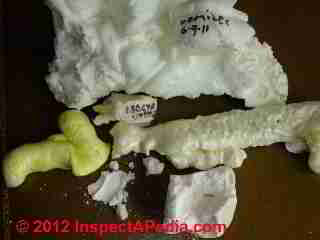
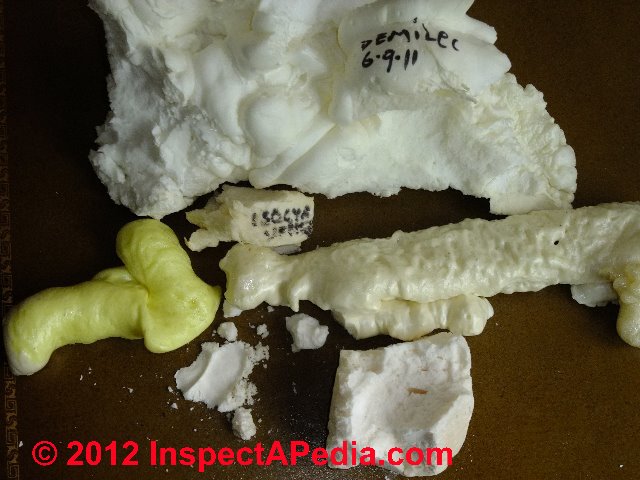
 Our page top photo illustrates an open celled 1/2 pound polyurethane foam, two can-sprayed polyurethane foam sealant/insulation products, Icynene foam, and UFFI.
All of these insulations are applied as foams that cure to a finished product. But their properties vary significantly as may installation costs and best uses.
[Click to enlarge any image]
Article Contents
Solid slab and pre-shaped cut styrofoam and other insulating board products are described separately
at INSULATION MATERIAL IDENTIFICATION GUIDE
Besides the details we outlined just above, it's easy to make a reliable distinction among urea formaldehyde foam insulation, Icynene® foam building insulation, and latex spray foam building insulation products using our simple finger probe test.
If the foam insulation product you find is quite firm it is probably a newer product such as ICYNENE SPRAY FOAM insulation.
But beware: another soft foam insulation product is latex foam spray insulation sold in small spray canisters at building supply houses. It's easy to tell the difference.
The latex foam spray and icynene foam spray products are not crumbly.
Visual and Tactile Characteristics of UFFI Urea Formaldehyde Foam Insulation
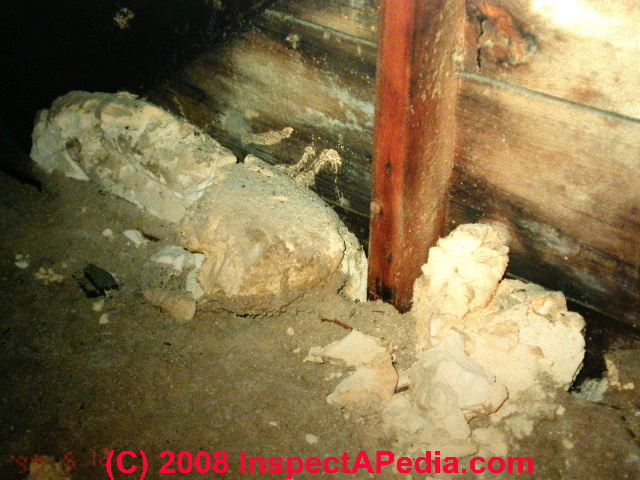
Urea Formaldehyde Foam Insulation expands to ooze out of openings in building cavities where it was inserted. (So do other expanding foam products such as Icynene® and Latex foams.)
When cured it forms a rather dull matte finish that may become gray with dust or dirt either with age or by movement through a dusty building cavity during its installation.
The color of the "skin" of cured UFFI is usually a darker gold color than the interior of the product.
You can see the brownish gold color if the UFFI in our photo (left).
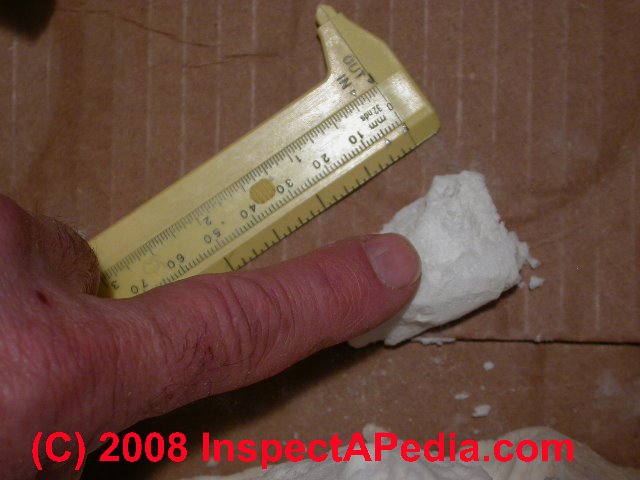
UFFI foam insulation is very crumbly and soft. It is very easy to break off a section of this foam with your hand using almost no pressure at all - the foam is very fragile. (Photo above left)
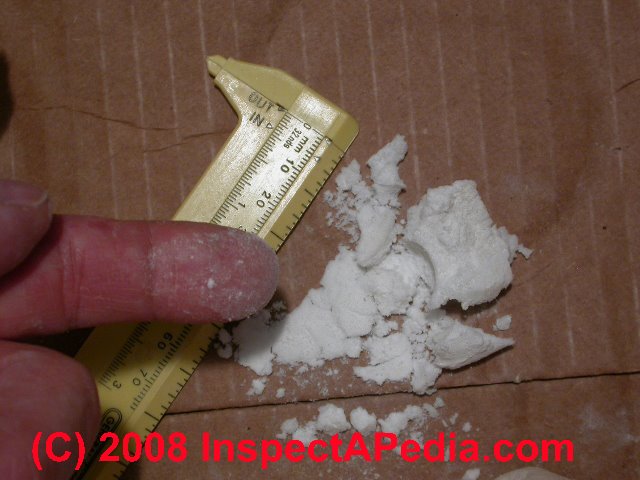
UFFI foam insulation will compress and usually disintegrate into a fine powder if you compress it, even by pressing on it with just a finger, and you'll see that UFFI leaves a dusty residue on your finger if you crush it. (Photo above right).
Because any fine dust particles can be a respiratory irritant, even when the particles are not themselves toxic, we recommend that you wear a respirator when performing this test.
(To avoid making a mess we conducted these tests inside of a disposable cardboard box.)
We discuss the identification and properties of UFFI insulation in buildings in detail
at UREA FORMALDEHYDE FOAM INSULATION, UFFI where we also explain the history of public fear of health hazards that were thought to be associated with this product.
The insulating or "R-value" properties of UFFI are
at INSULATION R-VALUES & PROPERTIES.
Visual and Tactile Characteristics of Icynene® Foam Insulation
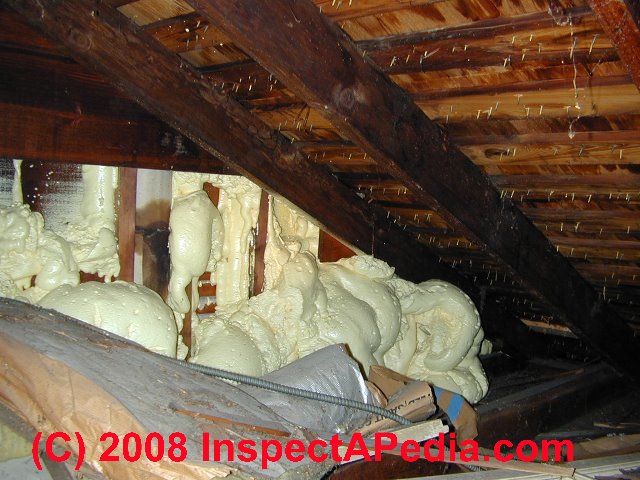
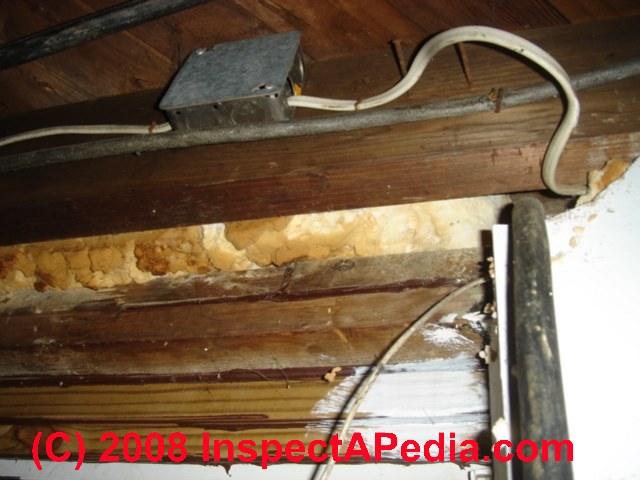
Icynene foam insulation is a foam spray insulation product in contemporary use (2008). Our photo (left) shows cured Icynene foam insulation oozing out of wall cavities in an attic. Here is another photo of Icynene foam insulation.
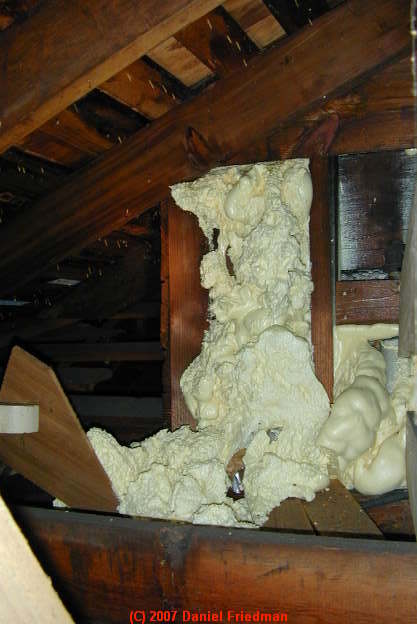
When cured it forms a rather hard shiny surface or "skin". You can depress this foam but some force will be needed and it is elastic. While dust can settle on and dirty this insulating material, its hard shiny surface picks up and holds less dust and debris than UFFI.
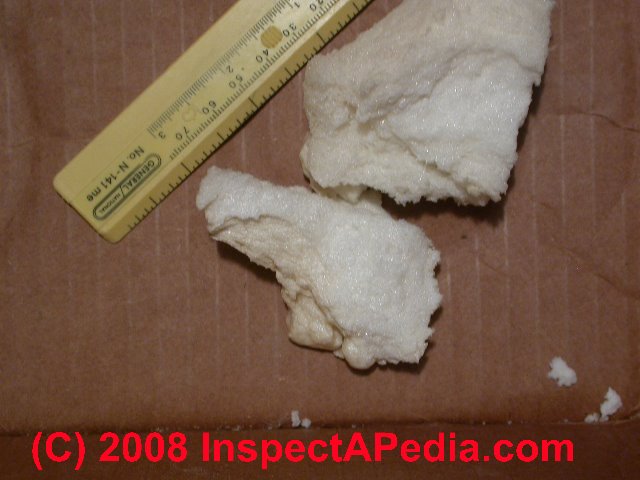
Icynene foam insulation is quite durable and while you can tear off a chunk of Icynene foam from a larger piece using your bare hand, it requires some strength and the torn pieces remain generally intact. (See photos just below).
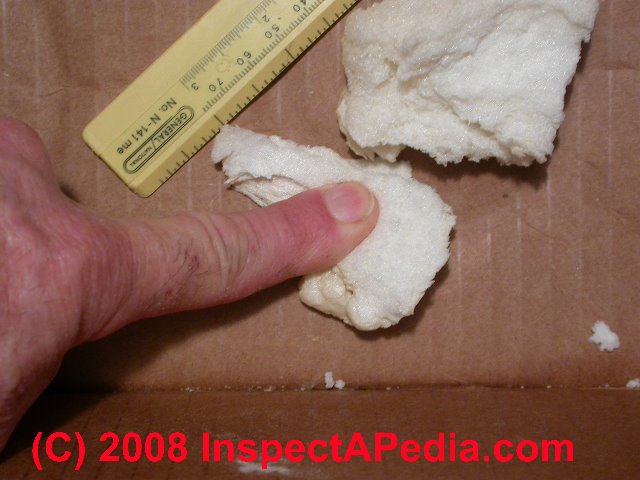
Icynene foam insulation is elastic. If you compress a sample with your finger, as we show in these two photos (above), it will remain intact and will expand pretty much back to its original shape when you remove your finger.
We discuss the properties of Icynene® foam spray insulation
at ICYNENE FOAM SPRAY INSULATION.
The insulating or "R-value" properties of Icynene foam are
at INSULATION R-VALUES & PROPERTIES.
We discuss the reduced risk of mold where Icynene® is in crawl spaces
at MOLD RISK in ICYNENE FOAM INSULATION.
Visual and Tactile Characteristics of Latex Foam Spray Insulation
Latex foam insulation is not really elastic. If you press down on latex foam insulation spray product after it has cured, it will compress and remain pretty much squashed into the smaller volume you've made.
Latex spray foam insulation is also whiter in color than the golden yellow of UFFI or Icynene and its finished surface is a dull matte not very shiny.
Like Icynene, latex foam insulation is not fragile but you can tear off a section from a larger chunk of cured latex foam insulation with your bare hand.
We have not found latex foam insulation used for complete building insulation retrofit, but it is often used by consumers to seal small building air leaks.
[Photos Wanted]
Visual and Tactile Characteristics of Open Celled 1/2 Pound vs Closed Cell 2-Pound Spray Foam Insulation
1/2 Lb. Open Celled Spray Foam Insulation - Demilec™
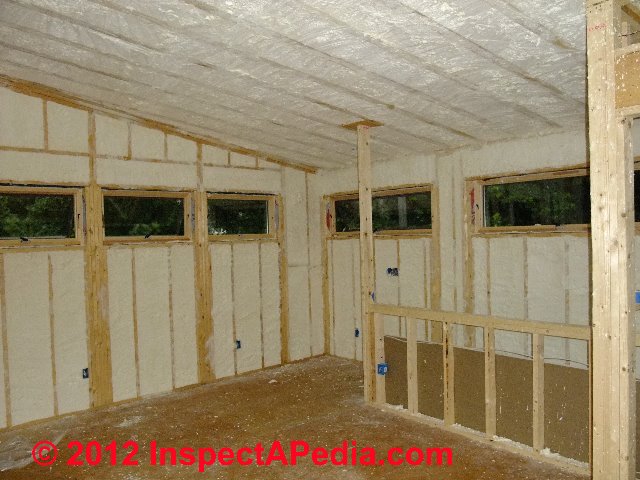
Our photos below illustrate application of a lightweight 1/2-pound open-celled spray foam insulation used in both new construction (left) and a retrofit insulation job at the same building (below right).
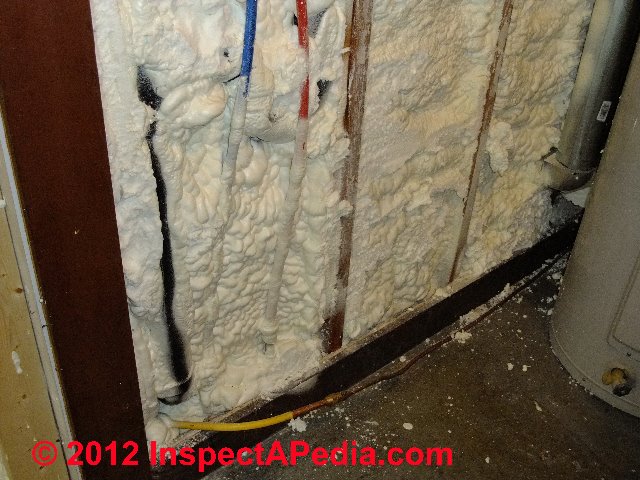
This lightweight open-celled foam (Demilec™) was sprayed to fill the building cavities and trimmed flush with the rafters, studs, or floor joists. This material is easily compressed between a thumb and forefinger, but is elastic and will spring back to nearly its pre-compressed state.
- Foam density: 0.45 - 0.5 lbs/cubic foot
- Foam R-value: R 3.81 sq ft.h deg/BTU [??]
- Low air permeance (that means the product is very resistant to air flow through the material)
- Water vapor transmission at 3.5" = 6.6 perms
- Water absorption: 0.30 % volume
We chose this foam product for the installation shown above because we had room for plenty of insulation. Framing was using 2x6 wall studs and 12" I-joists for the roof and floor support system.
Because this is an open-celled foam and vulnerable to water accumulation and leaks we felt that the design worked best below a standing-seam metal roof - a covering likely to be extra-resistant to penetration, even from falling tree branches, for a long time.
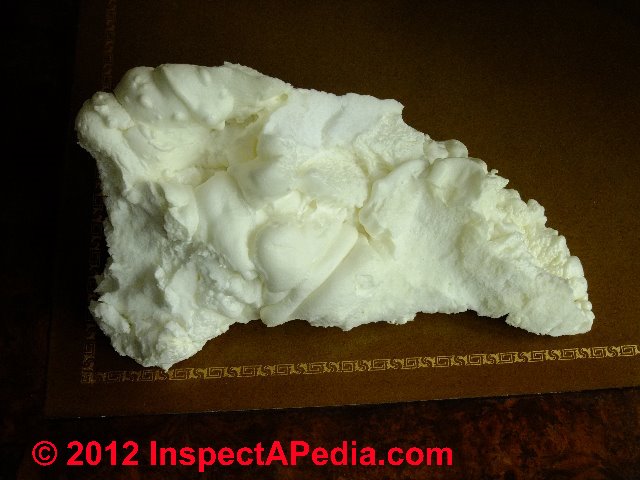
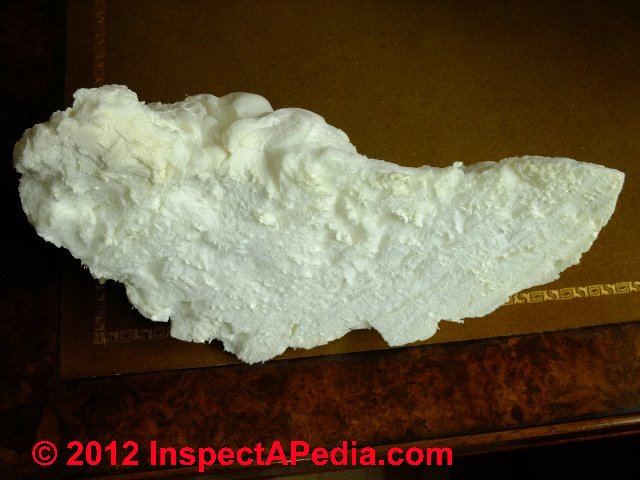
Just above and below we illustrate field-observable properties of Demilec's 1/2 lb. foam used in the building shown above. At below left is the exposed expanded cured side of the foam and at below right we show the interior of this foam "over spray" where it was trimmed from the building ceiling.
You can see that the foam is uniform in interior, unlike some of the canned spray polyurethane sealant applications we demonstrate in this article.
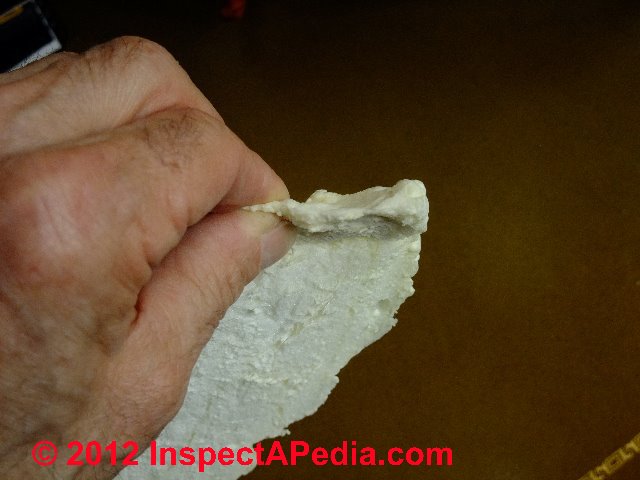
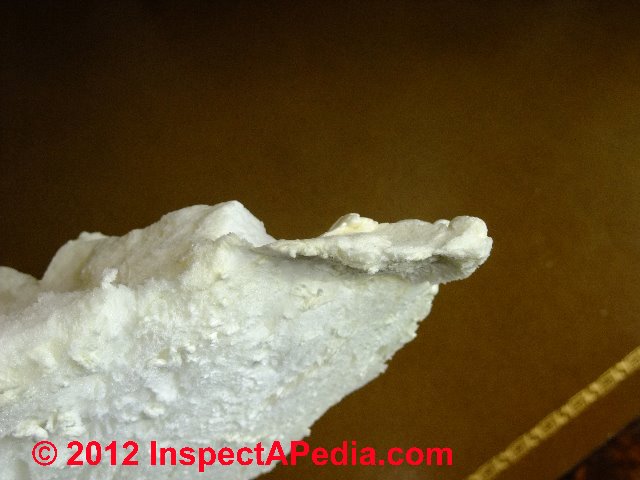
Below we illustrate the compression behavior of this foam material. Note that in normal application one would not compress the foam as we did for this illustration.
But you can observe that if you squash this type of foam it is not very elastic. Don't do that.
Demilec's Sealection Agribalance® spray foam insulation, in contrast, is an open-cell semi-rigid polyurethane foam insulation system, a water-blown insulation that is also spray applied, using "... more than 20% renewable agricultural based materials (refined vegetable oils) in the resin."
- Foam Density: 0.60 - 0.80 lbs/cubic foot
- Foam R-value: R 4.45 sq.ft./h/deF/BTU [??]
- Low air permeance at 3.5" thickness
- Water absorption: 15.27% volume
Visual and Tactile Characteristics of 2 Lb. Closed Cell Spray Foam Insulation
In contrast, closed-cell "two pound" spray foam insulation (see Icynene above) is a more dense and heavier product. Closed-cell foams are also by nature more resistant to both moisture and water penetration.
Soy-Based Foam Spray Building Insulation
According to Demilec[5] their Heatlok Soy-200 spray foam building insulation is a closed-cell polyurethane foam insulation that "... incorporates renewable oils and recycled plastic bottles in the creation of a high-performing insulation" that meets LEED requirements in various categories.
The product is formulated for use primarily as a moisture/vapor barrier and thermal insulation on above grade or below grade interior and exterior applications. You might want to take a look at the MSDS and other technical details provided by the company when evaluating this and all other insulating products.
- Foam density: 2.1 lbs/cubic foot
- Foam R-value: R 7.4/inch, R-26.6 @4-inches
- Low air permeance
- Water absorption: 0.30 % volume
Demilec's HeatLok Soy spray foam building insulation, is a similar product.
Visual and Tactile Characteristics of Polyurethane Foam Spray Building Insulation
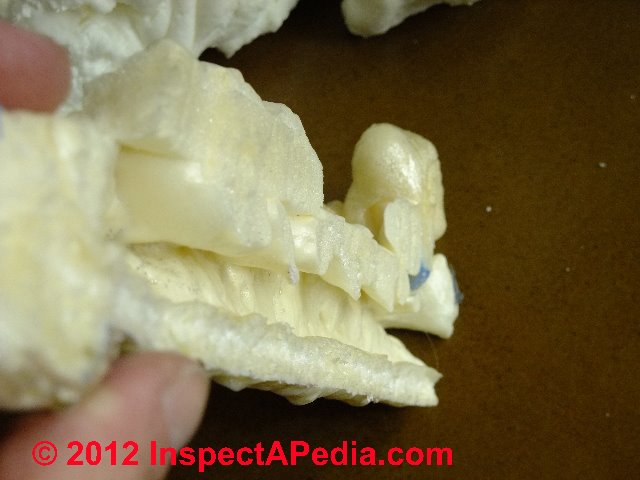
Canned spray polyurethane foam was used to fill gaps around the windows being renovated (below left). The foam expands in response to moisture in air, is very dense when cured (and horribly sticky messy when wet). It is trimmed using a sharp knife or saw.
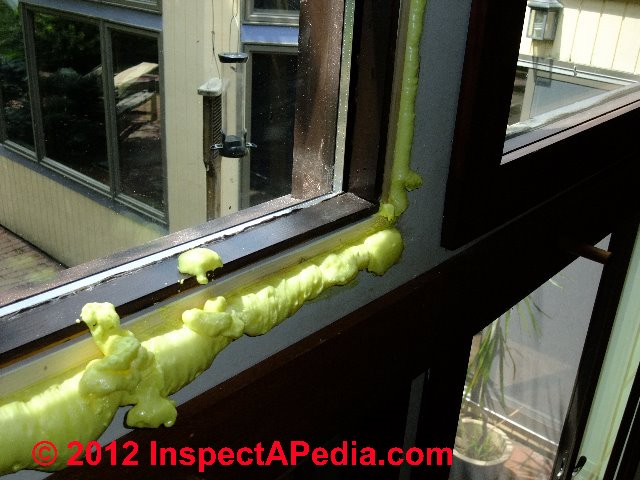
Be careful when filling building cavities with this foam product. If you do not move the spray nozzle with smooth uniform strokes, and if you have to re-visit the cavity to spray a second time, you may find when trimming the foam that you have left large air gaps that need further filling.
The surface finish of this polyurethane foam, when cured, is smooth, very firm, a bit shiny.
An example of a consumer-use spray-can applied foam sealant product is Dow Chemical's Great Stuff insulating foam.[6]
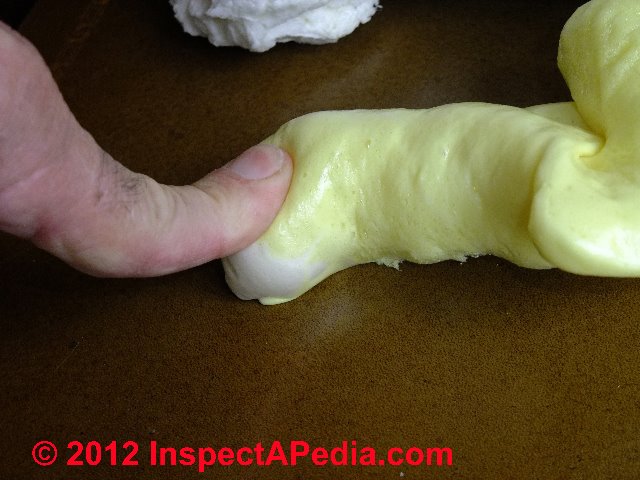
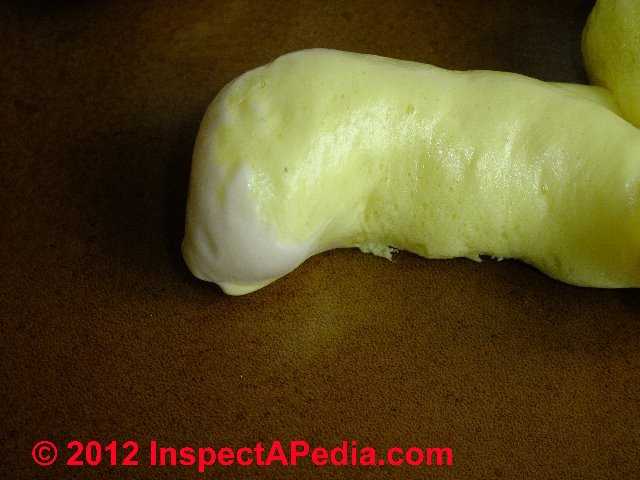
Above and we illustrate the elasticity and other properties of this polyurethane foam sealant-insulation. You can see that in this slow-tech empirical test we observe that the polyurethane foam insulation is harder to compress (more dense) than some of the other products discussed here, and that it is quite elastic (below right), springing back to close to its original shape when pressure is removed.
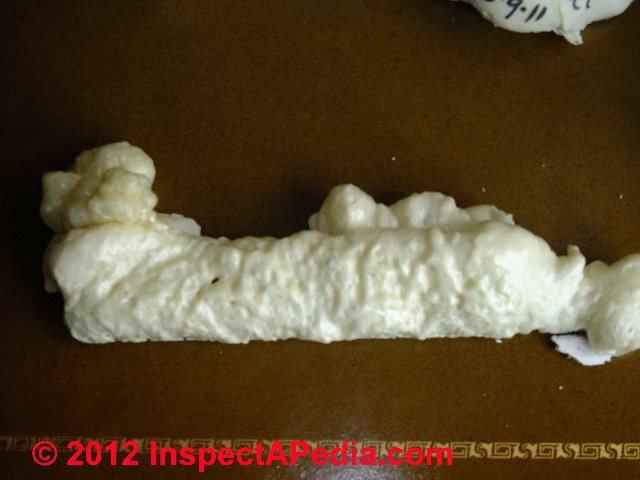
Watch out: however, for too-rapid spraying or using too much quantity of this foam. In the window sealing application we illustrated above, when we trimmed off some of the sections of polyurethane foam sealant overspray that exuded out of the gaps being filled, we observed large voids inside the insulation.
These voids reduce the foam's effective R-value, and depending on how it is trimmed, can also leave you with air leaks unless you make a second and more careful pass with the sealant.
Dow Chemical produces two versions of Great-Stuff spray foam insulating sealant commonly found at building suppliers.[6]
BASF provides SPF or Spray Polyurethane Foam insulation and air barrier material.
Spray Foam Properties, Products, Guides
SPF products are sold in both closed-cell and open celled forms and as we describe on this page, have different installation procedures & different properties.

- BASF INSULATION CARD [PDF] provides R-values and U-factor charts for the BASF foam insulation product line
- BASF TIPS for OPTIMUM YIELD for Enertite Open Cell Water-Blown Spray Foam Products [PDF] (2020) BASF Corporation 1703 Crosspoint Avenue Houston, TX 77054 (800) 706-0712 (713) 383-4592 (Fax)
- BASF WALLTITE Insulating Air Barrier Product Brochure [PDF] closed cell polyurethane spray foam or SPF insulation BASF, Web: spf.basf.com/ or Website-Canada: walltite.basf.ca/home Technical Support Tel: (800) 706-0712 - retrieved 2023/00/06, original source: http://www.spf.basf.com/walltite.php - Meets CAN/ULC S134.
WALLTITE®, SKYTITE®, ENERTITE® and SPRAYTITE® are registered trademarks of BASF. Walltitle is easily identified in its purple form. - Canada, Ontario Code Updates to comoply with the Montreal Protocol - FAQs Walltite-from BASF [PDF]
Excerpt: The change in blowing agents is to comply with Canada’s commitment to the Montreal Protocol that will require blowing agents used for foamed plastic insulations to have lower global warming potential than those currently used. This regulation will not allow foamed plastic insulations that currently use HFC after Dec 31, 2020 - SPF SPRAY POLYURETHANE FOAM INSTALLATION BEST PRACTICES [PDF] (2012) BASF & American Chemistry Council, Spray Foam Coalition, Center for the Polyurethanes Industry
- VENTILATION CONSIDERATIONS for SPRAY POLYURETHANE FOAM [PDF] (2016) BASF & American Chemistry Council, Spray Foam Coalition, - retrieved 2023/09/06 original source: spf.basf.com/DOCS/SPF-Ventilation-Guidance-v-3-2016.pdf
Visual and Tactile Characteristics of Fire-Block / Fire-Break Foam Spray Building Penetration Sealant
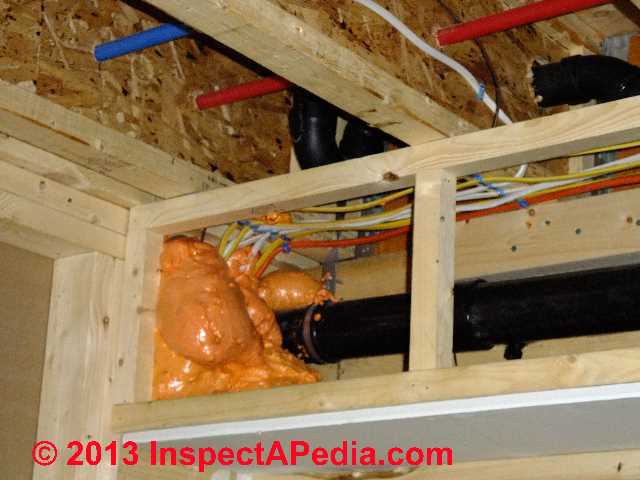
Fire-block foam is a fire-resistant foam spray used to seal building floor, wall, or ceiling penetrations, especially in new construction or a spray-foam insulation retrofit job.
Fire retardant foam spray insulation (shown at left) hardens and cures similarly to the polyurethane foam illustrated at the window seal job above, but has a characteristic orange color to help building inspectors recognize where it has been applied.
Cured this foam is quite hard and dense.
A producer of fire resistant spray foam in individual cans is Convenience Products [7].
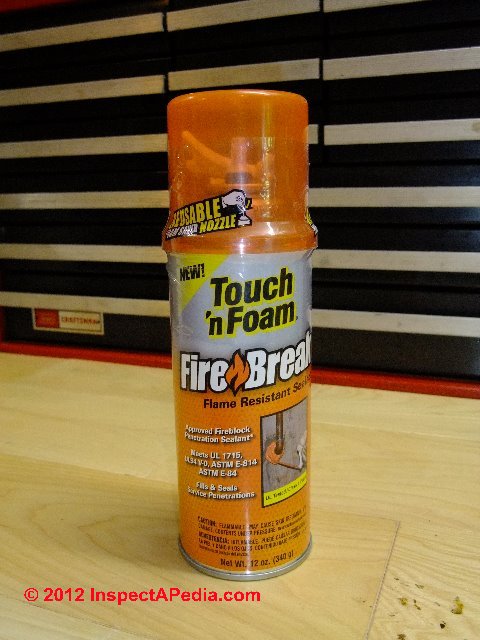
The company's product label describes their Touch 'n Foam FireBreak flame resistant sealant as a fireblock penetration sealant is intended to fill and seal building ceiling, wall, or floor penetrations, and meets the following standards:
- ASTM E-84 - flame spread
- ASTEM E-814 - fire stop
- UL 94 V-0 - flammability of plastics
- UL 1715 - finish material fire tests
- [1][2][3][4]
ASBESTOS FOAM LAMINATES discussed
in ASBESTOS INSULATION included fire resistant foam boards, wallpaper and similar products.
Reader Comments, Questions & Answers About The Article Above
Below you will find questions and answers previously posted on this page at its page bottom reader comment box.
Reader Q&A - also see RECOMMENDED ARTICLES & FAQs
On 2020-07-01 by Anonymous - identify this white insulation: UFFI, Urethane, or Latex foam?
 ...
...
[could] you take a quick look at the attached photos. It is some sort of insulation around the joists in my garage. It is powdery and crumbles when touched.

The colour is bright white. I am concerned it could be urea formaldehyde insulation but i read that this is yellowish in colour.
Moderator reply: UFFI, Urethane, Latex Foam or other Foam: tan or even white in color
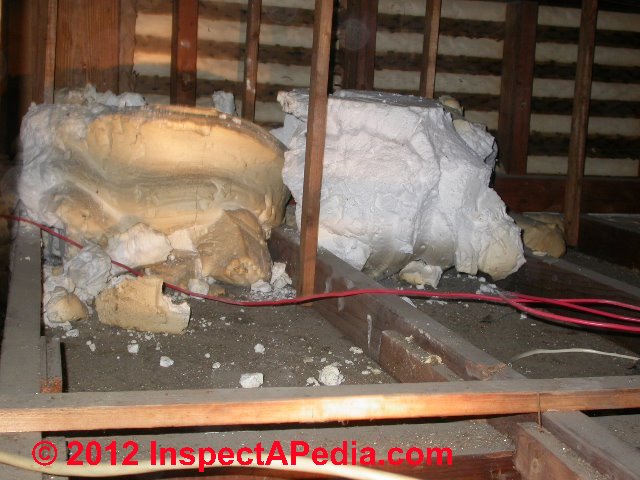 The photo is not quite sharp enough for me to be sure what that is - it could be UFFI, as you'll see in our identification photos.
The fact that it appears at multiple spots along the perimeter of your building floor frame and against a masonry wall or foundation suggests it may indeed be a foam insulating product, though from the colour I'd have guessed a latex foam.
My photos of UFFI found in a New York home shows both golden-yellow UFFI and pale white UFFI insulating foam.
Take a look at more UFFI identification photos found
at FOAM SPRAY INSULATION TYPES including both modern sprayed in place foam insulating products
Also see UREA FORMALDEHYDE FOAM INSULATION, UFFI
Also see URETHANE FOAM INSULATION
Usually UFFI is yellowish as you noted. Other foam insulating products are white.
If UFFI or any other foam insulating product was blown into the home you'll almost always find oozing out bits in more than just one location.
As you'll read in our articles on this topic, UFFI raised formaldehyde offgassing concerns when it was newly installed.
If it is UFFI there is no reason to be scared - there won't be measuring offgassing of formaldehyde in such an old installation.
Take a closer look. IF the material crumbles to a white powdery dust when poked or crushed between forefinger and thumb, it's probably UFFI. If it doesn't crumble but is more-durable, spongy, for example, it's another foam product. If it's fibrous it's insulation.
If it's damp and sticky it could be mineral efflorescence.
It would be helpful to know the country, city, and age of the building and its insulation and retrofit history.
Reader Follow-up:
I sent a sample of it off for asbestos testing and it came back negative. It just turns to a powder/disintegrates when touched.
The house is in Shropshire in England. It was built in 1963.
The white stuff looks quite clean and fresh - would it not look discoloured etc if it was put in 50 years ago?
Is the only health concern with uffi the off gassing when it is first put in, so breathing in powder would not be dangerous?
Moderator reply:
Thank you for the added details.
The formaldehyde off-gassing hazard from UFFI is explained in the article link that I sent to you earlier. Do take a look.
About dust, I would not be so cavalier as to assert, about a material whose identity and properties are not fully identified, it is or is not dangerous.
But in general, if the material is easily pulverized into a fine powder, certainly the powder may be at least a respiratory irritant. Some very-small inorganic particles, such as fiberglass, are asserted by some research, to not be a serious health hazard. You can read about that at FIBERGLASS FRAGMENT HAZARDS in AIR or DUST https://inspectapedia.com/Fiberglass/Fiberglass_in_Air.php
In researching the history of UFFI - and we yet have not established that that's what your material is - I have not come across a reference to hazards from the dust of old UFFI insulation other than classifying it as a "nonspecific dust irritant" (Norman 1986).
There actually has been a bit of commentary and research and disagreement on the UFFI dust hazard question.
- Frigas E, Filley WV, Reed CE: ASTHMA INDUCED BY DUST FROM UREA-FORMALDEHYDE FOAM INSULATING MATERIAL [PDF] Chest
1981; 79: 706-707
Abstract:
A patient developed severe asthma following insulation of her house with urea-formaldehyde foam.
Bronchial challenge with the buoyant dust of the foam caused an asthmatic attack; inhalation of formaldehyde, 3 ppm, did not. - Frigas, E., W. V. Filley, and C. E. Reed. "UFFI Dust: Nonspecific Irritant Only?." Chest 82, no. 4 (1982): 511-512. [Letter] included in the PDF below
- Newhouse, Michael T. UFFI DUST: NONSPECIFIC IRRITANT ONLY? [PDF] Chest 82, no. 4 (1982): 511. [Letter]
- Norman, G. R., and M. T. Newhouse. HEALTH EFFECTS OF UREA FORMALDEHYDE FOAM INSULATION: EVIDENCE OF CAUSATION [PDF] CMAJ: Canadian Medical Association Journal 134, no. 7 (1986): 733.
On 2017-09-05 by Lindsay - lingering paint smell from Eco insulation
Hi-
I just moved into a new apartment. I specifically asked them not to use spray foam to insulate the ac/heating unit. When they removed the cover to the unit, I saw that a shiny white spray foam had been applued.
They claim it is an "eco" type - but I have no way of knowing if that is true.
The only thing I can say is that there is a lingering paint smell in the apartment, even though it was painted a week ago. Now, I am concerned that the odor is coming from the spray foam and they may have used the harmful kind.
I have chemical sensitivities. Is there any way for me to distinguish what it is? Can it be safely removed if it is the dangerous type? Thank you.
On 2015-05-13 - by (mod) - foam insulation from an old spa - dangerous?
Trisha
This is not a question that can be answered by an e-text with no actual on-site information about conditions there. But in general, if there are very small, inhalable particles of any substance being inhaled they could be problematic.
If your neighbour won't cooperate by cleaning up the problem after a polite oral and written request you may have to ask for help from your local building code enforcement department. Generally we're not permitted to leave junk out permanently.
On 2015-05-13 by Trisha
My neighbour has an old spa sitting on its side in his driveway been there for months and now the foam is breaking down and blowing the dust all over my car is this dust dangerous. I have to small grandchildren and I worry about them breathing this in. Thanks Trisha.
Question:
I live in a home built in 1949. During a recent renovation, we found some loose insulation In a wall cavity. It looks like the white fluffy rock wool pictured on your site. However, when I wet it down and handled it it crumbled easily. Will rock wool behave this way or should I be concerned about asbestos?
Reply:
No mineral wool doesn't crumble nor compress to nothing when wet. Take a look at the comparative article at
About asbestos: it's rare but occasionally has shown up as wall insulation. See ASBESTOS INSULATION
We would much appreciate hearing any comments, critique, suggestions, or further questions that you may have after you've taken a look at that article.
...
Continue reading at FOAM INSULATION & INSECTS or select a topic from the closely-related articles below, or see the complete ARTICLE INDEX.
Or see these
Recommended Articles
- FOAM INSULATION PRODUCTS & PROPERTIES
- FIRE PROTECTION FOR FOAM BOARD INSULATION
- FOAM BOARD INSULATION TYPES
- FOAM SPRAY INSULATION TYPES
- FOAM INSULATION & INSECTS
- ICYNENE FOAM SPRAY INSULATION
- MOLD in FOAM INSULATION
- PERLITE INSULATION
- PHENOLIC FOAM INSULATION
- POLYISOCYANURATE FOAM BOARD
- POLYISOCYANURATE FOAM and IAQ
- POLYISOCYANURATE FOAM BELOW SLABS
- POLYSTYRENE FOAM INSULATION
- RIGID FOAM USE INDOORS
- SLAB INSULATION, RADIANT / PASSIVE SOLAR
- STRESS SKIN / STRUCTURAL INSULATED PANELS (SIPs)
- UREA FORMALDEHYDE FOAM INSULATION, UFFI
- URETHANE FOAM INSULATION
- INSULATION INSPECTION & IMPROVEMENT - home
- INSULATION R-VALUES & PROPERTIES - R-values & U Values of various materials
Suggested citation for this web page
FOAM SPRAY INSULATION TYPES at InspectApedia.com - online encyclopedia of building & environmental inspection, testing, diagnosis, repair, & problem prevention advice.
Or see this
INDEX to RELATED ARTICLES: ARTICLE INDEX to BUILDING INSULATION
Or use the SEARCH BOX found below to Ask a Question or Search InspectApedia
Ask a Question or Search InspectApedia
Try the search box just below, or if you prefer, post a question or comment in the Comments box below and we will respond promptly.
Search the InspectApedia website
Note: appearance of your Comment below may be delayed: if your comment contains an image, photograph, web link, or text that looks to the software as if it might be a web link, your posting will appear after it has been approved by a moderator. Apologies for the delay.
Only one image can be added per comment but you can post as many comments, and therefore images, as you like.
You will not receive a notification when a response to your question has been posted.
Please bookmark this page to make it easy for you to check back for our response.
Our Comment Box is provided by Countable Web Productions countable.ca
Citations & References
In addition to any citations in the article above, a full list is available on request.
- [1] ASTM E-84 - ASTM E84 - 12 Standard Test Method for Surface Burning Characteristics of Building Materials, ASTM, web search 5/22/12, original source: http://www.astm.org/Standards/E84.htm, Abstract:
This test method is intended to provide only comparative measurements of surface flame spread and smoke density measurements with that of select grade red oak and fiber-cement board surfaces under the specific fire exposure conditions described herein. This test method exposes a nominal 24-ft (7.32-m) long by 20-in. (508-mm) wide specimen to a controlled air flow and flaming fire exposure adjusted to spread the flame along the entire length of the select grade red oak specimen in 5 ½min. This test method does not provide for the following: Measurement of heat transmission through the tested surface. The effect of aggravated flame spread behavior of an assembly resulting from the proximity of combustible walls and ceilings. Classifying or defining a material as noncombustible, by means of a flame spread index by itself. - [2] ASTEM E-814 - ASTM E814 - 11a Standard Test Method for Fire Tests of Penetration Firestop Systems, ASTM, web search 5/22/12, original source: http://www.astm.org/Standards/E814.htm, Abstract:
This test method is used to determine the performance of a firestop system with respect to exposure to a standard time-temperature fire test and a hose stream test. The performance of a firestop system is dependent upon the specific assembly of materials tested including the number, type, and size of penetrations and the floors or walls in which it is installed. Two ratings shall be established for each firestop system. An F rating shall be based upon flame occurrence on the unexposed surface, while the T rating shall be based upon the temperature rise as well as flame occurrence on the unexposed side of the firestop system. These ratings, together with detailed performance data such as the location of through-openings and temperatures of penetrating items are intended to be one factor in assessing performance of firestop systems. - [3] UL 94 V-0 - UL 94, the Standard for Safety of Flammability of Plastic Materials for Parts in Devices and Appliances testing, UL, Underwriters Laboratories, web search 5/22/12, original source: https://www.ul.com/global/eng/pages/offerings/industries/chemicals/plastics/testing/flame/. Abstract: There are two types of pre-selection test programs conducted on plastic materials to measure flammability characteristics. The first determines the material's tendency either to extinguish or to spread the flame once the specimen has been ignited. The first program is described in UL 94 which is now harmonized with IEC 60707, 60695-11-10 and 60695-11-20 and ISO 9772 and 9773. The second test program measures the ignition resistance of the plastic to electrical ignition sources. The material's resistance to ignition and surface tracking characteristics is described in UL 746A, which is similar to the test procedures described in IEC 60112, 60695 and 60950.
- [4] UL 1715 - U: 1715, Fire Test of Interior Finish Material, UL, Underwriters Laboratories, web search 5/22/12, original source: http://ulstandardsinfonet.ul.com/scopes/1715.html, Abstract:
1.1 This test method describes the testing procedures and requirements applicable to the classification of interior finish material assemblies by use of a standardized room fire exposure.
1.2 This test method is intended for use in the evaluation of the flammability contribution of wall material assemblies, ceiling material assemblies, or both, exposed to early fire growth under specified room fire exposure conditions. The effectiveness of fire barrier materials as protection for other combustible materials or components within the assembly is of primary interest for this evaluation. [... and more ] - [5] Demilec (USA) LLC, Spray Foam Manufacturer, Demilec (USA) LLC 2925 Galleria Drive Arlington, TX 76011, Website: http://www.demilecusa.com/, Tel: 877-DEMILEC | 817-640-4900
- [6] Great Stuff Big Gap Filler Insulating Foam, or Great Stuff Window & Door foam sealant, Dow Chemical, Telephone: 800-441-4369., Website: http://greatstuff.dow.com/ - polyurethane foam sealants
- [7] Convenience Products, 866 Horan Dr., Fenton MO 63026, Tel: 636-349-5333, website: touch-n-foam.com.
- In addition to citations & references found in this article, see the research citations given at the end of the related articles found at our suggested
CONTINUE READING or RECOMMENDED ARTICLES.
- Carson, Dunlop & Associates Ltd., 120 Carlton Street Suite 407, Toronto ON M5A 4K2. Tel: (416) 964-9415 1-800-268-7070 Email: info@carsondunlop.com. Alan Carson is a past president of ASHI, the American Society of Home Inspectors.
Thanks to Alan Carson and Bob Dunlop, for permission for InspectAPedia to use text excerpts from The HOME REFERENCE BOOK - the Encyclopedia of Homes and to use illustrations from The ILLUSTRATED HOME .
Carson Dunlop Associates provides extensive home inspection education and report writing material. In gratitude we provide links to tsome Carson Dunlop Associates products and services.
 | HOME | ABOUT | ASK a QUESTION | CONTACT | CONTENT USE POLICY | DESCRIPTION | POLICIES | PRIVACY | |
| © 2024 - 1985 Publisher InspectApedia.com - Daniel Friedman | |||||||||