
InspectAPedia® FREE Encyclopedia of Building & Environmental Construction, Diagnosis, Maintenance & Repair |
Question? Just ask us! InspectAPedia
|
 Building Noise & Sound Complaints
Home Page & Index to Articles
- POST a QUESTION or COMMENT about diagnosing the source and finding the cure for noises or sounds in or around buildings and their systems
This page provides our index to detailed procedures for building noise troubleshooting: causes & cures.
Here we provide an extensive catalog of the sources of annoying sounds or noise complaints at or around buildings. We provide a complete index to sources of sounds helps diagnose, & cure noise problems in or at buildings.
These articles discuss building noise control: how to inspect, diagnose & cure noise or sound problems in homes or commercial buildings. Information is provided about auditory (hearing), visual, historic, medical, or other clues of building condition that explain various sounds heard in buildings.
We also discuss methods of sound or noise control in buildings during construction or as a building retrofit.
InspectAPedia tolerates no conflicts of interest. We have no relationship with advertisers, products, or services discussed at this website.
How to Identify & Cure Noises & Sounds in Building Interiors
 This page lists key articles useful in finding the source of annoying building noises or sounds, understanding when noises indicate problems in the building or its mechanical system, and controlling or eliminating building noise.
Also use the page top (blue area) search box to search InspectApedia by noise type, or use Ctrl-F to search within this article for specific noise or sound types such as buzz, creak, hiss, drip, etc.
[Click to enlarge any image]
Some building noises are just an annoyance - we'll focus on sound control, sound isolation, and sound insulation methods. But other building sounds or noises may be a sign of trouble, failing equipment, insect attack, rodent infestation, or other more dangerous conditions.
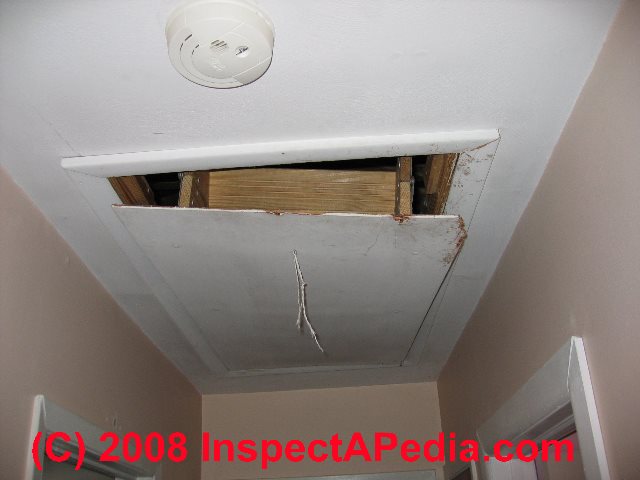
Our page top photo showed a severe air bypass leak at an attic pull-down stair. Occupants could at times hear air rushing through this opening.
This article explains how to locate the source of, identify and correct various building sounds and noises indoors or on occasion, noises from outside that penetrate indoors at annoying levels.
While we touch on environmental noise coming from outside of buildings (aircraft noise, highway noise, noisy neighbors) the focus of this article series is on identifying and curing unwanted indoor noise sources in buildings - noise control.
To find what you need quickly, if you don't want to scroll through this index you are welcome to use the page top or bottom SEARCH BOX to search InspectApedia for specific articles and information.
See our ARTICLE INDEX to BUILDING NOISE DIAGNOSIS for a complete list of building & building system noise diagnosis and cure articles including detailed articles on specific sound types, names, sources, causes, cures.
How are Noises Transmitted in Buildings?
Regardless of their source, noises are transmitted in buildings by two methods.
Airborne Sound:
Sound waves traveling through air move between building areas - such as through open windows, doors, or stairwells.
Mechanically transmitted sound:
When sounds move through solid building components such as floors, ceilings, walls, framing, carrying sound from one area to another the sound transmission is referred to more technically as impact insulation class transmission or IIC sound transmission.
In many cases the source of an annoying building sound may be obvious and we can move immediately to strategies for reducing that source to an acceptable noise level. But we also receive queries from people who have difficulty tracing a sound to its source, or who are unsure if a sound that they hear at a known source (say a humming sound at an electrical component) is normal or means trouble.
In our collection of sources of building sounds and noises, below, we describe common noises that may come from various sources and we link to more detailed diagnostic and repair advice for these problems.
Separately at SOUND CONTROL in BUILDINGS
we provide a series of detailed articles on noise or sound transmission control - that is, methods for reducing unwanted building noise levels through building design, insulation, sound isolation, and noise barriers.
Find the Source of Building Noises by Keeping a Sound or Noise Event Log
To track a mystery-noise or sound to its source in a building, try keeping a noise log, noting the conditions, times, events, and information we list in our printable sound event log worksheet:
We provide a sound event log in three formats:
- SOUND EVENT LOG a web article including explanation of what information should be recorded to help track down the source of building sounds & noises
- BUILDING NOISE LOG a simplified printable html file
- NOISE LOG, PRINTER-FRIENDLY- [PDF] RECOMMENDED - checklist and time/date log form useful in noise localization in buildings.
Help Finding the Source, Estimating the Level, & Controlling Noise at Buildings
- HUD, Noise Guidebook (2022) [HUD Website] US Department of Housing and Urban Development, Web: https://www.hudexchange.info/resource/313/hud-noise-guidebook/
This guidebook provides information on HUD's noise policy. It contains all the various reports, informational papers and other items that have been released by HUD over the past several years.
We provide the most-useful chapters from the HUD Noise Guidebook below as PDF downloads. - HUD, NOISE ATTENUATION (Chapter 4) [PDF]
Excerpt: There are two ways to determine noise levels for a site under review: the noise can be calculated or It can be measured. While one's first reaction might well be that It would obviously be better to go out and actually measure the noise l-Is at the site, calculated noise levels are really much better for Implementing HUD's noise policy. - HUD, SOUND TRANSMISSION CLASS GUIDANCE [PDF] U.S. Housing & Urban Development, Chapter 4 Supplement, in HUD Noise Notebook.
Excerpts:
The Noise Guidebook, pages 33-37, provides an elementary discussion of STC, provides some STC ratings for common building materials and limited exterior and interior wall construction configurations, and describes a method to determine composite STC value of a wall containing a window or door.
This update provides for an understanding of STC and provides an expanded material and construction classification for both internal and external building materials and typical construction patterns.
The intent of this chapter is not to endorse anyone building manufacturer or product over another but to keep HUD Environmental staff and other interested persons advised on the STC values of current building materials and practices which can be applied to HUD supported housing activities.
Additional subsections on specific types of building materials, construction techniques and STC values will be periodically added. - HUD, NOISE ASSESSMENT GUIDELINES (Chapter 5) [PDF]
- HUD, NOISE ASSESSMENT GUIDELINES WORKBOOK (Chapter 6) [PDF] - Op. Cit., retrieved 2022/05/28 original source: https://www.hudexchange.info/sites/onecpd/assets/File/Noise-Guidebook-Chapter-6.pdf
- HUD, USE of NOISE MEASUREMENTS (Chapter 7) [PDF]
Alphabetical List of Building Noises by Sound Source or Sound Type
Beginning below, we provide an alphabetically-ordered catalog of building noises and sounds, with suggestions for tracking down these disturbances.
Air Conditioning or Heat Pump System Noises
- At AIR CONDITIONING & HEAT PUMP NOISES we discuss a range of noises can be traced to air conditioning systems, including sounds of air leaks into or out of air ducts and air handlers as well as mechanical sounds traced to the air handler or blower, or the compressor unit (outside).
- Air handler / blower indoor cooling unit noises
see AIR HANDLER / BLOWER NOISES
for a discussion of air leaks, bubbling, clicking, duct noises, fan noises and vibration dampener noises, howling or hissing in air handlers and ducts, rattling at fan motors, hissing at failing electrical components, and more including the articles on these problems listed just below. - Air leaks
in ductwork often make a roaring or hissing sound. See - LEAKY DUCT CONNECTIONS and also see
- VIBRATION DAMPENERS for a discussion of devices used to isolate noises produced by HVAC air handlers such as air conditioners and furnaces.
- BLOWER FAN WON'T START, BUZZING
- COMPRESSOR CONDENSER NOISES provides detailed diagnostic help in finding, evaluating, and fixing noisy compressor units. Humming, rattling, explosion noises, bangs, clanks, hissing noises.
- DUCT SYSTEM NOISES, including air leaks, hisses, dripping condensation, creaks and clicks from thermal expansion & contraction, rattling & buzzing from loose components
- ELECTRIC MOTOR NOISE DIAGNOSIS - humming sounds from hard-starting motors
- FAN NOISES, HVAC - humming, rattling, banging, clicking noises traced to fan motors, fan belts, or fan blades impacting other items due to loose fans or failed fan bearings.
- HOWLING HVAC SOUNDS from air conditioners, air handlers, blower fans, heat pumps, furnaces, duct systems & their motors
- Other building HVAC system noise sources:
See NOISE CONTROL for HEATING SYSTEMS where we describe other heating system noise sources and cures. - Banging noises & sounds
in buildings also described as bangs, clangs, thumps, thunks, clunks and whumps.
See our catalog of common sources of banging noises in or around buildings
at BANGING BOOMING NOISE DIAGNOSIS & CURE
and also BANGING HEATING PIPES RADIATORS
and also BANGING WATER HEATER
and also WASHING MACHINE NOISE CAUSE & CURE
and of course WATER HAMMER NOISE DIAGNOSE & CURE - home - Bubbling sounds
occur in all types of building piping systems when there is air or gas mixed in with water or another liquid such as refrigerant. Bubbling sounds in hot water heating systems is discussed at - AIR-BOUND HEATING SYSTEMS
while bubbling sounds in the refrigerant piping is discussed at - REFRIGERANT LEAK REPAIR and may indicate a refrigerant leak, though bubbling sounds on split systems at the indoor wall unit may be normal for some products - see our note below about water noises.
You may also hear bubbling sounds in water piping if there is excess air in the water supply system. See - AIR DISCHARGE at FAUCETS, FIXTURES
- Booms, booming noises
aside from obvious boom noises traced to explosions or perhaps to an oil burner puffback explosion, methane gas explosions, and similar explosive causes, sounds coming from the ground, including loud booms, moaning, humming, and other sounds coming from the ground may be due to "stretch movement noises" due to tectonic plate movement.
See BANGING BOOMING NOISE DIAGNOSIS & CURE - Buzzing, snapping, crackling, popping
may be dangerous electrical switch or breaker indicators.
Buzzing also occurs at failing or failed relays such as the relay in a heating system aquastat or circulator controller or in relays used to control HVAC fans, blowers, and compressor motors.
See our complete guide to sources of buzzing noises in or around buildings now
at see BUZZING NOISE DIAGNOSIS - topic home - Chugging noises
See GAS BURNER RUMBLING CHUGGING NOISES
- Clanging noises
in buildings, excluding those made by alarm systems, are usually traced to plumbing or to hot water heating systems, though in unusual cases thermal expansion of metal such as ductwork or metal roofing may cause clanging sounds.
See the causes of clanging noises described
at PLUMBING SYSTEM NOISE DIAGNOSIS & CURE
at PLUMBING NOISE CHECKLIST
also at WATER PUMP NOISE DIAGNOSIS - a short cycling pump may cause water hammer and clanging pipes.
See WATER HAMMER NOISE DIAGNOSE & CURE for detailed diagnostic and repair steps
See TEMPERATURE CHANGE RELATED NOISES for examples of thermal expansion/contraction related clanging sounds.
See TEMPERATURE CHANGE & ROOF NOISE for clicking or clanging noises coming from a metal roof - Clicking noises
Review causes & cures of clicking sounds identified & cured at
CLICKING NOISES
- Duct system noises
hisses, whistles, even roars, and occasionally clunk or clank sounds from expanding or contracting metal ductwork. Take a look at- LEAKY DUCT CONNECTIONS. Leaks around the return air register are common and sometimes noisy - see
- RETURN DUCT AIR LEAKS. Hisses and whistles in supply air ducts and registers might be present too - see
- SUPPLY DUCT AIR LEAKS. Also buzzing, rattling, clanking or other noises originating at the air handler/blower unit may be transmitted into the physical ductwork and thus the building, if the system lacks an adequate vibration dampener
- VIBRATION DAMPENERS
- Fan noises
on heating and air conditioning systems are discussed
at FAN, AIR HANDLER BLOWER UNIT
and
at FAN, COMPRESSOR / CONDENSER UNIT and may include rattling and clanging - Gas burner noises
See GAS BURNER FLAME & NOISE DEFECTS - Ground noises
sounds coming from the ground, including loud booms, moaning, humming, and other sounds coming from the ground may be due to "stretch movement noises" due to tectonic plate movement.
Ground noises may be due to sinkhole formations, fracking, local drilling, mining activities above or below ground, or of course nearby construction or demolition.
See BANGING BOOMING NOISE DIAGNOSIS & CURE
Also see Sinkholes in GEORGIA - Heating boiler or furnace noises
See- HEATING SYSTEM NOISE DIAGNOSIS - home
- BANGING HEATING PIPES RADIATORS
- BANGING HEATING SYSTEM NOISES
- BANGING HEATING ZONE VALVES
- FUEL UNIT, HEATING OIL PUMPS
- GAS BURNER FLAME & NOISE DEFECTS
- GAS BURNER SOOT CAUSE & CURE
- GAS BURNER PILOT LIGHT PROCEDURE
- HEATING SYSTEM NOISES in BUILDINGS
- OIL BURNER NOISE SMOKE ODORS - home
- OIL BURNER NOISE DIAGNOSTIC INDEX
- OIL LINE BUZZ & VIBRATION CURE
- HEATING SYSTEM NOISE DIAGNOSIS - home
- Heating pipe or radiator noises
See BANGING HEATING PIPES RADIATORS
Also
see WATER HAMMER NOISE DIAGNOSE & CURE - Humming sound
might be traced to a failing compressor motor or a failing electric motor on a blower fan.
At HUMMING NOISES we list common sources of hum sounds found in or around buildings. - Honking noises
may be due to a loose or worn plumbing fitting, control valve, or solenoid operated water valve in an appliance such as a clothes washer.
See our discussion of honking, fog horn or oboe type building noises at
PLUMBING NOISE CHECKLIST
Some researchers also refer to this sound family as including baaing sheep or goats, chattering noises, sound of geese, or even outboard motor sounds. - Popping noises
See CLICKING NOISES - described above on this page
See POPPING SNAPPING NOISE DIAGNOSIS
See WATER HEATER NOISE DIAGNOSIS, CURE - a notorious source of loud clicks and pops
- Ringing Noises in and around buildings
or building plumbing, heating, air conditioning or other mechanical equipment: cause & cure.
Actually reports (to us over about five decades of building diagnosis work) of ringing sounds or bell like noises in buildings traced to the actual building or building mechanical system problems are among the less-common building noise complaints
Note that we are omitting the obvious ringing noise sources traced to bells, church bells, doorbells, telephones, wind chimes, etc. as we consider those normal or natural ringing sounds. However it's worth noting that even "normal" ringing sounds can be annoying, particularly in an urban environment (Ryu 2011).
Reports of ringing sounds, sometimes also described as high pitched shrieks, whistles, or even as buzzing or vibration can be produced by water running in building pipes and by malfunctions in heating, ventilating or air conditioning equipment as well as from pumps or other motors.
Examples of sources of ringing noises are discussed at various of our noise-diagnosis articles: note that because people often use different words to describe sounds, ringing, dinging, rattling, even buzzing or humming noise diagnostic procedures may well address a complaint of ringing sounds or noises at a building or its equipment.
GAS REGULATOR NOISES
HEATING SYSTEM BUZZING NOISE
HUMMING NOISES in BUILDINGS
OIL BURNER HUMMING NOISE
WATER SUPPLY PIPE WHISTLE NOISE
Ringing noises an also be caused by the properties of enclosed building spaces, the combination of shapes, sizes, and building materials can produce a reverberating ringing sound or echo noise in buildings. (Berendt, 1963).
Watch out: Computer Alerts can produce elusive ringing or chime noise sources.
As we were editing this ringing and bell noise diagnosis text (2021/12/14) or computer, a MacBook Pro running MacOS Monterey 12.1 began making a mysterious chime or bellring sound! The computer displays a brief message at upper right about a "test" - the message disappears so quickly that unless you're looking at that corner of the screen at the moment that the bell or ringing chime noise occurs, you'll miss it!
You can change your computer alert sounds in System Preferences under Sound Effects.
Watch out: Rule out tinnitus: If you are the only person hearing ringing noise be sure to check with your doctor or an audiologist for possible tinnitus. Prolonged or even brief exposure to very loud noises can produce a permanent ringing noise in the ears.
The Mayo Clinic defines tinnitus as
Tinnitus is when you experience ringing or other noises in one or both of your ears. The noise you hear when you have tinnitus isn't caused by an external sound, and other people usually can't hear it. Tinnitus is a common problem. It affects about 15% to 20% of people, and is especially common in older adults.
Ringing Noise & Noise Annoyance, Recent Research
Ayr, U., E. Cirillo, I. Fato, and F. Martellotta. "A new approach to assessing the performance of noise indices in buildings." Applied acoustics 64, no. 2 (2003): 129-145.
Berendt, Raymond D., George E. Winzer, Courtney B. Burroughs, AIRBORNE IMPACT and STRUCTURE BORNE NOISE-CONTROL in MULTIFAMILY BUILIDNGS [PDF] - temporarily offline, original file available Airborne-Structure-Borne-Noise-Contriol-NBS.pdf - (1963) U.S. National Bureau of Standards, retrieved 2021/12/14 original source: files.eric.ed.gov/fulltext/ED024212.pdf
Excerpts from definitions:
RESONANCE. The sympathetic vibration, resounding or ringing of enclosures, room surfaces, panels, etc. when excited at their natural frequencies.
REVERBERATION. The persistence of sound within a room or enclosure after a sound source has stopped radiating. This effect is very pronounced in large, relatively empty or partially furnished rooms with hard reflecting walls, ceilings and floor surfaces.
Bulunuz, Nermin,
Excerpt: Meetings should be conducted with school administrators for the elimination of announcements through loudspeakers and loud ring bells in the school building. Schools where no-bell school projects are carried out and effective results are obtained should be shown as …
Mızrap Bulunuz, Ali Yurdun Orbak, Nejla Mulu, and Ömer Faruk Tavşanlı. "An evaluation of primary school students' views about noise levels in school." International Electronic Journal of Elementary Education 9, no. 4 (2017): 725-740.
Loewen, Laura J., and Peter Suedfeld. "Cognitive and arousal effects of masking office noise." Environment and Behavior 24, no. 3 (1992): 381-395.
Masuda, Jeff, Diana Lewis, Blake Poland, and Carlos E. Sanchez-Pimienta. "Stop ringing the alarm; it is time to get out of the building!." Canadian Journal of Public Health 111, no. 6 (2020): 831-835.
Ryu, Jong Kwan, and Jin Yong Jeon. "Influence of noise sensitivity on annoyance of indoor and outdoor noises in residential buildings." Applied Acoustics 72, no. 6 (2011): 336-340.
Yishu, Jiao, Zhou Yumei, Jiang Jianhua, and Wu Bin. "A 0.5–1.7 GHz low phase noise ring-oscillator-based PLL for mixed-signal SoCs." Journal of Semiconductors 31, no. 9 (2010): 095002. - Rumbling Noises
See
GAS BURNER RUMBLING CHUGGING NOISES
RUMBLING WATER HEATER
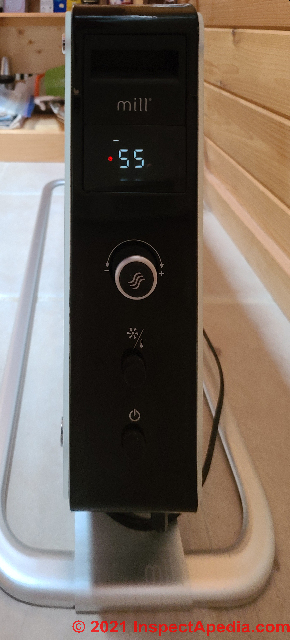
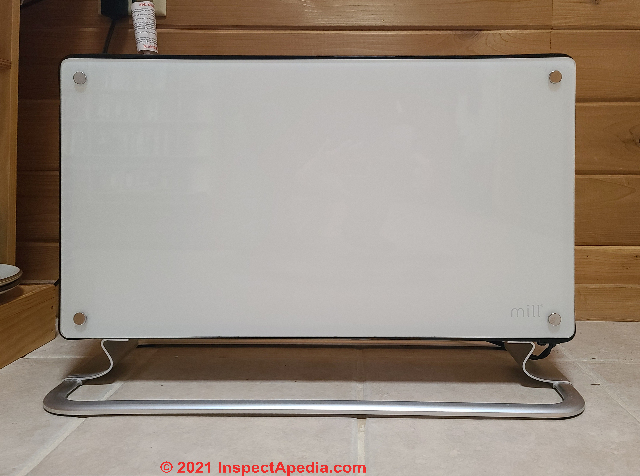
Miscellaneous sources of screaming noises in and around buildings include equipment with small moving parts such as the fan in the Mill International B.V. brand electric heater shown above.
Purchased at Amazon in 2020, this heater includes both convection heat and a small fan to increase heater output. In 2021, the fan motor failed in the middle of the night, making a horrible screaming screeching noise.
While these heaters are no longer sold in the U.S., the company has said it stands behind its warranty and that the heater's purchase price will be refunded.
- Screaming screeching noises in buildings
(or whistling noises) are usually traced to mechanical systems, such as failing bearings in motors, though wind noises over roofs and even through deck boards have been known to scream and moan as well.
See these sources of screaming sounds in or around buildings (usually excluding people, moms, children) - ELECTRIC MOTOR NOISE DIAGNOSIS - bad bearings, screaming motors
- GAS REGULATOR NOISES noises at the gas regulator or piping
- HOWLING NOISES in BUILDINGS
- HVAC NOISE-5 SCREAM SING TRUMPET WHINE WUWU
- OIL BURNER SQUEALING HIGH PITCHED SOUNDS
- SCREECHING WATER HEATER
- SCREAMING HVAC SYTEMS - compressor failures, bearing failures
- SCREAMING WATER HEATER - bad exhaust?
- SHRIEKER SISTERS - my mom knew how to raise Cain
- TANKLESS WATER HEATER WHISTLE
- WATER HEATER NOISE - screaming scaled water heaters
- WATER SUPPLY PIPE WHISTLE NOISE - screaming noises from pipes
- WATER PUMP NOISE DIAGNOSIS that may include shrieking or screaming
- WIND NOISES at BUILDINGS
- Sizzling noises
from a split system air conditioner / heat pump may be heard at the wall mounted unit when the system is in heating mode. [10]
Watch out: some sizzling noises may be traced to an electrical failure at a control, switch, motor, or electrical connection that in turn risks a building fire. Pinpoint the noise source. - Snapping flapping popping roof noises
see
SHINGLE FLAPPING POPPING SNAPPING CAUSE & CURE
and
POPPING SNAPPING NOISE DIAGNOSIS
and
TEMPERATURE CHANGE & ROOF NOISE
Watch out: check first for a nearby electrical problem such as a failing water pump control or even a short in nearby electrical controls for the water system.
Arcing and buzzing, snapping, sizzling noises at electrical controls indicates a fire risk as well as possibly indicating an imminent failure of the equipment or circuit or control.
Because people may use different words to describe similar sounds, be sure to review this full set of
Also see
CLICKING NOISES
POPPING SNAPPING NOISE DIAGNOSIS
TAPPING NOISES
TICKING NOISES
- Squeaking noises
from a split system air conditioner / heat pump might be heard coming from the wall mounted unit. According to Fujitsu, This is the result of minute expansion and contraction of the front cover due to temperature changes. [10]
Also see SCREAMING NOISE SOURCES
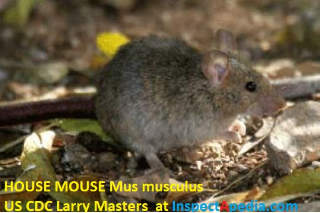
Despite decades of investigations into the causes of various noises in buildings, I've never heard a mouse squeaking in a building. But there are other squeaking noise sources, often from failing bearings or moving parts like door hinges that need a bit of oil. If you do have a mouse problem in your building.
Photo source: U.S. CDC, cited in the article below.see MOUSE in the HOUSE GET RID of ANIMAL PESTS
Photo: a mouse, above, courtesy of the US CDC.
- Tapping noises in buildings
often come from mechanical systems, from thermal expansion and contraction, and occasionally even from dripping water or condensate.
At TAPPING NOISES in BUILDINGS we list articles describing sources of tapping sounds in buildings.
See also Ticking noises at TICKING NOISE DIAGNOSIS
See also Clicking noises at
- Ticking noises in buildings
often come from timers, clocks (of course), electrical controls, but also from places you may not have thought to check like those listed at our article on this topic, now found at
TICKING NOISE DIAGNOSIS
- Water heater noises
include an impressive range of sounds.
See WATER HEATER NOISE or check these specific calorifier or geyser or hot water system sounds:- BANGING WATER HEATER
- BOILING WATER HEATER NOISE
- BOOMING WATER HEATER
- BUZZING WATER HEATER
- CLICKING WATER HEATER
- COMBUSTION NOISES
- CRACKLING WATER HEATER
- HUMMING WATER HEATER
- HISSING WATER HEATER
- KNOCKING WATER HEATER
- POPPING WATER HEATER
- POUNDING WATER HEATER
- RUMBLING WATER HEATER
- SCREECHING WATER HEATER
- SCREAMING WATER HEATER
- SHRIEKING WATER HEATER
- SIZZLING WATER HEATER
- TICKING WATER HEATER
- VIBRATING WATER HEATER
- WHISTLING WATER HEATER
- Water pipe noises
banging water pipes,
see WATER HAMMER NOISE DIAGNOSE & CURE
Water pipes may also make a clicking, snapping, ticking noise, particularly hot water pipes, passing through a tight space, due to thermal expansion or contraction. Heating pipes will click, snap, or tick even more loudly.
Water pipes may also make a hissing, screaming, or whistling sound - caused by water velocity. Try reducing water pressure or partly-closing the main water valve. Does the sound change? - Water pump noises
see - Water tank noises
see
WATER TANK NOISE DIAGNOSIS for a complete catalog of sounds coming from or near the water pressure tank or water storage tank. - Water noises, a sound like running water
may be heard from the following sources:
Running water in plumbing system drain piping system - when plumbing fixtures are in use ( a sink is running or a toilet was flushed) and will be more noticeable if the building drain piping is not sound-isolated or insulated and where plastic rather than cast iron drains are installed.
Running water in drains when no fixture is known to be running is likely to be traced to a running toilet or less often, to a roof drainage system routed through the building's interior or actually into its drain piping.
Running water in building water supply piping might be heard when fixtures are in use, again more-so when piping is not run through a sound-isolating system of mounts and / or insulation.
Refrigerant or condensate piping of a split system air conditioner or heat pump while the equipment is running and/or briefly during unit start-up as well as for a period immediately after the unit shuts off.
While usually we consider the sight or sound of bubbles in the refrigerant piping as an indication of low refrigerant, for some systems this may not be the case and for at least some split system models Fujitsu points out that this sound may be normal.[10]
However if you hear bubbling in the refrigerant piping and the system is not cooling properly, indeed there may be an improper charge or refrigerant may be leaking.
See REFRIGERANT LEAK REPAIR
Running or bubbling water sounds are heard in hot water heating system pipes, baseboards, radiators, & fan convectors if there is excess air in the heating system piping.
Air Leaks: How to Track Down Air Bypass Leak or Air Leak Noises in buildings
This topic has been moved to a new article found
at AIR LEAK NOISES in BUILDINGS
Animal noise and animal-caused noises in buildings, diagnosis & cure
This article topic has been moved to a new article found
at ANIMAL NOISES in BUILDINGS
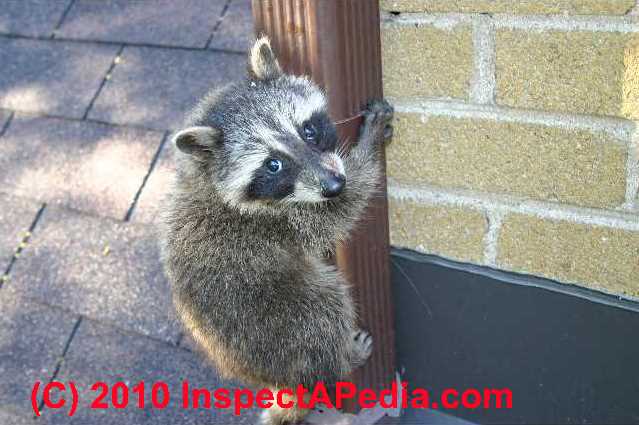
Isn't that raccoon cute?
Watch out: for bites, rabies, and for raccoons who like to find a way into the attic where they bat around the Christmas tree ornaments and leave little sooty footprints all over everything
Appliance Noises in buildings, Sources of
This article topic has been moved to a new article found
at APPLIANCE NOISE DIAGNOSIS
Appliance noises in buildings are a bit easier to track down.
If you are uncertain just which appliance is a noise source, or if it is a noise source, just try turning off individual appliances to check for cessation of noise. Appliance noises cover a wide range, from humming refrigerator compressors to rattling loose metal parts to all sorts of amazing sounds heard at washing machines and dishwashers.
Chimney noises in or on buildings - Danger Signs?
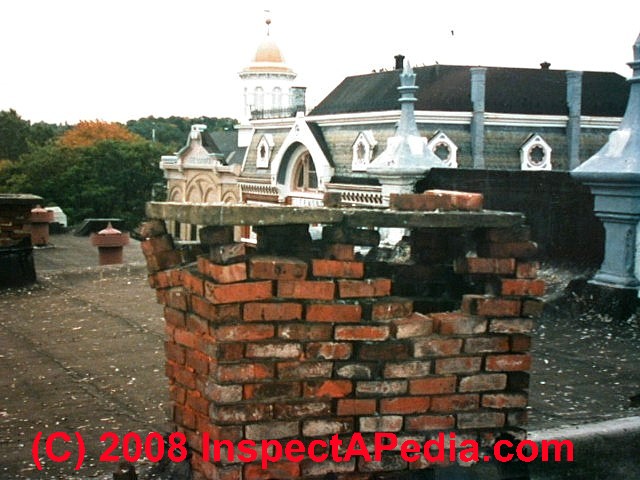
This article topic has been moved to a new article found
at CHIMNEY NOISE DIAGNOSIS
Watch out: A chimney fire sounds like a roaring freight train.
If you suspect a chimney fire and can do so safely, shut down your wood stove (close all air intakes) or close any chimney dampers as well, immediately exit the building, and call the fire department from outdoors.
Dripping Water Sounds in buildings, How to Track Down
This noise diagnosis and repair topic is now found
at DRIPPING WATER SOUND SOURCES
Electrical Equipment or Electrical System Noises in buildings: diagnosis & cure
Please see details we have moved
Watch out: Electrical System Noises can be signs of dangerous conditions: buzzing circuit breakers or fixtures may indicate that an electrical circuit is short circuiting or that a circuit breaker is not tripping when it should.
Fans and Fan Noises in buildings & How to Control Fan Noises
This topic has moved
Also see FAN NOISES, HVAC
Flooring and Floor Noises in buildings
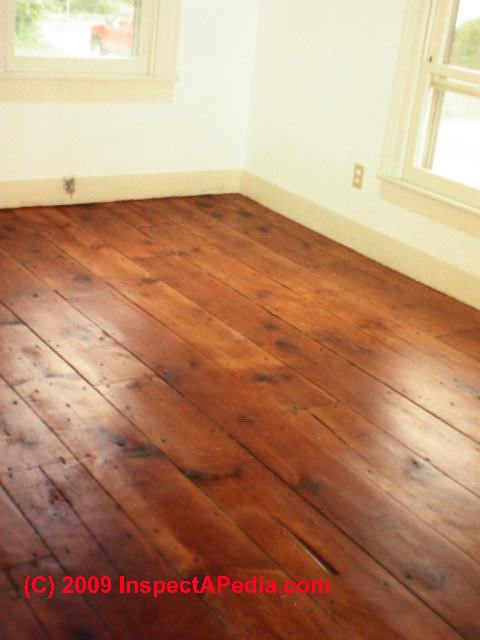
This information was moved to
FLOORING NOISES in BUILDINGS
Also see FLOOR TYPES & DEFECTS - inspection, diagnosis, repair, and installation tips for resilient flooring, vinyl and asphalt floor tiles, wood flooring, tile floors, carpeting in buildings.
Ghost Noises or Odors in & Around Buildings
Among of our building inspection & diagnosis clients have been a few folks who were quite sure that noises and even some visions in buildings were due to the presence of spirits or ghosts.
In most cases sounds and odors were tracked to a physical source and speaking more accurately, if a physiological, psychological, or neurological cause of noise perception is ruled out, all other building noises can ultimately be tracked to a physical source inside or outside of the building.
Readers with suggestions about diagnosing unresolved odors -
See ODORS GASES SMELLS, DIAGNOSIS & CURE
or unexplained noises in buildings -
See NOISE / SOUND DIAGNOSIS & CURE
are invited to comment using the comment box found at the bottom of each InspectApedia article.
Hardware Noises in Buildings: hinges, locks, bolts, etc. can be sources of surprising building noises
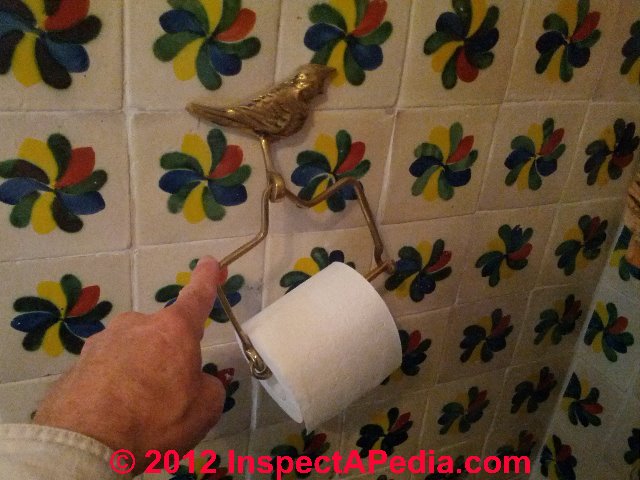
We have traced creaking, chirping, and creaking noises to moving hardware, typically metal or wood or metal and wood parts moving across one another.
More often we find these building noise sources by tracking the sound to a point of origin, seeing something moving, and then relating the sound to the cause of movement. A squeak or creak may be traced to use of a particular building door such as a room passage door or a cabinet door.
Often a squeak or creak that seems to occur in regular intervals that diminish in volume is traced to a hinged fixture that moves when disturbed. Some examples include:
- A creaking squeaking noise traced to a metal toilet paper holder that squeaked when it was jostled to move from side to side (photo, above left). Ironically this creaky toiler paper was a cast brass bird that was squeaking in a sound not unlike a chirping bird.
- A shrieking noise traced to a metal hinge supporting a building sign that waved when wind was blowing
- A creaking towel dispenser
Health, Neurological, and Psychologically-Related Noise Complaints in buildings
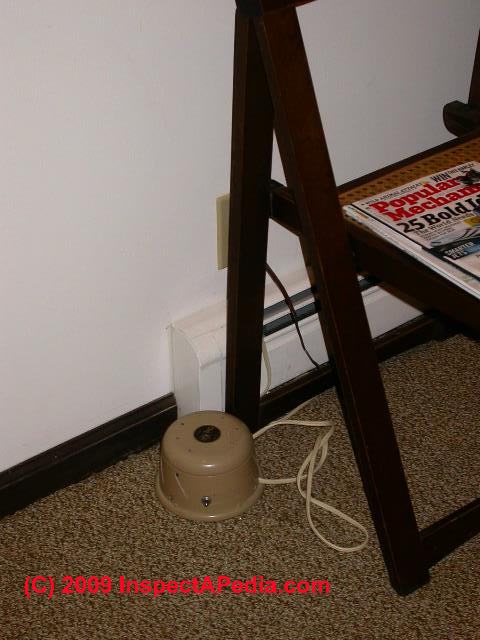
An introduction to this topic is now found
at HEALTH-RELATED NOISE PERCEPTION
Details about this topic are found
at HEALTH RELATED NOISE EFFECTS. Health related noise and apparent noise sources can involve common aging or hearing disorders, dementia, or other serious medical conditions.
Hearing Disabilities and Building Noises
Hearing Disabilities and the ability to identify and track the source of noises in buildings can be difficult for the hearing impaired.
Details are
at HEARING DISORDER NOISE ISSUES
Heating System Noises & Building Temperature-Change Noises
A quick summary of common sources of heating noise problems is
at HEATING SYSTEM NOISES in BUILDINGS
Or see our detailed heating noise diagnosis and repair article series on heating system noises found
at HEATING SYSTEM NOISE DIAGNOSIS
Hissing Noises in buildings
This data was moved to HISSING SOUNDS in BUILDINGS
Humming Sounds at buildings
Please see HUMMING NOISES in BUILDINGS
Howling Deck Noises: check wind, structure, surface textures
A summary of common sources of howling noises in buildings with links to howling noise diagnostic articles
see HOWLING NOISES in BUILDINGS
(Nov 2, 2014) Carolyn said:
We just had our deck rebuilt, changing the warped wood for grooved composite boards held together by hidden Trex fasteners.
The new deck makes a howling sound when the wind blows. We ruled out the deck balusters and railing, so we know it is something to do with the decking. Our builder is as stumped as are we. Any ideas on how to get to the root of the problem and fix it?
Reply:
Carolyn, if I could send you a prize for "best question" I'd do so.
Before posing a solution lets gain confidence in the noise cause.
I suspect the howling deck is a feature of one of the following, combined of course, with wind direction and site or terrain shape and features.
. Size / spacing of decking boards or gaps
. Framing orientation vs wind direction
. Wind over textured surface
. Wind through guardrails or balusters
. Wind redirection caused by decking,
. Something else we've not thought of
You could try a directional mike, even a mechanic's stethoscope but let's try something else first.
Try stapling house wrap first underneath the entire deck floor, from below, on the bottom of the joists. Don't worry, it won't be permanent.
For a complete discussion of howling noises traced to building decks including a completion of discussion of Carolyn's question above,
see HOWLING DECK NOISE- surface textures of decking, possibly framing, deck gaps, wind direction, other factors
Insect Noise and Insect-caused Noises in buildings: buzz, chirp, hum
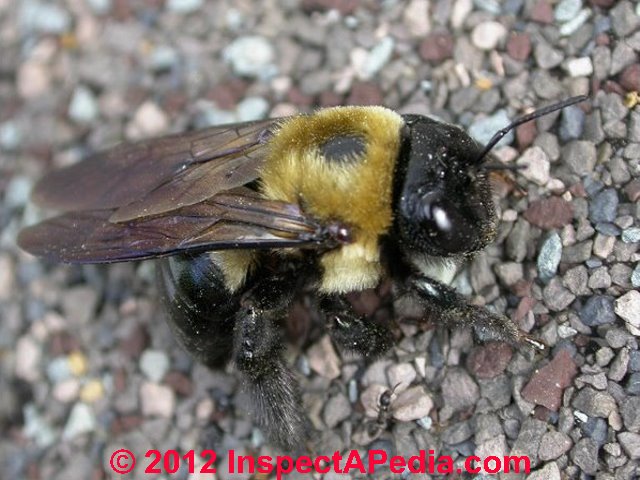
Insect noise and insect-caused noises in buildings include the following
- Buzzing - bees in walls such as honeybees nesting in a building wall or roof cavity, or other bee activity on the building exterior - such as carpenter bees. Buzzing noises may be a colony of honeybees in the building wall.
Watch out: don't go cutting the wall open - you may be attacked. - Chirping - cricket infestations
- Termites or carpenter ants, while tiny as individuals, as a group, chewing away at wood components in a building can make a chewing or tearing noise that some people and many pets or other animals can hear, especially if there is no covering background noise.
- See ANIMAL NOISES in or at BUILDINGS
- Also see BUZZING NOISE DIAGNOSIS - topic home
- Also see POPPING SNAPPING NOISE DIAGNOSIS
- See WOOD DESTROYING INSECTS carpenter ants, powder post beetles, & other wood destroying organisms
Plumbing System Noises in buildings
Our article PLUMBING SYSTEM NOISE SOURCES lists the sources of all types of plumbing noises and traces them to their source.
For the broad topic of controlling plumbing noises in buildings
see SOUND CONTROL for PLUMBING
Roof Noise Transmission & Structural Noises in buildings: Sources, Causes, Remedies
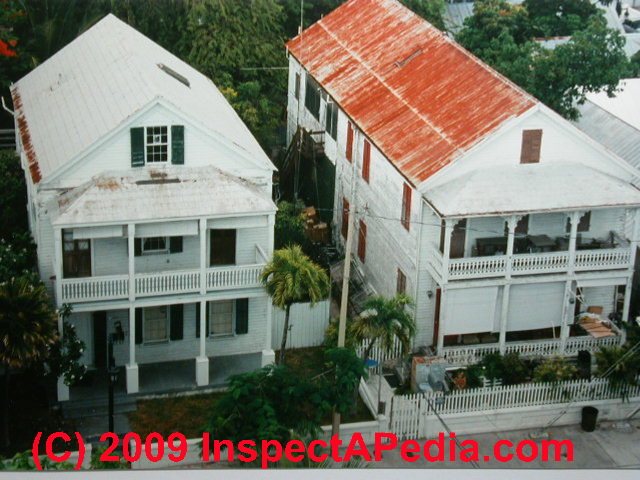 Details about roof noise and sound transmission cause and remedy are
at ROOF NOISE TRANSMISSION - topic home. Excerpts are below.
Certain building configurations, such as occupied attics or under-roof areas with cathedral ceilings, and metal roofed buildings may transmit noises to the building interior through the roof sheathing and building framing.
Where roof-transmitted sound reduction is most sought is in buildings located close to high noise areas such as under the flight path to airports.
Our photo of metal roofed homes (left) shows two older houses in Key West, Florida.
Types of Roof Noises & Sounds
Roof noises may be described as those attributed to an obvious source: the patter or even the roar of falling rain or hail, popping and cracking noises (perhaps due to thermal expansion and contraction of roof coverings, metal roofing, or roof structure), and transmitted noises from other external sources such as low-flying aircraft or nearby trains or auto & truck traffic from a nearby highway.
Types of Roof Noise Sources
- Noises generated by the roof itself,
such as thermal movement in a metal roof - Noises generated by impacts on the roof
such as acorns, rain, hail falling on the roof surface - Noises generated by roof interaction with the environment:
such as a roof that howls when wind blows from a particular direction - Noises caused by roof installation defects or failures:
such as wind flapping popping snapping shingles - Noises whose source is hosted by the roof:
roof-mounted mechanical equipment such as air conditioners, fans, chimneys & chimney caps or on occasion animals: stomping seagulls and scampering squirrels or rampaging raccoons
Accurate diagnosis of the source of roof noise transmission is important in deciding what remedy may work best.
For example, check during rainfall to accurately determine the loudest sound source - you might find that more noise is transmitted to the building interior through skylights than through the roof surface itself.
To the human ear, cutting noise levels in half, a
reduction of over 20 decibels is quite significant. - Colbond [2]
We describe
at METAL ROOF EXPOSED FASTENER FLASHING
One frequently cited disadvantage of metal roofing is that it generates a noticeable noise when struck by rain, hail, or even dropping acorns. If installed directly to purlins with no roof sheathing, the noise might be heard in the building interior.
However, when installed over a solid substrate, with normal levels of insulation, the noise should not be noticeably different than with other roofing types.
See details about roof noise source detection and noise control at
- METAL ROOFING
- POPPING SNAPPING NOISE DIAGNOSIS
- ROOF NOISE TRANSMISSION - topic home - catalog of roof noises, causes, cures, prevention
- TEMPERATURE CHANGE & ROOF NOISE - separate article
- WIND NOISES ON ROOFS - separate article
Sound Transmission Class - STC & OITC: Sound Transmission Loss Properties for Building Walls & Roofs
Definition of STC or Sound Transmission Class
STC or sound transmission class is defined as the level of reduction of sound transmission from outside noise sources to the building interior.
Higher STC numbers mean higher resistance to sound transmission to the building interior, or as acousticians would describe it, higher STC means greater sound transmission loss between outdoors and the building interior. Typical STC values for metal buildings are STC=20 to STC=55.
OITC or Outdoor-Indoor Transmission Class describes the sound transmission loss properties of building exterior components like windows and walls against noise from traffic, trains, or low flying aircraft.
- General Steel Corporation [3]
- SOUND CONTROL in BUILDINGS - How to control noise & sound transmission in buildings.
Reader Question: (Jan 13, 2015) Bonnie said:
I had an Owens Corning roof installed with Tru Definition shingles. They installed a Ridge Vent with O'hagin vents and there are the T Top Vents.
During a wind storm I hear a sound coming from the front of the house that sounds like a horn sound. It goes on and off for the entirety of the wind storm. Had the roofer here and he can't pinpoint what is making the horn sound or how to fix it. Ideas?
Reply:
Bonnie
I'd start by temporarily blocking off the ridge vent by simply taping some plastic over it.
Also see NOISE TRANSMISSION in ROOFS
Siding Noises, Possible Causes, Effects, Cures for Vinyl Siding
This material moved to a new article
Stair and Step Noises in buildings
Stair noises in buildings include noisy stair treads that may creak or snap when stepped-on. See
STAIRWAYS: Stair, Railing, Landing Safety Inspections, stair codes, stair design, stair hazards, stair inspection checklist
Also see FLOORING & FLOOR NOISES
and see POPPING SNAPPING NOISE DIAGNOSIS
Wall Noise Transmission Articles
Noise transmitted through walls (or ceilings) from mechanical rooms (boilers, furnaces) or utility rooms (WASHING MACHINE NOISE CAUSE & CURE, dryer) can be reduced by using good sound isolation construction and insulating materials.
See SOUND CONTROL in BUILDINGS for a series of articles on sound control in buildings.
Causes of Water heater noises or sounds in buildings
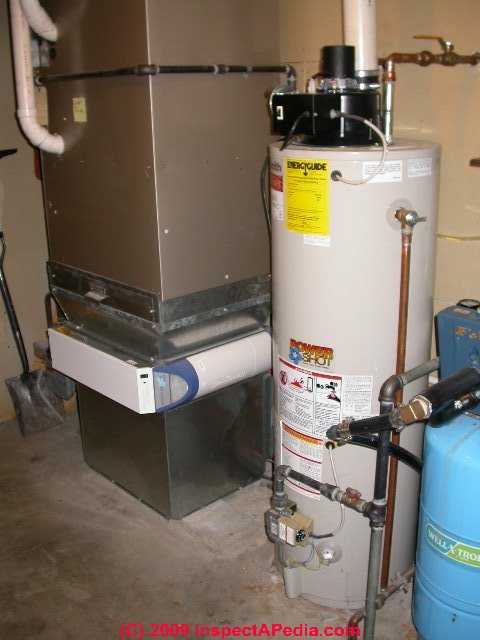
WATER HEATER NOISES in buildings include
Crackling or popping sounds as the water heater is warming up, especially if the water supply is high in mineral content, leading to mineral deposits on the bottom of the water heater or on electric water heating elements
Water heater noises & sounds:
see WATER HEATER NOISE DIAGNOSIS, CURE for details, diagnosis, and cure of water heater sounds.
Watch out: water heater noises can indicate a high level of water heater scaling that increases water heating cost, reduces the quantity of hot water available, and can reduce water heater life.
Water heater noises can also indicate that the heater has been set to a too-high temperature and may be unsafe, risking scalding or other hazards.
See these noise-related water heater articles:
- POPPING SNAPPING NOISE DIAGNOSIS
- WATER HEATER NOISE DIAGNOSIS, CURE
- WATER HEATER FLUSH OUT PROCEDURE
- WATER HEATER SCALE - DE-LIMING
- WATER HEATER SCALE PREVENTION
- WATER HEATER SAFETY
- WATER HEATER TEMPERATURE ADJUSTMENT CONTROLS
Wind-caused noises in or at buildings
Wind Noise and wind-caused noises in buildings include a surprising number of mechanisms and sounds now discussed
at WIND NOISES at BUILDINGS
Track Down Window & Door Related Noises in buildings
While sound-reducing or low-sound transmission windows using noise-reducing laminated glass and similar noise-reducing exterior or interior building doors are available, remember that as soon as you open a window for ventilation, the sound isolation benefit at that location is lost.
Sound-reducing doors should be of solid materials, have no glass windows or glazing, and should be sealed around the door perimeter with sound insulating foam or similar gaskets.
- DOORS, ENERGY EFFICIENCY
- DOORS, EXTERIOR FIBERGLASS vs STEEL
- DOORS, INTERIOR
- SKYLIGHT LEAK DIAGNOSIS & REPAIR
- SLOPED GLAZING DETAILS
- SPONTANEOUS GLASS BREAKAGE NiS
- VERTICAL GLAZING DETAILS
- WINDOWS & DOORS, AGE, TYPES articles on window selection, installation, efficiency, leaks, diagnosis, and repair
- WINDOW / DOOR ENERGY EFFICIENT, DOE
- WINDOW FLASHING & SEALING GUIDE
- WINDOW GLAZING BASED on CLIMATE
- WINDOW LEAKS INTO BASEMENT
- WINDOW SHADING, SCREENING
Reader Comments, Questions & Answers About The Article Above
Below you will find questions and answers previously posted on this page at its page bottom reader comment box.
Reader Q&A - also see RECOMMENDED ARTICLES & FAQs
On 2023-10-22 by InspectApedia Publisher - sounds carry farther over water
@Day canoeist,
In general sounds carry farther over water particularly quiet water and are more lost in background noise of a city.
On 2023-10-22 by Day canoeist
Do you think noises carry farther when we're canoeing and when we are in the city?
On 2023-08-21 by InspectApedia Publisher - Keeping a noise log can help identify noise source
@Anonymous,
Keeping a noise log as described above on this page might help you identify just what equipment is running at the intervals that makes that noise.
On 2023-08-21 by Anonymous
I am in an apartment building and here this strange noise every few minutes mostly in the evenings. Sounds like it is coming from above or next to the apt. Almost like something plumbing or mechanical. Usually two of these segments and then two more in ten minutes.
On 2023-07-12 by InspectApedia Publisher - what is causing the humming noise I hear
@Kathy,
Sure, glad to help.
Above at this page where we list tracking different types of noises to their source we have a link to
HUMMING NOISES
That's a good place to start. Step through that checklist and let me know what you find.
On 2023-07-12 by Kathy
In December, I began to get a humming noise in my house. It was traced to a faulty Xcel transformer next to my property. Xcel replaced the transformer and the humming got better.
But it has returned and has gotten worse. However, the transformed is quiet. I have contacted Xcel, but since the transformer is working correctly, they do not believe it is related to their equipment.
What else could be causing it? I have tried to drown it out with fans and a white noise machine, but nothing helps. It keeps me awake at night. Who could help me find the source of this problem?
Any help is appreciated. E-mail: cathygregorich@comcast.net
On 2023-02-27 by InspectApedia Editor - imminent risk of catastrophic building collapse requires immediate action
@Bernice,
Considering the risk of injury and loss of life should your building collapse, and given no other information but what you've cited, in my opinion you should call 911 - emergency services, and report that building noises and history raise enough worry about a possible catastrophic building collapse that an expert evaluation is needed immediately.
You would then notify your building management and other occupants that you've raised this concern, also immediately.
Most likely, people should get OUT of the building immediately and move to a safe distance until experts have determined its safety. Rather than risk loss of life we have no choice but to err on the side of caution.
Please give us the location of the building and let us know what is the response to your 911 call. But don't waste more time on the internet. Call 911. Take action. Now.
On 2023-02-27 by Bernice
For the past few months, residents living in this cracking, crumbling, neglected, low rise condominium building have been hearing strange rumbling noises that sometimes shake and shudder the walls and floors of many units on every floor.
At first we thought someone had built a skateboard ramp in their rental unit because the rumblings sounded very much like somebody was occasionally skating ramp from one side to the other because the sounds and vibrations would always come in patterns of two,, only a few times a day.
When the frequency of the sets increased to every few hours and most every long term tenant in building began questioning each other trying to determine where the sounds were coming from,
some suggested the sounds could be the result of tenants opening and closing their lanai’s sliding glass doors, but then the sounds increased to several times hour every hour around the clock
to the point it completely unimaginable that anybody would do such a thing as constantly open and shut their doors that frequently and our investigations of where could this rumbling be coming from
only proved that tenants on every floor from one end of the building to the other have been baffled and even quite worried by these sounds and other thunking and pipe clanging sounds that accompany what feels like the floors are moving beneath our feet.
There are so many warning signs that this old building is about to collapse, I fear for my children’s and grandchildren’s lives and actively searching for another home to rent.
So much debris has fallen from exterior walls and from beneath the bottom floor lanais that there’s caution tape and cones warning residents to avoid at least five areas around the building and surrounding property.
And there’s been two fires in a span of less than one year, as well as life threatening fire hazards from ancient faulty electrical wiring and massive cockroach infestations in nearly every unit,
as well as constant plumbing breaks and mysterious water puddles coming up through the floors and condensation bubbling the paint on the walls and ceilings, oh, and there’s rats and termites, too.
What do you think may be causing those sounds ? And do you have any suggestions about what authorities I should alert about these problems before I move?
I can’t in good conscience just leave the building knowing how many lives could be in danger if this should-be-condemned building crushes down on top of them.
On 2022-12-21 by InspectApedia (Editor)
@Nik,
Snoring noises can certainly come from a plumbing fixture drain or even supply piping (some types of water hammer or water velocity noise in piping). Keeping a careful note using the Sound Log that we recommend can help track down the sound, as can the simple test of slightly closing the main water valve to reduce the water flow rate.
Don't forget to include hot water heating piping and radiators/baseboards in such diagnosis.
On 2022-12-21 by Nik
@Suzann, I have the same thing - you described it perfectly. It's in between a half bath and a full bath, right in between two toilets, and it sounds like it's at the top. of my bathroom or at ear level. It's so weird - I originally thought it was a dog sleeping on the floor above me snoring, but now it sounds like something in the wall. I will check timing. I live in an old prewar building in UWS.
On 2022-12-13 by Suzann
@InspectApedia (Editor), I have! It’s crazy. 4:30am until midnight I’ve heard it. Perfectly spaced in time. No derivation.
On 2022-12-12 by InspectApedia (Editor) - "I hear rhythmic perfectly timed snoring sounds in my den"
@Suzann,
Above on this page we suggest
Find the Source of Building Noises by Keeping a Sound or Noise Event Log
To track a mystery noise or sound to its source in a building, try keeping a noise log, noting the conditions, times, events, and information we list in our printable sound event log worksheet:
We provide a sound event log in three formats:
SOUND EVENT LOG a web article including explanation of what information should be recorded to help track down the source of building sounds & noises
BUILDING NOISE LOG a simplified printable html file
NOISE LOG, PRINTER-FRIENDLY- [PDF] RECOMMENDED - to assist in noise localization in buildings.
SOUND EVENT LOG - provides more detail
On 2022-12-12 by Suzann
I hear rhythmic perfectly timed snoring sounds in my den near exterior wall. You can’t hear it outside.
On 2022-12-07 by InspectApedia (Editor) - How to register a noise complaint
@Anonymous,
How to register a noise complaint:
Noise complaints, a common concern, might be taken to your local building department; you need to identify your country and city of location; some cities have specific noise ordinances and enforcement authorities.
For example in San Francisco, CA, USA, In-Progress noise complaints are handled by the Police Non-Emergency Telephone Number 415-553-0123,
DO NOT CALL THIS NUMBER if you do not live in San Francisco - I just gave this as an example.
For another example, in Paris France, If your noise issue not urgent, like to make a noise complaint in the evening, you should call your nearest police station (commissariat de police).
In a smaller city ask your building or zoning department whom to call.
For larger cities in most countries you can try a simple web-search for "noise complaints in "cityname" "
Watch out: if the noise you hear suggests that there could be a life-safety emergency such as hissing gas, crumbling collapsing structures, or if you smell gas, or fire-smoke, get everyone out of the building and call emergency services from a safe distance.
On 2022-12-07 by Anonymous
I don't know where to go with this. I have a neighbor that has a industrial building ... . Some type of noise; I'm guessing a large cooler fan is LOUD and seems to never stop.
Where can I find out what my rights are as a neighbor, how long this noise can be going on and on, who can give me information.
Does the noise supposed to exceed a certain amount of decibles if so how many and for how long. Please point me in the direction I need to be. Please.
On 2022-11-30 by InspectApedia (Editor)
@Feroza,
If the noise occurs only when there is wind, it is certainly wind-related.
On 2022-11-30 by Feroza
We live in a condo that is designed like a ship. Our unit is like a Arc design. The wind is terrible but acceptable but recently we have started getting noises in the evening and late night from above like a rotating movement object like it is churning very deeply.
Our management has checked everything on the roof and has ruled it out as wind noise. The wind is so severe here and we know the difference between howling and churning.
What could be the cause
On 2022-10-19 by InspectApedia (Editor) - "we hear huge banging‘s or slamming intermittently"
@A C,
Above on this page you will find lists of sources of banging noises in buildings. Best bet is to take a look through those and select the ones that could possibly apply to your building and then investigate those possible sources. Let me know what you find or what further questions may arise.
On 2022-10-19 by A C
Hi I live in a three-story apartment building on the second level and I live in an end unit. My bedroom has two exterior walls. One interior wall faces into the living room and the other into the bathroom.
In my room only, we hear huge banging‘s or slamming intermittently. I did not hear it for the first six months I lived here And then suddenly between August 16 and 19th I heard it for those four days on and off.
It never is after 9 PM at night but sometimes start as early as 8 AM. I didn’t hear it again until around 29 September or that week and now I’ve been hearing it for the last week and a half almost every single day.
It is terrifying my small 12 year old dog who is hiding in the closet or the bathroom shaking uncontrollably. I thought my upstairs neighbors were doing it but now I have corroborating evidence from other neighbors who were in the third floor apartment at the time the noise occurred and none of them were doing it as were no one in my home.
What can this slamming/banging be that is causing me severe stress and anxiety as well as my dog!?? I am at my wits end. Any and all suggestions are appreciated.
On 2022-08-05 by InspectApedia-911 (mod)
@Wallyburger,
That certainly sounds like an electrical or wiring connection problem with your home theatre system.
I'm totally baffled, however, if in fact you've turned off components and still hear the sound.
I'd start over again. With power to the equipment OFF I'd check all of the speaker connections.
On 2022-08-05 by Wallyburger@aol.com
I have a sound that sounds like a low “explosion” near my home theatre. This has been going on for several weeks. It happens at close to the same time every day and only lasts a few seconds.
I have tried turning off all components, disconnecting components and moving them away. I have sat by each speaker and do not hear the sound from them. I can not find the source. Any suggestions would be appreciated!
On 2022-08-03 by Poppy
@InspectApedia-911, Brilliant. Thank you so much for your help! Much appreciated
On 2022-07-31 by InspectApedia-911 (mod)
@Poppy,
Certainly any building defect or appliance or equipment malfunction that is causing a short circuit is dangerous, risking shock or fire.
It seems that a simple first step would be to turn off circuits, one by one, to see which circuit stops the noise.
When you find that circuit you'll then follow it (or have your electrician follow it) to see what it's powering.
On 2022-07-31 by Poppy
@InspectApedia-911, thanks very much for your reply. So it’s been happening for just over a month but just recently has been shorting out the electrics in the kitchen. I’m wondering if it’s become a hazard? Should this be the job for a plumber to solve or an electrician do you think?
On 2022-07-24 by InspectApedia-911 (mod)
@Poppy,
If there is Plumbing in a basement apartment it's very often the case but a pump is used to lift the Wastewater up to the building drain. If that's happening and if there is a leak somewhere that is leaking into the pumping chamber, such as a running toilet, that could cause a pump to cycle on and off.
On 2022-07-23 by Poppy
Lived here a year and every now and then noticed a rhythmic pump sound, usually late at night, similar to the starting of a washing machine and the inlet of water. Recently this sound is constant and consistent — I’ve timed it as running for just over 6mins with a pause of just over 2mins. 24/7. Sometimes the pumping of water sounds strained and gargled, other times, it’s just like a flow.
I have no idea where’s it’s coming from. I have a very tiny kitchen — side by side are my washing machine, kitchen sink and boiler. I’ve checked all around them and behind the kickboards — It sounds as though it’s beneath the floor between them. I live in a basement and don’t believe there is a cavity under there.
My neighbour mentioned it could be a Saniflo — however, surely they do not run 24/7 and this is newly constant. Would anyone have any idea what this could be?
On 2022-06-01 by InspectApedia-911 (mod)
@Wanda,
If you've actually removed mechanical equipment and therefore it's not connected to power it seems to me that the noise has got to be coming from something that has been left in place. This article provides a check list of possible noise sources. Please take a look and don't hesitate to follow up with us
On 2022-06-01 by Wanda
Doing a whole house renovation. Removed furnace, HVAC and hot water heater. I've got a loud long whine or howling noise come from the same side of the house that the HVAC unit outside is on. The furnace was in the basement on that side also.
What is causing this noise? It comes and goes nothing long lasting just unexpected and kinda spooky. Contractor hasn't finished disconnecting all if the pipes from HVAC unit and possibly furnace. Any thoughts. He hasn't a clue.
On 2022-05-25 by InspectApedia-911 (mod)
@Dennis,
Yes often an audio engineer who is familiar with sound source tracing can use a dB meter to help track noises to their source.
But before going that more-costly route, take a look at
SOUND LOG - provides more detail
where you might find other factors such as other equipment on-off times that can help point to a source of noise.
On 2022-05-25 by Dennis
There is an undulating sound in my house 24/7. If Circuit breaker is shut off the sound is still there. Many plumbers have come; when the water main is shut off the annoying sound is still there. Is their some type engineer that can use an instrument to locate the source?
On 2022-03-26 by Inspectapedia Com Moderator
@Anonymous,
If there are explosion sounds coming from INSIDE YOUR HOME you should get everyone out and call 911.
Otherwise while there are other less-likely booming noise sound sources in Florida, for the case you mention, you may be hearing aircraft-generated booming sounds - your location is not far from Florida's Patrick Airforce Base or Cape Canaveral Space Force Station, Florida.
On 2022-03-26 by Anonymous
Explosion sounds right now saint cloud, fl?
On 2022-02-02 by Inspectapedia Com Moderator
@Kelly Trewella,
Please take a look at our catalog of sources of banging noises in homes
BANGING BOOMING NOISE DIAGNOSIS & CURE
and let us know what you find after stepping through those noise sources and noise diagnosis suggestions.
On 2022-02-02 by Kelly Trewella
Every 35 minutes I hear a loud bang inside my home. It doesn’t correlate with water running or the heater turning on. It happens when nothing is running. I’ve been in my utility closet when it happens (in my basement). Nothing is happening in there.
It seems to be above the basement below the first floor. No clogged drains or backed up water. Is this a plumbing issue or an HVAC issue?
...
Continue reading at AIR LEAK NOISES in BUILDINGS or select a topic from the closely-related articles below, or see the complete ARTICLE INDEX.
Or see NOISE / SOUND DIAGNOSTIC FAQs - questions & answers about finding and curing the source of building or house noises
Or see these
Recommended Articles
- NOISE / SOUND DIAGNOSIS & CURE - home
- NOISE TRANSMISSION PATHWAYS
- NOISE SOURCE LOCATION - LOG FILES
- ALPHABETICAL LIST OF NOISES by SOURCE or SOUND TYPE
- AIR CONDITIONING NOISES
- AIR LEAK NOISES in BUILDINGS
- ANIMAL NOISES in BUILDINGS
- APPLIANCE NOISE DIAGNOSIS
- BANGING BOOMING NOISE DIAGNOSIS & CURE
- BUZZING NOISE DIAGNOSIS
- CHIMNEY NOISE DIAGNOSIS
- CLICKING NOISE DIAGNOSIS & CURE
- DECIBEL METER dB METER CHOICES
- DRIPPING WATER SOUND SOURCES
- DUCT SYSTEM NOISES
- ELECTRIC MOTOR NOISE DIAGNOSIS
- ELECTRICAL SYSTEM NOISES
- FAN NOISES in BUILDINGS
- FLOORING NOISES in BUILDINGS
- GHOST NOISES
- HARDWARE NOISES
- HEALTH-RELATED NOISE PERCEPTION
- HEARING DISORDER NOISE ISSUES
- HEATING SYSTEM NOISES
- HISSING SOUNDS in BUILDINGS
- HOWLING NOISES in BUILDINGS
- HUMMING NOISES in BUILDINGS
- HVAC SYSTEM NOISE DIAGNOSIS
- HOWLING NOISES
- INSECT RELATED NOISES
- PLUMBING SYSTEM NOISE SOURCES
- POPPING SNAPPING NOISE DIAGNOSIS
- RINGING NOISE DIAGNOSIS
- ROOFING NOISES
- SCREAMING NOISES in BUILDINGS
- SIDING NOISES & SOUNDS
- SOUND CONTROL in BUILDINGS
- STAIR NOISES
- TAPPING NOISES in BUILDINGS
- TICKING NOISE DIAGNOSIS
- WALL NOISES
- WASHING MACHINE NOISE CAUSE & CURE
- WATER HEATER NOISE DIAGNOSIS, CURE
- WIND NOISES at BUILDINGS
- WINDOW NOISES
- SOUND CONTROL in BUILDINGS - home
Suggested citation for this web page
NOISE / SOUND DIAGNOSIS & CURE at InspectApedia.com - online encyclopedia of building & environmental inspection, testing, diagnosis, repair, & problem prevention advice.
Or see this
INDEX to RELATED ARTICLES: ARTICLE INDEX to BUILDING NOISE DIAGNOSIS
Or use the SEARCH BOX found below to Ask a Question or Search InspectApedia
Ask a Question or Search InspectApedia
Try the search box just below, or if you prefer, post a question or comment in the Comments box below and we will respond promptly.
Search the InspectApedia website
Note: appearance of your Comment below may be delayed: if your comment contains an image, photograph, web link, or text that looks to the software as if it might be a web link, your posting will appear after it has been approved by a moderator. Apologies for the delay.
Only one image can be added per comment but you can post as many comments, and therefore images, as you like.
You will not receive a notification when a response to your question has been posted.
Please bookmark this page to make it easy for you to check back for our response.
Our Comment Box is provided by Countable Web Productions countable.ca
Citations & References
In addition to any citations in the article above, a full list is available on request.
- ACGIH "A Guide For the Control of Audible Sound Hazards" 1st Ed., ACGIH, American Conference of Government Industrial Hygienists, Threshold Limit Value for Physical Agents Committee, (2020) Website: acgih.org
- Acoustical Society of AmericaElaine Moran, ASA Office Manager, Suite 1NO1, 2 Huntington Quadrangle, Melville, NY 11747-4502
516) 576-2360, FAX: (516) 576-2377 email: asa@aip.org.
ASA is an excellent source of noise and sound standards. Quoting from the associations history page:
"From the Society's inception, its members have been involved in the development of acoustical standards concerned with terminology, measurement procedures, and criteria for determining the effects of noise and vibration.
In 1932, The American National Standards Institute (ANSI), then called the American Standards Association, appointed the Acoustical Society as sponsor of a committee, designated as Z-24, to standardize acoustical terminology and measurements. The work of this committee expanded to such an extent that it was replaced in 1957 by three committees, S1 on Acoustics, S2 on Mechanical Shock and Vibration, and S3 on Bioacoustics, with a fourth, S12 on Noise, added in 1981.
These four committees are each responsible for producing, developing a consensus for, and adopting standards in accordance with procedures approved by ANSI. Although these committees are independent of the Acoustical Society, the Society provide s the financial support and an administrative Secretariat to facilitate their work.
After a standard is adopted by one of these committees and approved by ANSI, the Secretariat arranges for its publication by ASA through the American Institute of Physics. The ASA also distributes ISO and IEC standards.
Abstracts of standards and ordering information can be found online on the ASA Standards Page. More than 100 acoustical standards have been published in this way; a catalog is also available from the Standards Secretariat (631-390-0215; Fax: 631-390-0217).
The Society also provides administrative support for several international standards committees and acts as the administrative Secretariat (on behalf of ANSI) for the International Technical Committee on Vibration and Shock (TC-108)." - http://asa.aip.org/history.html - ANSI/ASA S12.60, Acoustical Performance Criteria, Design Requirements, and Guidelines for Schools, 2002.
- [1] Connelly, Maureen, Hodgson, Murray, "Thermal and Acoustical Performance of Green Roofs", Sound Transmission Loss of Green roofs, [presentation, Session 1.5], Greening Rooftops for Sustainable Communities, conference, awards, trade show, Baltimore MD, 30 April-2 may 2008. Web search 4/3/2011 original source: commons.bcit.ca/greenroof/publications/2008_grhc_connelly_hodgson.pdf.
These authors provide an excellent bibliography of references for sound transmission in buildings, including some of the references cited just below:- Sharp, BH 1973, Study of Techniques to Increase the Sound Insulation of Building Elements. U.S. Department of Commerce PB-222 829, Washington.
- Sharp, BH & Martin S 1996, "The Measurement of Aircraft Noise Reduction in Residences", Proceedings of Inter-Noise, Liverpool, 1996, pp. 2747-2752.
- Friberg, R 1973, "Transmission Loss and Absorption Factors for Corrugated Steel Roofs, Insulation on the Outside", Proceedings of Inter-Noise, Copenhagen, 1973, pp. 213-217.
- [2] Colbond, EnkaTech Note, "Acoustical Benefits of Roof Underlayments", Colbond Inc., PO Box 1057, Enka NC 28728, Tel: 800-365-7391, website: www.colbond-usa.com web search 4/3/2011, original source: products.construction.com/swts_content_files/1329/E835617.pdf
- [3] General Steel Corporation, "The Facts About the Acoustical Performance of Metal Building Insulation 2", Sound Transmission Class, General Steel Corporation, 10639 W. Bradford Road, Littleton, CO 80127, web search 4/3/11, original source: http://www.gensteel.com/insulation_facts-5a.htm
- [4] North American Insulation Manufacturers Association NAIMA, "Insulation Facts #58: The Facts About the Acoustical Performance of Metal Building Insulation", NAIMA, 44 Canal Plaza, Suite 310, Alexandria VA 22314, tel: 703-684-0084, website: http://www.naima.org/
- [5] Sarah Hager Johnston, Peregrine Information Consultants, Tel: 860-676-2228, Website: www.peregrineinfo.com Email: info@peregrineinfo.co
Research and writing for insurance, risk management, safety & health, business, and medical professionals. Quoting:
Peregrine Information Consultants provides customized secondary research, technical information, and standards, news, current awareness services, writing, and editing to support U.S. clients in property/casualty insurance, risk management and loss control, occupational safety and health, consumer safety, business, retail, manufacturing, and other industries. - Best Practices Guide to Residential Construction, by Steven Bliss. John Wiley & Sons, 2006. ISBN-10: 0471648361, ISBN-13: 978-0471648369, Hardcover: 320 pages, available from Amazon.com and also Wiley.com. See our book review of this publication.
- DEVELOPMENTS in NOISE CONTROL [PDF] NRCC, National Research Council, Canada, suggestions for noise control, sound transmission through block walls, plumbing noise control, noise leaks, and sound control advice. Web search 01/17/2011, original source: www.nrc-cnrc.gc.ca/eng/ibp/irc/bsi/90-noise-control.html
- Thanks to audiologist Cheryl P. Harllee, licensed hearing specialist, for discussing noises and noise problems in preparation for this article. Ms. Harllee can be located at the Village Hearing Center, 249 U.S. Highway One, Tequesta FL 33469 561-744-0231
- [10] Fujitsu Room Air Conditioner, Wall Mounted Type, Heat & Cool Model (Reverse Cycle) [Heat pump units] Operating Manual, Models: ASU18RLXS
ASU24RLXS
ASU30RLX (indoor & outdoor units).
Fujitsu General America, Inc., 353 Route 46 West, Fairfield, NJ 07004, Tel: (888) 888-3424, Tel-Service hotline: (866) 952-8324, Email: hvac@fujitsugeneral.com, Email service: servicehvac@fujitsugeneral.com, retrieved 8/30/12, original source: fujitsugeneral.com/PDF_06/OperationManual/%28OM%29ASU18-24RLX-30RLX.pdf - dead link 2023/04/13 - [11] Bauer, B., “Microphone Directivity”, Transactions of the IRE-PGA, July 1952, 10-20
- [12] Killion, M., et. al., “Real-World
Performance of an ITE Directional
Microphone”, The Hearing Journal, April
1998 - [13] Blauert, J.: Spatial hearing: the psychophysics of human sound localization; MIT Press; Cambridge, Massachusetts (1983)
- [14] Localization of sound in rooms, the effect of visual fixation [PDF] W.M.Hartmann, {Proceedings 11th ICA}, (Journal d'Acoustique) {3}, 139-142 (1983). - Original source: www.pa.msu.edu/acoustics/37loc.pdf
- [15] "Localization of a source of sound in a room," W.M. Hartmann, Proc. Audio Engr. Soc. Eighth International Conference, ed. S. Pizzi, pp 27-32, AES, New York (1990).
- Hartmann, W.M., LOCALIZATION of SOUND in ROOMS [PDF] , retrieved 2023/04/13, original source: web.pa.msu.edu/acoustics/rooms1.pdf and US NIH at pubmed.ncbi.nlm.nih.gov/6643850/
Abstract
This paper is concerned with the localization of sources of sounds by human listeners in rooms. It presents the results of source-identification experiments designed to determine whether the ability to localize sound in a room depends upon the room acoustics, and how it depends upon the nature of the source signal.
The experiments indicate that the localization of impulsive sounds, with strong attack transients, is independent of the room reverberation time, though it may depend upon the room geometry. For sounds without attack transients, localization improves monotonically with the spectral density of the source.
Localization of continuous broadband noise does depend upon room reverberation time, and we propose the concept of direct signal to reverberant noise ratio to study that effect.
Source identification experiments reveal certain localization biases, invisible to minimum-audible-angle experiments, and of uncertain origin. Appendices to this paper develop the statistics of the source-identification paradigm and show how they relate to the minimum audible angle. - Rakerd, Brad & W.M. Hartmann, LOCALIZATION OF SOUND IN ROOMS, II: THE EFFECTS OF A SINGLE REFLECTING SURFACE [PDF] The Journal of the Acoustical Society of America 78, no. 2 (1985): 524-533.
- Tabry, Vanessa, Robert J. Zatorre, and Patrice Voss. THE INFLUENCE OF VISION ON SOUND LOCALIZATION ABILITIES IN BOTH THE HORIZONTAL AND VERTICAL PLANES [PDF] Frontiers in psychology 4 (2013): 932.
Abstract:
Numerous recent reports have suggested that individuals deprived of vision are able to develop heightened auditory spatial abilities. However, most such studies have compared the blind to blindfolded sighted individuals, a procedure that might introduce a strong performance bias.
Indeed, while blind individuals have had their whole lives to adapt to this condition, sighted individuals might be put at a severe disadvantage when having to localize sounds without visual input.
To address this unknown, we compared the sound localization ability of eight sighted individuals with and without a blindfold in a hemi-anechoic chamber.
Sound stimuli were broadband noise delivered via two speaker arrays: a horizontal array with 25 loudspeakers (ranging from −90° to +90°; 7.5°) and a vertical array with 16 loudspeakers (ranging from −45° to +67.5°).
A factorial design was used, where we compared two vision conditions (blindfold vs. non-blindfold), two sound planes (horizontal vs. vertical) and two pointing methods (hand vs. head).
Results show that all three factors significantly interact with one another with regards to the average absolute deviation error. Although blindfolding significantly affected all conditions, it did more so for head-pointing in the horizontal plane.
Moreover, blindfolding was found to increase the tendency to undershoot more eccentric spatial positions for head-pointing, but not hand-pointing.
Overall, these findings suggest that while proprioceptive cues appear to be sufficient for accurate hand pointing in the absence of visual feedback, head pointing relies more heavily on visual cues in order to provide a precise response.
It also strongly argues against the use of head pointing methodologies with blindfolded sighted individuals, particularly in the horizontal plane, as it likely introduces a bias when comparing them to blind individuals. - [16] "Auditory Localization in rooms [PDF] W.M. Hartmann, Proc. Audio Engr. Soc. Twelfth International Conference, ed. S. Bech pp 34-39, AES, New York (1993). "Listening in a Room and the Precedence Effect," W.M. Hartmann, in
- [17] Binaural and Spatial Hearing} ed. R.H. Gilkey and T.B. Anderson, pp 191-210, L. Erlbaum Associates (1997).
- [18] Localization of noise in a reverberant environment, [PDF] B. Rakerd and W.M. Hartmann, Proceedings of the 13th International Symposium on Hearing, Dourdon, France, 2003. - original source: pa.msu.edu/acoustics/rakhar2.pdf
- [18] Medhi Batel et als., "Noise Source Location Techniques - Simple to Advanced Applications", Sound and Vibration, March 2003, retrieved 4/23/2013 original source www.sandv.com/downloads/0303bate.pdf [copy on file as Noise_Source_Location_Techs0303bate.pdf]
- Thanks to reader Sue Hazeldine, from the U.K. for discussing how she tracked down a whistling chimney noise to an antique hanging sign on the building exterior - 01/19/2010.
- Thanks to reader Michael Anderson, 8 May 2009, for discussing clicking sounds coming from air conditioning equipment.
- Thanks to reader Erna Ross who described loss of sleep due to a hissing noise at her home 06/15/2008.
- Marpac, produces white sound generators, a product that they identify as the Marpac sound conditioner. Marpac can be contacted at http://www.marpac.com/ or contact the Marpac Corporation, P.O. Box 560 Rocky Point, NC 28457 Phone: 800-999-6962 (USA and Canada) Fax: 910-602-1435 1-910-602-1421 (worldwide), 800-999- or email: info@marpac.com
- Sound Oasis sound conditioners are produced by Sound Oasis: http://www.sound-oasis.com/ email: info@sound-oasis.com or 1-866-625-3218
- Barrier Ultra-R super high-R building panels, produced by Glacier Bay, use Aerogel and are rated up to R-30 per inch, or in Barrier Ultra-r™ panels, R-50 per inch.
The company also produces acoustic panels that are Ultra-db resistant and lightweight. Unlike the appliance insulation panels discussed in the original Q&A above on miracle insulation, these Areogel based panels will continue to retain some, though reduced insulating value if punctured, performing at perhaps R-9 per inch.
The product is used in marine refrigerators, but in the future may be available as a residential construction product. The company is researching specialized products in medical, transportation, and aerospace applications. Contact: Glacier Bay, Inc., 2930 Faber Street, Union City, CA 94587 U.S.A., (510) 437-9100, Sales and Technical Information - sales@glacierbay.com - Tremco, Tremco Global Sealants Division, 10701 Shaker Blvd., Cleveland OH 44104 - see www.tremcosealants.com/
- Ideal Tape, Inc., 1400 Middlesex St., Lowell MA 01853 - see abitape.com/tape/iframe_ideal.htm Tel: 1-800-284-3325
- 3-M Corporation, tape products, see solutions.3m.com/
- US EPA Noise Regulations & References
- Noise Control act - http://www.nonoise.org/epa/act.htm
- Quiet Communities Act: noise law,
TITLE 42--THE PUBLIC HEALTH AND WELFARE CHAPTER 65-- NOISE CONTROL Sec. 4913. Quiet communities, research, and public information [PDF] (1996)
Excerpt:
To promote the development of effective State and local noise control programs, to provide an adequate Federal noise control research program designed to meet the objectives of this chapter, and to otherwise carry out the policy of this chapter, the administrator shall, in cooperation with other Federal agencies and through the use of grants, contracts, and direct Federal actions- - Quiet Communities Act - 1978 Text File
- Federal Regulations from the EPA's Office of Noise Abatement & Control - http://www.nonoise.org/epa/reg.htm
- Guignard, J.C., Ed., A BASIS FOR LIMITING NOISE EXPOSURE FOR HEARING CONSERVATION [PDF] (1973) University of Dayton Research Institute, Dayton, OH, prepared for the US EPA, Aerospace Medical Research Laboratory, AMRL-TR-73-90, EPA-550/0-73-001-A joint USAF - EPA study - original source: nonoise.org/epa/Roll1/roll1doc1.pdf
- Noise - a Health Problem - http://www.nonoise.org/library/epahlth/epahlth.htm - quoted below
Racket, din, clamor, noise. Whatever you want to call it, unwanted sound is America's most widespread nuisance. But noise is more than just a nuisance. It constitutes a real and present danger to people's health.
Day and night, at home, at work, and at play, noise can produce serious physical and psychological stress. No one is immune to this stress. Though we seem to adjust to noise by ignoring it, the ear, in fact, never closes and the body still responds - sometimes with extreme tension, as to a strange sound in the night.The annoyance we feel when faced with noise is the most common outward symptom of the stress building up inside us. Indeed, because irritability is so apparent, legislators have made public annoyance the basis of many noise abatement programs.
The more subtle and more serious health hazards associated with stress caused by noise traditionally have been given much less attention. Nonetheless, when we are annoyed or made irritable by noise, we should consider these symptoms fair warning that other things may be happening to us, some of which may be damaging to our health. - Protective Noise Levels - 1979, basis for many local noise ordinances and codes - http://www.nonoise.org/library/levels/levels.htm
This publication is intended to complement the EPA's "Levels Document,"* the 1974 report examining levels of environmental noise necessary to protect public health and welfare. It interprets the contents of the Levels Document in less technical terms for people who wish to better understand the concepts presented there, and how the protective levels were identified. In that sense, this publication may serve as an introduction, or a supplement, to the Levels Document.
- "Measurement of Highway-Related Noise", US Department of Transportation, Federal Highway Administration, http://www.fhwa.dot.gov/environment/noise/measure/chap8.htm
- "Sound Decisions" 9/85 p.11 and "Soundproof Room" in 5/85 p.7 in The New England Builder, Box 97, East Haven, VT 05837 (802) 223-6123.
- "Noise and Vibration Control in Buildings", Robert S. Jones, McGraw-Hill Book Co., PO Box 400, Hightstown, NJ 08520-9989 #006431-8 [$47.50]
- "Shoptalk", Builder Magazine, NAHB, Feb. 1986 p. 138, Martin M. Mintz, AIA, Director of NAHB Technical Services - article about constructing soundproof floors using wood joists and plywood subfloors.
- Guide to Airborne, Impact, and Structure Borne Noise Control in Multifamily Dwellings", Federal Housing Administration publication.
- "Construction Principles, Materials and Methods", Olin, Schmidt, and Lewis.
- "Soundproofing a Music Studio", Gene DeSmidt, Fine Homebuilding, Taunton Press, 63 S. Main St., PO Box 355, Newton, CT 06470 No. 35, October/November 1986.
- "Building a Recording Studio", Jeff Cooper, Synergy Group, Inc., Los Angeles, CA, ISBN 0-916899-00-4.
- "The Book Nook" - how to build a quite room, Rodale's Practical Homeowner, October, 1987, p. 50-61. This issue, p. 98-99, has a good list of manufacturers/distributors of a range of noise control products such as acoustical sealants, ceiling systems, resilient channels, wall panels, window coverings, etc.
- In addition to citations & references found in this article, see the research citations given at the end of the related articles found at our suggested
CONTINUE READING or RECOMMENDED ARTICLES.
- Carson, Dunlop & Associates Ltd., 120 Carlton Street Suite 407, Toronto ON M5A 4K2. Tel: (416) 964-9415 1-800-268-7070 Email: info@carsondunlop.com. Alan Carson is a past president of ASHI, the American Society of Home Inspectors.
Thanks to Alan Carson and Bob Dunlop, for permission for InspectAPedia to use text excerpts from The HOME REFERENCE BOOK - the Encyclopedia of Homes and to use illustrations from The ILLUSTRATED HOME .
Carson Dunlop Associates provides extensive home inspection education and report writing material. In gratitude we provide links to tsome Carson Dunlop Associates products and services.
 | HOME | ABOUT | ASK a QUESTION | CONTACT | CONTENT USE POLICY | DESCRIPTION | POLICIES | PRIVACY | |
| © 2024 - 1985 Publisher InspectApedia.com - Daniel Friedman | |||||||||