 Insulation R-Values & RSI-Values of Various Materials
- POST a QUESTION or COMMENT about the insulating properties of various materials
Insulation R values of various materials:
Here we provide extensive Tables of Insulation Values and Properties for Various Insulation & Building Materials or other substances useful in procedures to measure or calculate heat loss in a building.
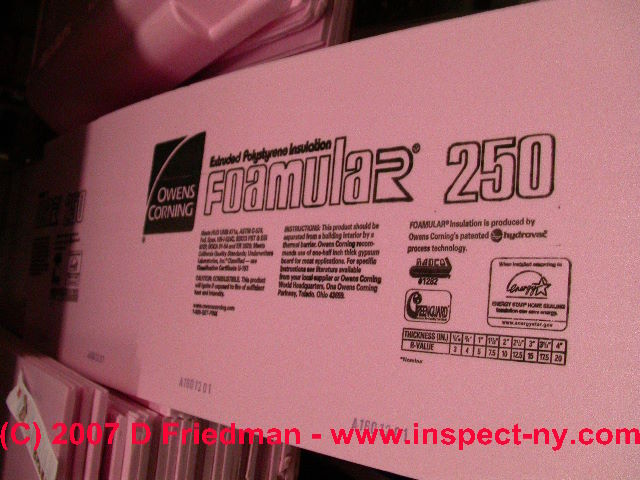
Page top photo by the author, the Formula-R and Owens Corning markings, which may be visible in this photograph of pink Styrofoam insulation boards, are registered trademarks of Owens Corning and were photographed at a Home Depot® building supply center.
InspectAPedia tolerates no conflicts of interest. We have no relationship with advertisers, products, or services discussed at this website.
- Daniel Friedman, Publisher/Editor/Author - See WHO ARE WE?
Insulating Characteristics of Various Materials
 These tables give R-values of all sorts of materials, in alphabetical order with direct links to some popular insulating materials.
They also give the insulating value of any material of interest in construction, for example: air, fiberglass, masonry mateirals, mineral wool, cellulose, foam insulating board, UFFI, soil or dirt, vermiculite, wood, & most other building materials.
Here we provide first an alphabetic index to the insulating or R-values of all sorts of building materials, even substances like air and dirt.
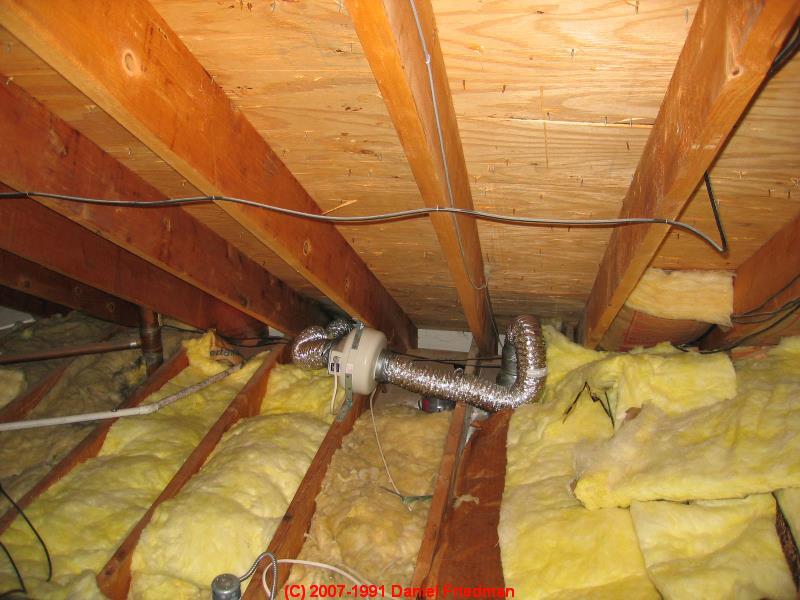
Photo: yellow fiberglass insulating batts in a sloppy insulation installation job.
Alphabetic Index to Insulating or R-Values of Materials
A - B - C - D - E - F - G - H - I - J - K - L - M - N - O - P - Q - R - S - T - U - V - W - X - Y - Z
Below we also give links to skip directly to popular insulation materials or just skip directly to the start of the COMPLETE INSULATION DATA TABLE where you will find that we list all building materials and insulating materials in alphabetic order.
Nearly all building materials are found there as well as the insulating properties of other materials of interest.
Tip: Use your browser's on-page search function (often Cmd-F) to search this web page for any material name, for example "Cork" to find the R-value or RSI value for cork, since we don't list every material name in the summary table below.
Also use the page top SEARCH BOX to look for our articles about specific insulating materials and their properties.
We also provide conversion values & formulas to convert between U.S., Metric, & Imperial system measures of insulating value or heat loss value.
Quick Links to Often Requested Material Insulating Properties |
|
| AIR SPACES | PLASTER |
| ASBESTOS | PLYWOOD & OSB |
| BALSAM WOOL | POLYCARBONATE films |
| BRICK | POLYISOCYANURATE foam |
| CELLULOSE | POLYSTYRENE foam |
| CONCRETE | POLYURETHANE foam |
| COTTON | REFLECTIVE barriers |
| DRYWALL | ROCK WOOL mineral wool |
| FIBERBOARD | ROOFING materials |
| FIBERGLASS | SIDING MATERIALS |
| FOAM INSULATION Icynene, Phenolic | SNOW |
| GLASS & INSULATED GLASS | SOIL - dirt |
| ICYNENE foam | UFFI Foam |
| MASONRY brick, block, concrete | VACUUM insulating panels |
| MINERAL WOOL | VERMICULITE insulation |
| PERLITE | WINDOWS & glazing & insulating shades |
| PHENOLIC spray foam | WOOD materials |
Conversion Among US, Metric & Imperial R-Value and other Insulating or Rate of Heat Loss/Gain Value Metrics
In general all of the measures of heat-loss or heat-gain insulating properties of materials are measuring the rate at which heat flows through a material.
The "R" value of a material is the material's resistance to heat flow through the material, but different countries or areas of the world use and compute these values differently.
Generally there are three different R-Values:
- U.S. R-value - written here as R-value USA
- Imperial R-Value - written here as R-value Imperial
- RSI or metric system or European R-Value - written here as RSI or as R-value Metric
To convert among R and U values in these different systems:
- U.S. R-Value = Imperial R-Value = R = (Heat Resistance x Degrees F x square feet) / BTUs
- RSI = Metric / European R-Value (m2 · K/W) where "RSI" is also referred to as Thermal Resistance Value.
RSI = 1/U Europe - RSI-Values: convert U.S. R-values to SI units or RSI as follows:
R-Value USA / 5.685 = RSI-Value Europe or "metric" or "SI" units
R-1 = 5.678263337 RSI
or
RSI-1 = 0.1761101838 R
- Metric R-Value = 0.1761 x Imperial Inch-Pound R-Value
- U-Value = 1 / R-Value for all of theses systems.
- Metric / European U-Value = U Europe = 1/R-Value Europe
Also: U Europe = [watts / kelvin x meters2]
The SI (System International) R-value is defined as units of Kelvin meters (Km) squared per Watt - KM2/W
Also
- US R-Value or Imperial Inch-Pound R-Value = Metric R-Value / 0.1761
R-Value Imperial measures (ft2·°F·h / BTU)
Imperial (UK or British) units, are expressed as well as square-foot degrees Farenheit (F) per British Thermal Unit (BTU).
See details at HEAT LOSS R U & K VALUE CALCULATION where we explain how to calculate or convert between R-value, U-value, and K-value of materials.
A
Tables of Insulation & Other Building Material Properties - Alphabetical OrderAcrylic to Asbestos |
|||||||||
| Insulation or other Building Material 9 |
R-ValueUSA1 |
RSI 1 | Density2 | Perm3 | Absorption4 | Flame Spread 5 |
Smoke6 | Toxicity7 | Aging Effects & Comments |
Acrylic twin-wall greenhouse glazing |
1.82 32 -U.S. |
0.3276 |
|
||||||
| Aerogel | 10.3 / Inch |
1.854 | See AEROGEL INSULATION | ||||||
| Air gap or air film, 3/4" air space insulating properties | 0.87 / inch
|
0.1566
|
The R=0.87 value for the first value in this Air R-value table subsection: For a 3/4" air gap or air space 30 Heat flow direction: up, one reflective surface, R=2.22 (Summer) or R=2.21 (Winter) Also see REFLECTIVE barriers Heat flow direction: down, no reflective surfaces, R=0.85 (Summer) or R=1.02 (Winter) Heat flow direction: down, one reflective surface, R=3.29 (Summer) or R=3.59 (Winter) Heat flow direction: horizontal, no reflective surfce, R= 0.84 (Summer) or R=1.01 (Winter) Heat flow direction: horizontal, one reflective surface, [45] and other sources cited on this page |
||||||
| Air film, inside surface, still air, no reflective surface, directions vary: horizontal, vertical, up, or down | 0.6140 - 0.92 0.1098 - 0.1656 |
0.11 - 0.17 0.02- 0.03 |
|||||||
| Air film, inside surface, still air, + reflective surface or barrier, directions vary: horizontal, vertical, up, or down | 1.32 - 4.55 30 | 0.24 - 0.82 | |||||||
| Air film, outside surface, any direction, any position, 15 mph wind in winter | 0.17 30 | 0.03 | |||||||
Air film, outside surface, any direction, any position, 7.5 mph wind in summer |
0.25 30 |
0.05 | |||||||
| Air, exterior film on walls | 0.17 30,40 | 0.03 | Presumes no wind or air movement? | ||||||
| Air, interior film on walls | 0.6840 | 0.12 | Presumes no air movement? | ||||||
| Dead air space in wall cavity, 3/4" to 4" (winter) | 0.97 | .17 | Presumes no convection air movement? Convection movements reducing R-values are more likely in wider dead air spaces and are virtually certain if there are leaks or penetrations at wall top and bottom. |
||||||
| Dead air space 1/2" to 4" | 1.0040 | 0.18 | 1.0040 total thickness Note "Dead" air space; convection currents in cavities or along surfaces lose insulating value. |
||||||
Air Krete®26 |
3.9 | 0.70 | 2.07 lbs/cuFt26 | 0.1457 in/sec coefficient, or 0.3407 in/sec flow rate at 68 degF H2O27 | 026 | 026 | no | Cementious foam insulation, fireproof, non-toxic, non-shrinking, also used for acoustical sound proofing; MgO cement (Magnesium Oxide); 6 mil poly vapor barrier required |
|
| Aluminum siding | 0.6140 metal thickness |
0.11 | 0.6140 full thickness, hollow-backed | ||||||
| Asbestos, corrugated paper pipe insulation | 1.4 | 0.25 | Estimated R-value of asbestos insulation per inch for pipe insulation corrugated paper. Asbestos lagging and paste will have a lower value |
||||||
| Asbestos cement board R-value | 0.25 | 0.45 | www.msu.edu
|
||||||
| Asbestos loose packed fibers / powder | Thermal conductivity k = 0.15 | ||||||||
| Asbestos cement shingle siding | 0.03 | 0.005 | [30] | ||||||
Notes on the R-value & K-values of different forms of asbestos:
- Rosato (ASBESTOS INSULATION) is the most authoritative source on asbestos properties and gives data for the thermal conductivity of asbestos in different forms and with varying temperatures. For magnesia-asbestos insulation at mean temperatures ranging from 100°F to 400°F the K-value (thermal conductivity, BTU in. per hr per sq.ft. per °F) ranged from 0.35 to 0.46.
- Details about the insulating, heat, and other properties of asbestos are at ASBESTOS PROPERTIES
- Current sources of asbestos R-values such as engineeringtoolbox provide very inconsistent data: Thermal conductivity k = 0.744 for "cement board", k=0.14 for asbestos millboard, and k= 1.66 for asbestos cement sheets; but the same source puts asbestos cement k = 2.07 and for loosely-packed asbestos k=0.15 - this is very inconsistent data - source: engineeringtoolbox.com retrieved 3/23/2014.
- Calculations converting US R-Values to RSI used the online calculator provided by the Efficiency Matrix website, an Australian company selling products used in building energy efficiency improvement. Tel: 1300 027 874,
Email for our Products: sales@efficiencymatrix.com Web: https://efficiencymatrix.com/
calculator at https://efficiencymatrix.com/r-value-wind-air-flow-imperial-metric-converter/
B
Insulation Values Table Continued: Balsam Wool to Building Paper |
|||||||||
| Insulation or other Building Material 9 |
R-Value1 | RSI | Density2 | Perm3 | Absorption4 | Flame Spread 5 |
Smoke6 | Toxicity7 | Aging Effects & Comments |
| Balsam Wool insulation | 2 - 3.5 | 0.36 - 0.63 | Spills out of wall or roof insulation if facing is cut | ||||||
|
4-inch |
0.218 30 0.80 40 |
0.036 - 0.144 | See BRICK WALL INSULATION RETROFIT [30] |
||||||
Brick facing 1" Brick facing 4" |
0.11 0.44 |
0.02 - |
[44] | ||||||
| More Brick values - see Masonry at - M - | |||||||||
| Bubble Foil Sheets | 1.1 - 1.3 / layer 4.4 / inch |
0.20 - 0.23 0.79 |
BUBBLE / CLOSED-CELL FOAM SHEETS | ||||||
| Building Paper, asphalt impregnated felt, 15# permeable | 0.06 | 0.01 | [30] | ||||||
| Building paper, red rosin paper | 0.06 | 0.01 | [Need citation] | ||||||
C
Cardboard, Ceiling Panels, Cellulose Insulation R-Values by type |
|||||||||
| Insulation or other Building Material 9 |
R-Value1 | RSI | Density2 | Perm3 | Absorption4 | Flame Spread 5 |
Smoke6 | Toxicity7 | Aging Effects & Comments |
| Cardboard as insulation | 3 - 421 | 0.54 - 0.72 | |||||||
| Ceiling Panels, suspended or drop ceilings | 0.4 - 6 | 0.07 - 1.08 | varies widely by material |
||||||
| Cellulose Blown (Attic) | 3.1340 | 0.56 | Settled thickness | ||||||
| Cellulose Blown (Wall) | 3.7040 | 0.67 | Settled thickness | ||||||
| Cellulose insulation loose fill | 3.1 - 3.820,24 | 0.56 - 0.68 | 2.2-3.0 | High | 5-20% | 15-40 | 0-45 | CO | 0-20% settlement, corrodes metal, mold resistant Or R 3.13 - 3.7030 |
| Cellulose insulation, spray-on (wet spray) | 2.8 - 3.520, 24 | 0.50 - 0.63 | [47] gives RSI: 0.53 to 0.67 (R-3 to 3.8) | ||||||
...
Carpeting & Carpet Padding Insulating R-values ) |
|||||||||
| Insulation or other Building Material 9 |
R-Value1 | RSI | Density2 | Perm3 | Absorption4 | Flame Spread 5 |
Smoke6 | Toxicity7 | Aging Effects & Comments |
| Carpeting with fiber padding | 2.0830 | 0.37 | |||||||
Carpeting with foam padding |
1.2330 | 0.22 | Typical low-pile carpeting with foam or rubber carpet padding | ||||||
Concrete Insulating R-values by type (Also see "Masonry Materials R-Values" below) |
|||||||||
| Insulation or other Building Material 9 |
R-Value1 | RSI | Density2 | Perm3 | Absorption4 | Flame Spread 5 |
Smoke6 | Toxicity7 | Aging Effects & Comments |
| Cementious Foam | 0.35 - 0.6921 | 0.63 - 0.12 | |||||||
| Cement asbestos wall shingles | 0.03 | 0.005 | [Need citation] |
||||||
| Concrete, air entrained | 3.9021, 40 | 0.70 | |||||||
Air Krete®26 also ThermalKrete and similar air-entraned MgO Products |
3.9026 | 0.70 | 2.07 lbs/cuFt26 | 0.1457 in/sec coefficient, or 0.3407 in/sec flow rate at 68 degF H2O27 | 026 | 026 | no | Cementious foam insulation, fireproof, non-toxic, non-shrinking, also used for acoustical sound proofing; MgO cement (Magnesium Oxide); 6 mil poly vapor barrier required |
|
| Concrete, uninsulated | 0.0818 30 - 0.312517 0.52 |
0.01 - 0.06 | Typical residential weight concrete 8" wall = R 2.5 | ||||||
| Concrete, sand & gravel aggregate | 0.13 - 0.6430 | 0.02 - 0.12 | 8" thick concrete slab or foundation wall has an R-value of about 1.04 30 while lightweight aggregate filled 8" thick concrete has an R-value of about 2.18 30 | ||||||
| Concrete-insulated | 0.85 - 1.2 | 0.15 - 0.22 | 12-88 | Varies | Varies | 0 | 0 | 0 | Insulated forms available |
| Concrete block, hollow core |
4" - 0.80 8" - 1.11 12" - 1.28 |
Without addition of insulation inserts into the block. |
|||||||
| Concrete block, 4-inch hollow core | 1.11 A | 0.20 | See citations at "Masonry" below | ||||||
| Concrete block, 8-inch hollow core | 1.04 - 2.18, commonly 1.04 30 | 0.18 - 0.39 | [30] | ||||||
| Concrete block, 12-inch hollow core | 1.90 | 0.34 | [need citation] | ||||||
| Concrete block, lightweight 8-inch | 2.2 | 0.40 | lightweight concrete | ||||||
| Concrete block, hollow cores grouted with concrete | 0.19 | elminination of the hollow core air space conducts more heat | |||||||
| Concrete block, hollow cores grouted with insulating material | Note A | See CONCRETE BLOCK INSULATION | |||||||
| More concrete values see Masonry at - M - | |||||||||
Notes to the table above
- A: Grouting hollow core concrete block can raise its R-value depending on the grout or fill material but keep in mind that the solid block webs surrounding the holes in hollow core block will continue to conduct heat unimpeded by the filled core.|
In essence if you raise the R-value of the hollow block core area from 1 (the R-value for air) then you raise the R-value for the percentage of the block's thickness comprised by the grouted volume. - ACI, Guide to Thermal Properties of Concrete and Masonry Systems. ACI 122R-02. American Concrete Institute, 2002.
- NCMA, R-VALUES AND U-FACTORS OF SINGLE WYTHE CONCRETE MASONRY WALLS [PDF] (2013) TEK 06-02C, NCMA, National Concrete Masonry Association, 13750 Sunrise Valley Drive Herndon, VA 20171 USA 703.713.1900 info@ncma.org - retrieved 2023/09/08, original source: ncma.org/resource/rvalues-ufactors-of-single-wythe-concrete-masonry-walls
- NCMA, R-Values of Multi-Wythe Concrete Masonry Walls, TEK 6-1C. National Concrete Masonry Association, 2013.
- NCMA THERMAL CATALOG of CONCRETE MASONRY ASSEMBLIES [PDF] (2012) 2nd Ed. NCMA
Excerpt:
The material presented does not cover all possible situations, but is intended to represent some of the more widely used concrete masonry constructions. The R-values provided are steady-state only; and do not take into account concrete masonry’s thermal mass contributions that often offer additional efficiencies for specific projects and climate zones.
...
Cork Insulating R-value |
|||||||||
| Insulation or other Building Material 9 |
R-Value1 | RSI | Density2 | Perm3 | Absorption4 | Flame Spread 5 |
Smoke6 | Toxicity7 | Aging Effects & Comments |
| Cork Insulating Value | 3.7 | 0.65 to 0.67 | [47] RSI (R/in.) | ||||||
|
|||||||||
Cotton Insulation R-Values by type |
|||||||||
| Insulation or other Building Material 9 |
R-Value1 | RSI | Density2 | Perm3 | Absorption4 | Flame Spread 5 |
Smoke6 | Toxicity7 | Aging Effects & Comments |
| COTTON INSULATION |
0.5 | 0.09 | .25-10 | ||||||
| Cotton Batts | 3.722 | 0.67 | "blue jean" insulation batts fireproofed with boric acid BORIC ACID MSDS (Fisher Scientific 2014) |
||||||
D
Dirt, Backfill, Soil R-Values |
|||||||||
| Insulation or other Building Material 9 |
R-Value1 | RSI | Density2 | Perm3 | Absorption4 | Flame Spread 5 |
Smoke6 | Toxicity7 | Aging Effects & Comments |
| DIRT or SOIL | 0.25 - 1 0.80 typical at 20% moisture |
0.45 - 0.18 | Depends on soil properties: density, moisture content, moisture movement See SOIL R-VALUES Note: soil often contains water that has its own R of around 0.004 |
||||||
...
Drywall or Gypsum Board or "Sheetrock" R-Values |
||||||||||||||||||||||||||||||||||||||
| Insulation or other Building Material 9 |
R-Value1 | RSI | Density2 | Perm3 | Absorption4 | Flame Spread 5 |
Smoke6 | Toxicity7 | Aging Effects & Drywall, 1/2-inch |
0.45 |
0.08 |
|
|
|
|
|
|
(McCullough 2011) [37] (Humberto 2018) [38] - [39] [Other citations welcomed]Drywall, 3/4-inch |
0.56 |
0.10 |
|
|
|
|
|
|
Gypsum board Insulating Value |
0.6 |
0.11 |
|
|
|
|
|
|
Drywall 1/2" Gypsumboard = R 0.45 30 5/8" Gypsum board = R 0.56 30 See DRYWALL R-Values | ||
...
E
| Insulation or other Building Material 9 |
R-Value1 | RSI | Density2 | Perm3 | Absorption4 | Flame Spread 5 |
Smoke6 | Toxicity7 | Aging Effects & Comments |
| Eel grass batts | 1 | 0.18 | See SEAWEED & EELGRASS INSULATION [47] Canada Nat. Res. |
||||||
F
Insulation Values Table Continued: Fiberboard Products |
|||||||||
| Insulation or other Building Material 9 |
R-Value1 | RSI | Density2 | Perm3 | Absorption4 | Flame Spread 5 |
Smoke6 | Toxicity7 | Aging Effects & Comments |
| Fiberboard insulating boards - per inch | 2.8 30 | 0.50 | Questionable data, Some sources claim 2.64 | ||||||
| Fiberboard 1/2" intermediate density, per inch | 2.44 30 | 0.44 | 1.32 40 full thickness Questionable; [30] Divide this per inch number by 2 to obtain the R-value for 1/2" medium density fiberboard = R 1.22 |
||||||
| Fiberboard 25/32" | 2.06 40 full thickness | ||||||||
| Fiberboard insulating sheathing, regular density, per inch | 2.64 30 | 0.48 | Questionable; [30] Divide this per inch number by 2 to obtain the R-value for 1/2" regular density fiberboard = R 1.32 | ||||||
| Fiberboard insulating sheathing, 25/32" thick, regular density, per inch | 2.64 30 | 0.48 | Questionable; [30] |
||||||
| Fiberboard nail base insulating board, 1/2-inch | 1.14 30 | 0.21 | Highly questionable [30] Also see HARDBOARD R-VALUES |
||||||
Insulation Values Table Continued: Fiberglass to Flooring |
|||||||||
| Insulation or other Building Material 9 |
R-Value1 | RSI | Density2 | Perm3 | Absorption4 | Flame Spread 5 |
Smoke6 | Toxicity7 | Aging Effects & Comments |
Fiberglass Insulation R-Values by type |
|||||||||
| Fiberglass, Blown (Attic) | 2.2040 | 0.40 | |||||||
| Fiberglass, Blown (Wall) | 3.2040 | 0.58 | |||||||
| Fiberglass chopped, loose fill | 2.5 - 3.720 | 0.45 - 0.67 | |||||||
| Fiberglass chopped/blown insulation | 3.6 - 4.4 | 0.65 - 0.79 | 100 | 6" = about R-22. Installers say expanding fiberglass assists in sealing air leaks | |||||
| FIBERGLASS BATT insulation | 3.1 - 4.320 | 0.56 - 0.77 | .6 - 1.2 | 100 | 1% | 15-20 | 0-20 | Fumes from paper, binders |
May collect debris/allergens/mold 3-3 1/2" thick fiberglass insulation = R 11 |
| Fiberglass, batts, high density | 3.6 - 521 |
0.65 - 0.90 | |||||||
| Fiberglass 3/4" | 3.0 | 0.54 | 3.00 40 full thickness | ||||||
| Fiberglass 1" | 4.0 | 0.72 | 4.00 40 full thickness | ||||||
| Fiberglass 1 1/2" | 6.0 | 1.08 | 6.00 40 full thickness | ||||||
| Fiberglass, Rigid | 4.0040 | 0.72 | (<4 lb/ft3) | ||||||
| Fiberglass glazing (greenhouse) | 0.83 32 - single | 0.15 | |||||||
| Fiberglass board, high density | 4 | 0.63 to 0.88 | [47] (R-3.6 to 5) | ||||||
| Fiberglass roof board | 3.8 | 0.67 | [47] | ||||||
| Fiberglass panel, rigid (fiberglass "boards") | 2.521 | 0.45 | e.g. used in HVAC ductwork or air handlers. | ||||||
| Fiberglass, spray-on | 3.7 - 2.920 | 0.67 - 0.52 | |||||||
...
Flooring R-Values
Flooring Insulating Values |
|||||||||
| Insulation or other Building Material 9 |
R-Value1 | RSI | Density2 | Perm3 | Absorption4 | Flame Spread 5 |
Smoke6 | Toxicity7 | Aging Effects & Comments |
| Flooring, hardwood, 3/4" thick, per inch: | 1.10 | 0.2 | 3/4" hardwood flooring = R 0.68 30 presuming no air leakage | ||||||
| Flooring, sheet resilient floors, linoleum, or tiles | 0.0530 | 0.009 | Applies to Asphalt/asbestos floor tiles, linoleum, vinyl, rubber floor tiles, per inch. | ||||||
Notes to the table of flooring insulating values:
- See other flooring types by searching for the material name, such as "Carpet" or "Tile"
G
Insulation Values Table Continues: Glass to Gypsum Board |
|||||||||
| Insulation or other Building Material 9 |
R-Value1 | RSI | Density2 | Perm3 | Absorption4 | Flame Spread 5 |
Smoke6 | Toxicity7 | Aging Effects & Comments |
Glass single glazing
|
0.1418
|
0.025 | U-Values for Glass & Glazing 30Single pane glass, Winter U = 1.10 30
|
||||||
Double glazed glass Note the U-values in Comments |
2.0 32 2.5 (low-E) |
0.36 0.45 |
Insulated Glass, double pane U=Values 303/16" Air Space, Winter U = 0.62 30 |
||||||
| Glass, triple-glazed | 2.27 - 3.22 | 0.41 - 0.58 | U Value, Winter 0.31-0.39 30 R = 1 / U U 1 = R 1 the R-values given at left are questionable. |
||||||
| Glass Storm Windows, 1 - 4" space between storm interior surface & interior window exterior surface | 0.50 30 | 0.090 | Highly questionable without assessment of the leakiness of the storm window and also of the leakiness of the principal window sash. | ||||||
| Also see glass insulating values discussed at WINDOWS & glazing & insulating shades | |||||||||
| Gypsum board Insulating Value | 0.6 | 0.11 | 1/2" Gypsumboard = R 0.45 30 5/8" Gypsum board = R 0.56 30 See DRYWALL R-Values |
||||||
H
R-Values of Hardboard & Insulating Boards
Insulation Values Table Continued: Hardboard to Insulating Board Products |
|||||||||
| Insulation or other Building Material 9 |
R-Value1 | RSI | Density2 | Perm3 | Absorption4 | Flame Spread 5 |
Smoke6 | Toxicity7 | Aging Effects & Comments |
| Hardboard siding 1/2" | 0.34 | 0.061 | 0.3440 full thickness | ||||||
| Hardboard, high density, standard tempered 1/4" thick, Per Inch | 1 30 | 0.180 | 1/4" thick hardboard, high-density = R 0.25 [30] Note that many builders refer to this wood product hardboard by a specific trade name "Masonite™" or "Masonite hardboard" |
||||||
| Hardboard underlayment, 1/4", per inch: | 1.24 30 | 0.22 | 1/4" thick hardboard underlayment = R 0.31 [30] | ||||||
Home®Foam25 Spray or pour |
3.921 | 0.70 | 0.51 lbs/ft3 | Insulthane 100, See Plastic, foamed insulation below Home Foam? should not be installed within 2" / 50mm of heat emitting devices producing temperatures in excess of 200deg. |
|||||
I
Insulating Board R-Values |
|||||||||
| Insulation or other Building Material 9 |
R-Value1 | RSI | Density2 | Perm3 | Absorption4 | Flame Spread 5 |
Smoke6 | Toxicity7 | Aging Effects & Comments |
| Insulating board, glass fiber organic bonded | 4.00 30 | 0.72 | |||||||
| Insulating board, expanded ploystyrene, extruded, cut cell | 4.00 30 | 0.72 | |||||||
| Insulating board, expanded polystyrene extruded smooth | 5.00 30 | 0.90 | |||||||
| Insulating board, expanded polystyrene molded bead panel | 3.57 30 | 0.64 | See POLYSTYRENE foam |
||||||
| Insulating board, expanded polyurethane | 6.25 30 | 1.125 | See POLYURETHANE foam |
||||||
| Insulating board, polyisocyanurate foam | 7.20 - 8.0 30 | 1.296 - 1.44 | See POLYISOCYANURATE foam |
||||||
| Insulating board, mineral fiber, resin binder | 3.45 30 | 0.621 | RSI range: 0.53 to 0.7 (R-3 to 4) [47] | ||||||
| Nail Base Insulated Panels R value | 4.2 - 5.3 LTTR 1 | 0.756 - 0.954 | Plywood or OSB laminated with rigid foam board insulation 1 | ||||||
Notes to the table above:
1. LTTR = Long Term thermal resistance, for panels ranging from 1.5" (LTTR 6.3) to 4.5" (LTTR 24.2) in thickness, OSB laminated to closed-cell polyisocyanurate foam board insulation, OSB on one side, used as roofing nail base, Source: Atlas Roof Wall Insulation, 2000 RiverEdge Parkway, Suite 800 Atlanta, GA 30328 USA Website: https://roof.atlasrwi.com 2020/11/08
Definition: LTTR provides an R-value based on a fifteen-year weighted average thermal resistance, in order to take into account the observation that for some foam insulating materials the R-value diminishes over time, or by some calculations, an eight-year average R-value.
Other versions of nail base include panels with plywood or OSB on both sides, nail base panels incorporating a reflecting surface, and vented insulation panels. Patent examples:
- Roe, Richard, and Robert Blanpied. "Vented insulation panel with reflecting surface." U.S. Patent Application 11/317,245, filed October 19, 2006.
- Schmidt, Kenneth. "Vented insulation for nail based applications." U.S. Patent Application 11/353,735, filed August 17, 2006.
Insulation Values: Icynene Foam |
|||||||||
| Insulation or other Building Material 9 |
R-Value1 | RSI | Density2 | Perm3 | Absorption4 | Flame Spread 5 |
Smoke6 | Toxicity7 | Aging Effects & Comments |
Icynene® FOAM-POUREDinsulation or pour fill insulation |
423 | 0.72 | .5-2 10 | low | low | low | Fire safety: may not be left exposed in living area; very good air bypass leak sealing properties | ||
| Icynene® FOAM-SPRAYED insulation | 3.6 - 3.7 23 | 0.648 - 0.666 | .5-2 10 | low | low | low | Fire safety: may not be left exposed in living area; very good air bypass leak sealing properties | ||
J
K
L
M
Masonry Materials R-Values: concrete block, "cinder block", brick, concrete masonry units, perlite filled concrete block
Insulation Values: Masonry R-Values |
|||||||||
| Insulation or other Building Material 9 |
R-Value1 | RSI | Density2 | Perm3 | Absorption4 | Flame Spread 5 |
Smoke6 | Toxicity7 | Aging Effects & Comments |
| Brick, common | 0.20 30 0.80 40 |
0.036 - 0.144 | [30] | ||||||
| Brick, 4" face | 0.44 40 |
0.079 | Nil. This is for clay brick. | ||||||
| Brick, 4" + 1" reflective air space | |||||||||
| Brick, facing or veneer | 0.11 30 | 0.0198 | |||||||
| Concrete Block, two rectangular core, 8" | 1.04 | 0.187 | Filled with sand and gravel aggregate [30] We consider this questionable and note that moisture content is omitted. | ||||||
| Concrete Block, two rectangular core, 8" | 0.44 + 2.89 = 3.33 |
0.079 + 0.52 = 0.599 | Filled with lightweight aggregate [30], same warning as above. | ||||||
| Concrete Block, 4" 72% solid (115#/ft3) |
1.19
|
0.213 | Nil 0.8040 per full thickness |
||||||
| Concrete Block, 6" 59% solid |
1.25 | 0.225 | Nil | ||||||
Concrete |
3.95 | 0.711 | |||||||
| Concrete Block, 8" 54% solid |
1.45 | 0.261 | 1.1140 per full thickness | ||||||
Concrete |
4.65 | 0.837 | |||||||
| Concrete Block 10" 52% solid |
1.55 | 0.279 | Nil | ||||||
| Concrete Block, 10" 52% solid perlite filled |
5.65 | 1.017 | |||||||
| Concrete Block 12" 48% solid |
1.65 | 0.297 | 1.2840 per full thickness | ||||||
| Concrete Block, 12" 48% solid perlite-filled |
7.05 | 1.269 | |||||||
| Concrete, poured | 0.08 40 | 0.0144 | |||||||
| Hempcrete | ~2 - 3.5 / inch 0.67/cm (1.7/in) - 1.2/cm (3.0/in) |
0.36 - 0.648 / inch 0.67 / cm |
Reader Eric 2022/03/12 Wikipedia same date |
||||||
| Lime/Expanded glass | ~1.5 - 2 / inch | 0.27 - 0.36 / inch | Reader Eric 2022/03/12 - sub-slab insulation | ||||||
Notes to the table above
Masonry R-values Source: adapted from "Sample R-Value Calculations" found at www.maconline.org
Notes:
1. Effects of water intrusion on insulating value and R-values are not included in the above nor was there discussion of variation in thermal conductivity at block segments that are solid rather than perlite filled.
2. Additional R-value for a masonry wall constructed using these materials needs to add the insulating value of additional wall components typically included, such as 1" solid foam (polyisocyanurate R 8, extruded polystyrene R 5, expanded polystyrene R 4, or 1" of perlite R 2.7) and
for an exterior air film (winter, no wind, R 0.17), an interior air film (again no air movement, R 0.68), 3/4" of reflective air space (no convective air movement, R 2.89), 1/2" drywall (R 0.45), interior wall cavity insulation (see various fiberglass or other insulating values in this table), to achieve a greater overall R-value than that afforded by the masonry block or brick wall alone.
3. Presumably the R-values given are then calcuated for the overall wall structure, averaging the effects of thermal breaks etc. - Ed.
4. Hempcrete R-Values: NADC, Dion, HEMPCRETE A Simple Solution to Housing Problems [PDF] Northern Alberta Development Council Bag 900-14 2nd fl Provincial Building 9621 - 96 Avenue Peace River, AB T8S 1T4 Main: 780.624.6274 Council Email: nadc.council@gov.ab.ca Dion Tel: 780 283 2837 dion@8thfireinnovations.com - retrieved 2022/03/12 original source: https://nadc.ca/media/1343/hempcrete-dion-lefebvre.pdf
More -M- Materials Insulating Properties |
|||||||||
| Insulation or other Building Material 9 |
R-Value1 | RSI | Density2 | Perm3 | Absorption4 | Flame Spread 5 |
Smoke6 | Toxicity7 | Aging Effects & Comments |
| Magnesium Oxide Cement Board MgO | 1.2 | 0.216 | permeable | 0 | see JetBoard Jet-Board.com; 2.1 lbs/sq.ft. for 1/2" thickness | ||||
| Mineral Wool Rock Wool Batt | 3.1440 | 0.565 | |||||||
| Mineral Wool Rock Wool Blown (Attic) | 3.1040 | 0.558 | |||||||
| Mineral Wool Rock Wool Blown (wall) | 3.0340 | 0.545 | |||||||
| MINERAL WOOL insulation (Rock Wool) |
3.2 - 3.720 |
0.576 - 0.666 | 1.5-2.5 | 100 | 2% | 0 | 0 | 0 | May collect debris/allergens/mold, also referred-to as rock wool, slag wool, glass wool (but not fiberglass) 3 3/4" - 5" Mineral Wool = R 11 |
N
O
P
Insulation Values: Particleboard to Plaster |
|||||||||
| Insulation or other Building Material 9 |
R-Value1 | RSI | Density2 | Perm3 | Absorption4 | Flame Spread 5 |
Smoke6 | Toxicity7 | Aging Effects & Comments |
| Particleboard 5/8" underlayment, per inch | 1.31 | 0.236 | 5/8" particleboard underlayment has an R-value of 0.82 [30] | ||||||
| Perlite insulation | 2.5 - 3.720, 30 | 0.45 - 0.666 | 2-11 | High | 0 | 0 | 0 | 0 | See details at PERLITE INSULATION |
| Plywood, A/C | 1.4 | 0.252 | Questionable, [need citation] | ||||||
| Plywood, 1/4" | 0.31 full thickness |
0.056 | R 0.31 30,40 full thickness | ||||||
| Plywood 3/8" | 0.47 full thickness |
0.085 | R 0.47 30,40 full thickness | ||||||
| Plywood 1/2" | 0.62 - 0.63 full thickness |
0.112 - 0.113 | R 0.62 - 0.63 30,40 full thickness | ||||||
Plywood 5/8" & Plywood siding 5/8" |
0.77 full thickness |
0.139 | R 0.77 30,40 full thickness | ||||||
Plywood 3/4" Pywood siding 3/4" |
0.93 - 0.94 full thickness |
0.167 - 0.169 | R 0.94 40 full thickness R 0.93 40 |
||||||
Phenolic Foam Insulation R-Values |
|||||||||
| Phenolic foam spray insulation | 4.8 - 721 | 0.864 - 1.26 | |||||||
Phenolic foam insulation Phenolic rigid panel |
8.3 4 - 521
|
1.494 0.72 - 0.90 |
Corrosion problems when in contact with steel roofing & moisture; very good air bypass leak sealing properties |
||||||
| Plaster, 1/2" lightweight | 0.32 30 | 0.058 | |||||||
Insulation Values: Plastic to Polyurethane |
|||||||||
| Insulation or other Building Material 9 |
R-Value1 | RSI | Density2 | Perm3 | Absorption4 | Flame Spread 5 |
Smoke6 | Toxicity7 | Aging Effects & Comments |
| Plastic, foamed: Home Foam25 low-density | 3.921 | 0.702 | 0.51 lbs/ft3 | Water-blown Unidentified ingredients 25 Spray or pour application see HomeFoam® above. |
|||||
| Polycarbonate sheeting, 10mm Twin-Wall | 4.7 / in ? 1.89 for 10mm |
0.846 / in 0.230 for 10mm |
U-Value 0.53 | ||||||
| Polycarbonate film, 6mm "Greenhouse Plastic" |
3. / in ? 0.83 - 0.85 for 6mm |
0.54 0.149 - 0.153 |
Double layer of 6mm R = 1.25 to 1.54 (sources vary) | ||||||
| Polycarbonate 16mm Sheet, 5-layer | 2.78 33 (not per in) | 0.500 | |||||||
| Polycarbonate sheet, 10-wall, 16mm | 3.34 34 (not per in) | 0.601 | |||||||
| Polycarbonate sheet, 10-wall, 40mm | 5.15 34 (not per in) | 0.927 | |||||||
| Polyethylene film (greenhoue glazing) |
0.87 32 (not per in) | 0.157 | |||||||
| Polyethylene film, 5mm double layer | 1.5 32 (not per in) | 0.27 | |||||||
| Polyethylene film, 6mm double layer |
1.7 32 (not per in) | 0.306 | |||||||
| Polyethylene foam sheets | 4.12 / 0.4" sheet up to 10.3 / inch |
0.74 / 0.4" sheet up to 1.854 / inch | BUBBLE / CLOSED-CELL FOAM SHEETS | ||||||
| Polyethylene foam | 321 | 0.54 | POLYURETHANE FOAM Spray Building Insulation | ||||||
...
Polyisocyanurate Foam Insulation R-ValuesPIR Insulation |
|||||||||
| Insulation or other Building Material 9 |
R-Value1 | RSI | Density2 | Perm3 | Absorption4 | Flame Spread 5 |
Smoke6 | Toxicity7 | Aging Effects & Comments |
Polyisocyanurate / Polyurethane panel PIR panels |
5.6 - 7.020 | 1.008 - 1.260 | POLYISOCYANURATE FOAM BOARD | ||||||
| Polyisocyanurate foam panel or board, foil faced | 6.821 - initial, pentane |
1.224 1.296 0.99 |
Rigid panel insulation board with foil facing both sides, edges exposed Aged R-values for foam panels assume aging in-situ for 5-10 years. |
||||||
| Polyisocyanurate foam panel Dow TUFF-R | 6.5 32 | 1.17 | 2 ASTM D1622, pcf |
<0.03 32 | |||||
| Polyisocyanurate spray, poured, or board insulation | 4.3 - 8.321 5.5 - 6.2 to 7.04 - 8.0 |
0.774 - 1.494 0.99 - 1.116 |
2 | 2-3 | 0 | 25 | 55-200 | CO | Closed cell, HCFC or CFC gases; Also see INSULATION CHOICES |
| Polyisocyanurate composite insulation | 2.8 (5.8-6.2) |
0.504 (1.044 - 1.116) |
2.0 | 2-3 | Closed cell Foil faced21 |
||||
...
Polystyrene Foam Insulation R-ValuesEPS Expanded Polystyrene Insulation (beadboard)
XPS Extruded Polystyrene Insulation |
|||||||||
| Insulation or other Building Material 9 |
R-Value1 | RSI | Density2 | Perm3 | Absorption4 | Flame Spread 5 |
Smoke6 | Toxicity7 | Aging Effects & Comments |
| Polystyrene peanuts for building insulation | not recom- mended |
5-25+ | 10-400 | Not recommended for building insulation, may be serious fires hazard. | |||||
| Polystyrene loose fill beads for building or window-wall insulation | 2.3 | 0.414 | 5-25+ | 10-400 | Static charge makes particles hard to control | ||||
Polystyrene board or beadboard 8 MEPS insulation Molded EPS low density |
3.6 - 5.0
3.8521 |
0.8-2.0 | 1.2-3.0 | 0.7-4% | 5-25 | 10-400 | CO | Degrades in sunlight (UV); R-value varies by board density Also see INSULATION CHOICES |
|
Polystyrene Expanded (XPS) insulation low-density |
3.85 3.6 - 4.721 |
0.648 0.648 - 0.846 |
See POLYSTYRENE FOAM INSULATION Also see INSULATION CHOICES |
||||||
| Polystyrene Expanded beadboard | 4.040 | 0.72 | |||||||
Polystyrene board, extruded expanded high-density (EPS) Molded |
5 - 5.421 4.221 |
0.90 - 0.972 0.756 |
|||||||
| EPS Expanded polystyrene | see POLYSTYRENE foam | ||||||||
| XPS Extruded polystyrene | 4 | also see Owens Corning FORMULAR FANFOLD XPS Re-Siding BOARD [PDF] - 1/4" = R-1. | |||||||
| Polystyrene board, Extruded XPS | 3.6 - 4.042 | 0.648 - 0.72 | See Owens Corning FORMULAR FANFOLD XPS Re-Siding BOARD [PDF] - 1/4" = R-1. |
||||||
| Polystyrene board, Expanded EPS | 4.5 - 5.040, 42 | 0.81 - 0.90 | 1.5 | 1.2-3.0 | Closed cell |
||||
... TEST ...
Polyisocyanurate / Polyurethane Foam Insulation R-Values |
|||||||||
| Insulation or other Building Material 9 |
R-Value1 | RSI | Density2 | Perm3 | Absorption4 | Flame Spread 5 |
Smoke6 | Toxicity7 | Aging Effects & Comments |
| Polyurethane spray - closed cell foam insulation. Thanks to Thanks to Andrew Cole for correcting our data on this product. |
5.0 - 6.8 5.5 - 6.521 Initial 7.14 |
0.90 - 1.224 0.99 - 1.17 Initial |
2.0 | 2-3 | 0 | 30-50 | 155-200 | CO | Closed cell foam spray insulation; 0-12% shrinkage, Fire safety: RSI 0.92 to 1.14 (R-5.2 to 6.5) per [47] |
| Polyurethane board | 6 | 0.97 to 1.2 | Design spec or average RSI/25.4 mm (R/in.) [47] (R-5.5 to 6.8) |
||||||
Polyurethane foam insulation rigid panels |
7-821 - Initial 6.25 - aged 5 to 10 years |
1.28 -1.44 1.125 Aged 5-10 Yrs |
CHC/HCFC expanded foam | ||||||
| Polyurethane foam insulation rigid panels | 6.821 - Initial 5.5 - aged 5 to 10 years |
1.224 0.99 |
Pentane expanded foam | ||||||
| Polyurethane spray foam insulation rigid panels, foil-faced | 7.9 - 8.4 | 1.422 - 1.512 | Pentane expanded foam, presence of an air-gap may increase panel performance. RSI = 45-48 |
||||||
| Polyurethane foamed in place | 6.2540 | 1.125 | |||||||
| Polyurethane spray foam insulation - open cell insulation | 3.621 - 7 (est) | 0.648 | Expands & seals more than closed-cell; lower cost; pourable-version available for building retrofit; |
||||||
Q
R
Insulation Values: Reflective to Rockwool |
|||||||||
| Insulation or other Building Material 9 |
R-Value1 | RSI | Density2 | Perm3 | Absorption4 | Flame Spread 5 |
Smoke6 | Toxicity7 | Aging Effects & Comments |
| Radiant barriers | 0 (none) | 0 | Blocks radiant heat gain/loss See RADIANT BARRIERS |
||||||
| Reflective barrier insulation | 0 - 1720 | 0 - 3.06 | Varies by product. Example: |
||||||
Rock Wool Batts Slag wool Batts |
3 - 3.8520 | 0.54 - 0.693 | See more details at MINERAL WOOL | ||||||
Rock Wool, Slag wool Loose Fill insulation R-value |
2.5 - 3.720 | 0.45 - 0.666 | |||||||
Insulating Values of Roofing Materials
Roofing Material R-Values |
|||||||||
| Insulation or other Building Material 9 |
R-Value1 | RSI | Density2 | Perm3 | Absorption4 | Flame Spread 5 |
Smoke6 | Toxicity7 | Aging Effects & Comments |
| Roofing: Asphalt shingles | 0.4430,40 | 0.0792 | |||||||
| Roofing: built-up 3/8" thick plies | 0.3330 | 0.0594 | |||||||
| Roofing: wood shingles | 0.9430 0.9740 |
0.1692 0.1746 |
Also see below at "wood". The use of this R-valuye is highly questionable since wood shingle roofs do not block air flow whatsoever. |
||||||
...
S
Other "S" Materials |
|||||||||
| Insulation or other Building Material 9 |
R-Value1 | RSI | Density2 | Perm3 | Absorption4 | Flame Spread 5 |
Smoke6 | Toxicity7 | Aging Effects & Comments |
| Sheeps Wool Insulation | 3.6 blown-in 4.3 batts |
0.648 0.774 |
Wool or recycled fabric insulation is also used as pipe lagging. |
||||||
| Silica Aerogel | 10 | 1.8 | |||||||
| Steel siding | 0.6140 full thickness, hollow-backed | ||||||||
| Snow | 1 | 0.18 | |||||||
| Soil or "dirt" | 0.25 - 1 0.80 typical at 20% moisture |
0.045 - 0.18 | Depends on soil properties: density, moisture content, moisture movement See SOIL R-VALUES |
||||||
| Straw Bale | 1.45 | 0.261 0.23 to 0.28 |
(Commins 1998) [36] Canada Nat. Res. [47] Design spec or average |
||||||
| Straw board (compressed) | 2.0 | 0.35 | Canada Nat. Res. [47] RSI (R/in.) | ||||||
| Stucco, conventional plaster/cement | 0.20 | 0.036 | [30] | ||||||
...
Insulating Values of Building Siding Materials
Building Siding R-Values |
|||||||||
| Insulation or other Building Material 9 |
R-Value1 | RSI | Density2 | Perm3 | Absorption4 | Flame Spread 5 |
Smoke6 | Toxicity7 | Aging Effects & Comments |
| Aluminum siding | 0.61 | 0.11 | R 0.6140 full thickness, hollow-backed | ||||||
| Aluminum siding w/ 1/2" insulating board backer | 1.80 | 0.324 | R 1.8040 full thickness, | ||||||
Asphalt Shingle, Insulbrick |
2.6 | 0.41 to 0.7 | See SIDING ASPHALT SHINGLE or SHEET [47] RSI (R/in.)(R-2.3 to 4) |
||||||
| Brick veneer 4" | 0.44 | 0.0792 | R 0.4440 full thickness | ||||||
| Hardboard siding 1/2" | 0.34 | 0.0612 | R 0.3440 full thickness | ||||||
| Logs (solid wood) | 1.2540 | 0.225 | Softwood logs RSI = 0.18 to 0.25 (R-1 to 1.4) / inch Hardwood logs RSI = 0.12 (R-0.7) [47] RSI (R/in.) |
||||||
| Logs (solid Cedar) | 1.3340 | 0.2394 | Log wall R-Values vary16 Canada's DNR: cedar logs RSI = 0.18 (R-1) [47] RSI (R/in.) |
||||||
| Log slab/board siding | see Wood siding / clapboards | ||||||||
| Plywood siding 5/8" | 0.77 full thickness |
0.1386 | R 0.7740 full thickness | ||||||
| Plywood siding 3/4" | 0.93 full thickness |
0.1674 | R 0.9340 full thickness | ||||||
| Vinyl Siding | 0.61 see notes |
0.1098 | Low | 0 | 1/16" (0.175") to 3/32" (0.093") thick vinyl siding, hollow-backed | ||||
| Vinyl siding | 0.61 | 0.1098 | 0.6140 full thickness, hollow-backed | ||||||
| VInul siding w/ 1/2" insulating board backer | 1.80 | 0.324 | 1.8040 full thickness | ||||||
| Wood shingle siding, single course | 0.8730 |
0.1566 | |||||||
| Wood clapboard siding, 1/2-inch clapboard or shiplap | 0.8040 0.8130 |
0.1440 0.1458 |
|||||||
...
T
| Insulation or other Building Material 9 |
R-Value1 | RSI | Density2 | Perm3 | Absorption4 | Flame Spread 5 |
Smoke6 | Toxicity7 | Aging Effects & Comments |
| Tectum™ insulated roof panels | 2.0 | 0.36 | Tectum: a patented cementitious wood fiber EPS-core insulating roof deck tile, plank, or panel of several thicknesses. | ||||||
| Thinsulate | 5.75 | 1.035 | Clothing insulation, not used in buildings |
U
Urea Formaldehyde UFFI Foam Insulation R-Values & Properties
Insulation Values: Urea Formaldehude UFFI to Vinyl |
|||||||||
| Insulation or other Building Material 9 |
R-Value1 | RSI | Density2 | Perm3 | Absorption4 | Flame Spread 5 |
Smoke6 | Toxicity7 | Aging Effects & Comments |
| Urea terapolymer foan | 4.4840 | 0.8064 | |||||||
| Urea Formaldehyde Foam Panels or in-wall spray | 4 - 4.621 | 0.72 - 0.828 | Formaldehyde outgassing concerns, especially new, possibly | ||||||
| UFFI insulation (Urea Formaldehyde Foam) |
4.2 5.2521 |
0.756 0.945 |
0.6-0.9 | 4.5-100 | 18% | 0-25 | 0-30 | 0 (may outgas formal-dehyde) | 1-4% shrinkage, Fire safety: may not be left exposed in living area; on aging, leaves significant air bypass leaks at shrinkage points |
V
...
| Insulation or other Building Material 9 |
R-Value1 | RSI | Density2 | Perm3 | Absorption4 | Flame Spread 5 |
Smoke6 | Toxicity7 | Aging Effects & Comments |
| VERMICULITE insulation | 2.1319, 40 - 3.0 2.10 - 3.720 |
0.3834 |
4-10 | High | 0 | 0 | 0 | 0 (may contain asbestos) | May contain asbestos, virtually always installed as loose-fill. Some sources cite R = 2.08 RSI 0.37 - .41 [47] RSI (R/in.) |
| Vinyl Siding | 0.61 full thickness |
0.1098 | Low | 0 | 1/16" (0.175")to 3/32" (0.093") thick vinyl siding, hollow-backed | ||||
| Vinyl siding | 0.61 | 0.1098 | 0.6140 full thickness, hollow-backed | ||||||
| Vinyl Siding, Insulated | 2.0 | 0.36 | Manufactured with rigid foam plastic insulation laminated to thje siding ASTM D7793 requires insulated siding to demonstrate a INSULATED VINYL SIDING as HOME INSULATION [PDF] Vinyl Siding Institute |
||||||
| Vinyl Thin Film Window Covering | 0.07 - 0.81 see notes |
0.0126 - 0.1458 | Low | 0 | U-value and emissivity values vary depending on the type of film, with emissivity values from 0.07 to 0.81 - DeBusk [29] |
W
Insulating value & other properties of water |
|||||||||
| Insulation or other Building Material 9 |
R-Value1 | RSI | Density2 | Perm3 | Absorption4 | Flame Spread 5 |
Smoke6 | Toxicity7 | Aging Effects & Comments |
| Water | 0.004 | 0.0007 | Roughly 1 g/ml or more-accurately, the density of water is 0.9998395 g/ml at 4.0° Celsius (39.2° Fahrenheit). |
The R-value of water has little practical application but in various discussions is placed around R 0.004 - effectively almost zero. | |||||
Notes on the R-value of water
- Water has a specific heat capacity or J/ kg °K of 4200.
- For the density of water we quoted Water Density at the USGS Water Science School (2018) - retrieved 2024/02/17, original source: https://www.usgs.gov/special-topics/water-science-school/science/water-density
- Choudhary, M. K., K. C. Karki, and S. V. Patankar. "Mathematical modeling of heat transfer, condensation, and capillary flow in porous insulation on a cold pipe." International Journal of Heat and Mass Transfer 47, no. 26 (2004): 5629-5638.
Abstract:
Porous insulation used on pipes carrying cold fluids suffers thermal degradation due to condensation of water vapor and the build up of water in the insulation. ... The presence of the wick is shown to significantly reduce the amount of liquid water in the insulation. - Endrusick, Thomas L. "Effects of prolonged water contact on the thermal insulation of cold weather footwear." In Proceedings of the Fifth International Conference on Environmental Ergonomics, Lotens WA and Havenith G (Eds.), pp. 188-9. 1992.
- Hall JR, John F., and Johannes W. Polte. EFFECTS OF PROLONGED WATER CONTACT ON THE THERMAL INSULATION OF COLD WEATHER FOOTWEAR [PDF] Journal of applied physiology 8, no. 5 (1956): 539-545.
- Hallett, Paul D., Th Baumgartl, and Iain M. Young. "Subcritical water repellency of aggregates from a range of soil management practices." Soil Science Society of America Journal 65, no. 1 (2001): 184-190.
Excerpt: An R value of 10, for instance, would indicate that water repellency accounts for a tenfold decrease in sorptivity (ie, the initial wetting rate) - Kim, Hyunglok, Michael H. Cosh, Rajat Bindlish, and Venkataraman Lakshmi. "Field evaluation of portable soil water content sensors in a sandy loam." Vadose Zone Journal 19, no. 1 (2020): e20033.
...
R-Values of Windows
Insulating R-Values of Windows |
|||||||||
| Insulation or other Building Material 9 |
R-Value1 | RSI | Density2 | Perm3 | Absorption4 | Flame Spread 5 |
Smoke6 | Toxicity7 | Aging Effects & Comments |
| Windows, single glazed | 0.9740 full thickness |
0.1746 | |||||||
| Single glazed window w/ storm | 2.0040 full |
0.36 | thickness May vary widely depending on air leaks |
||||||
| Double insulated glass window 3/16" air space | 1.6140 full thickness |
0.2898 | |||||||
| Double insulated glass window 1/4" air space | 1.6940 full thickness |
0.3042 | |||||||
| Double insulated glass window 1/2" air space | 2.0440 full thickness |
0.3672 | |||||||
| Double insulated glass 3/4" air space | 2.3840
|
0.4284 | Caution: larger air gaps can cause heat loss due to internal convection currents! |
||||||
| Double insulated glass 1/2" w low-E 0.20 | 3.1340 full thickness |
0.5634 | |||||||
| Glass w/suspended film | 2.7740 full thickness |
0.4986 | |||||||
| Glass w/ 2 suspended films | 3.8540 full thickness |
0.693 | |||||||
| Glass w/ 2 suspended films, Low-E | 4.0540 full thickness |
0.729 | |||||||
| Triple insulated glass 1/4" air spaces | 2.5640 full thickness |
0.4608 | |||||||
| Triple insulated glass 1/2" air spaces | 3.2340 full thickness |
0.5814 | |||||||
| Added insulation at windows from tight-fitted drapes, shades, closed-blinds | +0.2940 | 0.0522 | |||||||
| Double celled blinds with side rails a | 1.6 - 4.7 | ||||||||
| Also see insulating properties of glass at - G - | |||||||||
a. R- Value of Double Celled Window Blinds with Side Rails:
Thanks to Ted Chaban for this note, 2024/04/04, possible references include:
Cellular Window Shades (a vendor of this product) gives R-values for cellular type window blinds ranging from R 1.6 for single-celled light filtering, up to R 4.7 for double celled black-out type window shades with side tracks. - 2024/04/04 original source: https://cellularwindowshades.com/content/33-rvalue-and-insulating-cellular-window-treatments
The actual R-value provided by single or double-celled window blinds will vary by product and product features and also on the percentage of time and time of day during which such shades or blinds are left partly open.
Cameron Bonnell, Louisa Bachman, Caitlin Bugash, Josiane Rosario, Lucas Ghilardi, "A Plan of Action to Green Buildings on Campus Recommendation to the University of Massachusetts Amherst" [PDF] - retrieved 2024/04/04 original source: https://icons.cns.umass.edu/sites/default/files/student-work/2020-06/greenbuildingsustainablebuildingsrecommendationfinaldraft.pdf
Coffin, Donna. (2012). Bulletin #7214, Maine Home Energy: Insulated Interior Window Treatments and Coverings - Cooperative Extension Publications - University of Maine Cooperative Extension. Retrieved May 3, 2020, from https://extension.umaine.edu/publications/7214e/
Kirimtat, Ayca, Basak Kundakci Koyunbaba, Ioannis Chatzikonstantinou, and Sevil Sariyildiz. "Review of simulation modeling for shading devices in buildings." Renewable and Sustainable Energy Reviews 53 (2016): 23-49.
...
R-Values of Wood Building Materials
Insulation Values: Wood |
|||||||||
| Insulation or other Building Material 9 |
R-Value1 | Density2 | Perm3 | Absorption4 | Flame Spread 5 |
Smoke6 | Toxicity7 | Aging Effects & Comments |
|
| Wood R-Values |
1.01 - 1.41 (softwoods) 0.71 (hardwoods) 1.2540 |
0.1818 - 0.2538 0.1278 0.225 |
The R-value of wood R-value of typical 3/4" Wood: 2" nominal Wood 2x4 Wood 2x6 |
||||||
| Wood Logs & Lumber (Cedar) | 1.3340 | 0.2394 | Log wall R-Values vary16 | ||||||
| Wood door, solid, per inch | 1.56 | 0.2808 | Varies by species, no authoritative source. |
||||||
| Wood Fibre | 3.3 | 0.58 | [47] RSI (R/in.) | ||||||
| Wood Fiber Insulation Batts | 1 - 3.4 | 0.18 - 0.612 | BALSAM WOOL BATT INSULATION |
||||||
| Wood Fiber Insulation Panels Fiberborad Beaverboard |
3.3 | 0.594 |
and SHEATHING, FIBERBOARD - home |
||||||
| Wood Shavings | R-2.4 | 0.18 to 0.53 | [47] RSI (R/in.)(R-1 to 3) | ||||||
| Wood, soft | 1.25 | 0.225 | Questionable, [need citation] | ||||||
| Wood Flooring, assume 3/4" hardwood | 0.68 | 0.1224 | [need citation] | ||||||
| Wood sheathing panels (Plywood,OSB) | 2.521 | 0.45 | [need citation] | ||||||
| Wood shingle siding, single course | 0.8730 |
0.1566 | |||||||
| Wood siding, 1/2-inch clapboard or shiplap | 0.8040 0.8130 |
0.144 0.1458 |
|||||||
Notes to the Table of Building Insulation Properties
Because no amount of insulation can keep a drafty building warm, also review ENERGY SAVINGS PRIORITIES. See BLOWER DOORS & AIR INFILTRATION for a discussion of measuring air leakage in buildings.
Also see HEAT LOSS INDICATORS (where is the building losing heat during the heating season, or gaining un-wanted heat during the cooling season),
and see HEAT LOSS R U & K VALUE CALCULATION for a guide to calculating heat loss (or gain) rates for buildings and building insulation.
- R-Value is expressed as rate of heat loss per hour per square foot per inch of thickness of material per deg. F - see "R" value definition
at DEFINITIONS of R K U VALUES For some building materials (such as sheet flooring) we give an R-value for a specfic thickness other than the standard 1".
and
at HEAT LOSS R U & K VALUE CALCULATION
- Insulation density is expressed in pounds per cubic foot of material
- Permeability is expressed as the water vapor permeability of the material per inch of thickness. These numbers are most useful to compare one insulating material to another.
- Absorption is the tendency of the insulation to absorb water in percent by weight. This is important for assessing the risk of mold in some materials
- Flame Spread is a measure of fire resistance of the material. Use these numbers to compare one insulating material to another.
- Smoke is a measure of fire safety - that is, the relative amount of smoke produced if the insulation is exposed to flame or combustion
- Toxicity is a measure of fire safety - that is, toxins given off if the insulation is exposed to flame or combustion.
- Polystyrene may be in molded or extruded forms and like some other plastic or foam insulations may be in open or closed cell form. (Closed cell foams are more moisture resistant). Polystyrene also is referred to as molded expanded polystyrene (MEPS), expanded polystyrene (EPS), and extruded polystyrene (XPS) - the most common foam board insulation product. MEPS & XPS are used in insulated structural panels and in insulating concrete forms (ICFs).
- INSULATION IDENTIFICATION GUIDE [web article] Insulation product names in the first table column include links to articles that help identify and provide the properties of each insulating material listed.
- Open vs. closed cell: Foam insulation densities vary among closed-cell vs open cell forms. Open cell foams are typically about 1/2 lb/cubic foot; Closed cell foams are more dense and rigid, typically about 2 lb/cu. ft.
- C or Thermal conductance of these materials is the reciprocal of the R-value. C is known only when the k, the thermal conductivity of a material is known. k is the heat transmitted through a 1-inch thickness of homogenous material per square foot per hour when there is 1 degree of temperature change. k= (BTU * inch) / sq.ft. * hour * degF.
- Air film: This table of R-values does not consider the insulating characteristic of the air film on each side of a surface nor the effects of wind on the air film or on the material itself. Some of these materials are more resistant to wind-caused heat transmission than others.
- Moisture: Closed cell foams resist moisture uptake (good) but if construction is improper they can trap moisture (bad) leading to rot or mold problems in other building materials.
- Insects: Exterior foam board on foundations can ease attack by wood destroying insects.
- Fire & smoke: Foam insulation products present fire-smoke hazards and usually they must be protected with a fire barrier (usually 1/2" drywall).
- R-Values for wooden log walls WOOD R-VALUES given by the U.S. DOE [PDF] are in error except for square log walls. D-logs and round logs that are given a nominal log thickness, say 6" logs are calculated by DOE as having an R-value of just over 8.
Watch out: This is incorrect for non-square logs because the cross section of the log is 6" only at the log's widest point. A correct assessment of the R-value of a wooden log wall needs to be calculated based on the average wall thickness, considering the variation in thicknesses over the curvature of the logs. Therefore the DOE's value is on the "high" end of the R-value of a log wall. - R-Values of uninsulated concrete: Concrete Homes Magazine web search 5/18/2010
- R-Value for concrete, glass, other materials, Wikipedia web search 5/18/2010 citing Ristinen, Robert A., and Jack J. Kraushaar. Energy and the Environment. 2nd ed. Hoboken, NJ: John Wiley & Sons, Inc., 2006.
- E-Star Colorado. Energy Saving Calculations. Energy Living Alliance, 2008. Web 05/18/2010
- U.S. Department of Energy, DOE Handbook, see http://buildingsdatabook.eren.doe.gov/TableView.aspx?table=5.1.3 18 May 2010. The DOE in turn cited these sources
- ASHRAE, 1997 ASHRAE Handbook: Fundamentals, p. 24-4, 22-5
- DOE, Insulation Fact Sheet, Jan. 1988, p. 6
- U.S. DOE, INSULATION TYPES [PDF] table of common building insulation properties from U.S. DOE.
- Journal of Thermal Insulation, 1987, p. 81-95
- ORNL, ORNL/SUB/88-SA835/1, 1990
- ORNL, Science and Technology for a Sustainable Energy Future, Mar. 1995, p. 17
- ORNL for vacuum insulation panel
- Wikipedia, web search 5/18/2010 R-Values per Inch
- EcoHaus UltraTouch cotton insulation batts batts http://www.ecohaus.com/C-121/ultratouch+batts Web search 5/18/2010
- Icynene product information see http://www.icynene.com/icynene-insulation/ - Web search 5/18/2010
- ICC Legacy Report ER-2833 - Cocoon Thermal and Sound Insulation Products, ICC Evaluation Services, Inc., Website: icc-es.org - Web search 5/18/2010
- HomeFoam®, Home Insulation Corp. - see http://www.homefoam.ca/articles/Why_HF.htm - Web search 5/18/2010
Home Foam® does not contain formaldehyde, fibrous particulate, HFCs1, CFCs2 or HCFCs3 and is a zero-ODP4 product. The Saskatchewan Research Council (SRC) advises that even sensitive individuals may take occupancy just 24 hours after application is complete. - Air Krete®, Air Krete Inc., P.O. Box 380, Weedsport NY 13166-0380 Keene Christopher, Principal Telephone: (315) 834- 6609, Retrieved 05 Dec 2010, AirKrete® Green Insulation Specifications, original source: http://www.airkrete.com/ Specifications for AirKrete® can be found at http://www.airkrete.com/pdf/072101specification.pdf
- AirKrete® Water Permeability Coefficient, 03/02/2005, letter provided by AirKrete, retrieved 05 Dec 2010, original source: http://www.airkrete.com/testResults_files/PermRating.pdf
- Nomaco Insulation, "Calculation of K Value and R-Value, Technical Bulletin TS12-0909", Nomaco Insulation, 3006 Anaconda Rd., Tarboro NC 27886, Tel: 866-876-2684, Website: nomacoinsulation.com, offers this helpful explanation of K values: Quoting:
The actual k-factor is based on the number of BTUs per hour that pass through a one inch (1”) thick by one foot (1’) square section of insulation with a 1°F temperature difference between the two surfaces.
Insulation materials usually have k-factors less than one and are reported at what is called Mean Temperature. To determine the mean temperature, measure the surface te mperatures on both sides of the insulation, add them together and divide by two.
When comparing the insulation value of different types of insulation it’s important to look at the k-factor AND the mean temper ature. As mean temperature rises, the k-factor on some insulation materials also increase. - retrieved 3/23/14, original source: http://www.nomacoinsulation.com/pdf/polyolefin%20faq/TS12%200909.pdf - Steve DeBusk, writing on low-e glass vs window films at Buildings.com, retrieved 4/16/2014 original source: , quoting; Low-e window film U-value and emissivity values can range, depending on the type of film.
Standard window films ... U-value and emissivity values vary for standard window films, depending on the type of film, with emissivity values ranging from 0.70 to 0.81,. ... Conventional low-e window film has an emissivity rating of 0.33 ... there are newer low-e window films available with emissivity ratings as low as 0.07 - "Resistance Values of Structural and Finish Materials", Ira A. Fulton College, Engineering Faculty, 368 CB, Provo, UT 84602 USA, retrieved 2016/10/25, original source: http://cmfac.groups.et.byu.net/jsmith/Lessons/TempSoundControl/R-Values.pdf
Watch out: this PDF of the heat transfer resistance of strucutral and finish materials may in fact have obtained some of its numbers from our own data at this web page: beware of circular reference citations. - Dow® TUFF-R™ and Super TUFF_R™ POLYISOCYANURATE INSULATION [PDF] properties, The Dow Chemical Company Dow Building Solutions 200 Larkin Midland, MI 48674 1-866-583-BLUE (2583) Fax 1-989-832-1465 www.dowbuildingsolutions.com retrieved 2020/02/14 original source: http://msdssearch.dow.com/PublishedLiteratureDOWCOM/dh_09a8/0901b803809a8de7.pdf?filepath=styrofoam/pdfs/noreg/179-07932.pdf&fromPage=GetDoc
- Awad, Shelly, consultant, Greenhouse glazing options as discussed by greenhousegab.com retrieved 2020/07/07 original source: http://greenhousegab.com/consider-the-r-value/
- Charley's Greenhouse, "16mm Clear Super 5X-Wall Storm Clear Polycarbonate Sheet", Polycarbonate Store, 17979 State Route 536 Mount Vernon, WA 98273-3269 1 (888)-977-POLY [888-977-7659] service@polycarbonatestore.com retrieved 2020/07/07 original source: http://www.polycarbonatestore.com/16mm-clear-super-5x-wall-storm-clear-polycarbonate-sheet/
- Co-Ex, 10-Wall Polycarbonate Sheet, 16mm/10X E.S. with a U-Value of 1.7W/m2K, [PDF] 5 Alexander Dr., Wallingford, CT 06492 Tel: (203) 679-0500, (800) 888-5364 E-mail: info@co-excorp.com , Website: www.co-excorp.com retrieved 2020/07/07 original source: http://www.co-excorp.com/pdf_files/10X.pdf
- Gutex R-values for Ultratherm 50 given as R 6.6 for a 1 15/16" thickness. R-values vary by board thickness. Gutex Ultratherm 160 is 6 5/16" thick and has an R-value of 21.5. More on Gutex is at FIBERBOARD SHEATHING
- source: https://foursevenfive.com/gutex-ultratherm/ retrieved 2020/11/13 - Commins, Tav, and J. E. Christian. "R-value of straw bales lower than previously reported." California Energy Commission, URL (consulted April 2003): http://www. buildinggreen. com/news/r_value. cfm (1998).
- McCULLOUGH, NICHOLAS W. "Drywall product." U.S. Patent Application 12/823,542, filed December 29, 2011.
- Hassey, Humberto, and L. L. C. MagBoard. ROK-ON SteelStud Thermal Analysis [PDF] (2018). VP Engineering MagBoard LLC, e May 2018
Abstract:
All wall assemblies use a number of components with varying Rvalue properties. Heat transfer through these materials can significantly impact the overall thermal performance of the walls reducing the effective R-value of the assembly through thermal bridging the insulation layers.
Effective R-value of a wall assembly is not just the sum of the R-value of various components due to the fact of thermal bridging. Metal can be thousands of times better at conducting heat than the typical insulating materials found in a wall,
t herefore the thermal bridge incurred by using steel elements can be substantial if no continuous insulation break of the thermal bridge is provided A finite element analysis of the thermal flux properties of a wall system using regular batt insulation with the ROK-ON Panel System
coupled with different gauge 6” steel studs is studied, The effective R values are calculated and shown. - Duton, John E.,, Composite Wall R-Values, Penn State University, e-Education Institute, College of Earth & Mineal Sciences, retrieved 2021/01/24 original source: https://www.e-education.psu.edu/egee102/node/2064
- R-VALUE of BUILDING MATERIALS [PDF] Alaska Housing Finance Corporation, P.O. Box 101020 Anchorage, Alaska 99510 USA, Tel: 800-478-2432 Website: https://www.ahfc.us/ retrieved 2021/01/24 original source https://www.ahfc.us/iceimages/manuals/building_manual_ap_1.pdf
- Lawton, Mark, Patrick Roppel, David Fookes, A. Teasdale, and Daniel Schoonhoven. "Real R-value of exterior insulated wall assemblies." All are with Morrison Hershfield Ltd., Vancouver, BC, Canada (2010).
Excerpt:
Batt insulation for installation between studs is manufactured slightly oversized so that when it is compressed by the drywall it is possible to avoid even small gaps. In the field, air gaps often form at the corners of batt insulation because of defects in installation.
This common defect can allow significantly more heat flow than the rated R-value would suggest as it allows convective loops to form. - Insulfoam, EPS vs XPS DATA SHEET [PDF] (2021) Insulfoam Co., Carlisle, Tel: (800) 248-5995 Web: www.Insulfoam.com - retrived 2022/07/15 original source: https://www.insulfoam.com/wp-content/uploads/2021/07/IF-14188-EPS-vs-XPS-Sell-Sheet_07-07-21.pdf
Excerpts:
Expanded Polystyrene insulation (EPS) is produced through expansion using heat via steam and pentane in a large mold to expand and fuse the resin together.
This process produces a closed-cell structure that contains air. Expanded polystyrene is very versatile because it can be molded and cut into different shapes and can be produced with additives such as pest deterrents.
Extruded polystyrene insulation (XPS) is manufactured using a process of extrusion from polystyrene resin and blowing agents which are extruded into boards.
This continuous process results in a closed-cell structure XPS which contains gases other than air within the closed cells. XPS insulation is typically available in standard dimension square or rectangular boards.
Brands of XPS are generally recognizable by the color of the insulation: green, blue, pink, etc. - Teesdale, Laurence Victor. THERMAL INSULATION MADE OF WOOD-BASE MATERIALS: ITS APPLICATION AND USE IN HOUSES [PDF] (1958) Report No. 1740, US Forest Products Laboratory, U.S. Department of Agriculture, Madison 5, Wisconsin, in cooperation with the University of Wisconsin.
- Alaska Housing Finance Corporation, R-Value of Building Materials [PDF] - Appendix I, retrieved 2027/07/22, Alaska HFC, P.O. Box 101020
Anchorage, Alaska 99510, USA, 800-478-2432- Toll Free in Alaska, 907-338-6100 In Anchorage. Web: https://www.ahfc.us/ copy on file as R-Value-of-Building-Material-AK.pdf - Athabasca University, RSI Thermal Resistance Values [PDF] Athabasca University
1 University Drive
Athabasca, AB T9S 3A3
Canada, Web: https://www.athabascau.ca/contact/index.html - retrieved 2025/07/22, copy on file as RSI-values-AthabascaU.pdf
This document from the RAIC Centre for Architecture at Athabasca University cites this data as adapted from a now dead web page (as of 2025/07/22) previously housted by Natural Resources Canada - https://natural-resources.canada.ca/
- Canada Energy- Star Tables for Calculating Effective Thermal Resistance of Opaque Assemblies [Web page] from the Government of Canada that include RSI values (Effective Thermal Resistance) for various wood framing systems.
and - Canada, Natural Resources, Keeping The Heat In - Section 3: Materials: insulation, house wrap barriers and weatherstripping [Web page] Government of Canada, retrieved 2027/07/22
X
| XPS polystyrene | see POLYSTYRENE foam |
Y
Z
...
Reader Comments, Questions & Answers About The Article Above
Below you will find questions and answers previously posted on this page at its page bottom reader comment box.
Reader Q&A - also see RECOMMENDED ARTICLES & FAQs
What is the R-value of a 10mm thick Concrete Skim Coat?
It is quite common to skim a wall with a cement coat (say approx 10mm thick) as a base on which to then apply a finish coat of lightweight plaster.
I can find the R-value for lightweight plaster, but nothing for cement skims applied to vertical walls - everything relates to concrete only (and usually horizontal concrete slabs).
I strikes me that the cement skim layer underlying the plaster must also have an insulating property........ but I cannot find any R-values for thin cement skims applied to vertical walls. Can you help please.....any ideas would be most welcoe.
- Anonymous by private email 2022/05/10
Moderator reply: 10mm concrete has an R-value of about R 0.1
Right on this page at CONCRETE R-Values we give the insulating values of various types and thickensses of concrete.
You'll see our statement that a ypical residential weight concrete 8" wall has an R-value of about R 2.5.
That is, ordinary concrete has an R-value of 0.08 - 0.3125 per inch, depending on various sources and variations in concrete mix.
Using the first data point of R 2.5 for an 8-inch thick wall, that's the high end of the R-value range (and in my opinion optimistic) and would be
R 0.35 per inch.
Since 10mm = 0.3937 inches or about 0.4 inches
The highest-estimate R-value of a concrete skim coat would be R0.35 x 0.4in = R 0.14 - maximum,
and a minimum of
R-0.032 at the lower end of the concrete R-values range.
A plausible guess therefore, at mid-range would put the concrete skim coat R-value at 0.1
...
Help me out by a little education: what use is made of the data when the R- is so low?
I guessed that even a very-low R-value, if over a sufficiently-large area, and with enough indoor-vs-outdoor temperature difference, might be of interest.
Reader follow-up:
Thank you very much for your helpful reply. I always thought the R-value would be quite small, akin to or less than lightweight plaster, but nevertheless I was interested as to what it might be.
I am very happy for this question to be made public, provided that my name, email and any other personal data are kept private. Also, if possible I do not want to be identified as a contributor. But please feel free to publish the question, and the answer.
Your website is incredibly comprehensive and a real find - well done.
...
Although the R-value for a cement skim coat might be small, it is still there.
Everyone would usually factor in a 13mm coat of lightweight plaster if it was present, and use an R-value of about 0.081, and this is in the ball-park of 0.10 which is a plausible average R-value for a 10mm cement skim coat. So I reckoned that if I was taking the plaster coat into account, I may as well account for the cement skim coat too.
The question might well be put, "why bother?" And I think your answer hit the nail on the head. It's because of the large areas of wall that are being dealt with.
In the UK, when domestic houses are bought and sold, a formal Energy Performance Certificate (EPC) has to be produced for the house in question so that the buyer can see what they are letting themselves in for in terms of future energy costs (a hot topic at the moment!).
A larger house might have 400m2 of wall-area and so these smaller R-values add up, even though they might be overshadowed by the insulation in the cavity of the wall which is providing most of the wall's overall R-value. Every little helps, as they say.
How to calculate the U-Value and R-Value of 7 cms thick and 4,4 cms thick plastic bricks
Hello. I'm looking for some advice. I want to know how to calculate the U-Value and R-Value of 7 cms thick and 4,4 cms thick plastic bricks (100% plastic mixing recycled bricks). Heat dissipation of both of them is 62.59% (7 cms) and 33,52% (4,4 cms). Any idea? - On 2022-03-11 by Samuel -
Reply by Inspectapedia Com Moderator (mod) - how to calculate the U-Value and R-Value
@Samuel,
Sure,
Look at the Recommended Articles on this page and you'll see links to HEAT LOSS RATE CALCULATIONS - R, U, & K VALUES R-Value and U-value calculation procedures.
...
Continue reading at HEAT LOSS R U & K VALUE CALCULATION or select a topic from the closely-related articles below, or see the complete ARTICLE INDEX.
Or see INSULATION R-VALUES & PROPERTIES FAQs - questions & answers posted originally at this page.
Or see these
Recommended Articles
- ENERGY SAVINGS in BUILDINGS - home
- ENERGY USE MONITORING, SOLAR
- HEAT LOSS INDICATORS - where is the building losing heat during the heating season, or gaining un-wanted heat during the cooling season
- HEAT LOSS R U & K VALUE CALCULATION - guide to calculating heat loss (or gain) rates for buildings and building insulation.
- INSULATION CHOICES & PROPERTIES
- INSULATION IDENTIFICATION GUIDE
- INSULATION INSPECTION & IMPROVEMENT - home
- PERM RATINGS of BUILDING MATERIALS
Suggested citation for this web page
INSULATION R-VALUES & PROPERTIES at InspectApedia.com - online encyclopedia of building & environmental inspection, testing, diagnosis, repair, & problem prevention advice.
Or see this
INDEX to RELATED ARTICLES: ARTICLE INDEX to BUILDING INSULATION
Or use the SEARCH BOX found below to Ask a Question or Search InspectApedia
Ask a Question or Search InspectApedia
Share this article:Search the InspectApedia website
Need to make a private comment? Email editor@inspectApedia.com. We welcome email with your website content critique, corrections, suggestions or questions. Email is monitored daily but our workload may prevent an immediate reply. For immediate results, we hope you'll first try asking your question using the search box just above.
Citations & Reviewers
In addition to any citations in the article above, a full list is available on request.
- Thanks to Andrew Cole, FOAM FACTOR, a Canadian based installer of 2lb. Closed Cell foam. Mr. Cole informs us that they only work with this material. "We feel that the superior performance characteristics make it a far superior choice in building envelopes of all types. Our material of choice now is POLARFOAM 7300-0 SOYA which is manufactured by DEMILEC here in Canada." Mr. Cole can be contacted at 905-271-6644 or at acole@bestsprayfoam.com - 04/30/2009.
- American Plywood Association, APA, "Portland Manufacturing Company, No. 1, a series of monographs on the history of plywood manufacturing",Plywood Pioneers Association, 31 March, 1967, www.apawood.org
- Nogging: See this photo of exposed bricks on a building exterior On a building exterior in Canada. [Thanks to Carson Dunlop, Toronto - see References below].
- Piquet Wall Construction: involving timber-framed wall construction with long top girts, diagonal timber bracing, and small diameter logs placed vertically along with concrete chinking to fill in the wall plane.
- Plank House Construction: weblog from plankhouse.wordpress.com/2009/01/25/plank-house-construction/ and where plank houses were built by native Americans, see
Large 1:6 Scale Plank House Construction / P8094228,Photographer: Mike Meuser
06/12/2007 documented at yurokplankhouse.com where scale model Museum quality Yurok Plank Houses are being sold to raise money for the Blue Creek - Rubblestone Wall Filler: See this Lartigue House using exterior-exposed rubblestone filler between vertical timbers of a post and beam-framed Canadian building.
- In addition to citations & references found in this article, see the research citations given at the end of the related articles found at our suggested
CONTINUE READING or RECOMMENDED ARTICLES.
- Carson, Dunlop & Associates Ltd., 120 Carlton Street Suite 407, Toronto ON M5A 4K2. Tel: (416) 964-9415 1-800-268-7070 Email: info@carsondunlop.com. Alan Carson is a past president of ASHI, the American Society of Home Inspectors.
Thanks to Alan Carson and Bob Dunlop, for permission for InspectAPedia to use text excerpts from The HOME REFERENCE BOOK - the Encyclopedia of Homes and to use illustrations from The ILLUSTRATED HOME .
Carson Dunlop Associates provides extensive home inspection education and report writing material. In gratitude we provide links to tsome Carson Dunlop Associates products and services.
 |
HOME | ABOUT | ASK a QUESTION | CONTACT | CONTENT USE POLICY | DESCRIPTION | POLICIES | PRIVACY | |
| © 2026 - 1985 Publisher InspectApedia.com - Daniel Friedman | |||||||||