
InspectAPedia® FREE Encyclopedia of Building & Environmental Construction, Diagnosis, Maintenance & Repair |
Question? Just ask us! InspectAPedia
|
 Insect Damage & Foam Building Insulation Products: Termites, Carpenter Ants, Contaminants
- POST a QUESTION or COMMENT about insect attack through or behind foam building foundation insulation.
Insect resistance of foam building insulation board: this article illustrates and describes the causes of risk of wood destroying insect attack (like termites or carpenter ants) on buildings using foam foundation or wall insulation.
Note that the insect risk associated with foam insulating board details (or any building design and product) varies by geographic location and the types of insect pests that are or are not present. Therefore good construction details to avoid insect damage must suit local requirements and meet local building codes.
InspectAPedia tolerates no conflicts of interest. We have no relationship with advertisers, products, or services discussed at this website.
Foam Insulation Products and Risk of Wood Destroying Insect Damage: termites, carpenter ants, etc.
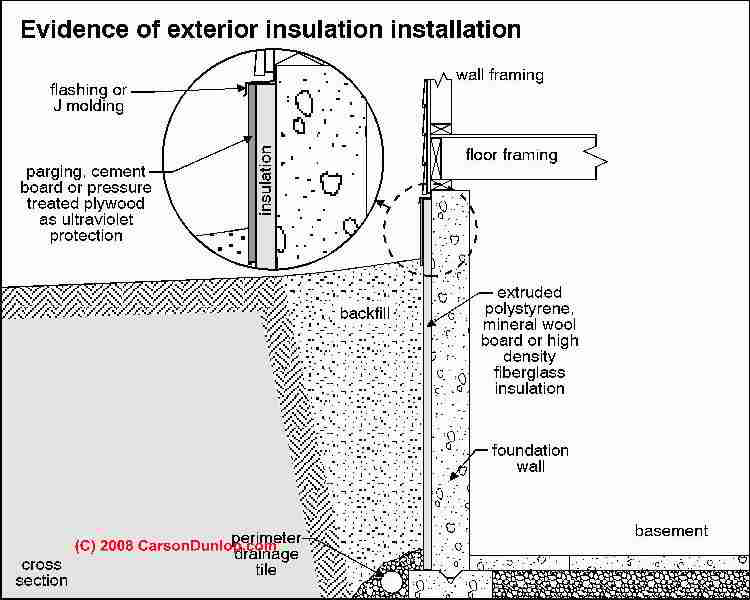
 The following comments pertain regardless of whether the foam insulation products we are addressing are sprayed foam insulation or solid foam insulating boards or panels. Sketch of common foam insulating board details courtesy of Carson Dunlop Associates, a Toronto home inspection, education & report writing tool company [ carsondunlop.com ].
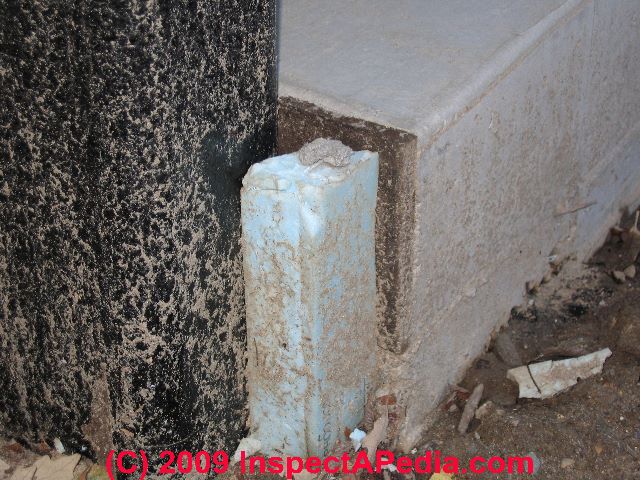
Photo: a foundation and floor slab installation in Minneapolis, Minnesota, using blue foam insulation board under and around the slab. By encasing the foam completely in concrete we think that the installer was avoiding a potential attack path for carpenter ants or other wood-destroying insects.
[Click to enlarge any image]
- Wood destroying insect effects of foam insulation:
foam insulation is not an insect barrier; while these materials do not provide food for termites, they are easily penetrated by termites or carpenter ants (as are other insulating materials).
For this reason our opinion is that it is bad design to bring foundation insulating foam panels up into contact with building wood framing materials unless an approved insect barrier has also been installed.
What can we do to improve the insect resistance of buildings where solid foam board or foam spray foundation insulation are being applied?- Chemical barrier that resists insect attack:
is applied around and under the building. Chemical barriers for termites and other wood destroying insects used to work very well, but modern chemicals may be less effective/less durable over time due to changes in pesticides to make these chemicals less of an an environmental hazard.
See TERMITE SHIELDS vs TERMITICIDE. - Mechanical barrier that resists insect attack:
a metal shield is set atop all wood sills, extending an inch or more past the building interior and exterior wall surfaces, bent on an angle downwards to shed water, with exact details specified by a pest control officer and installed during construction.
A termite shield may be effective but remains a risky approach to bug-proofing if the shield is not inspected and if not kept visually accessible on both inside and outside of the buildings for periodic check - a termite mud tube might bypass a metal shield.
See TERMITE SHIELDS vs TERMITICIDE. - Good architectural design to resist insect attack:
the best wood destroying insect resistant-building design is to keep wood and other insect-friendly materials at least 8" above ground, provide no protected path for insect entry into the structure (such as behind solid insulation boards) - Building maintenance to resist wood destroying insect attack:
keep surface water and roof spillage away from the building perimeter. Do not pile up leaves, organic debris, wood piles, or mulch against building walls. Hire a professional to inspect the building, especially at high-risk points.
- Chemical barrier that resists insect attack:
Because insect damage on buildings is very often related to locations of water leaks or moisture traps, readers should also
see WATER ENTRY in BUILDINGS.
...
Continue reading at TERMITE SHIELDS vs TERMITICIDE or select a topic from the closely-related articles below, or see the complete ARTICLE INDEX.
Or see
Recommended Articles
- CARPENTER BEES - attacking polyurethane foam trim
- INSECT INFESTATION / DAMAGE - home
- POLYSTYRENE FOAM INSULATION
Suggested citation for this web page
INSECTS & FOAM INSULATION at InspectApedia.com - online encyclopedia of building & environmental inspection, testing, diagnosis, repair, & problem prevention advice.
Or see this
INDEX to RELATED ARTICLES: ARTICLE INDEX to BUILDING INSULATION
Or use the SEARCH BOX found below to Ask a Question or Search InspectApedia
Ask a Question or Search InspectApedia
Questions & answers or comments about insect attack through or behind foam building foundation insulation. .
Try the search box just below, or if you prefer, post a question or comment in the Comments box below and we will respond promptly.
Search the InspectApedia website
Note: appearance of your Comment below may be delayed: if your comment contains an image, photograph, web link, or text that looks to the software as if it might be a web link, your posting will appear after it has been approved by a moderator. Apologies for the delay.
Only one image can be added per comment but you can post as many comments, and therefore images, as you like.
You will not receive a notification when a response to your question has been posted.
Please bookmark this page to make it easy for you to check back for our response.
Our Comment Box is provided by Countable Web Productions countable.ca
Citations & References
In addition to any citations in the article above, a full list is available on request.
- Thanks to Mark Cramer, Tampa Florida, for assistance in technical review the deteriorating gray Owens Corning flex duct in a hot Mr. Cramer is a Florida home inspector and home inspection educator.
- API Alliance for the Polyurethanes Industry Fire Safety Guidelines for Use of Rigid Polyurethane and Polyisocyanurate foam Insulation in building Construction (.pdf file)
- Our recommended books about building & mechanical systems design, inspection, problem diagnosis, and repair, and about indoor environment and IAQ testing, diagnosis, and cleanup are at the InspectAPedia Bookstore. Also see our Book Reviews - InspectAPedia.
- In addition to citations & references found in this article, see the research citations given at the end of the related articles found at our suggested
CONTINUE READING or RECOMMENDED ARTICLES.
- Carson, Dunlop & Associates Ltd., 120 Carlton Street Suite 407, Toronto ON M5A 4K2. Tel: (416) 964-9415 1-800-268-7070 Email: info@carsondunlop.com. Alan Carson is a past president of ASHI, the American Society of Home Inspectors.
Thanks to Alan Carson and Bob Dunlop, for permission for InspectAPedia to use text excerpts from The HOME REFERENCE BOOK - the Encyclopedia of Homes and to use illustrations from The ILLUSTRATED HOME .
Carson Dunlop Associates provides extensive home inspection education and report writing material. In gratitude we provide links to tsome Carson Dunlop Associates products and services.
 | HOME | ABOUT | ASK a QUESTION | CONTACT | CONTENT USE POLICY | DESCRIPTION | POLICIES | PRIVACY | |
| © 2024 - 1985 Publisher InspectApedia.com - Daniel Friedman | |||||||||