
InspectAPedia® FREE Encyclopedia of Building & Environmental Construction, Diagnosis, Maintenance & Repair |
Question? Just ask us! InspectAPedia
|
 Linoleum Flooring Materials
History, Components, Identification, Asbestos content
- POST a QUESTION or COMMENT about the history, uses, & ingredients in linoleum rugs or sheet or linoleum tile floor coverings
Linoleum Flooring Materials
History, Components, Identification: this article provides information about linoleum flooring: the history of linoleum, linoleum ingredients, and the properties of linoleum resilient or sheet floor coverings.
InspectAPedia tolerates no conflicts of interest. We have no relationship with advertisers, products, or services discussed at this website.
Linoleum Floor Covering Materials: history, ingredients, uses
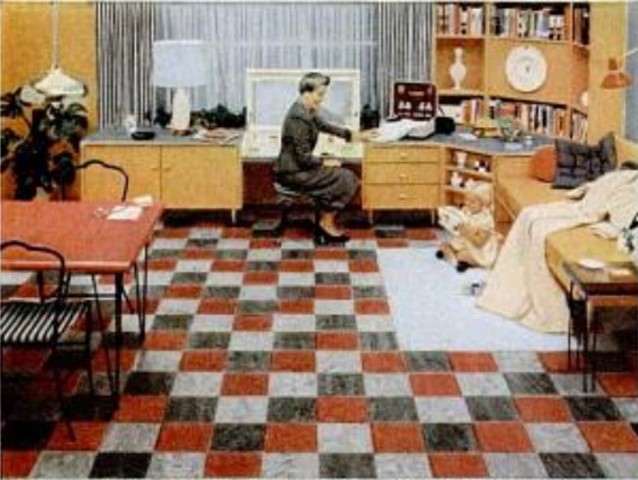 Linoleum was invented in 1860 by Frederick Walton and was intended for use first as a ship deck covering (battleship linoleum up to 1/2" thick).
Earlier, in the 1700s, non-woven floor coverings were made of oil cloth - heavy canvas coated with wax or oils (for water resistance and durability) that were then painted.
Previously, painted oilcloth floor covering was probably the most common non-woven floor covering for nearly two hundred years, or until Walton's linoleum entered production.
[Click to enlarge any image]
Article Series Contents
- FLORAL PATTERN LINOLEUM & SHEET FLOORING - separate article
- LINOLEUM FLOOR HISTORY
- LINOLEUM ASBESTOS CONTENT? - separate article
- LINOLEUM, ASBESTOS FREE - Congoleum Gold Seal & Others
- LINOLEUM FLOOR INGREDIENTS
- LINOLEUM FLOORING RESTORATION & REPAIR - Conservation resources, separate article
- LINOLEUM "LOOKALIKES" ADHERED to FELT
Inventor & History of Linoleum Flooring & Its Descendants Lincrusta & Anaglypta
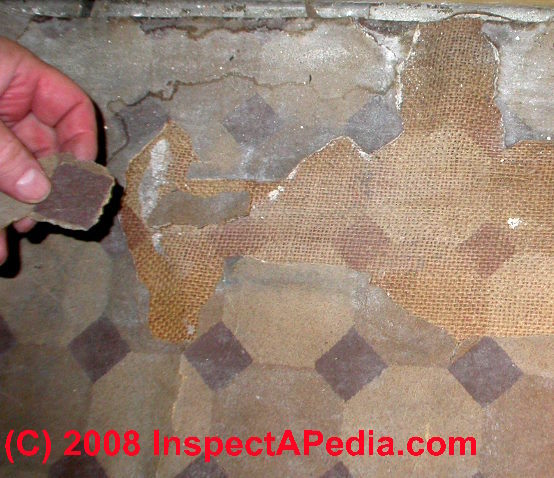
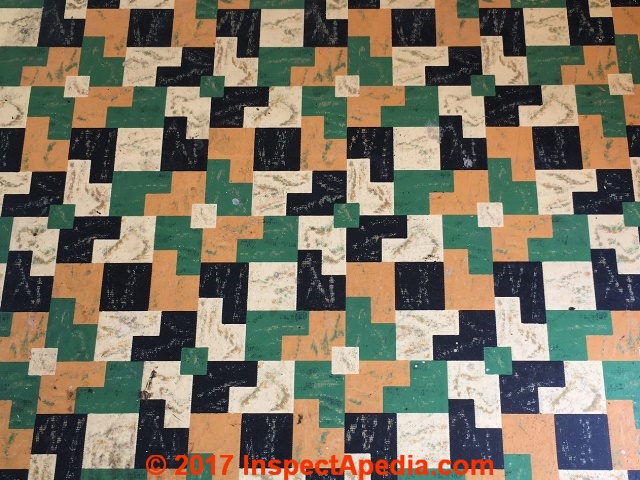 Our photo illustrates sheet flooring uncovered by reader JH in a 1920's apartment.
JH was worried that this flooring might contain asbestos. Subsequent tests did not find asbestos in this floor sample.
Our photo illustrates sheet flooring uncovered by reader JH in a 1920's apartment.
JH was worried that this flooring might contain asbestos. Subsequent tests did not find asbestos in this floor sample.
Linoleum was the first modern, democratic floor covering.
This invention – patented in 1863 by a Scot, Sir Frederick Walton – had a revolutionary impact.
From the late 19th century right up until the 1950s, it was one of the few products which was simultaneously practical, hardwearing, non-flammable, low-maintenance and cheap.
Before the advent of linoleum, the only available floor coverings for homes or communal buildings were wood or tiles.
In the early 20th century, about one hundred factories were combining natural materials (linseed oil, jute, cork and pigments) to make linoleum by the square meter. (Tarkett ret. 2018)
Because of its durability and ease of production, Sir Walton's linoleum quickly found use as a floor coverings in buildings - a much larger application than battleships.
Linoleum's appeal rose from its properties as a durable, water-resistant sheet-type floor covering. Glued to a backer of jute or canvas to resist cracks and tears, this flooring has a long history of durability and service.
"Linoleum" was named by Walton from his observation that his original linoleum products were made using linseed oil as an ingredient (linseed oil forms a thick flexible skin when it dries), combined with ground cork dust, pigments, and resins, often with a jute, burlap or canvas fabric backing (see our antique linoleum photos just below).
Descendents of Linoleum include Anaglypta and Lincrusta (many writers spell it "Linocrusta or linacrusta"), an embossed patterned covering used on walls and ceilings.
Walton was also the inventor of a textured sheet
product LINCRUSTA CEILINGS & WALLS.
Our photo at below shows antique sheet flooring found in a home built in the 1800's.
Thomas Palmer, who had worked for Walton, soon produced a similar but lighter
sheet product ANAGLYPTA CEILINGS & WALLS.
Besides linseed-oil based linoleum flooring, other sheet floorings backed with jute or asphalt-impregnated black paper typically were composed of mostly cellulose (wood fiber or paper products) (60%) with a bit of horsehair (5%) for strength, and tar.
While people often refer to those pre-vinyl sheet flooring products as "linoleum" in a true sense of ingredients they're not.
Watch out: some asphalt-felt or black tar paper-like backed sheet flooring products might contain asbestos, as we'll explain next.
Linoleum's ingredients, both historical and modern, rug patterns & other designs
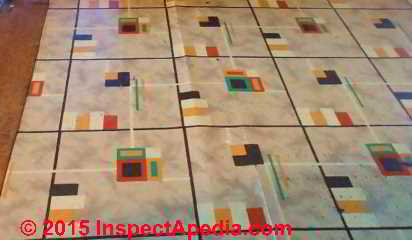
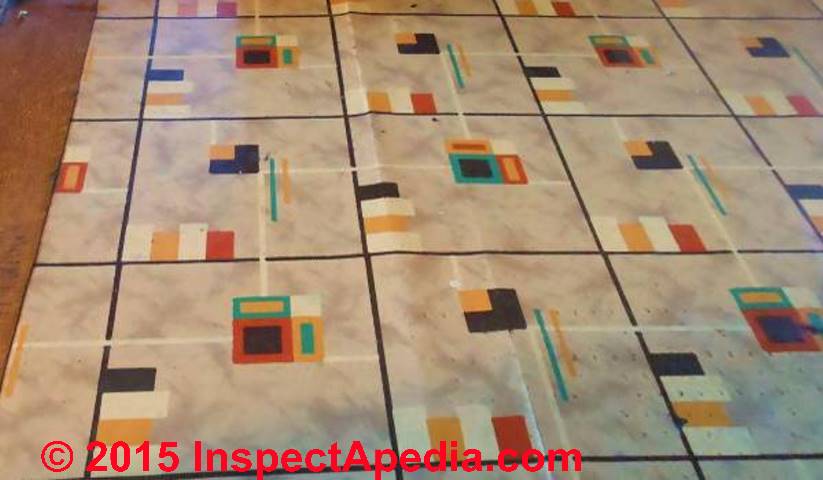
The reader-contributed photographs just below demonstrate Congoleum's Gold Seal™ linoleum in a braided rug design or pattern. [Click to enlarge any image]. Below we list the ingredients found in linoleum floor coverings.
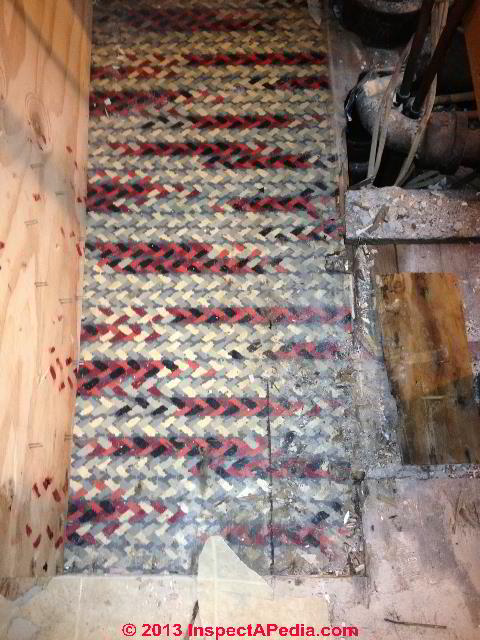
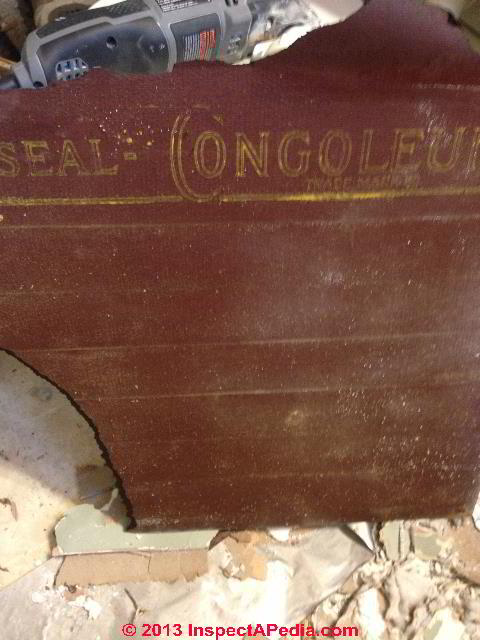
Because of its solid red color we wondered if this Gold Seal Congoleum product was a rubber-backed flooring product.
Help in distinguishing sheet flooring types is
at RESILIENT SHEET FLOORING ID GUIDE and
at SHEET FLOORING INSPECT / TEST.
Here are the ingredients in true linoleum:
- Natural resins: linseed oil (original linoleum), also balsam and copal resins or as a substitute dammar resin. Resins form the binder or "glue" that holds the product together. Linseed oil is made from flax seeds.
- Jute is used as the flooring backer for strength and dimensional stability.
As a kid we called jute "burlap" as it was commonly used also to produce burlap bags.
Jute is a natural fabric. We also have found older linoleum floor coverings that used asphalt-impregnated paper ("tar paper" or roofing felt) as a backer. - Color pigments are used to form the patterns in the linoleum surface (see our photos here).
Armstrong points out that their Armstrong DLW Linoleum, care was given to choice of pigments to protect the "natural" claim for this flooring material. Quoting:
In the Armstrong DLW Linoleum all the colour pigments are free of lead, cadmium and chrome.
The dark colours are produced for the most part with iron oxide pigments, the bright colours with pigments of organic origin. All pigments were examined by a toxicologist and are classified as being physiologically harmless.
Among other requirements Armstrong DLW Linoleum therefore meets the demands of the toy norm EN71 or better and the various legal requirements for the colouring of consumer goods. - [1]
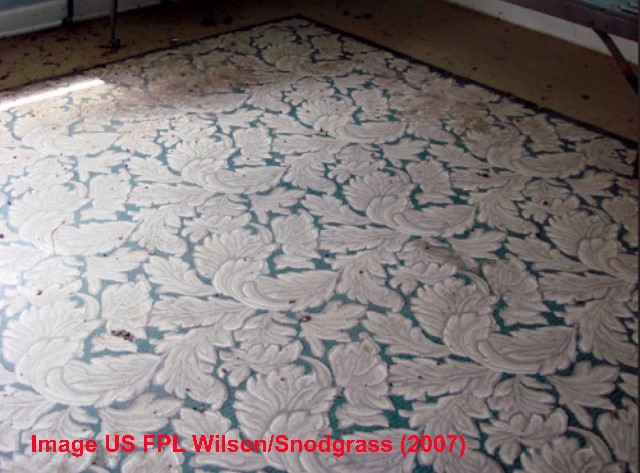
Photo above: Congoleum "Linoluem" rug in a green and white floral pattern.
- Cork powder is used in Linoleum to give body to the flooring flexible surface.
Armstrong uses cork powder waste. Readers familiar with the Iberian peninsula will recognize that cork is a long-standing and important export product from both Spain and Portugal.
The "linoleum" photo at left in rug pattern (notice that the sheet flooring does not extend fully to the room perimeter) illustrates a linoleum "rug". Source: Wilson & Snodgrass, U.S. FPL (2007).
This rug pattern sheet flooring is discussed in detail
at CONGOLEUM-NAIRN FLOOR TILES & LINOLEUM.
and more examples of the floral linoleum pattern above are given
at FLORAL PATTERN LINOLEUM & SHEET FLOORING
CORK FLOORING also uses ground cork, but in a more coarse form described in that article.
- Limestone powder is used as a filler in the resilient linoleum floor covering body.
Really? Pending further research our GUESS is that some early forms of linoleum could have used asbestos powder as a similar filler material, just as asbestos powder was used as a filler in some floor tiles.
See ASBESTOS FLOORING IDENTIFICATION
where we pose 5 questions that can help make a reasonable guess at whether or not a specific flooring product contains asbestos before a lab test. - Wood powder (see cork above) is also used as a filler and body component of linoleum.
Linoleum "lookalikes" Adhered to Asphalt Felt Underlayment or green, red, or black backings
Identify Older Linoleum Rug or Black-Asphalt-Backed (dark felt underlayment-backed) Sheet Flooring
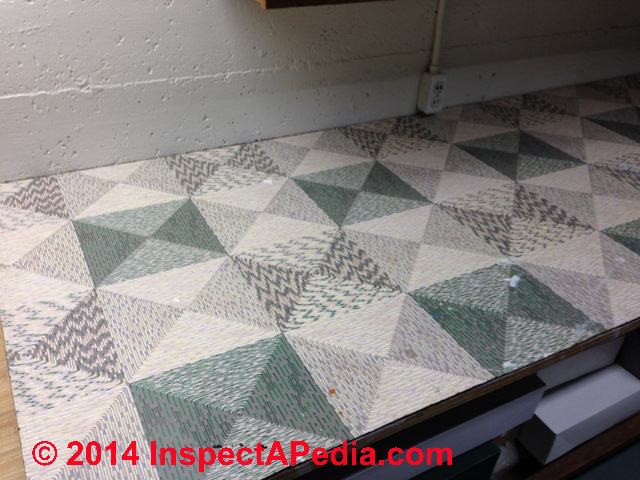
Photos of saturated felt-backed "linoleum" flooring (installed on a bench top) were provided by reader C.W.
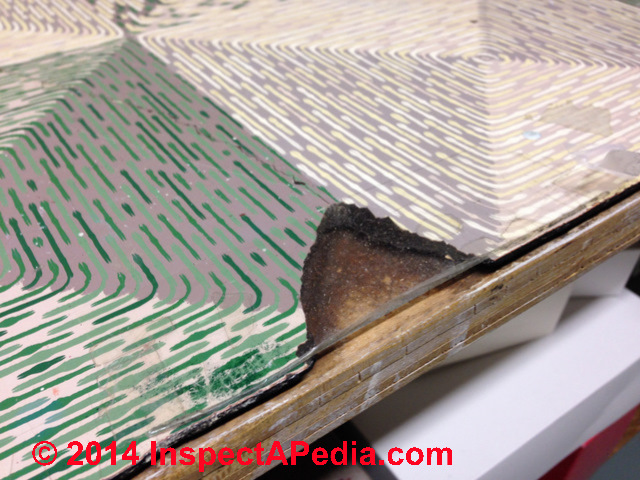
In addition to use on floors, linoleum was a popular covering for workbenches and kitchen counters and sink draining areas.
Reader Question: linoleum sheet flooring in rug pattern used on work bench
I wanted to seek your advice on the attached images which is some sort of tiling that a previous homeowner put on a work bench as a covering.
I looked through your website, but couldn't find a match. Does this look like asbestos tiles to you? If so, any idea on the brand? Thanks in advance! - C.W. 1/17/2014
Reply: forms of "linoleum" may include products glued to felt underlayment vs. glued to a jute backing
Our guide to identifying older types of sheet flooring, including products that may contain asbestos, is found
at RESILIENT SHEET FLOORING ID GUIDE. There we describe some simple tests that can often confirm the flooring type and basic materials.
From your photographs (the pair above and second pair given below) showing that the flooring product, now covering a workbench top, has a woven rug -patterned top layer over a black substrate or backer, I would guess that this is an asphalt felt paper-backed sheet flooring product resembling linoleum.
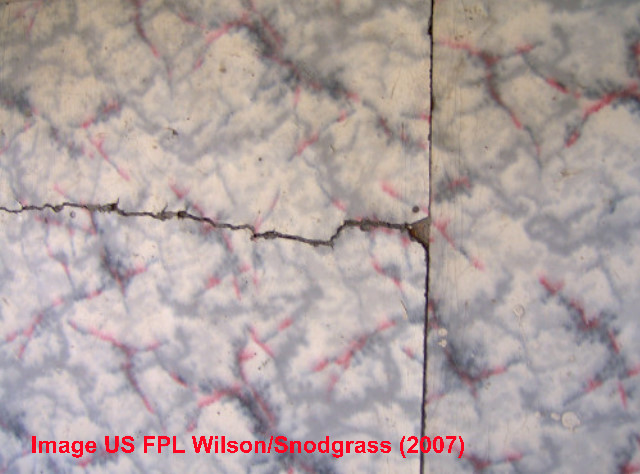
The "linoleum" photo at left in a "marbleized pattern" illustrates a similar example of black felt-backed sheet flooring referred to by some experts as "linoleum". Source: Wilson & Snodgrass, U.S. FPL (2007).
We explain in this article that the ingredients of true linoleum include natural resins, linseed oil, color pigments, cork powder and limestone, with a jute backing. Those products do not contain and never contained asbestos.
But other sheet flooring products loosely called "linoleum" may indeed contain asbestos. The US Forest Products Lab asserts that some forms of "linoleum" were glued to felt underlayment. (US FPL 2007).
The black backing and body of the flooring in your photos looks to me like an asphalt product, though I'd have to see and test a sample to know for certain.
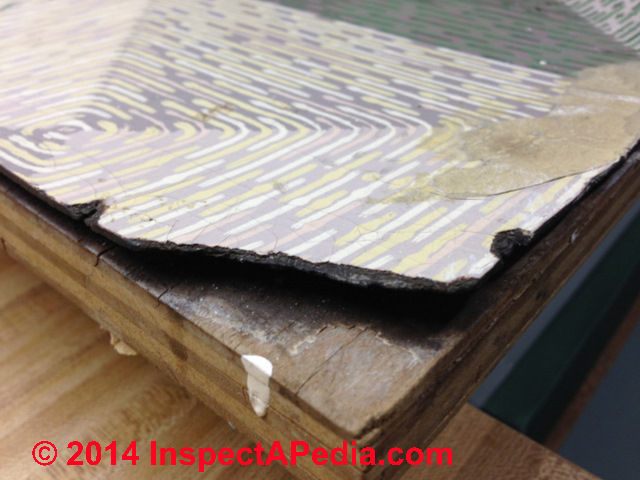
Photos above and below, show felt-backed "linoleum" provided by reader C.W.
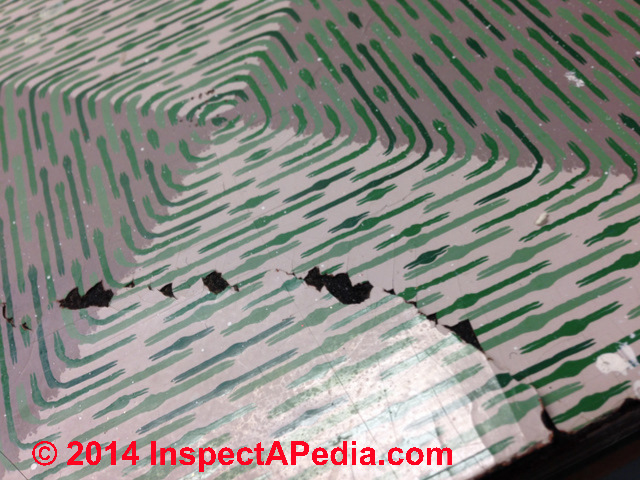
Watch out: some older felt underlayments and similar asphalt paper products used in flooring, roofing, and wall coverings or building papers contained asbestos. While I'm doubtful that the small quantity of flooring in your photo presents a measurable asbestos hazard (unless some fool grinds or rips it into shreds), it may thus contain asbestos.
If this asphalt-felt backed antique flooring sample were mine I'd preserve it, or a square of it, as it may be historically important.
Your second photo of the four (above right) seems to show a plastic or glass cover over this sheet flooring "rug" (as they were called). In that installation the material is protected and most likely completely harmless.
If you decide to dispose of the material as construction debris, I'd be glad to have you cut a pattern square and send it to me for lab examination pro-bono.
While we have expertise in asbestos and other material identification in our forensic lab, if you needed an asbestos certification (which in my opinion would be inappropriate for this case) you'd want to use a certified asbestos test lab.
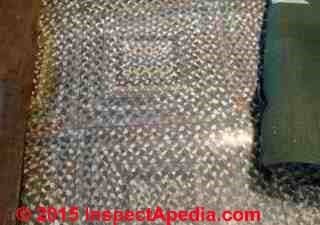
Reader Question: Not sure if this rub-pattern sheet flooring contains asbestos or not. Rug pattern sheet flooring with green backing
They are old - the kind that last a long time! The fleck type one was under several layers of flooring in my grandparents home. I think they built it around 1935.
[Click to enlarge any image]
The second one, [shown immediately above] the rug pattern is the one I am most interested in finding out about. The backing is green but I cannot find a makers mark on it. Any idea if that means anything? - Anon [by private email] 23 Aug 2015
Reply:
The photo shown just above looks like a rug pattern linoleum and if the green rolled material in the right of your photo is the same flooring, it is more likely a Congoleum (or less likely Armstrong) sheet flooring product.
Some Congoleum sheet flooring and also some Armstrong sheet flooring included a red or possibly green rubber backing that is not an asbestos material.
If you can examine the backing of this sheet flooring there is a good chance you'll see an Armstrong or Congoleum imprinted logo - do send me a photo of what you see.
Red backed sheet flooring by Congoleum is a rubber backing (not asbestos); green-backed sheet flooring is probably a similar product; asphalt felt paper (some of which can contain asbestos) would normally be black (as it's an asphalt product).
IF you are faced with a requirement for demolition and if you are uncertain about the flooring's asbestos content and cannot identify it through our guides, then you have a sample tested.
See ASBESTOS TESTING LAB LIST and as it will help other readers, if you have this flooring tested please confirm the lab result with us and send me a copy of the lab report.
Reader Question: what is this sheet flooring from my home that was built in 1865?
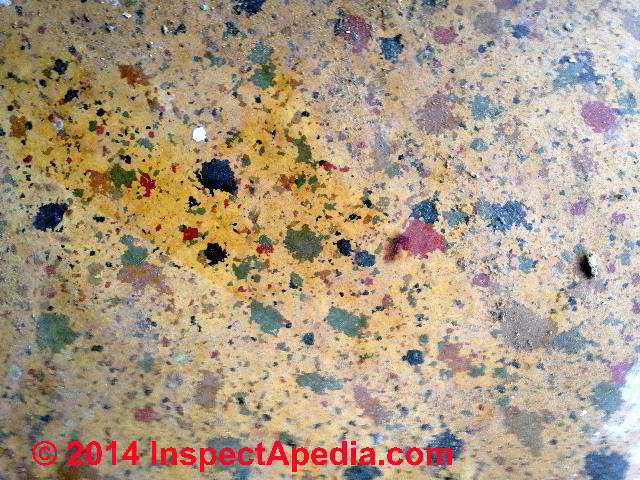 Can you give me an idea of date or asbestos?
House was built 1865.
Several layers.
This one is the last on top of tongue and groove.
Black felt backing. With asphalt type adhesive.
Thank you. - L.P. 6/3/2014
Reply:
LP this looks like a linoleum floor to me.
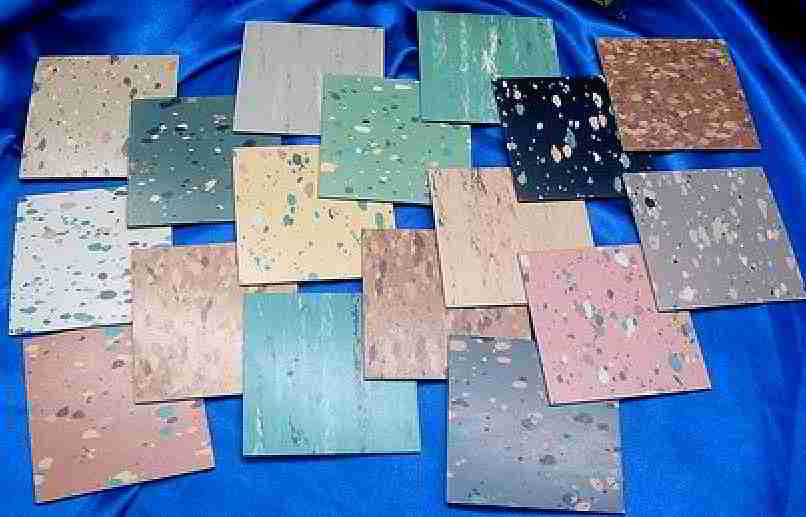
The spatter pattern was later picked-up and popularized in a similar (not identical) design that appeared in some of the Kentile flooring as
its CARNIVAL PATTERN but those were individual floor tiles, not sheet flooring like yours.
See my warning above about some older felt backing and some flooring adhesives that contain asbestos.
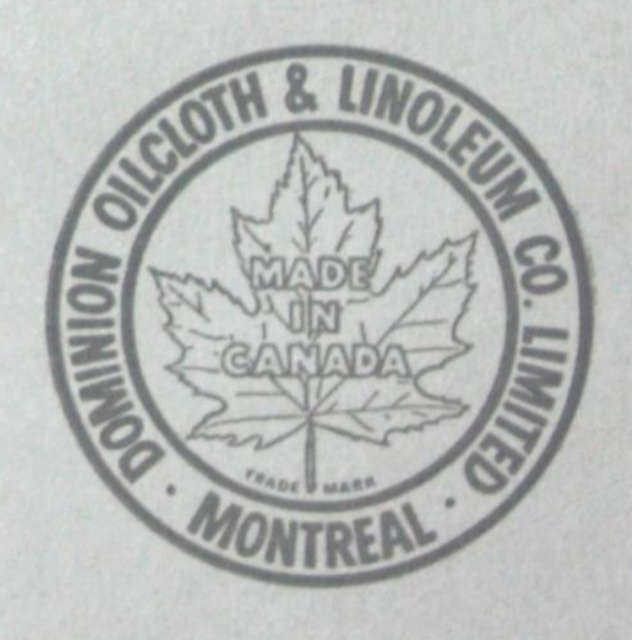
Canadian Linoleum Floor Coverings: Dominion Sheet Linoleum & Floor Tiles
This topic has moved to a separate page now found
at DOMINION & Other CANADIAN FLOORING ASBESTOS
Is there Asbestos in "Linoleum"?
Moved to
- LINOLEUM ASBESTOS CONTENT?
- LINOLEUM, ASBESTOS FREE Congoleum Gold Seal & Others
Modern Linoleum Flooring
Moved to MODERN LINOLEUM FLOORS - separate article
Where to Buy Modern Linoleum Flooring & Linoleum Flooring
Moved to WHERE TO BUY LINOLEUM, RUBBER, CORK FLOORS
How to Identify Armstrong, Congoleum, & other Asbestos-Containing Resilient Sheet Flooring
Details about identifying older installations of sheet flooring or sheet-forms of resilient flooring that may contain asbestos are now found at RESILIENT SHEET FLOORING ID GUIDE - live link is given just below.
Armstrong's sheet flooring is described at ARMSTRONG SHEET FLOORING
Linoleum Floor Restoration & Care Advice
MOVED to LINOLEUM FLOORING RESTORATION & REPAIR - Conservation resources
Reader Comments, Questions & Answers About The Article Above
Below you will find questions and answers previously posted on this page at its page bottom reader comment box.
Reader Q&A - also see RECOMMENDED ARTICLES & FAQs
On 2023-12-10 by InspectApedia DF (mod)
@Ashlee
Sure, I'm working on compiling a list of and examples of floral pattern linoleum or sheet flooring and will post more here asap
I'll post your photo also at a page where we've collected the most examples of floral pattern linoleum, Congoleum, and similar flooring products dating from early in the 20th century.
FLORAL PATTERN LINOLEUM & SHEET FLOORING
On 2023-11-18 by Ashlee
@InspectApedia Publisher, could you link where it has been seen on the website? Ive tried to dig through and find it but I've been unable to.
I would hate to be a bother though, so you definitely don't have to! :)
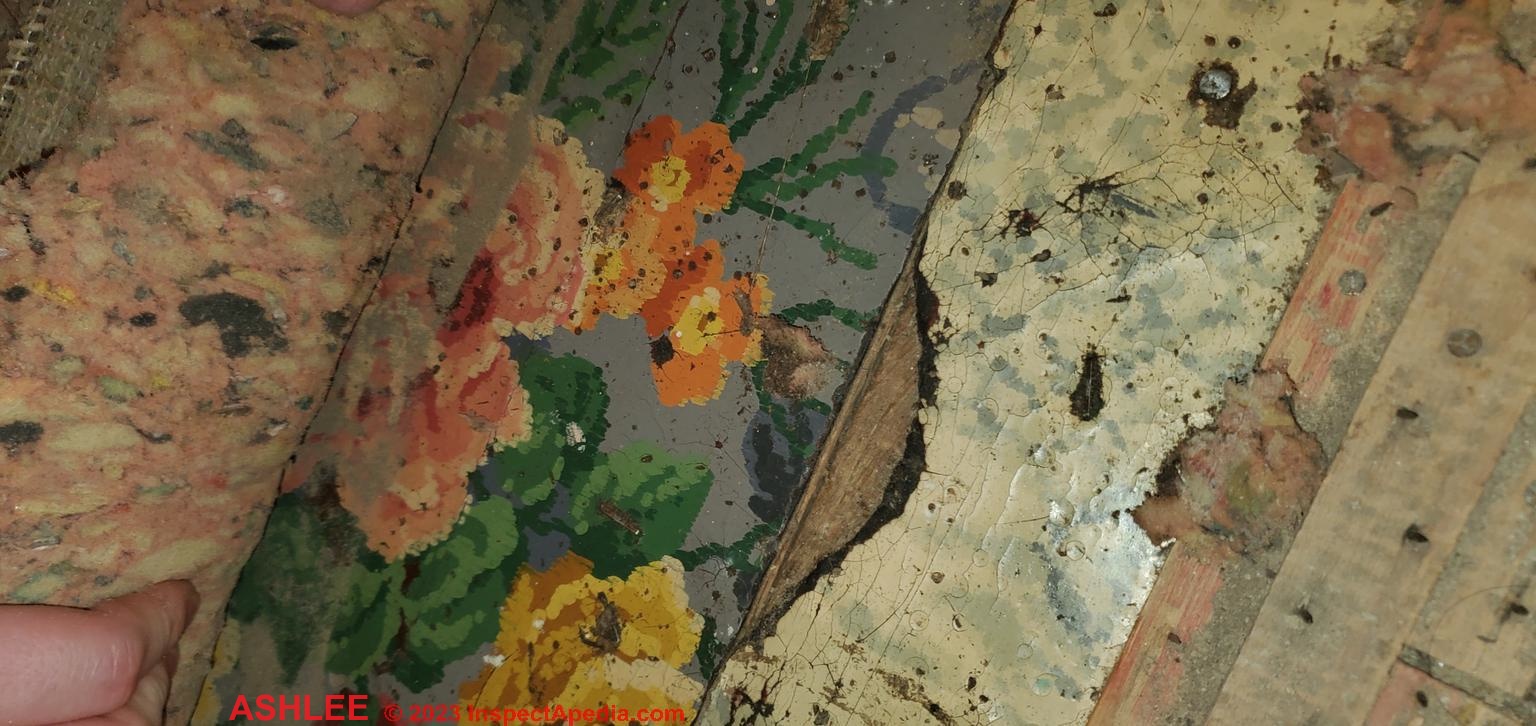
On 2023-11-18 1 by InspectApedia DF (mod)
@Ashlee,
Some asphalt-backed sheet flooring or "linoleum" did contain asbestos, and we do look forward to seeing your lab test result.
But don't panic. (Doing so is bad for your health and for your wallet.)
Even if your test results came back positive for asbestos, if you use appropriate handling methods for removal as discussed in the article we cite, framing a piece of the flooring would not be an issue.
If you're able to salvage a piece and then frame it, the framing and its cover would enclose the flooring and take care of any risk.
And yes, that floral pattern linoleum or patterns quite similar to it makes several appearances in this linoleum flooring series.
where you'll see similar products, though I'm not sure there's an exact match.
On 2023-11-18 by Ashlee
@InspectApedia Publisher, I pulled back more of the carpet to reveal more of the design. [Photo above]
I'm having a hard time finding the exact match. I can find similar but the similar ones don't contain the little orange flowers.
I'm planning on sending samples to a lab though, hopefully no asbestos so I can frame cuttouts of the flooring! Thank you for the flooring removal suggestions! :D
On 2023-11-14 y InspectApedia Publisher (mod)
@Ashlee,
Yes it's possible that that flooring contains asbestos
If you are removing the floor, see the suggestions at
https://inspectapedia.com/hazmat/Asbestos-Floor-Removal.php
Continuing...
Also take a look at the article in the Recommended Articles list above titled
DOES THIS FLOORING CONTAIN ASBESTOS? - 5 easy questions help make a reasonable guess
On 2023-11-14 by Ashlee
I know there's not a lot off the patterns showing but could either of these sheet floorings contain asbestos?
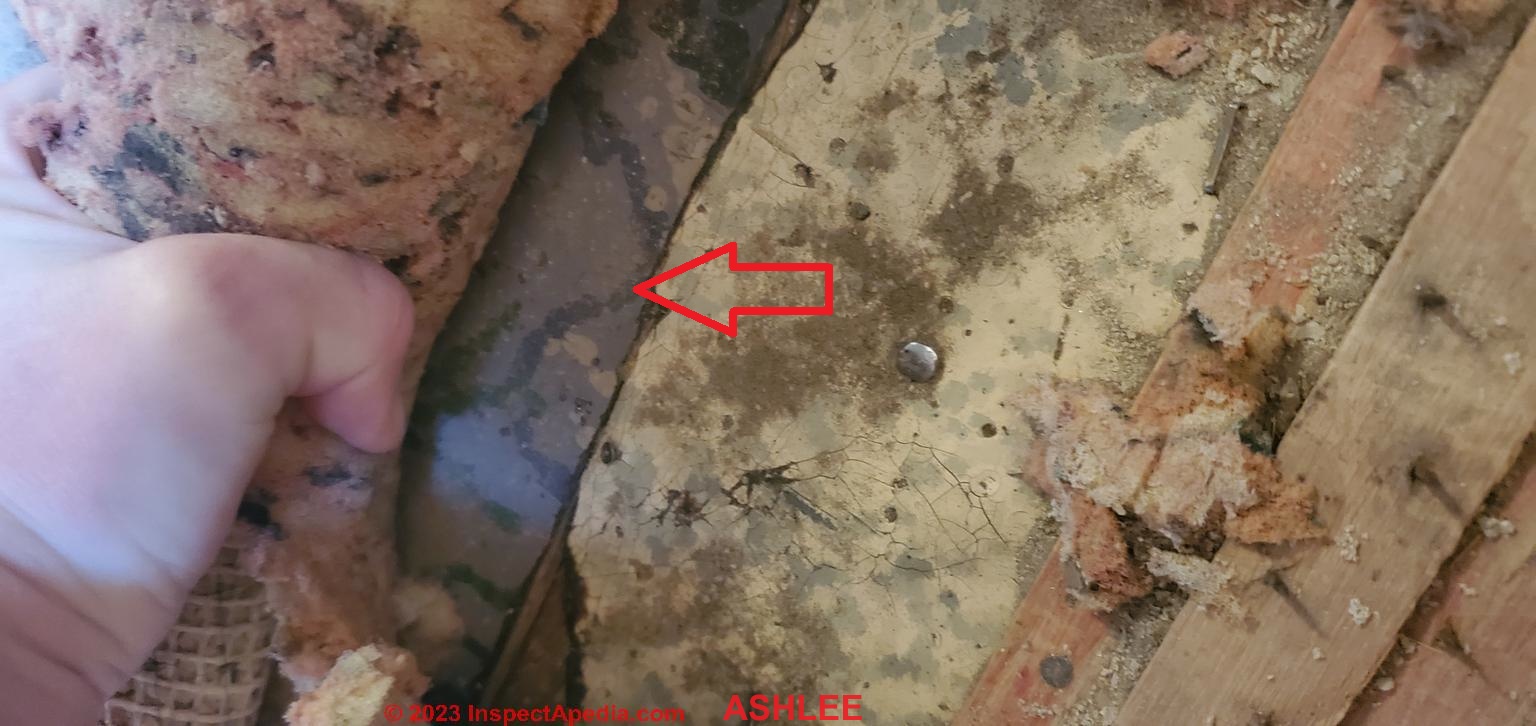
House was built in 1929, but I'm guessing the floor covering got installed later on? Located in Utah, Cache Valley.
On 2023-08-13 1 by InspectApedia Publisher (mod)
@Kayleigh,
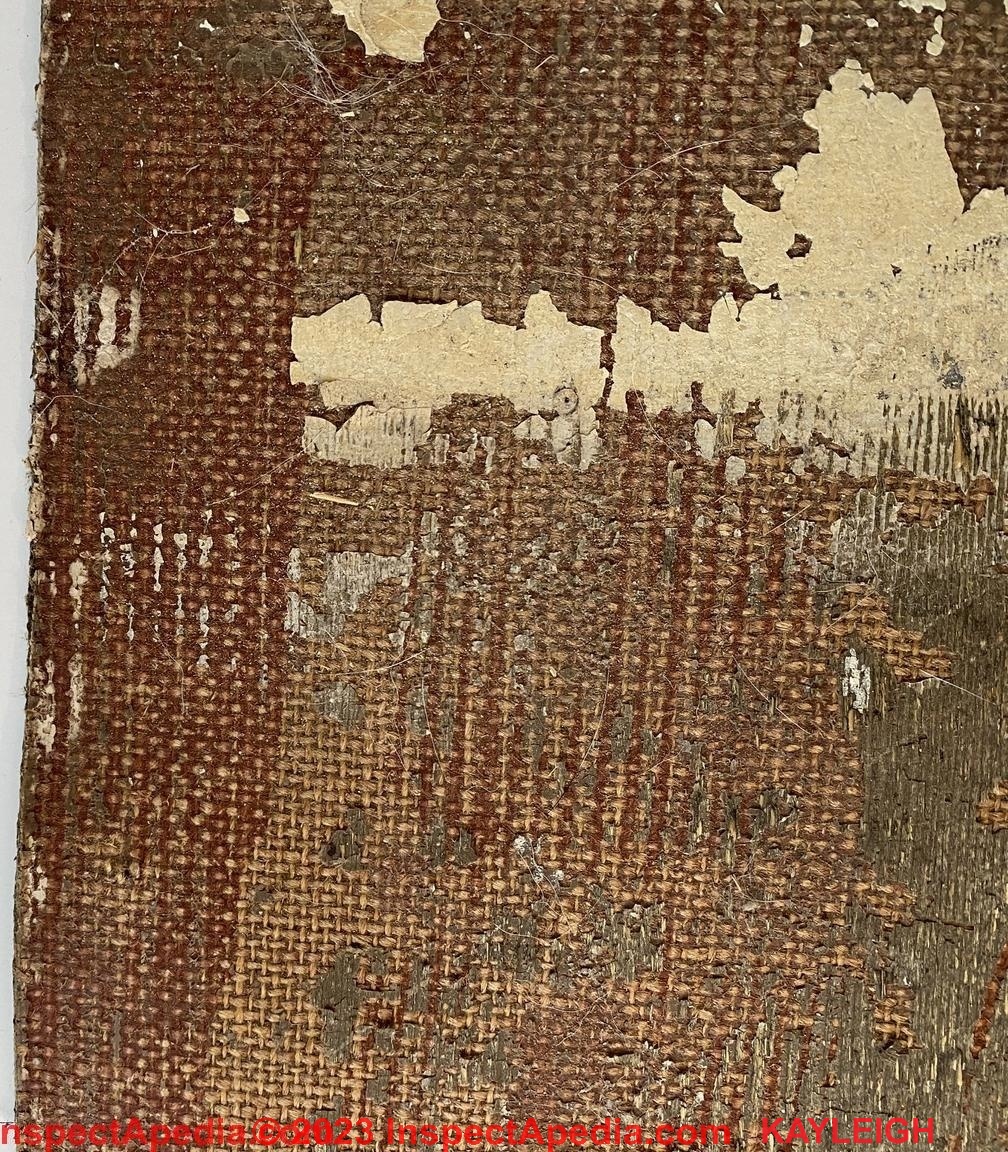
That looks like a jute backer on sheet flooring in your first photo;
If it was glued down, beware that some mastic adhesives, both black asphaltic and also lighter colored versions, also contained asbestos.
In your second gray fibrous photo that does not look to me like a walking surface - are you sure it's the upper surface of a sheet flooring material?
From just the image, I can't say for sure whether or not that old sheet flooring backer contains asbestos.
It's possible.
If you can remove the flooring without grinding, chopping, sawing, sanding or otherwise creating a dusty mess from the flooring itself then there's not likely to be much potential hazard.
If not, then I'd have a sample tested for asbestos.
On 2023-08-13 by Kayleigh
Me again, not sure if my first comment worked - suspected linoleum floor in a 1901 home. Unsure if asbestos is a possibility. None of this flooring are “tiles” but rather bigger pieces on the stairs and footboards.
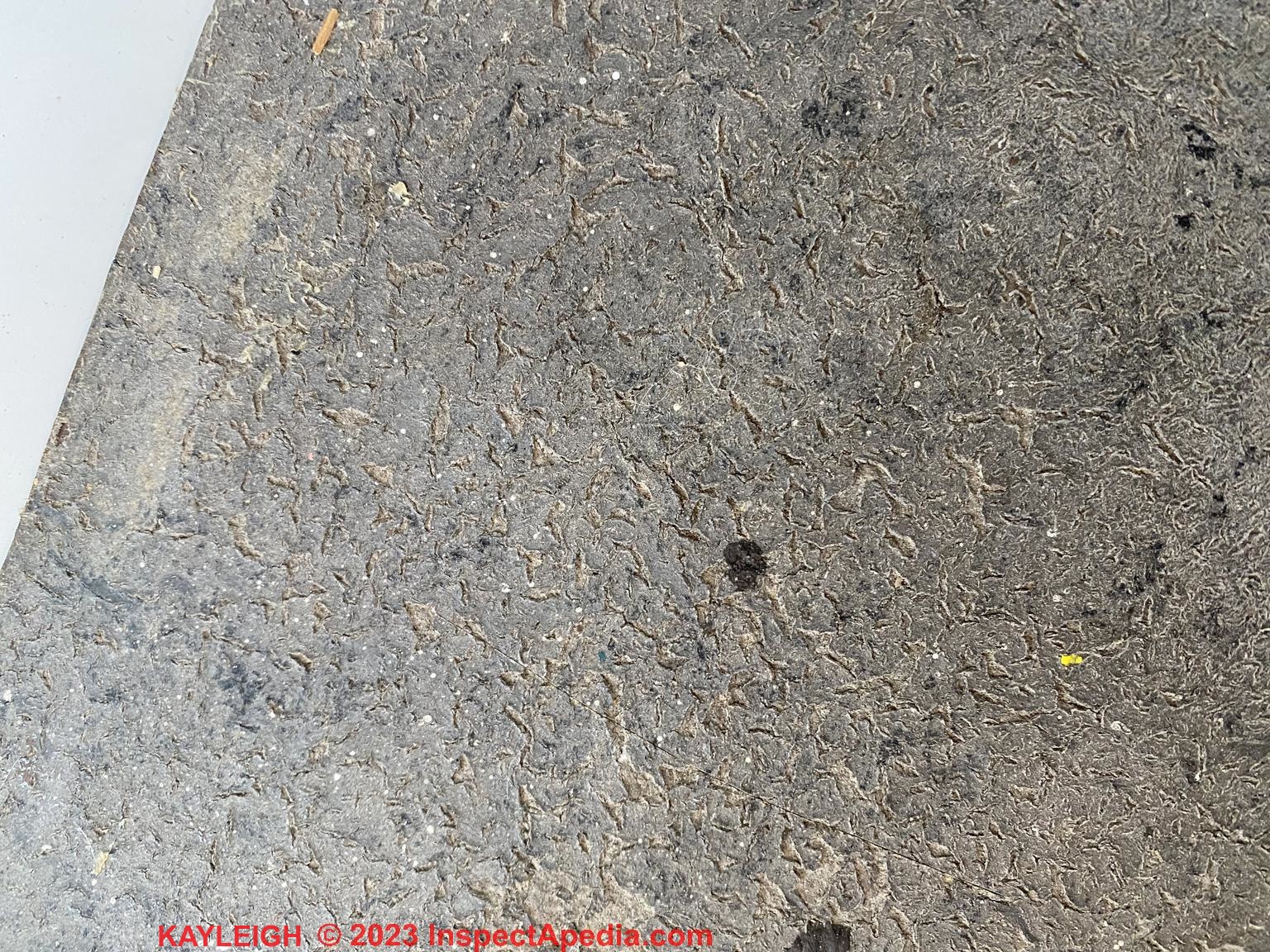
On 2023-08-13 by Kayleigh again
Here’s a photo of the back
On 2023-08-02 by InspectApedia DF (mod)
@Anonymous,
That sure looks like black mastic remnants although it’s hard to tell from just one photo. Keep in mind that some of the asbestos containing mastics were not black. Also, the backer could contain asbestos as well.
You can read more about that at
ASBESTOS-CONTAINING FLOOR TILE ADHESIVE
https://inspectapedia.com/hazmat/Tile_Mastic_Asbestos_ID.php
You may also want to take a look at (live link just above in the Recommended Articles list)
DOES THIS FLOORING CONTAIN ASBESTOS? - 5 easy questions help make a reasonable guess
It would be helpful to other readers as well if you’re willing to share the results you get from sending a sample out for testing.
On 2023-08-01 by Anonymous
Hi, I recently found this flooring that was under some other linoleum flooring. It is an Armstrong 9x9 house was built in the 50’s I am not sure if it is linoleum or vinyl, from my research it almost looks like linoleum from the looks of the backing.
As the black stuff does not appear to be black mastic cause I can see the clear glue used. What is your opinion on this? I did a home kit and sent it out for testing won’t receive the results until next week.
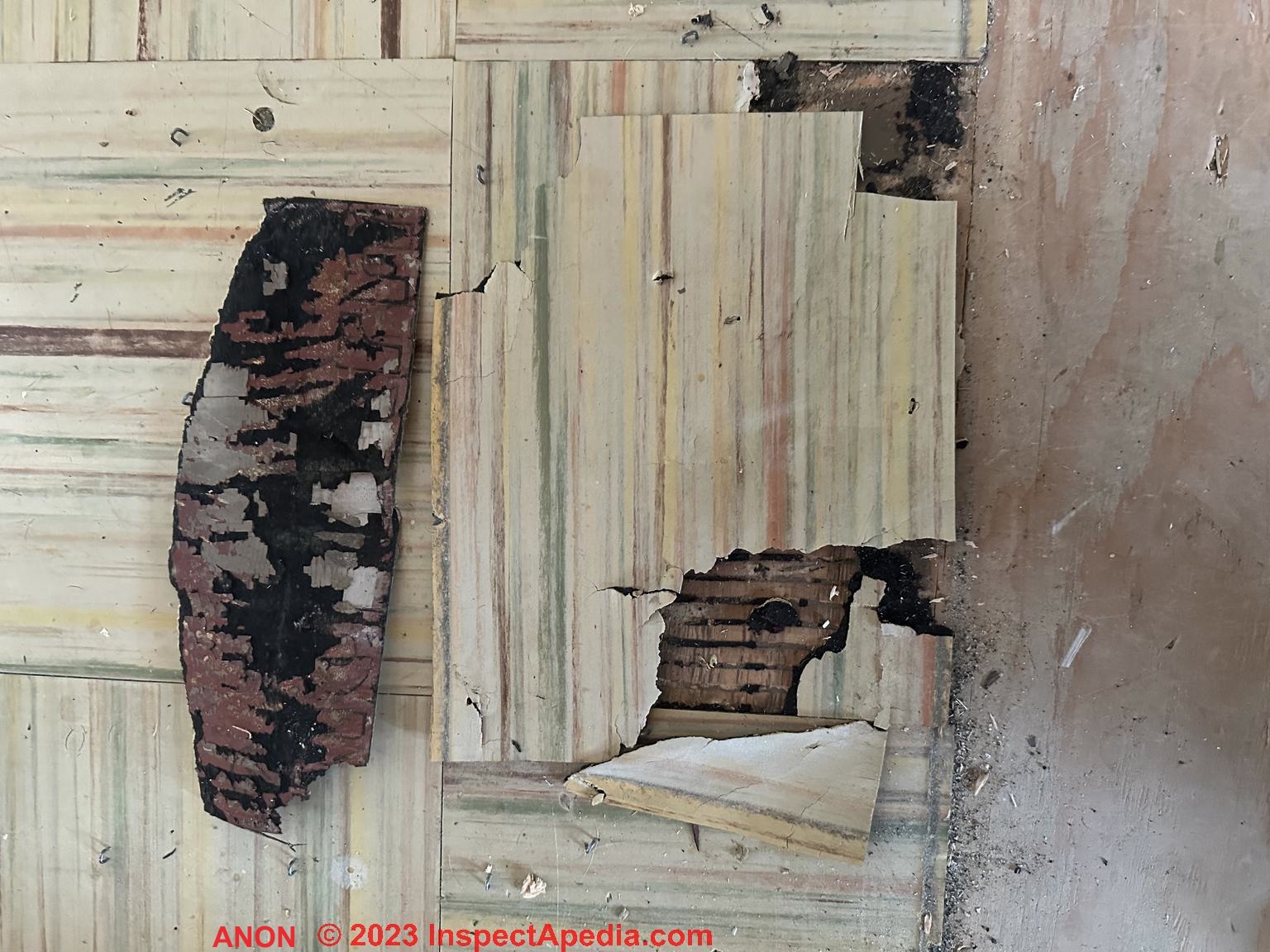
Top [at left in the photo above] picture is the back of the tile and bottom picture is the front.
On 2023-03-02 by InspectApedia Publisher (mod)
@Anonymous by private email,
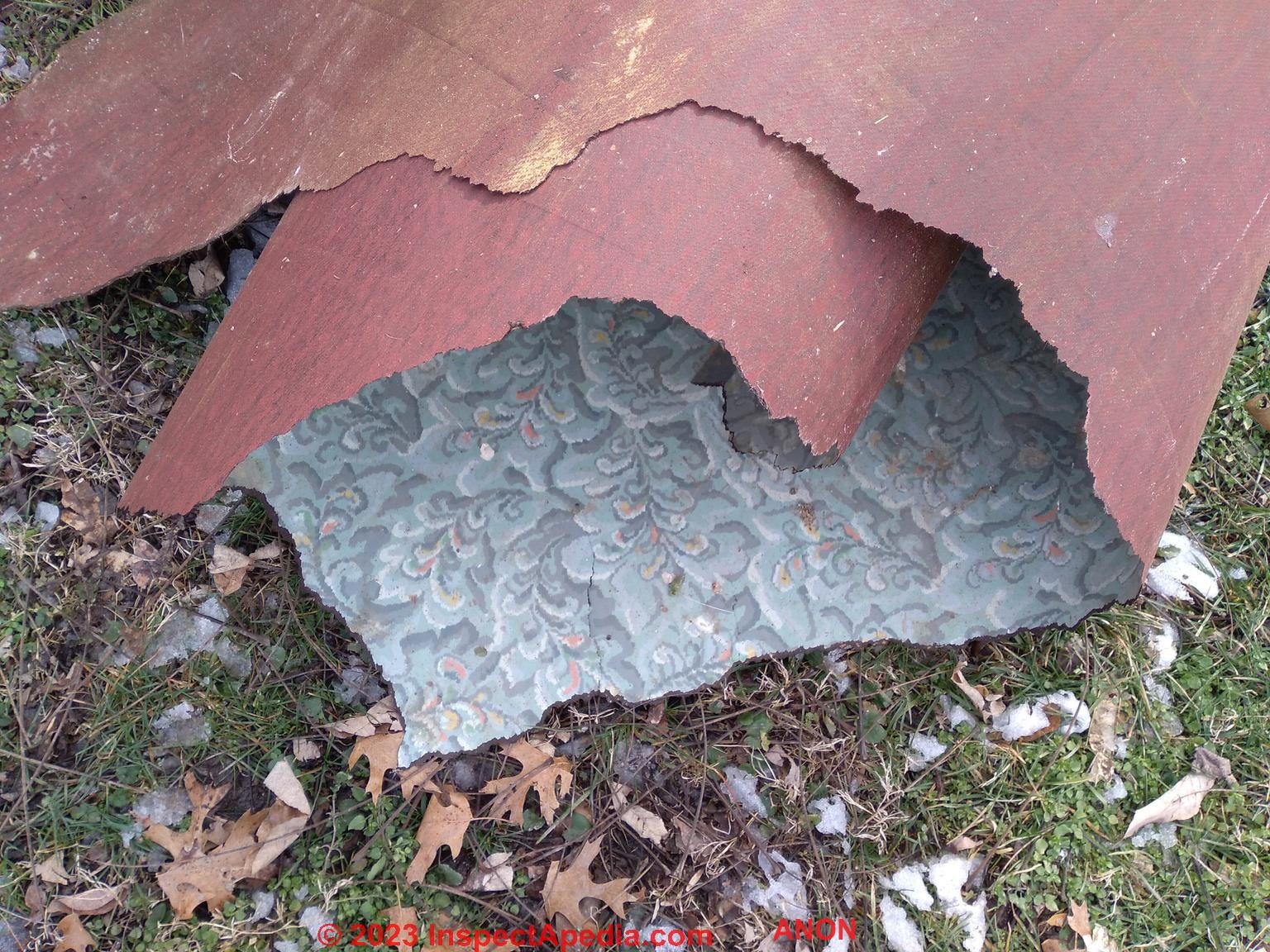
Thank you for those nice linoleum "rug" photos - you'' find both of those patterns aor very similar ones ppearing above on this page and in more detail
at FLORAL PATTERN LINOLEUM & SHEET FLOORING.
Do take a look and don't hesitate to ask any follow-up questions you need.
On 2023-03-02 by Anonymous by private email (mod)
2nd photo
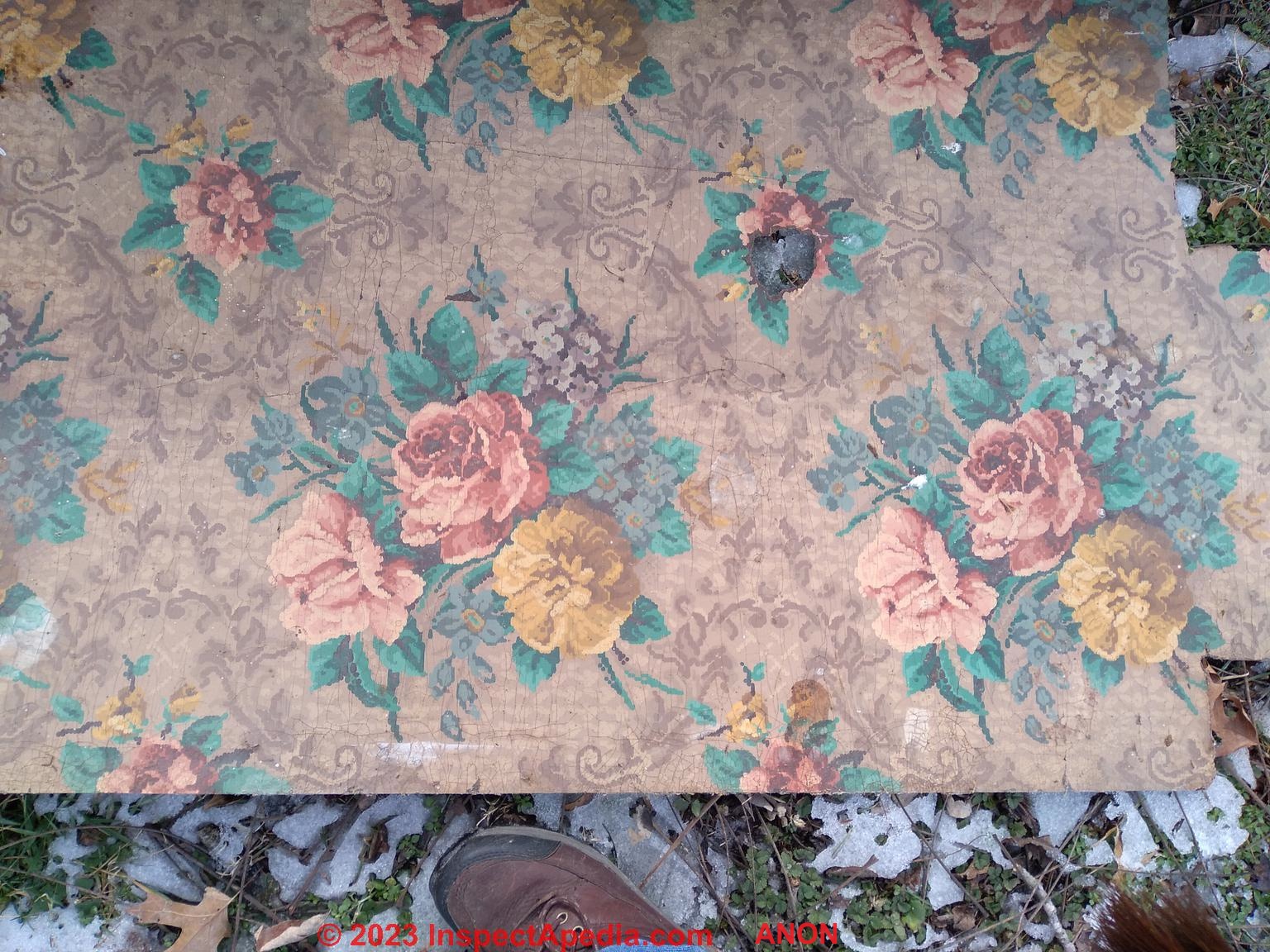
On 2023-03-02 by Anonymous by private email (mod)
I am trying to find out the year of manufacture of this vinyl rug and if it contains asbestos. The house was built in 1920's but the rugs could be from any era since.
See photos.
- 02/20/2023 by private email
On 2022-07-28 by InspectApedia-911 (mod)
@Alice,
Certainly that floor could be from the 1950s or 1960s and so could contain asbestos.
On 2022-07-28 by Alice
Hello, we have just moved into a property built in 1955. Under the carpet we have found tiles in multi colours.
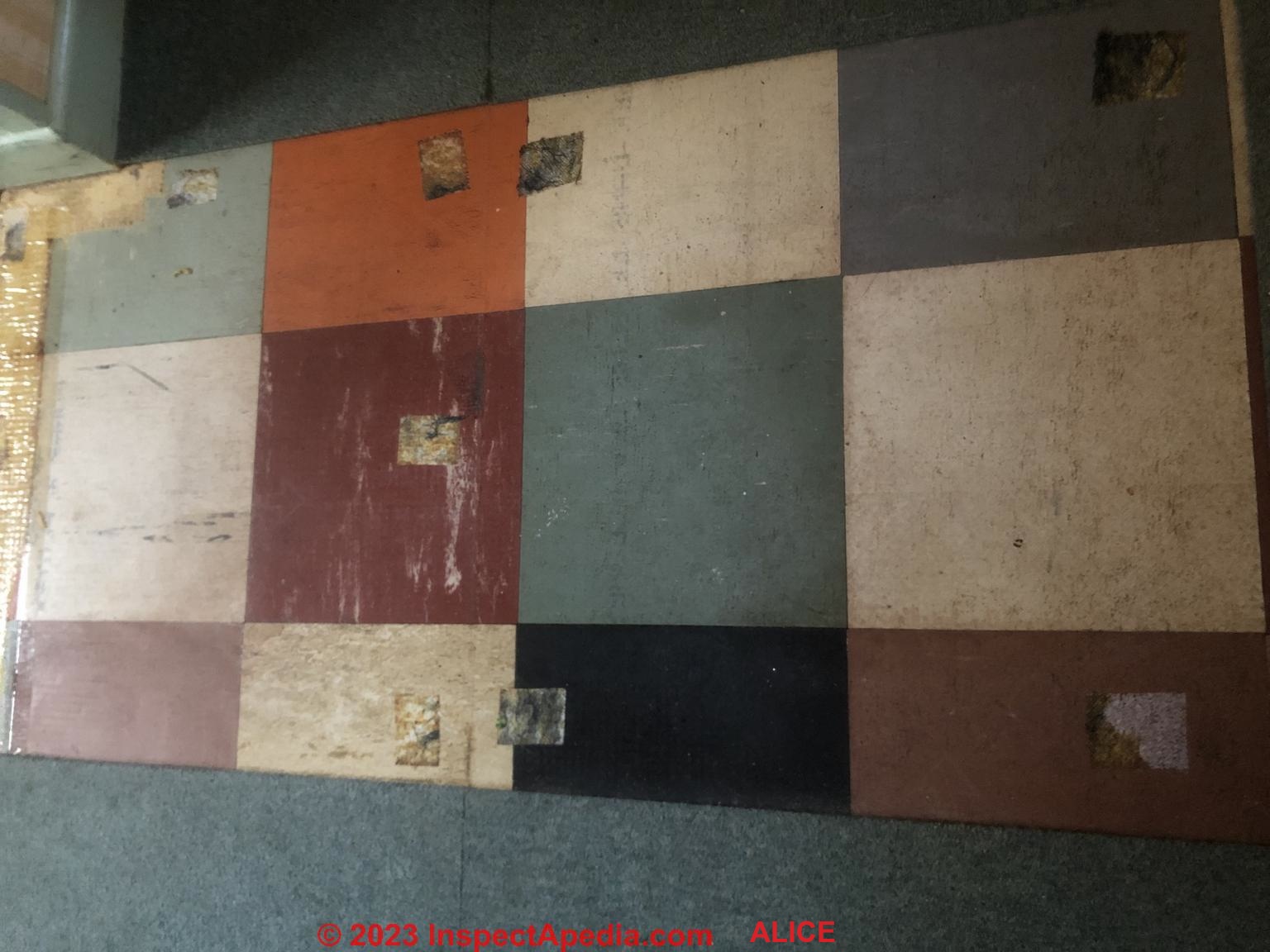
Do you think this could be asbestos or linoleum? Nothing was picked up on the survey of the house around this. Many Thanks
On 2021-03-10 by Lisa Salb
We found this stuck to our 1876 pine floorboards. Do you think it was linoleum?
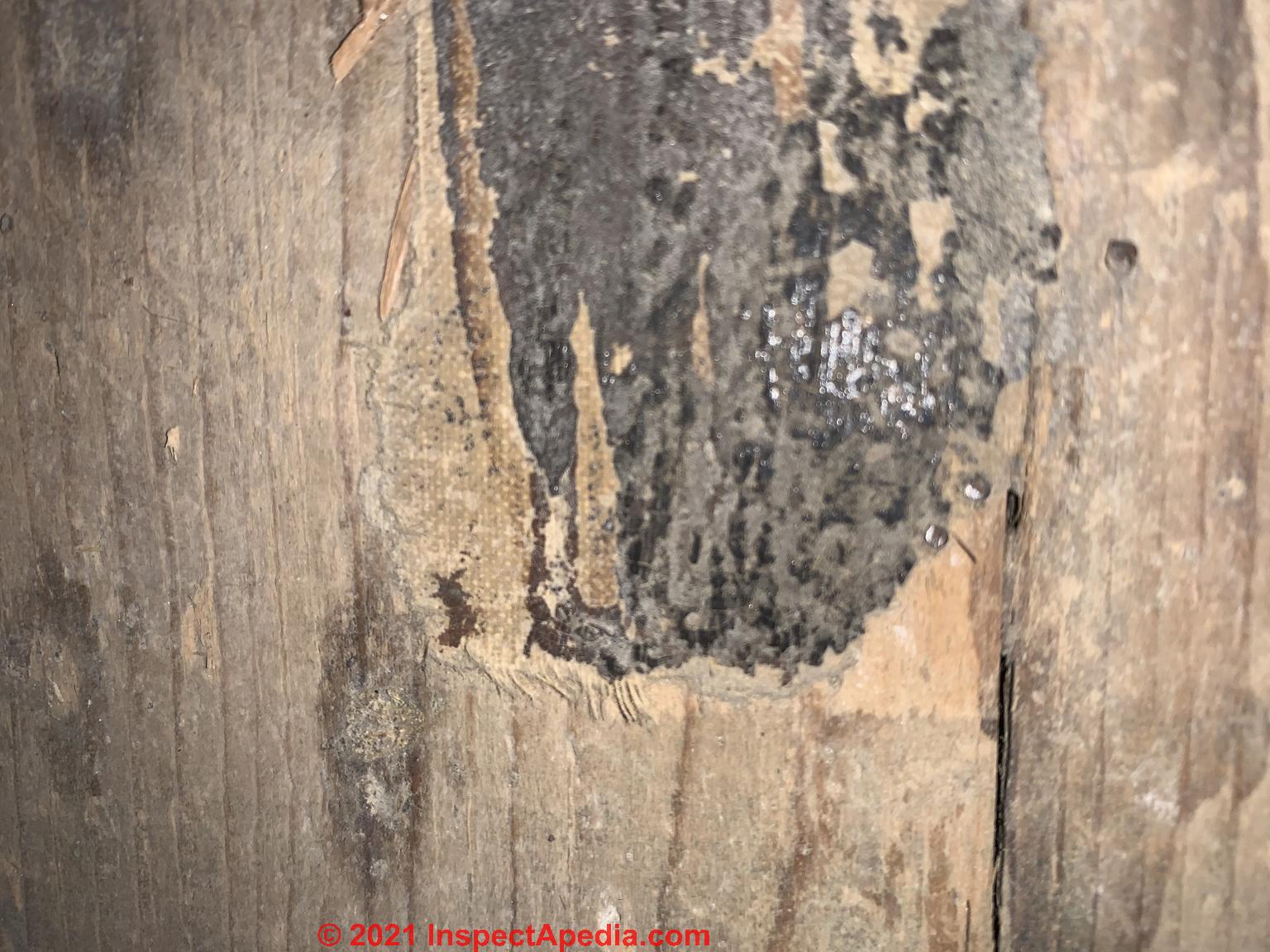
On 2021-03-12 - by (mod) -
@kerry,
Your photo shows a linoleum rug that you will find in our articles found in the page bottom ARTICLE INDEX under "Linoleum"
Or go directly to LINOLEUM & SHEET FLOORING
Some of those products contain asbestos in the asphalt-impregnated paper backer.
On 2021-03-12 by kerry
I am trying to figure out if this flooring maybe asbestos. Any help appreciated.
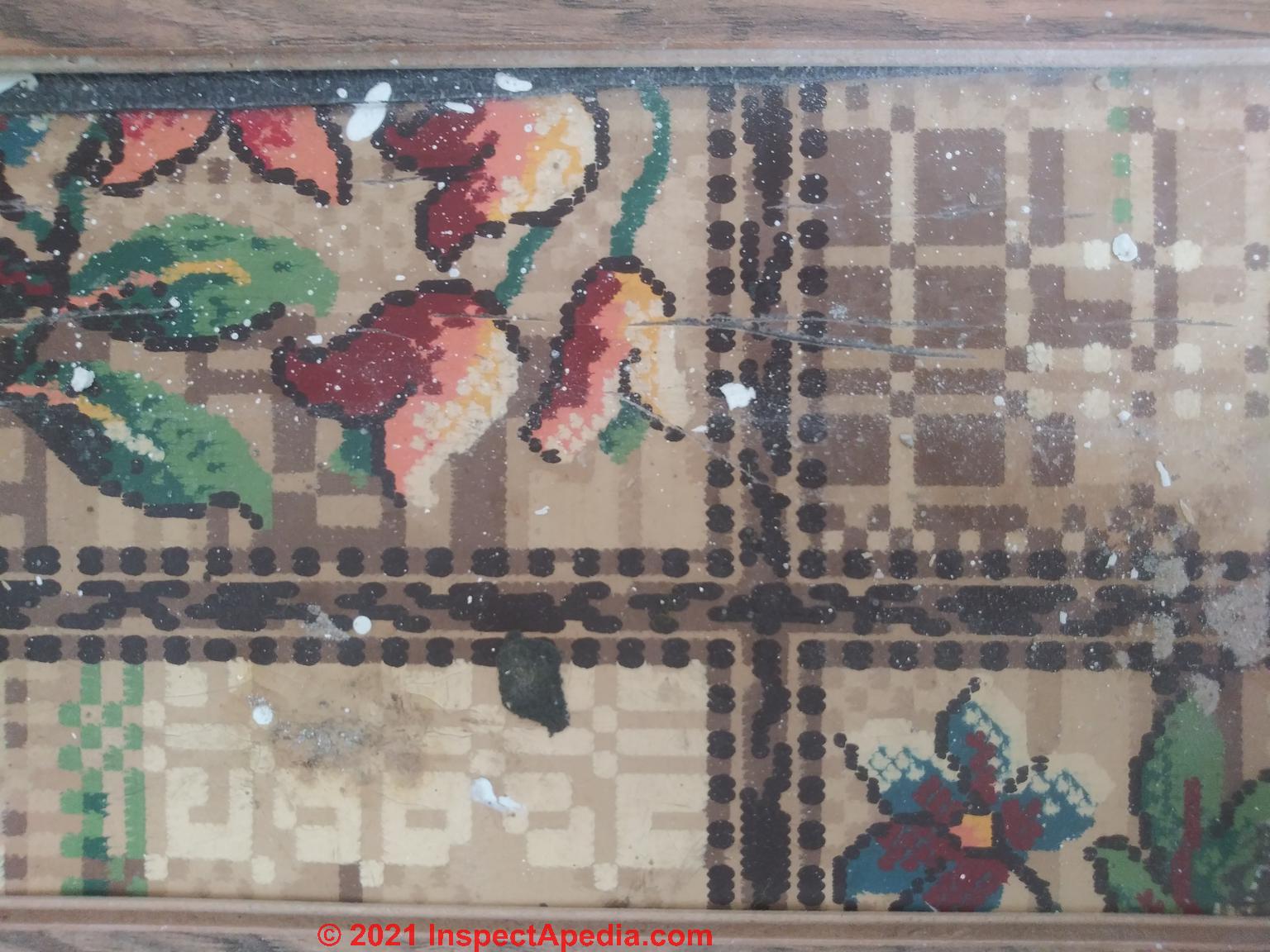
Photo above: floral pattern linoleum rug.
This Q&A were posted originally at ASBESTOS FLOOR TILE IDENTIFICATION COLOR KEY
On 2020-11-13 by (mod) - older linoleum, ca 1930-1950
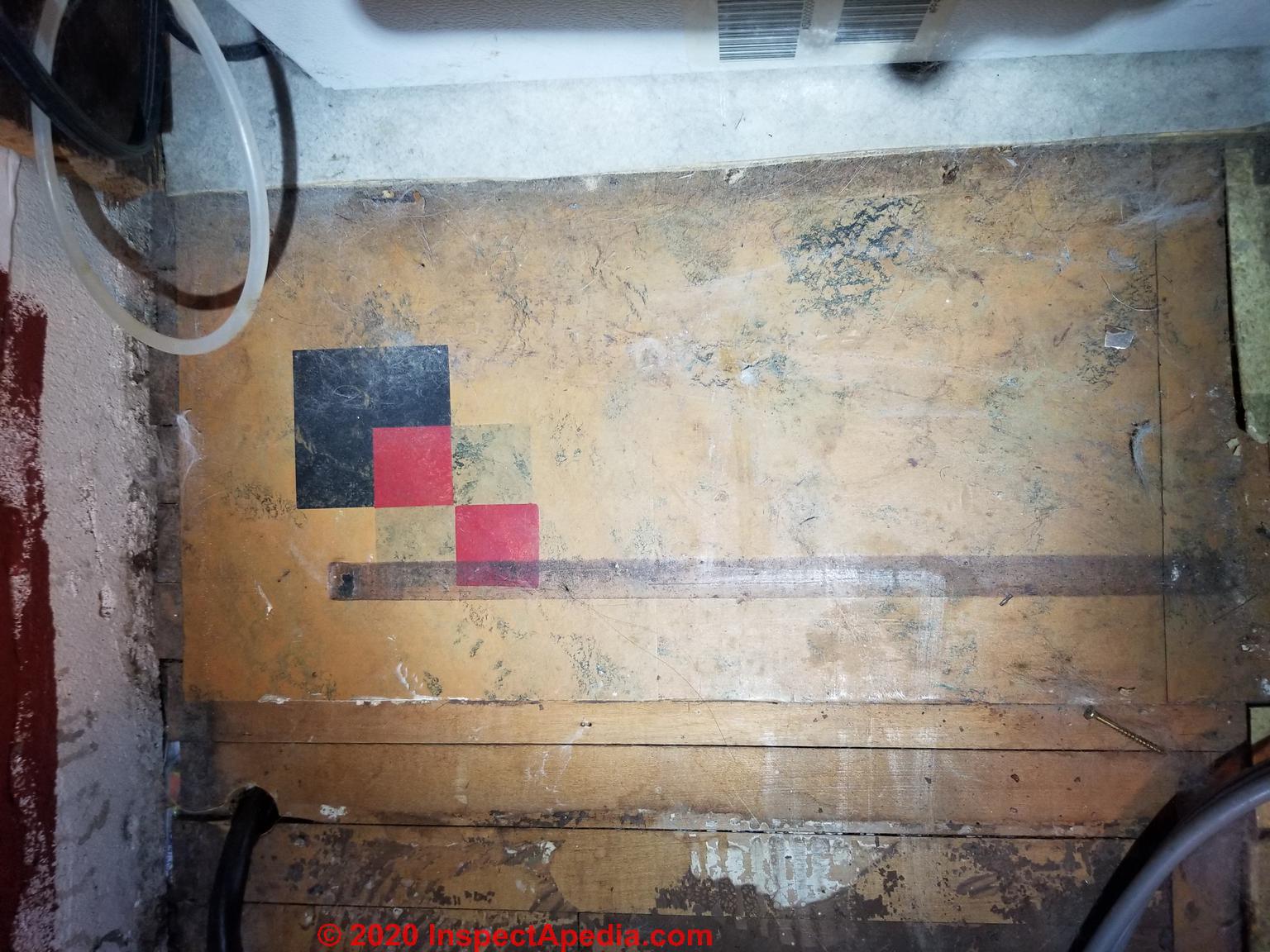 Jared
Jared
That looks like 1930s or 1940s linoleum; there were multiple manufacturers (such as Armstrong, Congoleum, others) with a still-longer list depending on the country where your building is located.
A good place to start is at RESILIENT SHEET FLOORING ID GUIDE
or you may also want to click right to LINOLEUM & OTHER SHEET FLOORING - above on this page -- where I will re-post your question so as to invite comments from other readers who may recognize your floor pattern.
There we include links to several early sheet flooring and linoleum catalogs where you might spot your exact flooring pattern. Note that some asphalt-felt-backed sheet flooring does contain asbestos, at least in the felt backer.
On 2020-11-13 by Jared
I plan to get the flooring [shown above] and adhesive tested, but is this recognizable as any certain manufacturer? House was built in 1929, not sure when the updates happened. Original floor is hardwood, pictured is the first layer on top of the hardwood. It's got a red backing, and a black interior.
This Q&A appeared originally at ASBESTOS FLOORING IDENTIFICATION
On 2020-10-28 - by (mod) -
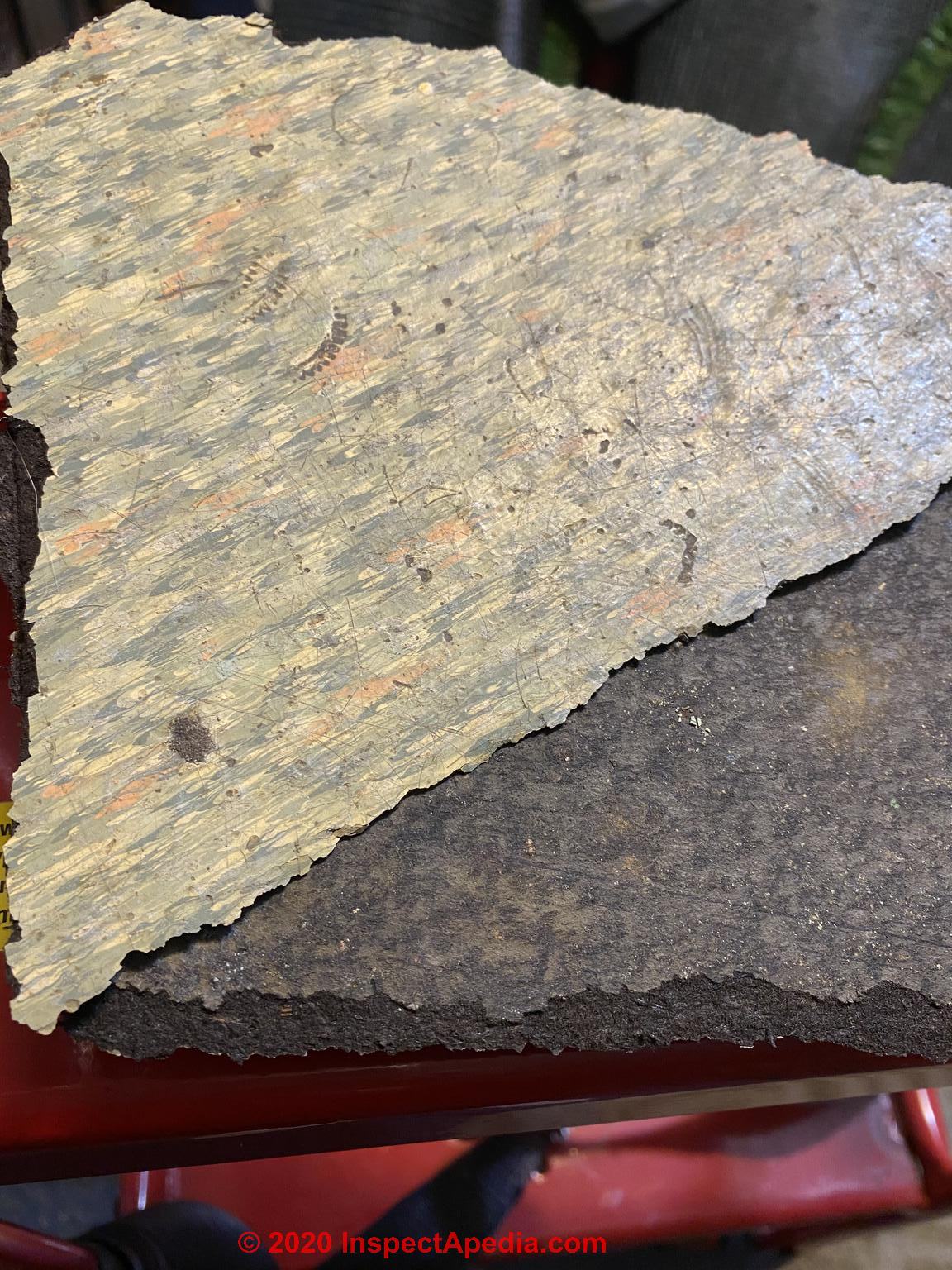
Very nice linoleum rug, typically from the 1940s; some asphalt backers like shown on your torn sample contain asbestos.
On 2020-10-28 by Denise
Trying to send second picture...age of linoleum rug?
And possible asbestos, would like to keep.
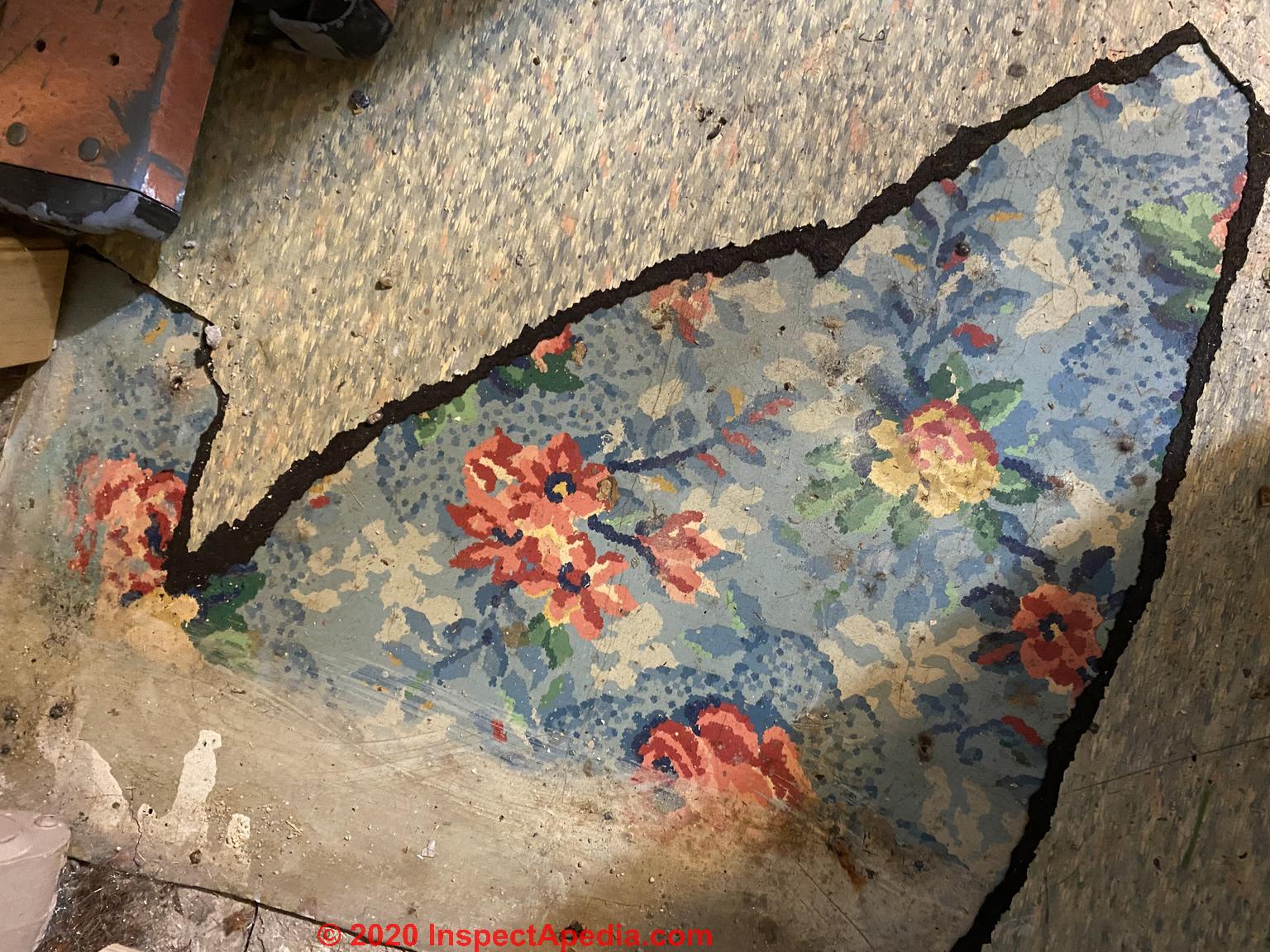
Photo above: asphalt-backed floral pattern linoleum rug.
On 2020-10-28 - by (mod) -
Possibly Denise.
the questions posed at DOES THIS FLOORING CONTAIN ASBESTOS? inspectapedia.com/hazmat/DIY-Asbestos-Floor-Test.php
will help you make a best guess short of actually testing the material
On 2020-10-28 by Denise
House built 1900. This is kitchen in basement ( mother in law ) ? With full bath and berm. The two rugs linoleum ? Wondering age pattern ? Asbestos in either or both?
On 2020-08-02 - by (mod) -
Yes, Jeff depending on your answers to the questions posed at DOES THIS FLOORING CONTAIN ASBESTOS? https://inspectapedia.com/hazmat/DIY-Asbestos-Floor-Test.php
On 2020-08-01 by Jeff
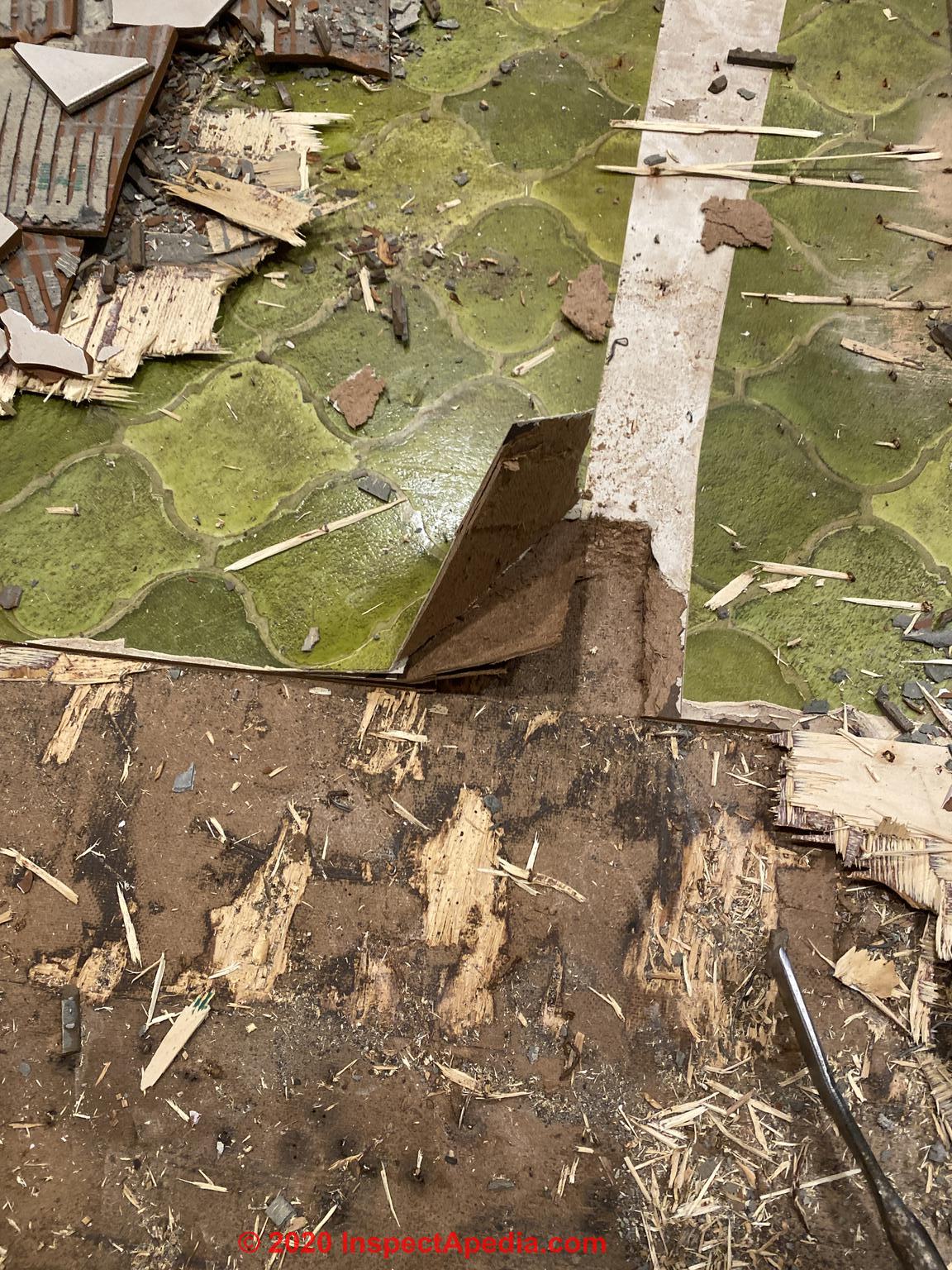
Found this under a tile floor and some underlayment. We already removed it as safely as possible. Someone else mentioned it may have asbestos after we finished. Look like a possibility?
On 2020-06-29 - by (mod) - old farmhouse flooring
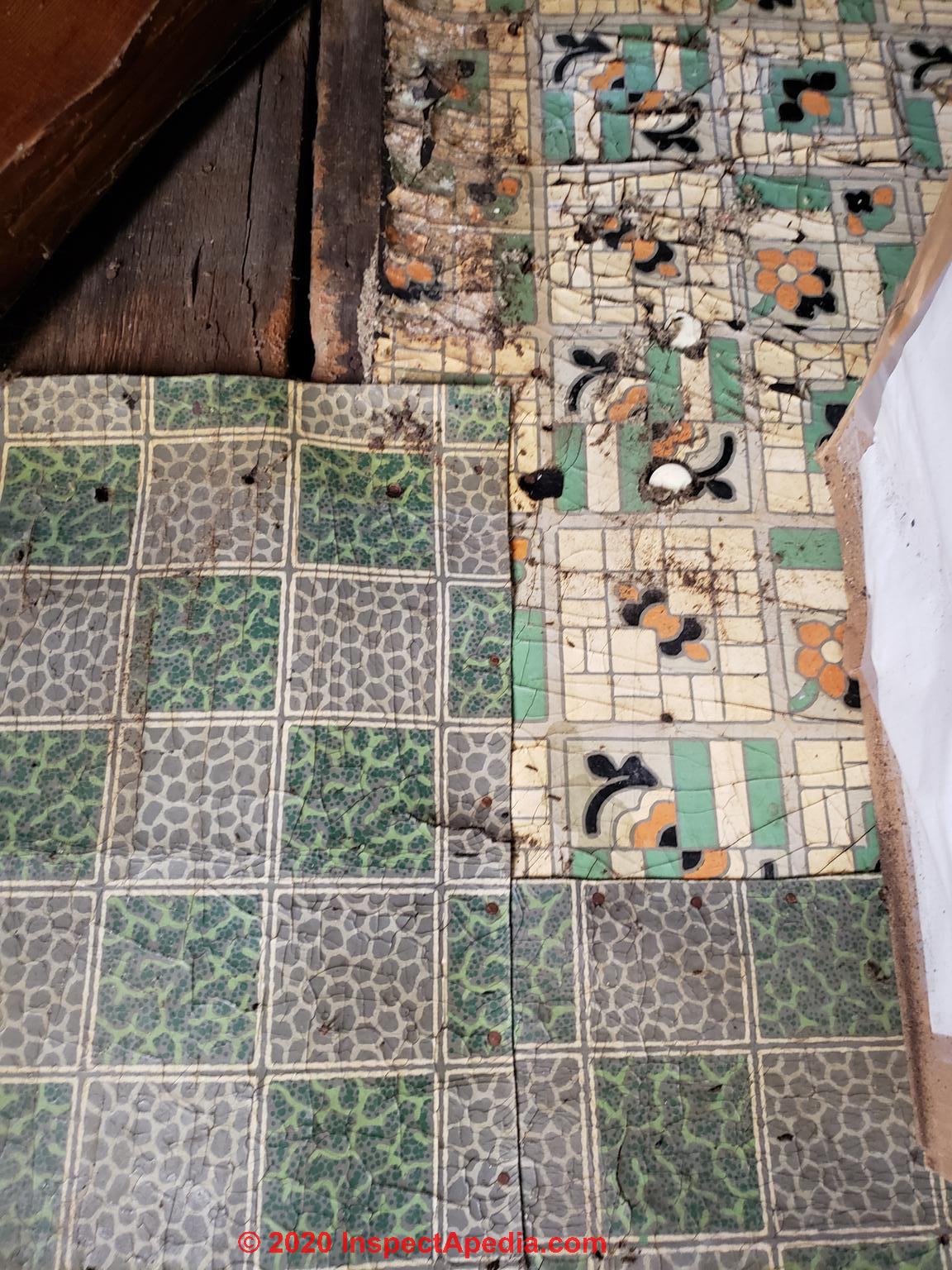 My guess is 1940s 1950s
Lots of reasons, ranging from draft blocking to ease of cleaning
Thanks for the compliment too; we also welcome your content suggestions, criticism, corrections, questions.
On 2020-06-29 by Leigh
I love this website. I live in an old farmhouse (the original part of the house) build approx. 1890, in upstate NY. It has so many quirks, so trying to figure out the what and why of the history of this house constantly has me curious.
I noticed tonight there is old linoleum on the wall inside the storage area off above what is now our living room.
I've seen where it was removed other places in the home as well by the person we bought it from in trying to "repair" things. Anyway, it peaked my curiosity why people would cover the inside wall of the storage area with linoleum, and how old the linoleum is?
Here are the pictures. [above] The linoleum is very cracked, and hard. The blue & grey square printed piece has a thin red back, looks kind of like sandpaper? Interestingly, the other piece, with the bigger title squares & flowers has a grey back that is also very thin.
On 2020-01-24 - by (mod) - subfloor in a 1953 Lake Erie NY Cottage
Typically the original floors in a 1953 Lake Erie cottage would have been at least wood subfloor common pine and sometimes pine finish floor, on occasion more elevated materials as a finish floor such as heart pine.
If the linoleum is not glued down then it's usually pretty easy to remove.
...
Continue reading at LINOLEUM ASBESTOS CONTENT?, or select a topic from the closely-related articles below, or see the complete ARTICLE INDEX.
Or see LINOLEUM & SHEET FLOORING FAQs - questions and answers posted originally on this page.
Or see these
Recommended Articles
- ASBESTOS FLOORING HAZARD REDUCTION
- ASBESTOS TESTING LAB LIST
- ARMSTRONG RUBBER BACKED RUG PATTERNS
- ARMSTRONG SHEET FLOORING 1940 - 1980
- CONGOLEUM-NAIRN FLOOR TILES & LINOLEUM
- DOES THIS FLOORING CONTAIN ASBESTOS? - 5 easy questions help make a reasonable guess -
- DOMINION & Other CANADIAN FLOORING ASBESTOS
- FLOOR, RESILIENT VINYL or CORK
- IDENTIFY SHEET FLOORING TYPE
- LINOLEUM & OTHER SHEET FLOORING
- FLORAL PATTERN LINOLEUM & SHEET FLOORING
- LINOLEUM FLOOR HISTORY
- LINOLEUM ASBESTOS CONTENT?
- LINOLEUM, ASBESTOS FREE Congoleum Gold Seal & Others
- LINOLEUM FLOOR INGREDIENTS
- LINOLEUM FLOORING RESTORATION & REPAIR - Conservation resources
- LINOLEUM "LOOKALIKES" ADHERED to FELT
- MODERN LINOLEUM FLOORS
- WHERE TO BUY LINOLEUM, RUBBER, CORK FLOORS
- RESILIENT SHEET FLOORING ID GUIDE
- SHEET FLOORING POSSIBLE ASBESTOS - 1960-1987
- SWEDISH TARKETT FLOORING POSSIBLE ASBESTOS
Suggested citation for this web page
LINOLEUM & SHEET FLOORING at InspectApedia.com - online encyclopedia of building & environmental inspection, testing, diagnosis, repair, & problem prevention advice.
Or see this
INDEX to RELATED ARTICLES: ARTICLE INDEX to BUILDING FLOORING
Or use the SEARCH BOX found below to Ask a Question or Search InspectApedia
Or see
INDEX to RELATED ARTICLES: ARTICLE INDEX to BUILDING INTERIORS
Or use the SEARCH BOX found below to Ask a Question or Search InspectApedia
Ask a Question or Search InspectApedia
Questions & answers or comments about linoleum floor coverings, age, history, safety, materials, contents.
Try the search box just below, or if you prefer, post a question or comment in the Comments box below and we will respond promptly.
Search the InspectApedia website
Note: appearance of your Comment below may be delayed: if your comment contains an image, photograph, web link, or text that looks to the software as if it might be a web link, your posting will appear after it has been approved by a moderator. Apologies for the delay.
Only one image can be added per comment but you can post as many comments, and therefore images, as you like.
You will not receive a notification when a response to your question has been posted.
Please bookmark this page to make it easy for you to check back for our response.
Our Comment Box is provided by Countable Web Productions countable.ca
Citations & References
In addition to any citations in the article above, a full list is available on request.
- Richa Wilson, Kathleen Snodgrass, " EARLY 20TH-CENTURY BUILDING MATERIALS: RESILIENT FLOORING " [Very large PDF], Richa Wilson, Intermountain Regional Architectural Historian Kathleen Snodgrass, Project Leader, United States Department of Agriculture Forest Service, Technology & Development Program, August 2007, 7300-0773-2322-MTDC. Contact Kathie Snodgrass at MTDC: Phone: 406–329–3922 Fax: 406–329–3719 E-mail: ksnodgrass@fs.fed.us
- [1] Armstrong, Portugal: Ingredients of Linoleum, web search 03/31/2011, original source: http://www.armstrong.pt/commflreu/es-pt/ingredients.html
- America's Favorite Homes, mail-order catalogues as a guide to popular early 20th-century houses, Robert Schweitzer, Michael W.R. Davis, 1990, Wayne State University Press ISBN 0814320066 (may be available from Wayne State University Press)
- American Plywood Association, APA, "Portland Manufacturing Company, No. 1, a series of monographs on the history of plywood manufacturing",Plywood Pioneers Association, 31 March, 1967, www.apawood.org
- Armstrong ® Residential Flooring - Website 05/15/2010 https://www.armstrongflooring.com/ lists current flooring products provided by the Armstrong Corporation, including Armstrong's current vinyl floor tile products at https://www.armstrongflooring.com/flooring/products/vinyl-floors
- Armstrong Corporation, Corporate History - armstrongflooring.com/corporate/corporate-history.html - Web Search 05/19/2010
- Armstrong vinyl asbestos floor tiles: photos of asbestos floor tiles as catalog pages (PDF form) are at www.asbestosresource.com/asbestos/tile.html
- Thanks to reader Robin DiNunzio for contributing samples of cork flooring from a 1949 home M1y 2010
- In addition to citations & references found in this article, see the research citations given at the end of the related articles found at our suggested
CONTINUE READING or RECOMMENDED ARTICLES.
- Carson, Dunlop & Associates Ltd., 120 Carlton Street Suite 407, Toronto ON M5A 4K2. Tel: (416) 964-9415 1-800-268-7070 Email: info@carsondunlop.com. Alan Carson is a past president of ASHI, the American Society of Home Inspectors.
Thanks to Alan Carson and Bob Dunlop, for permission for InspectAPedia to use text excerpts from The HOME REFERENCE BOOK - the Encyclopedia of Homes and to use illustrations from The ILLUSTRATED HOME .
Carson Dunlop Associates provides extensive home inspection education and report writing material. In gratitude we provide links to tsome Carson Dunlop Associates products and services.
 | HOME | ABOUT | ASK a QUESTION | CONTACT | CONTENT USE POLICY | DESCRIPTION | POLICIES | PRIVACY | |
| © 2024 - 1985 Publisher InspectApedia.com - Daniel Friedman | |||||||||