
InspectAPedia® FREE Encyclopedia of Building & Environmental Construction, Diagnosis, Maintenance & Repair |
Question? Just ask us! InspectAPedia
|
 Stair Dimensions & Clearances for Stair Construction & Inspection
What are the required height, width, slope for stairs?
- POST a QUESTION or COMMENT about building stair codes, stair dimensions, clearances, and construction guidelines
Stairway dimensions, recommendations & building code citations:
Stair, railing, guardrail, landing, tread, and step specifications & measurement dimension requirements . Stair & railing sizes, widths, heights, clearances, gaps, measurements - Sketches of stair design measurements & requirements.
This document provides the stair dimensions required by building code specifications and includes sketches, photographs, and examples of defects used in inspecting indoor or outdoor stairs, railings, landings, treads, and related conditions for safety and proper construction.
InspectAPedia tolerates no conflicts of interest. We have no relationship with advertisers, products, or services discussed at this website.
Summary of Stairway, Railing & Landing Construction Dimensions, Codes, Standards & Rules
 Stairway dimensions & construction requirements & codes are summarized here.
For a complete list of articles on stairs, railings, and ramps, their inspection, trip hazards, and good design,
see STAIRS, RAILINGS, LANDINGS, RAMPS - INSPECTIONS, CODES.
Because more people are injured by trips and falls than other hazards, experts have looked closely at the specifications for stairs, steps, and rails to reduce the falling hazards.
This work has been translated into stair and railing specifications that are similar among codes and countries (but not identical). -- IBC, IRC, BOCA, Kingston NY Stair Code, & other sources cited atReferences or Citations .
Stair and Railing Specification Topics for stair (U.S. and International Residential Codes) include the items listed below.
Stair Dimensions for Straight Stairway Runs: Stair width, landing length
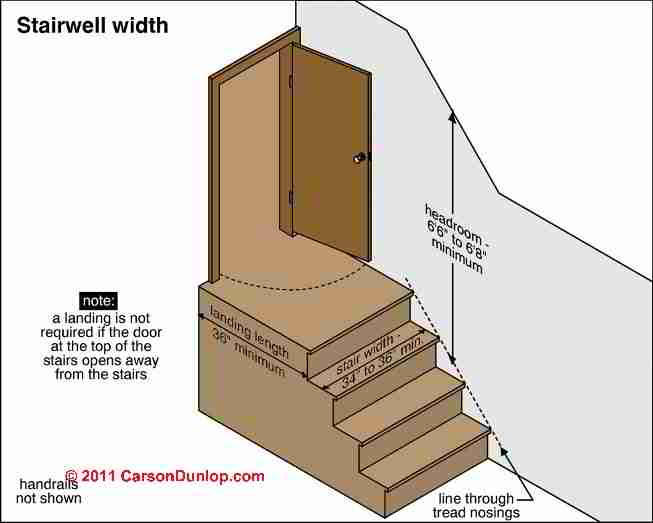
Stairwell width and stair landing platform requirements are summarized by these sketches courtesy of Carson Dunlop Associates, a Toronto home inspection, education & report writing tool company [ carsondunlop.com ].
The minimum recommended stair width is between 34" and 36" Across the width of the tread. Some codes such as CA/OSHA specify a minimum stairway width of 24" [35]..
The minimum recommended stair landing length is 36" (or a length and width sufficiently greater than the swing of the door if a wider door is present.
Is a landing required at the top of stairs?
Ordinarily, yes, a top landing is required. For example most exterior stairs approaching a building entry door encounter a door or storm/screen door that swings out. We need somewhere to stand when opening the door.
But a stair top landing is not required if the the stairs rise to a doorway at which the door opens away from the stairwell.
Of course standing one step "down" from the door opening might place the door knob a bit high for shorter users of the entry.
Stairway Height, Width, Headroom Requirements
- Stairway headroom or "overhead clearance": the distance from the top of the stair tread to the ceiling above, measured at the stair tread nose, should be six feet eight inches (or more).
(Stairway headroom should be => 6'8" over tread or landing) - Stairway maximum height: the total vertical rise of a straight run of stairs should be twelve feet or less between floors. For higher total rises a landing may be required.
(Stairway maximum height should be <= 12' between floors - this means landings could be required)
Also see STAIR HEADROOM
and
see STAIR PLATFORMS & LANDINGS, ENTRY
Exceptions to stair dimension requirements may be made for stairs giving access to non-living areas of a building such as storage lofts and mechanical rooms. Check with your local building officials.
Specifications for Recommended Minimum Stairway Widths & Stair Lengths
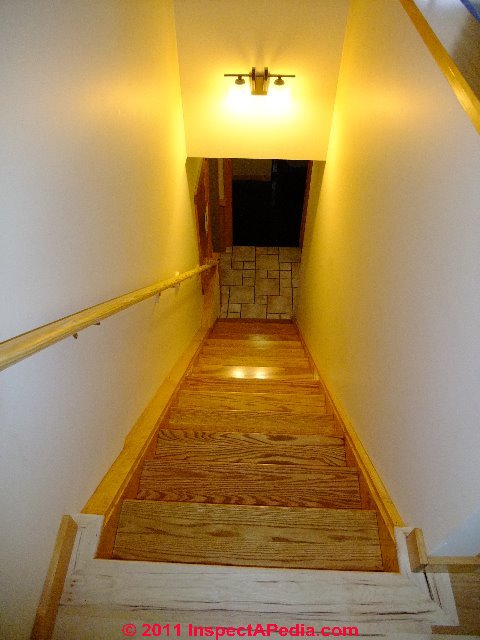
- Stairway width should be equal to or greater than 36" of clear unobstructed distance measured at all points above the [permitted] hand-railing height. This is the blue arrow in our photograph below.
- Stairway width should also be equal to or greater than 36" of clear unobstructed space between the top of the handrail (the permitted handrailing height) and the required headroom clearance upper height.
44" width is required for emergency stairs in the U.S. Details are
at FIRE ESCAPES & FIRE STAIRS - For a stairway with a railing on just one side, stairway width can be a bit smaller, with a clear width of 31.5" in the space below the handrail height.
This allows taking into account stair stringer trim such as shown in our photographs. This space is shown with the green arrow in our photograph below. - For a stairway with a handrailing along both sides, the clear stairway width is permitted to be smaller still, with a clear width of 27".
- Handrailings should not project more than 4 1/2" into the stairway walking space on either side of the stairway.
Definition of Stairway Width or Stair Width - don't confuse stair width with stair depth
Watch out: it's confusing but many people refer to stair tread depth
and
also STAIR RISER SPECIFICATIONS ) as stair step or tread width, including our Canadian stair dimension illustration just below.
If you stick to using the word stair tread depth you can avoid this confusion.
Oops, that is, unless you start confusing tread depth with stair tread riser height. Stair tread depth is defined above as the horizontal distance from nose to nose or from riser face to nose on open riser stairs.
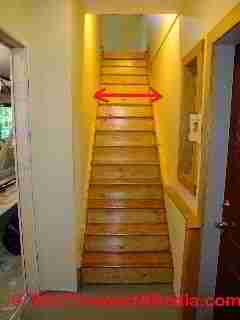
Stairway width is the horizontal width of the stair opening (blue arrow in our photo). For stairs enclosed by a wall on both sides, usually the stairway width is the distance between those walls.
Stair tread width (green arrow in our photo) is the horizontal left to right width of the stair tread.
At left our photo illustrates three different stair width measurements
- Stair tread width (green arrow) (smaller than stairway width due to side trim boards)
- Stairway width (blue arrow) over most of this stairway (nominally 36" or wider)
- Stairway width near stair top (pink arrow) due to a wall projection (nominally 36" or wider)
Recommended Stairway Width
Stairwell width and stair landing platform requirements are summarized by the sketches at page top. The measurement locations for determining a stairway width are illustrated in our stairwell photo shown just above.
In the stairway shown, the owners opted for a 36" wide stairwell.
The minimum recommended stair width is between 34" and 36" across.
Handrailings reduce the nominal stairwell width
In these sketches and in our photographs used here, the required handrails have been omitted for clarity.
Handrailings will protrude into and may reduce the nominal the stairwell width.
For a 36" wide stairwell such as that shown above, the stair railing intrusion is not a problem, but for more narrow stairs it may be, especially where accessible stairways are required.
If your stairway is considrably more than 36" across
see HANDRAILS for WIDE STAIRWAYS
Step Riser Height Specifications & Common Stair Construction Mistakes
 Stair Step Risers
- Step riser specifications riser height (<= 7.75")
- Step riser height uniformity (<= 3/8" variation)
- Step riser slope (out of vertical) (<= 30 deg measured from horizontal surface of the tread)
- Step risers: open risers are permitted provided the opening will not pass a 4" sphere (child safety)
Stair Riser Defects
- Stair risers of uneven height - no variation greater than 0.375 inches is allowed
- Stair risers of improper height, too tall
- Stair risers of improper height, too short
Details are
at STAIR RISER SPECIFICATIONS
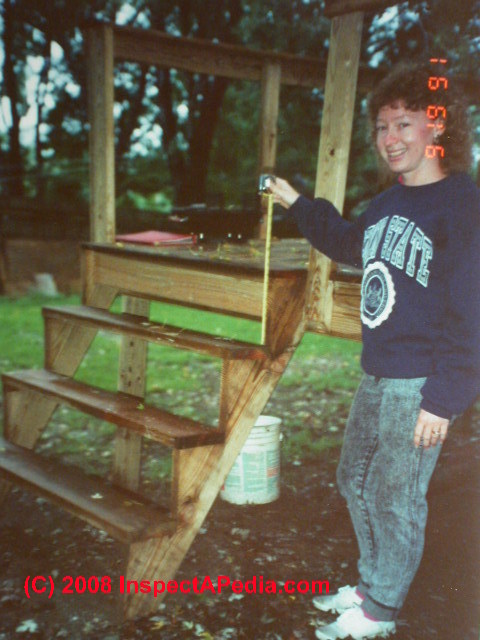
Bad Deck Stair Example: Nothing is right about the exterior stairs shown in our photo from a 1991 home inspection:
- This stair stringer is too-deeply notched and could split;
- The stair risers are too high, as our client is showing with our tape.
- The stair treads do not have enough depth - the treads were made from a single 2x6 (so they are 5 1/2" in depth).
- There is no railing on the steps although the height above ground is more than 30".
- The deck and platform railing is open with no guardrail balusters.
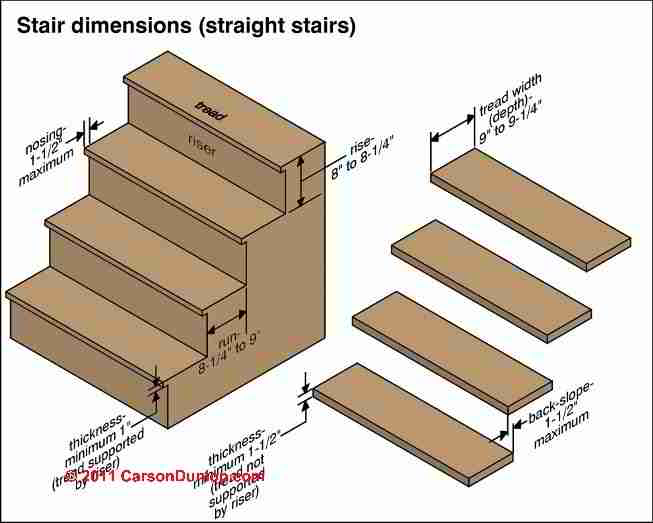
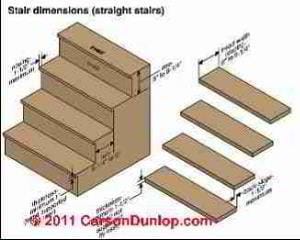
Closed stair treads using a solid riser are shown at the left of the sketch and
Open stair treads are shown at the right sketch. "Open stair treads" means that no solid riser is installed between the stair treads.
Stair tread nose projection and radius: stair treads should have a projecting nose that is rounded and projecting a maximum of 1.5 " over the tread below.
The requirements for a projecting stair nose over the tread below may be amended for open riser stairs in some jurisdictions, but in no case should the front of a stair tread be more than 1.5" back from the inside edge of the tread below - see sketch annotations.
[Click any of our images to see an enlarged, detailed version]
Stair tread thickness: The minimum tread thickness for stair treads supported by risers is 1".
Notice that the minimum stair tread thickness is increased to 1.5" when the stair tread is not supported by a solid riser.
Sketch at above left courtesy of Carson Dunlop Associates, a Toronto home inspection, education & report writing tool company [ carsondunlop.com ].
See BALUSTERS, STAIR & RAILING CODES for full details of this topic.
For more details about balusters (vertical spindles in railing construction) see details
at RAILING CODES & STANDARDS for a discussion of safety barriers along stairs,
and
see GUARDRAIL CODES & STANDARDS (railings on landings and open hallways, porches, screened porches, balconies that are more than 30" above floors or grade).
Example Building Code Specifications For Stairway Dimensions
California and other U.S. states often take as a starting point for state building codes pertaining to stair, landing, railing, tread and other stairway design specifications the national model building codes. The California CA/OSHA Section 1003.3.3 Stairways and Landings provisions, as well as the California Building Code (CBC) illustrate:
CA/OSHA: California Stair & Railing Code details
The following stair dimension example citation is from CA/OSHA Subchapter 4. General Industry Safety Orders, Article 17. Ramps, Runways, Stairwells, and Stairs. Note: this code establishes minimum occupational safety & health standards that apply to all places of employment in California.
This is not a residential building code requirement, but this text in our OPINION models stair construction safety & design specifications.
See RAILING CODES & STANDARDS for model building code specifications of when a handrailing is required, heights, stairway widths, graspability, etc.
Also see HANDRAILS & HANDRAILINGS
and
CA/OSHA Section 1626. Stairwells and Stairs.
CA/OSHA Title 8 Section 1626. Stairwells and Stairs [36] With added stair details quoting from the CBC 1003.3.3
(a) General. [Stairway width, free space, step rise, step run or depth, tread width & riser height variation permitted]
(1) Stairways shall be al least 24 inches in width and shall be equipped with stair rails, handrails, treads, and landings.
Note: this is a CA/OSHA specification. The CBC 1003.3.3 Stairways and Landings model code states these stairway specifications:
Private stairways shall be a minimum of thirty-six inches wide. Trim and handrails may not encroach into this minimum width by more than 3 1/2 inches.
The maximum rise of each step is eight inches;
the minimum rise is four inches.
The minimum run is nine inches.
The largest tread width or riser height in any flight of stairs shall not exceed the smallest by more than 3/8 inch.
(2) Railings and toeboards meeting the requirements of Article 16 of these safety orders shall be installed around stairwells.
(b) The following requirements apply to all stairways as indicated:
(1) Temporary stairways that will not be a permanent part of the structure on which construction work is being performed shall be at least 24 inches in width. The stairway shall have landings at each floor, or level, of not less than 30 inches in the direction of travel and extend at least 24 inches in width at every 12 feet or less of vertical rise.
(2) Stairs shall be installed between 30° and 50° from horizontal.
(3) Riser height and tread depth shall be uniform within each flight of stairs, including any foundation structure used as one or more treads of the stairs. Variations in riser height or tread depth shall not be over 1/4-inch (0.6 cm) on any stairway.
(4) Where doors or gates open directly on a stairway, a platform shall be provided, and the swing of the door shall not reduce the effective width of the platform to less than 20 inches (51 cm).
(5) Unprotected sides and edges of stairway landings shall be provided with railings. Design criteria for railings are prescribed in Section 1620 of these safety orders.
(6) Metal pan landings and metal pan treads, when used, shall be secured in place before filling with concrete or other material.
(7) All parts of stairways shall be free of hazardous projections, such as protruding nails.
(8) Slippery conditions on a stairway shall be eliminated before the stairway is used to reach another level.
(c) Stair rails and handrails. The following requirements apply to all stairways as indicated:
Some codes (CA/OSHA Title 8 Section 1626) may cause a little confusion between the definition of handrail and guardrail, by adding a third term, "stair rail":
(1) Stairways having four or more risers or rising more than 30 inches (76 cm), whichever is less, shall be equipped with:
(A) At least one handrail and
(B) A stair rail consisting of a top rail and mid-rail along each unprotected side or edge.
See RAILING CODES & STANDARDS for model building code specifications of when a handrailing is required, heights, stairway widths, graspability, etc.
See HANDRAILS & HANDRAILINGS for more handrail and stair rail code & construction details
At least in the 2006 IRC Section R202 these terms are defined clearly:
Definition of guardrail or guard: Guard [or guardrail or guard railing]: A building component or a system of building components located near the open sides of elevated walking surfaces that minimizes the possibility of a fall from the walking surface to a lower
level.
See GUARDRAIL CODES & STANDARDS for details.
Definition of "stair rail" as guardrail: In general people speak of guardrails or guards as installed along balconies or elevated walkways and decks. When we enclose open side(s) of a stairway with a "guardrail" some codes such as the 2006 IRC Section R202 use the unfortunate term "stair rail".
More unfortunate if readers don't continue along to discover that the horizontal members described in ((B) above must be further enclosed with balusters.
Definition of handrail or hand railing: Handrail [or hand railing] . A horizontal or sloping rail intended for grasping by the hand for guidance or support.
See HANDRAILS & HANDRAILINGS for details about stairway handrailing dimensions, graspability, railing heights, railing continuity, termination, projection distances and all other parameters.
(d) Temporary Service [stairs] - Temporary service stairs, treads, landings:
The following requirements apply to all stairways as indicated:
(1) Except during stairway construction, foot traffic is prohibited on stairways with pan stairs where the treads and/or landings are to be filled in with concrete or other material at a later date, unless the stairs are temporarily fitted with wood or other solid material at least to the top edge of each pan.
(2) Except during stairway construction, foot traffic is prohibited on skeleton metal stairs where permanent treads and/or landings are to be installed at a later date, unless the stairs are fitted with secured temporary treads and landings long enough to cover the entire tread and/or landing area.
(3) Treads for temporary service shall be made of wood or other solid material, shall cover the full width and depth of the stair and shall be supported to prevent undue deflection.
(4) Temporary treads and landings shall be replaced when worn below the level of the top edge of the pan.
Note: Authority cited: Section 142.3, Labor Code. Reference: Section 142.3, Labor Code.
Dimensions for Stairway Chair Lifts
Please see details about stairway lifts now found
Reader Comments, Questions & Answers About The Article Above
Below you will find questions and answers previously posted on this page at its page bottom reader comment box.
Reader Q&A - also see RECOMMENDED ARTICLES & FAQs
On 2020-10-27 - by (mod) - squeezing landings in to ascend total rise without enough horizontal run
 Bo
Bo
I think, to get us using the same words for the same things, your steps have an 8" rise (vertical height between step surfaces) and a 9" tread depth (the width of the step on which to place your foot)
I use the word "run" similar to how you did but reserve it for the entire horizontal distance the stairway has to cover - which I think is that 136" in your note.
And yes, a door opening out onto a too-small landing can finish someone off as it did to my neighbor years ago; he got up at night to use the bathroom, fell down the stairs, and never recovered.
The question of a variance is nothing on which I can advise - that's in the hands and mind of your local building code inspector; but often those folks understand the difficulty of shoehorning stairs into an older home.
Sometimes we solve this problem by putting a landing not at mid-flight (where we may run into headroom trouble too) but near the stair top or bottom (usually bottom).
You can mitigate the hazards a bit by
- good stair lighting
- proper handrailings - continuous, graspable, etc.
proper guardrails along any open stair or landing sides
A ove is my photo of a stair in a Poughkeepsie NY house (57 S. Grand Ave) built ca 1900 - take a look at how the builders located the two stair landings.
On 2020-10-27 by Bo
I'm trying to reconfigure the stairs in my 1886 Kentucky home but, with the home's narrow footprint, I'm running into issues. Right now the stairs have an 8 inch rise and a 9 inch run, traveling 136 inches vertically to a landing that is only 26 inches at the top.
What makes it even more dangerous is that a 32 inch bedroom door opens to the landing so, if you're coming from inside the bedroom headed straight to the bathroom, you are in danger of your right foot stepping into a void and tumbling down to the first floor.
I would like to tear the stairs out, increase the landing to 36 inches at the top, and run U-shaped stairs down to the first floor. The problem is, if I follow minimum code guidelines on the run, I do not have enough space for 36 inch landings at the mid and first floor levels.
The easiest, and most logical place to make up the 10-12 inches I am short would be at the mid level landing. My question is, can I hope to get a variance on a mid level landing, hopefully bringing it to 26 inches? Or is the only solution a set of winder stairs?
Any insight or ideas would be greatly appreciated!
On 2020-02-07 - by (mod) -
Todd
Thanks for an important question that, if I understand you, is answered clearly at
STAIR ANGLE & SLOPE - https://inspectapedia.com/Stairs/Stair-Angle-Slope-Specifications.php
in a section titled
Stair Tread Slope vs Stairway Slope or Angle
there, among other details, you'll see that stair treads do not have to be "dead level" but need to be close to level; they might, for example be slightly sloped to drain;
Stair treads themselves must also be close to level, as you'll see in the following standards:
1995 CABO 314.2 allows a maximum 2% slope on stair treads themselves - this is the slope of the tread surface, not the slope of the stairway. The 1:48 (2%) max. will also comply with the accessibility requirements of ICC/ANSI A117.1-1998. I also agree that UBC 1003.3.3.5 applies.
2000 IBC 1003.3.3.5.1 - "The walking surface of treads and landings of a stairway shall not be sloped steeper than one unit vertical in 48 units horizontal in any direction."
On 2020-02-06 by Todd
For the landing at the top-of-steps, is any cross-fall acceptable, or does the landing at top-of-step have to be perfectly level from side-to-side? There is a raised concrete landing that slopes out from the building at 1:100 slope.
Stairs must be built up to the side of the landing, which would mean that the top of the landing would be ever so slightly at a different slope than level steps leading up to it. Is there any acceptable cross-slope along the width of a stair tread?
On 2020-01-13 22:46:05.780928 - by (mod) -
Paul
The final legal authority to answer your question is our local building code inspector. In my own opinion you could install a center handrail and you'll probably be required to stand it be on the top and the bottom of the stairs to comply with Ada regulations.
However is also my opinion that would be a safer sphere with a hand railing on each side. That way when people are going up and down the stairs simultaneously, that is when different people are doing that, everybody has a hand railing available.
On 2020-01-13 by Paul
There is a stairway in the middle isle of a gymnasium that is 48" wide which has no railing. Am I permitted to install a center railing on this stairway? If so, would the railing need to be continuous the entire length up the stairway?
On 2019-08-27 - by (mod) -
Daniel:
In Canada the current code is https://www.nrc-cnrc.gc.ca/eng/solutions/advisory/codes_centre/presentations/2010/stairs.html
from 2010. Earlier code adoptions are dated as follows:
The first National Building Code of Canada (NBC) was published in 1941; subsequent editions were published in 1953, 1960, 1965, 1970, 1975, 1977, 1980, 1985, 1990 and 1995.
You can probably buy a copy of the earlier 1990 code by contacting
Email: codes@nrc-cnrc.gc.ca
Telephone: 1-613-993-9960
Fax: 1-613-952-4040
Mail: Codes Canada
National Research Council Canada
1200 Montreal Road, Building M-20
Ottawa, Ontario K1A 0R6
Or you can order (if available) these earlier Canadian building code editions directly, online, at
https://nrc.canada.ca/en/certifications-evaluations-standards/codes-canada/codes-canada-publications/historical-editions-codes-canada-publications-1941-1998
On 2019-08-27 by Daniel
I'm looking to find the Canadian NBC / BC code for 1990 stair (riser and tread) code requirements.
If there is a historical (code) resource that anyone knows of that would be great. Thanks you!
On 2019-01-22 - by (mod) -
Steve
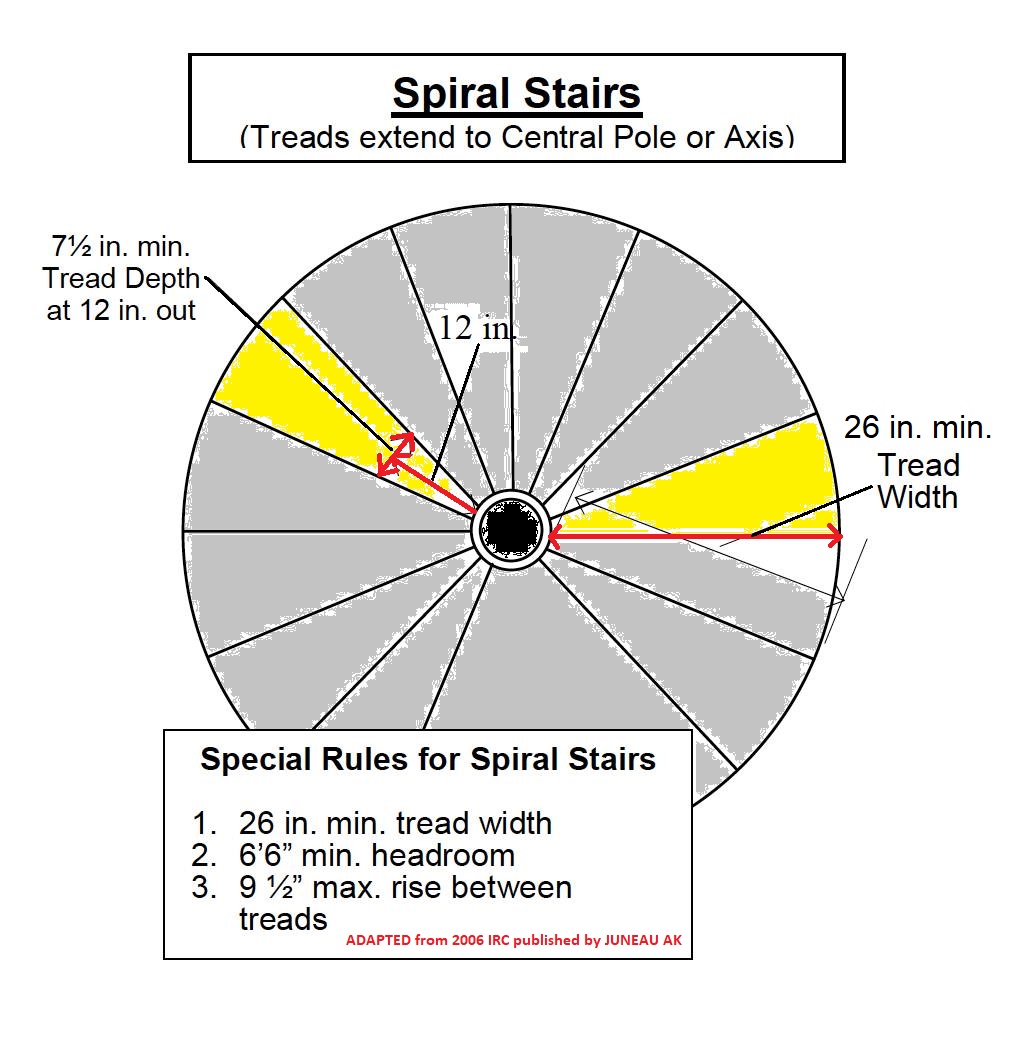
The IRC section on stair specifications that you cite does not quite fit a circular stairway, for which there are separate provisions.
You'll see in the most-recent circular stair codes that some want the builder to actually add guards to block access that would permit someone to try to put their foot in the very small inner triangular space on the treads.
About your second question, the final legal authority is your local building code compliance inspector. In my OPINION, I'm not happy about seeing the intrusion of the stair opening cutout into the walking space on the more-important wider section of the triangular stair tread.
Please take a look at CIRCULAR & CURVED STAIRS
and you will also want to see this example code for
BUILDING STAIR CODE for SPIRAL, CURVED & WINDER STAIRS [PDF] - Juneau Building Department, AK
On 2019-01-22 by Steve C.
We're putting in a winding stairway, and I have two questions about headroom and stairway width per IRC 2015 section 11.7:
(1) "Stairways shall be not less than 36 inches (914 mm) in clear width at all points above the permitted handrail height and below the required headroom height." Does this mean that, if my stair width is 39", then only 36" of it needs to be clear - in other words, on a lower step, the outer 3" of the stairs could be tucked under the floor/ceiling?
(2) "Where the nosings of treads at the side of a flight extend under the edge of a floor opening through which the stair passes, the floor opening shall be allowed to project horizontally into the required headroom not more than 4 3/4 inches (121 mm)."
Does this mean, that, IN ADDITION to the situation in the first question, the floor opening can impinge another 4.75" into the step - meaning that for a 39" stair going under the floor opening only (39 - 3 - 4.75) = 31 1/4" of the step needs to meet the headroom requirement of 6' 8"?
The picture attached shows what we're doing: Step 7 is exactly 6' 8" below the upper floor level, so the original cut provides the headroom needed over the entire step. Can we instead cut less by allowing the floor opening to impinge 7 3/4 inches into that step?
IMAGE LOST by older version of Clark Van Oyen’s Comments Box code - now fixed. Please re-post the image if you can. Sorry. Mod.
...
Continue reading at STAIR HEADROOM or select a topic from the closely-related articles below, or see the complete ARTICLE INDEX.
Or see STAIR DIMENSIONS & SPECIFICATIONS FAQs questions & answers posted originally at this article
Or see these articles on stair construction
- CIRCULAR & CURVED STAIRS
- STAIR CODES & STANDARDS - home
- STAIR DIMENSIONS, WIDTH, HEIGHT
- STAIR ANGLE & SLOPE
- STAIR DESIGN for SENIORS
- STAIRWAY CHAIR LIFTS
- STAIR DIMENSIONS, IDEAL
- STAIR HEADROOM
- STAIR PLATFORMS & LANDINGS
- STAIR RISE & RUN CALCULATIONS
- STAIR RISER SPECIFICATIONS
- STAIR STRINGER SPECIFICATIONS
- STAIR STRINGER DEFECTS
- STAIR TREAD DIMENSIONS
- STAIR TREAD - HALTING WALK STUTTER STEP
- STAIR TREAD NOSE SPECIFICATIONS
- STAIR USER FOOT & HAND PLACEMENT
- STAIRWAY CHAIR LIFTS
Suggested citation for this web page
STAIR DIMENSIONS, WIDTH, HEIGHT at InspectApedia.com - online encyclopedia of building & environmental inspection, testing, diagnosis, repair, & problem prevention advice.
Or see this
INDEX to RELATED ARTICLES: ARTICLE INDEX to STAIRS RAILINGS LANDINGS RAMPS
Or use the SEARCH BOX found below to Ask a Question or Search InspectApedia
Ask a Question or Search InspectApedia
Try the search box just below, or if you prefer, post a question or comment in the Comments box below and we will respond promptly.
Search the InspectApedia website
Note: appearance of your Comment below may be delayed: if your comment contains an image, photograph, web link, or text that looks to the software as if it might be a web link, your posting will appear after it has been approved by a moderator. Apologies for the delay.
Only one image can be added per comment but you can post as many comments, and therefore images, as you like.
You will not receive a notification when a response to your question has been posted.
Please bookmark this page to make it easy for you to check back for our response.
Our Comment Box is provided by Countable Web Productions countable.ca
Citations & References
In addition to any citations in the article above, a full list is available on request.
- Best Practices Guide to Residential Construction, by Steven Bliss. John Wiley & Sons, 2006. ISBN-10: 0471648361, ISBN-13: 978-0471648369, Hardcover: 320 pages, available from Amazon.com and also Wiley.com. See our book review of this publication.
- [3] Stephenson, Elliott O., THE ELIMINATION OF UNSAFE GUARDRAILS, A PROGRESS REPORT [PDF] Building Standards, March-April 1993
- [4] "Are Functional Handrails Within Our Grasp" Jake Pauls, Building Standards, January-February 1991
- [5] Access Ramp building codes:
- UBC 1003.3.4.3
- BOCA 1016.3
- ADA 4.8.2
- IBC 1010.2
- [6] Access Ramp Standards:
- ADA (Americans with Disabilities Act), Public Law 101-336. 7/26/90 is very often cited by other sources for good design of stairs and ramps etc. even where disabled individuals are not the design target.
- ANSI A117.4 Accessible and Usable buildings and Facilities (earlier version was incorporated into the ADA)
- ASTM F 1637, Standard Practice for Safe Walking Surfaces, (Similar to the above standard
- [7] The Circular Staircase, Mary Roberts Rinehart
- [8] Construction Drawings and Details, Rosemary Kilmer
- [9] Falls and Related Injuries: Slips, Trips, Missteps, and Their Consequences, Lawyers & Judges Publishing, (June 2002), ISBN-10: 0913875430 ISBN-13: 978-0913875438
"Falls in the home and public places are the second leading cause of unintentional injury deaths in the United States, but are overlooked in most literature. This book is unique in that it is entirely devoted to falls. Of use to primary care physicians, nurses, insurance adjusters, architects, writers of building codes, attorneys, or anyone who cares for the elderly, this book will tell you how, why, and when people will likely fall, what most likely will be injured, and how such injuries come about. " - [11] The National Institute of Standards and Technology, NIST (nee National Bureau of Standards NBS) is a US government agency - see www.nist.gov
- "A Parametric Study of Wall Moisture Contents Using a Revised Variable Indoor Relative Humidity Version of the "Moist" Transient Heat and Moisture Transfer Model [copy on file as/interiors/MOIST_Model_NIST_b95074.pdf ] - ", George Tsongas, Doug Burch, Carolyn Roos, Malcom Cunningham; this paper describes software and the prediction of wall moisture contents. - PDF Document from NIS
- [12] Slips, Trips, Missteps and Their Consequences, Second Edition, Gary M. Bakken, H. Harvey Cohen,A. S. Hyde, Jon R. Abele, ISBN-13: 978-1-933264-01-1 or ISBN 10: 1-933264-01-2, available from the publisher, Lawyers ^ Judges Publishing Company,Inc., www.lawyersandjudges.com sales@lawyersandjudges.com
- [13] Slips, Trips, Missteps and Their Consequences, Gary M. Bakken, H. Harvey Cohen, Jon R. Abele, Alvin S. Hyde, Cindy A. LaRue, Lawyers and Judges Publishing; ISBN-10: 1933264012 ISBN-13: 978-1933264011
- [14] The Stairway Manufacturers' Association, (877) 500-5759, provides a pictorial guide to the stair and railing portion of the International Residential Code. [copy on file as http://www.stairways.org/pdf/2006%20Stair%20IRC%20SCREEN.pdf ] -
- [17] Steps and Stairways, Cleo Baldon & Ib Melchior, Rizzoli, 1989.
- [18] The Staircase, Ann Rinaldi
- [19] Common Sense Stairbuilding and Handrailing, Fred T. Hodgson
- [20] The Art of Staircases, Pilar Chueca
- [21] Building Stairs, by pros for pro, Andy Engel
- [22] A Simplified Guide to Custom Stairbuilding, George R. Christina
- [23] Basic Stairbuilding, Scott Schuttner
- [24] The Staircase (two volumes), John Templar, Cambridge: the MIT Press, 1992
- [25] The Staircase: History and Theories, John Templar, MIT Press 1995
- [26] >Steps and Stairways, Cleo Baldon & Ib Melchior, Rizzoli, 1989.
- [27] "The Dimensions of Stairs", J. M. Fitch et al., Scientific American, October 1974.
- [42] STAIRWAYS & LADDERS, A Guide to OSHA Rules, OSHA, U.S. Department of Labor, 3124-12R 2003 - Web Search 05/28/2010 original source: http://www.osha.gov/Publications/osha3124.pdf. OSHA regulations govern standards in the construction industry and in the workforce Quoting from OSHA whose focus is on workplace safety and so excludes discussion of falls and stair-falls in private homes:
OSHA estimates that there are 24,882 injuries and as many as 36 fatalities per year due to falls from stairways and ladders used in construction. Nearly half of these injuries are serious enough to require time off the job--11,570 lost workday injuries and 13,312 non-lost workday injuries occur annually due to falls from stairways and ladders used in construction. These data demonstrate that work on and around ladders and stairways is hazardous.
More importantly, they show that compliance with OSHA's requirements for the safe use of ladders and stairways could have prevented many of these injuries. -osha.gov/doc/outreachtraining/htmlfiles/stairlad.html - [43] International Building Code, Stairway Provisions, Section 1009: Stairways and Handrails, retrieved 8/29/12, original source: http://www.amezz.com/ibc-stairs-code.htm [copy on file as IBC Stairs Code.pdf]
- [44] Model Building Code, Chapter 10, Means of Egress, retrieved 8/29/12, original source: http://www2.iccsafe.org/states/newjersey/NJ_Building/PDFs/NJ_Bldg_Chapter10.pdf, [copy on file as NJ_Bldg_Chapter10.pdf] adopted, for example by New Jersey. International Code Council, 500 New Jersey Avenue, NW, 6th Floor, Washington, DC 20001, Tel: 800-786-4452
- In addition to citations & references found in this article, see the research citations given at the end of the related articles found at our suggested
CONTINUE READING or RECOMMENDED ARTICLES.
- Carson, Dunlop & Associates Ltd., 120 Carlton Street Suite 407, Toronto ON M5A 4K2. Tel: (416) 964-9415 1-800-268-7070 Email: info@carsondunlop.com. Alan Carson is a past president of ASHI, the American Society of Home Inspectors.
Thanks to Alan Carson and Bob Dunlop, for permission for InspectAPedia to use text excerpts from The HOME REFERENCE BOOK - the Encyclopedia of Homes and to use illustrations from The ILLUSTRATED HOME .
Carson Dunlop Associates provides extensive home inspection education and report writing material. In gratitude we provide links to tsome Carson Dunlop Associates products and services.
 | HOME | ABOUT | ASK a QUESTION | CONTACT | CONTENT USE POLICY | DESCRIPTION | POLICIES | PRIVACY | |
| © 2024 - 1985 Publisher InspectApedia.com - Daniel Friedman | |||||||||