
InspectAPedia® FREE Encyclopedia of Building & Environmental Construction, Diagnosis, Maintenance & Repair |
Question? Just ask us! InspectAPedia
|
 Roof Ice Dam Leaks & Attic Moisture
Attic Condensation,
Leaks, Mold due to ice dam formation on roofs,
Cause & Cure
in Buildings
- POST a QUESTION or COMMENT about how to diagnose and fix attic moisture, condensation, and mold sources
This article series describes roof venting problems and solutions:
Ice dams, attic condensation, attic mold, and inspection methods and clues to detect roof venting deficiencies, insulation defects, and attic condensation problems in buildings.
It describes proper roof ventilation placement, amounts, and other details.
These recommendations are based on many years of building inspections, on the observation of the locations of moisture, mold, ice dams, condensation stains, and other clues in buildings, and on the correlation of these clues with the roof venting conditions at those properties, and frequent literature review and professional discussion.
We have also measured changes in airflow, temperature, and moisture before and after installing roof venting.
InspectAPedia tolerates no conflicts of interest. We have no relationship with advertisers, products, or services discussed at this website.
How to Stop Roof Ice Dam Leakage & How to Prevent Ice Dam Formation at the Roof Edges & Gutters
 How to STOP ongoing roof ice dam leaks
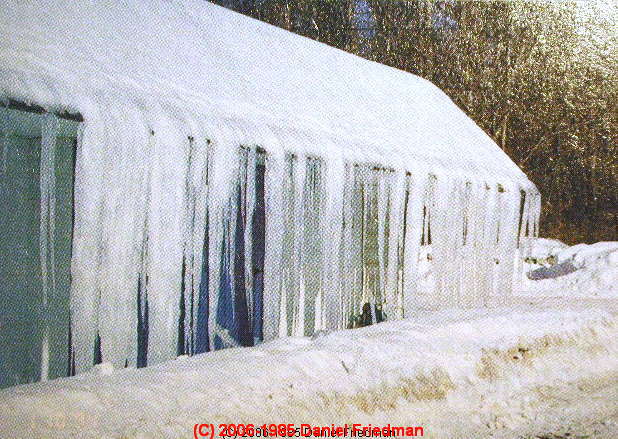
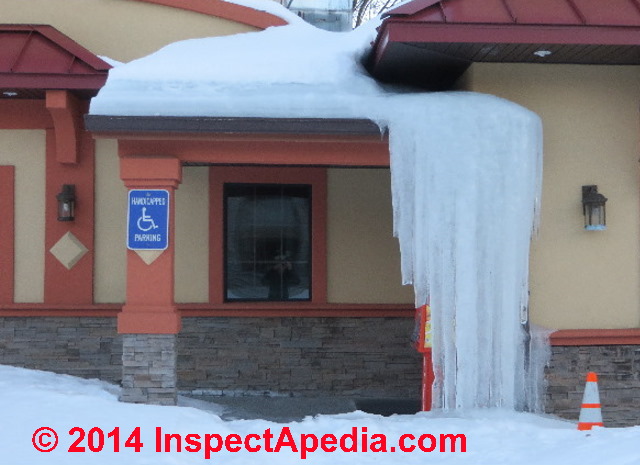
Let's start with emergency measures for buildings already in trouble with heavy roof ice dams and leaks into the building attic, walls, or other areas.
[Click to enlarge any image]
These are the useful approaches to curing existing roof ice dam leaks into a building attic, walls or other areas:
- Use heat tapes:
during winter & freezing conditions when weather precludes actual building modifications or repairs to add ventilation or ice and water shield, you can use
HEAT TAPES & CABLES on Roofs for Ice Dams to melt channels in existing ice or to prevent water back-ups between new-forming ice on roof edges and in roof gutters.
Heat tapes at the roof eaves are not a great permanent fix but it's a useful stop-gap measure if you're having ongoing ice dam leaks into the building. - Fix air & heat leaks:
winter is a fine time to take a look at the attic for missing insulation, gaps in insulation, or for dark spots on insulation that mark air bypass leaks. Fixing insulation gaps and air leaks drops the attic temperature and thus cuts ice dam formation. - Turn down the heat:
A neighbor told us that as her dad's currently empty house in New York had a long history of ice dam trouble she was keeping the heat up to hope she would melt ice off of the roof!
Really? No, she was taking the wrong approach. Making the house warmer means sending more heat into the attic or roof space where the under-roof heat melts snow on the upper roof sections.
That melting snow water runs beneath the snow cover on the roof just fine, right down the warm roof deck until it hits the cold roof overhang or lower edges. There it freezes solid. The more water we send down the roof to the cold roof edge the bigger the ice dam. Don't do that.
The neighbor then asked: "OK so should I turn the heat down?" Geez! not knowing the house I was worried that if I told her to do that the pipes might freeze - we'd go from one problem to another.
See WINTERIZE - HEAT ON PROCEDURE for details on how to turn down the heat without freezing the pipes.
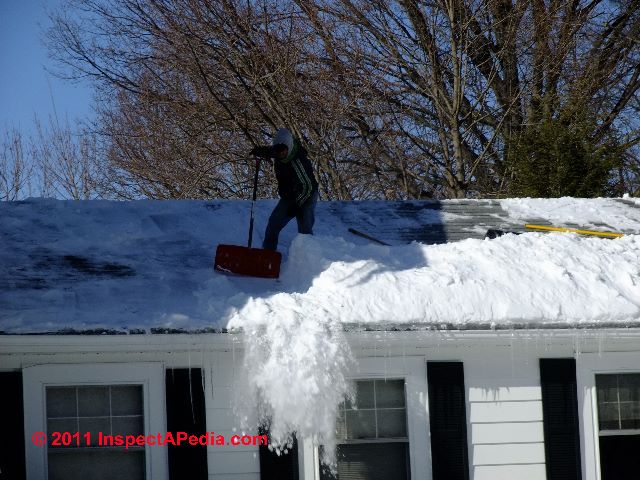
- Rake snow off of the roof ?
lots of people risk their lives or the lives of others having somebody shovel or rake snow off of the roof when ice dams seem to be a problem.
Really? Snow raking might be appropriate where unusual conditions of deep snow threaten structural collapse of a building, but that's not a great fix for ice dams unless all of the snow is removed from the roof.
Otherwise, snow high on the roof still melts (in that hot attic), running down to the eaves where it freezes to form ice dams.
OK maybe smaller ice dams as we have less melting snow and a somewhat cooler attic due to increased heat loss through the non-snow-coverd area, but we'll continue to see ice dams nevertheless.
Emergency steps in stopping roof ice dam leakage that included removing snow from the roof are illustrated
at ICE DAM LEAK EMERGENCY REPAIRS
Raking snow off of roofs (photo at left) is discussed
at COLD WEATHER ROOF TROUBLE. - Get Rid of the Ice:
ok so we've seen all sorts of crazy schemes: socks filled with ice-melt crystals or salt (which is hell on the aluminum gutters), chopping ice (which wrecks the roof shingles) at the roof eaves, and my favorite - squirting a jet of hot water to melt drainage channels in the ice dams to allow backed-up water off of the roof.
I confess, I've done this. It works, for a few hours. Maybe that's a way to make room for heat tapes.
See HEAT TAPES & CABLES for ROOF ICE DAMS
How to Prevent Future Roof Ice Dam Leaks
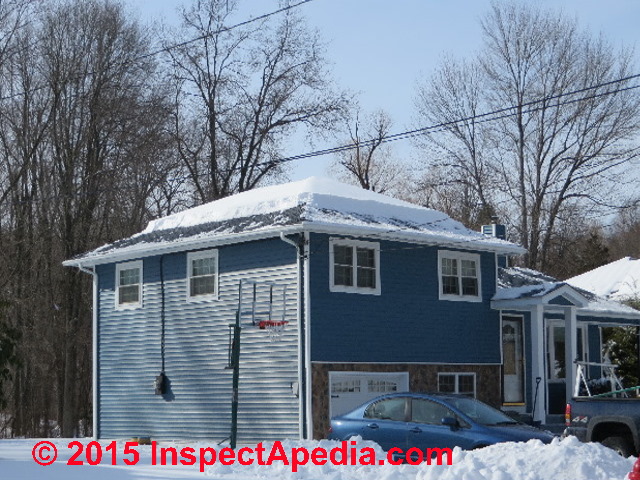 OK so either by choosing from the steps listed above in this article, or by other desperate measures shown
at ICE DAM LEAK EMERGENCY REPAIRS we've taken emergency measures to stop ice dam leaks.
Now how do we stop ice dam leaks in the future, and how do we fix an existing building or build a new one that won't have ice dam leak troubles.
Do we really want to be raking a high roof like the one shown at left every winter?
Doesn't raking snow risk roof damage or a shorter roof life? Are there falling and electrocution hazards? You bet. Here are some other approaches to avoiding ice dam problems on roofs:
- Ventilate the roof properly at soffits (eaves) and ridge.
We'll say more about this below. If you can't ventilate the roof you'll have to go to a hot roof design and hope that nothing ever punctures the roof covering.
Over at ROOF ICE DAM CURE: Comparing Two Houses we show the best long term way to avoid ice dam formation and roof ice dam leaks: good ventilation and good insulation and no air leaks into the roof cavity. - Inspect & fix insulation & air bypass leaks.
Details about air bypass leaks themselves can be read
at AIR BYPASS LEAKS.
Readers who want to find and fix un-wanted air bypass leaks should also
see AIR LEAK DETECTION TOOLS
and AIR LEAK MINIMIZATION as well
as AIR SEALING STRATEGIES. - Add insulation
in the attic floor or under the roof if the present R-value doesn't match your climate zone.
Readers who want to understand the significance of air bypass leaks and how this problem is corrected should
see ENERGY SAVINGS RETROFIT CASE STUDY
and ENERGY SAVINGS RETROFIT LEAK SEALING GUIDE. - Use Ice & Water Shield:
even in really careful construction, challenging weather conditions or unusual building conditions (someone left the door to the attic open) can cause so much ice formation on a roof that ice dam leaks occur where they never have before.
As extra insurance against roof ice dam leaks when re-roofing, use ice and water shield at the building roof eaves, running this impermeable membrane (it even seals around nails) up the roof at least three feet, or in some climates or on problem roofs, up six feet or more.
Watch out: ice formation in gutters at the roof edges can push water back up underneath ice and water shield if it did not bond perfectly to the roof sheathing, or it may push water up underneath the roof deck itself.
Extra detailing at the roof edges, including wrapping the ice and water shield down over the fascia may be needed - Install & Use Heat Tapes at Roof Eaves & In Problem Spots:
Sometimes the most expedient, least costly, and fastest way to stop ice dam leaks is to remove accumulated snow and ice (as much as possible and safely) and then install heat tapes in those areas.
Particularly for un-vented roofs or roof spots at which adding ventilation and insulation to stop ice dam formation is very costly or difficult, the appeal of ice melting heat tapes becomes overwhelming.
See HEAT TAPES & CABLES for ROOF ICE DAMS
Why Roof Iced Dams Form & How Water Backs Up & Leaks at Ice Dams
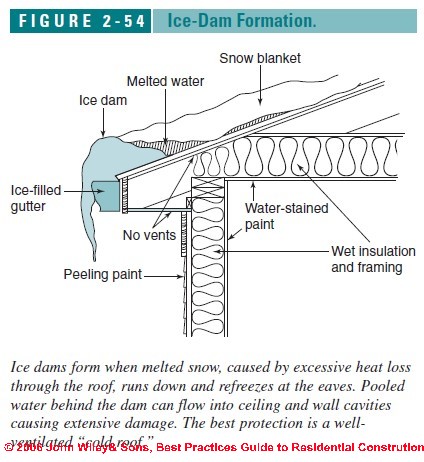 As explained in Best Practices Guide to Residential Construction (Steve Bliss, J Wiley & Sons) , chapter
Ice dams form when heat leaking into attics or roof cavities from the building below, or from attic ductwork, melts the bottom layer of snow on the roof.
The melt water runs down the length of the roof to the eaves, where it refreezes, forming a dam and icicles.
In the worst cases, liquid water pools behind the dam and flows under the shingles and into the building (Figure 2-54 shown at left).
Research has indicated that the ice-dam risk is greatest when temperatures range between 15°F and 20°F— when it is warm enough for snow to melt but cold enough for it to refreeze at the eaves.
Also, the greater the depth of snow on the roof, the greater the risk of ice dams due to the insulating value of the snow itself.
Cold Roofs Prevent Ice Dams
So how much roof ventilation do we need to prevent roof ice dams, leaks, and attic moisture, condensation & mold problems?
Ventilation helps prevent ice dams by keeping the roof surface cold enough to limit uneven melting. Tests conducted in 1996 at the U.S. Army Corps of Engineers Cold Regions Research and Engineering Laboratory (CRREL), showed that the traditional 1:150 ventilation rule was sufficient to prevent ice dams on roofs with R-25 or greater ceiling insulation.
The 1:300 rule proved adequate for roofs with R-38 or greater insulation. Since most standard eave and ridge vents sold today meet the higher ventilation rates, most new homes are protected as long as there are no large heat leaks into the attic, or tricky sections of the roof with inadequate ventilation. - - Adapted with permission from Best Practices Guide to Residential Construction (Steve Bliss, J Wiley & Sons) .
But just adding outlet vents at a ridge (or worse, at gable ends of a building) or just adding soffit vents alone does not work very well to ventilate attics or under-roof spaces.
We need both air inlet at the building eaves or lower roof edges, and air outlet at the ridge in order to move air up beneath the entire roof surface, keeping the roof deck and attic cool and dry.
See ROOF VENTIILATION INTAKE-OUTLET RATIOS for details about the ratio of soffit intake vent area to ridge outlet vent area.
Attic Condensation and Roof Leaks as a Source of Building Mold - Diagnosis and Cure
 Sources of Attic Mold: Roof leaks or, alternatively, high levels of attic moisture due to a combination of inadequate attic (soffit intake and ridge outlet)
ventilation combine with building moisture sources (such as a chronic or even a single-event wet basement, plumbing leaks, or a leaky roof from
roof failure or from ice dams) are likely to cause excessive moisture or actual wet
conditions in an attic.
Sources of Attic Mold: Roof leaks or, alternatively, high levels of attic moisture due to a combination of inadequate attic (soffit intake and ridge outlet)
ventilation combine with building moisture sources (such as a chronic or even a single-event wet basement, plumbing leaks, or a leaky roof from
roof failure or from ice dams) are likely to cause excessive moisture or actual wet
conditions in an attic.
High attic moisture levels or actual wet attic conditions invite extensive mold growth.
Also see DEW POINT TABLE - CONDENSATION POINT GUIDE
Visible frost may appear on attic roof surfaces if the building is located in a freezing climate and high levels of moisture are trapped in a poorly vented attic or roof cavity (photo, left).
Visible mold may appear on wood surfaces in an attic such as on rafters or roof sheathing.
Hidden mold may be present and may be even more of a problem if it forms in insulation or in the ducts and air handler of an air conditioning or heating/air conditioning system.
Typical building air convection currents tend to move air up and out from lower to upper building levels, so one would not think that much mold would move down from an attic into the living area.
But important exceptions to this can quickly move problem mold from an attic into a living area.
Conditions that Cause Air Movement Upwards into an Attic or Roof Cavity Space
As home inspection expert Roger Hankey has pointed out,
"... attic bypasses are one of the primary causes of ice dams. You effectively discuss insulation and ventilation
at INSULATION INSPECTION & IMPROVEMENT
and
at VENTILATION in buildings) but if attic bypasses remain in an insulated and ventilated attic, then the result can be frost and moisture damage to the roof sheathing, and/or spot ice dams." - R. Hankey 01/28/2008.
Because warm air rises up through buildings by natural convection, tending to displace heavier cold air, warm building air leaks and forces its way into roof spaces primarily through small openings leaking from heated space into the roof cavity or attic space.
The pressure difference between a warm interior ceiling and a cooler attic or cathedral ceiling space needs only to be slight for air to move from warm to cool spaces in a building.
Remarkably, the current of rising air in a two story or higher building can be quite adequate to even draw cool, moist, or possibly moldy air from a building's crawl space or basement too.
Conditions moving air and potentially moldy air downwards from an attic or roof space include
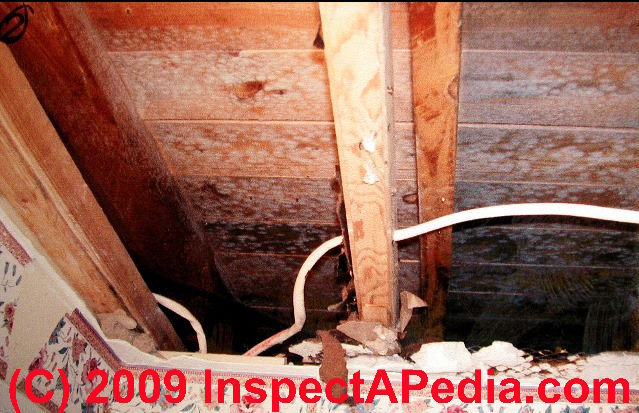
- Mold growth in heating and air conditioning HVAC ducts or air handlers found in an attic
- Mold on any attic surface or in attic insulation
if it is a species producing airborne spores (moldy attic photo at left) and if the building uses a whole house ventilating fan, especially if there is inadequate exit venting for the fan operation.
This condition pressurizes the attic and moves mold down through various openings into the floors below. - Mold on building surfaces
in an attic or attic knee wall space which opens onto or has a knee wall common with an upper floor living space such as a bedroom. - Ventilation fan or exhaust fan use
causing downwards movement of air from upper building levels - Air conditioning use causing down-currents of air in buildings
from an upper floor: heavier, cool air flows downwards in the structure and draws attic air into the upper floor from attic or roof cavity air bypass leak points (such as at light fixtures, stairs, attic hatch).
Building Exteriors Leaks and Mold vs Attic Ventilation & Moisture Troubles
No mold cleanup project will be successful unless you correct the conditions that caused mold growth in the first place.
An expert inspection and report should find and suggest remedies for site and building exterior conditions that produce mold or for building areas that serve as a mold reservoir or as amplifiers for allergens, mold, mildew, excessive pollen or pet dander.
The basic steps: find all unwanted moisture sources, correct appropriate building, site, landscaping, & construction details. 90% of the wet basements and crawl spaces I see are caused by bad or missing roof gutters and downspouts.
An IAQ investigator who has training and experience in building science, mycology (mold science), and IAQ, or in some cases an experienced ASHI-Certified home inspector or sick building investigator who is who has a similar in-depth understanding of construction failures can be helpful at this step.
...
Continue reading at HEAT TAPES & CABLES for ROOF ICE DAMS or select a topic from the closely-related articles below, or see the complete ARTICLE INDEX.
Or see ROOF ICE DAM LEAK FAQs - questions and answers about ice dam and leak problems posted originally on this page
Or see these
Recommended Articles
- ATTIC CONDENSATION CAUSE & CURE
- ATTIC INSULATION MISSING
- COLD WEATHER ROOF TROUBLE
- ICE DAM PREVENTION on ROOFS
- ROOF ICE DAM CURE: Comparing Two Houses
- ROOF ICE DAM LEAKS - home
- ROOF VENTILATION for DEEP SNOW
- ROOF VENTILATION SPECIFICATIONS - home
Suggested citation for this web page
ROOF ICE DAM LEAKS at InspectApedia.com - online encyclopedia of building & environmental inspection, testing, diagnosis, repair, & problem prevention advice.
Or see this
INDEX to RELATED ARTICLES: ARTICLE INDEX to BUILDING VENTILATION
Or use the SEARCH BOX found below to Ask a Question or Search InspectApedia
Ask a Question or Search InspectApedia
Questions & answers or comments about how to diagnose and fix attic moisture, condensation, and mold sources
Try the search box just below, or if you prefer, post a question or comment in the Comments box below and we will respond promptly.
Search the InspectApedia website
Note: appearance of your Comment below may be delayed: if your comment contains an image, photograph, web link, or text that looks to the software as if it might be a web link, your posting will appear after it has been approved by a moderator. Apologies for the delay.
Only one image can be added per comment but you can post as many comments, and therefore images, as you like.
You will not receive a notification when a response to your question has been posted.
Please bookmark this page to make it easy for you to check back for our response.
Our Comment Box is provided by Countable Web Productions countable.ca
Citations & References
In addition to any citations in the article above, a full list is available on request.
- Mark Cramer Inspection Services Mark Cramer, Tampa Florida, Mr. Cramer is a past president of ASHI, the American Society of Home Inspectors and is a Florida home inspector and home inspection educator. (727) 595-4211 mark@BestTampaInspector.com 11/06 & 12/08
- John Annunziata, P.E. - NY Metro ASHI during informal chapter discussions about roof and attic ventilation options (1986-1996).
- Roger Hankey is principal of Hankey and Brown Inspections, Winter Park, CO. Mr. Hankey is a past chairman of the ASHI Standards Committee and served in other ASHI chapter and national leadership roles. Mr. Hankey is a National Radon Proficiency Program certified measurement professional and a Level II infrared thermographer. Contact Roger Hankey at: 970-393-6604 - rogerhankey47@gmail.com . Website: www.HankeyandBrown.com Mr. Hankey is a frequent contributor to InspectAPedia.com.
- The Smart Vent™ by DCI roof intake venting provides an intake at the lower edge of roof decking for difficult cases. See www.dciproducts.com/html/smartvent.htm
- The AccuVent™ attic ventilation roof baffle produced by Berger permits insulation to extend over the top plate as far forward as possible. See www.bergerbuildingproducts.com/pdfs/AccuVentAtticVent.pdf
- GAF Cobra® and other GAF roof ventilation products: see www.gaf.com/Content/GAF/RES1/roof/RS_whyuse_ventchart.asp?viewer=&module=
- WEATHER RESISTIVE BARRIERS [PDF] U.S. Department of Energy, ", how to select and install housewrap and other types of weather resistive barriers
- In addition to citations & references found in this article, see the research citations given at the end of the related articles found at our suggested
CONTINUE READING or RECOMMENDED ARTICLES.
- Carson, Dunlop & Associates Ltd., 120 Carlton Street Suite 407, Toronto ON M5A 4K2. Tel: (416) 964-9415 1-800-268-7070 Email: info@carsondunlop.com. Alan Carson is a past president of ASHI, the American Society of Home Inspectors.
Thanks to Alan Carson and Bob Dunlop, for permission for InspectAPedia to use text excerpts from The HOME REFERENCE BOOK - the Encyclopedia of Homes and to use illustrations from The ILLUSTRATED HOME .
Carson Dunlop Associates provides extensive home inspection education and report writing material. In gratitude we provide links to tsome Carson Dunlop Associates products and services.
 | HOME | ABOUT | ASK a QUESTION | CONTACT | CONTENT USE POLICY | DESCRIPTION | POLICIES | PRIVACY | |
| © 2024 - 1985 Publisher InspectApedia.com - Daniel Friedman | |||||||||