
InspectAPedia® FREE Encyclopedia of Building & Environmental Construction, Diagnosis, Maintenance & Repair |
Question? Just ask us! InspectAPedia
|
 Attic Ice, Moisture, Mold
Inspect Attics for Moisture
Correct Attic Condensation, Frost, Ice Dam Leaks & Mold
- POST a QUESTION or COMMENT about detecting the cause of attic moisture, condensation, frost, leaks, or mold
How to inspect an attic for condensation, leaks, or moisture problems:
This article describes inspection methods and clues to detect roof venting deficiencies, insulation defects, and attic condensation problems, in buildings. It describes proper roof ventilation placement, amounts, and other details.
This chapter "How to Inspect in the Attic or Roof Cavity for Signs of an Under-roof Condensation Problem, is part of our article series on "Attic Condensation".
InspectAPedia tolerates no conflicts of interest. We have no relationship with advertisers, products, or services discussed at this website.
Inspecting in the Attic or Roof Cavity for Signs of an Under-roof Condensation Problem
 How to inspect a building attic for evidence of ice dam leaks, condensation, frost, or moisture. How to detect roof venting deficiencies, attic insulation defects, and attic condensation problems.
Check the Entry & Exit Pathways for Attic Ventilation Air
After examining the eaves or lower roof edges, look up at the ridge for a continuous opening on either side of the ridge board, providing an exit vent path.
On some buildings I've found that a ridge vent was installed but the installer just nailed it over the existing roof sheathing, forgetting to cut the necessary opening.
"Spot vents" on lower roof slopes, or power vent fans are not as good a substitute for the year-round passive venting provided by a ridge vent.
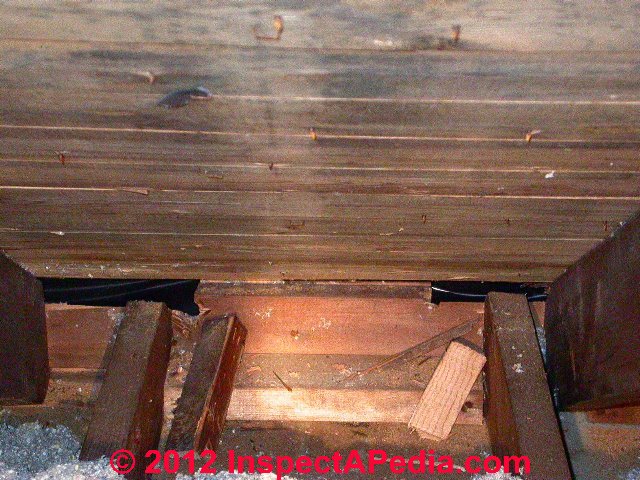
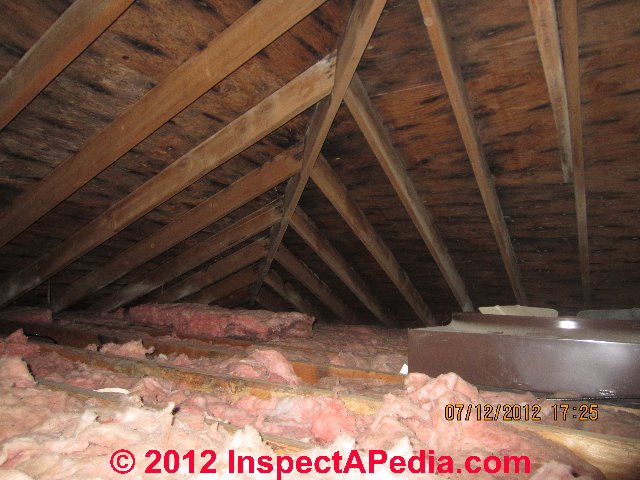
Our photo (left) illustrates a common construction practice on wood framed homes built in North America into the 1950's: at the house eaves blocking was nailed between or against the ceiling joist ends to minimize air flow into the attic at the house eaves or soffits.
You can see dark mold stains on the underside of areas of this roof.
The presence of perforated panels covering the soffit undersides on this home amounted to faux-venting since there was actually no air pathway into the attic.
Check for Signs of Attic Condensation & Moisture
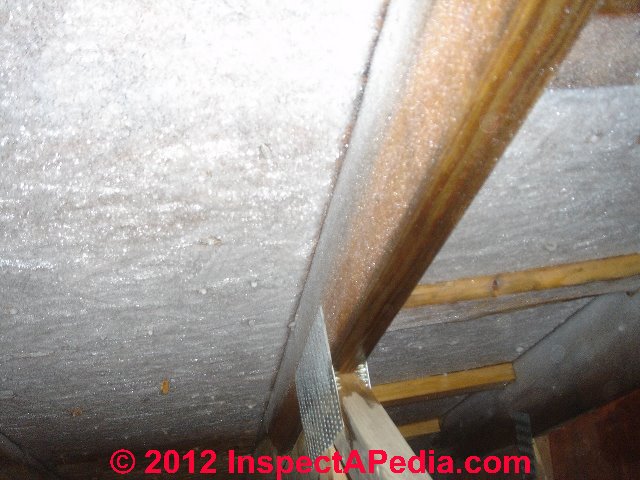
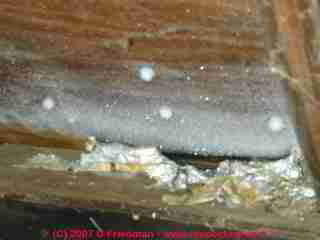
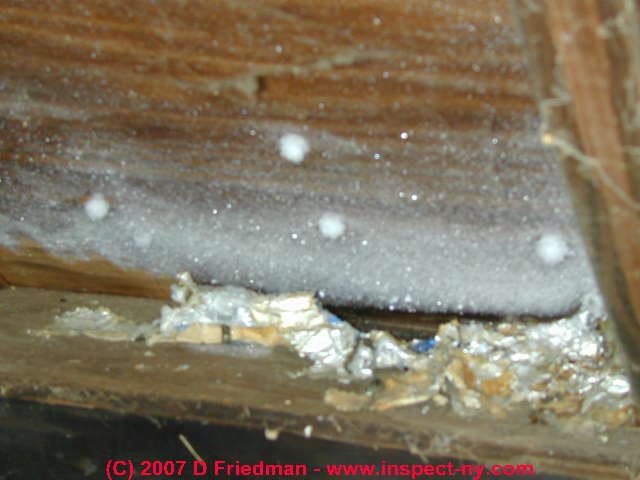
Inspecting attic spaces in winter weather in freezing climates you may find extensive frost over roof sheathing and framing, as shown in home inspector Arlene Puentes' [2]photograph of a log home inspection (at left).
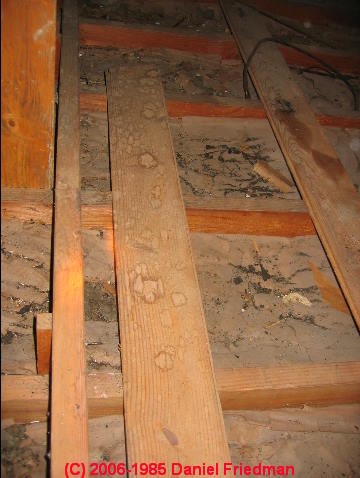
Even in warm or dry weather you often will see stains around roofing nails penetrating the roof sheathing, or condensate drip spots on the attic flooring or insulation (Left photo below).
This is caused by moisture condensing on the roofing nails and dropping to the surface below. This is sure evidence of a condensation problem. The pattern of drip marks may be remarkably just like the pattern of roof shingle nails which protrude through the roof sheathing.
Winter condensation on the nails, even forming frost in freezing weather, rusts the nails and stains the roof sheathing around them.
Frost later melts off of these nails and drips onto the floor below.
The pattern may occur more on the cooler or north slope of the roof.
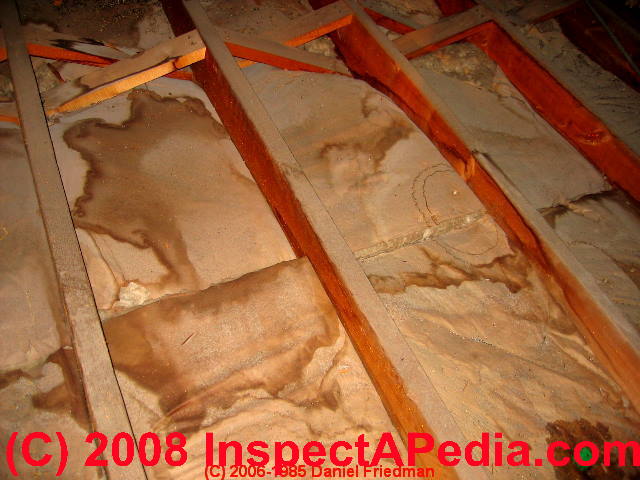
If attic stains are from roof leaks, (photo above) they will usually be much larger and will appear on the sides of rafters, on larger areas of the roof sheathing, and on larger areas of the attic floor.
If you see evidence of extensive roof leaks or condensation leaks, I'd also check the insulation and the attic side of the ceiling drywall for a hidden mold problem.
If you see condensation drip stains in the attic photo above), you'll be confirming what you suspected from outside -- inadequate ventilation.
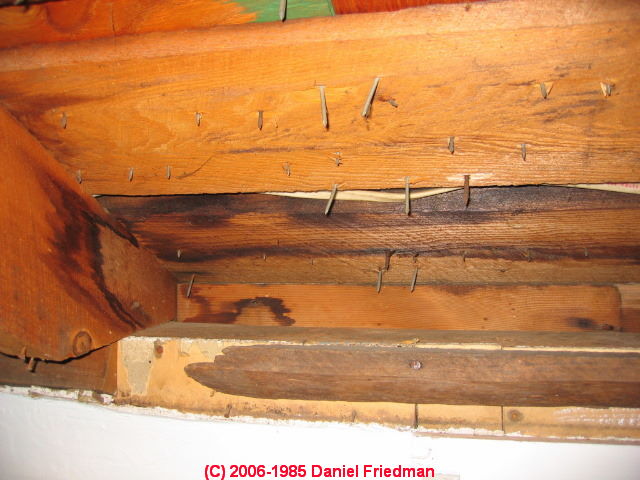
Be careful and don't overlook viewing the roof eaves.
There could be rotting fascia boards, decaying rafter ends, and delaminating plywood.
Look in that location for moisture-stained roof sheathing, and look carefully for ice dam leak stains into the eaves, such as the water marks shown in this photograph.
How to Inspect the Attic for Moisture - Stains Around Roofing Nails
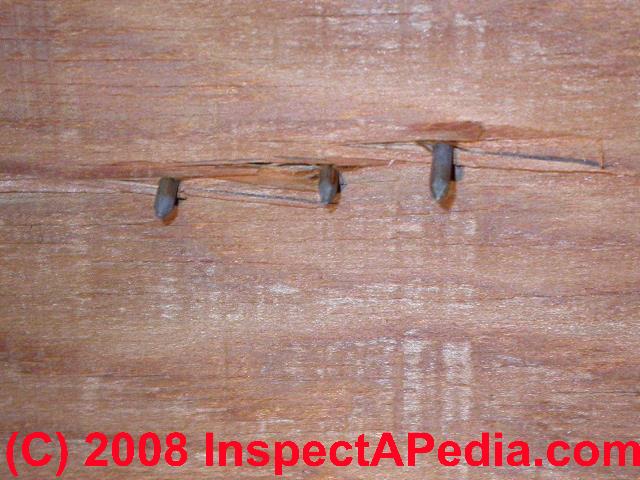
Rust or stains around roofing nails that protrude through the attic sheathing (they're supposed to stick through) are a clear indication of high attic moisture.
Our photograph above shows roofing nails protruding through plywood roof sheathing visible in an attic where there is no under-roof condensation or moisture problem.
Our photograph above shows roofing nails which have rusted and stained the roof plywood in an attic where indoor moisture has risen through the building to condense on the under-side of the roof.
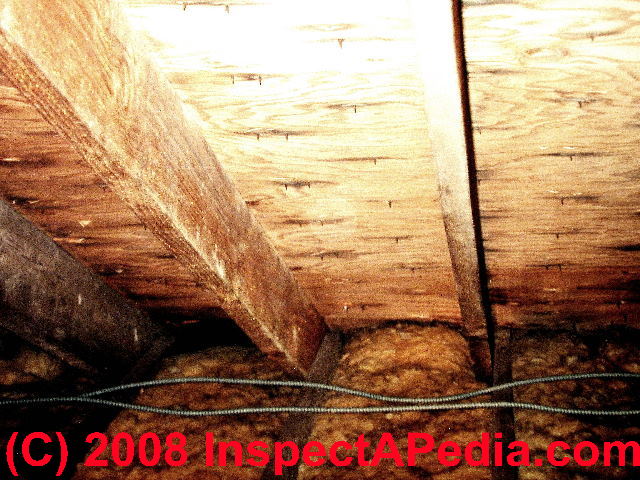
Our photo at left shows the typical staining pattern in an attic where there has been modest condensation at the roofing nails.
If you perform this inspection step in winter in a freezing climate you may find frost on these nails. In other seasons or in non-freezing climates you will see rust on the roofing nails and often stains on the roof sheathing surrounding the nail.
On an older home that has been re-roofed, you may see these nail-stains but no nails - the old nails may have been removed during re-roofing, leaving just the rust-marked roof sheathing.
Excessive attic moisture condenses on the cool metal surface of the roofing nails, causing corrosion or rust on the nails and stains on the surrounding wood materials.
These same condensation points - the roofing nails - will often map exactly the drip stains found on the attic insulation or attic floor below each nail.
Because moisture may enter the attic more at some locations than others, for example over a bathroom or kitchen, nail staining and drip marks will not be uniformly distributed throughout an attic.
How to Spot Attic Mold Due to High Attic Moisture or Roof Leaks
 ...
... 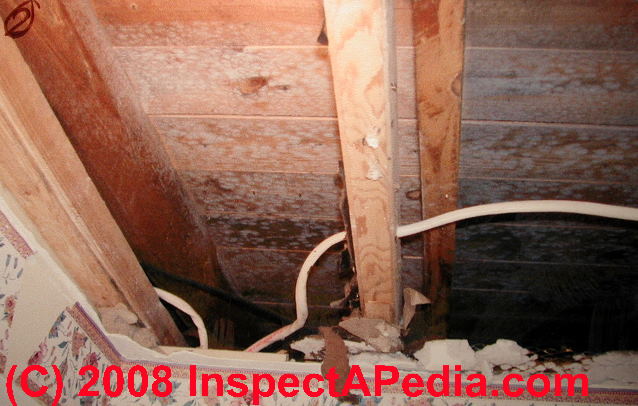
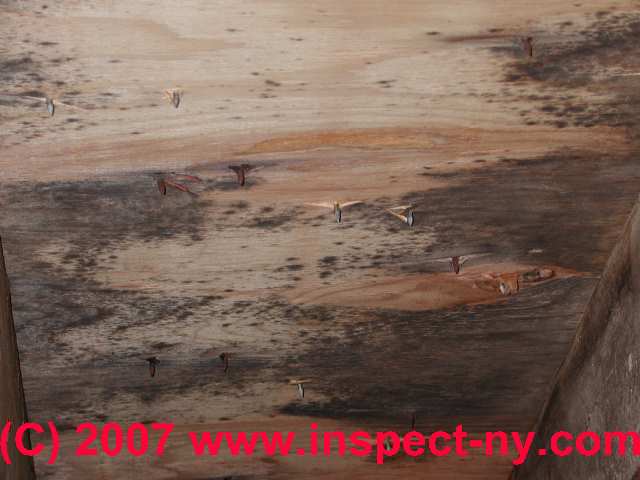
These photos show mold on attic surfaces due to high moisture in that area. While many inspectors notice dark mold or mold-suspect material on roof framing or roof sheathing, it is at least as important, and often more important to spot the light-colored molds that may also be present - often these are the more hazardous, particularly if building conditions cause air movement downwards out of the attic into the living space or into an attic-located HVAC duct system.
The brown/black attic mold on plywood in the left-hand photo is easy to spot and is often an allergen or problematic attic fungus like Cladosporium sp., Pithomyces chartarum, Ulocladium sp., or Aureobasidium pullulans but the light colored mold on the tongue-and-groove pine roof sheathing in the right photo was found to be Penicillium sp. which is more likely to be airborne and transmitted in the building.
How to Correct High Attic Moisture, Condensation, Leaks
A first step in fixing a wet or moist attic problem is the correct identification of the source of the moisture.
Stains or even wet areas on the under-side of roof decking and on rafters can appear to be a roof leak but in fact moisture may be entering the attic not from above (outside and through the roof), but by rising through a building suffering from leaks, a prior fire extinguishment, or most common, a wet basement or crawl space.
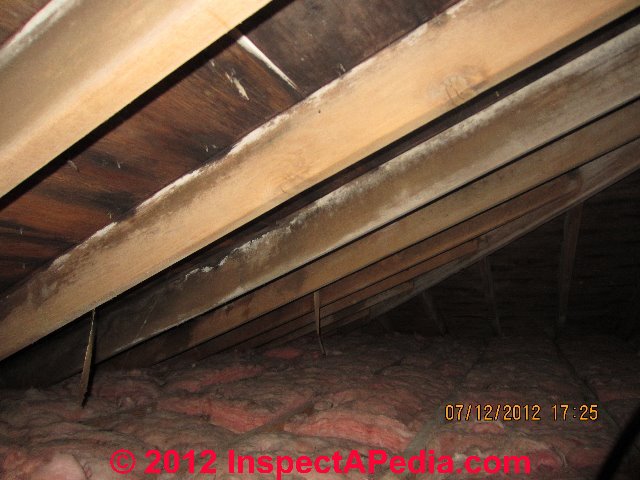
Home inspector David Grudzinski[1]provided the attic moisture photographs shown below.
 ...
... 
From just the photographs, and without having inspected the building exterior, roof, nor other areas, the photos look like a roof that had numerous leaks, perhaps from worn out roofing, possibly even some rotting sheathing.
The photos show areas of apparent mold on some rafters.
But especially in the 2nd photo at above right, the very extensive condensation stains around the nail protrusions through the roof deck tell us that the whole attic interior has been soaking wet. Now for the big question: is this wet attic caused by roof leakage or is there a building water entry problem?
Mr. Grudzinski provided the additional, crucial diagnostic information about this wet attic:
The basement was a wet one, and as is typical the moisture finds a way to the attic. This house had poor insulation, and a poorly insulated attic access, as well as a whole house fan which are notorious for heat loss causing condensation. The person buying the house is a pregnant female and I strongly advised complete and thorough mold testing and remediation.
In other words, an expert roof and attic inspection include an inspection of the entire building, basement to roof, in order to understand where moisture or condensation are originating and what may have been their effects on the building.
A Wet Attic Risks Hidden Mold Contamination of its Insulation
Also, we wonder if, in a soaked area like this where fiberglass insulation is present, because of the risk of hidden mold in the insulation it may be worth checking the attic side of the ceiling drywall below the areas of most-apparent-worst leakage into that space - looking for water stains there, mold, &c.
See FIBERGLASS INSULATION MOLD
If you find significant levels or large areas of mold in your attic the mold should be cleaned - that is, removed. Do not rely on magic bullets like sprays alone. The spray approach does not remove the problem mold and it may spread it into otherwise uncontaminated materials like insulation.
Don't tear off the roof over a moldy attic: Unless the mold-causing conditions have also rotted framing or delaminated plywood roof sheathing, structural removal/replacement, such as a roof tear-off are unnecessary and inappropriate. But don't forget that if you see attic mold the insulation or ceiling drywall below may also be moldy.
See HOW TO FIND, TEST FOR, & REMOVE MOLD IN ATTICS for details about where and how to look for attic mold and what to do about it.
Reader Comments, Questions & Answers About The Article Above
Below you will find questions and answers previously posted on this page at its page bottom reader comment box.
Reader Q&A - also see RECOMMENDED ARTICLES & FAQs
On 2023-11-07 by InspectApedia Publisher - need to assess drip edge flashing installation
@Amie,
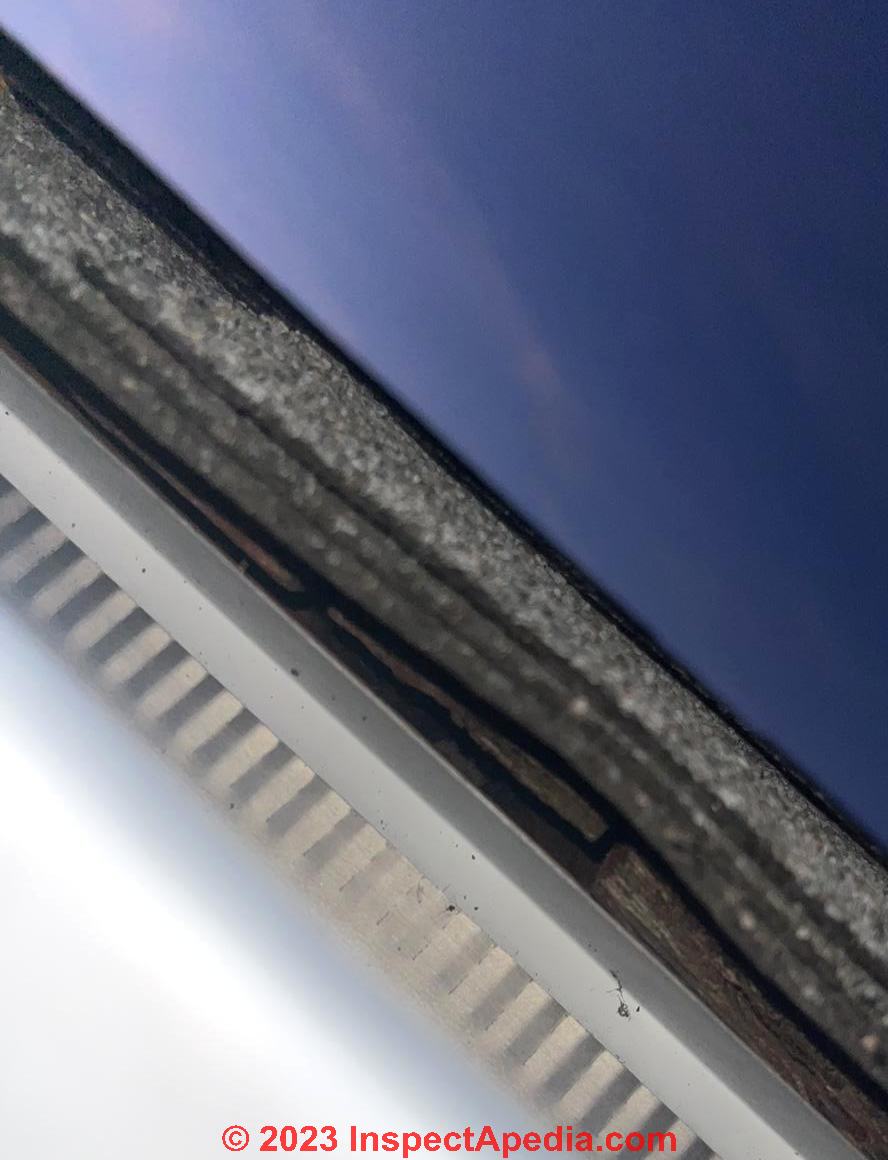
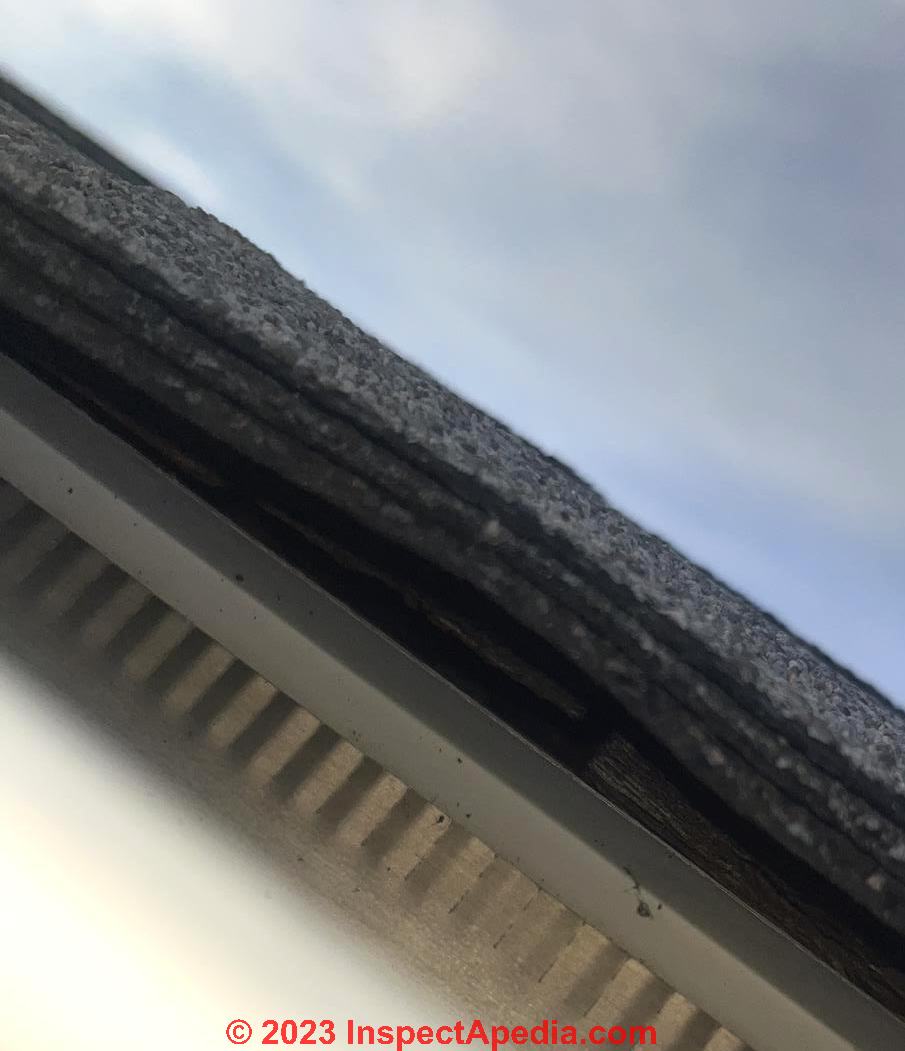
It's still a little hard to make out but it looks to me as if the drip edge is stuck behind the gutter rather than hanging over into the gutter.
And I think I see some black or darkened edges of plywood that are not nailed down flat at the roof edge. You could of course be seeing decay but I can't get enough out of the photos to say more.
I would suggest getting an experienced inspector at the property to look at everything to give you a list of repairs in order of priority.
The first priorities to fix things that are dangerous.
Second is to fix things that are causing rapid expensive damage.
Third is to fix things that don't work or don't work at an acceptable level of reliability.
On 2023-11-07 by Amie
@InspectApedia Publisher, I went outside and took another pic. Lol See if this is any better...
And the entire house was very cheaply built. Cookie cutter ranch homes piled on top of one another in a subdivision. All built by the same contractor and he's always had a reputation for terrible workmanship.
We found out a few years ago we've got a radon issue. Had to get a sub-slab mitigation system installed. (Cheap test kit from Lowes showed numbers over 4.0 in all areas of the home.)
During the installation, a GOOD contractor obviously had to drill into the slab in basement...we quickly realized there's no vapor barrier.
Called the original contractor to ask if we were in a nightmare or if we REALLY didn't have a vapor barrier under us....he assured us they "changed the code" that year and no longer required a vapor barrier in order to pass inspection. (Yup. I can't make this stuff up.)
Meanwhile we are the last house in the cul-de-sac at the bottom of a massive hill. We get swamped with rainwater and runoff each time it rains. We get EVERYBODY'S runoff from the 14 houses uphill.
Anyways...here's the other pic...
On 2023-11-06 by InspectApedia Publisher - roof edge looks rotted
@Amie,
Nice photo but I can't see enough to be sure I know what's going on.
If you're sure you're seeing delaminating or rotted plywood roof sheathing at the roof edges then I think
- a drip edge flashing was omitted or improperly installed
- and there might be a problem with ice dam leaks - depending on where your home is located - that in turn could mean that when someone blew in a lot of attic floor insulation they blocked the roof eaves intake venting.
If you're seeing mold (mildew only grows on living plants) on the interior walls I would make a test cut into the wall at the worst or most-suspect location to check wall cavity conditions for mold in the wall cavity. Let me know what you see - post photos of that too (one photo per comment but as many comments and photos as you like)
Perhaps you could post more photos and details; here if you want, though better would be take a look at and post at
ATTIC MOISTURE or MOLD
- you're on this page
or at
ROOF VENTILATION SPECIFICATIONS
We're glad you're a regular InspectApedia user; working together helps us both.
Daniel
[Ed. note: this question was originally posted on our home page and moved to this relevant topic page.]
On 2023-11-06 by Amie
I've become a "regular" in the comments/questions section. This is the third time I've come to you for insight within the past month or so.
I'm posting a photo of my roof...I'm holding my phone just inside the gutter and pointed upwards...you'll see the roof sheathing and a gap between the wood and the shingles. Not sure if it makes a difference, but we have a ridge vent up there. House was built in 2006 and we've been here since then.
That would definitely looks rotted, wouldn't you agree? We have no obvious leaks or issues but house stays extremely humid and hot/musty air gets sucked inside the home at both attic hatches and bathroom exhaust fans during warm months and the opposite during cold months.
Attic is inaccessible at both hatches due to an extreme amount of insulation that was installed during construction. (Several feet deep. It's loose-fill cellulose.) We're noticing quite a bit of mold/mildew at the tops of interior walls, more so in bathrooms.
Plumbing vents have been checked and all seem to exit correctly. Exhaust fans are sucking air...I've done the toilet paper test. Fans run for a significant amount of time after showers.
What would cause the sheathing to rot like this? I'm sure it's not just this one area. I feel as though it's an issue for the majority of the roof. It's beginning to sag in areas that are visible from the exterior. What are your thoughts?
On 2020-08-14 by (mod) - leaky roof on Australian home shows up as wet ceiling
 Is this really on the roof, or did you mean on an interior ceiling?
Look for an ice dam leak above the ceiling in this area.
On 2020-08-13 by Kirra Williams
Ok I live in auatralia (W.A)
It’s winter time and in the last two days I have noticed a water like patten on the roof near the front door and the master bedroom.
It almost looks frozen What is it and is it harmful
On 2016-08-19 - by (mod) -
Oh darn. It sounds as if the temporary tarp job didn't withstand the rainstorm.
I would certainly replace any insulation that got wet; the cost of leaving it and then having to go back and do the job a second time later when you find that the insulation as well as the drywall it covered are now a mold palace is best avoided up front.
By NO means would I just paint over water-stained drywall before first performing a thorough inspection for mold contamination on both sides of any drywall that got wet as well as any cavities (ceilings, walls, floors) through which water passed. Painting over mold isn't an effective remediation.
IF all of the wet drywall could have been thoroughly dried in 24-48 hours after the wetting event (which is doubtful) THEN it's possible that everyone involved was lucky. But f you release the roofer from responsibility by a mere paint-job and later discover more-costly damage everyone will be sorrier.
On 2016-08-19 by Ronda
I recently had my roof replaced and a thunderstorm moved into the area when the roof was covered with a tarp. Two days later I found water stains in every room. The roofing company is covering the painting but do I need to have the insulation replaced as well?
On 2015-10-06 by RockMD
ROOF & ATTIC VENTILATION: I am re-roofing a home with asphalt shingles on a 3:12 pitch, in a northern climate.
The current roof/attic ventilation is inadequate. Since I need to replace the roof I want to take this opportunity to provide additional (high-side) ventilation by installing a continuous ridge vent. I recognize that until the (low-side) soffit ventilation is upgraded the ventilation will still not be fully corrected. My intent is that once the soffit ventilation is corrected, in a future project, roof / attic ventilation will be fully corrected.
Question: By doing so, am I making a bad situation worse? Should I leave the current situation alone and put-off upgrading the high-side ventilation until both the low-side and high-side can be addressed at the same time?
Question: diagnosing moisture high on building walls
I have a double wide manufactured home that I'm renovated. It has vinyl siding and perforated soffits common on manufactured homes. We've noticed moisture high in the walls all around the home and can't identify the cause. Any ideas? - T.B., Colorado
Reply:
What T.B. found was a combination of accumulated snow or frost or ice in the home's eaves, possibly due to wind-washed insulation, moisture and condensation, or snow and ice building up in the eaves, combined with leaks into the house walls when weather warmed and the accumulated snow or ice melted. Details about this Q&A are
at MOBILE HOMES, DOUBLEWIDES, TRAILERS.
Question:
(Feb 14, 2014) Ben Bailey said:
Some of my roof decking boards have holes in them from previous leak damage. there is 4 spots across the whole roof. is there a way to fix or resecure this in an acceptable way without tearing off the roof?
Reply:
Ben, are we fixing the roof deck or the leaks? Most likely the leaks must be addressed first. Then if the area of damaged decking is just a few inches it's probably ok to leave it alone until further evaluate at re roof time. If there are large areas of decking rot it may be impossible to repair leaks without re-decking the damaged areas. The decision to make spot repairs vs complete reroofing depends on the overall roof condition and it's estimated remaining life.
Question:
(Aug 11, 2014) Anonymous said:
Do I need to encapsulate moldy delaminated decking before removal ? It HAS to come off in several areas. I heard the mold could spread when agitated.
I have suspicions of the origins of leakage & am going to correct anything I can.Cant go another winter the decking is 100% saturation
Reply:
Anon,
Typically demolition of damaged roof decking is performed from outdoors - from the rooftop, not from inside.
If there has been a history of leaks or high attic moisture you should be alert for contaminated insulation, upper side of ceiling drywall etc. If those conditions present there's more cleanup to do. If they are not, you might want to put down some tarps in the attic before the roof demolition.
...
Continue reading at ATTIC VENTILATION or select a topic from the closely-related articles below, or see the complete ARTICLE INDEX.
Or see these
Recommended Articles
- ATTIC CONDENSATION CAUSE & CURE
- ATTIC VENTILATION
- BASEMENT MOISTURE to ATTIC
- CATHEDRAL CEILING INSULATION
- MOISTURE CONTROL in BUILDINGS - home
- MOISTURE PROBLEMS: CAUSE & CURE
- ROOF VENTILATION SPECIFICATIONS - home
Suggested citation for this web page
ATTIC MOISTURE or MOLD at InspectApedia.com - online encyclopedia of building & environmental inspection, testing, diagnosis, repair, & problem prevention advice.
Or see this
INDEX to RELATED ARTICLES: ARTICLE INDEX to BUILDING VENTILATION
Or use the SEARCH BOX found below to Ask a Question or Search InspectApedia
Ask a Question or Search InspectApedia
Try the search box just below, or if you prefer, post a question or comment in the Comments box below and we will respond promptly.
Search the InspectApedia website
Note: appearance of your Comment below may be delayed: if your comment contains an image, photograph, web link, or text that looks to the software as if it might be a web link, your posting will appear after it has been approved by a moderator. Apologies for the delay.
Only one image can be added per comment but you can post as many comments, and therefore images, as you like.
You will not receive a notification when a response to your question has been posted.
Please bookmark this page to make it easy for you to check back for our response.
Our Comment Box is provided by Countable Web Productions countable.ca
Citations & References
In addition to any citations in the article above, a full list is available on request.
- [1] David Grudzinski, Advantage Home Inspections, ASHI cert # 249089, HUD cert# H-145, is a professional home inspector who contributes on various topics including structural matters. Mr. Grudzinski, Cranston RI serving both Rhode Island and Eastern Connecticut can be reached at 401-935-6547 fax- 401-490-0607 or by email to Davidgrudzinski@aol.com. Mr. Grudzinski is a regular contributor to InspectAPedia.com - see DECK FLASHING LEAKS, ROT Case Study, and BASEMENT WATER MOLD IMPACT and VERMICULITE INSULATION for examples.
- [2] Arlene Puentes [Website: www.octoberhome.com ] , an ASHI member and a licensed home inspector in Kingston, NY, and has served on ASHI national committees as well as HVASHI Chapter President. Ms. Puentes can be contacted at ap@octoberhome.com
- Our recommended books about building & mechanical systems design, inspection, problem diagnosis, and repair, and about indoor environment and IAQ testing, diagnosis, and cleanup are at the InspectAPedia Bookstore. Also see our Book Reviews - InspectAPedia.
- In addition to citations & references found in this article, see the research citations given at the end of the related articles found at our suggested
CONTINUE READING or RECOMMENDED ARTICLES.
- Carson, Dunlop & Associates Ltd., 120 Carlton Street Suite 407, Toronto ON M5A 4K2. Tel: (416) 964-9415 1-800-268-7070 Email: info@carsondunlop.com. Alan Carson is a past president of ASHI, the American Society of Home Inspectors.
Thanks to Alan Carson and Bob Dunlop, for permission for InspectAPedia to use text excerpts from The HOME REFERENCE BOOK - the Encyclopedia of Homes and to use illustrations from The ILLUSTRATED HOME .
Carson Dunlop Associates provides extensive home inspection education and report writing material. In gratitude we provide links to tsome Carson Dunlop Associates products and services.
 | HOME | ABOUT | ASK a QUESTION | CONTACT | CONTENT USE POLICY | DESCRIPTION | POLICIES | PRIVACY | |
| © 2024 - 1985 Publisher InspectApedia.com - Daniel Friedman | |||||||||