
InspectAPedia® FREE Encyclopedia of Building & Environmental Construction, Diagnosis, Maintenance & Repair |
Question? Just ask us! InspectAPedia
|
 Lightning Protection Certification of Components & Installers
- POST a QUESTION or COMMENT about lightning protection system installer or equipment licenses & certifications
Certification for lightning protection systems:
This lightning protection system article describes common lightning protection systems, certification, installation, and lightning protection system inspection. We provide information about lightning strikes, lightning hazards, related equipment, sources of lightning protection system installers, and lightning strike risk assessment
InspectAPedia tolerates no conflicts of interest. We have no relationship with advertisers, products, or services discussed at this website.
Lightning Protection System Certification
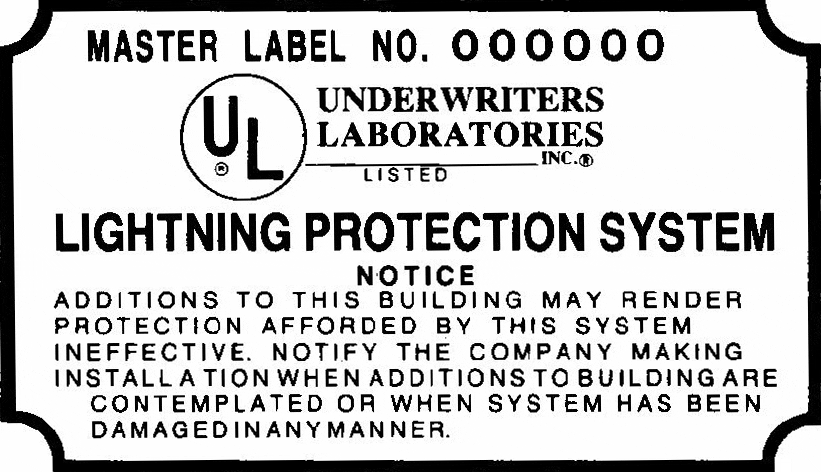
Lightning protection systems are examined and certified by Underwriters Laboratories, Inc. Be sure your installer is listed by UL and that a Master Label application is submitted to UL for your installation.
There are other listing and certifying agencies as well, including the Lightning Protection Institute (LPI) and the National Fire Protection Association (NFPA).
Verify that your Lightning Protection System Installer is LPI-certified and your Lightning Protection System Components are UL-Listed
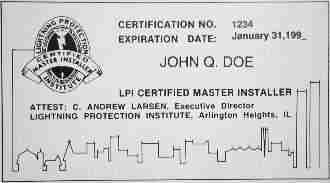
The Lightning Protection Institute certifies Journeyman and Master Installers and Professional Design/Inspectors for lightning protection systems.
These professionals pass a series of tests and are re-tested annually.
[Click to enlarge any image]
LPI-certified professionals are provided with an identification card, or you can contact the LPI to ask about someone's credentials by calling the Lightning Protection Institute at 800-488-6864.
Underwriters Laboratory, UL To verify that a lightning protection system or component is is UL-Listed or to obtain further information call the Follow-Up Services Department at the Underwriters Laboratory, UL, 1285 Walt Whitman Road, Melville, NY 11747 516/271-6200.
Readers can check for a UL Listing certificate on any lightning protection equipment you are considering from any manufacturer by contacting UL by email: LightningProtection@ul.com or by telephone 1.877.854.3577 or at UL LLC, 333 Pfingsten Road, Northbrook, IL 60062
UL has other offices in Northbrook, IL, Santa Clara, CA, and Research Triangle Park, NC and in Australia
Lightning System Code & Design References
- ARP5412, Aircraft Lightning Environment and Related Test Waveforms, Warrendale, PA: SAE, 2005.
- DIRECTORY of UL-CERTIFIED LIGHTNING SYSTEM INSPECTORS [PDF] retrieved 2017/05/13, original source: http://services.ul.com/service/lightning-protection-systems/
- NFPA 780, Standard for the Installation of Lightning Protection Systems, National Fire Protection Association, Quincy, MA 2000, 2004.
- NFPA 70, National Electrical Code, National Fire Protection Association, Quincy, MA 1999, 2005.
- NFPA 54, National Fuel Gas Code, National Fire Protection Association, Quincy, MA 1999, 2002, 2006.
- Appendix I of the National Fire Protection Association's Lightning Protection Code, NFPA #780. The guide considers type of structure, type of construction, structure location, topography, occupancy, contents and lightning frequency. Contact NFPA, Batterymarch Park, Quincy, MA 02269 617-770-3000.
- Lightning Protection Institute, (LPI) 3365 N. Arlington Heights Rd., Suite J., Arlington Heights IL 60004 USA, Website: https://lightning.org/
To join the Lightning Protection Institute, (LPI) see this web page: https://lightning.org/memberships/ where you can join in one of several membership categories. - Underwriters Laboratory Standard UL96A.
These requirements cover the installation of lightning protection systems on all types of structures other than structures used for the production, handling, or storage of ammunition, explosives, flammable liquids or gases, and other explosive ingredients including dust. These requirements apply to lightning protection systems that are complete and cover all parts of a structure.
Partial systems are not covered by this standard. These requirements do not cover the installation of lightning protection systems for electrical generating, distribution, or transmission systems. These requirements do not cover lightning protection components, which are covered by the Standard for Lightning Protection Components, UL 96. - Underwriters Laboratory Standard UL96: These requirements cover lightning protection components for use in the installation of complete systems of lightning protection on buildings and structures. These requirements do not cover the installation of lightning protection components. Products of this type are covered by the Standard for Installation Requirements for Lightning Protection Systems, UL 96A.
- UL's LIGHTNING PROTECTION CERTIFICATION SERVICES: Installers and Contractors [PDF], retrieved 2017/05/13, original source: https://www.ul.com/wp-content/uploads/2014/04/LightningProtection_Contractor_aus_4.pdf
...
Continue reading at LIGHTNING PROTECTION SYSTEM DESIGN or select a topic from the closely-related articles below, or see the complete ARTICLE INDEX.
Or see LIGHTNING PROTECTION SYSTEM CERTIFICATION FAQs questions and answers posted originally at this page
Or see these
Recommended Articles
- GAS PIPING, FLEXIBLE CSST for a discussion of lightning protection needed for flexible stainless steel tubing used as gas piping
- LIGHTNING BOLT FORMATION & MOVEMENT
- LIGHTNING PROTECTION SYSTEMS - home
- LIGHTNING PROTECTION SYSTEMS, DEFINITIONS
- LIGHTNING PROTECTION, HOW IT WORKS
- LIGHTNING PROTECTION SYSTEM DAMAGED, UNSAFE
- LIGHTNING PROTECTION SYSTEM CERTIFICATION
- LIGHTNING PROTECTION SYSTEM DESIGN
- LIGHTNING PROTECTION for TREES
- LIGHTNING PROTECTION, HIDDEN
- LIGHTNING STRIKE RISK ASSESSMENT
- LIGHTNING, AVOID BEING STRUCK BY
- LIGHTNING STRIKES SMALL BOAT
- SAFETY for ELECTRICAL INSPECTORS
Suggested citation for this web page
LIGHTNING PROTECTION SYSTEM CERTIFICATION at InspectApedia.com - online encyclopedia of building & environmental inspection, testing, diagnosis, repair, & problem prevention advice.
Or see this
INDEX to RELATED ARTICLES: ARTICLE INDEX to LIGHTNING PROTECTION SYSTEMS
Or use the SEARCH BOX found below to Ask a Question or Search InspectApedia
Ask a Question or Search InspectApedia
Try the search box just below, or if you prefer, post a question or comment in the Comments box below and we will respond promptly.
Search the InspectApedia website
Note: appearance of your Comment below may be delayed: if your comment contains an image, photograph, web link, or text that looks to the software as if it might be a web link, your posting will appear after it has been approved by a moderator. Apologies for the delay.
Only one image can be added per comment but you can post as many comments, and therefore images, as you like.
You will not receive a notification when a response to your question has been posted.
Please bookmark this page to make it easy for you to check back for our response.
Our Comment Box is provided by Countable Web Productions countable.ca
Citations & References
In addition to any citations in the article above, a full list is available on request.
- Portions of this information are based on UL publication 200-81 11/87 and other local service company information about lightning protection systems and lightning strike hazards.
- Special thanks to Associated Lightning Rod Company, Cooper Road Box 329A, Millerton NY who has been contributing technical content in presentations to NY ASHI home inspectors since 1996. Some of that information [on lightning system material and installation details] was edited for clarity. ALRCi can be reached at 518-789-4603, 845-373-8309, 860-364-1498 and will inspect your lightning protection system at no charge. [We have no financial nor any other business relationship with any company or product discussed at this website--DF]
- For more details on how lightning protection systems work, see Lightning Protection from Pacific Electric and Gas Company, and Electrical System Grounding and Lightning Protection, Engineering Technical Letter 90-6, Department of the Air Force, HQ USAF.
- Lightning strike risk assessment: for the full body of this excellent article which summarizes recent opinions about lightning strike risk assessment and safe practices for individuals or groups needing to avoid being struck by lightning, see Updated Recommendations for Lightning Safety - 1998 Ronald L. Holle and Raul E. Lopez from National Severe Storms Laboratory, NOAA and Norman, Oklahoma, Christoph Zimmermann Global Atmospherics, Inc. Tucson, Arizona
- As we indicated in an original version of this article, a lightning strike risk assessment guide can be found in Appendix I of the National Fire Protection Association's Lightning Protection Code, NFPA #780. The guide considers type of structure, type of construction, structure location, topography, occupancy, contents and lightning frequency. Contact NFPA, Batterymarch Park, Quincy, MA 02269 617-770-3000.
- Lightning Protection Institute, 3365 N. Arlington Heights Rd., Suite J., Arlington Heights IL 60004
- Underwriters Laboratory Standard UL96A. These requirements cover the installation of lightning protection systems on all types of structures other than structures used for the production, handling, or storage of ammunition, explosives, flammable liquids or gases, and other explosive ingredients including dust. These requirements apply to lightning protection systems that are complete and cover all parts of a structure. Partial systems are not covered by this standard. These requirements do not cover the installation of lightning protection systems for electrical generating, distribution, or transmission systems. These requirements do not cover lightning protection components, which are covered by the Standard for Lightning Protection Components, UL 96.
- Underwriters Laboratory Standard UL96: These requirements cover lightning protection components for use in the installation of complete systems of lightning protection on buildings and structures. These requirements do not cover the installation of lightning protection components. Products of this type are covered by the Standard for Installation Requirements for Lightning Protection Systems, UL 96A.
- Cianos, N. and Pierce, E.T., A Ground-Lightning Environment for Engineering Usage, Menlo Park, California: Stanford Research Institute, 1972. Figure 25, pp. 66.
- Crouch, K.E., Lightning Technologies Incorporated, Pittsfield, MA 2007
- Kithil, R., Lightning Protection for Engineers, Louisville, CO: National Lightning Safety Institute, 2005.
- Martzloff, F. D. and Crouch, K. E., “Coordination de la Protection Contre les Surtensions dans les Reseaux Basse Tension Residentiels”, Proceedings 1978 IEEE Canadian Conference on Communications and Power, 78CH1373-0, pp. 451-454.
- "Lightning Awareness," Gerry Schulte, BMW ON magazine, June 2007 pp. 58-60, provided some technical details about lightning, and refers readers to www.lightningsafety.noaa.gov/outdoors.htm
- Anderson, R.B. and Eriksson, A.J., Lightning Parameters for Engineering Applications, Suceava, Roumania: Colloquium and Study Committee Meeting, Cigre Study Committee 33, 1979.
- Our recommended books about building & mechanical systems design, inspection, problem diagnosis, and repair, and about indoor environment and IAQ testing, diagnosis, and cleanup are at the InspectAPedia Bookstore. Also see our Book Reviews - InspectAPedia.
- Armor Lightning Protection Inc Manchester Center, VT, 802-375-0266 state-of-the-art lightning protection and surge protection for residential and commercial buildings in Vermont, New England, and throughout the Northeast
- Associated Lightning Rod Company, Inc., Box 329A, Cooper Road, Millerton, NY 12546 914/373-8309 518/789-4603
- A-C Lightning Security, Inc., 2100 East First St., PO Box 329, Maryville MO 64468 816-582-8115 800-821-5575 816-562-2932. In New York, Hudson Valley, contact Christensen Electrical Power Systems, Richard G. Christensen, 518-537-4128.
- Lightning Eliminators & Consultants6687 Arapahoe Road Boulder, CO 80303 (303) 447-2828. "Engineering Solutions For Lightning, Grounding and Surge Protection Worldwide Since 1971"
- Electrical EINET
- Lightning Protection for Facilities, Dr. Bruce Gabrielson, Robert B. Marcus, Published and presented: EMCEXPO92, Washington D.C.
- MIT's Electrical Safety Files
- Lightning Protection for Workers What to Do if You're Outside in a Lightning Storm - Center to Protect Workers' Rights (PDF)
- 1998 and Current Lightning Protection Conferences & Exhibitions
- Lightning Risk and Hazard Analysis Measurement from the National Lightning Safety Institute (NLSI).
- "Lightning Fatalities, Injuries, and Damage Reports in the United States from 1959-1994", E. Brian Curran, Ronald L. Holle, Raul E. Lopez, NOAA Technical Memorandum NWS SR-193 October 1997
- UL - Underwriters Labs Lightning equipment certification program. "Underwriters Laboratories Inc. (UL) has been testing and certifying lightning protection equipment since 1908. UL issues certificates of conformance for systems, inspecting system components and checking completed installations. Installations are required to comply with UL's internationally recognized Standards for lightning protection systems. Manufacturers, suppliers and installers demonstrate their commitment to safety by building, selling and installing only those lightning protection products that pass UL's rigorous testing." -- (Op.Cit.)
- In addition to citations & references found in this article, see the research citations given at the end of the related articles found at our suggested
CONTINUE READING or RECOMMENDED ARTICLES.
- Carson, Dunlop & Associates Ltd., 120 Carlton Street Suite 407, Toronto ON M5A 4K2. Tel: (416) 964-9415 1-800-268-7070 Email: info@carsondunlop.com. Alan Carson is a past president of ASHI, the American Society of Home Inspectors.
Thanks to Alan Carson and Bob Dunlop, for permission for InspectAPedia to use text excerpts from The HOME REFERENCE BOOK - the Encyclopedia of Homes and to use illustrations from The ILLUSTRATED HOME .
Carson Dunlop Associates provides extensive home inspection education and report writing material. In gratitude we provide links to tsome Carson Dunlop Associates products and services.
 | HOME | ABOUT | ASK a QUESTION | CONTACT | CONTENT USE POLICY | DESCRIPTION | POLICIES | PRIVACY | |
| © 2024 - 1985 Publisher InspectApedia.com - Daniel Friedman | |||||||||