
InspectAPedia® FREE Encyclopedia of Building & Environmental Construction, Diagnosis, Maintenance & Repair |
Question? Just ask us! InspectAPedia
|
 Safety Tips to Avoid Being Struck by Lightning
- POST a QUESTION or COMMENT about avoiding being struck by lightning
Howw to avoid being stuck by lightning:
This article cites opinions from experts on what to do to reduce the chances of personal injury by lightning during a storm - how to avoid being struck by lightning while outdoors during a storm or if you are indoors in a building lacking lightning protection.
This article series describes common lightning protection systems, certification, installation, and lightning protection system inspection.
We provide information about lightning strikes, lightning hazards, related equipment, sources of lightning protection system installers, and lightning strike risk assessment
InspectAPedia tolerates no conflicts of interest. We have no relationship with advertisers, products, or services discussed at this website.
How to Avoid Being Struck by Lightning
 This text cites opinions about what an individual should do to reduce the chances of being struck by lightning if
one is caught outdoors during a lightning storm. (Most of the articles at this
website describe lightning protection systems for buildings, certification, installation, and lightning protection system inspection.)
This text cites opinions about what an individual should do to reduce the chances of being struck by lightning if
one is caught outdoors during a lightning storm. (Most of the articles at this
website describe lightning protection systems for buildings, certification, installation, and lightning protection system inspection.)
My opinion is that specific details such as being in the wrong place at the wrong time or conducting yourself improperly during a storm can significantly increase the chances of being injured by lightning.
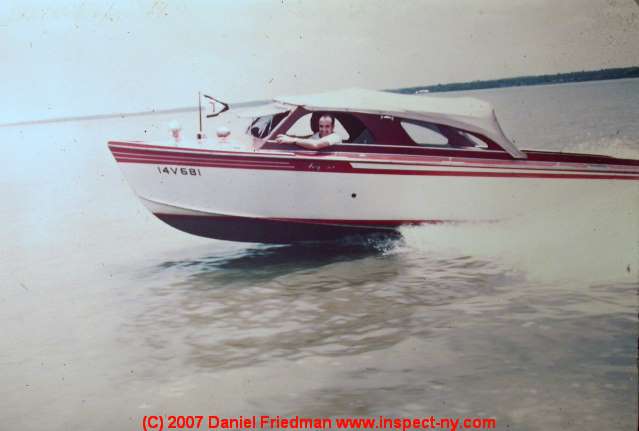
The boat shown in the photo was being driven by my father.
When this Higgins speedboat was sold, the new owner tried to beat an oncoming storm as he fled across the wide expanse of the Rapphannock. The boat was struck by lightning, its occupants never found, and pieces of the craft were located floating in one of the freshwater creeks feeding the river. Details are
at LIGHTNING STRIKES SMALL BOAT
[Click to enlarge any image]
Holle (2005) points out that a significant factor in the risk of being struck by lighning is simply being present outside in the open during a thunderstorm. Simply standing on wet ground in the open during a thunderstorm can be fatal. Lightning strikes, possibly a single bolt, killed more than 300 reindeer who were simply standing iin the open on wet rocky ground in Norway in August 2016. - Cristancho 2017 & Yin 2018
Watch out: it's an inaccurate myth that lightning never strikes the same place twice. Some inspection clients have informed me as well that the old adage "lightning does not strike twice in the same place" is incorrect. Some particular homes, trees, or locations receive frequent lightning strikes.
Those are places to avoid during a thunderstorm, and for buildings or equipment at risk of lightning damage, those are places that merit installation of a lightning protection system.
Simple Basic Advice on How to Avoid Being Hit by Lightning
 When you hear thunder, seek shelter indoors, go in before the storm, stay in afterwards: don't wait until the rain or thunderstorm has reached your location.
If you hear lightning, even before you see the storm, it may be as much as 10 miles away. But lightning strikes can occur
before you ever see the storm. "Blue sky lightning" is equally dangerous so don't wait for the rain to start to go indoors.
When you hear thunder, seek shelter indoors, go in before the storm, stay in afterwards: don't wait until the rain or thunderstorm has reached your location.
If you hear lightning, even before you see the storm, it may be as much as 10 miles away. But lightning strikes can occur
before you ever see the storm. "Blue sky lightning" is equally dangerous so don't wait for the rain to start to go indoors.
Similarly, since more than half of lightning strike deaths occur after the storm has gone by, don't rush outside right after the rain has passed.
Additional advice from several sources of information about lightning safety is provided just below.
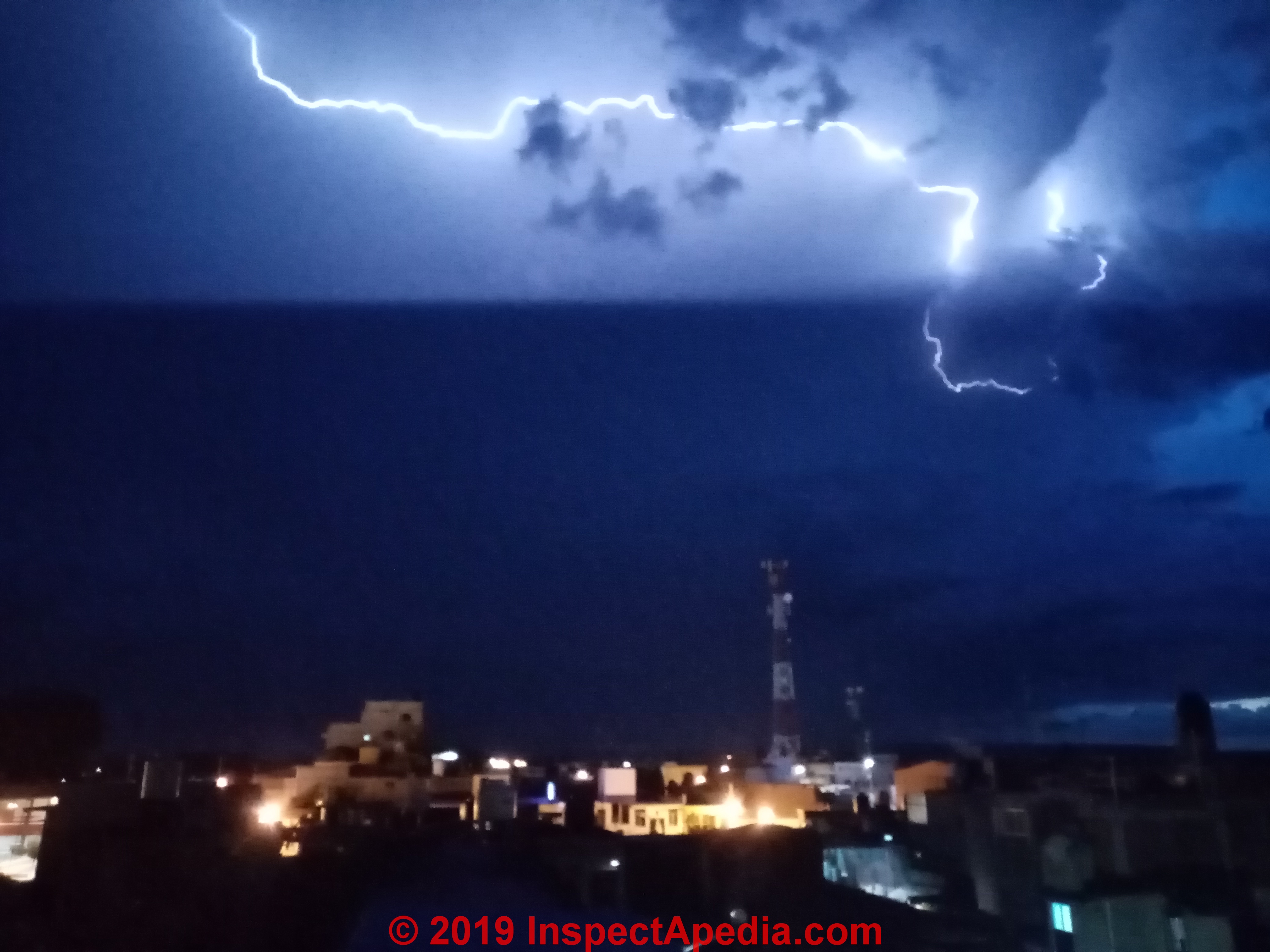
Photo: horizontal and vertical lightning bolts over a city in central Mexico, courtesy of Inspectapedia.com contributor Isabel Sanchez-Luna.
Opinions on what to do in a thunderstorm to avoid being hit by lightning vary
"Although the scientific understanding of lightning has advanced significantly in the last few decades (Krider 1996), a consistent match between basic science and applications to safety had not been made.
For example, NOAA (1992) said to squat on the balls of your feet and minimize contact with the ground, while NOAA (1985) recommended dropping to the knees during the lightning threat, and NOAA (1970) suggested dropping to the ground.
Concerning when to reach a safe location, NOAA (1992) recommended going to a safe location at the first sound of thunder, NOAA (1985) was not specific about when to go to a safe place, and NOAA (1970) made no mention of this decision process. Similar variations can be found in these and many other publications regarding additional issues such as medical and first aid approaches to lightning victims." -- Quotation Holle/Lopez.
Advice from the Lightning Protection Institute (LPI) on lightning safety during storms
Consumer pamphlets distributed by the Lightning Protection Institute include this advice:
Lightning safety while indoors during a thunderstorm
If your building is not protected by a lightning protection system, LPI advises:
- Stay away from windows and doors
- Stay away from electrical equipment and appliances such as hairdryers, curling irons (other electrical plug-in devices that you might be touching)
- Do not attempt to unplug TV's, stereos, or computers during a storm. [Presumably you might be struck at the very moment of handling the equipment or its wiring. Unplugging equipment well in advance of a coming storm would most likely be much safer--DF]
- Don't touch plumbing fixtures like sinks, bathtubs, faucets, piping
- Stay off of the telephone except for emergency calls
Lightning safety while outdoors during a thunderstorm
If you are caught outside during a storm and cannot reach a safe building or a hard-topped automobile, LPI has some advice about what to do and what not to do:
- Stay in low areas - avoid areas that are higher than the surrounding landscape
- Stay away from trees - do not use a tree as shelter
- Stay away from metal objects - keep off of bicycles, motorcycles, golf carts
- Stay away from tall objects - like fences, poles, power lines, towers
- Spread out - if you are in a group of people, don't all stand together in a huddle
- Crouch down - if you feel a tingling and your hair stands on end, lightning may be about to strike! Immediately crouch down. Do not lie down. Do not place your hands on the ground.
More lightning safety advice for what to do if you're caught outdoors is just below where I report the advice from UL and add comments from other sources --DF.
Advice from Underwriters Laboratories on Lightning Safety during Storms
UL advises six steps to avoid being struck by lightning: [Bracketed comments are added information gleaned from other sources --DF].
- Go indoors in a large or metal frame building, preferably one which has lightning protection installed
- Avoid high areas where you will be the highest object. As stated by LPI, UL adds, Crouch down - if you feel a tingling and your hair stands on end, lightning may be about to strike! Immediately crouch down. Do not lie down. Do not place your hands on the ground. Put your hands on your knees. [If you seek shelter in a ditch, don't lie down in it and don't seek shelter in a wet or flooding ditch, just a dry one!--DF]
- Stay off of the lake, the tractor, etc.: lakes, beaches, open water, fishing from a boat or dock, riding golf carts, operating farm equipment,
bicycles, motorcycles, even riding in a convertible can be dangerous. [Metal-roofed automobiles are usually good protection--DF] If you are riding
a motorcycle down the highway in a thunderstorm, take shelter in a tunnel, or in emergency, even in a ditch or cave if there is no better location.
[Motorcycle riders may seek shelter from lightning strikes under an overpass or bridge if there is no nearby building available, but don't lean against concrete or steel pillars as they may end up conducting a lightning bolt to earth (and you)! Motor cycle riders who ride during thunderstorms should see "Lightning Awareness," by Gerry Schulte, and appearing in the BMW ON magazine, June 2007 --DF] linked atReferences or Citations at the end of this page. - If caught outside on high ground or in the open, go to a low area and stay away from trees, particularly isolated trees. [Stay away from trees at a horizontal distance of at least twice that of the height of the tree.
- Avoid fences, poles, trees or other electrically conductive objects as they can send out "side flashes" during a lightning strike.
- Indoors do not: stand by open windows or doors, near TVs, nor near large metal objects like sinks, tubs, radiators, stoves, refrigerators. Avoid using small electrical appliances like toasters, radios, hair dryers.
- [Added-DF: Metal objects which you may be carrying such as metal frame backpacks or golf clubs increase the chances of being stuck by lightning or of being burned by a strike or nearby strike and a side-flash. Take off such items and stay at least 50 feet from them.]
First aid for lightning strike victims
This is very basic advice and does not address CPR training or other levels of expertise.
- If more than one rescuer is present or if you have a cell phone, call 911 for emergency assistance immediately
- Start mouth-to-mouth resuscitation
- If the victim does not have a pulse, start cardiac compressions.
- If the victim is cold and wet, put them on a blanket or cover to insulate them from the ground and to reduce the risk of hypothermia.
Report on Lightning Strike Catastrophes for Small Boats on Open Water
Stay off of open water: OPINION by DF: Living on the Rappahannock river in Virginia [photo] we had heard of people who were killed by lighting.
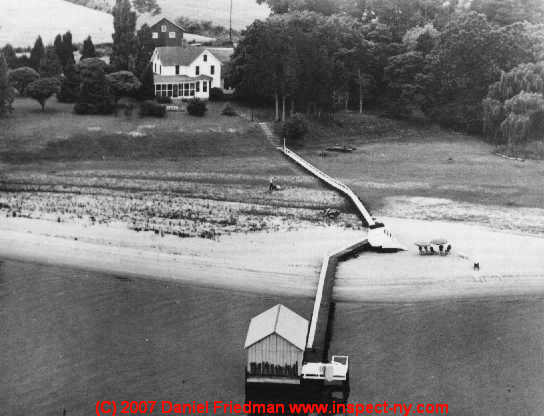
A case involving my Dad's speedboat shown here ended in tragedy in Virginia in 1950 [the photograph was taken in 1949]: a neighbor who had purchased my dad's Higgins speedboat came to take delivery. The new owner was struck by lightning while on the water.
Research on Lightning Strikes, Protection, Animal Deaths
- Bernstein, Theodore. "Effects of electricity and lightning on man and animals." Journal of Forensic Science 18, no. 1 (1973): 3-11.
- Cristancho, C. Jorge Alejandro, Holman Suárez, Yeison Urbano, and Francisco Román. "Fatal livestock lightning accident in Colombia." In Lightning Protection (XIV SIPDA), 2017 International Symposium on, pp. 295-298. IEEE, 2017.
Abstract:
Lightning-caused accidents with multiple fatalities in livestock and other four-legged animal are informed by the media every year, frequently without any technical point of view, all around the world. This paper reports a lightning accident in Los Llanos, eastern plains region of Colombia, related to the death of a herd of 83 cattle occurred on May 2013.
The relative localization and a description of the case scenario in which the cattle were sheltering from the rain on a scrub under some trees is presented. From the lightning data collected for the years 2012 to 2016, the incident area has an average lightning stroke density of 4 to 16 flashes per square kilometer.
The analysis of this type of accidents would help to develop and improve protection systems for livestock against lightning currents and for insurance companies to assess livestock farming lightning risks and claim investigations. - Elsom, D. M. "Deaths and injuries caused by lightning in the United Kingdom: analyses of two databases." Atmospheric Research 56, no. 1-4 (2001): 325-334.
Abstract:
Two databases of incidents in which lightning struck people, either directly or indirectly, are examined.
Analyses of TORRO's UK database of lightning injuries and deaths for the period from 1993 to 1999 reveal that, on average, 49 people are struck by lightning each year. Approximately one half of the lightning incidents affecting people happened inside a building, with one quarter of indoor incidents involving the telephone.
The majority of all people struck by lightning experience only minor injuries. A minority suffer severe effects (e.g. full thickness burns and/or require resuscitation) and, on average, three people are killed each year. With a UK population of around 58.2 million the risk of being struck by lightning (indoors and outdoors combined) is one person in 1.2 million and the risk of being struck and killed by lightning is one person in 19 million.
Expressed in a different way, the average annual number of people struck by lightning per million people is 0.84 and the average annual number of deaths caused by lightning per million people is 0.05.
Based on records of the total number of cloud-to-ground lightning strikes, an incident in which one or more persons are struck by lightning occurs, on average, approximately every 12,000 strikes. A lightning incident in which someone is killed happens, on average, approximately every 100,000 strikes. All the fatalities during 1993 to 1999 occurred outdoors.
Analyses of the number of lightning fatalities in England and Wales (in which 88% of the UK population live currently), as recorded on death certificates since 1852, reveal that lightning fatalities have fallen dramatically during the past century and a half. The annual average number of fatalities each half century has decreased from 19 for the period 1852 to 1899, through 12 for the period from 1900 to 1949, to five for the period 1950 to 1999. Males accounted for four out of every five deaths. - Holle, Ronald L., Raúl E. López, and Bradley C. Navarro. "Deaths, injuries, and damages from lightning in the United States in the 1890s in comparison with the 1990s." Journal of Applied Meteorology 44, no. 10 (2005): 1563-1573.
Abstract:
A reduction by a factor of 10 in the population-weighted rate of lightning-caused deaths over the last century has been determined in several previous studies.
The reasons have been attributed to a number of factors, but none have been quantified in detail with a large dataset. Several thousand lightning-caused deaths, injuries, and reports of property damage in the United States from 1891 to 1894 were analyzed manually from descriptions provided by an 1895 data source.
A similar manual analysis was made of information in the NOAA publication Storm Data 100 yr later, from 1991 to 1994. Comparisons show that the decrease in lightning risk to people coincides with a shift in population from rural to urban regions. Major changes in the types of property damaged by lightning between the two periods 100 yr apart are also shown.
In addition, the results identify significant shifts in the kinds of incidents in which people and objects are impacted by lightning. This information can help in the development of better guidelines for lightning safety and education. - Hoole, P. R. P., M. R. M. Sharip, J. Fisher, K. Pirapaharan, Norhuzaimin Julai, Shirley Anak Rufus, Shafrida Sahrani, and S. R. H. Hoole. "Lightning Protection of Aircraft, Power Systems and Houses Containing IT Network Electronics." Journal of Telecommunication, Electronic and Computer Engineering (JTEC) 9, no. 3-10 (2017): 1-7.
- Yin, Steph, "Making a Laboratory of Reindeer Carcasses", The New York Times, 21 August 2018 p. D2.
...
Continue reading at LIGHTNING STRIKES SMALL BOAT or select a topic from the closely-related articles below, or see the complete ARTICLE INDEX.
Or see these Lightning Strike Protection System Articles
- LIGHTNING BOLT FORMATION & MOVEMENT
- LIGHTNING PROTECTION SYSTEMS - home
- LIGHTNING PROTECTION SYSTEMS, DEFINITIONS
- LIGHTNING PROTECTION, HOW IT WORKS
- LIGHTNING PROTECTION SYSTEM DAMAGED, UNSAFE
- LIGHTNING PROTECTION SYSTEM CERTIFICATION
- LIGHTNING PROTECTION SYSTEM DESIGN
- LIGHTNING PROTECTION for TREES
- LIGHTNING PROTECTION, HIDDEN
- LIGHTNING STRIKE RISK ASSESSMENT
- LIGHTNING, AVOID BEING STRUCK BY
- LIGHTNING DAMAGE to ELECTRICAL SYSTEM
- LIGHTNING STRIKES SMALL BOAT
Suggested citation for this web page
LIGHTNING, AVOID BEING STRUCK BY at InspectApedia.com - online encyclopedia of building & environmental inspection, testing, diagnosis, repair, & problem prevention advice.
Or see this
INDEX to RELATED ARTICLES: ARTICLE INDEX to LIGHTNING PROTECTION SYSTEMS
Or use the SEARCH BOX found below to Ask a Question or Search InspectApedia
Ask a Question or Search InspectApedia
Try the search box just below, or if you prefer, post a question or comment in the Comments box below and we will respond promptly.
Search the InspectApedia website
Note: appearance of your Comment below may be delayed: if your comment contains an image, photograph, web link, or text that looks to the software as if it might be a web link, your posting will appear after it has been approved by a moderator. Apologies for the delay.
Only one image can be added per comment but you can post as many comments, and therefore images, as you like.
You will not receive a notification when a response to your question has been posted.
Please bookmark this page to make it easy for you to check back for our response.
Our Comment Box is provided by Countable Web Productions countable.ca
Citations & References
In addition to any citations in the article above, a full list is available on request.
- Isabel Sanchez Luna is an engineer who studied environmental enginnering at the University of Guanajuato, Guanajuato, Mexico. Ms. Sanchez-Luna interned at water and wastewater treatment facilities, has worked as a consulting environmental engineer at livestock abbatoir facilities (pig slaughterhouse) in Penjamo, Mexico, and is presently employed as an engineer in the automotive industry.
She has assisted in air and water quality studies & reports conducted under the aegis of InspectApedia.com beginning in 2012. Ms. Sanchez can be contacted through the website editor using the CONTACT links found on our web pages. - Portions of this information are based on UL publication 200-81 11/87 and other local service company information about lightning protection systems and lightning strike hazards.
- Special thanks to Associated Lightning Rod Company, Cooper Road Box 329A, Millerton NY who has been contributing technical content in presentations to NY ASHI home inspectors since 1996. Some of that information [on lightning system material and installation details] was edited for clarity. ALRCi can be reached at 518-789-4603, 845-373-8309, 860-364-1498 and will inspect your lightning protection system at no charge. [We have no financial nor any other business relationship with any company or product discussed at this website--DF]
- For more details on how lightning protection systems work, see Lightning Protection from Pacific Electric and Gas Company, and Electrical System Grounding and Lightning Protection, Engineering Technical Letter 90-6, Department of the Air Force, HQ USAF.
- Lightning strike risk assessment: for the full body of this excellent article which summarizes recent opinions about lightning strike risk assessment and safe practices for individuals or groups needing to avoid being struck by lightning, see Updated Recommendations for Lightning Safety - 1998 Ronald L. Holle and Raul E. Lopez from National Severe Storms Laboratory, NOAA and Norman, Oklahoma, Christoph Zimmermann Global Atmospherics, Inc. Tucson, Arizona
- As we indicated in an original version of this article, a lightning strike risk assessment guide can be found in Appendix I of the National Fire Protection Association's Lightning Protection Code, NFPA #780. The guide considers type of structure, type of construction, structure location, topography, occupancy, contents and lightning frequency. Contact NFPA, Batterymarch Park, Quincy, MA 02269 617-770-3000.
- Lightning Protection Institute, 3365 N. Arlington Heights Rd., Suite J., Arlington Heights IL 60004
- Underwriters Laboratory Standard UL96A. These requirements cover the installation of lightning protection systems on all types of structures other than structures used for the production, handling, or storage of ammunition, explosives, flammable liquids or gases, and other explosive ingredients including dust. These requirements apply to lightning protection systems that are complete and cover all parts of a structure. Partial systems are not covered by this standard. These requirements do not cover the installation of lightning protection systems for electrical generating, distribution, or transmission systems. These requirements do not cover lightning protection components, which are covered by the Standard for Lightning Protection Components, UL 96.
- Underwriters Laboratory Standard UL96: These requirements cover lightning protection components for use in the installation of complete systems of lightning protection on buildings and structures. These requirements do not cover the installation of lightning protection components. Products of this type are covered by the Standard for Installation Requirements for Lightning Protection Systems, UL 96A.
- "Lightning Awareness," Gerry Schulte, BMW ON magazine, June 2007 pp. 58-60, provided some technical details about lightning, and refers readers to www.lightningsafety.noaa.gov/outdoors.htm
- Our recommended books about building & mechanical systems design, inspection, problem diagnosis, and repair, and about indoor environment and IAQ testing, diagnosis, and cleanup are at the InspectAPedia Bookstore. Also see our Book Reviews - InspectAPedia.
- Armor Lightning Protection Inc Manchester Center, VT, 802-375-0266 state-of-the-art lightning protection and surge protection for residential and commercial buildings in Vermont, New England, and throughout the Northeast
- Associated Lightning Rod Company, Inc., Box 329A, Cooper Road, Millerton, NY 12546 914/373-8309 518/789-4603
- A-C Lightning Security, Inc., 2100 East First St., PO Box 329, Maryville MO 64468 816-582-8115 800-821-5575 816-562-2932. In New York, Hudson Valley, contact Christensen Electrical Power Systems, Richard G. Christensen, 518-537-4128.
- Lightning Eliminators & Consultants6687 Arapahoe Road Boulder, CO 80303 (303) 447-2828. "Engineering Solutions For Lightning, Grounding and Surge Protection Worldwide Since 1971"
- Electrical EINET
- Lightning Protection for Facilities, Dr. Bruce Gabrielson, Robert B. Marcus, Published and presented: EMCEXPO92, Washington D.C.
- MIT's Electrical Safety Files
- Lightning Protection for Workers What to Do if You're Outside in a Lightning Storm - Center to Protect Workers' Rights (PDF)
- 1998 and Current Lightning Protection Conferences & Exhibitions
- Lightning Risk and Hazard Analysis Measurement from the National Lightning Safety Institute (NLSI).
- "Lightning Fatalities, Injuries, and Damage Reports in the United States from 1959-1994", E. Brian Curran, Ronald L. Holle, Raul E. Lopez, NOAA Technical Memorandum NWS SR-193 October 1997
- In addition to citations & references found in this article, see the research citations given at the end of the related articles found at our suggested
CONTINUE READING or RECOMMENDED ARTICLES.
- Carson, Dunlop & Associates Ltd., 120 Carlton Street Suite 407, Toronto ON M5A 4K2. Tel: (416) 964-9415 1-800-268-7070 Email: info@carsondunlop.com. Alan Carson is a past president of ASHI, the American Society of Home Inspectors.
Thanks to Alan Carson and Bob Dunlop, for permission for InspectAPedia to use text excerpts from The HOME REFERENCE BOOK - the Encyclopedia of Homes and to use illustrations from The ILLUSTRATED HOME .
Carson Dunlop Associates provides extensive home inspection education and report writing material. In gratitude we provide links to tsome Carson Dunlop Associates products and services.
 | HOME | ABOUT | ASK a QUESTION | CONTACT | CONTENT USE POLICY | DESCRIPTION | POLICIES | PRIVACY | |
| © 2024 - 1985 Publisher InspectApedia.com - Daniel Friedman | |||||||||