
InspectAPedia® FREE Encyclopedia of Building & Environmental Construction, Diagnosis, Maintenance & Repair |
Question? Just ask us! InspectAPedia
|
 Lightning Strikes Small Boat
- POST a QUESTION or COMMENT about lightning strikes on waterways & lightning risks to small boats
Lightning & small boat safety on the Rappahannock river near Dunnsville Virginia:
This article cites further opinions on what to do to reduce the chances of personal injury by lightning during a storm - how to avoid being struck by lightning while outdoors near a river. This article series describes common lightning protection systems, certification, installation, and lightning protection system inspection. We provide information about lightning strikes, lightning hazards, related equipment, sources of lightning protection system installers, and lightning strike risk assessment
InspectAPedia tolerates no conflicts of interest. We have no relationship with advertisers, products, or services discussed at this website.
Lightning Strike Catastrophes for Small Boats on Open Water
Small boat lightning safety advice.
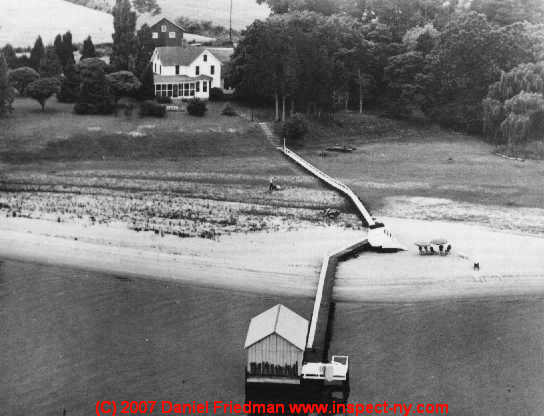
Stay off of open water: OPINION by DF: Living on the Rapphannock river in Virginia [photo] we had heard of people who were killed by lighting.
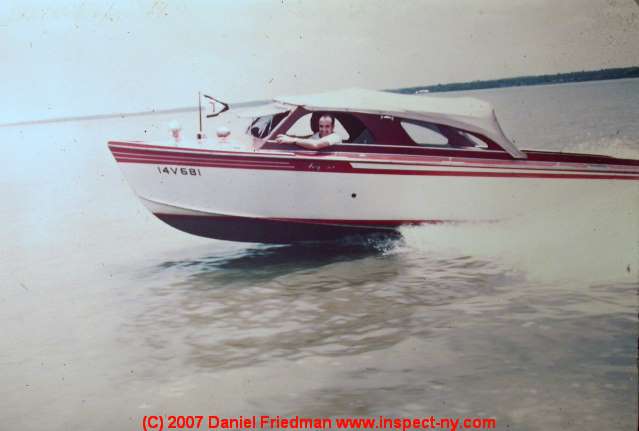
A case close to home and involving the speedboat Teal I, shown here ended in tragedy in 1950 [the photograph was taken in 1949]: a neighbor who had purchased my dad's Higgins speedboat came to take delivery at our home on the Rapphannock river in Dunnsville, Virginia.
[Click to enlarge any image]
The new owner was excited about the Higgins' reputation for speed and handling. This Higgins boat was a plywood-hulled inboard-motor speedboat made famous by its larger cousins such as the PT109 and Higgins' Eureka design landing craft boats that served ably during World War II.
The boater, who lived across the river from us, ignored Dad's advice that he wait with us until a rapidly-approaching storm had passed. Instead the new owner, in a rush to get his new boat home and proud of its speed, insisted on making a dash across the wide river. We watched him cast off and we also watched a wall of rain and storm rush up the river from the Chesapeake bay.
He disappeared from view, roaring East into a wall of black storm front.
The neighbor was never found. Charred portions of the boat were found floating in a freshwater creek across the river on the following day, and it was believed he was struck by lightning while on the water.
Other Boats Named Teal & A Bit of History of Boats named Teal and of Higgins Boats
The original Teal was and remains a duck, (genus Anas) including green-winged, blue-winged, cinnamon, gray, silver, ringed, and Baikal Teal ducks that are found mostly in freshwater areas and who feed on insects at the water surface
Teal I (the Higgins built speed boat, above) was named for our Teal, nee Mathilde, our mom. Dad owned a series of boats carrying that name and running on the Rapphannock except the last, perhaps Teal V (we lost track of the count) which was a cruiser based in Miami, Florida.
Andrew Jackson Higgins' (b1886) boat building business (founded in 1930 as an adjunct to his lumber business and experimenting with plywood) first demonstrated successfully in 1938, a Higgins design for a landing craft, the ramp bow, the Eureka boat became the successful design for LCVPs or "Higgins Boats" used extensively during World War II. [10] Other Higgins designs produced the 78-foot PT gunboats that saw extensive service in the the Mediterranean as well as the Pacific.[11]
Following the end of World War II, Higgins boatbuilding continued to produce a smaller series of plywood-hulled craft known for combining speed, agility, and stability. Dad loved to demonstrate, to the terror of visitors, full-speed U-turns in the Teals. He also "drownproofed" his children by shouting EMERGENCY and tossing us (well not my sister) out of the boat at high speed.
Higgins boats continue to have a following among people who enjoy classic boats - contact the Higgins Classic Boats Association [12]
A modern seventy-foot cruiser, also a Teal, currently provides Hudson River Cruises out of Kingston, New York and in more elegant surroundings than Teal I shown above. Contact: http://www.theteal.com/ Tel: 845-750-6025, Email: info@theteal.com
...
Continue reading at CSST GAS PIPING SAFETY & PROTECTION - lightning protection recommended for CSST gas piping, or select a topic from the closely-related articles below, or see the complete ARTICLE INDEX.
Or see these
Recommended Articles
- BURMA SHAVE - life along the Rappahannock
- LIGHTNING PROTECTION SYSTEMS
Suggested citation for this web page
LIGHTNING STRIKES SMALL BOAT at InspectApedia.com - online encyclopedia of building & environmental inspection, testing, diagnosis, repair, & problem prevention advice.
Or see this
INDEX to RELATED ARTICLES: ARTICLE INDEX to LIGHTNING PROTECTION SYSTEMS
Or use the SEARCH BOX found below to Ask a Question or Search InspectApedia
Ask a Question or Search InspectApedia
Questions & answers or comments about lightning strikes on waterways & lightning risks to small boats.
Try the search box just below, or if you prefer, post a question or comment in the Comments box below and we will respond promptly.
Search the InspectApedia website
Note: appearance of your Comment below may be delayed: if your comment contains an image, photograph, web link, or text that looks to the software as if it might be a web link, your posting will appear after it has been approved by a moderator. Apologies for the delay.
Only one image can be added per comment but you can post as many comments, and therefore images, as you like.
You will not receive a notification when a response to your question has been posted.
Please bookmark this page to make it easy for you to check back for our response.
Our Comment Box is provided by Countable Web Productions countable.ca
Citations & References
In addition to any citations in the article above, a full list is available on request.
- [1] Portions of this information are based on UL publication 200-81 11/87 and other local service company information about lightning protection systems and lightning strike hazards.
- [2] Special thanks to Associated Lightning Rod Company, Cooper Road Box 329A, Millerton NY who has been contributing technical content in presentations to NY ASHI home inspectors since 1996. Some of that information [on lightning system material and installation details] was edited for clarity. ALRCi can be reached at 518-789-4603, 845-373-8309, 860-364-1498 and will inspect your lightning protection system at no charge. [We have no financial nor any other business relationship with any company or product discussed at this website--DF]
- [3] For more details on how lightning protection systems work, see Lightning Protection from Pacific Electric and Gas Company, and Electrical System Grounding and Lightning Protection, Engineering Technical Letter 90-6, Department of the Air Force, HQ USAF.
- [4] Lightning strike risk assessment: for the full body of this excellent article which summarizes recent opinions about lightning strike risk assessment and safe practices for individuals or groups needing to avoid being struck by lightning, see Updated Recommendations for Lightning Safety - 1998 Ronald L. Holle and Raul E. Lopez from National Severe Storms Laboratory, NOAA and Norman, Oklahoma, Christoph Zimmermann Global Atmospherics, Inc. Tucson, Arizona
- [5] As we indicated in an original version of this article, a lightning strike risk assessment guide can be found in Appendix I of the National Fire Protection Association's Lightning Protection Code, NFPA #780. The guide considers type of structure, type of construction, structure location, topography, occupancy, contents and lightning frequency. Contact NFPA, Batterymarch Park, Quincy, MA 02269 617-770-3000.
- [6] Lightning Protection Institute, 3365 N. Arlington Heights Rd., Suite J., Arlington Heights IL 60004
- [7] Underwriters Laboratory Standard UL96A. These requirements cover the installation of lightning protection systems on all types of structures other than structures used for the production, handling, or storage of ammunition, explosives, flammable liquids or gases, and other explosive ingredients including dust. These requirements apply to lightning protection systems that are complete and cover all parts of a structure. Partial systems are not covered by this standard. These requirements do not cover the installation of lightning protection systems for electrical generating, distribution, or transmission systems. These requirements do not cover lightning protection components, which are covered by the Standard for Lightning Protection Components, UL 96.
- [8] Underwriters Laboratory Standard UL96: These requirements cover lightning protection components for use in the installation of complete systems of lightning protection on buildings and structures. These requirements do not cover the installation of lightning protection components. Products of this type are covered by the Standard for Installation Requirements for Lightning Protection Systems, UL 96A.
- [9] "Lightning Awareness," Gerry Schulte, BMW ON magazine, June 2007 pp. 58-60, provided some technical details about lightning, and refers readers to www.lightningsafety.noaa.gov/outdoors.htm
- [10] Dictionary of American Naval Fighting Ships, (8 Vols), U.S. Navy Department, 1971, ASIN: B003T4C87C
- [11] The Higgins 78' PT Boat, PT Boats. Inc. P.O. Box 38070, Germantown, TN, 38183 Tel: (901) 755-8440 , Fax: (901) 751-0522, web search 5/14/12, original source: http://www.ptboats.org/20-01-05-ptboat-006.html
- [12] Higgins Classic Boats Association, P.O. Box 2361, Decatur, GA 30031, website: http://www.wootenmedia.com/sites/hcba3/index.html
- Our recommended books about building & mechanical systems design, inspection, problem diagnosis, and repair, and about indoor environment and IAQ testing, diagnosis, and cleanup are at the InspectAPedia Bookstore. Also see our Book Reviews - InspectAPedia.
- Armor Lightning Protection Inc Manchester Center, VT, 802-375-0266 state-of-the-art lightning protection and surge protection for residential and commercial buildings in Vermont, New England, and throughout the Northeast
- Associated Lightning Rod Company, Inc., Box 329A, Cooper Road, Millerton, NY 12546 914/373-8309 518/789-4603
- A-C Lightning Security, Inc., 2100 East First St., PO Box 329, Maryville MO 64468 816-582-8115 800-821-5575 816-562-2932. In New York, Hudson Valley, contact Christensen Electrical Power Systems, Richard G. Christensen, 518-537-4128.
- Lightning Eliminators & Consultants6687 Arapahoe Road Boulder, CO 80303 (303) 447-2828. "Engineering Solutions For Lightning, Grounding and Surge Protection Worldwide Since 1971"
- Electrical EINET
- Lightning Protection for Facilities, Dr. Bruce Gabrielson, Robert B. Marcus, Published and presented: EMCEXPO92, Washington D.C.
- MIT's Electrical Safety Files
- Lightning Protection for Workers What to Do if You're Outside in a Lightning Storm - Center to Protect Workers' Rights (PDF)
- 1998 and Current Lightning Protection Conferences & Exhibitions
- Lightning Risk and Hazard Analysis Measurement from the National Lightning Safety Institute (NLSI).
- "Lightning Fatalities, Injuries, and Damage Reports in the United States from 1959-1994", E. Brian Curran, Ronald L. Holle, Raul E. Lopez, NOAA Technical Memorandum NWS SR-193 October 1997
- UL - Underwriters Labs Lightning equipment certification program. "Underwriters Laboratories Inc. (UL) has been testing and certifying lightning protection equipment since 1908. UL issues certificates of conformance for systems, inspecting system components and checking completed installations. Installations are required to comply with UL's internationally recognized Standards for lightning protection systems. Manufacturers, suppliers and installers demonstrate their commitment to safety by building, selling and installing only those lightning protection products that pass UL's rigorous testing." -- (Op.Cit.)
- * Safety Hazards and Safe Inspection Procedures for Electrical and Home Inspectors at Residential Electric Panels
- Aluminum Wiring Information WebsiteAluminum Electrical Wiring Hazards and Repairs: in-depth authoritative info, photos, documents including selection of proper vs. ineffective repair methods. E.g.: Ideal 65 "Twister" purple connector fails in field and lab testing with aluminum wire.
- Electrical Panels, How to Inspect in buildings, safety for electrical inspectors, electrical panel, fusing, wiring defects, defective products. Inspection Class Presentation
- Lightning Strike Risk Assessment, Protection Systems & Services
- Multi-wire branch circuit inspection and defects
- Rust and Corrosion in Electrical Panels, A Study and Report on Frequency and Cause for Electrical and Home Inspectors at Residential Electric Panels
- Directory of Home Inspectors accessible via internet
- Electrical System & Wiring Hazard Inspection, Detection, Cause, Remedy, Prevention - Main Electrical Page
- In addition to citations & references found in this article, see the research citations given at the end of the related articles found at our suggested
CONTINUE READING or RECOMMENDED ARTICLES.
- Carson, Dunlop & Associates Ltd., 120 Carlton Street Suite 407, Toronto ON M5A 4K2. Tel: (416) 964-9415 1-800-268-7070 Email: info@carsondunlop.com. Alan Carson is a past president of ASHI, the American Society of Home Inspectors.
Thanks to Alan Carson and Bob Dunlop, for permission for InspectAPedia to use text excerpts from The HOME REFERENCE BOOK - the Encyclopedia of Homes and to use illustrations from The ILLUSTRATED HOME .
Carson Dunlop Associates provides extensive home inspection education and report writing material. In gratitude we provide links to tsome Carson Dunlop Associates products and services.
 | HOME | ABOUT | ASK a QUESTION | CONTACT | CONTENT USE POLICY | DESCRIPTION | POLICIES | PRIVACY | |
| © 2024 - 1985 Publisher InspectApedia.com - Daniel Friedman | |||||||||