
InspectAPedia® FREE Encyclopedia of Building & Environmental Construction, Diagnosis, Maintenance & Repair |
Question? Just ask us! InspectAPedia
|
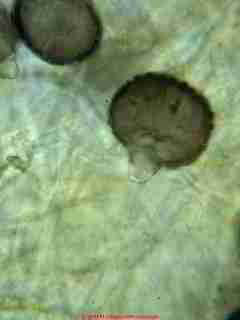 Estimate the Activity of Mold Contamination
- POST a QUESTION or COMMENT about how to determine the age of mold growth or contamination in buildings or on building surfaces
Age of mold contamination in buildings:
This article discusses how we assess the activity or inactivity of mold contamination in a building, what difference that means (or does not) in risk to building occupants, and how we can find evidence suggesting that a given mold contamination case is new, old, or includes both old and new fungal growth.
InspectAPedia tolerates no conflicts of interest. We have no relationship with advertisers, products, or services discussed at this website.
Determining Whether or Not a Mold Test Sample Shows Active Mold Growth
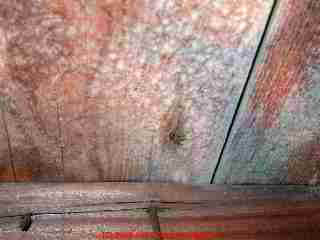 Reader Question: how do we determine whether or not mold in a building is active vs. inactive?
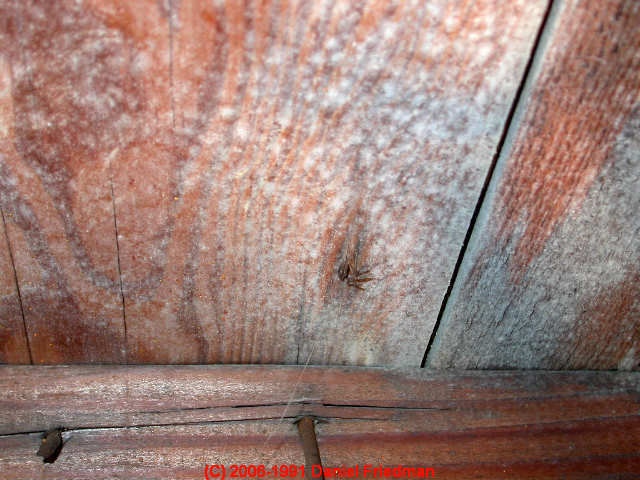
Would you please let me know how an individual (or lab) would test for whether a mold found on attic sheathing is active vs. inactive?
Research on-line has told me the test for active vs inactive is whether it smears when you rub it. Is there a more technical test that can be done? Should a lab be able to tell me this when I supply a sample? - M.O.
Answer:
The question of how we determine whether or not mold in a test sample is "active" is a bit misleading, although some surface test samples of mold do indeed give compelling evidence of recent active fungal growth. Our site photograph of moldy roof sheathing (above left) is an example. Is this mold growth "active" or "inactive", and does activity make much difference in risk to building occupants?
At MOLD AGE, HOW OLD is the MOLD? we discuss visual clues that help determine the age of mold contamination in buildings or on building surfaces. There we explain what dried, desiccated, "old" mold growth may look like on a surface, in a test sample, and under the microscope. Among other factors, we distinguish between
- Dry desiccated fungal material is consistent with prior, currently inactive fungal growth on the surface which was sampled. Very desiccated sample materials are almost certainly not indicators of active current fungal growth.
- Fresh, hydrated fungal hyphae or fungal fruiting bodies (conidiophores or other sporulating bodies) are consistent with ongoing, current fungal growth. Some fungal bodies such as thick woody structures grow much more slowly and if present, almost certainly have been developing over a long time.
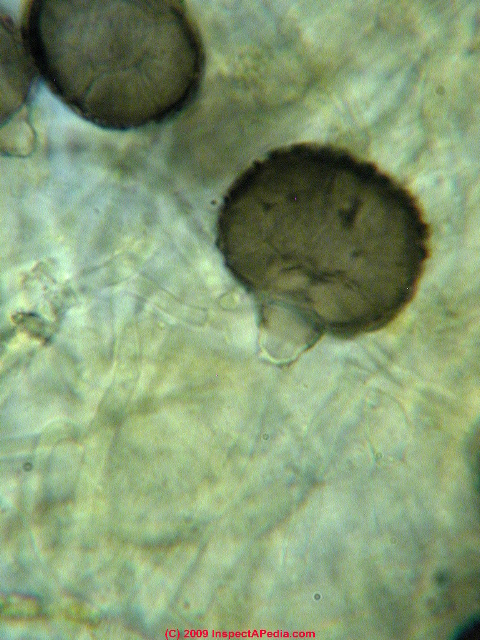
Often we can confirm recent fungal growth in a tape sample by the presence of certain growth structures, hyphal buds, or even the state of a conidiophore.
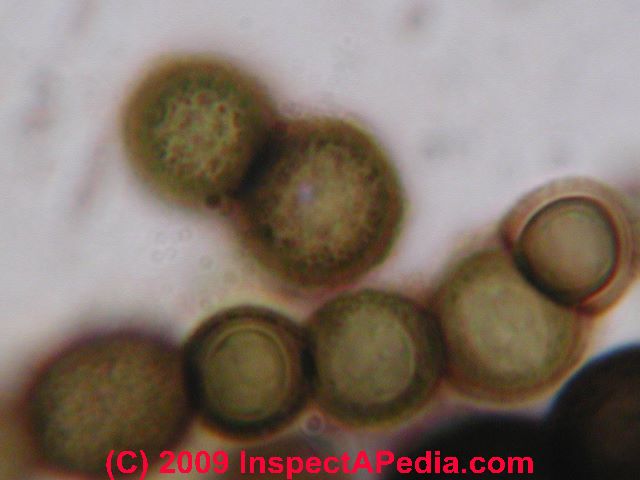
Our photo of Epicoccum sp. fungal spores and hyphae (above left) collected from a building surface shows intact, fragile hydrated complete spores still connected to hyphae - this mold growth is recent and might indeed be considered "active mold growth" as would the intact, hydrated, and budding Aureobasidium pullulans spores shown in our second lab photo (above right).
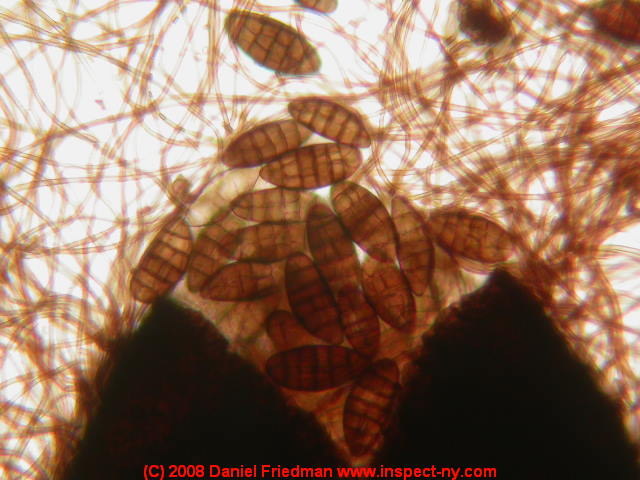
This burst of Pleospora spores is clearly active. Similarly, for certain species that produce long fragile spore chains, the presence of long mold spore chains is certainly indicative of nearby active fungal growth, as these chains break up rapidly into individual spores when airborne.
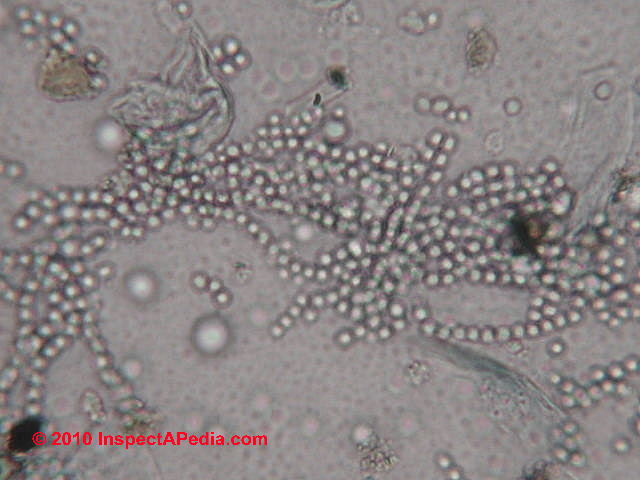
Conversely, highly-dessicated, fractured, or damaged fungal material that lacks budding hyphae or sporulating intact conidiophores are almost certainly "inactive" mold growth in the spot where sampled.
Sources of Error in Estimating Whether or Not Mold Growth in a Building is Active

Watch out: "mold activity" or "mold inactivity" can be misleading conclusions about the risks associated with mold growth in buildings.
The moldy books in a college library (photo at left) were in the opinion of some people "an old inactive mold problem" but when workers began dehumidifying the area in preparation for a mold cleanup, visible clouds of Aspergillus sp. spores were released into the air by small air currents caused by simply walking down the aisle between stacks of books.
- Mold test sample size:
Because a sample represents a small area of a building and of time, and because other materials may be present that the sampler did not see, detect, or test, a single sample is an indicator, not a conclusion about a building's condition. - Multiple mold genera/species:
Next, the conditions that produced fungal growth that was seen and tested mean that building conditions were ripe for mold growth, perhaps on other surfaces or in cavities or in less visible locations.
For example we may see one species of mold on an attic roof underside, say Cladosporium cladosporioides, perhaps even desiccated by the heat of sun beating on the roof, while the conditions that produced that growth also produced a non-visible but more troubling Aspergillus sp. contaminating growth in building insulation in the attic floor.
So at a given time, some mold on building surfaces may be "inactive" while nearby another genera/species may be growing like mad, or releasing spores like mad, i.e. "active". - Dead toxic mold:
Next, we suspect an underlying faulty premise that the salient question is whether or not a fungal growth is active or not in a building. In fact even currently inactive (no apparent recent fungal propagation) fungal presence on a surface can be a hazard since spores and fungal hyphal fragments may be toxic, pathogenic, or allergenic even in that state.
That point remains true even if some misinformed "mold remediator" tries to "kill" the fungus with a fungicide or bleach. - Smearing mold?:
Further, he claim that smearing mold with a finger determines whether or not it is active or not is nonsense. A mold growth on a surface could be very desiccated and may not have actively propagated for a long time but still can be "smeared" with a finger wipe.
But we agree that if you cannot smear suspected-mold or better, if you cannot obtain particles on an adhesive tape sample, then the surface may have been previously cleaned, and what remains may be no more than a cosmetic stain. - Inoculation of mold:
Finally, even if mold is "not actively growing" at the time that a sample is obtained from a surface (or in dust or air), the presence of a large amount of fungal material in a building can lead to rapid mold re growth and propagation when building conditions change to those more conducive to growth of the fungi already present.
All mold is everywhere all the time in the form of spores ready to inoculate a material or surface. So when building conditions are ripe for mold growth, it is likely to occur. Predominantly, it is the building conditions that determine whether or not we will have a building mold problem, not the presence or absence of mold in general.
. But the presence of a large reservoir of pre-existing (inactive) mold can speed both the recurrence and the extent of a future mold contamination. "Inactive" does not mean "non-viable".
Watch out: however: using a swab or culture test for "viable mold" in buildings can give very misleading results since what grows in the culture is what likes the culture, not necessarily what is present or dominant in the building.
See MOLD TESTING METHOD VALIDITY and in
particular Mold Culture Plate Test Errors.
These reasons explain why in addition to testing to confirm the presence of mold growth, and to confirm that it is not simply cosmetic, in cases of possibly costly mold cleanup or diagnosing a possible building contribution to indoor air quality complaints, is important to have an expert perform a competent inspection of the building.
As we explain at MOLD AGE, HOW OLD is the MOLD?, especially in older buildings where there has been a recent sudden leak event associated with mold growth, it is often possible to identify pre-existing mold as well as mold-producing conditions.
In unambiguous cases, the "new" mold associated with the building leak event may, by luck, appear in a limited area of the building which maps the area wet by the recent leak, and separated by distance or building area from other moldy areas which in turn are associated with other building leaks or conditions.
The physical separation of wet areas and wet conditions may be sufficient to make a clear assignment of mold causation in such cases.
In ambiguous cases, there is fresh, active fungal growth, probably associated with a recent leak or flooding event in the building, which has grown entirely or partly overlapping pre-existing mold growth. In this case the assignment of cause and age of mold in the building can be ambiguous. If an insurance claim is involved, insurance company policy details and internal claims adjustment guidelines will determine the extent to which insurance coverage will address building remediation and repair for these overlapped-occurrence mold conditions.
Reader Comments, Questions & Answers About The Article Above
Below you will find questions and answers previously posted on this page at its page bottom reader comment box.
Reader Q&A - also see RECOMMENDED ARTICLES & FAQs
Question: where do I go to find out if my headaches and other problems are due to toxic molds in my home
(July 12, 2015) Jill White said:
I have been mislead by slumlord who kept promising me she would fix the leaking roof and floor plumbing, but now the damage is total
The new management came to say that instead of repairing the home it would be demolished. Are you belongings all tainted with mold/fungi?
Where can I go to get the blood/urine/lab work to find out if my headaches, dizziness, nasal problems, worsening allergies, increased inhaler usage, lack of energy, depression, ect- .is from toxic molds inside and outside my home. Help asap-court with new landlord soon
Reply:
Jill
Outdoor mold is not likely to be a source of medical illness unless someone rubs mold growth in an eye or into an open cut. But high levels of a number of indoor mold contaminants can be a cause of a wide range of health complaints.
Start by checking with your doctor.
Also see MOLD RELATED ILLNESS GUIDE
You'll find an extensive mold-guide-for-renters beginning at RENTERS & TENANTS: MOLD ADVICE & IAQ
You can find a mold doctor at MOLD DOCTORS - ENVIRONMENTAL MEDICINE
...
Continue reading at MOLD AGE, HOW OLD is the MOLD? or select a topic from the closely-related articles below, or see the complete ARTICLE INDEX.
Or see these
Recommended Articles
Suggested citation for this web page
ACTIVITY of MOLD in BUILDINGS at InspectApedia.com - online encyclopedia of building & environmental inspection, testing, diagnosis, repair, & problem prevention advice.
Or see this
INDEX to RELATED ARTICLES: ARTICLE INDEX to MOLD CONTAMINATION & REMEDIATION
Or use the SEARCH BOX found below to Ask a Question or Search InspectApedia
Ask a Question or Search InspectApedia
Try the search box just below, or if you prefer, post a question or comment in the Comments box below and we will respond promptly.
Search the InspectApedia website
Note: appearance of your Comment below may be delayed: if your comment contains an image, photograph, web link, or text that looks to the software as if it might be a web link, your posting will appear after it has been approved by a moderator. Apologies for the delay.
Only one image can be added per comment but you can post as many comments, and therefore images, as you like.
You will not receive a notification when a response to your question has been posted.
Please bookmark this page to make it easy for you to check back for our response.
Our Comment Box is provided by Countable Web Productions countable.ca
Citations & References
In addition to any citations in the article above, a full list is available on request.
- Thanks to reader Mike Olsen for discussing the problem of how a lab can determine whether or not mold in a test sample is active or inactive - June 2010
- Our recommended books about building & mechanical systems design, inspection, problem diagnosis, and repair, and about indoor environment and IAQ testing, diagnosis, and cleanup are at the InspectAPedia Bookstore. Also see our Book Reviews - InspectAPedia.
- "Management of Powdery Mildew, Leveillula taurica, in Greenhouse Peppers," Ministry of Agriculture and Lands, British Columbia - Original source: www.agf.gov.bc.ca/cropprot/peppermildew.htm
- Fifth Kingdom, Bryce Kendrick, ISBN13: 9781585100224, - we recommend the CD-ROM version of this book. This 3rd/edition is a compact but comprehensive encyclopedia of all things mycological. Every aspect of the fungi, from aflatoxin to zppspores, with an accessible blend of verve and wit. The 24 chapters are filled with up-to-date information of classification, yeast, lichens, spore dispersal, allergies, ecology, genetics, plant pathology, predatory fungi, biological control, mutualistic symbioses with animals and plants, fungi as food, food spoilage and mycotoxins.
- Fungi, Identifying Filamentous, A Clinical Laboratory Handbook, Guy St-
- US EPA: Mold Remediation in Schools and Commercial Building [Copy on file at /sickhouse/EPA_Mold_Remediation_in_Schools.pdf ] - US EPA
- Mycology, Fundamentals of Diagnostic, Fran Fisher, Norma B. Cook, W.B. Saunders Co. 1998, ISBN 0-7216-5006-6
- In addition to citations & references found in this article, see the research citations given at the end of the related articles found at our suggested
CONTINUE READING or RECOMMENDED ARTICLES.
- Carson, Dunlop & Associates Ltd., 120 Carlton Street Suite 407, Toronto ON M5A 4K2. Tel: (416) 964-9415 1-800-268-7070 Email: info@carsondunlop.com. Alan Carson is a past president of ASHI, the American Society of Home Inspectors.
Thanks to Alan Carson and Bob Dunlop, for permission for InspectAPedia to use text excerpts from The HOME REFERENCE BOOK - the Encyclopedia of Homes and to use illustrations from The ILLUSTRATED HOME .
Carson Dunlop Associates provides extensive home inspection education and report writing material. In gratitude we provide links to tsome Carson Dunlop Associates products and services.
 | HOME | ABOUT | ASK a QUESTION | CONTACT | CONTENT USE POLICY | DESCRIPTION | POLICIES | PRIVACY | |
| © 2024 - 1985 Publisher InspectApedia.com - Daniel Friedman | |||||||||