
InspectAPedia® FREE Encyclopedia of Building & Environmental Construction, Diagnosis, Maintenance & Repair |
Question? Just ask us! InspectAPedia
|
 Mycophobia field report: BBSM - Basketball Mold Syndrome
Seeing a pre-existing condition for the first time we think it is new - but it may have been there for a long time!
- POST a QUESTION or COMMENT about harmless building dirt & stains mistaken for toxic mold growth
Mycophobia extends to confusion between imagined toxic "black mold" contamination that is instead a harmless indoor stain.
This article explains how some building occupants can be misled by harmless stuff mistaken for mold: dirt stains mistaken for mold can be scary: BBMS or "basketball mold syndrome" describes the case of old pre-existing conditions at a property which are mistaken for new or changed events.
InspectAPedia tolerates no conflicts of interest. We have no relationship with advertisers, products, or services discussed at this website.
Basketball Mold Syndrome (BBMS)
How Old, Pre-Existing Building Conditions Can Be Perceived as Brand New and Threatening
 When investigating a building for a mold problem, structural problem, or during other forensic investigations, some care may be needed to avoid focusing on the wrong clues.
A variety of explanations are offered to help us avoid mistakes when examining and diagnosing structural, health or air quality problems in a building.
BBMS may also explain other errors made in forensic and diagnostic work, especially in deciding which evidence is important at the scene.
BBMS is a mycophobia term we coined for the phenomenon which describes an observer who is certain that an indoor stain, smudge, or dirt s/he has recently seen is a new condition even though solid forensic evidence shows that the condition is long-standing and a closer look reveals that the stain or dirt is just that - not mold growth.
BBMS occurs when a person who has (other) reasons to be anxious about health or structural or safety conditions in a building (or any other condition where BBMS may apply) observes some mark, material, or substance for the first time. In other words, the condition or clue, mark, or substance was there before, but the person had no reason to attend, recognize, and consider it.
What Conditions Lead to BasketBall Mold Syndrome?
 BBMS occurs most often (in our experience) where health concerns are present and people have become worried about mold contamination, or where structural concerns are present and people have become worried about cracks, stains, or possible indications of building damage.
Basketball print mold:
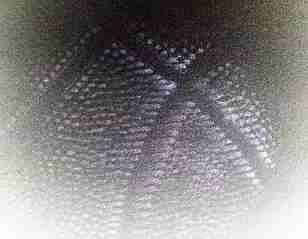
A client was certain that a large collection of round black speckled marks on his garage ceiling were toxic mold, that the marks were growing in size, and that they had not been there when he purchased the home a few years before.
During a mold investigation we had seen and rapidly discounted the significance of these marks, preferring to follow water leaks and moisture to an actual building problem. To an experienced eye it was immediately obvious that the marks had been made by a basketball which someone had bounced against walls and ceilings.
At the end of our site investigation, during our recap of site observations and of the samples we had collected, the client expressed surprise that we had not sampled "that black mold on the garage ceiling". "That was the reason I hired you in the first place," he added.
We explained that these marks were not characteristic of mold growth. The client disagreed and asked us to take another look at the "black mold" in his garage. He added that not only were these black ceiling marks new, but that he could prove that they were growing. "I drew a pencil line around one of these mold colonies," he explained, "and it has now grown outside of my line."
From our stepladder I (DF) studied his pencil line and the basketball dirt mark carefully. "It looks to me as if the mark is entirely inside of of your line," I said.
"Well I think I drew the original line a little outside of the actual mold because I didn't want to touch it," the client explained.,
The client had owned the building for more than six years and was absolutely certain that these marks were of recent origin and that they were black toxic mold. He thought that these "mold colonies" had been caused by moisture problems in the home. The client was also absolutely certain that these marks had not been in place when he purchased the home.
The sample: At the client's firm demand, we collected a sample of the ceiling drywall surface and we analyzed these stains in our laboratory. Because we had trouble collecting any of the surface debris from the mold-suspected marks using the
clear mold sample adhesive tape method, we cut an entire rectangle of stained drywall surface paper and packaged it for lab analysis.
We also made test cuts through the ceiling drywall to permit examination of the drywall ceiling cavity side as well as ceiling insulation and surfaces (where no mold and no moisture evidence was found).
Forensic microscopy lab results:
Transmitted light and polarized light microscopy were able to confirm that the black marks were comprised of dirt and soot from the garage floor nd from a basketball surface.
Examined at magnifications between 10x and 1920x we found that the smudge particles on the ceiling drywall paper were made up primarily of concrete and road particles with a few tire particles tossed-in along with an occasional airborne pollen spore or mold spore.
There was no fungal growth in the material whatsoever.
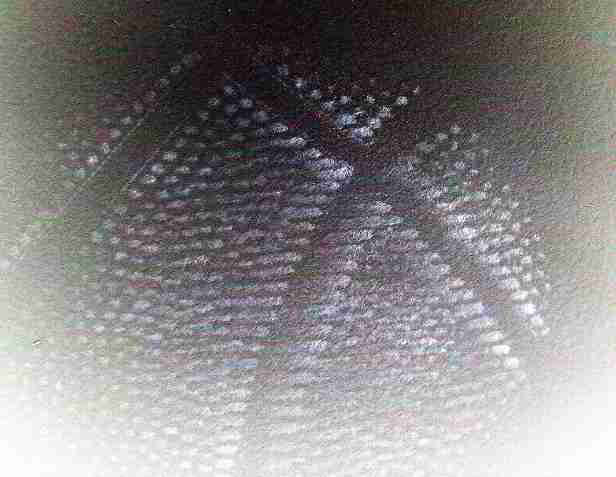
Photographs of the ceiling stain marks are shown at the top of this page and just below.
BBMS: Basketball Mold Syndrome Explained
It is important to realize that a stain or mark may have been in place but un-noticed for a long time on a building surface.
In its form of black on white on the garage ceiling the stain pattern was a bit hard to see.
We used this trick of reversing black and white in the lab computer, making the basketball characteristic surface pattern of the ceiling marks which we sampled quite obvious.
Causes of BBMS - Basketball Mold Syndrome
Anxiety about a building environment or simply new discovery of an existing mark or substance can convince even the most hard thinker that the substance is "brand new" when sometimes it is not.
We have encountered basketball mold syndrome many times. Speaking as an experienced field and forensic lab investigator (but with no qualifications as a psychologist or psychiatrist) we offer these factors involved in BBMS:
- Fear:
An occupant has become anxious or actually frightened by an event (building flood) or by a health concern (development of asthma, mold-related illness) - Frustration:
An occupant is frustrated with the difficulty of obtaining a clear diagnosis for an illness or diagnosis of the cause of a problem or simply an observation and concern at a building - Fragile health:
The person is responsible for the health of others in fragile health such as an infant, elderly person, someone who is immunocompromised, or has another chronic and serious health concern - Health catastrophes:
A person has suffered the involvement in a sudden catastrophic illness or medical conation concerning themselves or someone close to them.
Some medical conditions for which there is no clear explanation can be so disturbing that people naturally continue to seek a cause that they can pin down; this has been particularly frequent when the involved were parents of small children who had suffered an unusual and debilitating illness - Building catastrophes or fear of catastrophes:
a building which has suffered an event: fire, flood, mold contamination can leave an owner/occupant with a high level of worry about remaining conditions. Is that crack we've just noticed in the ceiling or in the garage floor evidence that our house is going to collapse?
We've seen and also have received reports of a number of cases in which people were frightened that a "new structural crack" in their home was a serious problem. Sometimes we find that the crack is a very old one and possibly of little or no worry.
Certainly the truly sudden appearance of a structural crack is indeed cause for concern and depending on where and in what material such a crack appears, it can be cause for immediate expert attention and could be a safety or even a building collapse indicator.
(An example of a serious immediate major hazard would a bulging structural brick wall with cracked or broken brick bond courses.)
But some building cracks can quickly be determined to have been long standing, dating in some cases from the time of original construction, without change, or as not normally involving the building structure. An example is shrinkage cracks in concrete floor floating slab at a building with independent footings and foundation walls. - Financial motives:
A person may on occasion seek an insurance settlement to provide financial relief for building conditions that would not normally be covered by the terms of their insurance policy.
In the case of the ceiling basketball marks mistaken as toxic black mold, it was our opinion that a member or friend of the family who had previously owned the home had been bouncing a basketball in the garage.
The basketball, picked up dirt and debris from the concrete garage floor (or from other places where the ball had been used) had deposited some this debris onto the garage ceiling when it hit that surface, leaving a perfect, and un-mistakable imprint of a basketball surface.
Once a person becomes concerned about health or mold (or some other building damage or condition which may be significant), or if some other event (such as a building flood) makes us look anew at the building surface, seeing such marks for the first time we may form the mistaken belief that they are new.
Careful investigation can usually resolve this question without ambiguity. This home did have a substantial mold reservoir, but in another location and on different materials than those found in the garage.
So a second risk of the basketball mold syndrome is that by focusing our attention on something that is not diagnostic of an important building problem, we risk failing to notice and attend an important health, safety, or structural issue elsewhere in the building.
Unbiased Expertise is Needed to Sort Out BBS from Real Hazards
An expert can often produce compelling evidence that sorts out which building conditions are new and which are long pre-existing, and an expert should be able to advise whether the condition represents a significant threat to the building or its occupants.
The "expert" should not only be experienced and articulate, but s/he must be absolutely without conflict of interest. A "structural expert" who evaluates a foundation crack but who stands to profit from performing the repair may in fact be accurate in her judgment, but is not at arm's length from the repair work.
A "mold expert" who offers to test for the presence of mold contamination, who also offers to clean up the mold (the expensive part of the job and the more profitable), and who also offers to perform the final clearance inspection and testing that certifies that the mold remediation was performed correctly and successfully is hardly at arm's length from that transaction.
...
Continue reading at MYCOPHOBIA, STAINS MISTAKEN for MOLD or select a topic from the closely-related articles below, or see the complete ARTICLE INDEX.
Or see these
Recommended Articles
- EFFLORESCENCE SALTS & WHITE DEPOSITS
- ENVIRO-SCARE - PUBLIC FEAR CYCLES
- MOLD APPEARANCE - STUFF THAT IS NOT MOLD
- MOLD / ENVIRONMENTAL EXPERT, HIRE ?
- MORGELLONS SYNDROME
Suggested citation for this web page
BBMS BASKETBALL MOLD SYNDROME at InspectApedia.com - online encyclopedia of building & environmental inspection, testing, diagnosis, repair, & problem prevention advice.
Or see this
INDEX to RELATED ARTICLES: ARTICLE INDEX to MOLD CONTAMINATION & REMEDIATION
Or use the SEARCH BOX found below to Ask a Question or Search InspectApedia
Ask a Question or Search InspectApedia
Questions & answers or comments about harmless building dirt & stains mistaken for toxic mold growth
Try the search box just below, or if you prefer, post a question or comment in the Comments box below and we will respond promptly.
Search the InspectApedia website
Note: appearance of your Comment below may be delayed: if your comment contains an image, photograph, web link, or text that looks to the software as if it might be a web link, your posting will appear after it has been approved by a moderator. Apologies for the delay.
Only one image can be added per comment but you can post as many comments, and therefore images, as you like.
You will not receive a notification when a response to your question has been posted.
Please bookmark this page to make it easy for you to check back for our response.
Our Comment Box is provided by Countable Web Productions countable.ca
Citations & References
In addition to any citations in the article above, a full list is available on request.
- Mycology, Fundamentals of Diagnostic, Fran Fisher, Norma B. Cook, W.B. Saunders Co. 1998, ISBN 0-7216-5006-6
- In addition to citations & references found in this article, see the research citations given at the end of the related articles found at our suggested
CONTINUE READING or RECOMMENDED ARTICLES.
- Carson, Dunlop & Associates Ltd., 120 Carlton Street Suite 407, Toronto ON M5A 4K2. Tel: (416) 964-9415 1-800-268-7070 Email: info@carsondunlop.com. Alan Carson is a past president of ASHI, the American Society of Home Inspectors.
Thanks to Alan Carson and Bob Dunlop, for permission for InspectAPedia to use text excerpts from The HOME REFERENCE BOOK - the Encyclopedia of Homes and to use illustrations from The ILLUSTRATED HOME .
Carson Dunlop Associates provides extensive home inspection education and report writing material. In gratitude we provide links to tsome Carson Dunlop Associates products and services.
 | HOME | ABOUT | ASK a QUESTION | CONTACT | CONTENT USE POLICY | DESCRIPTION | POLICIES | PRIVACY | |
| © 2024 - 1985 Publisher InspectApedia.com - Daniel Friedman | |||||||||