
InspectAPedia® FREE Encyclopedia of Building & Environmental Construction, Diagnosis, Maintenance & Repair |
Question? Just ask us! InspectAPedia
|
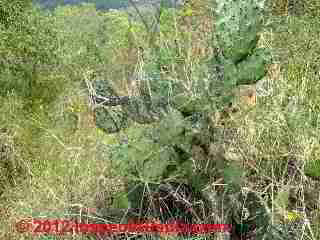 Fungal / Mold Growth on Prickly Pear Cactus
Opuntia Mill. fungal infections, white fuzz, mealy bugs
- POST a QUESTION or COMMENT about problems with mold growth on cactus plants: cactus mold identification, cactus mold causes, & cactus mold remedies
Investigation of mold growth on the Nopal cactus and treatments for cactus mold contamination or growth:
The Mexican Nopal, or in English "prickly pear cactus" or "Barbary Fig cactus" is a member of the group Opuntia Spp. within the Cactaceae family.
Mold growth appears to be more common on cacti such as the Nopal when growing in higher and less arid regions such as the village of la Yerbabuena, near the foot of the volcano above Colima, Mexico.
This article describes mold growth on the Mexican Nopal cactus plants in the wild and on those grown as a food crop.
With a fungal growth sample collected from Nopal growing in Yerbabuena, Colima Mexico. in 2011 we began seeking an accurate identification of the fungus, and an exploration of its properties both on the plant and as a possible seasonal contributor to the aerobiological milieu.
Our project will also investigate and document the causes and effects of mold infection of Mexican prickly pear cactus plants, and the identification of other mold genera/species commonly found growing on and affecting those important plants.
InspectAPedia tolerates no conflicts of interest. We have no relationship with advertisers, products, or services discussed at this website.
Mold Growth on Cactus: genera/species of mold that infect cactus plants
 Daniel Friedman
Here we describe common growths or pests that injure or even kill cactus and some succulent plants, including
- CACTUS COCHINEAL INFESTATION - Cochineal Scale
- CACTUS SCALE REMEDIES
- CACTUS FUNGUS - DARK
- CACTUS FUNGUS - WHITE MILDEW - also see Cochineal Infestation above
- CACTUS ROT PREVENTION & CURE - don't over-water your cacti
- CACTUS or SUCCULENT MEALYBUGS - or perhaps Mites
- LIST OF CACTUS FUNGAL INFECTIONS
- SUN SCORCH & OTHER BLACK DAMAGE on CACTUS
- NOPAL CACTUS PADDLE DAMAGE
Photo above: a Nopal Cactus in Guanajuato, with a pair of ripe fruits. [Click to enlarge any image]
Watch out: no matter how much you may like cactus plants, don't just buy anything from anybody. In many areas of the world cactus rustlers are invading protected areas, stealing cactus plants, and re-selling them on an illegal cactus market. Be sure that any plant you buy is from a legal and legitimate source.
In Mexico, some people have "rescued" cactus plants that were found along the roadside where they were ploughed up during new road construction. Depending on where that roadway is located, even those cactus plants ought to have been re-planted nearby.
Watch out: while there are photos of various cactus and some succulent plant afflictions here along with discussions of their cure and prevention, I'm not a cactus expert nor even a botanist. For valuable plants you should be sure to consult a cactus expert or at least your local farm and home center expert. There are 127 cactus genera and at least 1750 individual cactus species in the order Caryophyllales - it's not likely that anybody knows all about all of them.
Most of our cactus photos are from the plants in the wild or cactus plants as observed in a botanical garden or preserve. Others are from legally obtained plants from cactus growers. We cannot claim to know the source of cactus plants in photos posted by our readers.
 The Mexican Nopal, or in English "prickly pear cactus" or "Barbary Fig cactus" is a species or group of species of Opuntia Spp. within the Cactaceae family.
While some sources [22] claim over 200 species in that group, the USDA lists 59 species and 75 accepted taxa within the Genus Opuntia Mill.[20]
I am particularly interested in fungi found on species of Nopal found at altitude in more wet or humid highlands of Mexico.
These include fruit-bearing prickly pear species (Opuntia ficus indica) that are widely used as a food (both the cactus fruit or Tuna and the younger cactus pads or nopalito) and drink product (an intense purple juice in water) in Mexico as well as an export product in the form of Nopal fruits, Nopal juice, and in power and cosmetic forms. [22]
Some might think that because cactus plants generally grow in dry locations that they never suffer from fungal attack, but that's certainly not the case.
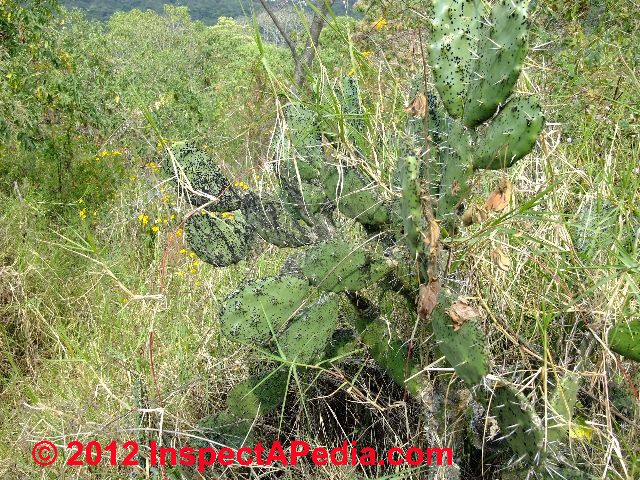
The page top photograph of a mold-infected Nopal (prickly pear) cactus plant was taken in Yerbabuena, Colima Mexico.
Yerbabuena is a tiny village located at a comparatively high altitude and close enough to Mexico's Pacific coast to receive more rainfall than some other areas of the country.
I have observed both superficial fungal growth on the intact skin of cactus plants and plants injured or destroyed by fungal attack.
Experts report fungal invasion of cactus plants by other vectors such as through wounds, cuts, and direct penetration of the cactus.
Watch out: while this article discusses cactus diseases that appear to be fungal or mold growths, some insect or parasitic cactus diseases maybe mistaken for mold.
At CACTUS COCHINEAL INFESTATION you will see examples of white fluffy or barnacle-like diseases on cactus that may not be funguses at all.
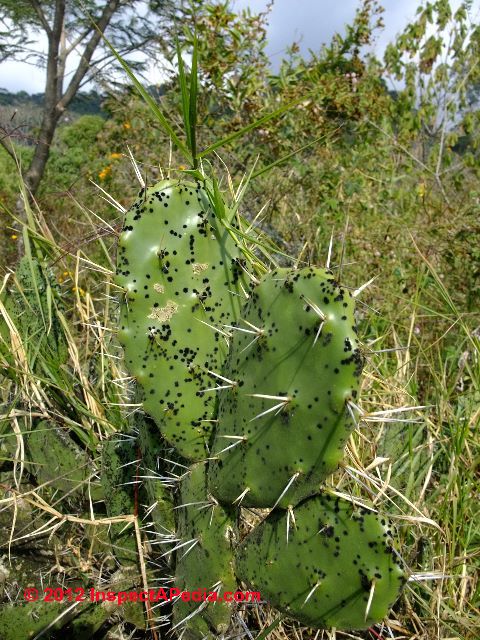
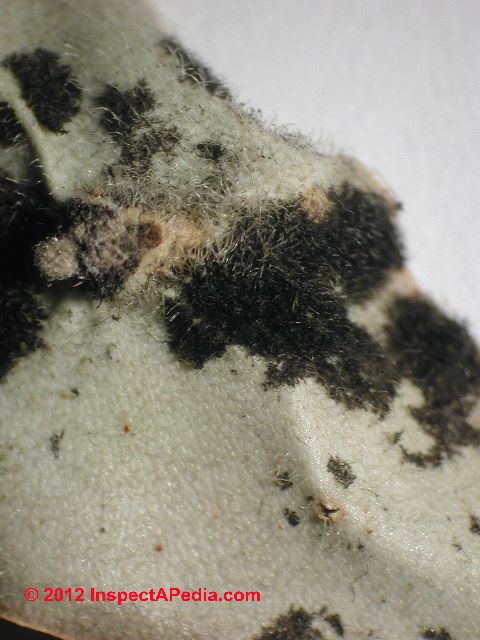
Above: small round black fungal colonies on a Nopal in Yerba Buena in Colima, Mexico.
Also see MOLD GROWTH on SURFACES, PHOTOS - What Does Mold Look Like on Various Materials & Surfaces? An extensive photographic guide to mold as it is found growing on various building materials & surfaces.
Appearance of Mold on Cactus: on the plant & under the microscope
Black & Other Dark Colored Molds on Cactus Plants
Mold growth on cactus is more common in areas where cacti such as the Mexican Nopal (below left) grows in higher and less arid regions such as la Yerbabuena, near the foot of the volcano above Colima, Mexico.
(Photographs by DF, la Yerbabuena, Colima, Mexico, November 2011) Prickly pear cactus (Opuntia Mill.) are also found in the U.S. in Florida and Hawaii as Opuntia cochenillifera.
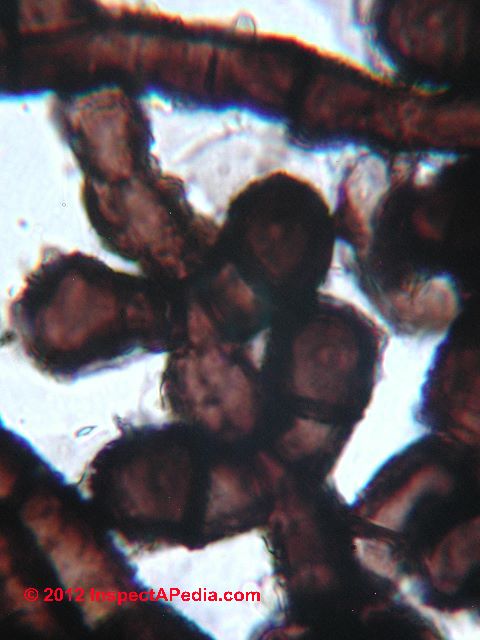
Our Mexican Nopal cactus mold photo (at left, 1200x) seeks expert help with confirming its identity, and is discussed below.
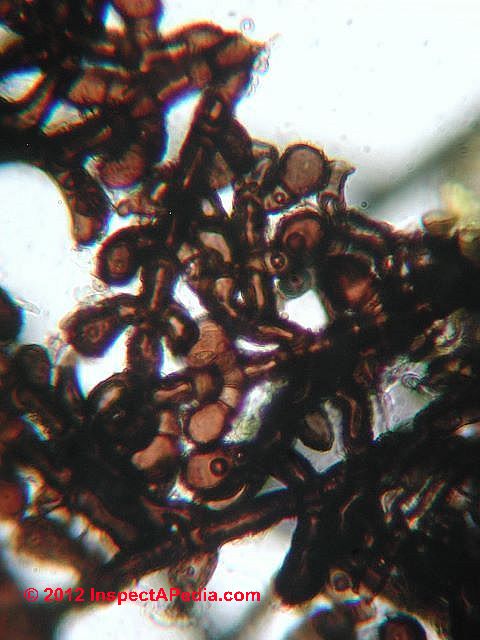
Below (right) and tentatively identified as a Lasiodiplodia theobromae -like fungus are microscopic images (approximately 600x) of the mold we found growing on the Mexican Nopal cactus.
The conidia (spores) are obovate to pyriform, with a thick cell wall, dark brown, smooth, with a single transverse septum near the base.
They appear to grow in opposed pairs on either side of the hypha. The upper larger segment of the spore is generally darker than its base.
We also found, no surprise, species of Cladosporium sp. on this cactus surface.
Some experts report that superficial molds such as powdery mildew may appear on some cactus houseplants.
Mildew on cactus will appear white or gray-white and is principally a cosmetic issue. [1]
 ...
... 
Lab microphotographs and work to identify the black cactus mold shown above are in process - Ed.
Question: cause & treatment for black mold on cactus
(Feb 5, 2015) Darlene said:
I have a Suharo that looks healthy but it has several hard black circles close to the bottom of the cactus. Is the mold? and what should I do to stop it?
Thanks
Reply:
Darlene
Over-watering or too much shade are factors that can increase the risk of mold growth on a cactus but of course by e-text I can't see what's going on with your plant.
If you like use the email found at our CONTACTS link (page bottom) to send me some photos of your Saguaro (Carnegiea gigantea) cactus common in the Sonoran desert and in the Organ Pipe Cactus National Monument in the U.S. A 5-armed saguaro is likely to be as much as 200 years old.
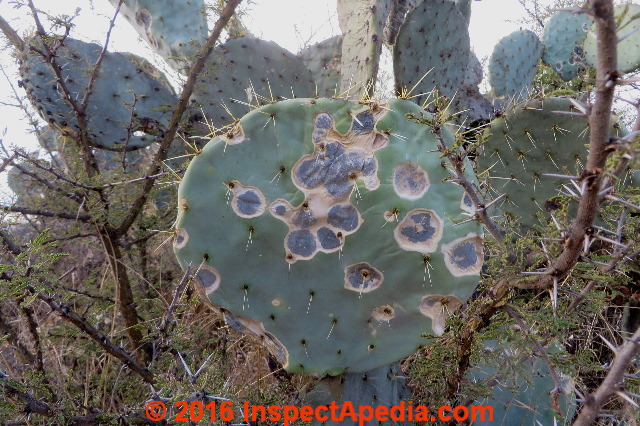
Below is a photograph of round black fungal attack on a different cactus, the species discussed on this page, the Nopal.
List of fungal diseases of cactus plants
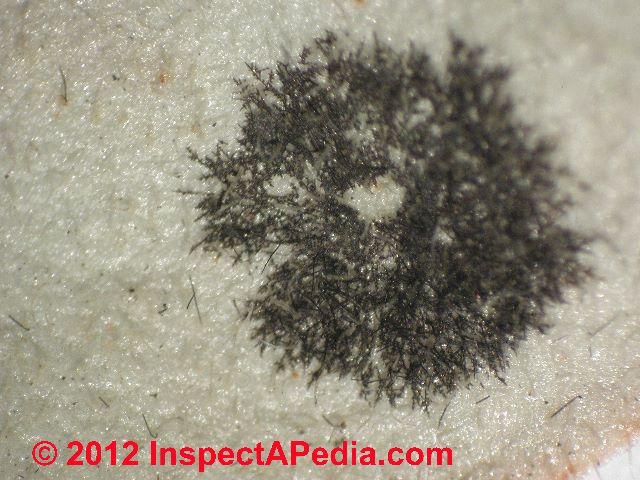 Here our photo shows a typical colony formation on the surface of a cactus plant, viewed by stereo microscope.
Here are some of the many fungal species associated with cactus plants and/or the soils around them.[16]
Keep in mind that many fungi may be helpful to certain cactus species both in soils and at cactus roots and at other plant locations or in controlling cactus pests[13][19].
But some fungal genera/species are indeed reported to invade or attack and damage or even kill cactus plants including:
- Fusarium sp. [2]
- Aspergillus fumigatis [through plant soil][12]
- Aspergillus niger [through plant soil][12]
- Aspergillus parasiticus [possibly]
- Colletotrichum sp, (anamorph: C. gloeosporioides) (cactus stem rot)[17]
- Fomes robustus (heart rot fungus) [18]

- Glomerella cingulata (cactus stem rot) [17]
- Lasiodiplodia theobromae - a member of the Botryosphaeriaceae/ B. rhodina family, wide ranging plant pathogen, may cause fungal (mycotal) keratitis and stem-end rot, a citrus plant disease, possible cause of nail and skin lesions on humans [5][6]
- Phialocephala virens
- Poria sp. [18]
- Sporothrix schenckii [12] [human pathogen , Rose-picker's disease]
- [Possibly] Yeasts [10][11] brought by insects
- 22 fungal species associated with cactus plants were identified by an assay of 900 endophyge isolates[14]
Comment: Apressoria or hyphopodia on cactus
(Sept 8, 2015) Ludovic said:
The mold you show here is none of the one suggested. The peg-like projection from the darkly colored hyphae are called 'appressoria' or 'hyphopodia', used to anchor on their substrate and also suck up nutrient from it.
The ones you show are characteristics of epiphyllous fungi in the Orders Meliolales (or black mildew) or Asterinales, depending the ascoma (=fruiting body, spore containing structure) associated with them. Did you find big spore with 3 to 5 cells (Meliolales) or small spore with only 2 cells (Asterinales)?
I love fungi but I have no idea how to treat plant that carry them. It seems to me that these fungi proliferate in particularly wet places (tropical?). I saw many of them on almost all sorts of plants in some very wet part of Costa Rica. I don't know if that will help.
Reply:
Thank you Ludovic, I've continued to collect fungal growth from succulents, particular cactus plants in central Mexico.
From the in-situ look these do not seem to be a mildew - the surface is very scaly and hard.
When I'm back I'll take a look through the microscope to see what spores we can isolate - if any. Possibly during wet weather they'll make a cameo appearance. But generally these are appearing at various altitudes up to 7000 ft but in a usually-dry climate.
I'd be grateful for any citations / references you can add for cactus-infecting cacti.
White & Light Colored Mildew & Other Molds on Cactus Plants
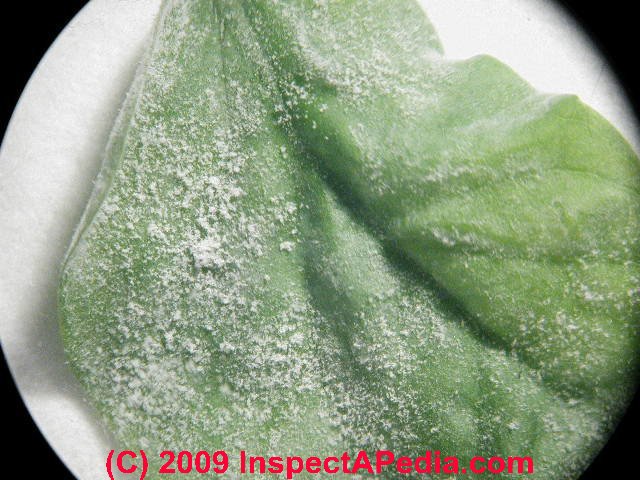
White stuff found on both indoor and outdoor plants (photo at left) including cactus plants may be mildew,
If the cactus is being kept in a too-wet or too-humid environment.
Mildew infection of a cactus is more likely for plants grown out of their native (dry) environment, and when the cacti are kept close to other mildew-infected plants.
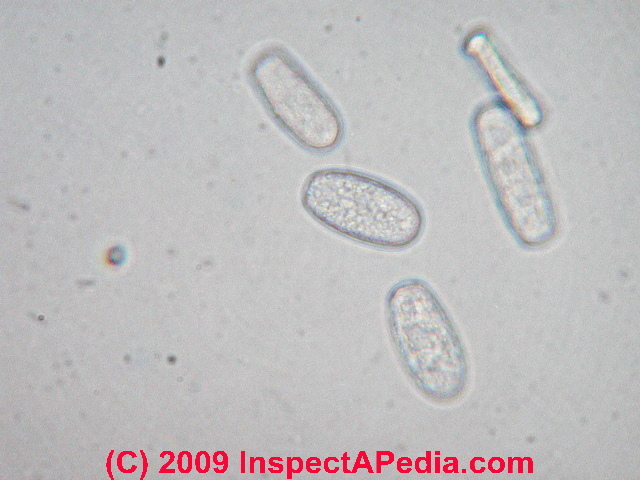
Our photo (above left) shows what mildew spores look like under the microscope.
Photographs of mildew on plants are at MILDEW in buildings ? and advice on curing & preventing mildew on plants is at MILDEW REMOVAL & PREVENTION
Because the skin on most succulents is so thick, mildew may do less damage to a cactus than to other plants.
However other white and light colored molds found in buildings and on some plants can be harmful to people and animals as well, such as some species of Aspergillus sp. and Penicillium sp.
See WHITE MOLD PHOTOS for photographs of white mold growth in buildings.
Other "white stuff" we see on cactus plants may be a left-over deposit from having sprayed or washed the cactus plant with vinegar or other solutions.
How to Remove a Mealybug Infestation on Cactus
Watch out: some "white stuff" on cacti and certainly on other plants may be mealy bugs not a fungal infection, but deserving action. Our mealybug photo below was provided by Iranian reader P.C. 2018/10/12.
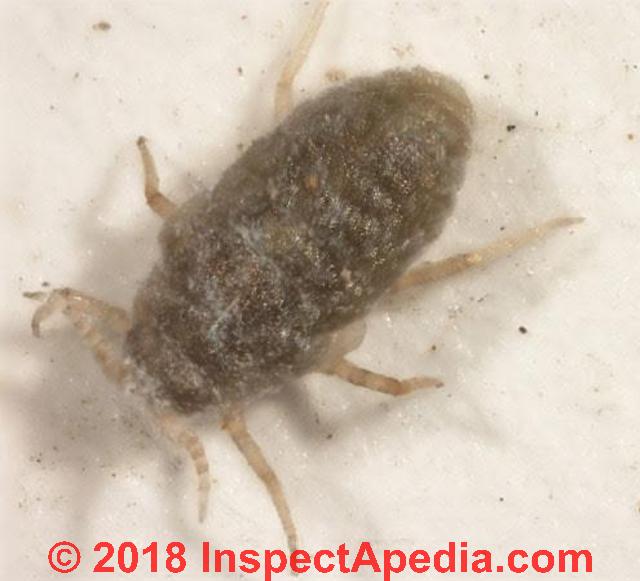
- The insecticides discussed earlier on this page
are helpful at dealing with mealybug infestation. Alternatively, cleaning the infected area with a soft brush and a spray of 70% isopropanol (alcohol) can be effective at removing mealy bugs from cactus and other succulents. - Using a soap solution and brush
can also rid mealybug infections. - Neem oil,
as we discuss in this article, can be sprayed as an effective mealybug control. - "Commercially available beneficial insects,
such as ladybugs, lacewing and the Mealybug Destroyer (Cryptolaemus montrouzieri), are important natural predators of this pest.", according to planetnatural.com. - Pesticides such as Bonide Chemical 952 Number-1 2-Percent Systemic Granules
can be applied to the soil to (ultimately) provide systemic protection against recurrent mealybug infestations. - Natural predator insects
that attack mealy bugs and soft scale include Cryptolaemus montrouzieri, aka dark brown ladybugs, small predatory beetles sold by garden suppliers. These insects, in both larval and in their adult forms, feed on aphids, mealy bugs, and scale.
Treatments for Cactus Mold Growth - may also be helpful with mealybug infestation
Some, perhaps most molds, observed on cactus plants may not actually harm the plants but may remain a cosmetic issue for hobbyists. Popular cactus mold cures include:
- Removal and disposal
of the mold-infected cactus part if feasible - suitable for cactus house plants; - Using a cotton swab moistened with vinegar
or with 70% alcohol to clean small infected areas of cacti used as house plants.
Watch out: cactus horticulturists point out that vinegar can be purchased in varying strengths for horticultural and other uses (thus its effectiveness as a fungicide may vary), and it is also reported that using vinegar on cactus may both help and harm the plant, depending on the strength of the vinegar solution, its application, and the plant species.
Also, there may be a connection between subsequent cactus damage and acetic acid bacteria. [8] Stan Starbuck reports that while vinegar has been used successfully to treat certain fungal infections on soil surfacesSome plants such as Aloe, Haworthia and Euphorbia suffered small amounts of cosmetic skin damage. Other plants sprayed in the same manner such as Hurenia, Echinocereus, Mammillaria and Rebutia suffered fatal results.[7]
Watch out: furthermore, often "white stuff" that appears to be "growing" on the surface of soil around plants, particularly houseplants, may not be a fungus at all, but rather a white mineral deposit left on the soil surface from watering activities.
The "vinegar cure" for this condition is not killing off a mold infection. Instead it is dissolving the mineral salts back into the soil, just as we use vinegar to de-scale a coffee maker. - For cacti grown as crops,
different approaches are needed including attention to mold sources (piles of organic debris nearby) and perhaps dusting the crop with a Bordeaux mixture. - Avoid over-watering cactus
at any time but particularly if it is suffering from mildew or mold growth.
Question: treatments for white fungus on cactus
(May 20, 2014) mark said:
White mold or fungus treatment on Nepal cactus
(Oct 11, 2015) steven said:
have a 12 foot cactus and i see white mold on it. How do I save it or is it doomed?
Reply:
Mark, I guess you meant to type Nopal. Indeed there can be more than one genera/species of fungi on a plant, or the same fungus may appear differently at different growth stages.
I'm doubtful that a spray fungicide is the best approach for the plant - at least not before diagnosing the cause of the fungus growth. For example an over-wet plant may continue to have trouble.
Australia's Garden Web (www.au.gardenweb.com) has listed these fungicides used successfully on cactus plants
- Benlate
- Fongarid
- Hortico Rose dust fungicide and insecticide
- Sulphur powder
- Yates Garden Spray insecticide fungicide
Depending on where you live, different products may be available.
Watch out: if you are harvesting nopal for food use be sure to read the MSDS and toxicity data for the fungicide that you are considering.
White "Mold" on Cactus may be an insect scale: Cochineal, Not Mold
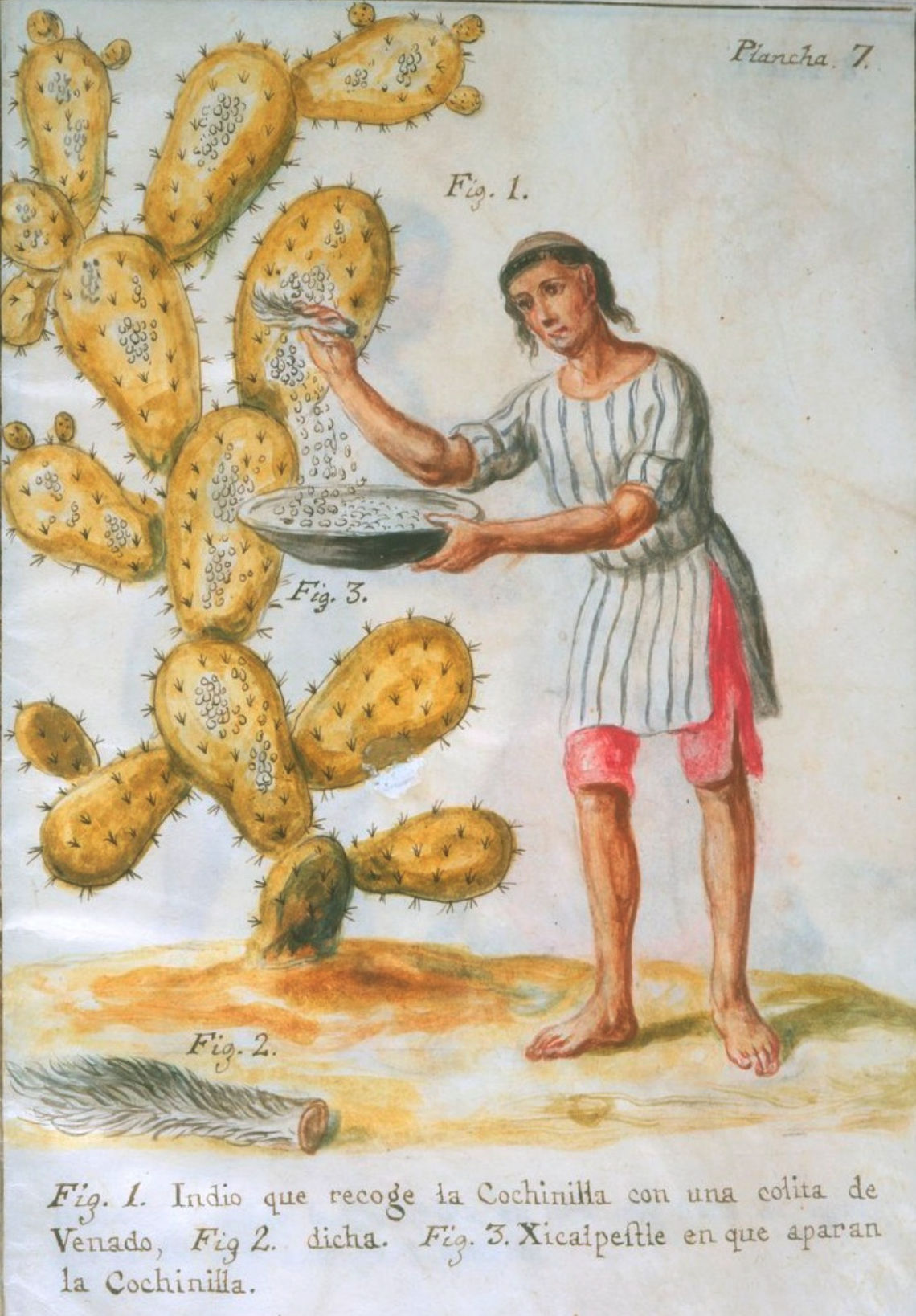 Shown here: Using a deer's tail as a brush, the worker is collecting Cochineal. The painting is by José Antonio de Alzate y Ramírez (1777), and the caption reads: Fig. 1, Indio que recoge la Cochinilla con una colita de venado, Fig 2. Dicha [colita de venado], Fig 3. Xicalpeftie en que aparan la cochinilla.
- source: Wikipedia, retrieved 2021/06/09, original source: https://en.wikipedia.org/wiki/Cochineal
[Click to enlarge any image]
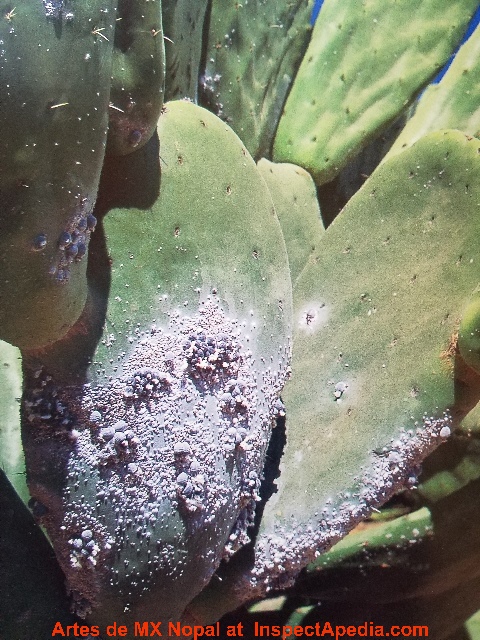
Cochineal (Dactylopius coccus) is a white cactus scale insect that is both a cactus plague and a fascinating organism with a long history in Mexico.
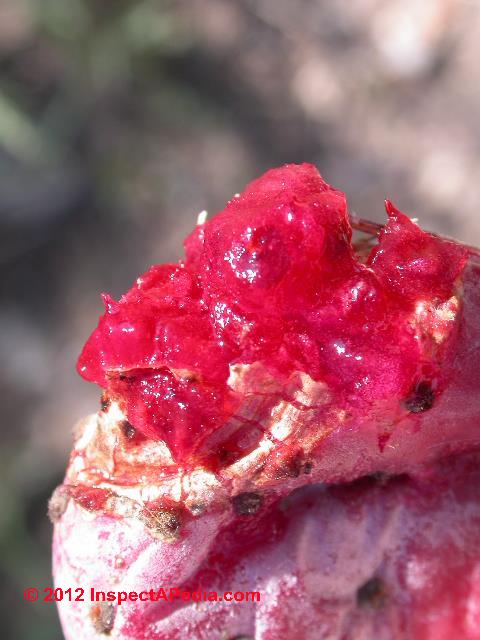
Remarkably, if you smash a bit of this white scale on a cactus you may find an intense carmine red liquid (alizaron crimson) under your thumb.
While Cochineal (Dactylopius coccus) is a cactus parasite, it was also very valuable as a source of red dye that was so valuable as an export product that until the close of the Mexican War of Independence, Spain kept this source of red dye a state secret and held a monopoly of its production in Mexico. The Wikipedia article we cite above notes that
Pigments produced from the cochineal insect gave the Catholic cardinals their vibrant robes and the English "Redcoats" their distinctive uniforms. - Wikipedia Op. Cit.
Continuing today in the Mexican state of Oxaca, the intense red Cochineal dye is still used to give a stunning carmine color to hand-woven textiles.
In Mexico we find this parasite and dye source particularly on the prickly pear or nopal plant, though I have found it on organos and other cactus plants too, though on those plants it usually appears at a much lower volume and area.
Reader Question: tons of white mold on cactus trees
2016/08/22 Jane C. Ti said:
Dear Cactus Specialist, Our Cactus trees which are about more than 12 ft. tall, & they did have pink fruits, guess = Prickly Pears; are all sick with tons of white mold, please see the attached picture.
 Would you please advise me, regarding: how to rescue these poor sick ones.
Thanks in advance! Sincerely looking forward to hearing from you at your convenience! Desperately, Jane
Shown here, la Cochinilla (Cochineal) on a Nopal cactus, illustrated in "el Nopal", Artes de Mexico, No. 59.
Reply:
Jane:
With regret, I'm a cactus-interested investigator but not a cactus expert by any means.
Your description sounds like one of the species of Nopal or prickly-pear cactus (Opuntia is the "prickly pear cactus" genus in the cactus family, Cactaceae). There are about 90 species of Opuntia.
You can use our page bottom CONTACT link to send us photos for posting or comment.
From what I've read as an amateur, fungal diseases on cactus plants are difficult to treat, in my opinion largely because the fungus is environmentally caused - all molds are everywhere all the time: it's the local conditions that make a mold flourish and become a problem.
In the left of this photo you see a light gray-white fungus on the nopal and a common parasite climbing on the organos cactus in the right of the same image.
These cacti were photographed in Pozos, in Guanajuato, Mexico.
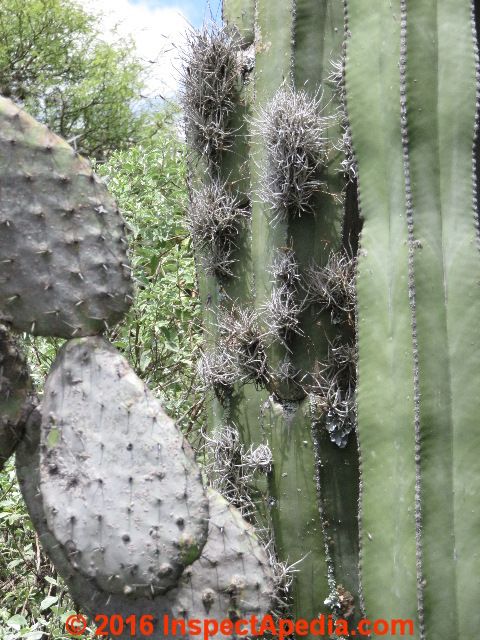 at least one cactus "expert" (cactiguide.com) gives the depressing advice that you give up, take a clean healthy cutting and start a new plant.
In my view that's not gong to cut it if problem source in the local environment - too much water, shade, or something else isn't also found and corrected.
I'm doubtful that a fungicidal spray will be effective for dark scaly mold damage: the cacti I've examined with such black or dark molds were almost impossible to clean of mold growth.
But here's the good news. Well good of a sort.
Often a white "mold" or "fungus" people think they see on cactus is not a fungal disease but rather an insect. In fact often a white fuzzy "deposit" seen on Opuntia is cochineal (Dactylopius coccus) a scale insect in the suborder Sternorrhyncha, from which the natural dye carmine is derived.
Cochineal produces an intense red dye whose cultivation in pre-hispanic Mexico and whose later production was kept secret by the Spanish in Mexico.
Without over-pricking yourself, scrape off a bit of the white stuff and rub it between thumb and forefinger.
If your fingers become stained with an intense red dye, that's Dactylopius coccus (some texts refer to it as a "mealybug" ).
If that's what's on your cactus you might be able to clean it off with a soft long-bristle brush and dish soap or an insecticidal soap.
I'd avoid very strong power washing as it's likely to damage the cactus itself. Locally here in San Miguel de Allende our jardinero expert uses neem oil on several plant species to resist insect attack.
How to remove Cochineal from your cactus
We have successfully cleaned off small infections by the Cochineal scale insect using a soft brush and an insecticidal soap; those products are discussed in this article. You don't have to use a deer's tail.
Frankly I don't like to disturb the scale unless it's become a serious infection on a valuable plant.
White Growth on Melon Cactus in Iran
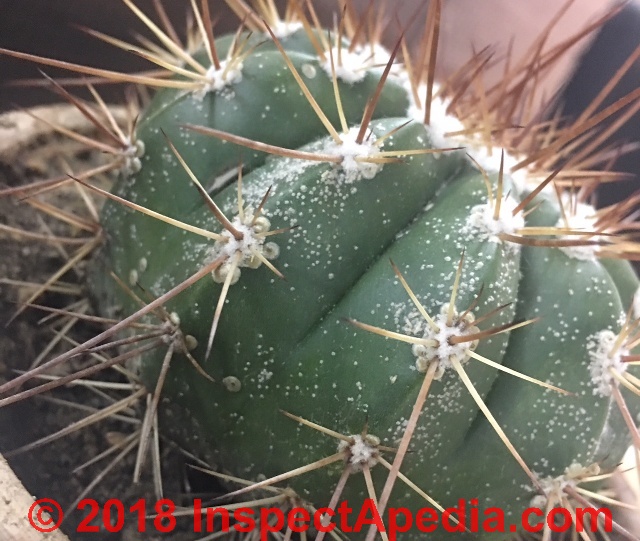
Reader Question: white growth on Melocactus diamantinus and other cactus
2018/10/07
im from iran
I have a few cactus and i have a problem (disease)
My Melocactus diamantinus and a few other cactus have a disease but I can't find a treatment.
I need to help find diseases and treatment ? I send few picture this email .
Thanks for help. - Anonymous by private email
Reply: diagnosis & treatment of white fluffy or barnacle-like infestation on cactus: mealybug / cochineal insects
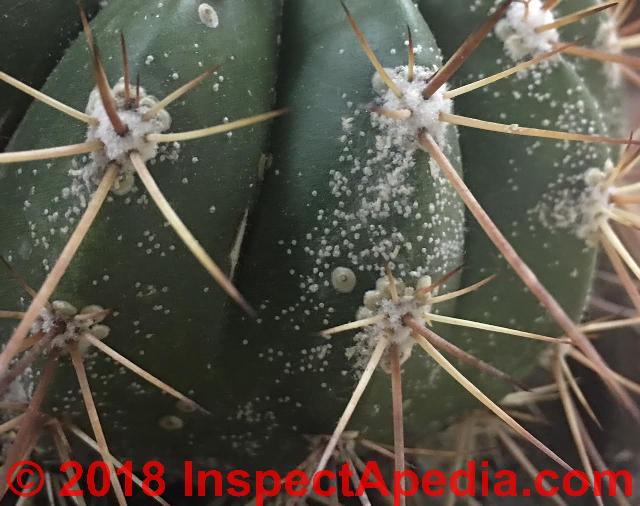
As we illustrate starting at CACTUS COCHINEAL INFESTATION you will see examples of white fluffy or barnacle-like diseases on cactus that are insect-based rather than fungal.
Try scraping off some of the larger white growths on your cactus and mashing those between a thumb and forefinger. If you see a red dye in the result your cactus are infested with mealy bugs or cochineal insects.
For other readers, English names for Melocactus diamantinus include Turk’s Cap, Melon Cactus
Treatments for Dactylopius sp. - cochineal mealybug infestations on cactus
- For limited cochineal / mealybug infestations and those detected early you can often remove the insects using a garden hose with a spray nozzle, taking care to aim the spray so as to send the mealy bugs and their white fuzz into a harmless area of the ground, not down into the soil around your cactus plant.
- For more firmly-attached barnacle-like white cochineal growths on cactus you may need to use a stiff bristle brush or on smaller cactus plants, a toothbrush, to scrub off the growth. Scrub using an insecticidal soap or neem oil mixture.
What are Dactylopius sp. - mealy bugs, or cochineal bugs ?
[Mealy bugs] are small scale insects that feed on the cactus.
They produce fluffy white wax that hides their bodies as they feed on the cactus and protects them from the elements (drying out, in particular) and from predation.
The fluffy wax also serves as a sail or balloon to float on the wind and take the bugs to a new patch of cactus.
The bugs produce carminic acid that also helps protect them from predation, especially from ants.
This carminic acid in the bugs has been used by indigenous peoples of southwestern North America, Central America and sub-tropical South America to make a brilliant red dye for centuries, perhaps millennia, to produce beautifully colored textiles.
Originally, the cochineal bugs were limited to the New World. When the European explorers visited and saw the beautiful red cloth of the natives, they took the cochineal bugs back with them and now they occur all over the world. - source: Ladybird Johnson Wildflower Center, 4801 La Crosse Ave., Austin, TX 78739 USA, Tel: 01 512.232.0100, https://www.wildflower.org/expert/show.php?id=9592 retrieved 2018/10/07
Other Prickly pear Cactus Nopal or Tuna Photographs
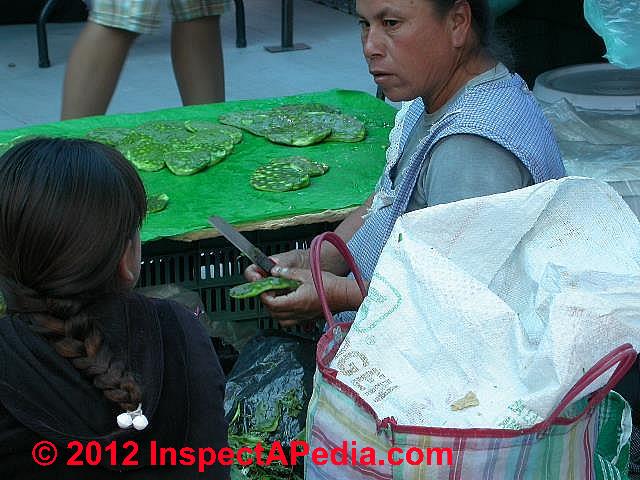
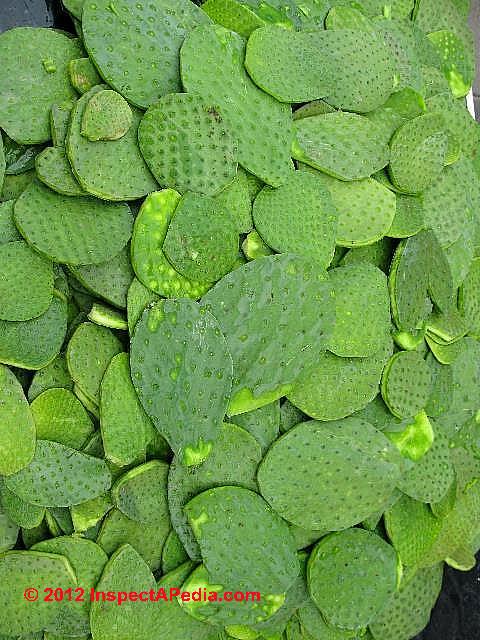
Nopalitos are sold in local markets as well as larger supermarkets and are exported as well. The young nopalito pads are harvested and cleaned of thorns for sale. (Left and below left).
Nopal is sliced into strips or diced, then cooked alone (boiled or grilled) or with a mixture of onions and other herbs, and consumed as a vegetable.
The Nopal fruit or Tunas (see photo near page top and below right) are harvested using a long pole on the end of which may be a forked nail-pair used to hook the fruits.
Tunas may be peeled and eaten as a fruit but quite often are immersed in water, on occasion with added sugar, to make a fruit beverage.
 ...
... 
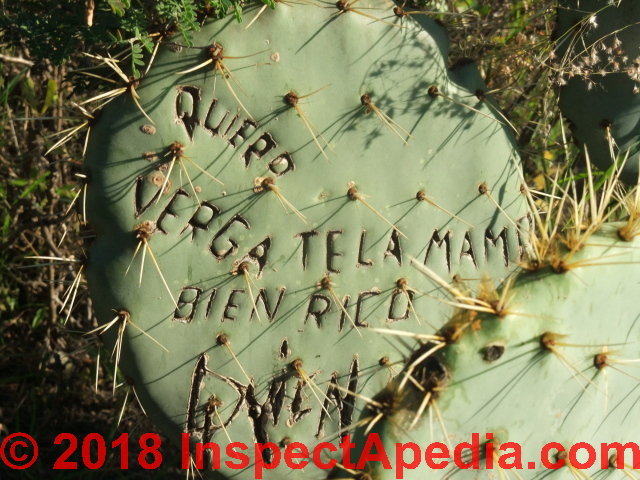
Below, two more common afflictions of nopal cacti in San Miguel de Allende, Guanajuato, Mexico.

Below: parasitic attack on Organos cactus
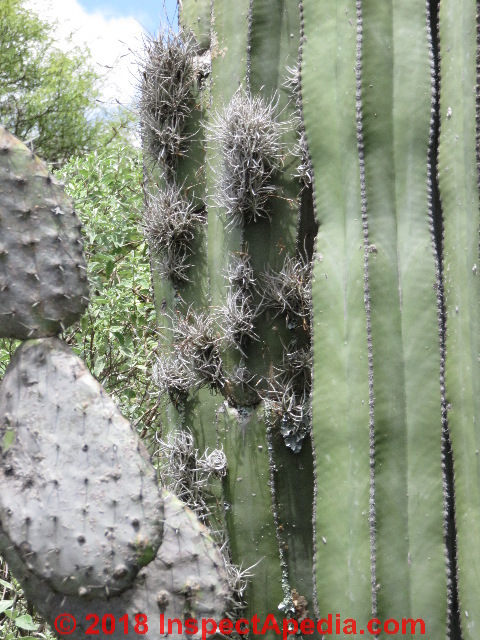
Cactus Rot Damage
Watch out: the number one killer of cactus plants kept by many enthusiasts is over-watering. Cactus rot kills of the roots of the plant first so by the time you see rot there may be more damage than is obvious.
But it may be possible to save your rot-damaged cactus by judicial cutting, drying, sun exposure, and avoiding over-watering.
Below: Organos cactus that are telling you they've had enough water. Stop watering these plants.
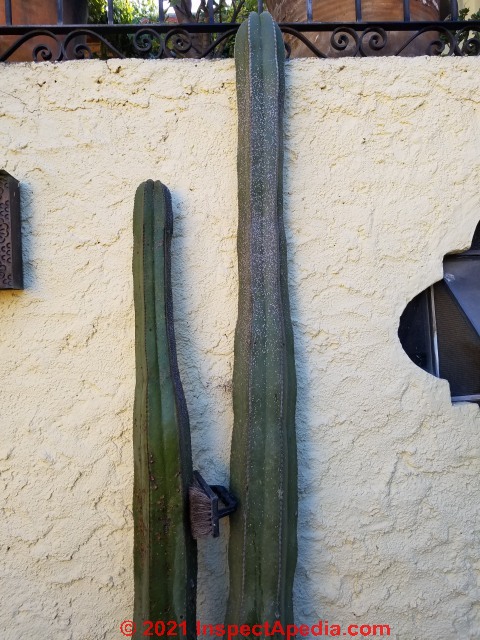
In the case of Organos that appear in several photos on this page including just above, the cactus will show you that it has had plenty of water by its swollen appearance.
On 2021-06-03 by mak.church (mod) - black rot on cactus tip
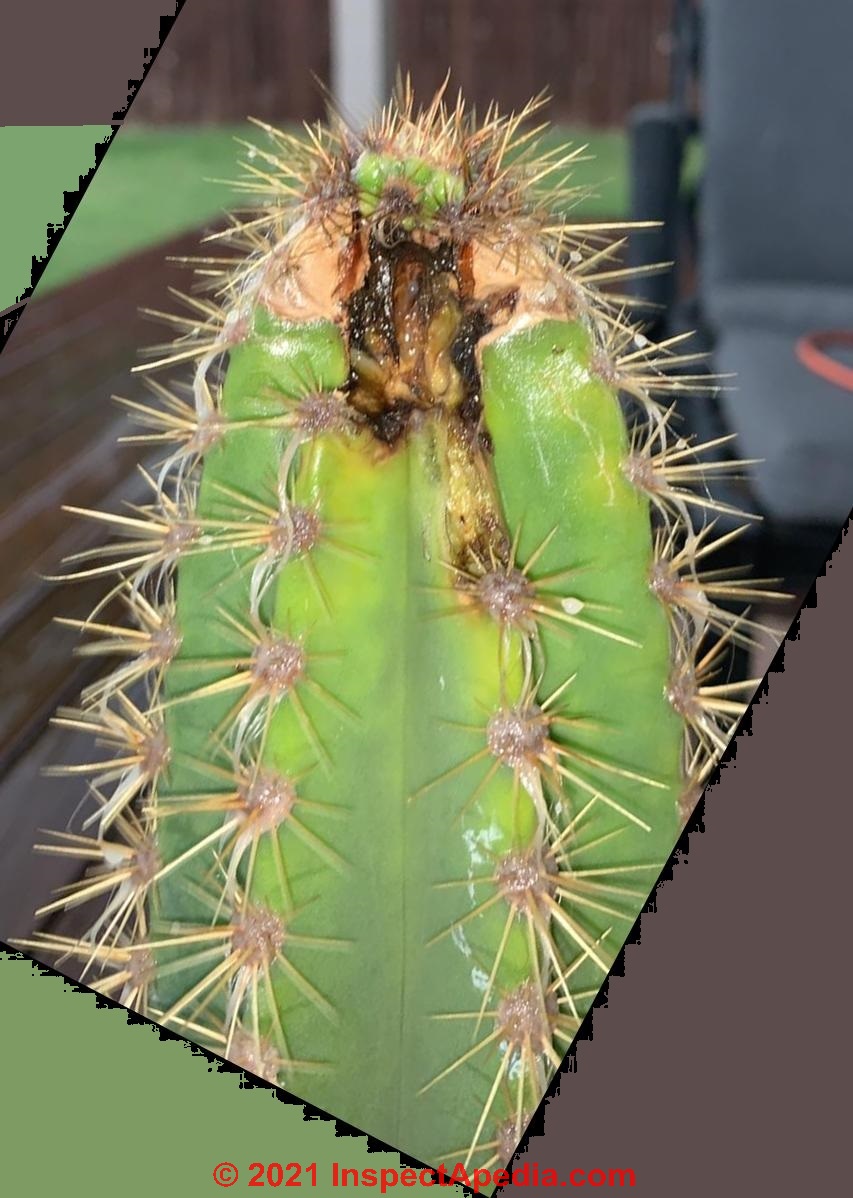 @Heidi Sebastian,
You're on the right page and I would direct you to the section: on this page:
Treatments for Cactus Mold Growth or mealybug infection. Or rot.
Your spray might be helpful but as we both will read in cactus mold treatment advice from experts, one needs to match the spray or other treatment to the specific pest: molds, insects or,
if the problem is over-watering that causes root rot. But rot can appear at the cactus at any location, near its base, along its stem, or as in your case, at its tip.
I think your cactus has stem rot showing up at the tip, better called "cactus tip rot".
Cactus pros say you have to act quickly to remove the rotting tip of the cactus.
Use a sharp and clean knife or other cutting tool (disinfect it with soap and water or in 95% alcohol before using it) to cut off the damaged tip.
When you cut off that tip, look at the cross-section of the cactus top that remains: if there is any rot in its center, you need to cut a bit lower down on the plant until you see only healthy tissue.
Now keep the cactus out of the rain and give it sunlight until the exposed cut area has dried and become callused over - it will turn a thick gray colour.
Don't over-water your cactus.
On some of our organos in pots in Mexico we have had to stop watering them entirely as even when rains are intermittent more watering was killing the cacti.
On 2021-06-02 by Heidi Sebastian
My cactus has recently got black spots and more so at the tip. Can you please advice how to treat? I’ve cut some of it out and sprayed with an organic garden spray.
[Photo above]
On 2020-06-08 - by (mod) - saving a cactus paddle or pad by re-planting
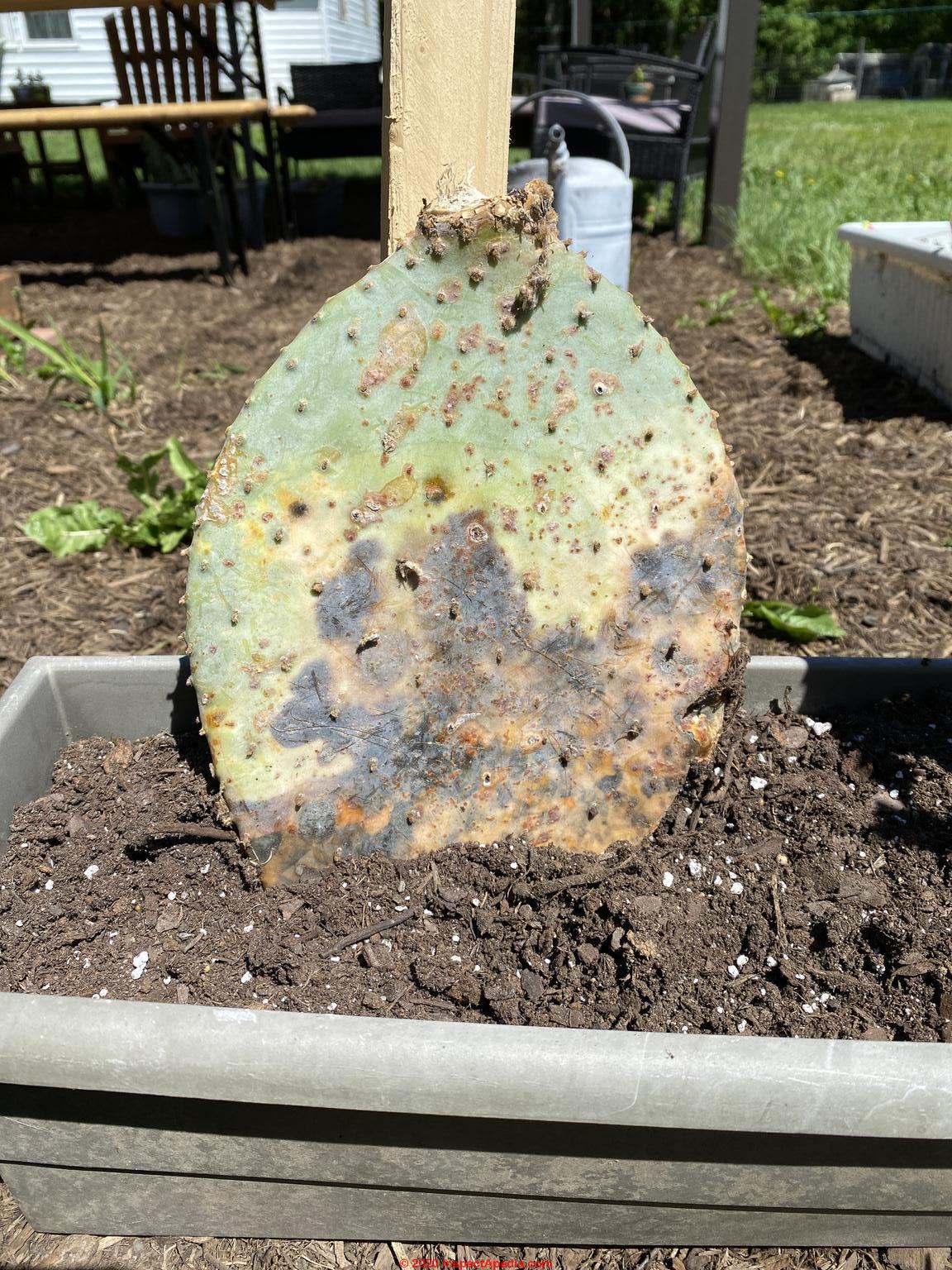 Emili
Emili
That looks to me less like mold than like cactus rot. Over-watering or too much rain can indeed cause rot. The cactus roots will be totally gone.
If I were trying to save that pad I'd pull the over-wet, partly-rotted end out of the planting soil and instead flip it over, put the stem side down (assuming its dry), and keep watering to a minimum for a time;
the rot-damaged area won't get pretty but you may get some new growth off of the sides of the paddle.
On 2020-06-08 by Emili
What should I do with this Santa Rita pad?
It got rained on one day and I believe this caused it to mold
Other Black Damage on Cactus
Anon from Feb 2: re: black cactus fungus - Sun Scorch
That looks to me like Henersonia opuntiae a fungal infection aka "sun scorch" (which isn't really due to sun).
You should remove those infected Nopal cactus or "paddle cactus" pads by cutting or twisting them off (we use cooking tongs to hold the paddle).
Then dispose of the paddles as bagged garbage or burn them so as to avoid spreading this fungus to the rest of your cactus plants.
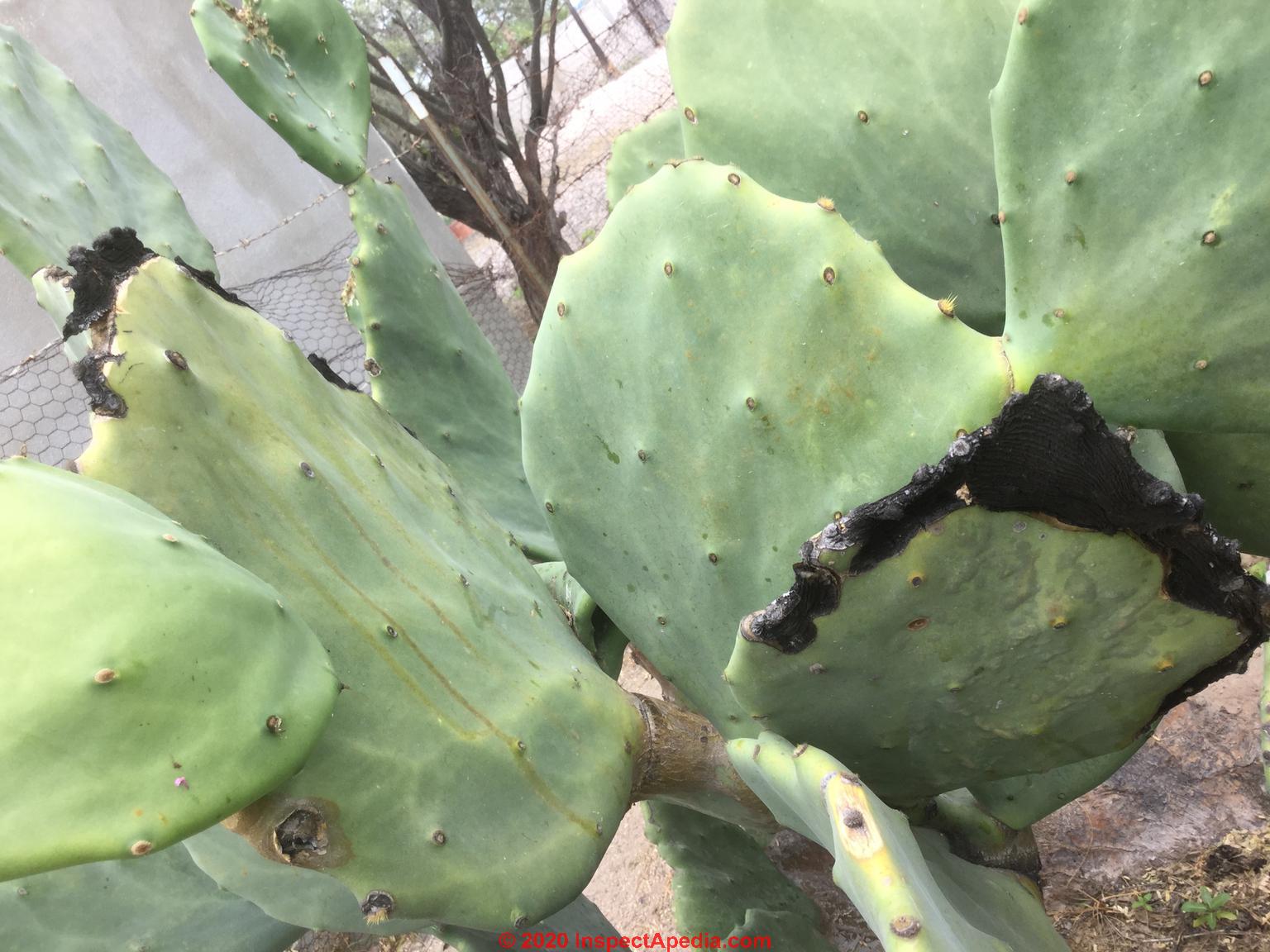
On 2020-02-16 by Anonymous
I have white substance on my cactus and when I scrape it off it looks like a cross between soft rice and very small styrofoam. How do I get rid of it?
Cactus Scale Damage & Scale Removal
These Organos cacti, gift of my sister-in-law Lili, live in pots, get pretty-good sun, and were sometimes over-watered. ( I didn't do it!)
Definition: Cactus scale is a small light colored or white flattened "armored" (hard-surfaced) scale that is circular and has a dark center spot. It's found growing only on cactus, though of course there are other armored scales found on other plants.
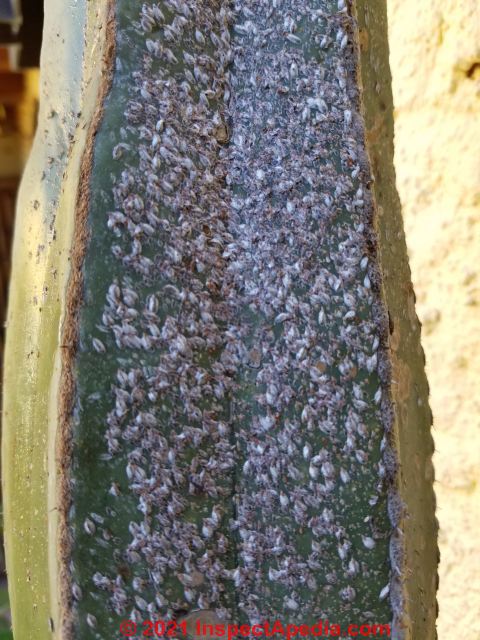
Above: you can see that this cactus has got a lot of water; its pleats are quite expanded. It's also got a lot of scale that developed over several years. At first we just watched it and hoped (in futility) that the scale would magically go away.
Left alone, the scale simply has a fantastic time growing all over the cactus. More sun helps fight it but that's not enough. Below: feeling aggressive and frantic we decided to use, household food-grade white vinegar, straight out of the bottle, as a cleaner. That's a bit strong.
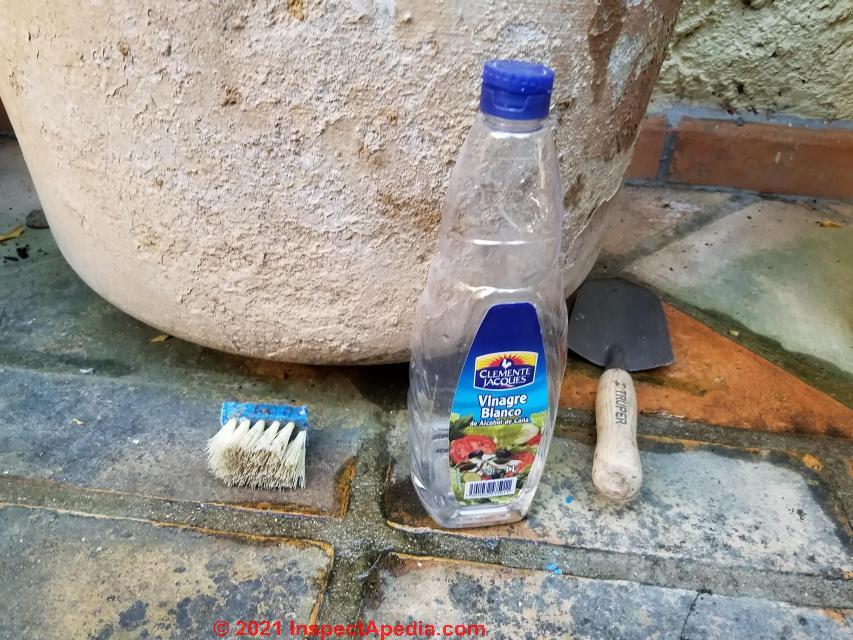
I decided not to use the white brush shown in the photo above as its bristles seemed a bit too stiff and scratchy. Instead I used the softer natural bristle brush shown below.
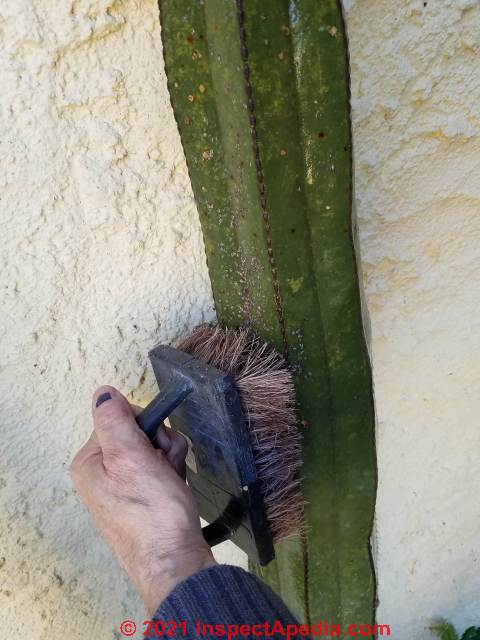
I scrubbed, but not too hard. It's better to scrub gently, with more liquid cleaner, and take more time. You want to leave the cactus' skin un-harmed. The result is below.
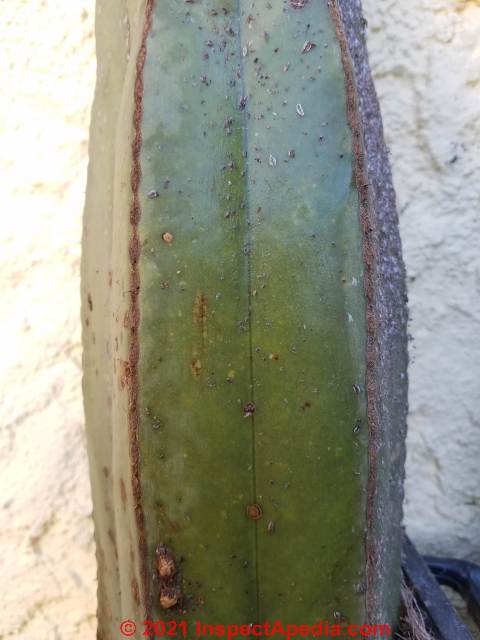
The photos show a successful effort to remove cactus scale growth from these fellows. I used household food-grade vinegar, but will describe some other remedies below.
Treatments for Cactus Scale
A common treatment for cactus scale is gentle cleaning of the surface using either a commercial insecticide or treatment sold for cactus scale such as those listed here.
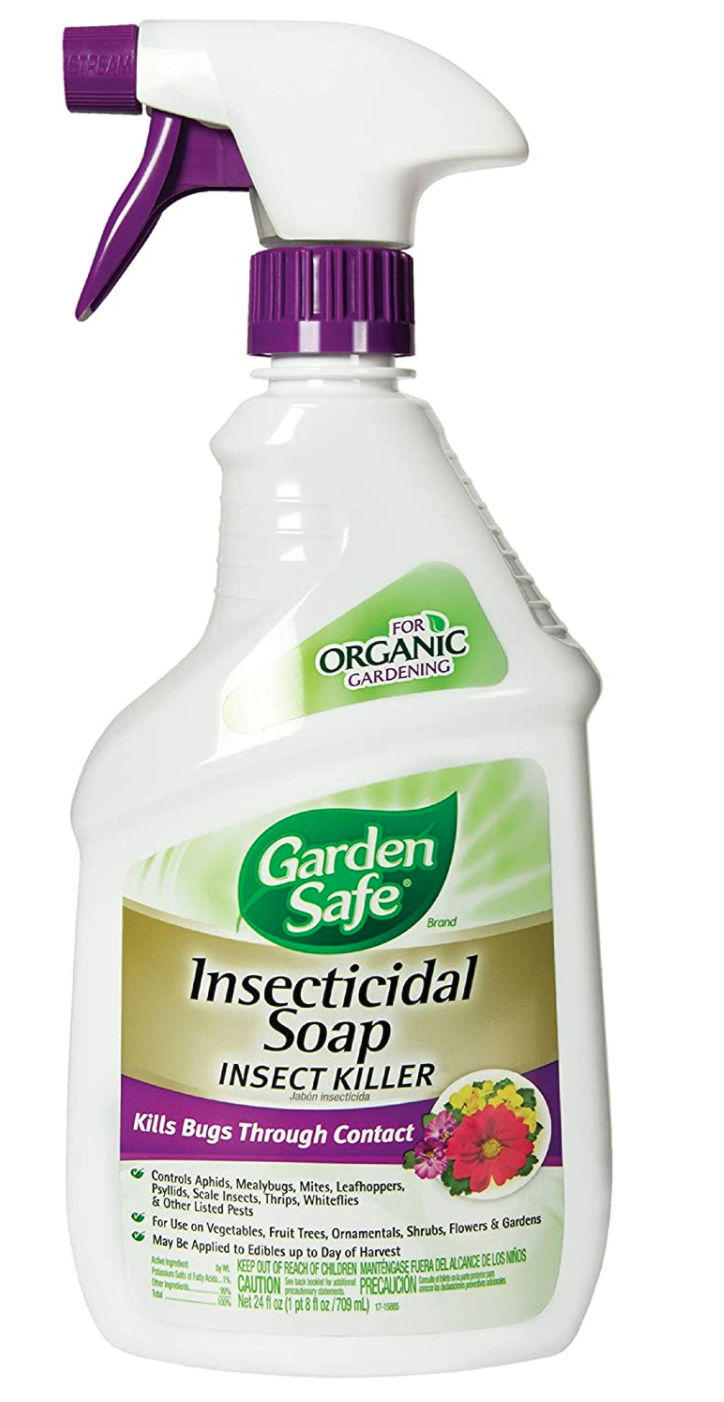
- Insecticidal soaps
such as this product sold by Garden Safe [photo above] can be sprayed on all sorts of plants and plant parts. This product is said to control aphids, mealy bugs, mites, Leafhoppers, Psyllids, Scale insects, Thriips, Whiteflies and "other listed pests".
Manufacturer's product description:
Potassium Salts of Fatty Acids, the active ingredients in Garden Safe(R) Brand Insecticidal Soap Insect Killer, are made from plant-derived sources.
The active ingredients damage the cell membranes of many soft-bodied insects, such as aphids, whiteflies and mites, killing them through contact. - Neem Oil Spray -
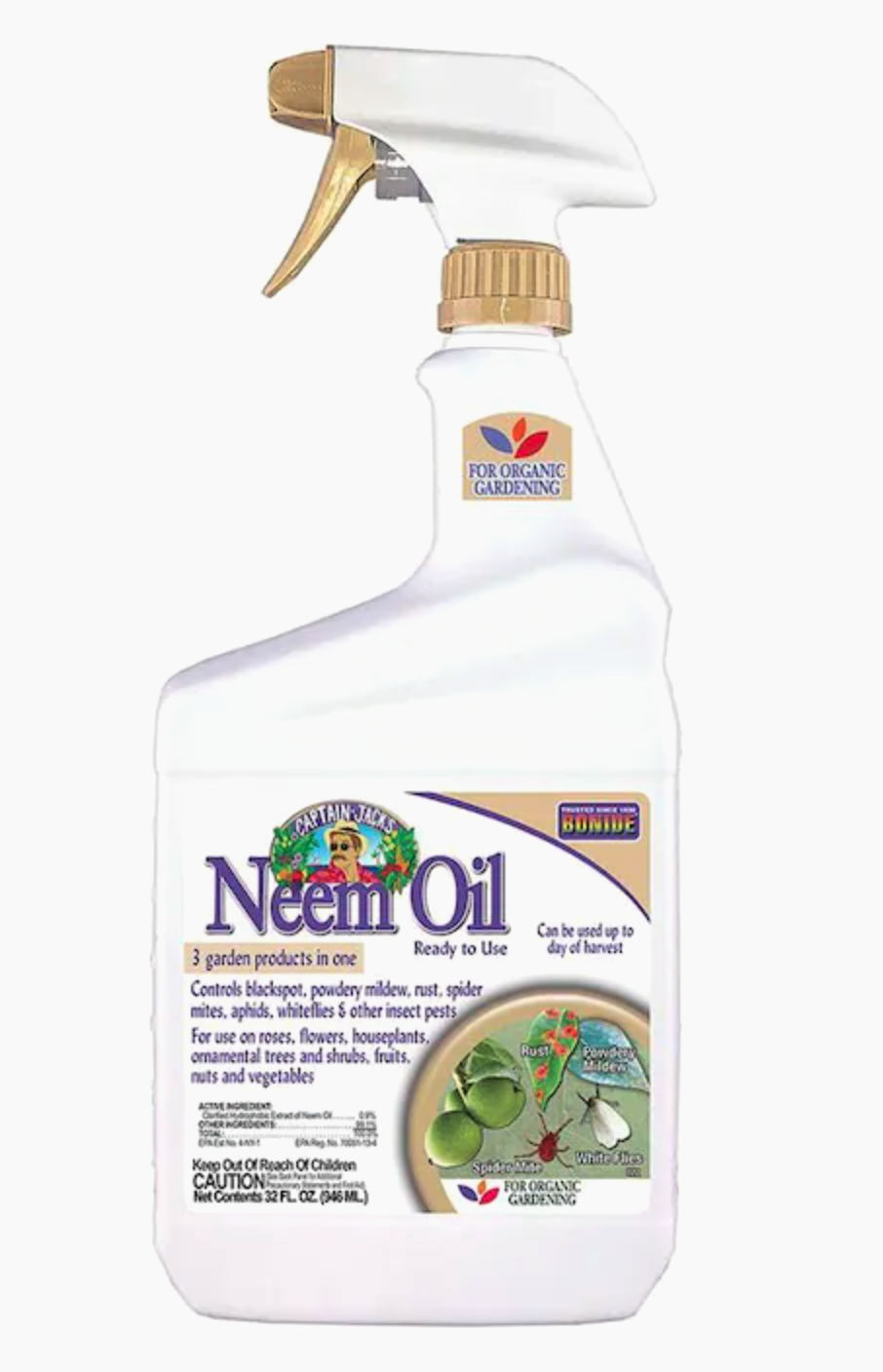
an "organic" insecticide, fungicide, and miticide (mite Killer) (shown below) - we use this also on our peach trees but not close to harvest. Be sure to use Neem oil as directed by the manufacturer. Shown here is Neem Oil spray from Bonide.
Bonide, Ortho, and other manufacturers sell a wide range of fungicides and pesticides for plants. Other examples are copper fungicides, a mixture of Neem oil with fungicides and miticides, Be sure to read the manufacturer's label about proper selection of the treatment as well as how it should be applied.
Bonide's description:
An all purpose insecticide, miticide, fungicide for organic gardening. Derived from the Neem seed, Neem Oil is an excellent choice for use on virtually any plant, including roses, flowers, vegetables, herbs, spices, houseplants, trees, turf and shrubs. Kills all stages of insects - eggs, larvae and adults. Makes a great dormant spray.
A spray mixture of 50% rubbing alcohol (76 to 95 %) and 50% water and 4-5 drops of dishwashing detergent to make a total of about 16 oz of liquid (2 cups).
Put that into a clean spray bottle, spray the scale, and wipe it gently with a soft cloth or a sponge. On our tall Organos cactus which are the iron-men of San Miguel de Allende I used a natural-bristle scrubbing brush that worked quite well.
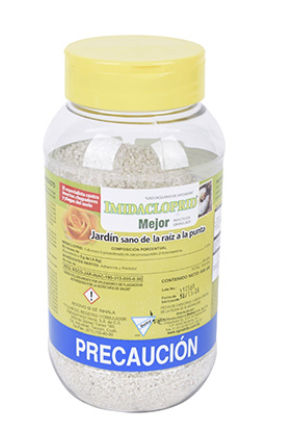
- Systemic insecticides for cactus scale:
some cactus experts suggest that if your cactus have a lot of scale you might prefer a systemic insecticide such as Imidacloprid applied as a "soil drench" to the soil around the cactus (+ normal watering).
- Natural predator insects
that attach some, but not all scales, may be effective on soft cactus scale: Cryptolaemus montrouzieri, dark brown ladybugs, sold by garden suppliers in both larval and in their adult forms.
Really? Well not everywhere. These insects feed on aphids, mealybugs, and soft scale and are effective in greenhouses where humidity may be kept high (over 70%) and temperatures kept between 64 and 80 F; they will probably not survive very hot conditions such as the Arizona desert in July nor very dry conditions such as the high plains of Guanajuato.
If you clean off the scale before it coats most of the cactus you can probably save it.
I also avoid over-watering and too much shade.
Reader Comments, Questions & Answers About The Article Above
Below you will find questions and answers previously posted on this page at its page bottom reader comment box.
Reader Q&A - also see RECOMMENDED ARTICLES & FAQs
On 2022-06-14 by InspectApedia-911 (mod)
@steven,
Super. Do keep us posted, perhaps taking photos of your work, as that will help others.
Daniel
On 2022-06-14 by steven
@InspectApedia-911, thanks again, so I will try option 1 on 4 cactus, and option 2 on the remaining 3, after a month I will tell u the results. by the way, your website is great and has so much good stuff on it. well done creating it.
On 2022-06-14 by InspectApedia-911 (mod) - trimming and repotting may save overwatered cacti
@steven,
I'm not sure, but some cactus experts - more expert than I - have described two vastly-different approaches;
1. leave the cactus unwatered and watch it for signs of recovery - stabilizing and eventually new growth - I'd skip watering for no less than a month.
2. remove the cactus from the pot, cut off any rotted damage at its base, let it dry out - days or more - then re-plant it in sandy soil.
If when you remove the cactus you see that its base and roots are not totally rotted away, then you'd wash off the roots, cut away rotted cactus body, let that dry, re-pot in new sterile soil. Some cactus experts also use sulphur powder as a disinfectant on the wounded area.
Others, concerned with aesthetics, excise all of the rot and dry the cactus and re-pot it so that the injured area is no longer visible.
If the cactus base is badly rotted, people cut away salvageable parts from the upper cactus and re-root those as new plants.
Bottom line: based on our experience with cactus in Mexico, we cut off the intact top of the plant, let it dry for a week or longer until the base is a dry scarred surface, then re-pot the cactus in new clean "sterile" sandy soil. That plus patience is what have worked for us.
On 2022-06-14 by steven
@InspectApedia-911, thanks a lot for answering. so, I will reduce the amount of watering. Do you think these symptoms indicate a disease that will progress and kill the plants? what can I do besides reducing watering to make sure they won't die?
On 2022-06-13 by InspectApedia-911 (mod)
@steven,
I suspect those cactuses are being over-watered. We have quite a few of them on a hot dry sun exposed rooftop in central Mexico and it is still the case that we would never water them every week. Sometimes a clue of over watering besides stem rot is that the folds of the cactus begin to open up or the cactus looks a bit bloated.
On 2022-06-12 by steven
Due to the symptoms, I thought my cacti's disease was a kind of fungus, so I sprayed it once a week, for 2 weeks with carbendazim+iprodione "these are fungicides", however, the disease is progressing. In addition, the disease has only affected the epidermis of the plant.
Could these symptoms also be due to bacterial disease? Can someone help me diagnose and treat my cactus disease?
The size of these cacti is small, so larger pots are usually watered once a week, and small pots are watered twice a week.
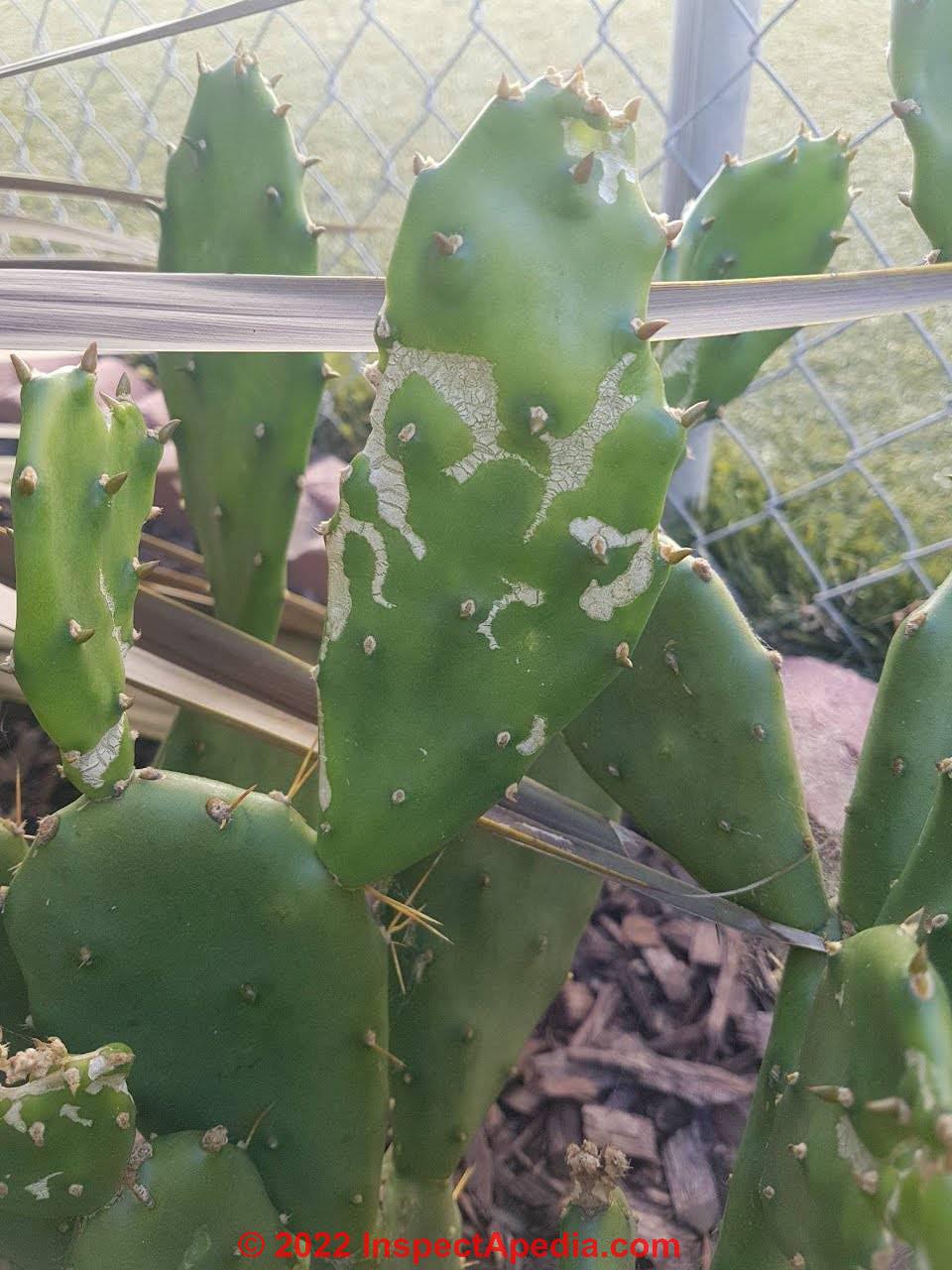
On 2022-06-01 by InspectApedia-911 (mod) - cactus scarring
@Jen,
To me that looks more like scarring than a fungus. It's possible that the cactus was rotted from watering and is healing itself.
On 2022-06-01 by Jen
What is this whiteish stuff on my cactus. It can be scraped off with my fingernail but it looks weird
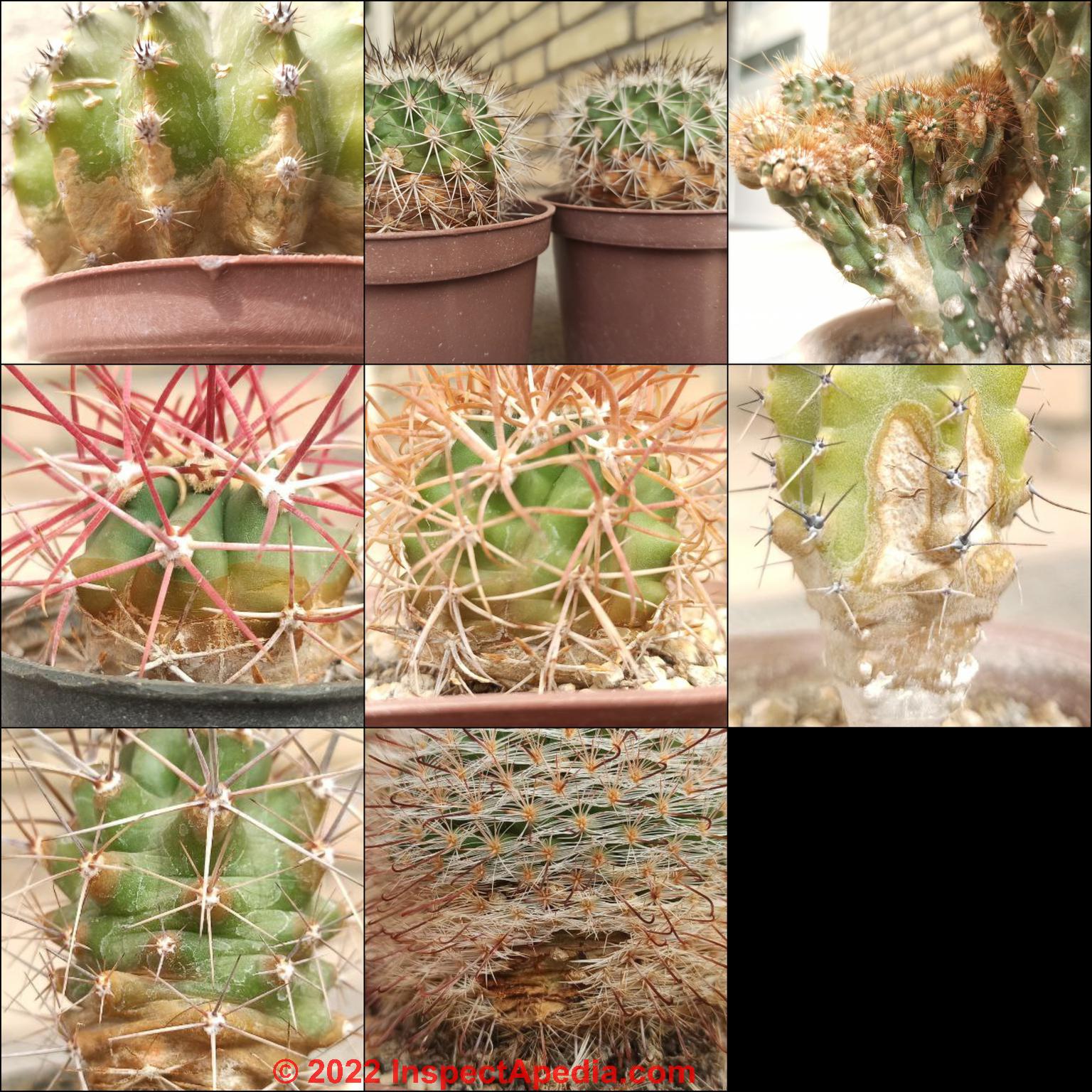
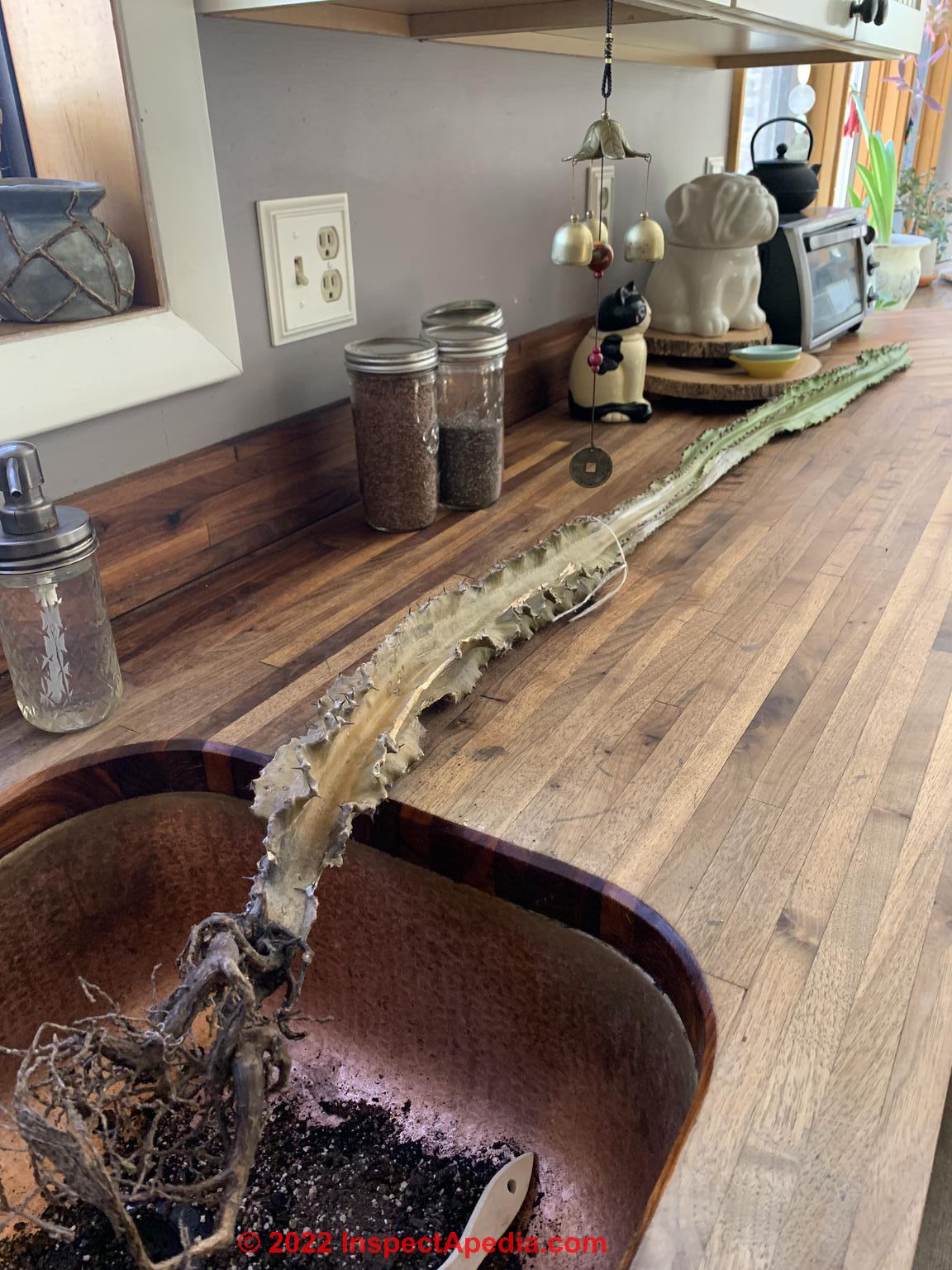
On 2022-04-03 by Inspectapedia Com Moderator - cut away dead part and repot green portion
@Kb,
There's a good chance you can save the green upper portion of that cactus (Organos ?) - cut away all of the damaged base,
then let the cut-end of the salvaged cactus plant dry thoroughly for a week or so - until its cut-base is no longer fresh or damp.
Then you can re-plant it in a fresh pot of sandy soil - well drained.
On 2022-04-03 by Kb
I've had this cactus for 19 years and am heartbroken something is wrong with it . After noticing I repotted and added neem oil
On 2021-10-22 by inspectapedia.com.moderator - cochineal scale treatment needed
@Nicolas,
In the above article, you will want to take a look at our description of cochineal scale and its treatment in the article above.
On 2021-10-22 by Nicolas
I have had this cactus for a little more than a year, and this white stuff has grown all over one of the cacti. Additionally, it also appears to be releasing many tiny tiny flying bugs (they are almost microscopic). Please help!

On 2021-07-12 by inspectapedia.com.moderator
@Clare,
You will want to take a look at our description of cactus scale and its treatment in the article above
On 2021-07-12 by Clare
What is happening to my only cactus? This white stuff has increased rapidly over the last 3 to 4 weeks.
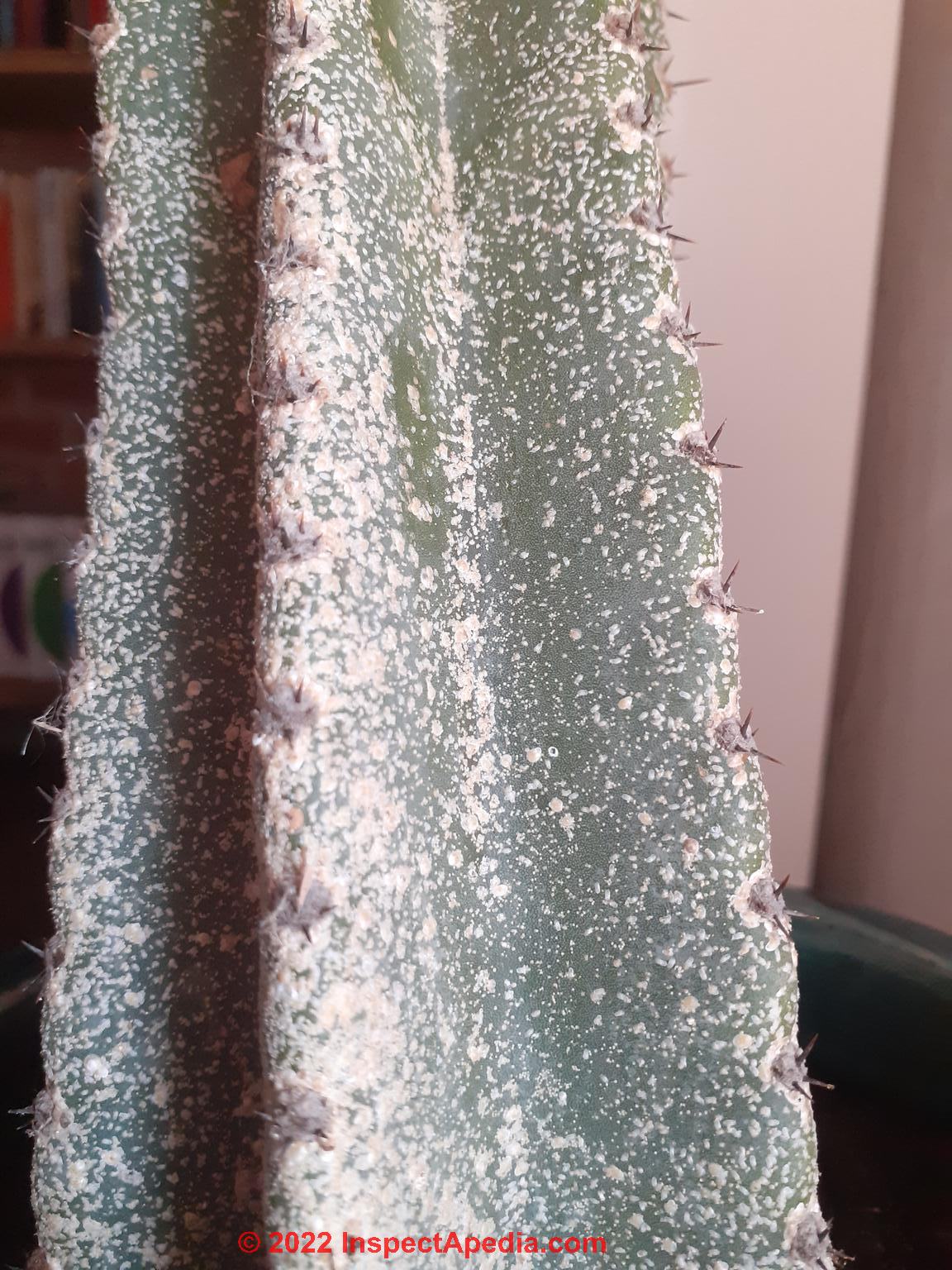
On 2021-06-08 by (mod) - remedies for light colored scale on cactus
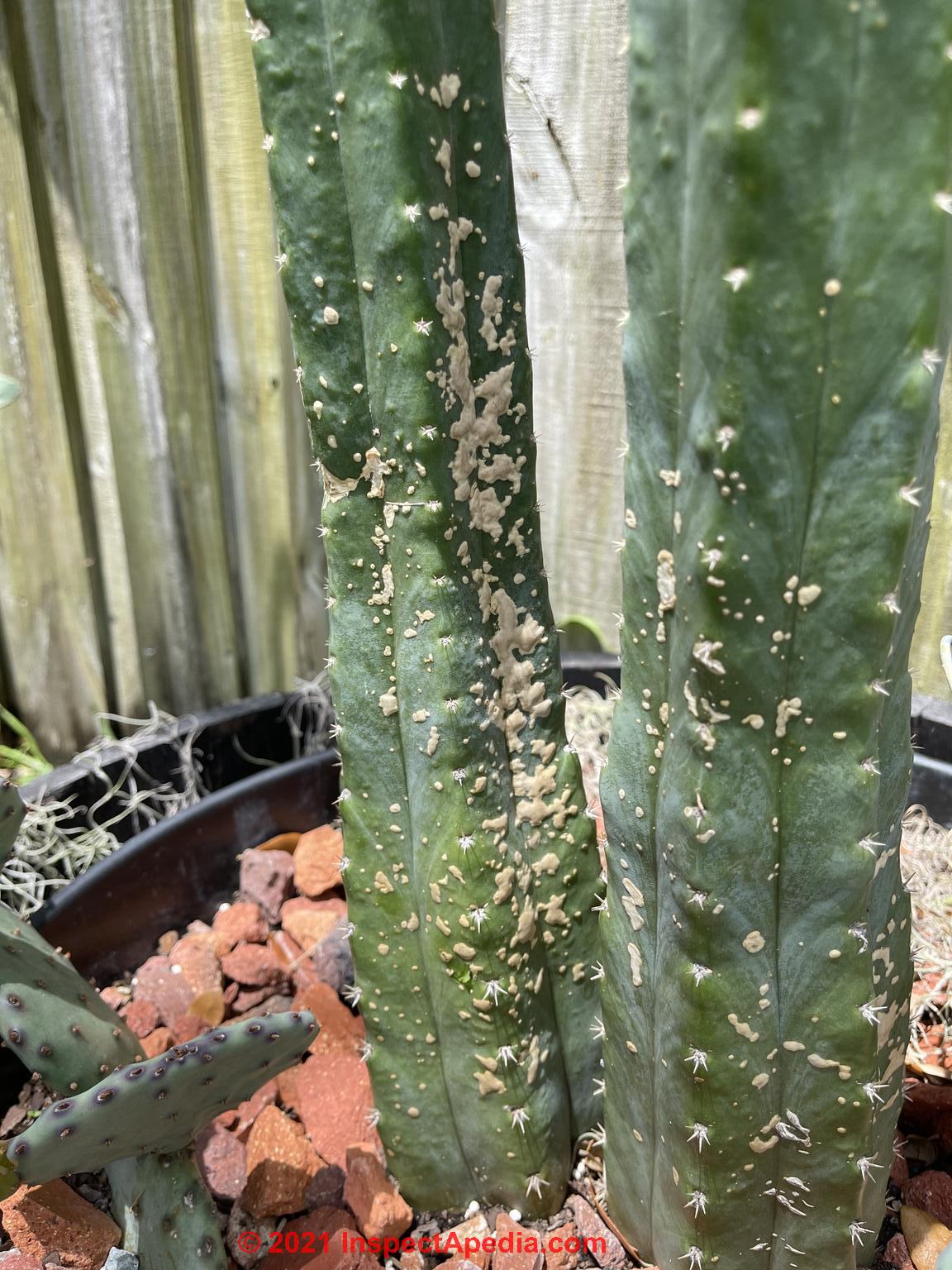
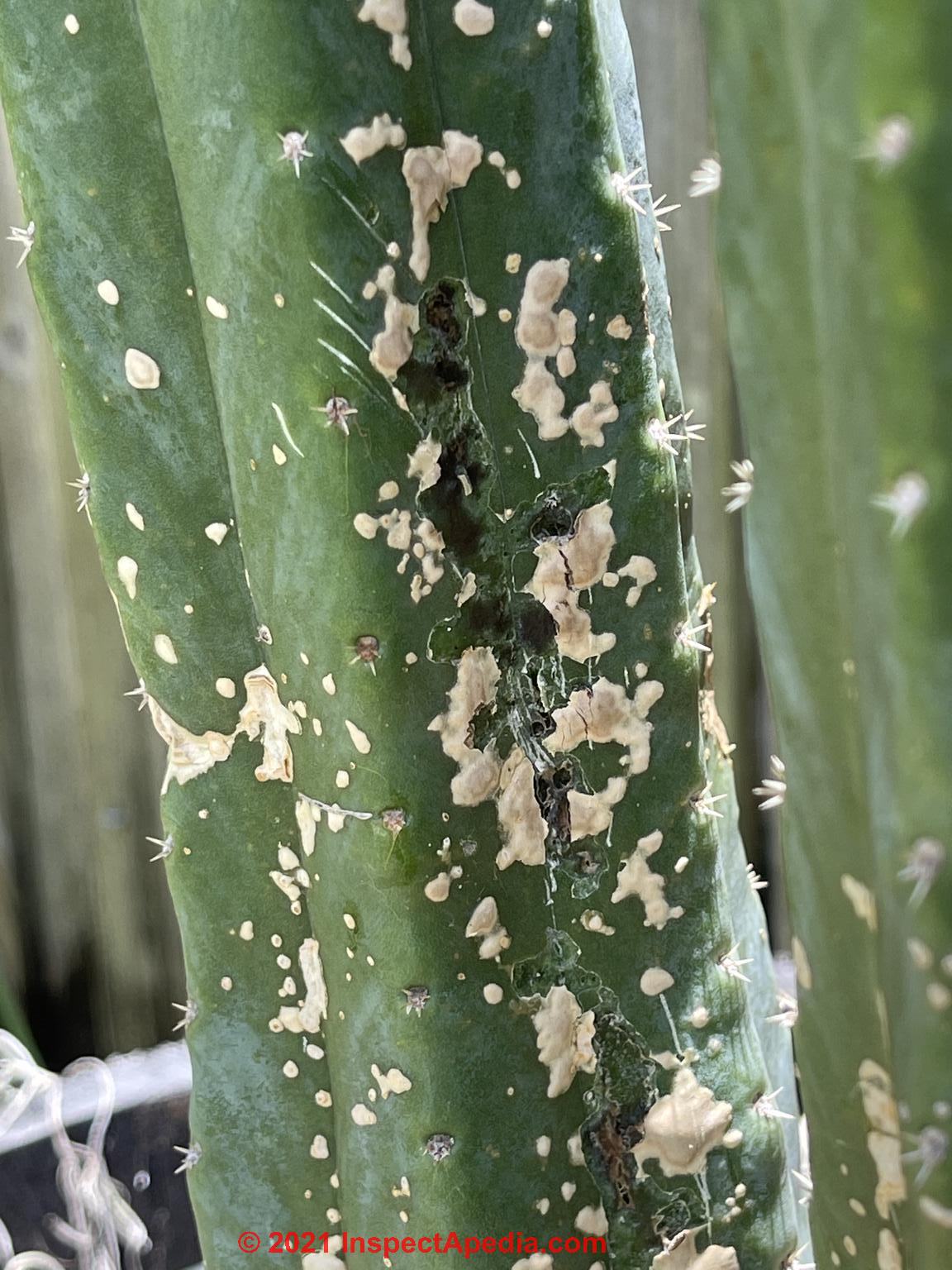 @Maria
On the page above you will want to read the problem description and recommended remedies at
- CACTUS SCALE REMEDIES - read this section first
and perhaps also take a look at
- CACTUS FUNGUS - WHITE MILDEW - also see COCHINEAL Infestation above
On 2021-06-08 by Maria
I don’t see it I just took some off and this is what it looks like [Photo above]
On 2021-06-08 by (mod)
@Maria, in the article above take a look at the discussion of scale on cacti.
On 2021-06-08 by Maria
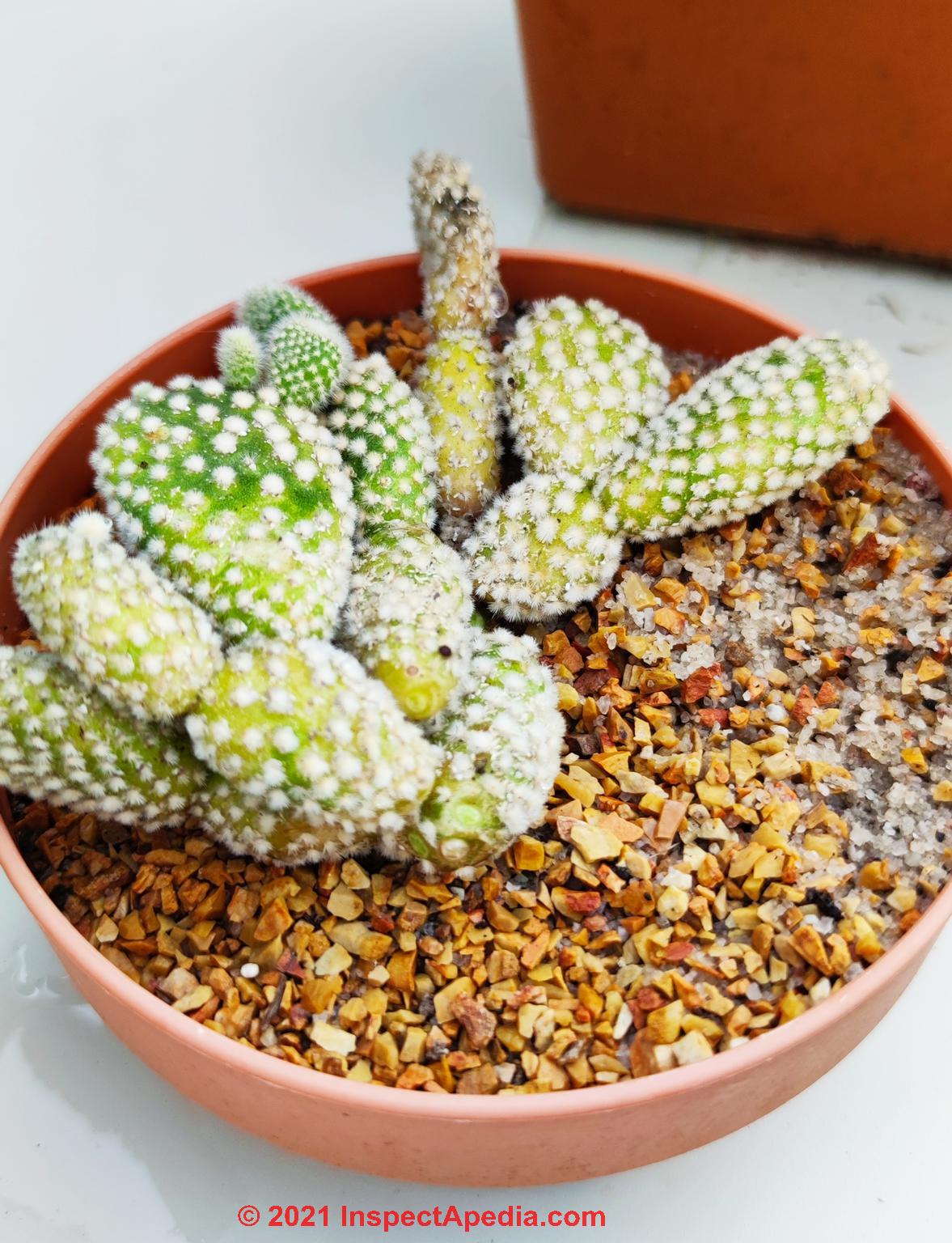
hi! I need help I don’t know what this is growing on my cactus. PLEASE HELP!!
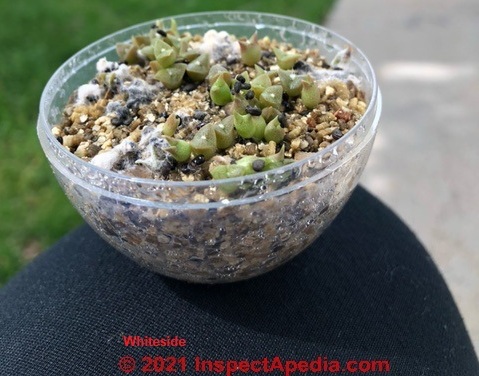
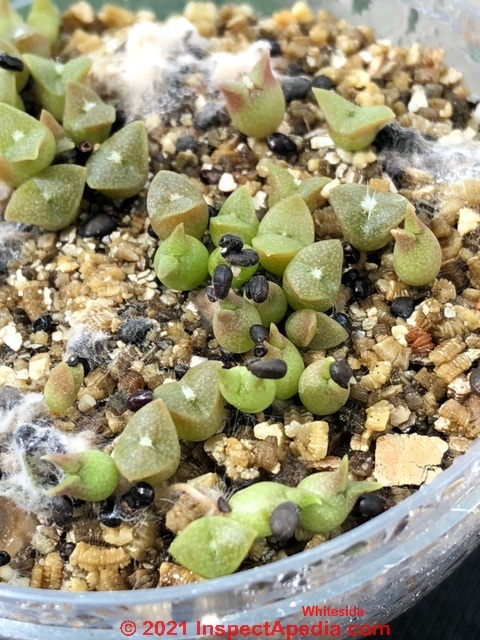
Question: identify & treat white growth on succulent plants
I am growing these seeds and am not sure if this is mold and if so the best way to get it off these babies. - Anonymous by private email 2021/06/08
 ...
... 
Moderator reply:
Above and below on this page we illustrate several white growths on cactus and succulent plants, including
- CACTUS COCHINEAL INFESTATION - COCHINEAL Scale (my first guess) or
- CACTUS FUNGUS - WHITE MILDEW - Also see
- CACTUS or SUCCULENT MEALYBUGS - or perhaps Mites
mold and mealybugs or other pests along with recommended treatments.
Please take a look and don't hesitate to ask follow-up questions if you need.
On 2021-05-06 - by (mod) -
@Michael Harrigan, worth the try, just bring them in if it rains. Let me know if that helps.
On 2021-05-05 by Michael Harrigan
Thank you for your comments and advice. I think I'll try rotating them outside the greenhouse for direct sun and fresh air!
On 2021-05-05 by (mod) - cactus fungal attack, Gulf of Thailand
@Michael Harrigan, thank you for all of the cactus-mold photos; you're not over-doing it.
I agree that it's probably humidity that invites mold growth on your cacti, particularly as you already know not to over-water them.
Short of installing a dehumidifier, about all you can do is increase sun exposure and be sure that your indoor RH is as low as you can get.
On 2021-05-05
by Michael Harrigan
I just noticed that we have what looks like mold/fungus on a few types of opuntia. I'm attaching photos as I'm not sure
We live in Thailand, on the Gulf of Thailand and are coming out of our hot season (hot and dry) and the humidity is on the rise.
The rainy season starts in a couple of weeks. I have been keeping the plants in a small greenhouse with an open flap, with the idea that I would keep them from the heavy rains. Any suggestions?
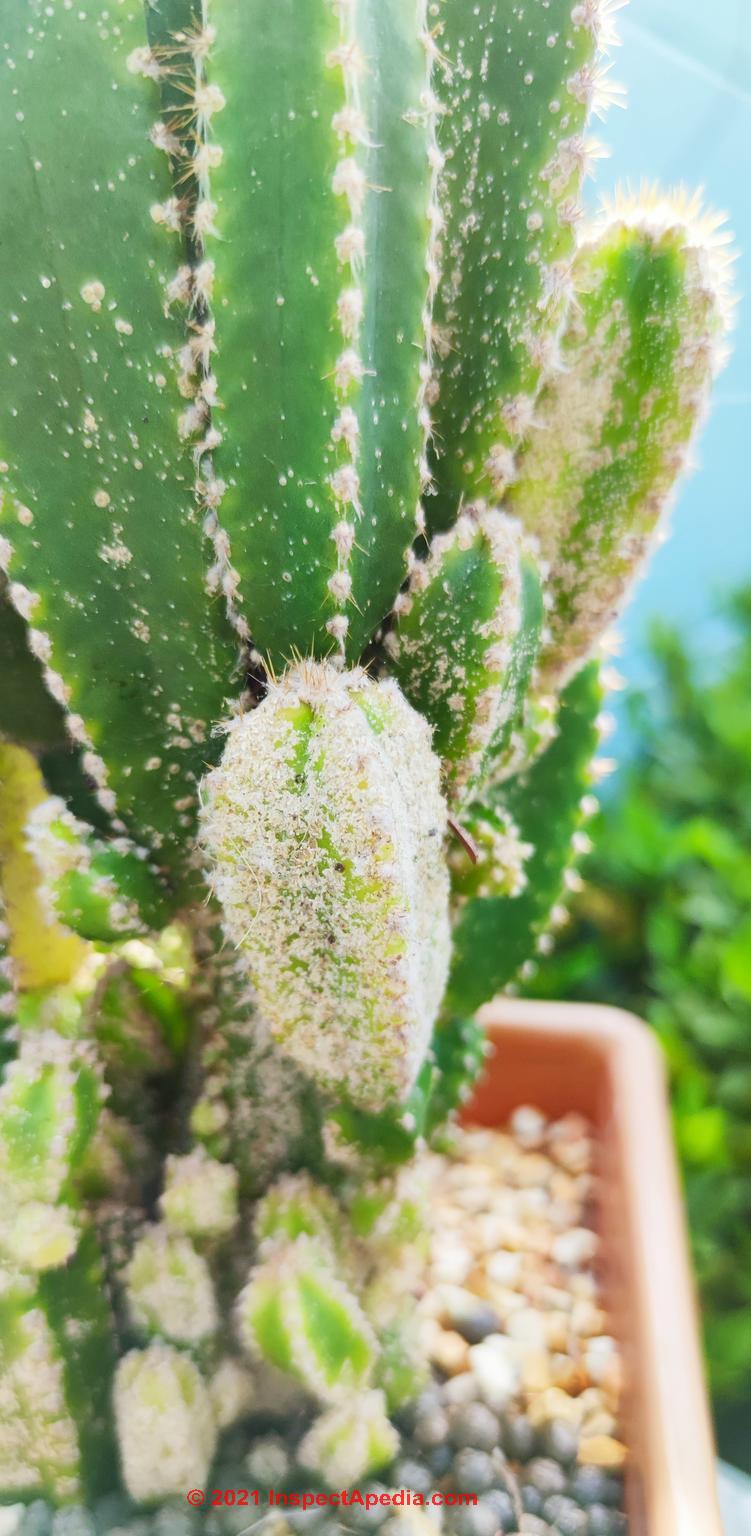 ...
... 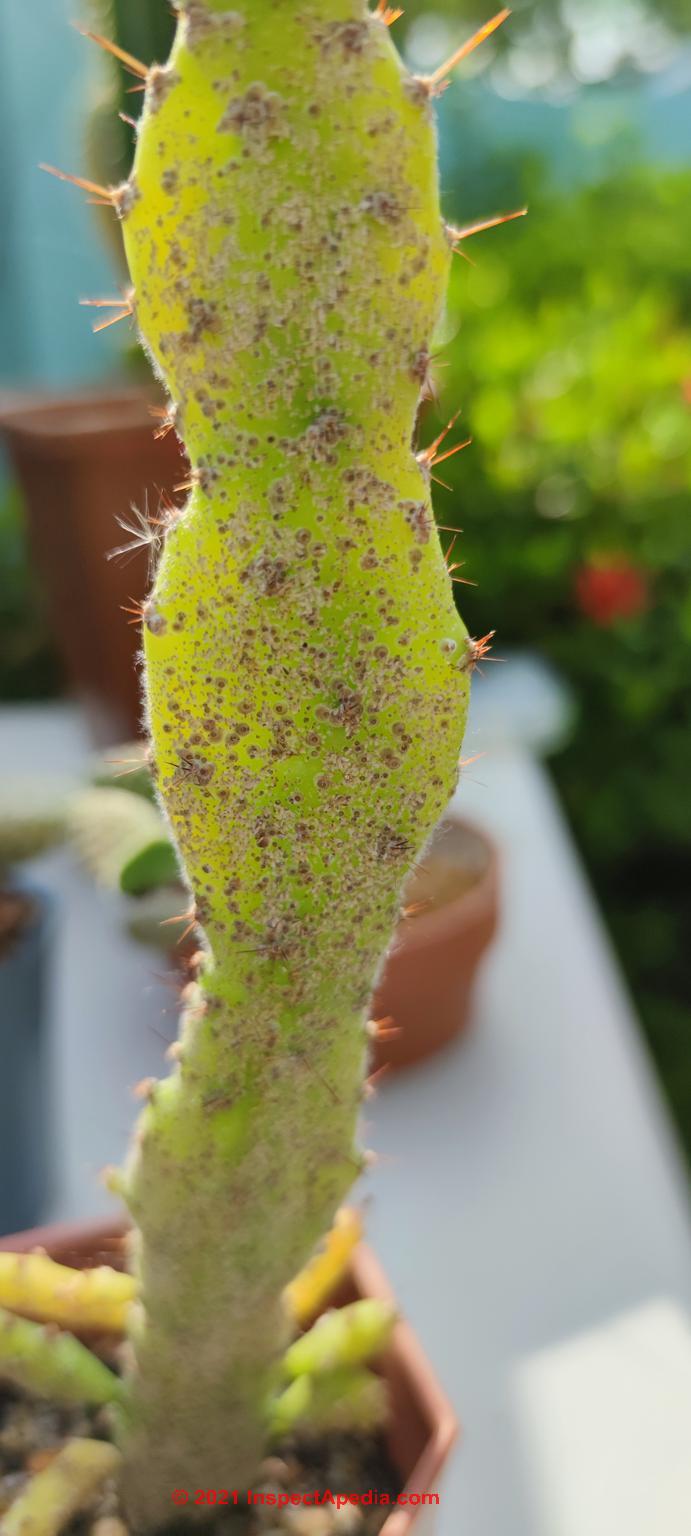 ...
... 
On 2021-02-25 b danjoefriedman (mod)
I'm not the most-expert but that looks like a form of scale or rot; You could try gently rubbing the spots with alcohol on cotton and then make sure the plant is getting sun.
On 2021-02-25 by Melinda
I know nothing about this cactus as it was given to me. It is planted on the same pot as a big aloe plant and was doing great. Had 3 babies grow off it and now suddenly these spots and drooping started happening.
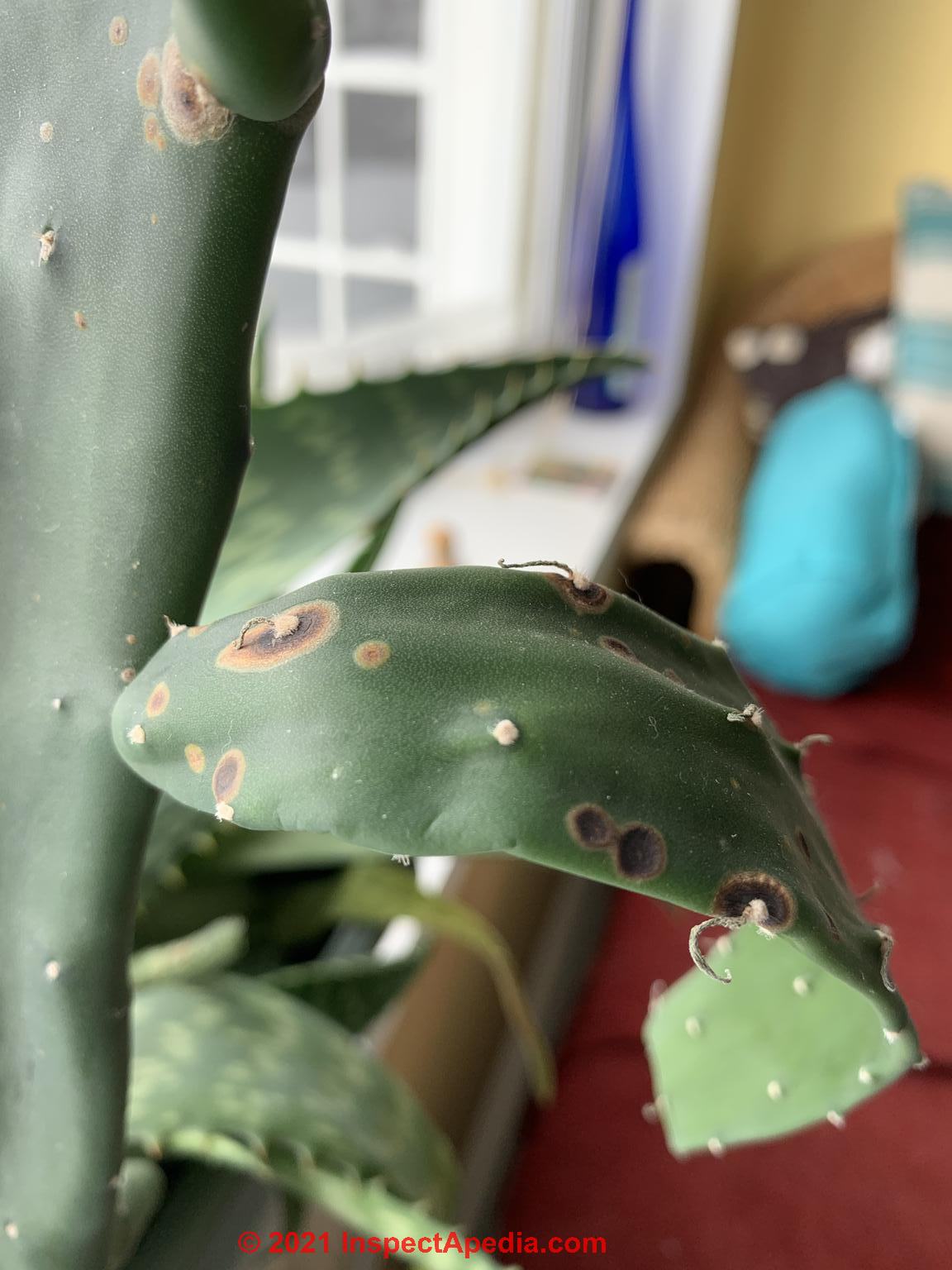
On 2020-12-16 - by (mod) - white cactus mold Rx
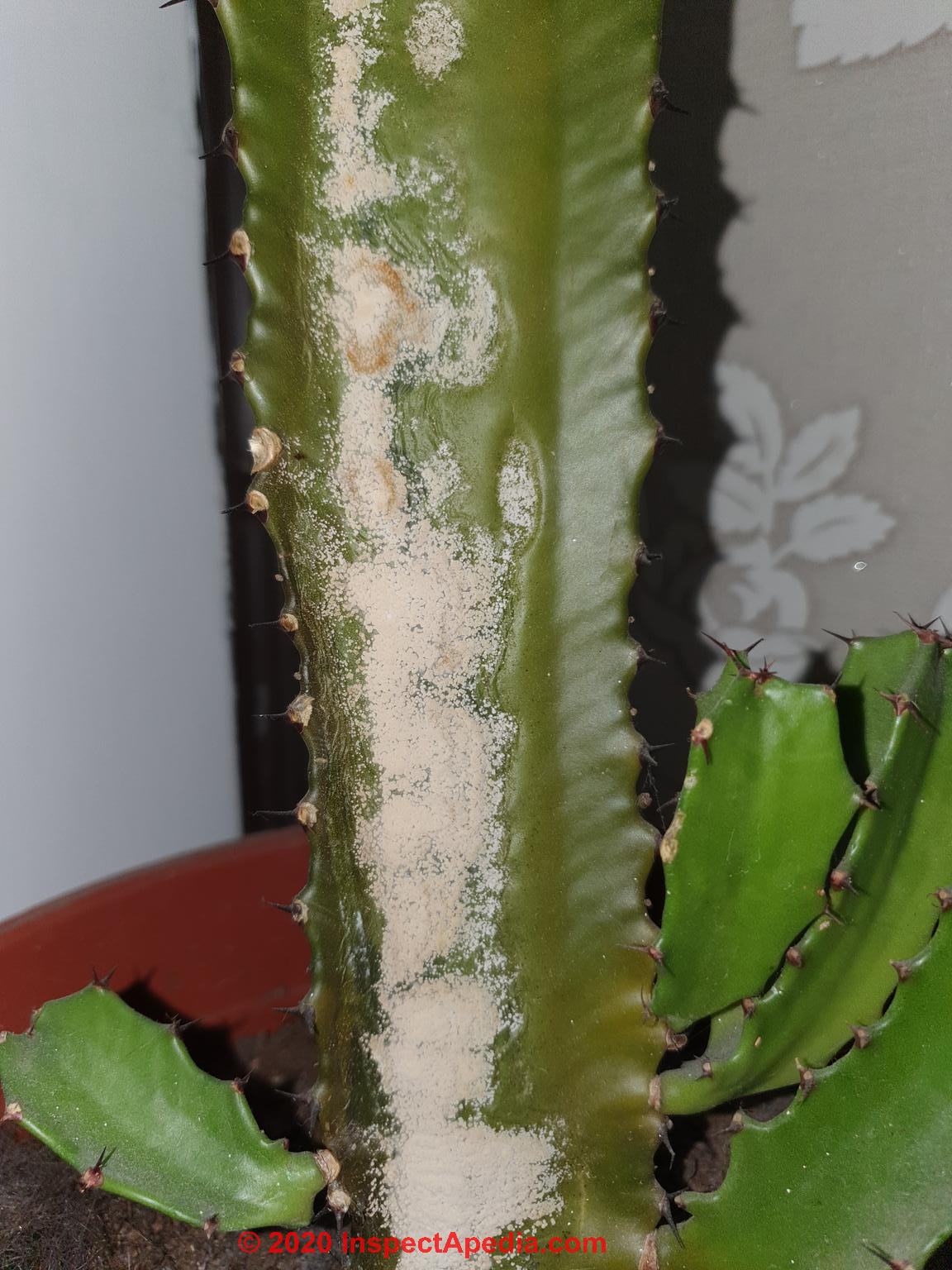 Alex
Alex
I'm not sufficiently expert to be sure that I have exactly the right opinion for you here but it sounds to me that if you have gone through all of the white cactus mold examples described on the page above, reviewing their appearance, cause, and treatment, and you're left with an unidentified fungus and rotted cactus, then you need to cut out or excise the infected part of your cactus.
I know that's traumatic but that may be the only solution if in fact the cactus is rotted.
I can't tell from your photo but if this surface material is fuzzy and white it's not rot; see if you can wipe it off, and then read our suggestions above for dealing with mealybugs, mites, and for cleaning cactus surfaces using a plant soap or mixture.
On 2020-12-15 by Alex
There is a white growth on my cactus. The whiteness does not rub red so I don't believe it is mealybugs.The tissue under the white mold is soft when pressed although the rest of the cactus is firm. Unfortunately the infected area is at the base. Is there any advice on how I can save him?
On 2020-10-05 by (mod) - cactus probably finished off by scale
Looks like scale;
I'm afraid that cactus is a goner. I'd keep it away from the others if not send it to the trash. Light scale can sometimes be gently scrubbed off but in my OPINION (I'm not expert) that one is about as scale-covered as I've seen. \
On 2020-10-05 by Rachel
My aunt bought this cactus like 6 months ago and now it looks like this. What could be growing all over this cactus?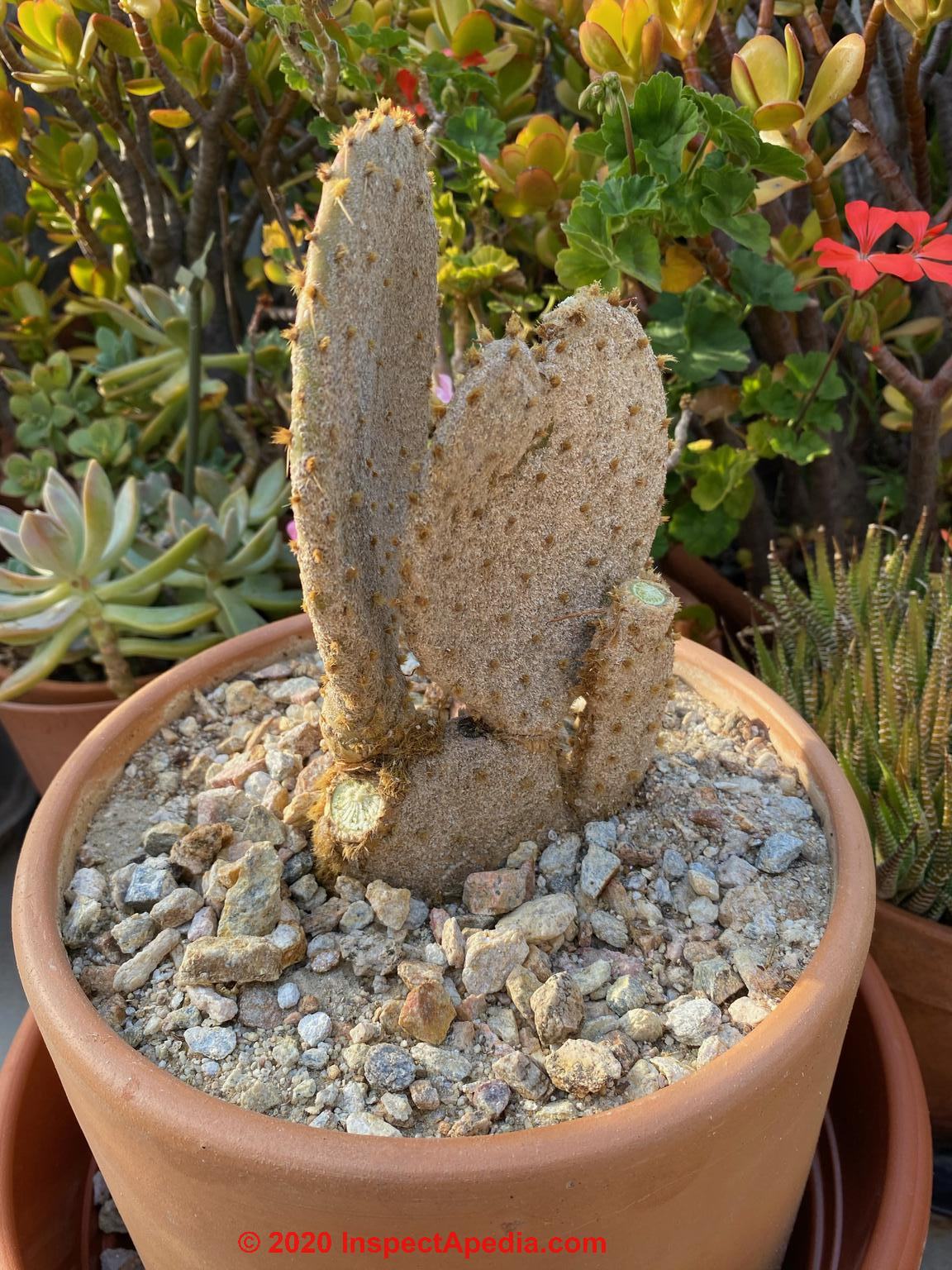
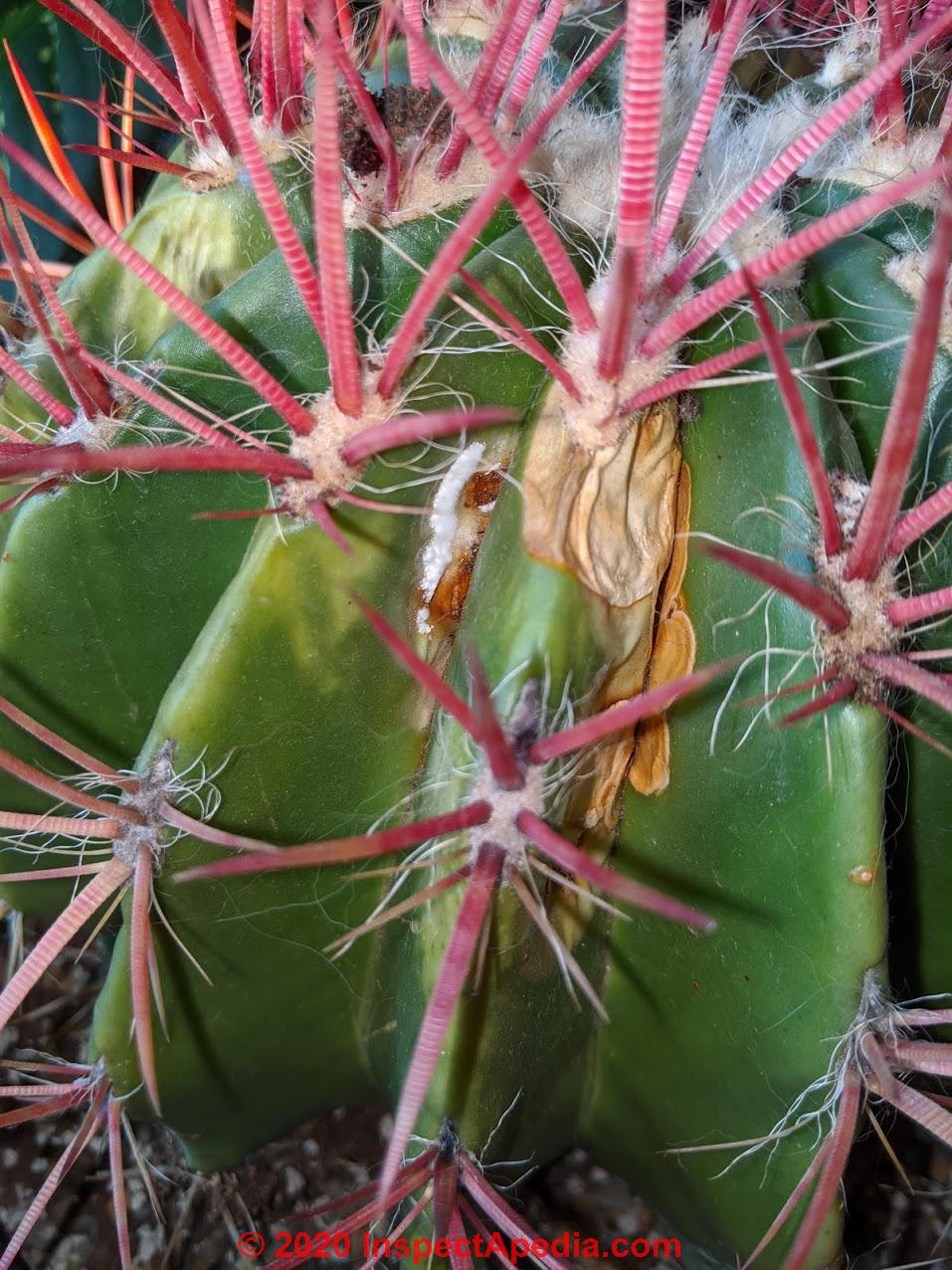
On 2020-09-28 - by (mod) - Ferocactus has started showing yellow dry spots
Nate:Cactus experts usually tell us to cut out the infected moldy parts of the cactus and let the wound dry and heal; perhaps your cactus needs more sun. A plant light may give the required UV but not the warmth.
On 2020-09-28 by nate
Ferocactus Pilosus rot or mold forming. In the last week my Ferocactus has started showing yellow dry spots on it, it has gotten worse over the last few days and now one spot has white stuff on the yellow dry spot. Any idea what is causing this?I have had the cactus for over a year, it doesn't get a lot of sun, but I have a plant light shinning on it daily. I watered it about once or twice a month. Not sure what to do about this.
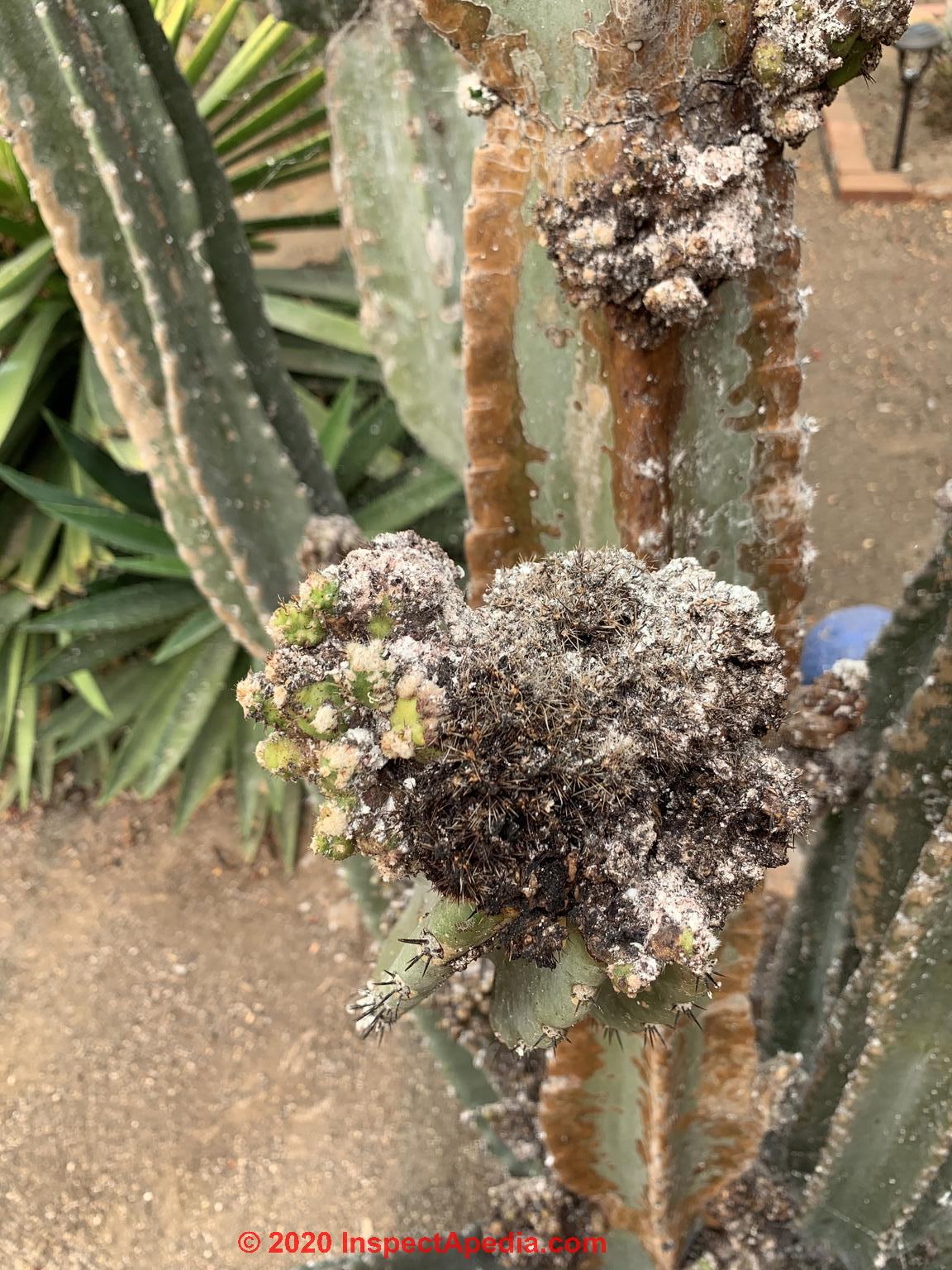
On 2020-09-10 - by (mod) -
BeckyI have not seen that exact growth on a San Pedro or similar cactus, but it looks to me as if we may be seeing a combination of scale on your cactus and an oozing sap that has built-up near the plant base.
I've seen similar damage ascribed to bacterial growth in the cactus. You might try cutting away the damaged "growths" and making sure your cactus gets adequate sunlight.
On 2020-09-10 by Becky
I've had this cactus growing for about 5 years. the last year or so it has Developed this growths . no flowers or fruit or new growth.here are some pictures of it.
On 2020-07-26 - by (mod) -
Without knowing exactly what the white dust is I can only suggest the most mild remedy such as I dilute dish soap solution at a toothbrush to do a little gentle scrubbing.
Make sure your cacti are getting enough sunlight. And of course rinse thoroughly but don't over water the cactus itself.
If you think that it's parasite you could try a dilute vinegar spray
On 2020-07-25 by Brenda
What can I put on my cactus to get white dust off of them
On 2020-05-30 by Teddy
How to naturally get this off my cactus
On 2020-05-06 - by (mod) -
Maiya
My guess is that the in-focus cactus suffered from rot from over-watering. Both of them have some bulges that may indicate trouble moving water up through the plan or episodic over-watering.
On 2020-05-06 by Maiya
I am wondering what is going on with two separate cactus. They were growing side by side in a fairly well lit window sill. I may have over watered one and the other one may have got sun burn from my research so far.
The over watered one is showing signs of rot or fungus , or it could be an infestation.
The sun burned one is also having brown lesions spreading and both of them have very white fuzzy prickles.
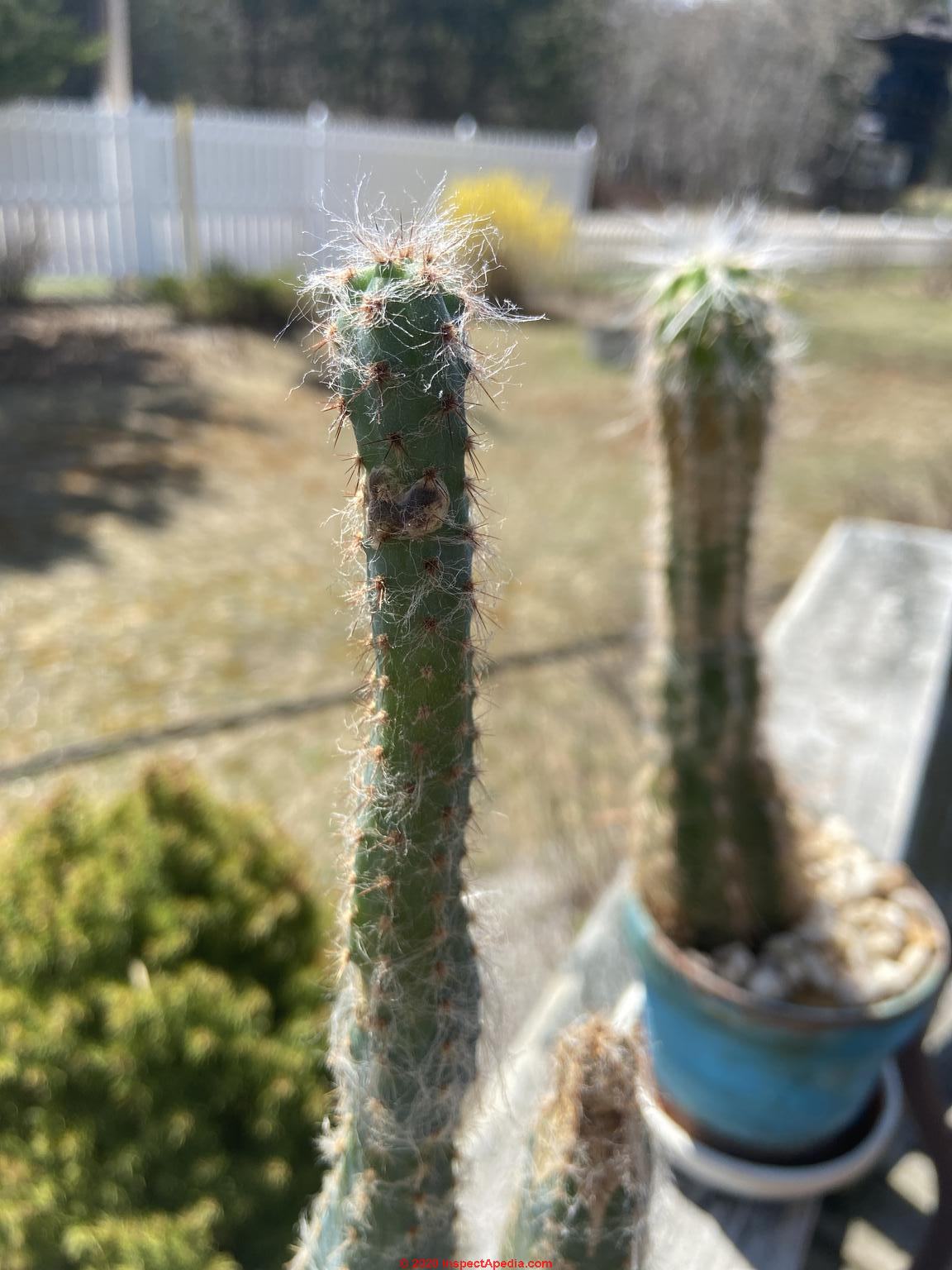
On 2020-03-25 - by (mod) -
Thanks for the follow-up, Joe.
Over-watering can cause paddle rot and whitening too - though usually we see obvious soft, soggy rotted areas during that event.
Watch out: the bad news is that over-watering can kill the cactus root system. I'd put the cactus on a water-diet. I don't water our cactus until the soil is thoroughly dry - for at least as far into the sandy soil as I can get my finger or a probe.
I find that many people over-water their cacti or perhaps like yours the cactus location gets more water than wanted.
I would consider installing gutters and a downspout to get water away from both the cactus and the house.
On 2020-03-25 by Joe
Thanks for your comments. The affected Pear located in Oro Valley AZ (Tucson area) is in a front yard facing NE with rock/gravel drainage. I tested for the parasite infestation and don't believe that is the cause. This white substance is quite hard and dry.
While I believe that the drainage is quite good, I noticed that part of the roof where there are no gutters drains straight the area in which the PP is located and there has been quite a lot of rain this winter/spring.
I'm suspect that it may be the result of over-watering for the reasons mentioned and that it seems to start at the tips of the pads though it's fairly widespread, some areas more than others. Thoughts and comments appreciated.
On 2020-03-22 - by (mod) - large patches of dry scaly white areas on several cactus pads
Joe:
I think your cactus may be sunburned.
Is this a hothouse or greenhouse-raised cactus that was later moved outdoors?
What are the country and state and nearby city of its location?
Try:
- watering the cactus at a consistent time (of course not over-watering)
- erecting a fabric sunshade (these don't block all sun, just much of it) over the most-injured paddles of the cactus between 11AM AND 2PM daily for a few months and let me know if the shaded paddles are in better shape than other un-shaded areas - this will help both you and other readers diagnose these white patches.
Unfortunately nothing will bring back the white areas of damage. But as we've seen marching around the deserts of central Mexico, even very ugly damaged paddles can support new growth. (Some people cut the damaged area of paddle away but I'd not do that unless it's increasing in area).
See Amy Grant's article on sunburned cactus at
https://www.gardeningknowhow.com/ornamental/cacti-succulents/scgen/saving-sunburned-cactus-plants.htm
On 2020-03-21 22 by Joe
I have a mature prickly pear with large patches of dry scaly white areas on several pads (see photo). Can anyone tell me what this is and if it needs to be treated to preserve the health of the plant? Thanks.
IMAGE LOST Please re-post the image if you can. Sorry. Mod.
On 2020-02-16 - by (mod) - White fuzzy cactus growth:
Anon:
RE: White fuzzy cactus growth:
If smushing a bit of the white material shows a clear or red liquid I suspect you're seeing either a scale or a parasite or fungus - see CACTUS COCHINEAL INFESTATION inspectapedia.com/mold/Cactus-Mold-Identification.php#Cochineal
It's easy to remove using a soft brush and a mild dish soap solution or better, an insecticidal soap or horticultural oil, but
Watch out: test your treatment on your cactus in just a small area for 48 hours and watch to assure there is no yellowing or other damage - before treating the whole plant.
See the CACTUS SCALE treatments given above.
On 2017-09-15 - by (mod) -
You'll see some remedies for cleaning off soft modes on Cactus in the article above. You might want to look at where your Cactus is located in to be sure it's getting plenty of soon and not being soaked by sprinkler system.
On 2017-09-15 by araceli moralez
My nopal has white spore-like growth all over them. They almost look like foam
On 2017-06-06 - by (mod) -
Anon
I'm not a cactus expert but it sounds to me as if there may be an over watering or rot problem. YOu are welcome to use our page top or bottom CONTACT link to send me some photos of Colin and we may be able to comment further.
On 2017-06-06 by Anonymous
We have a beloved cactus, (Colin), who is around 25 years old and 6 feet tall...he has outlived all of my partners previous relationships, though he has been nurtured since he came to live with me. He has pride of place in a bright spot in the kitchen french windows, and was re-potted last year into a larger pot, with fancy specialist compost and given a good feed.
All of a sudden,this year, he has developed small black spots, and has begun looking 'withery'. He also feels rather spongey, towards the top rather than the bottom; which still looks strong.Your thoughts would be much appreciated, as my partner has stated that if he does die, I will be booking a coffin which can fit both of them in (not that he is being dramatic of course!)
We have attached a selection of pictures which may help to diagnose the problem..
Many thanks and best wishes
Sally and a deeply distressed Alan (Nottingham)
...
Continue reading at CACTUS MOLD Article Summary & Abstract of the article above published by PAAA, or select a topic from the closely-related articles below, or see the complete ARTICLE INDEX.
Or see these
Recommended Articles
- BLACK MOLD, HARMLESS - Photos of of often recognizable, usually harmless or cosmetic black mold on wood
- MOLD APPEARANCE - WHAT MOLD LOOKS LIKE - Photos of what mold looks like in buildings, organized by mold color and appearance.
- MOLD ATLAS & PARTICLES INDEX, Pathogens, Allergens and Other Indoor Particles - actual and possible medical health effects of Mold (separate online document)
- MOLD GROWTH on SURFACES, TABLE OF - Summary table of what mold genera/species are frequently found on various building surfaces and materials
- MOLD BY MICROSCOPE - Mold under the microscope - photo identification of the most common indoor molds found in buildings
- PAPAYA WHITE GROWTH vs DISEASE
- SAN MIGUEL de ALLENDE - 88 Great Photographs
Suggested citation for this web page
CACTUS, NOPAL PRICKLY PEAR MOLD at InspectApedia.com - online encyclopedia of building & environmental inspection, testing, diagnosis, repair, & problem prevention advice.
Or see this
INDEX to RELATED ARTICLES: ARTICLE INDEX to MOLD CONTAMINATION & REMEDIATION
Or use the SEARCH BOX found below to Ask a Question or Search InspectApedia
Ask a Question or Search InspectApedia
Questions & answers or comments about problems with mold growth on cactus plants: cactus mold identification, cactus mold causes, & cactus mold remedies.
Try the search box just below, or if you prefer, post a question or comment in the Comments box below and we will respond promptly.
Search the InspectApedia website
Note: appearance of your Comment below may be delayed: if your comment contains an image, photograph, web link, or text that looks to the software as if it might be a web link, your posting will appear after it has been approved by a moderator. Apologies for the delay.
Only one image can be added per comment but you can post as many comments, and therefore images, as you like.
You will not receive a notification when a response to your question has been posted.
Please bookmark this page to make it easy for you to check back for our response.
Our Comment Box is provided by Countable Web Productions countable.ca
Citations & References
In addition to any citations in the article above, a full list is available on request.
- [1] North Dakota State University Extension Service, Cass County, Horticulture & Gardening, web search 02/29/2012, original source: ag.ndsu.edu/casscountyextension/horticulture
- [2] "Cactus Rot, Prevention, Causesd, Identification & Solutions - Stem Rot [ on cactus plants ]", Cactus Culture, Kada's Garden, web search 02/29/2012, original source kadasgarden.com/Crot.html
- [3] Martin B. Ellis & J. Pamela Ellis, Croom Helm, London, 1988, ISBN 0-7099-5316-X. , Ref: Microfungi on Miscellaneous Substrates, an Identification Handbook, Martin B. Ellis & J. Pamela Ellis, Croom Helm, London, 1988, ISBN 0-7099-5316-X.
- [4] Martin B. Ellis & J. Pamela Ellis, Croom Helm, London, 1988, ISBN 0-7099-5316-X. , Ref: Microfungi on Miscellaneous Substrates, an Identification Handbook, Martin B. Ellis & J. Pamela Ellis, Croom Helm, London, 1988, ISBN 0-7099-5316-X.
- [5] Atlas of Clinical Fungi, 2nd Ed., GS deHoog, J Guarro, J Gene, & MJ Figueras, Centraalbureau voor Schimmelcultures, Universitat Rovira I Virgili, 2000, ISBN 90-70351-43-9
- [6] "Lasiodiplodia theobromae", Mycology online, University of Adelaide, web search 02/29/2012, original source mycology.adelaide.edu.au/Fungal_Descriptions/Coelomycetes/Lasiodiplodia/
- [7] "Ideas, ... Using Vinegar on Succulent and Cactus Plants", Stan Starbuck, windowsillcactus.com, web search 02/29/2012, original source: http://windowsillcactus.com/ideas.shtml Email: stan@windowsillcactus.com
- [8] "Acetic Acid Bacterial Biota of the Pink Sugar Cane Mealybug, Saccharococcus sacchari, and Its Environs", Nicholas J. Ashbolt, Peter A. Inkerman, Applied and Environmental Microbiology, Appl. Environ. Microbiol. March 1990 vol. 56 no. 3 707-712
- [9] "Acetic Acid Bacteria, Newly Emerging Symbionts of Insects", Elena Crotti1, et als, Appl. Environ. Microbiol. November 2010 76:6963-6970
- [10] "Yeasts vectored by insects feeding on decaying saguaro cactus", Starmer4, WT et als, and
- [11] "The vectoring of cactophilic y
- [12] "Aspergillus fumigatus and aspergillus niger in two potted ornamental plants, cactus (epiphyllum truncatum) and clivia (clivia miniata). Biological and epidemiological aspects", F. Staib, B. Tompak, D. Thiel and A. Blisse, Mycopathologia, Volume 66, Numbers 1-2, 27-30, DOI: 10.1007/BF00429589. Abstract quotation:
The presence and growth of Aspergillus fumigatus and Aspergillus niger in the soil of ornamental plants have been demonstrated. The ecological conditions in the soil of such plants as influenced by temperature, humidity, desiccation, fertilization and ventilation obviously influence such fungal growth. The epidemiological significance of these findings is of interest with a view to the present efforts to control aspergillosis in the environment of susceptible persons. Observations of a preferential growth of certain Aspergillus species in the soil of defined plants under defined conditions raise problems of soil microbiology. - [13] "Mycorrhizal fungi enhance growth and nutrient uptake of prickly-pear cactus (Opuntia albicarpa Scheinvar `Reyna') plantlets after ex vitro transplantation", Estrada-Luna, A. A. Davies, F. T., JOURNAL OF HORTICULTURAL SCIENCE AND BIOTECHNOLOGY, 2001, VOL 76; PART 6, pages 739-745
- [14] "Endophytic fungi associated with cacti in Arizona", Trichur S. Suryanarayanana, Sally K. Wittlingerb, Stanley H. Faeth, Mycological Research, Volume 109, Issue 5, May 2005, Pages 635–639
- [15] "Survey of Diseases Discovered on Opuntia Ficus-Indica [cactus pear] in Producer Countries", G. Granata, A. Sidoti,
ISHS Acta Horticulturae 581: IV International Congress on Cactus Pear and Cochineal,
The numerous diseases present on cactus pear (Opuntia ficus-indica) in the producer areas worldwide are caused by biotic agents such as bacteria, yeasts, fungi, phytoplasmas and viruses, and abiotic agents such as atmospheric conditions. The terms virus- like or phytoplasma- like diseases refer to symptoms of which the underlying pathogen is not known but which resemble the symptoms caused by viruses or phytoplasms. Most diseases are caused by fungi. The diseases often result in severe damage, especially to the cladodes, roots, and fruits, even in the postharvesting period. As some of the diseases can jeopardize the entire cultivation, stricter control should be exercised on propagative material and on importation from other countries. Prevention is often the best way to control the diseases and keep them from spreading into areas that are not affected. This paper reports on the major cactus pear diseases present in the growing areas, the characteristics of the causal agent, the symptomatology and the control measures. - [16] "Fungi Isolated in Culture from Soils of the Sonoran Desert", Francis V. Ranzoni, Department of Biology, Vassar College, Poughkeepsie, NY, Mycologia, Vol 60 No. 2. Mar.-Apr. 1968, Mycological Society of America
Samples were taken from the top 2 inches, including the surface, of virgin soils from 24 localities in the Sonoran Desert. There were 107 [fungal] genera and 229 [fungal] species isolated in addition to some unidentified Phoma spp., mycelia with clamp connections and large numbers of other seterile mycelia. No thermophiles were isolated.
There does not seem to be a fungus flora that is characteristic of desert soils. The melanic Fungi Imperfecti occurred in large numbers, though not necessarily in greater numbers of species than the non-melanic forms. Many of the isolated species are pan-world. The soil contained many species commonly associated with dung, others known to be plant or animal pathogens and others as laboratory contaminants. Many of the species may not be true soil fungi and their presence in the soil simply fortuitous. - [17] Occurrence of Colletotrichum Stem Rot Caused by Glomerella cingulata on Graft-Cactus in Korea
Young Ho Kim, Ok Kyoung Jun, Mi Joo Sung, Jun-Sung Shin, Jung Ho Kim, Myoung-Il Jeoung, The Plant Pathology Journal Vol.16 No.4, 2000.8, page(s): 189-246
In 1999 and 2000, a rot of graft-cacti including Hylocereus trigon us (three-angled cactus), Gymnocalycium mihanovichii, and Chamaecereus silvestrii occurred in several greenhouses in major cactus-growing areas of Korea. Typical symptoms included a moist, light brown rot or a watery rot of the stems. A Colletotrichum sp, was isolated from the lesions. The fungus formed dark gray, dense or floccose colonies on potato dextrose agar, frequently forming many light pink acervuli often surrounded with setae. The hyaline, cylindrical conidia were one-celled with round ends. Appressoria were mostly semicircular or clavate. Thin-walled asci contained eight, one-celled, hyaline ascospores (biseriate in ascus). Ascopspores were straight or curved, ellipsoidal or subcylindrical. Based on these characteristics, the fungus was identified as Glomerella cingulata (anamorph: C. gloeosporioides). Wound inoculation of basal stems of the cactus by the mycelial plugs or conidia produced symptoms identical to those described above. Various cactus species were compared in susceptibility using stem disc inoculation. Cereus tetragonus, Eriocereus jusbertii, Myrtillocactus geomentrizans, and three-angled cacti from Mexico and Taiwan were susceptible, but C. peruvianus (Peruvian apple cactus) and Harrisia tortuosa not This is the first report of G. cingulata causing stem rot of graft-cactus in Korea - [18] "Fomes Robustus, a Heart-Rot Fungus on Cacti and Other Desert Plants", Ross W. Davidson, James L Mielke, Mycologia, Vol. 39, No. 2, Mar. - Apr., 1947, Mycological Society of America, [... wood-decaying Hymenomycetes have not been reported as causing decay in the woody skeleton in living cacti. In 1941 Baxter described Poria carnegiea Baxter, which he collected on the woody ribs of fallen plants of the giant cactus or saguaro (Cereus giganteus). He states "This plant is the first Poria described on cactus." In 1941 during investigations of disease and decline of the giant cactus in Arizona, L.S. Gill and P.C. Lightle of the Division of Forest Pathology observed sporophores of a Fomes on the bark-like tissues at the base of arms of living plants and also near the base of the main stem on ribs exposed as the result of injury.
Specimens of the Fomes were collected and sent to the senior author for identification and later collections of similar specimens from cacti and other desert shrubs and trees were obtained by the junior author and others. Also, older collections from certain woody plants filed in the Forest Pathology herbarium at Albuquerque were examined." - [19] "Pathogenicity of Beauveria bassiana (Deuteromycota: hyphomycetes) against the cactus weevil, Metamasius spinolae (Coleoptera: curculionidae) under laboratory conditions", Felipe Tafoyaa, Mario Zuñiga-Delgadillob, Raquel Alatorre, Juan Cibrian-Tovar, and David Stanley, Florida Entomologist 87(4):533-536. 2004
Three strains of the entomopathogenic fungus Beauveria bassiana Vuill. were tested for pathogenicity against adults of Metamasius (=Cactophagus) spinolae Gyllenhal. M. spinolae is an important pest of cactus plants (Opuntia ficus indica), which are used as a food crop and to avoid erosion in Mexico. After inoculation in a spray tower, M. spinolae adults were susceptible to B. bassiana at concentrations of 1 × 10⁸ conidia per milliliter. Female mortality was steadily higher than male mortality for all isolates. One of the three isolates caused significantly higher mortality (82%) in females, whereas male mortality was the same for all isolates. These results indicate for the first time the possible use of B. bassiana as biocontrol agent against this insect pest.
Tres aislamientos del hongo entomopatógeno Beauveria bassiana Vuill. fueron evaluados en su patogenicidad contra adultos de Metamasius (=Cactophagus) spinolae, Gyllenhal. M. spinolae es una importante plaga de plantas de nopal (Opuntia ficus indica), que son usadas como alimento y para evitar la erosión en México. Después de ser inoculados en una torre de aspersión, adultos de M. spinolae fueron susceptibles a concentraciones de B. bassiana de 1 × 10⁸ conidios por mililitro. La mortalidad en hembras fue consistentemente mayor que la mortalidad de machos para todos los aislamientos. Uno de los tres aislamientos causó significativamente mayor mortalidad (82%) en hembras, mientras que la mortalidad en machos fue la misma para todos los aislamientos. Estos resultados muestran por vez primera el posible uso de B. bassiana como agente de control biológico en contra de este insecto plaga. - [20] "Opuntia cochenillifera (L.) Mill. cochineal nopal cactus", United States Department of Agricutlture (USDA) Natural Resources Conservation Service, web search 3/27/12, original source: http://plants.usda.gov/java/profile?symbol=OPCO4, [copy on file as /mold/Opuntia_cochenillifera_cochineal_nopal_cactus_USDA.pdf]
- [21] "Classification for Kingdom Plantae Down to Genus Opuntia Mill.", USDA, Natural Resources Conservation Service, web search 3/27/12, original source: http://plants.usda.gov/java/ClassificationServlet?source=display&classid=OPUNT [copy on file as /mold/Opuntia_Mil_Species_List_USDA.pdf]
- [22] "What is Nopal", [no named author, no named mailing address] Email: sales@nopalexport.com, web search 3/27/12, original source: http://www.nopalexport.com/What.htm, [copy on file as /mold/What_is_Nopal.pdf]
- Dictionary of the Fungi, 9th Ed., PM Kirk, PF Cannon, JC David, && JA Stalpers Ed., CABI Publishing 2001 ISBN 0 85199 377 X www.cabi.org UK
- "Disease Prevention Program for Certain Vegetable Crops," David B. Langston, Jr., Extension Plant Pathologist - Vegetables, University of Georgia (PDF document) original source: www.reeis.usda.gov/web/crisprojectpages/209797.html
- Disease Prevention in Home Vegetable Gardens [PDF], Patricia Donald,Department of Plant Microbiology and Pathology,
Lewis Jett
Department of Horticulture, University of Missouri Extension - extension.missouri.edu/publications/DisplayPub.aspx?P=G6202 - "Management of Powdery Mildew, Leveillula taurica, in Greenhouse Peppers," Ministry of Agriculture and Lands, British Columbia - Original source: www.agf.gov.bc.ca/cropprot/peppermildew.htm
- Fifth Kingdom, Bryce Kendrick, ISBN13: 9781585100224, - we recommend the CD-ROM version of this book. This 3rd/edition is a compact but comprehensive encyclopedia of all things mycological. Every aspect of the fungi, from aflatoxin to zppspores, with an accessible blend of verve and wit. The 24 chapters are filled with up-to-date information of classification, yeast, lichens, spore dispersal, allergies, ecology, genetics, plant pathology, predatory fungi, biological control, mutualistic symbioses with animals and plants, fungi as food, food spoilage and mycotoxins.
- Fungi From Utility Poles in the Eastern United States, Identification Manual for, CJK Wang & RA Zabel Ed., Allen Press, 1990, ISBN 0-93-0009-31-2
- Fungi, Identifying Filamentous, A Clinical Laboratory Handbook, Guy St-Germain, Richard Summerbell, Star Publishing, 1996, ISBN 0-89863-177-7 (English)
- Pictorial Atlas of Soil and Seed Fungi, , 2nd Ed., Tsuneo Watanabe, 2002 CRC Press, ISBN 0-8493-1118-7
- Fungus, The Whole, Vol. 1, Bryce Kendrick, Ed., National Museum of Natural Sciences (et als), 1979, ISBN 0-660-00146-2 (available from B. Kendrick, Waterloo, Canada)
- Fungus, The Whole, Vol. 2, Bryce Kendrick,Ed., National Museum of Natural Sciences (et als), 1979, ISBN 0-660-00146-2 (available from B. Kendrick, Waterloo, Canada)
- Fusarium, Paul E. Nelson Memorial Symposium, Summerall et als. Ed., APS Press 2001, ISBN 0-89054-268-6
- Hyphomycetes their perfect and imperfect connexions, K. Tubaki, J Cramer 1981, ISBN 3-7682-1267-X
- Dematiaceous Hyphomycetes, , M.B. Ellis, CAB International 1971, ISBN 0-85198-027-8, Commonwealth Mycological Institute, Kew, Surrey, England, ABE-Print.com
- More Dematiaceous Hyphomycetes, M.B. Ellis, CAB International 1976, ISBN 0-85198-3650-, Commonwealth Mycological Institute, Kew, w:st="on">Surrey, England
- Illustrated Genera of Imperfect Fungi, 4th Ed., HL Barnett & Barry B. Hunter, American Phytopathological Society Press, St. Paul, 1998, ISBN 0-89054-192-2
- Microfungi on Miscellaneous Substrates, Martin B. Ellis & J.Pamela Ellis, Crook Helm, London & Sydney 1988, ISBN 0-88192-115-7
- . ..
- Our recommended books about building & mechanical systems design, inspection, problem diagnosis, and repair, and about indoor environment and IAQ testing, diagnosis, and cleanup are at the InspectAPedia Bookstore. Also see our Book Reviews - InspectAPedia.
- In addition to citations & references found in this article, see the research citations given at the end of the related articles found at our suggested
CONTINUE READING or RECOMMENDED ARTICLES.
- Carson, Dunlop & Associates Ltd., 120 Carlton Street Suite 407, Toronto ON M5A 4K2. Tel: (416) 964-9415 1-800-268-7070 Email: info@carsondunlop.com. Alan Carson is a past president of ASHI, the American Society of Home Inspectors.
Thanks to Alan Carson and Bob Dunlop, for permission for InspectAPedia to use text excerpts from The HOME REFERENCE BOOK - the Encyclopedia of Homes and to use illustrations from The ILLUSTRATED HOME .
Carson Dunlop Associates provides extensive home inspection education and report writing material. In gratitude we provide links to tsome Carson Dunlop Associates products and services.
 | HOME | ABOUT | ASK a QUESTION | CONTACT | CONTENT USE POLICY | DESCRIPTION | POLICIES | PRIVACY | |
| © 2024 - 1985 Publisher InspectApedia.com - Daniel Friedman | |||||||||