
InspectAPedia® FREE Encyclopedia of Building & Environmental Construction, Diagnosis, Maintenance & Repair |
Question? Just ask us! InspectAPedia
|
 Flooded Car Detection
- POST a QUESTION or COMMENT about how to tell if a car, truck, RV or other vehicle has been flood-damaged or flooded
Flooded car detection or identification:
How used car buyers can avoid buying a headache: how to identify previously flooded automobiles, trucks, campers
How to identify a car or other vehicle that has been flooded by storm waters, hurricanes, area flooding, or severe leaks. This article warns about the problems likely to ensue if you purchase and intend to drive a vehicle that has been inundated by flood waters. We list key inspection points that can help detect a previously-flooded car.
InspectAPedia tolerates no conflicts of interest. We have no relationship with advertisers, products, or services discussed at this website.
Flooded Car Detection Tips for Used Car Buyers
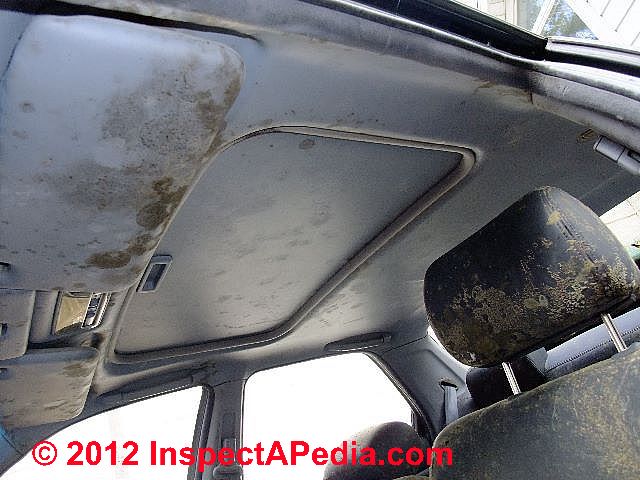
How to Identify a Car or Other Vehicle that Has Been Flooded, Flood-Damaged, or Soaked.
Reporting on the sale of formerly flood-damaged cars to people who may not recognize that a vehicle has been flooded or soaked sufficiently to make the vehicle potentially dangerous or even unsafe to occupy, the New York Times described cars damaged by flooding during Hurricane Sandy in 2012.
From that article and other sources, here are some clues that should warn anyone buying a used car that the vehicle may have been flooded: [8][9]
- Check the vehicle title
for flood-car branding. Cars or other vehicles that have been declared a total loss due to flooding bear a title indicating that the vehicle is a "flood car".
Check the National Motor Vehicle Title Information System (vehiclehistory.gov) Also check services such as CarFax (carfax.com) or AutoCheck (autocheck.com) where that same information may be available.
These data bases are incomplete as not all flooded cars may be reported and registered.
Watch out: a car may have been "title washed" by re-registering it in a state that does not carry-over flood-damage branding (such as Colorado or Vermont).
A check of the car's title history may show that it was previously owned in a state where flooding occurred; often flooded cars are re-sold in other countries. - Check the vehicle identification numbers
(VIN) to see that the numbers you can find all match, and that they match the title.
VINs can be found inside the vehicle atop the dash at the base of the windshield on the driver's side, on the front of the engine block, at the front of the vehicle frame, usually near the window washer fluid container, inside the driver's side door jamb, beneath the spare tire.
NMFTIS: In the U.S. the Justice Department's U.S. National Motor Vehicle Title Information System (NMFTIS) provides a vehicle history check that you can purchase through second-party vendors.
If you are making a purchase your dealer may offer a free CarFax report or at the CarFax website you can run a free check for flood damage for your car based on its VIN.
Details about finding the VIN for a vehicle are at at least eleven services whose website links are given at the NMFTIS:
Here is the NMFTIS CheckThatVin website. Watch out: Thirteen U.S. states are not in full compliance with the Anti Car Theft Act of 1992 that requires reporting title data to the Justice Department's system and that requires verification of the vehicle history before the new title is issues.
NCIB VinCheck: Also check with the National Insurance Crime Bureau (NICB) who provide a free VINCheck service.
But keep in mind that your car could have been flooded but not reported to the NICB.
Here is the NCIB VinCheck website. Watch out: 10% or so of personal-use vehicles that have been flooded won't be in this database. The NCIB data base describes vehicles insured by insurance companies that support the NCIB.
CarFAX provides a free CARFAX Flood Check that requires entry only of the vehicle VIN and your email.
Watch out: a dishonest car vendor may try swapping the VIN from a previously-flooded car for a different vehicle or may obtain a fraudulent VIN or title from a different state from that in which the car was originally registered.
- Check for residues of mud, grit, sewage, salt, debris or for flood lines
in cracks and crevices of the vehicle such as- inside hood or trunk stiffening members (through access holes)
- inside the spare tire well
- inside rear-view mirror
- underneath glove compartment or door pocket compartment liners
- inside of electrical connector covers
- Check for mold odors
inside the vehicle. With the vehicle's windows and doors closed (the longer the closed-up interval the better) notice if the interior smells moldy. (Some use the incorrect term "mildew").
Watch out: Also beware of cars whose interior smells strongly of bleach, perfumes, cleaners, or other chemicals that may have been used in an attempt to cover-up a mold odor. A car that was flooded by storm waters may also smell like sewage; Also be sure to run the vehicle's air conditioning and heating system and sniff for odors.
Also see CAR MOLD CONTAMINATION. - Check seat mounting bolts,
screws or other hardwater for evidence that the seats have been removed or replaced. New screws and bolts may indicate that a seat was removed as part of a car dry out procedure or the screws or bolts may be rusted or simply damaged by having been removed and replaced. - Check for missing, removed, or damaged drain plugs
in the vehicle floors under floormats - Check for strong bleach, chemical, disinfectant or plastic odors
inside the vehicle.
In an article series beginning at OZONE MOLD / ODOR TREATMENT WARNINGS we explain that attempts to rid a car, boat, truck, camper or other vehicle of mold odors by over-dosing with ozone can actually oxidize plastics or other materials, causing strong plastic or chemical odors that can be cured only by complete removal of the damaged, oxidized contents. - Inspect the dashboard
for indications of water in the instrument panel and also inspect below the dashboard for rust on un-painted metal screws or rust on un-painted metal parts & surfaces - Inspect the upholstery,
head liner, carpeting for sagging, puckering;

- Inspect carpets & headliners
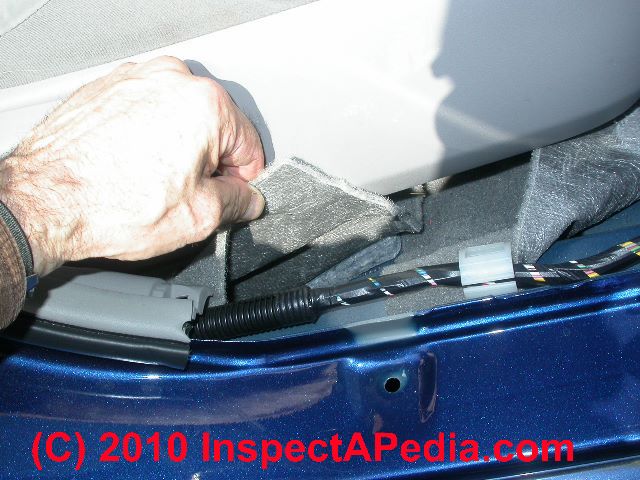
or door liners or for traces of mud and rust below floor carpets and padding; take a close whiff of floor carpeting.
Watch out: all-new carpeting in a car that should show some wear can also be a clue that the vehicle was flooded.
Similarly, an all-new-looking headliner or door panels whose color does not exactly match other car interior upholstery or liners may indicate that those components were replaced after a car-flood. - Inspect interior trim and plastic components
for signs of removal-replacement, such as screws whose head-slots have been gouged or damaged or missing, incomplete trim screws. - Look for moisture or condensation in headlights,
tail lights, other vehicle lights. You may also see actual flood, mud, or debris lines inside of headlights or tail lights, or inside of a door behind the door panel. - Look for unusual or non-working electrical components;
test every electrical component or light on the vehicle; flood damage often leaves electrical components in disarray, not working, or incompletely or incorrectly replaced by hasty workers; lights that don't work or that are abnormally dim and LCD displays that are incomplete or have odd black or blank spots are examples;
Look closely at the various fuse containers for signs of discoloration, corrosion, or even for all-new fuses: signs of water intrusion and damage to the electrical system.
Try pulling apart a few plug-connectors under the dash or in the engine compartment: inspect the connector for corrosion, dirt, mud, debris. - Look for salt corrosion on engine parts
under the hood; - Check the engine oil
for light brown froth after the engine has been run; water left in the crankcase from any source can cause this condition; note that it's quick and easy to change engine oil so absence of evidence (of flooding) is not evidence of absence (of flooding). - Check the power steering and transmission oil
for frothing and water as well. Depending on the depth to which a car has been flooded and possibly the duration of flooding water may enter a power steering fluid reservoir, transmission, or even a differential gear box.
- Ask for an independent, expert vehicle inspection
either from a mechanic you know and trust, or from companies who provide that service.
National as well as local automobile inspection companies offer on-site vehicle inspections that can easily pay for the inspection cost by helping avoid purchase of a car that turns out to be a money pit.- Australia: mtavehicleinspections.com.au
- New Zealand: aa.co.nz
- UK - car-inspections.co.uk ; dekra-expert.co.uk ; theaa.com
- USA: automobileinspections.com - $350 ; carchex.com - $120 or more; also look for individual companies operating in your state, such as falconworks.net in southern Arizona
Look for and trace the source of water leaks into the vehicle
It is essential to find and cure the cause of a moldy smell in a vehicle - otherwise the entire diagnostic, cleaning, and testing process will be wasted.
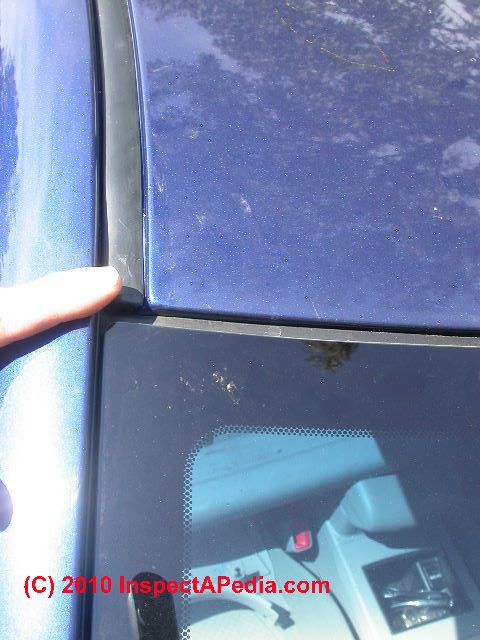
In the moldy car case used as an example in this article, a water leak at the front passenger side windshield pillar was sending water down inside the pillar into the area behind and under the dash board on the passenger side, ultimately onto the passenger side floor.
The car's owners first noticed the leak problem as a wet floor mat. On exploring they found that carpeting below the floor mat was still more wet. This meant trouble.
In our photo above the author points to the very origin of the roof and windshield pillar leak on the car's passenger side.
 The dealer was able to trace the leak to its source, and the leak was repaired. But the moldy smell remained.
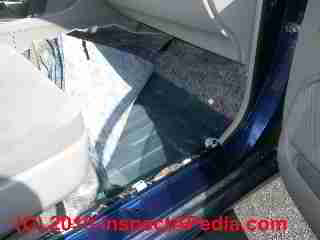
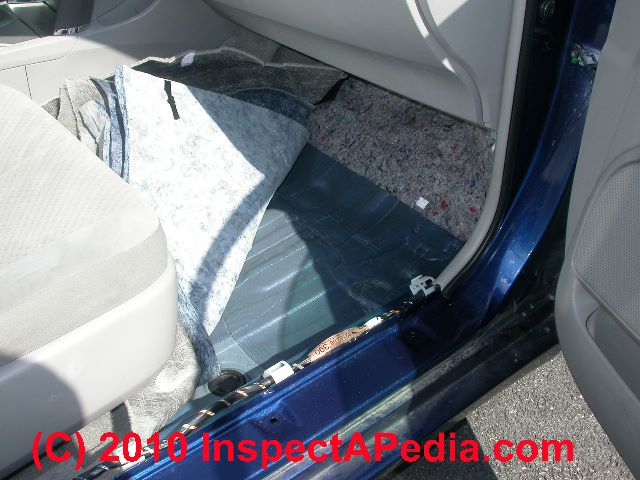
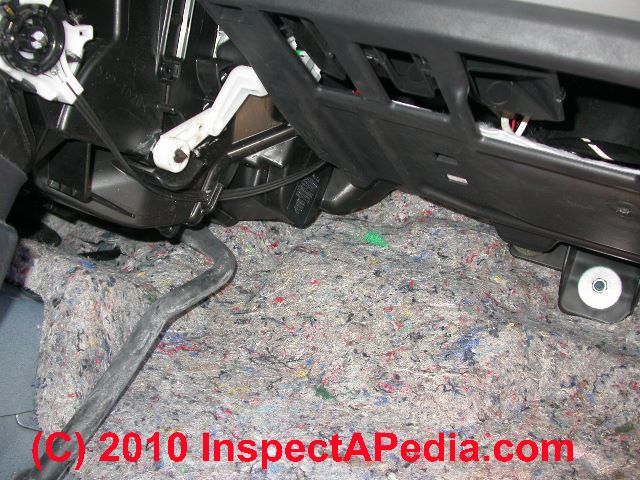
At left we are taking a look at the carpet and carpet padding in this same vehicle.
Carpeting, seats, sound insulation, head liners, door liners, or other vehicle materials that have actually been soaked and that smell moldy need to be removed and disposed-of, and the exposed surfaces of the vehicle cleaned using conventional cleaners (soap and water would be fine).
Our photo (above left) shows the primary smell reservoir in this mold-stinky car: the carpet padding and sound insulation material.
A topic of considerable discussion was just how much of this padding to remove.
Our opinion is that it is cheapest to replace the entire carpet and carpet padding in the front, rear, or both areas of the car than to try to cut, patch and paste repeatedly.
Legal and Insurance Issues for Flood, Mold & Water Damaged Cars, Boats, RVs & Trucks
Your car, boat, RV or other vehicle may be covered for flood and mold damage if you have purchased comprehensive coverage as part of your vehicle insurance. Check your insurance policy and check with your insurance company. If you live in an area at high risk of flooding you may want to add comprehensive damage coverage if you don't already have it.
Ann Carrns writing for the New York Times in June 2015 points out that flood damaged cars that have been written off by insurance companies often find their way back into the used car market, perhaps being sold in other states from the one in which the car was originally registered.
Such vehicles are supposed to be given a "salvage title" but not all flooded cars or other vehicles go through that process and some may be sold directly by owners or may be re-titled by dishonest vendors.
Carrns explains that while it is legal to sell a previously-flooded vehicle in the U.S. it is illegal to fail to disclose the flood damage to a potential buyer.
Flooded Boat Car RV Truck References
- Andy Gieseke, Canyon Auto Sales, 3500 N. 1st Ave., Tucson AZ 85719, Tel: 520-293-3324. Mr. Gieseke is an expert used car purchaser and re-seller and the author's son-in-law. Andy provided technical advice on identifying flooded vehicles.
- Ann Carrns, "Car Shopping? How to Identify Flood Damage Before Driving Home", The New York Times, 20 June 2015, p. B4.
- Anit Car Theft Act of 1992, Public Law 102-519 [PDF] enacted 25 October 1992, original source: https://www.justice.gov/sites/default/files/jmd/legacy/2014/05/18/act-pl102-519.pdf
- Auto Theft and Recovery: Effects of the Anti Car Theft Act of 1992 and the Motor Vehicle Theft Law Enforcement Act of 1984, Report to Congress 1998, National Highway Traffic Safety Administration, U.S. Department of Transportation, retrieved 2017/09/22 original source: https://crashstats.nhtsa.dot.gov/Api/Public/ViewPublication/808761
- Darah Maslin Nir, "Dried Out and Title-Scrubbed, Flooded Cars Lure the Unwary", The New York Times, 13 January 2013, p. 1
- NICB National Insurance Crime Bureau, Website: https://www.nicb.org/contact_us
The NICB link above includes a telephone number for law enforcement assistance and a link to report suspected insurance crime. Quoting:
NICB's VINCheck is a free service provided to the public to assist in determining if a vehicle has been reported as stolen, but not recovered, or has been reported as a salvage vehicle by cooperating NICB member insurance companies. To perform a search, a vehicle identification number (VIN) is required. - NMVTIS Program Office,Bureau of Justice Assistance U.S. Department of Justice Washington, DC 20531 E-mail: NMVTIS@usdoj.gov Website: http://www.vehiclehistory.gov/nmvtis_contact.html
VinCheck: https://www.nicb.org/theft_and_fraud_awareness/vincheck - NMVTIS Annual Report for 2015 [PDF], retrieved 2017/09/22, original source: https://www.vehiclehistory.gov/pdfs/2016-08-02_NMVTIS_AR_2015.pdf This report includes the current legislative status of each of the U.S. states participating in (or not) the program.
- NMVTIS National Motor Vehicle Title Information System, Final Rule discussion, [PDF] retrieved 2017/09/22, original source:
Excerpts:
The Anti-Car Theft Act of 1992, Public Law No. 102-519, 106 Stat. 3384, required the Department of Transportation (DOT) to establish an information system intended to enable states and others to access automobile titling information. As part of the Anti-Car Theft Act of 1992, DOT was authorized to designate a third party to operate the system.
Since 1992, the American Association of Motor Vehicle Administrators (AAMVA) has acted in the capacity of the operator of the system. AAMVA is a nonprofit, tax exempt, educational association representing U.S. and Canadian officials who are responsible for the administration and enforcement of motor vehicle laws. The requirements of the Anti-Car Theft Act of 1992 were amended by Public Law 103-272 and the Anti-Car Theft Improvements Act of 1996, Public Law No. 104-152, 110 Stat. 1384.
The Anti-Car Theft Improvements Act of 1996 renamed the automobile titling system the “National Motor Vehicle Title Information System” and transferred responsibility for implementing the system from DOT to the Department of Justice (DOJ). Hereinafter, the Anti-Car Theft Act of 1992 and the revisions made by Public Law 103-272 and the Anti-Car Theft Improvements Act of 1996, codified at 49 U.S.C. 30501-30505, are collectively referred to as the “Anti-Car Theft Act”or the “Act.”
While the overall purpose of the Anti-Car Theft Act is to prevent and deter auto theft, title II of the Act, which authorizes NMVTIS, is intended to address automobile title fraud.
Accordingly, the primary purpose of NMVTIS is to prevent various types of theft and fraud by providing an electronic means for verifying and exchanging title, brand, theft, and other data among motor vehicle administrators, law enforcement officials, prospective and current purchasers (individual or commercial), and insurance carriers.[1]
Currently, 37 states are actively involved with NMVTIS, representing nearly 75% of the U.S. motor vehicle population. Specifically, 13 states are participating fully in NMVTIS, 14 states are regularly providing data to the system, and an additional 10 states are actively taking steps to provide data or participate fully.[2]
States that participate fully in the system provide data to the system on a daily or real-time basis and make NMVTIS inquiries before issuing a new title on a vehicle from out of state and preferably before every title verification, regardless of its origin or reason. Participating states also pay user fees to support the system and the services provided to the state. - Scott Sturgis, "Shaky Seats, Leaky Fluids, Toyota" The New York Times, 01/24/2010, Automobiles section, p. 4.
- [1] "Health effects of a mold-contaminated automobile", J. Santilli, W. Rockwell, W. Vaughn, Journal of Allergy and Clinical Immunology, Volume 113, Issue 2, Page S59. Quoting abstract:
Most reactions to indoor mold exposure have been reported from mold-contaminated homes, office buildings or schools. We report a patient who experienced symptoms from exposure to a contaminated air-conditioner in her automobile. ...
This case demonstrates that we should be testing work environments, homes and schools for mold contamination and must now add automobiles to our testing regimen where indicated. - [2] "Mold contamination of automobile air conditioner systems", Kumar P, Lopez M, Fan W, Cambre K, Elston RC., Ann Allergy. 1990 Feb; 64(2 Pt 1):174-7. Department of Medicine, Louisiana State University Medical Center, New Orleans. Abstract:
Eight cars belonging to patients who were found to have exacerbation of allergic rhinitis and bronchial asthma after turning on the air conditioner in their cars were examined ...Furthermore, placement of a filter at the portal of entry of outside air significantly reduced the mold concentration in the passenger compartment. - [3] ASTM E2600 - 08 Standard Practice for Assessment of Vapor Intrusion into Structures on Property Involved in Real Estate Transactions is available from the ASTM at astm.org/Standards/E2600.htm
"This practice is intended for use on a voluntary basis by parties who wish to conduct a VIA on a parcel of real estate, or more specifically conduct a screening evaluation to determine whether or not there is potential for a VIC, and if so, identify alternatives for further investigation."
The standard goes on to emphasize the uncertainty in testing any site for gases and vapor intrusion. - [4] "Shaky Seats, Leaky Fluids, Toyota" Scott Sturgis, The New York Times, 01/24/2010, Automobiles section, p. 4.
- [7] Click and Clack the Tappet Brothers, is the nom-de-radio for NPR's Car Talk radio program hosts Tom and Ray Magliozzi, who can also be contacted by telephone at 888-227-8255. An online discussion of the detection, cause, and cure of smells or mold in cars, reviewing this InspectAPedia article has been opened at Car Talk at action.publicbroadcasting.net/cartalk/posts/list/2136105.page - cartalk.com
- [8] Darah Maslin Nir, "Dried Out and Title-Scrubbed, Flooded Cars Lure the Unwary", The New York Times, 13 January 2013, p. 1
...
Continue reading at CAR MOLD CONTAMINATION - illustrations of a vehicle that was mold-contaminated beyond salvage and a study to identify the types of mold found in vehicles, or select a topic from the closely-related articles below, or see the complete ARTICLE INDEX.
Or see these
Recommended Articles
- BLEACHING MOLD, Advice
- BOAT & CAR SMELLS & ODORS
- BLEACHING MOLD, Advice
- CAR MOLD CONTAMINATION
- CAR SMELL - MOLD DEODORIZING
- CARPET MOLD / ODOR TESTS
- CARPET PADDING ASBESTOS, MOLD, ODORS
- FLOODED CAR DETECTION
- OZONE MOLD / ODOR TREATMENT WARNINGS
- SMELL PATCH TEST to FIND ODOR SOURCE
Suggested citation for this web page
FLOODED CAR DETECTION at InspectApedia.com - online encyclopedia of building & environmental inspection, testing, diagnosis, repair, & problem prevention advice.
Or see this
INDEX to RELATED ARTICLES: ARTICLE INDEX to BUILDING ODOR DIAGNOSIS & CURE
Or use the SEARCH BOX found below to Ask a Question or Search InspectApedia
Ask a Question or Search InspectApedia
Questions & answers or comments about how to determine that a car, truck, RV, camper or other vehicle has been flooded or subjected to severe water damage.
Try the search box just below, or if you prefer, post a question or comment in the Comments box below and we will respond promptly.
Search the InspectApedia website
Note: appearance of your Comment below may be delayed: if your comment contains an image, photograph, web link, or text that looks to the software as if it might be a web link, your posting will appear after it has been approved by a moderator. Apologies for the delay.
Only one image can be added per comment but you can post as many comments, and therefore images, as you like.
You will not receive a notification when a response to your question has been posted.
Please bookmark this page to make it easy for you to check back for our response.
Our Comment Box is provided by Countable Web Productions countable.ca
Citations & References
In addition to any citations in the article above, a full list is available on request.
- [4] Thanks to B.L., Poughkeepsie, NY, for discussion of the cause and cure of moldy car smells and permission to take and use photos of the family's moldy car during its mold deodorizing procedure, 2009.
- [6] Thanks to M.R. for discussing an ineffective attempt at deodorizing a smelly car - November 2010
- Ozone Odors & Ozone "deodorizers": The Use of Ozone Generators Indoors for Control of Odors and Mold Removal in Buildings: A Summary of Hazards and False Claims.
Ozone is widely promoted by ozone generating equipment companies and cleaning services for use in indoor building environments to deodorize, disinfect, "kill" mold, and for "general health".
This article explains the effects of using ozone in buildings for these purposes and warns consumers about misapplication of and health risks from ozone in buildings. Because at least some of these claims are based on marketing desire, not good science, and because ozone exposure can be both dangerous and ineffective indoors, we have collected some information and references on this topic. - Ozone generators: The Hazards of Ozone & Ozone Gas Generators. This article gives an overview of the hazards associated with use of ozone indoors as a "mold remedy" or as an "air purifier". Ozone is widely promoted by ozone generating equipment companies and cleaning services for use in indoor building environments to deodorize, disinfect, "kill" mold, and for "general health".
- Ozone Toxicity & Ozone Gas Exposure Hazards This article discusses Ozone Toxicity in Buildings - A Summary of Hazards of Indoor Ozone, Ozone Generators, and Use of Ozone for Mold Remediation. While there are some important uses of ozone (such as for medical disinfection under controlled conditions), in general this is an idea which ranges from bad to dangerous in the home. This article explains the effects of using ozone in buildings for these purposes and warns consumers about misapplication of and health risks from ozone in buildings. Because at least some of these claims are based on marketing desire, not good science, and because ozone exposure can be both dangerous and ineffective indoors, we have collected some information and references on this topic.
- OZONE GAS EXPOSURE EFFECTS Description
- Plastic odors: Plastic Odors, including Siding Odors. This discussion also pertains to other vinyl or plastic materials used in buildings such as diagnosing odors from plastic trim, plastic or vinyl windows, window screens, doors, or similar materials. This article includes a plastic odor diagnosis checklist and it lists common sources of plastic-like smells in buildings.
- MVOC Testing Standard: As of 3 March 2009 the ASTM Committee E50 on Environmental Assessment, Risk Management and Corrective Action released ASTM E2600-08 Standard Practice for Assessment of Vapor Intrusion into Structures on Property Involved in Real Estate Transactions.
- In addition to citations & references found in this article, see the research citations given at the end of the related articles found at our suggested
CONTINUE READING or RECOMMENDED ARTICLES.
- Carson, Dunlop & Associates Ltd., 120 Carlton Street Suite 407, Toronto ON M5A 4K2. Tel: (416) 964-9415 1-800-268-7070 Email: info@carsondunlop.com. Alan Carson is a past president of ASHI, the American Society of Home Inspectors.
Thanks to Alan Carson and Bob Dunlop, for permission for InspectAPedia to use text excerpts from The HOME REFERENCE BOOK - the Encyclopedia of Homes and to use illustrations from The ILLUSTRATED HOME .
Carson Dunlop Associates provides extensive home inspection education and report writing material. In gratitude we provide links to tsome Carson Dunlop Associates products and services.
 | HOME | ABOUT | ASK a QUESTION | CONTACT | CONTENT USE POLICY | DESCRIPTION | POLICIES | PRIVACY | |
| © 2024 - 1985 Publisher InspectApedia.com - Daniel Friedman | |||||||||