
InspectAPedia® FREE Encyclopedia of Building & Environmental Construction, Diagnosis, Maintenance & Repair |
Question? Just ask us! InspectAPedia
|
 Mold Hyphal Fragments as Sign of Mold Contamination
- POST a QUESTION or COMMENT about the identification & significance of various fungal or mold hyphal fragments found in building tests and samples of mold contamination
Definition of mold hyphae or hyphal fragments & what they mean in building mold samples:
This article defines mold hyphae or hyphal fragments and then discusses the significance of hyphal fragments as an indicator of mold contamination in a building and how we can find evidence suggesting that a given mold contamination case is new, old, or includes both old and new fungal growth.
InspectAPedia tolerates no conflicts of interest. We have no relationship with advertisers, products, or services discussed at this website.
What Does the Presence of Hyphal Fragments Signify in a Mold Test Sample
Useful Lay-person Definitions of Hyphae and Fungal Hyphal Fragments
The Dictionary of the Fungi defines hyphae as
hypha (pl. hyphae), one of the filaments of a mycelium;
At MOLD ATLAS & PARTICLES INDEX we offer our own longer definition of fungal hyphae or hyphal fragments found in mold samples and mentioned in mold lab reports:
Hyphal fragments or mycelia are components of fungal growth (similar to the roots and branches of a tree); it is common to find small hyphal fragments in outdoor air and possibly in indoor dust.
But their presence in indoor air samples, if in quantity or in large segments, suggests an active fungal colony in the building. Their presence in a surface sample in quantity or in large segments indicates that active fungal growth is present or nearby, or that fungal material has been disturbed in the building. May be allergenic. -DF
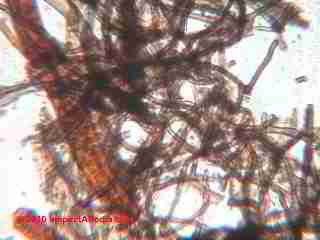
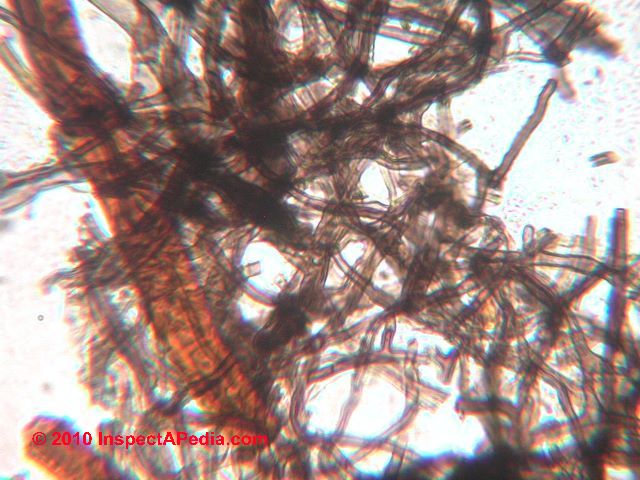
Hyphal fragments might be just one or two little bits or a rats nest of growing mycelia (as we show at page top).
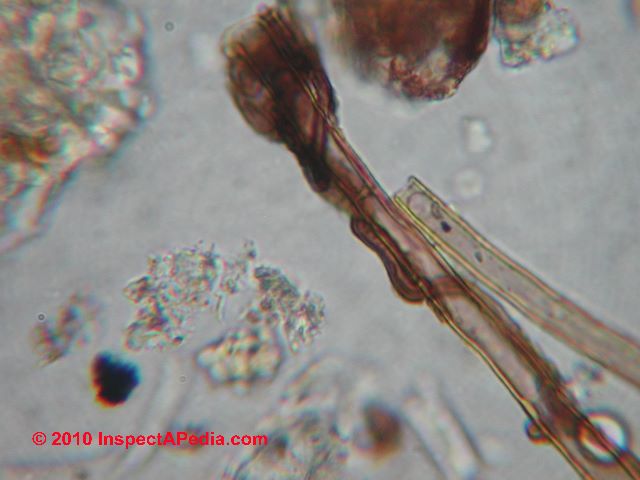
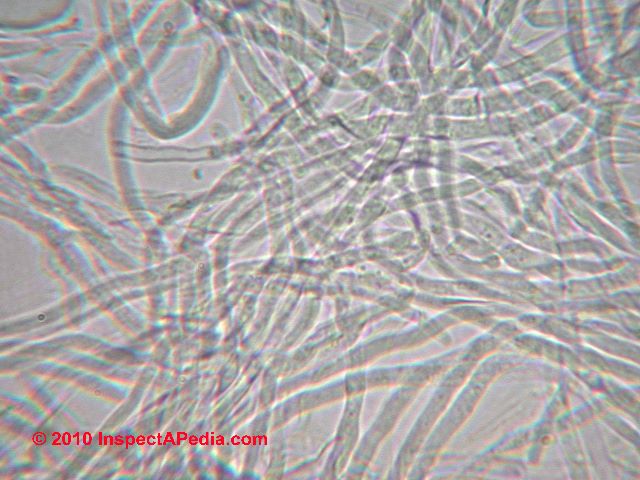
Hyphal fragments or hyphae may be colored (brown for example shown at the top of this page and just above) or colorless as in our photograph below (mycologists report colorless spores or hyphae as hyaline - just in case your report is not written in plain english).
Of course this means we need another definition right away.
 Mycelia: a mass of hyphae; the thallus of a fungus, this is the vegetative body portion of the organism,
akin to the "root" structure of a plant, used to absorb nutrients.
Mycelia: a mass of hyphae; the thallus of a fungus, this is the vegetative body portion of the organism,
akin to the "root" structure of a plant, used to absorb nutrients.
Mycelia would not easily be visually identifiable as belonging to a specific species unless other components of the fungus are present. Particles of this material are probably allergenic. - DF; derived from op cit.
Mycelial cord, a discrete filamentous aggregation of hyphae which, in contrast to a rhizomorph, has no apical meristem; syrrota; - op cit.
What is the Biological Job of a Mycelium or of Hyphae?
From a lay person's view, it's reasonable to think of hyphal fragments as little pieces of plant stems or roots - except in this case the organism is not a tree or bush, but a fungal structure - mold.
When you see a mushroom sprouting in the forest, that's the fruiting body of what can be a very large, but hidden root structure underground - a mycelium.
From the fungi's point of view, the mycelium is the "stomach" of the organism.
 A mycelium exudes chemicals that help dissolve food that it is contacting, such as a leaf, or a piece of wood or paper. Nutrients are dissolved and transported into the mycelial structure.
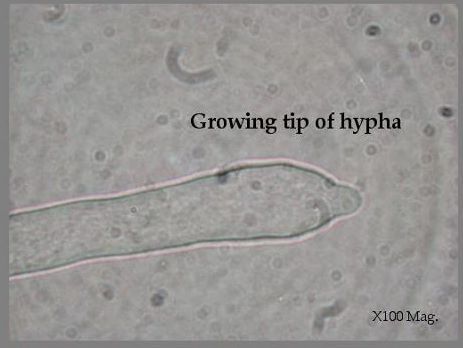
A mycelium grows, that is, gets bigger, from the tips of individual hyphae.
Photo showing growing tip of a fungal hypha at a McCrone presentation, excerpted by the author, DF while at McCrone Research during lab work.
What is the Significance of Hyphal Fragments Reported in a Mold Lab Test Report?
It is normal to find a few hyphal fragments in outdoor air and thus also in indoor air. At high levels or in some circumstances, these particles might tell us something more about the building in which they were detected. But if just a few such particles are reported in a mold lab report, they are most likely insignificant.
In some fungi hyphal fragments may be allergenic or may even contain mycotoxins. (In our terminology, fungal material may be harmless-cosmetic, allergenic, toxic, or pathogenic, depending on the genera/species and on its growth conditions.)
But the hyphal fragments or pieces found in air or dust samples are usually quite large and not likely to be inhaled deeply into the lungs. So mold hyphal fragments are less of an airborne risk to building occupants than say a high level of airborne toxic or allergenic mold spores such as Aspergillus sp.
We report hyphal fragments in air or dust samples (where it is common to find at least some) for these reasons:
- a high level of hyphal fragments can mean a high level of allergenic particles
- a high level of hyphal fragments is often corroboration of active nearby fungal growth (though absence of them does not affirm absence of fungal growth)
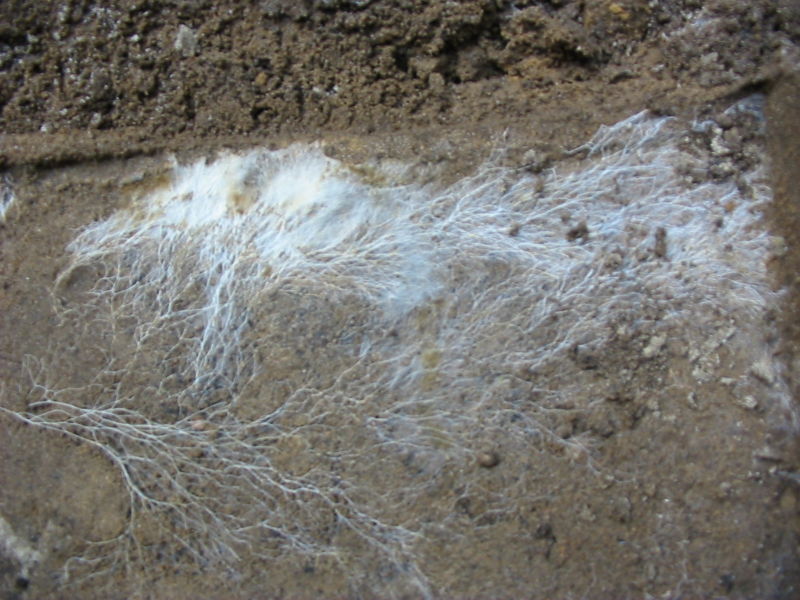
Above: a photograph of a fungal mycelium or a "mushroom's roots" courtesy of Wikipedia, retrieved 2019/10/09 original source https://en.wikipedia.org/wiki/Mycelium. Mycelia, viewed by the naked eye, are typically white or light gray in colour.
Below: photographs of mold hyphal fragments or mycelia under the microscope. This mold was sampled from a car destroyed by mold and discussed
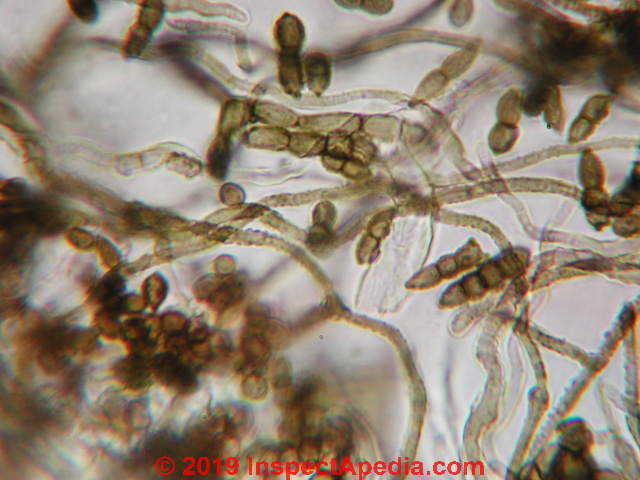
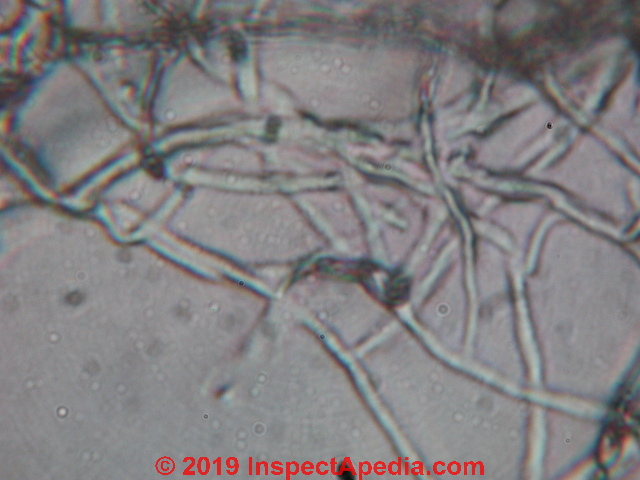
The first fungal sample above was isolated from the vinyl window trim in the car while the second was isolated from the car's headliner.
Does the Presence of Hyphal Fragments Indoors Threaten New Mold Growth?
While some hyphal fragments might, if conditions were ripe, begin growing and eventually also lead to mold spore production, that's not really a critical focus. In our opinion, if conditions are ripe to grow mold, you'll get mold growing whether there were previously some hyphal fragments there or not.
Reader Comments, Questions & Answers About The Article Above
Below you will find questions and answers previously posted on this page at its page bottom reader comment box.
Reader Q&A - also see RECOMMENDED ARTICLES & FAQs
Question: tested positive to hyphal fragments
(Mar 23, 2013) jennifer scorcia said:
tested positive to hyphal fragments , chlamydoconidia and arthroconidia
how to cure these fungal infections
thank you
jennifer scorcia
jenni_scor@yahoo.com
Reply:
Jennifer,
You should consult your personal physician and if necessary, obtain a referral to a doctor who specializes in environmental medicine and fungal infections.
If you and your doctors have reasons to suspect that your fungal related illness or complaints are due to or aggravated by exposure to molds in your home, you may want to hire an expert to perform a thorough inspection to find visible or hidden mold reservoirs, to recommend mold cleanup procedures, and to identify what repairs are needed to stop mold growth in the building. Search Inspectapedia
for MOLD / ENVIRONMENTAL EXPERT, HIRE ? for detailed advice on that point.
...
Continue reading at MOLD AGE, HOW OLD is the MOLD? or select a topic from the closely-related articles below, or see the complete ARTICLE INDEX.
Or see these
Recommended Articles
- MOLD APPEARANCE - WHAT MOLD LOOKS LIKE
- MOLD / ENVIRONMENTAL EXPERT, HIRE ?
- MOLD GROWTH on SURFACES for an index of what mold genera/species are frequently found on various building surfaces and materials.
Suggested citation for this web page
MOLD HYPHAL FRAGMENTS at InspectApedia.com - online encyclopedia of building & environmental inspection, testing, diagnosis, repair, & problem prevention advice.
Or see this
INDEX to RELATED ARTICLES: ARTICLE INDEX to MOLD CONTAMINATION & REMEDIATION
Or use the SEARCH BOX found below to Ask a Question or Search InspectApedia
Ask a Question or Search InspectApedia
Try the search box just below, or if you prefer, post a question or comment in the Comments box below and we will respond promptly.
Search the InspectApedia website
Note: appearance of your Comment below may be delayed: if your comment contains an image, photograph, web link, or text that looks to the software as if it might be a web link, your posting will appear after it has been approved by a moderator. Apologies for the delay.
Only one image can be added per comment but you can post as many comments, and therefore images, as you like.
You will not receive a notification when a response to your question has been posted.
Please bookmark this page to make it easy for you to check back for our response.
Our Comment Box is provided by Countable Web Productions countable.ca
Citations & References
In addition to any citations in the article above, a full list is available on request.
- "Dictionary of the Fungi," 9th Ed., Kirk, Cannon, David, and Stalpers.
- Our recommended books about building & mechanical systems design, inspection, problem diagnosis, and repair, and about indoor environment and IAQ testing, diagnosis, and cleanup are at the InspectAPedia Bookstore. Also see our Book Reviews - InspectAPedia.
- ENVIRONMENTAL HEALTH & INVESTIGATION BIBLIOGRAPHY - our technical library on indoor air quality inspection, testing, laboratory procedures, forensic microscopy, etc.
- Adkins and Adkins Dictionary of Roman Religion discusses Robigus, the Roman god of crop protection and the legendary progenitor of wheat rust fungus.
- Kansas State University, department of plant pathology, extension plant pathology web page on wheat rust fungus: see http://www.oznet.ksu.edu/path-ext/factSheets/Wheat/Wheat%20Leaf%20Rust.asp
- A BRIEF GUIDE to MOLD, MOISTURE, and YOUR HOME, [PDF] U.S. Environmental Protection Agency US EPA - includes basic advice for building owners, occupants, and mold cleanup operations. See http://www.epa.gov/mold/moldguide.htm
- US EPA - MOLD REMEDIATION in SCHOOLS & COMMERCIAL BUILDINGS - - US EPA
- US EPA - UNA BREVA GUIA a MOHO / HONGO - en Espanol
- A BRIEF GUIDE to MOLD, MOISTURE, and YOUR HOME, [PDF] U.S. Environmental Protection Agency US EPA - includes basic advice for building owners, occupants, and mold cleanup operations. See http://www.epa.gov/mold/moldguide.htm
- "Disease Prevention Program for Certain Vegetable Crops," David B. Langston, Jr., Extension Plant Pathologist - Vegetables, University of Georgia (PDF document) original source: www.reeis.usda.gov/web/crisprojectpages/209797.html
- Disease Prevention in Home Vegetable Gardens [PDF], Patricia Donald,Department of Plant Microbiology and Pathology,
Lewis Jett
Department of Horticulture, University of Missouri Extension - extension.missouri.edu/publications/DisplayPub.aspx?P=G6202 - "Management of Powdery Mildew, Leveillula taurica, in Greenhouse Peppers," Ministry of Agriculture and Lands, British Columbia - Original source: www.agf.gov.bc.ca/cropprot/peppermildew.htm
- Fifth Kingdom, Bryce Kendrick, ISBN13: 9781585100224, - we recommend the CD-ROM version of this book. This 3rd/edition is a compact but comprehensive encyclopedia of all things mycological. Every aspect of the fungi, from aflatoxin to zppspores, with an accessible blend of verve and wit. The 24 chapters are filled with up-to-date information of classification, yeast, lichens, spore dispersal, allergies, ecology, genetics, plant pathology, predatory fungi, biological control, mutualistic symbioses with animals and plants, fungi as food, food spoilage and mycotoxins.
- Fungi, Identifying Filamentous, A Clinical Laboratory Handbook, Guy St-
- US EPA: Mold Remediation in Schools and Commercial Building [Copy on file at /sickhouse/EPA_Mold_Remediation_in_Schools.pdf ] - US EPA
- Mycology, Fundamentals of Diagnostic, Fran Fisher, Norma B. Cook, W.B. Saunders Co. 1998, ISBN 0-7216-5006-6
- In addition to citations & references found in this article, see the research citations given at the end of the related articles found at our suggested
CONTINUE READING or RECOMMENDED ARTICLES.
- Carson, Dunlop & Associates Ltd., 120 Carlton Street Suite 407, Toronto ON M5A 4K2. Tel: (416) 964-9415 1-800-268-7070 Email: info@carsondunlop.com. Alan Carson is a past president of ASHI, the American Society of Home Inspectors.
Thanks to Alan Carson and Bob Dunlop, for permission for InspectAPedia to use text excerpts from The HOME REFERENCE BOOK - the Encyclopedia of Homes and to use illustrations from The ILLUSTRATED HOME .
Carson Dunlop Associates provides extensive home inspection education and report writing material. In gratitude we provide links to tsome Carson Dunlop Associates products and services.
 | HOME | ABOUT | ASK a QUESTION | CONTACT | CONTENT USE POLICY | DESCRIPTION | POLICIES | PRIVACY | |
| © 2024 - 1985 Publisher InspectApedia.com - Daniel Friedman | |||||||||