
InspectAPedia® FREE Encyclopedia of Building & Environmental Construction, Diagnosis, Maintenance & Repair |
Question? Just ask us! InspectAPedia
|
 Building Mildew Mistakes
Mold in buildings is Often Mistaken for Mildew - a plant fungus
- POST a QUESTION or COMMENT about mildew and mildew odors in buildings and on building surfaces - is it really mildew? Probably not.
Mildew mistakes: this article discusses how to recognize building mold and how to know that indoors, it's not mildew.
We include photographs of a variety of white and green mold growths on clothing, leather, artworks, baskets and building surfaces - all examples of light colored molds that are not mildew (and that are potentially more harmful).
This article describes building mold (black mold, green mold, yellow mold, gray mold, and white mold) that is often mistaken for mildew.
InspectAPedia tolerates no conflicts of interest. We have no relationship with advertisers, products, or services discussed at this website.
Photographs of Mold Found on or In buildings, Building Contents, Clothing, Baskets, & Artworks: Molds that are Sometimes Mistaken for Mildew
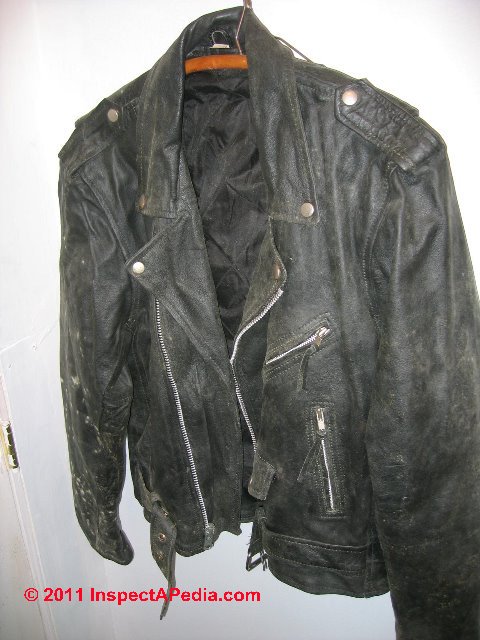 Our photo (left) of white mold on a leather jacket illustrates a fungus that might be mistakenly called "mildew".
Here are photographs of mold on building exteriors, interiors, or building contents.
At this website, other photos of mold on indoor building surfaces may help you recognize mold in buildings, recognize probably-cosmetic mold, and recognize stuff that is not mold and does not need to be tested.
More photographs of mold that is often mistaken for or mis-named "mildew" are included in this article and links provide articles that correctly identify mildew as well as explain the difference between mildew and mold.
For teaching the distinction between the broad family of mold and its little subordinate clan of mildew, I owe a special thankyou to Dr. J.H., a New York mycologist who is not only far more educated than I (DF) about mold, mildew, and the world of fungi, but who also is a gentle and generous man.
When in my enthusiasm I showed J.H., light green "mildew" samples I'd collected from leather shoes in the closet of a very moldy home I'd inspected, J. asked gently: "Are you sure you want to call that 'mildew'?" He went on to explain that
Mildew, a sub-class of molds, is an obligate parasite that grows only on living plants, and is generally white in appearance.
At MILDEW PHOTOGRAPHS we illustrate the two mildew groups:
- Oidium-Erysiphe, familiarly named Powdery Mildew, and
- Peronosporaceae, familiarly named Downy Mildew
Often an inexperienced mold inspector, home inspector, or consumer may refer to these molds incorrectly as "mildew", either out of lack of technical expertise or out of an accurate belief that many people around real estate transactions are much less frightened by "mildew" than by "mold".
There are very many mold genera or species that can grow on a remarkably wide range of organic materials that are found both outdoors and inside, and that can appear in an wide range of colors (black, brown, red, green, gray, white, orange, tan, yellow, for example) and textures. A popular subset of about 200 of those are often found inside buildings on building contents or materials. Those are not likely to be mildew - unless you're looking at plants indoors.
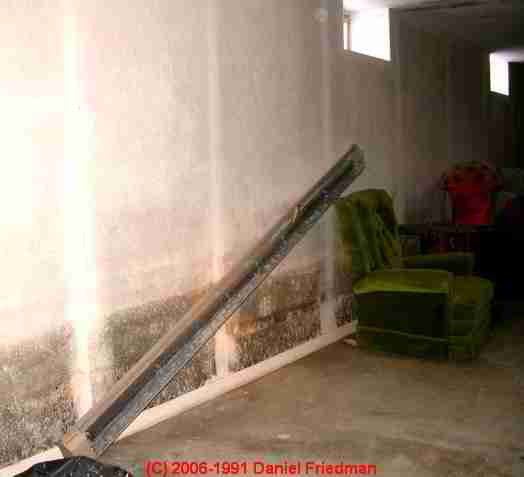
Our page top photograph a severe basement mold contamination in a flooded home found in Poughkeepsie, New York.
Carpet mildew diagnosis: carpeting that has light mold or smells like mold might be described by an inexperienced inspector or a building owner as mildewed carpeting.
If your carpeting smells like "mildew" or "mold" it 's probably moldy whether you can see the mold or not by simple visual inspection.
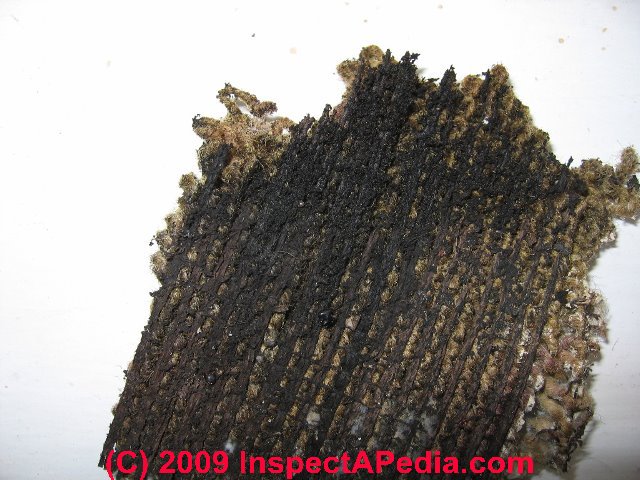
See CARPET MOLD / ODOR TESTS for details.
Our photo of moldy carpet (left) was taken from a sample of carpeting that was the final target of a building mildew odor diagnosis procedure.
Carpet odors: carpeting that smells can be caused by a wide range of problems.
See ODORS GASES SMELLS, DIAGNOSIS & CURE
Carpet stains: can also be caused by a wide range of sources, some of which are harmless, others may diagnose other building problems such as a heating system that is not working properly, or building air leaks.
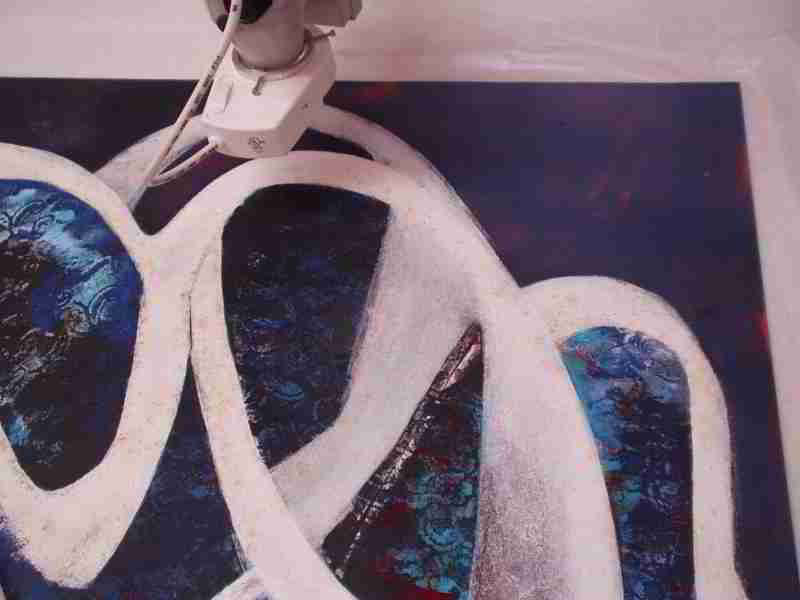
Mold on works of art: We define "mildew" stains on or in paint at MILDEW IN / ON PAINT.
In support of museum conservators we have also identified mold growth on as well as in paint in works of art. Mildew is not found on art works.
Our photograph of a painting being examined for contaminants was provided courtesy of museum conservator Ulrik Runeberg, Puerto Rico Art Museum during a joint forensic investigation.
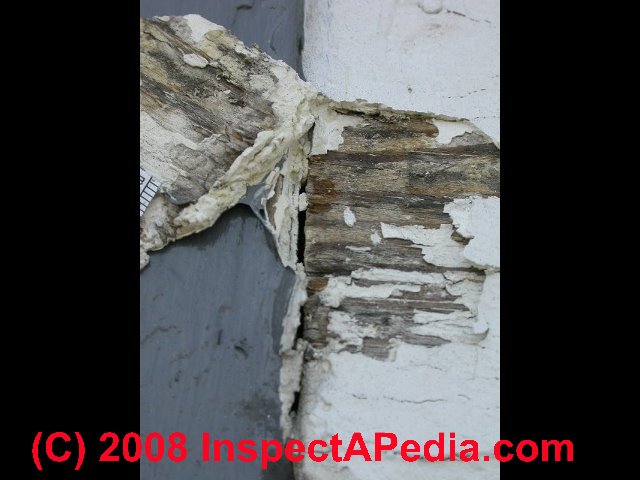
Mold on painted building surfaces or furnishings: We define "mildew" stains on or in paint at Mildew in paint. Look closely at our peeling paint photograph at above left and you can see some black mold on the back surface of an old layer of exterior paint exposed by our peel-back of blistered paint on a wood clapboard wall. More black mold is visible on the exposed wood surface too.
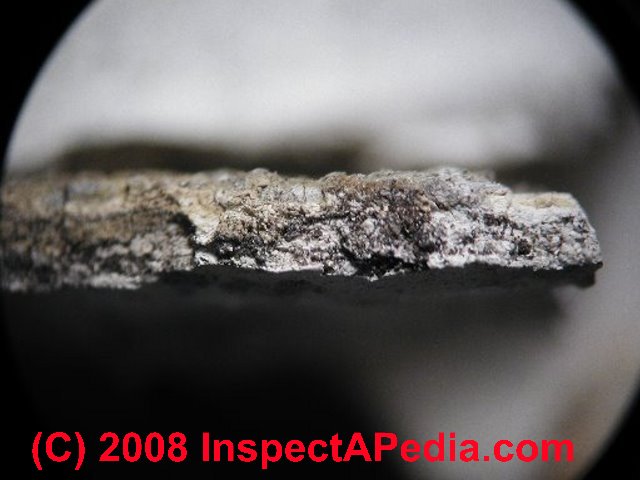
Our micro-photograph of a cross-section cut moldy paint (below right) shows black mold growth inside the layer of paint sampled from a surface. It's mold, not mildew.
Our high-resolution microscope photograph (below) of mold found on exterior wall paint confirms that this is a mitosporic fungi, not mildew.
 ...
... 
A closeup microscopic photo of mold found on building wall paint is shown here.
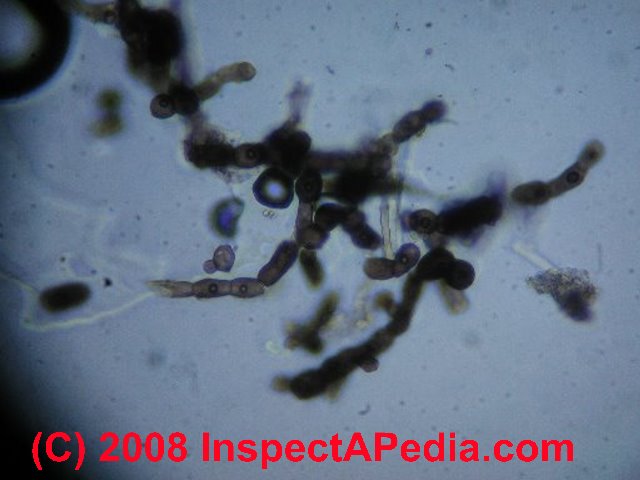
Our high-resolution microscope photograph (above) of mold found on exterior wall paint confirms that this is a mitosporic fungi, not mildew.
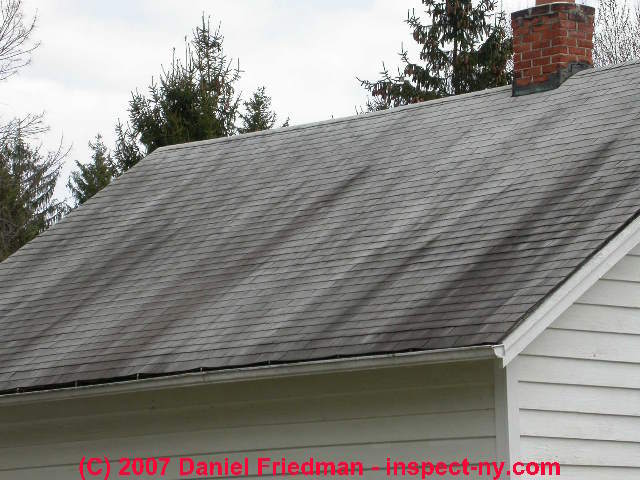
Mold or algae on roofs: We discuss stains mistaken for mildew on building roofs
at Catalog of BLACK ROOF STAINS
Mold on a Leather Jacket or on Clothing
In our forensic lab we confirmed that this "mildewed" leather jacket was actually contaminated with Aspergillus versicolor - it was moldy, not mildewed even though the owner naturally used that term to describe the odor.
Clothing that smells like "mildew" is moldy and can usually be restored by laundering or dry-cleaning. Leather garments need to be cleaned by a leather cleaning professional.
Mold on a Woven Laundry Basket
This "mildewed" laundry basket found in Mexico was mold-contaminated but although the basket was made of plant material, this black mold was not mildew. (Samples are on hand for further laboratory analysis.)
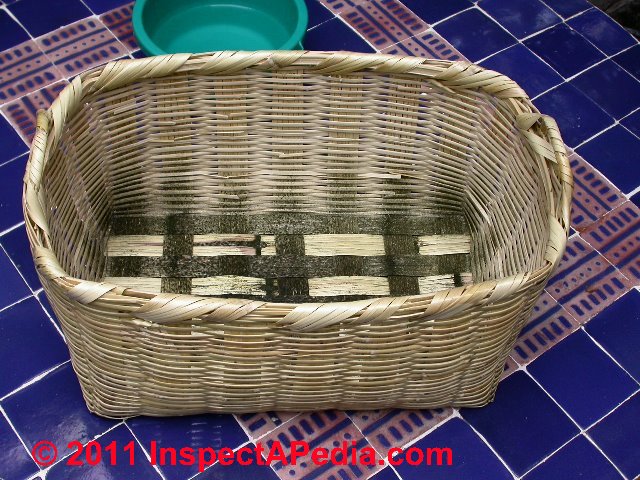
Interestingly the mold grew only on the basket fiber interior surfaces - a side of the plant material that was exposed after the basket reed material was first hand-split for weaving. The harder exterior surface of this bamboo-like plant material did not show much mold growth.
Even using bleach solution (plastic bowl at upper left) we were unable to successfully clean this moldy laundry basket - it was passed on to the trash truck along with other building basura.
Green "Mildew" Reported on Basement Ceiling
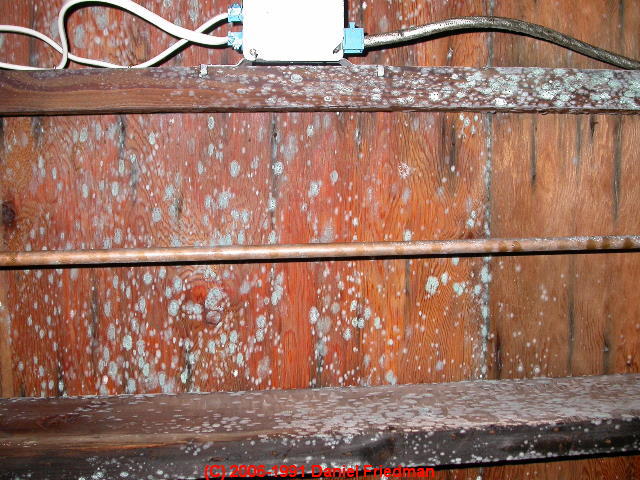
This green "mildew" on basement surfaces was confirmed to be mostly Aspergillus sp. mold.
The white, gray, and green "mildew" found on the underside of this building subflooring and on the floor joists was confirmed in our forensic laboratory as not "basement mildew" but rather a mixture of mostly Aspergillus sp. and some Penicillium sp. molds.
We also often find Trichoderma sp. (another green mold) on wooden subfloors and framing over wet or damp basements or crawl spaces.
Green and gray molds on building surfaces are often mistaken for mildew.
White mold in buildings that is not mildew is very common, found for example on wood surfaces, both painted and raw wood. Our photograph (left) shows white mold on an interior basement door.
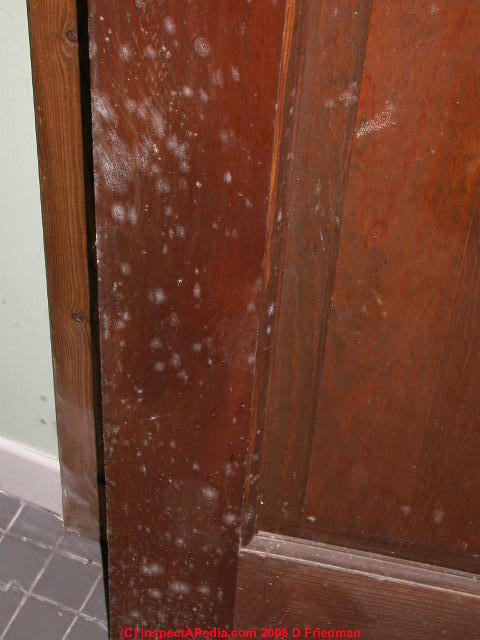
Often we find white or light gray Aspergillus sp. or Penicillium sp. molds on these surfaces, but there are numerous other light colored or white indoor molds that may be present.
White Stuff that is Niether Mildew nor Mold
Other examples of white mold found in buildings that is often mistakenly called "mildew" can be seen
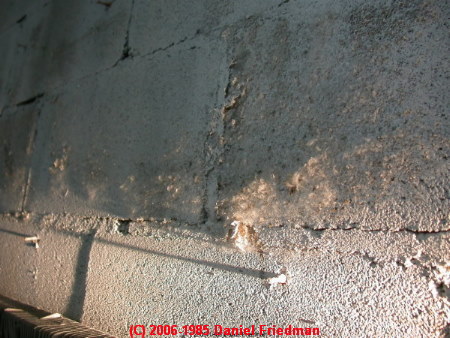
White stuff that is not mold is also not mildew: Beware: many people mistake mineral salts or efflorescence for white mold or mildew.
Efflorescence is a white crystalline salt left on masonry surfaces where water or moisture have been evaporating.
.In general, mold is a term encompassing a very wide family of organisms (the Fifth Kingdom) that includes more than a million and a half species. Lots of molds grow on lots of different organic substances, under a variety of conditions of light and temperature, but all molds require moisture and something organic on which to grow (paper, wood, paint, cloth, leather, plastic, etc.).
Are There Colored Mildews? Pink Mildew?
On 2019-01-10 by Amy Reineri - my books and vinyl and other stuff are covered in mildew
Mildew only needs moisture or humidity to develop. In humid regions, mildew spores are everywhere and can grow on - literally - anything: ceramics, stone countertops, plastic laminate, vinyl siding, etc. They only need moisture, not "living plants" as your article states.
You may be mistakenly thinking of "powdery mildew" which is a plant problem, but the pink/salmon-colored mildew grows everywhere and on everything with enough warmth and humidity present - humidity or water is the key ingredient. It has a distinctive sour smell to it.
This Q&A were posted originally
at BOOK / DOCUMENT MOLD & WATER DAMAGE RESTORATION
On 2019-01-10 by (mod) - speaking properly, NO. Breadth of usage of the term "mildew" to refer to fungi vs. its "more proper" usage
Amy thank you for your comment.
Are you sure it's a proper "mildew" on your books and not some other mold genera/species that some people might loosely call "mildew"? Perhaps a pink or reddish yeast fungus or even an Aspergillus or a yeast fungus?
Confusion about what should be called "mildew" has been around since I was in knee pants, maybe longer. (Yarwood 1957)
The mildew sub-group of molds (it is argued that mildew is not a true mold) includes itself two families: Oidium-Erysiphe (powdery mildew) or "true mildew" and Peronosporacae (downy mildew) or "false mildew".
But in both cases, these grow only on living plants. Of course once a plant is diseased the sick portion of the plant may be other colors, often gray or brown. - (Bouzid 2008)
And I acknowledge that plenty of people use the word "mildew" widely when it'd be more-accurate to call their fungus "mold". Who cares? Well proper identification of a mildew or other fungus can be essential in choosing its method of control and key understanding its potential effects on plants, humans, or other animals or on other materials.
I believe that speaking properly or perhaps a bit strictly using current terminology, mildews are oblilgate parasites - found only on living plants - and are in the two groups I cite below, Erysiphales Powdery mildews and Peronosporacae Downy Mildews. An easy-to-use authority is Dictionary of the Fungi, from which I quote this definition of mildew:
Definition of mildew
(1) a plant disease in which the pathogen is seen as a growth on the surface of the host.
A powdery ('true') mildew is caused by one of the Erysiphaceae (e.g. the American (Sphaerotheca mors-uvae) and European - (Microphaera grossulariae) of Ribes);
a downy ('false') mildew is by one of the the Peronosporaceae (the first may be controlled by sulphur, the second by copper fungicides);
a dark mildew, or black mildew, by one of the Meliodales or Capnodiaceae;
(2) the staining, and frequently the breaking up, of cloth and fibres, paint, etc., by fungi and bacgteria (cf. mould);
(3) a fungus causing (1) or (2) (Kirk 2008)
Taxonomy of the Powdery mildews - "true" mildews - Erysiphales
Taxonomy of Powdery Mildew: Kingdom Eumycota, Phylum: Dikaryomycota, subphylum Ascomycotina, order Erysiphales (contains 28 genera, 100 species)
All of the members of this order are obligate parasites on leaves and fruits of higher plants, causing diseases called powdery mildews. (Kendrick 2017)
- Braun, U., R. T. A. Cook, A. J. Inman, and H. D. Shin. "The taxonomy of the powdery mildew fungi." The powdery mildews: a comprehensive treatise (2002): 13-55.
- Braun, Uwe. The powdery mildews (Erysiphales) of Europe. VEB Gustav Fischer Verlag, 1995.
- Jones, Hannah, John M. Whipps, and Sarah Jane Gurr. "The tomato powdery mildew fungus Oidium neolycopersici." Molecular Plant Pathology 2, no. 6 (2001): 303-309.
- Moseman, John G. "Genetics of powdery mildews." Annual Review of Phytopathology 4, no. 1 (1966): 269-288.
- Yarwood, Cecil E. "Powdery mildews." The Botanical Review 23, no. 4 (1957): 235-301.
Introduction excerpt:
Powdery mildews (Erysiphacaea) are a clearly defined family of obligately parasitic ascomycetous fungi which grow principally on the foliage of angiosperms and cause damage on a wide varity of crops.
...
The term "mildew", used alone, is an unfortunate one, since a great variety of fungi is sometimes called "mildews". Since 1886 (255) the term "powdery mildews" has been commony limited to the Erysiphaceae and the term "downy mildews" to the Peronospracae.
Powdery mildews were recognized and named at least as early as 1753 by Linnaeus (263).
Taxonomy of the Downy Mildews - "false" mildews - Peronosporaceae
Taxonomy of Downy Mildews: Kingdom Chromista, Phylum Oomycota, order Peronosporales, family Peronosporacae, genera Peronospora, species - various
Numerous species of Peronosporacae are obligately parasitic on higher plants (Kendrik 2017) and belong to the genera Bremia, Peronospora, Plasmopara and Pseudoperonospora.
Common examples: Downy Mildew of grape Plasmopara viticola ( Plasmopara - Peronosporacae) and Blue Mould of Tobacco Peronospora tabacina (Peronospora - Peronosporacae)
- Francis, SHEILA M., and Grace M. Waterhouse. "List of Peronosporaceae reported from the British Isles." Transactions of the British Mycological Society 91, no. 1 (1988): 1-62.
- Nasraoui, Bouzid. MAIN FUNGAL DISEASES OF CEREALS AND LEGUMES IN TUNISIA [PDF] Centre de Publication Universitaire, Tunisia (2008): 186.
- Swingle, W. T. "Some Peronosporaceae in the herbarium of the Division of Vegetable Pathology." The Journal of Mycology (1892): 109-130.
- Thines, Marco, and Young-Joon Choi. "Evolution, diversity, and taxonomy of the Peronosporaceae, with focus on the genus Peronospora." Phytopathology 106, no. 1 (2015): 6-18.
Abstract:
Downy mildews are a notorious group of oomycete plant pathogens, causing high economic losses in various crops and ornamentals. The most species-rich genus of oomycetes is the genus Peronospora.
This review provides a wide overview of these pathogens, ranging from macro- and micro-evolutionary patterns, their biodiversity and ecology to short overviews for the currently economically most important pathogens and potential emerging diseases.
In this overview, the taxonomy of economically relevant species is also discussed, as the application of the correct names and species concepts is a prerequisite for effective quarantine regulations and phytosanitary measures. - Thines, Marco, Hermann Voglmayr, and Markus Göker. "Taxonomy and phylogeny of the downy mildews (Peronosporaceae)." Oomycete Genetics and Genomics: Diversity, Interactions, and Research Tools. Weinheim: Wiley-VCH (2009): 47-75.
- Voglmayr, Hermann, and Johann Greilhuber. "Genome size determination in Peronosporales (Oomycota) by Feulgen image analysis." Fungal Genetics and Biology 25, no. 3 (1998): 181-195.
- SeeReferences or Citations for additional citations
If you are seeing red or pink mildew I think that perhaps you are seeing species of other molds.
References on the Confusion of Types of Mildews
- BLACK.M.\N, V. H. and WELSFORD, E . J. (1916). Studies in the physiology of parasitism. II. Infection by Botrvtis cinerea. Ann. Bot. 30, 389
- BOOK / DOCUMENT MOLD & WATER DAMAGE RESTORATION
- BOYLE, C. (1921). Studies in the physiology of parasitism. VI. Infection by Sclerotinia Liheiiiaiia. Ann. Bot. 35, 337
- Corner, E. J. H. "Observations on resistance to powdery mildews." [PDF] New Phytologist 34, no. 3 (1935): 180-200.
Excerpt:
mildew conidia will germinate on any plant up to the stage of penetration of the cellulose layer of the host cell and of formation of an infection papilla, but that except on susceptible varieties the penetration process is then killed before it can enter the cytoplasm or after it has formed a rudimentary haustorium - Kendrick, Bryce. The Fifth Kingdom. Hackett Publishing, 2017. ISBN13: 9781585100224, [book for sale at Amazon]
- Kirk, P. M., P. F. Cannon, D. W. Minter, and J. A. Stalpers. "Dictionary of the fungi 10th edition." CAB International, Wallingford, UK (2008).
- SALMON, E. S. (1904). Cultural experiments with the barley mildew, Erysiphe graminis. Ann Mycol. 2, 70, 255. 307.
- Sedlářová, Michaela, Lucie Kubienova, Zuzana Drabkova Trojanova, Lenka Luhova, Aleš Lebeda, and Marek Petřivalský. "The role of nitric oxide in development and pathogenesis of biotrophic phytopathogens–downy and powdery mildews." In Advances in Botanical Research, vol. 77, pp. 263-283. Academic Press, 2016.
Excerpt: ... iotrophic oomycetes (Peronosporales, Oomycetes, Chromalveolata), causative agents of downy mildews, are distinct from the true fungi in many features … to study plant biotrophic oomycete interactions from the field conditions to molecular level ... - Stakman, E. C. "PLANT PATHOLOGIST'S MERRY-GO-ROUND: A Survey of the Never-Ending Battle Against Plant Diseases." Journal of Heredity 37, no. 9 (1946): 259-265.
Excerpt:
There are rots and blights, wilts and cankers, smuts and rusts, mildews and galls, spots and scabs, each attacking particular kinds of plants … And there are hundreds of kinds of mildews: rose mildew, lilac mildew, oak mildew, wheat mildew, clover mil- dew, and so on and on …
...
Continue reading at MILDEW REMOVAL & PREVENTION or select a topic from the closely-related articles below, or see the complete ARTICLE INDEX.
Or see these
Mildew Articles
- MILDEW REMOVAL & PREVENTION
- MILDEW on BOOKS?
- MILDEW ERRORS, IT's MOLD
- MILDEW in or on PAINT
- MILDEW PHOTOGRAPHS
- PAPAYA WHITE GROWTH vs DISEASE
- MOISTURE CONTROL in BUILDINGS
- MOLD APPEARANCE - WHAT MOLD LOOKS LIKE
- MOLD ATLAS & PARTICLES INDEX
- WHITE MOLD PHOTOS
Suggested citation for this web page
MILDEW ERRORS, IT's MOLD at InspectApedia.com - online encyclopedia of building & environmental inspection, testing, diagnosis, repair, & problem prevention advice.
Or see this
INDEX to RELATED ARTICLES: ARTICLE INDEX to MOLD CONTAMINATION & REMEDIATION
Or use the SEARCH BOX found below to Ask a Question or Search InspectApedia
Ask a Question or Search InspectApedia
Questions & answers or comments about mildew and mildew odors in buildings and on building surfaces - is it really mildew? Probably not.
Try the search box just below, or if you prefer, post a question or comment in the Comments box below and we will respond promptly.
Search the InspectApedia website
Note: appearance of your Comment below may be delayed: if your comment contains an image, photograph, web link, or text that looks to the software as if it might be a web link, your posting will appear after it has been approved by a moderator. Apologies for the delay.
Only one image can be added per comment but you can post as many comments, and therefore images, as you like.
You will not receive a notification when a response to your question has been posted.
Please bookmark this page to make it easy for you to check back for our response.
Our Comment Box is provided by Countable Web Productions countable.ca
Citations & References
In addition to any citations in the article above, a full list is available on request.
- Atlas of Clinical Fungi, 2nd Ed., GS deHoog, J Guarro, J Gene, & MJ Figueras, Centraalbureau voor Schimmelcultures, Universitat Rovira I Virgili, 2000, ISBN 90-70351-43-9
- Mycology, Fundamentals of Diagnostic, Fran Fisher, Norma B. Cook, W.B. Saunders Co. 1998, ISBN 0-7216-5006-6
- Fifth Kingdom, Bryce Kendrick, ISBN13: 9781585100224, - we recommend the CD-ROM version of this book. This 3rd/edition is a compact but comprehensive encyclopedia of all things mycological. Every aspect of the fungi, from aflatoxin to zppspores, with an accessible blend of verve and wit. The 24 chapters are filled with up-to-date information of classification, yeast, lichens, spore dispersal, allergies, ecology, genetics, plant pathology, predatory fungi, biological control, mutualistic symbioses with animals and plants, fungi as food, food spoilage and mycotoxins.
- Fungi, Identifying Filamentous, A Clinical Laboratory Handbook, Guy St-Germain, Richard Summerbell, Star Publishing, 1996, ISBN 0-89863-177-7 (English)
- Aerobiology, Building Science, Microscopy, & Laboratory References for our in-lab bibliographical resource list. Other useful references for mold, allergens, and medical effects are listed below.
- "Identification of two powdery mildew fungi, Oidium neolycopersici sp. nov. and O. lycopersici, infecting tomato in different parts of the world",
Levente KISS, Roger T. A. COOK, Gregory S. SAENZ, James H. CUNNINGTON, Susumu TAKAMATSU, Ian PASCOE, Marc BARDIN, Philippe C. NICOT, Y. SATO and Amy Y. ROSSMAN, Mycological Research (2001), 105:6:684-697 Cambridge University Press, The British Mycological Society 2001 provides an example of the problem of mildew damage to crops, from which we quote the abstract:
A world-wide study of the Oidium species causing economic damage on tomato has identified two taxa using classical morphological, scanning electron microscope (SEM) and molecular phylogenetic analyses. The material consisted of a total of 25 tomato powdery mildew isolates and 29 herbarium specimens coming from all continents where tomatoes are grown. A taxon with non-catenate conidia widespread in Europe, Africa, North and South America and Asia was identified as an O. subgen. Pseudoidium species (teleomorph: Erysiphe sect. Erysiphe). Formerly mistaken for O. lycopersicum (or O. lycopersici), it is now recognised as a distinct species, O. neolycopersici sp. nov. A phylogenetic analysis of the internal transcribed spacer (ITS) sequences of the ribosomal DNA (rDNA) indicated that O. neolycopersici is closely related to Erysiphe macleayae, E. aquilegiae and other Pseudoidium species. Only a taxon with catenate conidia was found on Australian specimens. This was identified as a species of O. subgen. Reticuloidium (teleomorph: Golovinomyces sp.). Phylogenetic analysis of the rDNA ITS sequences showed that this species is closely related to O. longipes infecting eggplant. Because it is most likely to be the same species as the original O. lycopersicum, which was actually first described in Australia, this is here neotypified as O. lycopersici. - "Greenhouse Flower Crop Disease Prevention," USDA, originally from the Cornell University Extension, see www.reeis.usda.gov/web/crisprojectpages/209797.html Abstract is quoted in part just below:
Greenhouse flower growers are annually faced with the need to manage new diseases caused by powdery mildews and downy mildews that disfigure crops and make them unsaleable. Information is not available to help them determine the source of the epidemics, to control the environment so it is not conducive to disease, to identify less-susceptible crops, or to use the most environmentally responsible chemical protectants. - "Disease Prevention Program for Certain Vegetable Crops," David B. Langston, Jr., Extension Plant Pathologist - Vegetables, University of Georgia (PDF document) original source: www.reeis.usda.gov/web/crisprojectpages/209797.html
- Disease Prevention in Home Vegetable Gardens [PDF], Patricia Donald,Department of Plant Microbiology and Pathology,
Lewis Jett
Department of Horticulture, University of Missouri Extension - extension.missouri.edu/publications/DisplayPub.aspx?P=G6202 - "Management of Powdery Mildew, Leveillula taurica, in Greenhouse Peppers," Ministry of Agriculture and Lands, British Columbia - Original source: www.agf.gov.bc.ca/cropprot/peppermildew.htm Below we provide a partial quote from the introduction to this excellent document:
Powdery mildew, Leveillula taurica, became a new and serious threat to British Columbia’s greenhouse bell pepper industry early February, 2003. The disease was found simultaneously in two separate locations near Langley in southern British Columbia. Trace amounts of mildew developed on the foliage of cultivar Zamboni in one operation and 10-80% of the foliage of cultivar Triple Four in an organic operation. Reported pepper fruit yield losses have been 2 to 4 kg/m2. By summer, pepper powdery mildew was reported throughout British Columbia’s pepper greenhouses. Dutch research has shown a direct relationship between per cent mildew infection of the leaves and yield loss. One per cent mildew infection on the leaves results in a one percent yield loss. Studies show that the higher the level of powdery mildew infection the higher the loss of production. An early, heavy infection with mildew had about 30% loss of production compared to a later, lighter infection. Powdery mildew generally has caused 10-15% yield loss in NA greenhouse pepper crops. Greenhouse pepper growers need to follow an intensive disease prevention plan because it is very important that powdery mildew never gets out of hand. Once pepper leaves are infected with powdery mildew it is difficult to control; if left unchecked the crop can be entirely destroyed. Monitor the crop right from the start. Apply preventive fungicide sprays once the disease is detected. Carry out strict hygiene throughout the year and practice a thorough year-end clean up. There are no powdery mildew resistant pepper varieties currently available.
Also see:- First report of powdery mildew of greenhouse pepper caused by Leveillula taurica in British Columbia, Canada. Cerkauskas, R.F. and A. Buonassisi. Plant Disease 87: 1151. 2003.
- First report of powdery mildew of greenhouse pepper caused by Leveillula taurica in Canada. Cerkauskas, R.F. and J. Brown. Plant Disease 83:781. 1999.
- Suppression of powdery mildew on greenhouse-grown cucumber by addition of silicon to hydroponic nutrient solution is inhibited at high temperature. Schuerger, Andrew and W. Hammer. Plant Disease 87:177-185. 2003.
- Thanks to reader Debra H. for discussing this topic and whose questions suggested this clarifying article 11/28/2009
- Our recommended books about building & mechanical systems design, inspection, problem diagnosis, and repair, and about indoor environment and IAQ testing, diagnosis, and cleanup are at the InspectAPedia Bookstore. Also see our Book Reviews - InspectAPedia.
- ENVIRONMENTAL HEALTH & INVESTIGATION BIBLIOGRAPHY - our technical library on indoor air quality inspection, testing, laboratory procedures, forensic microscopy, etc.
- Adkins and Adkins Dictionary of Roman Religion discusses Robigus, the Roman god of crop protection and the legendary progenitor of wheat rust fungus.
- Kansas State University, department of plant pathology, extension plant pathology web page on wheat rust fungus: see http://www.oznet.ksu.edu/path-ext/factSheets/Wheat/Wheat%20Leaf%20Rust.asp
- A BRIEF GUIDE to MOLD, MOISTURE, and YOUR HOME, [PDF] U.S. Environmental Protection Agency US EPA - includes basic advice for building owners, occupants, and mold cleanup operations. See http://www.epa.gov/mold/moldguide.htm
- US EPA - MOLD REMEDIATION in SCHOOLS & COMMERCIAL BUILDINGS - - US EPA
- US EPA - UNA BREVA GUIA a MOHO / HONGO - en Espanol
- A BRIEF GUIDE to MOLD, MOISTURE, and YOUR HOME, [PDF] U.S. Environmental Protection Agency US EPA - includes basic advice for building owners, occupants, and mold cleanup operations. See http://www.epa.gov/mold/moldguide.htm
- "Disease Prevention Program for Certain Vegetable Crops," David B. Langston, Jr., Extension Plant Pathologist - Vegetables, University of Georgia (PDF document) original source: www.reeis.usda.gov/web/crisprojectpages/209797.html
- Disease Prevention in Home Vegetable Gardens [PDF], Patricia Donald,Department of Plant Microbiology and Pathology,
Lewis Jett
Department of Horticulture, University of Missouri Extension - extension.missouri.edu/publications/DisplayPub.aspx?P=G6202 - "Management of Powdery Mildew, Leveillula taurica, in Greenhouse Peppers," Ministry of Agriculture and Lands, British Columbia - Original source: www.agf.gov.bc.ca/cropprot/peppermildew.htm
- Fifth Kingdom, Bryce Kendrick, ISBN13: 9781585100224, - we recommend the CD-ROM version of this book. This 3rd/edition is a compact but comprehensive encyclopedia of all things mycological. Every aspect of the fungi, from aflatoxin to zppspores, with an accessible blend of verve and wit. The 24 chapters are filled with up-to-date information of classification, yeast, lichens, spore dispersal, allergies, ecology, genetics, plant pathology, predatory fungi, biological control, mutualistic symbioses with animals and plants, fungi as food, food spoilage and mycotoxins.
- Fungi, Identifying Filamentous, A Clinical Laboratory Handbook, Guy St-
- US EPA: Mold Remediation in Schools and Commercial Building [Copy on file at /sickhouse/EPA_Mold_Remediation_in_Schools.pdf ] - US EPA
- Mycology, Fundamentals of Diagnostic, Fran Fisher, Norma B. Cook, W.B. Saunders Co. 1998, ISBN 0-7216-5006-6
- In addition to citations & references found in this article, see the research citations given at the end of the related articles found at our suggested
CONTINUE READING or RECOMMENDED ARTICLES.
- Carson, Dunlop & Associates Ltd., 120 Carlton Street Suite 407, Toronto ON M5A 4K2. Tel: (416) 964-9415 1-800-268-7070 Email: info@carsondunlop.com. Alan Carson is a past president of ASHI, the American Society of Home Inspectors.
Thanks to Alan Carson and Bob Dunlop, for permission for InspectAPedia to use text excerpts from The HOME REFERENCE BOOK - the Encyclopedia of Homes and to use illustrations from The ILLUSTRATED HOME .
Carson Dunlop Associates provides extensive home inspection education and report writing material. In gratitude we provide links to tsome Carson Dunlop Associates products and services.
 | HOME | ABOUT | ASK a QUESTION | CONTACT | CONTENT USE POLICY | DESCRIPTION | POLICIES | PRIVACY | |
| © 2024 - 1985 Publisher InspectApedia.com - Daniel Friedman | |||||||||