
InspectAPedia® FREE Encyclopedia of Building & Environmental Construction, Diagnosis, Maintenance & Repair |
Question? Just ask us! InspectAPedia
|
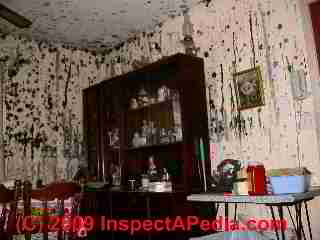 Table of Kinds of Mold Growth Found on Building Surfaces
- POST a QUESTION or COMMENT about what mold will grow on in buildings, and what different mold genera/species are often found on particular building surfaces & materials
Here we provide a table identifying the molds most commonly found on specific building surfaces or in/on building materials, furnishings, and other building contents.
InspectAPedia tolerates no conflicts of interest. We have no relationship with advertisers, products, or services discussed at this website.
Table of Common Indoor Molds Found on Building Surfaces
 We list here the most common mold genera/species that our field investigations have detected in the screening of more than 2000 buildings between 1986 and the present.
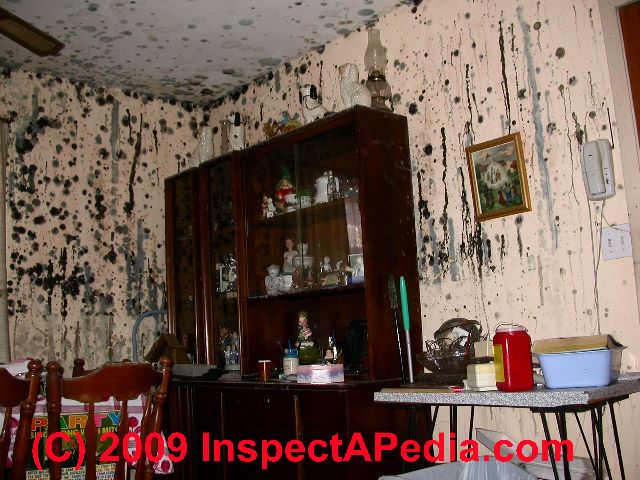
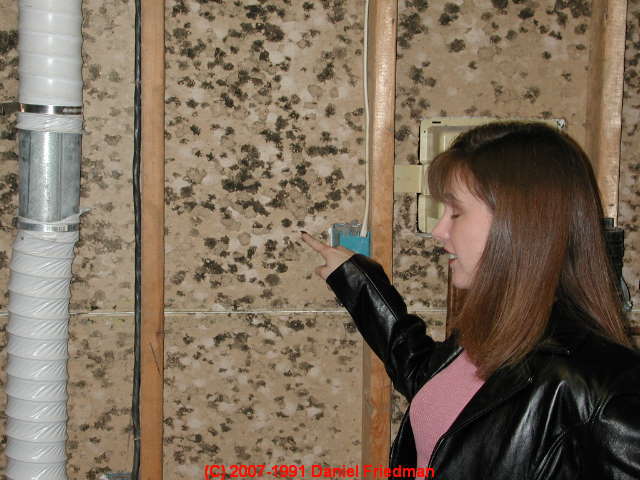
Our page top photo of a mold damaged home shows an area with many different surfaces, materials, and in some cases different genera/species of mold contamination.
[Click to enlarge any image]
Like bird-watching, knowing what molds are likely to be present, what they look like, and what they like to eat, in other words, knowing some mycology, can make a significant difference in what a building inspection for mold actually turns up.
The difference between what molds are found in buildings and what molds commonly grow on various building surfaces is that most mold tests and mold reports involve samples collected by people who are not expert at recognizing and sampling mold in buildings.
So easy-to-see molds are over-reported and hard-to-see molds are under-reported in consumer-generated mold tests and samples. This reporting error also confounds attempts to correlate mold related illness and sick building complaints with specific genera or species of indoor mold.
Simple "mold screening methods" which omit the inspection, and "test only" sampling methods, such as air and culture methods
can produce very unreliable results when used quantitatively - as we discuss
at IAQ Methods and at other articles at this website.
We are conducting ongoing research on the presence of specific molds on building surfaces and materials. Comments, critique, and contributions are invited. CONTACT US.
Wet or Moldy Furnishings:
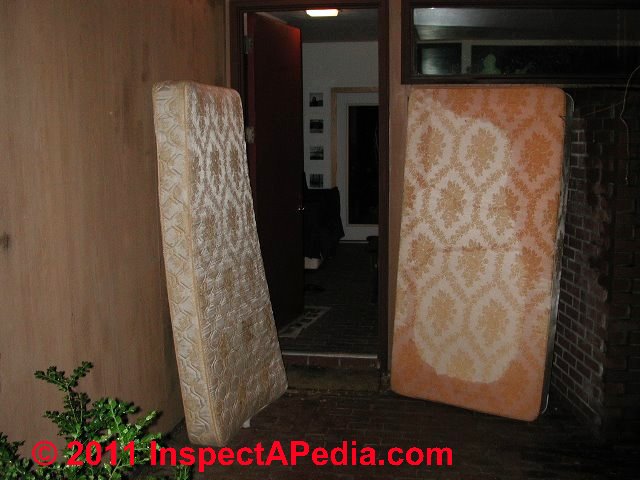
following a building flood or water entry, some items that have been soaked do not need to be tested for mold contamination. A mattress that has been soaked (photo at left), had visible mold growth, or smells moldy is best just discarded. In our mold table below we include additional comments about furnishings that have may not have been wet but that may be mold-contaminated.
NOTICE: the molds we list as most-commonly found on building surfaces and materials in the table below are by no means the only genera/species that may appear in a specific build ling or case. Further, the mold genera/species that grows on a particular surface depends primarily on its growth conditions, in particular moisture level, and of course temperature, light exposure, and similar factors.
It is often the case that multiple mold genera/species are present on the same surface; some molds may be growing parasitically on others, and the particular mold found at a particular spot on a building surface may depend on the moisture level at that location.
Our investigations include extreme-mold cases in which a building had been subjected to severe water damage and left unattended for weeks or months, leading to extensive mold growth throughout the structure on many or nearly all surfaces.
In those extremely-moldy buildings we collected tape samples of mold on each different type of surface or material in the building as well as collecting vacuum and air samples of mold to observe the dominant airborne molds in those environments.
Our OPINION is that the genera of Aspergillus ranks as a wide-lead first as most widely adapted to grow on the greatest number of different indoor building surfaces, with Penicillium sp. probably second.
As we discuss
at MOLD FREQUENCY in BUILDINGS, these two mold genera are probably under-reported by consumers who collect mold samples using test kits as well as many mold test consultants who naturally focus on the most visually obvious dark or "black" molds in buildings. Outdoors we most often find the king of molds, Cladosporium sp. on widespread building surfaces.
Table of Common Indoor Building Molds on Surfaces or In Materials |
||
| Building Surface or Material Links Photographs of Mold on Various Materials found On or In buildings |
Mold | Comments |
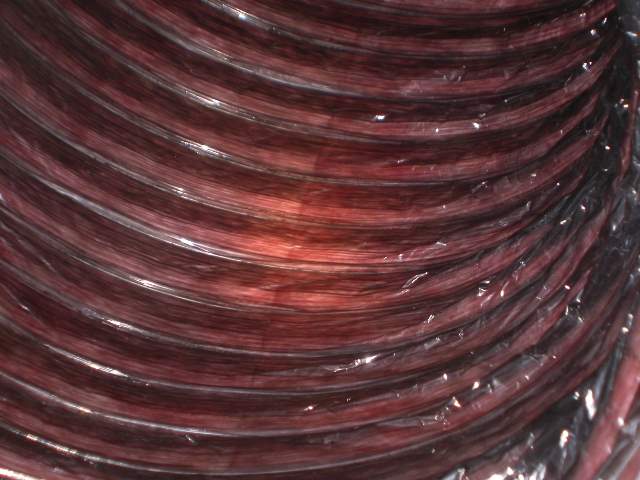
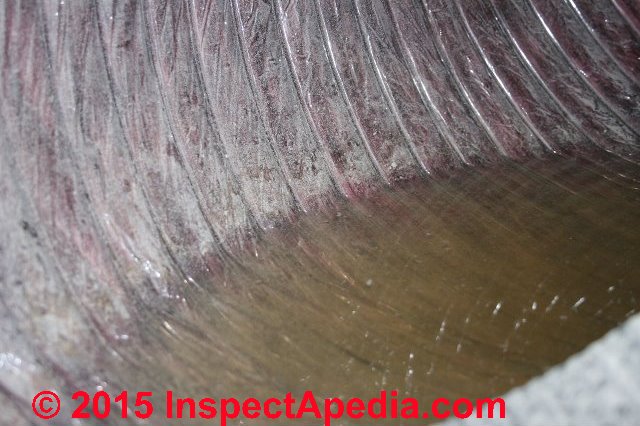
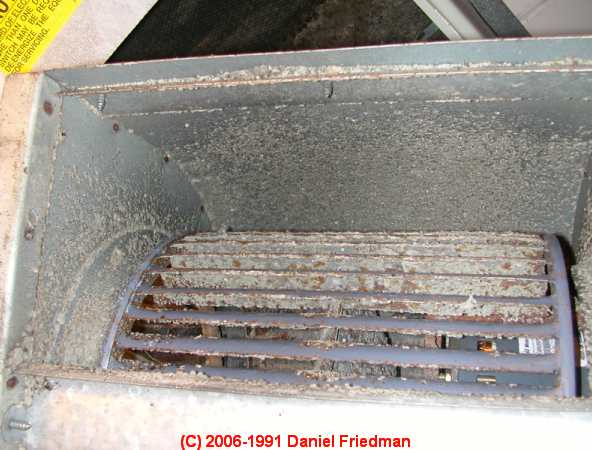
Air duct mold, PLASTIC FLEX DUCT MOLD |
Cladosporium sp. / C. sphaerospermum See MOLD on/in AIR DUCTS in HVAC systems MOLD in AIR HANDLERS of air conditioners and heating furnaces |
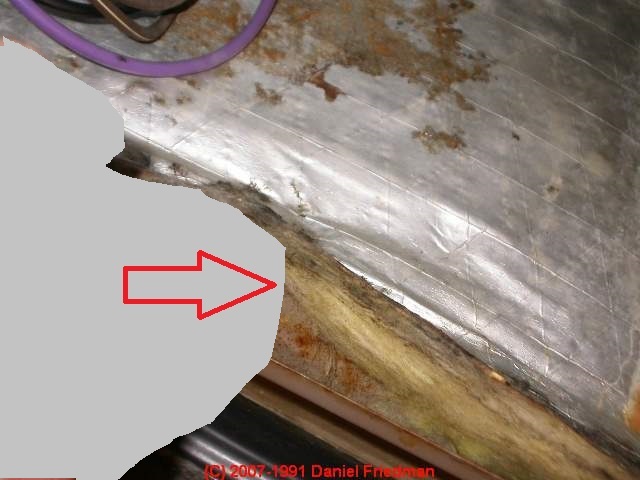
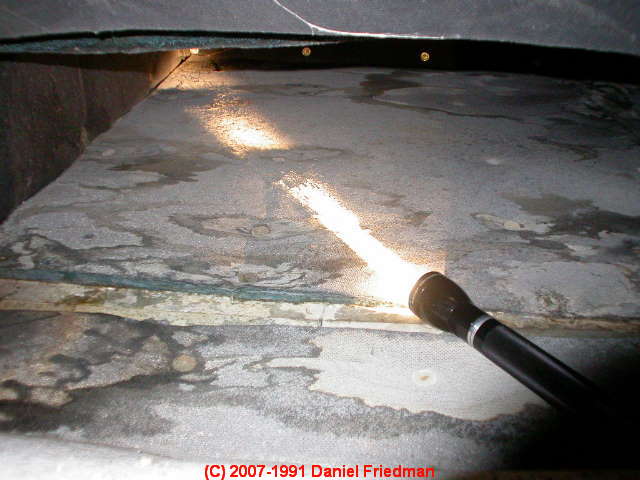
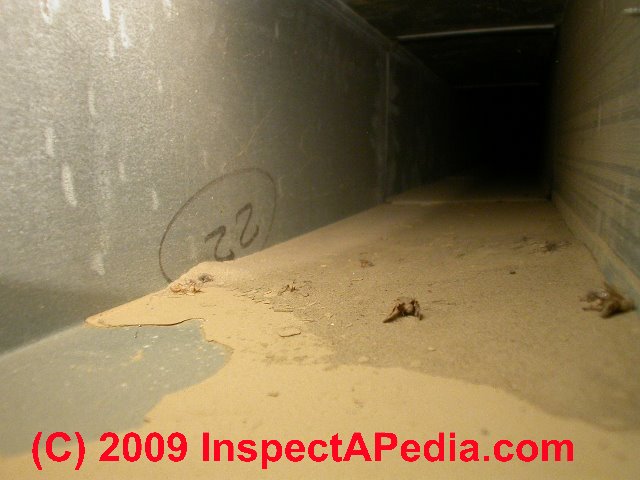
Common in various duct systems especially where normal organic building dust and debris accumulate along with WATER [photo] downstream of condensate blow-off in the air handler or where condensation has occurred, or where external AIR DUCT LEAKS [photo] occurred into rooftop mounted ducts or where building DUCTS were EXPOSED to FLOODING [photo] |
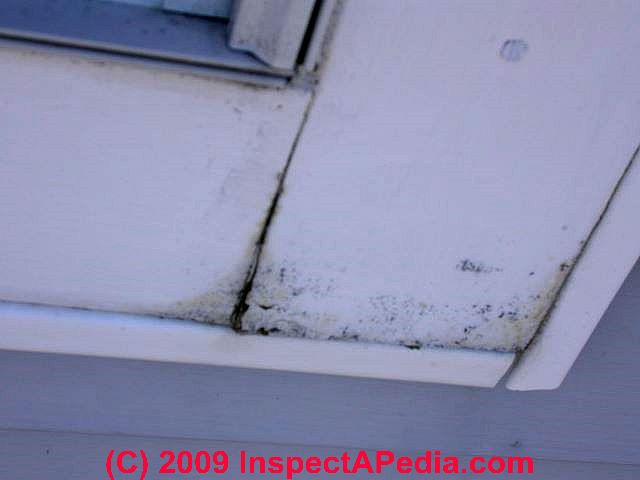
| Aluminum siding & aluminum exterior trim mold - building exteriors | Various | Associated with damp, shaded locations; don't mistake algae or dirt for mold; |
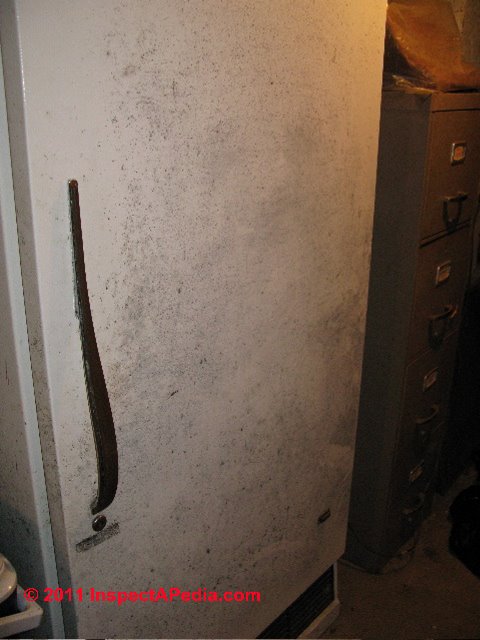
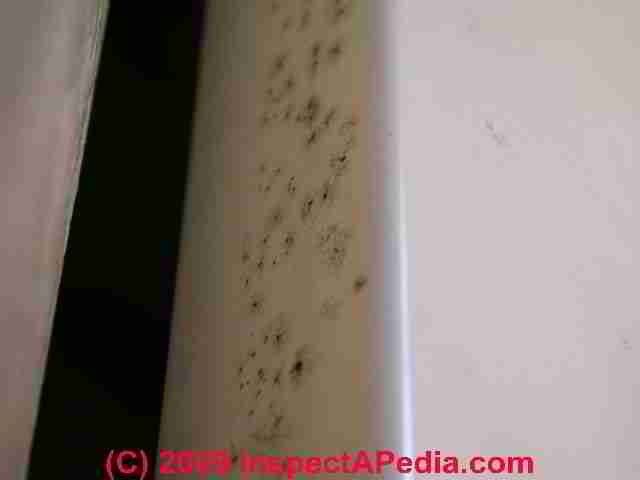
Appliances, painted or porcelain surfaces of MOLDY REFRIGERATORS, etc. includes UNIMPORTANT MOLD on REFRIGERATORS, |
Refrigerator gaskets: Cladosporium sp. / C. sphaerospermum |
Presence of mold probably depends mostly on the presence of organic dust and debris such as food, grease, house dust or animal dander. Very different molds grow on painted or porcelain appliance surfaces than those most often found on rubber or plastic parts. |
| ART WORK MOLD (joint project photo courtesy Ulrik Runeberg, Museo de Arte Contemporaneo de Puerto Rico), oil on canvas (others available) | Cladosporium sp.; also Penicillium sp. & Aspergillus sp. especially on masonite substrates See MOLD on ARTWORKS |
Varies widely by paint chemistry, substrate of fabric, hardboard, wood, and varies significantly between exposed surface and hidden surfaces. (Study projects with several art museum conservators include mold contamination, bleed-through from hardboard substrates, and paint failures on historic buildings and artifacts. |
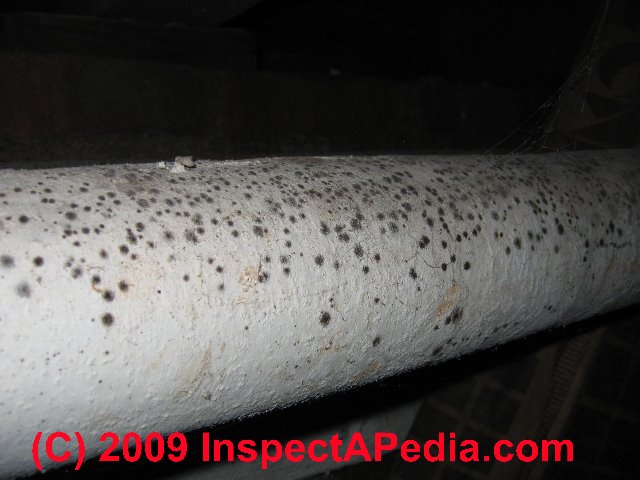
| ASBESOTOS PIPE INSULATION MOLD, painted cloth covering | Cladosporium sp. / C. sphaerospermum
|
See MOLD on ASBESTOS PIPE INSULATION |
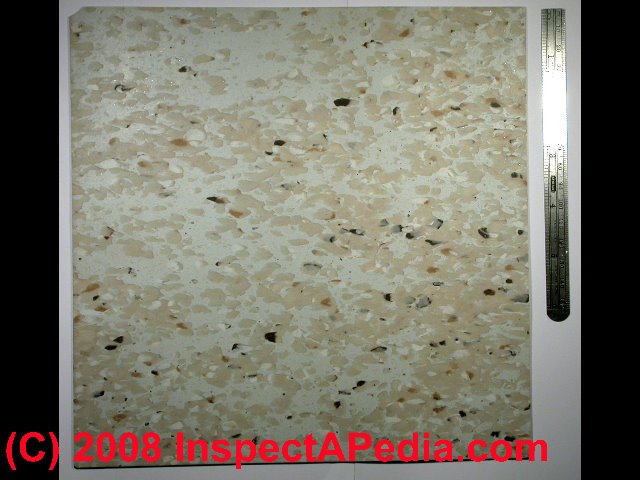
| Asbestos floor tiles or vinyl asbestos tiles | Rare unless coated with paint or organic debris; | |
|
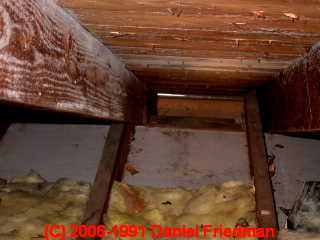
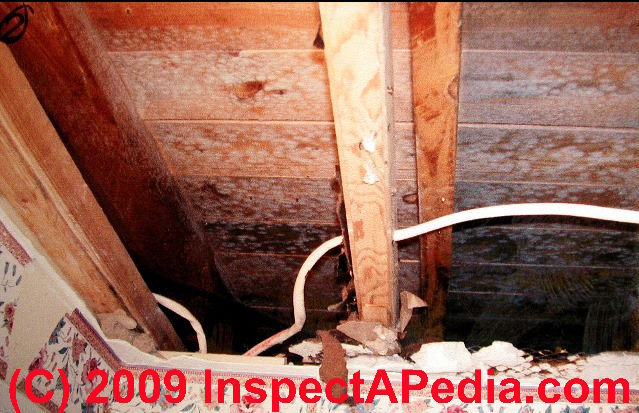
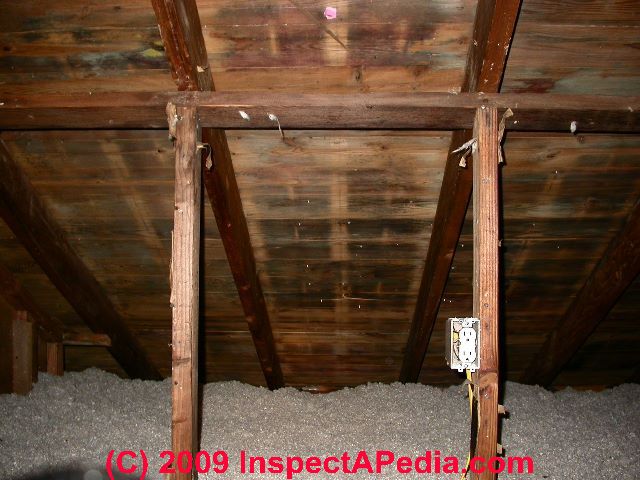
Wood RAFTER MOLD framing, PINE BOARD SHEATHING MOLD, attic floors, attic insulation, attic stairs, contents stored in attics |
Cladosporium sp.; C. sphaerospermum; Aureobasidium pullulans; Ulocladium sp.; Pithomyces sp.; |
See Roof Sheathing, Framing-wood, Insulation; also |
| Automobiles | Aspergilllus sp. and many others, varying by surfaace material | See MOLD on/in AUTOMOBILES, boats, cars, RVs |
| Barns, common mold on barn framing (excluding moldy hay, straw, leather) | See MOLD on BARN FRAMING, new construction | |
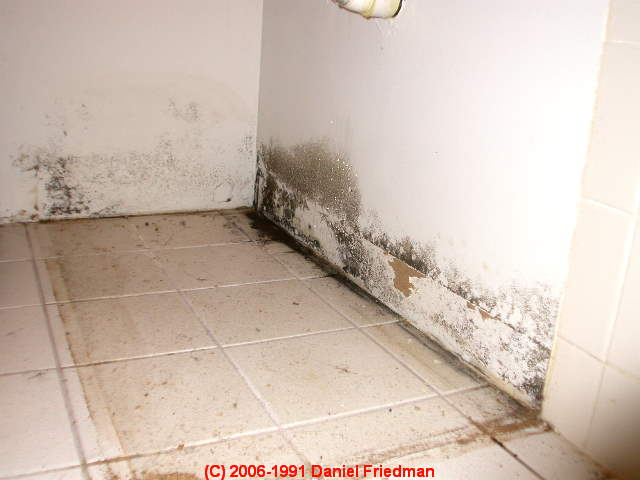
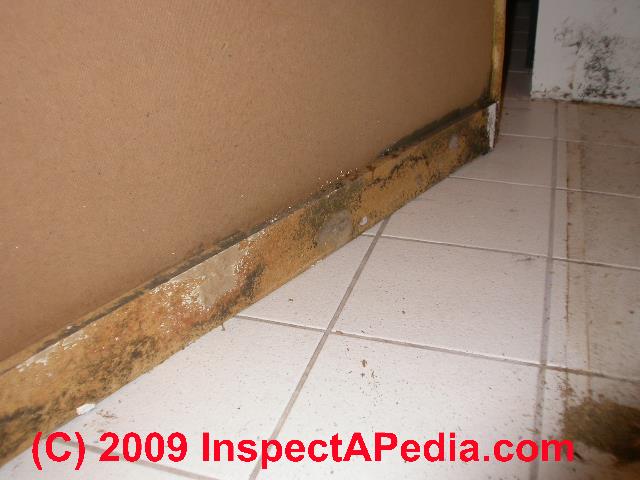
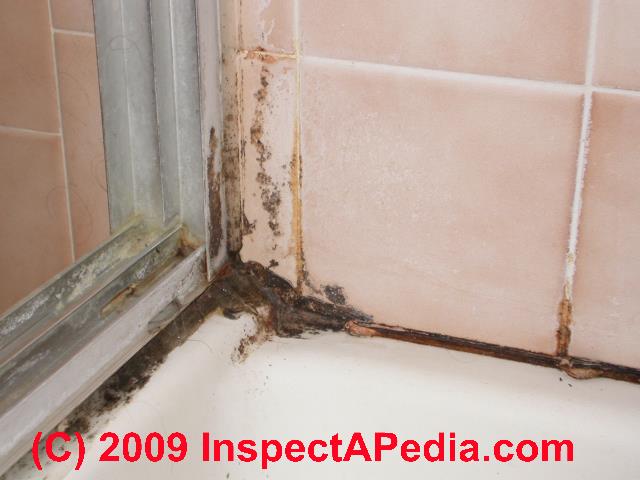
Bathroom mold: bath tiles, bathroom tub caulk, porcelain fixtures, bath ceilings, wallpapered bathroom walls, HIDDEN BATH MOLD in VANITY such as MOLD BEHIND / UNDER CABINETS |
See MOLD on CERAMIC SURFACES | |
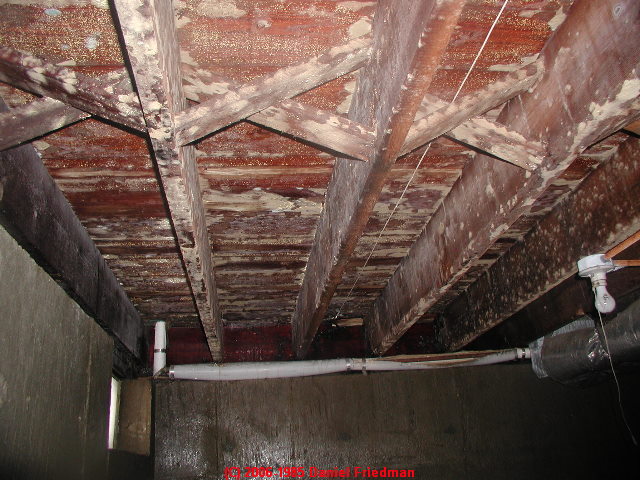
| Beams, WOOD GIRDERS & BEAMS in buildings, especially in wet or damp basements or crawl spaces | Cladosporium sp.; C. sphaerospermum; Aspergillus sp.; Penicillium sp.; |
For wet basements and crawl spaces, also see WATER ENTRY in BUILDINGS For log homes with moisture and mold problems see LOG HOME Leak Diagnosis & Cure And for buildings subject to flooding, see FLOOD Damage Assessment & Repairs |
| Bedding, pillow surfaces, sheets, fabrics | Various molds and yeasts. Also dust mites, fecals, allergens. |
May vary by fabric fiber type, cotton vs. synthetic |
| Books, mold on books | Aspergillus sp. on cloth bindings Cladosporium sp.; on exposed edges of paper, varying by organic dust level; |
Varies significantly by binding type and glue, cloth, paper, etc. |
| Cabinets, kitchens or bath vanities, visible and hidden mold | Aspergillus sp.; Penicillium sp.; |
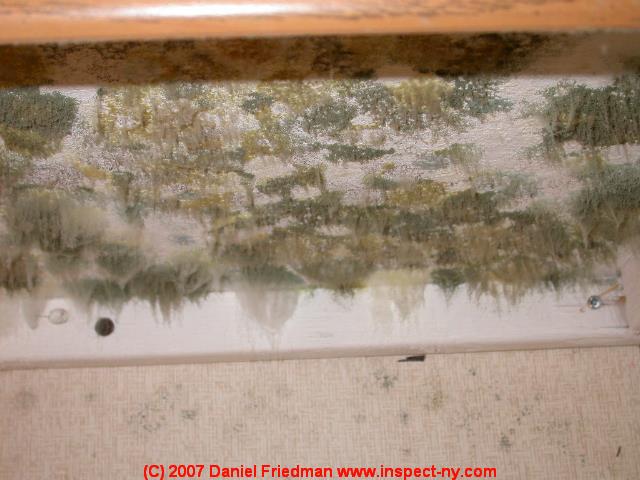
Varies by cabinet material, wood, pressboard, paint, and presence of kitchen grease or food particles; Also very significant variation between coated or finished surfaces and un-coated or un-finished surfaces such as cabinet backs. See GREEN MOLD PHOTOS for photos of green mold on indoor cabinets & furniture. |
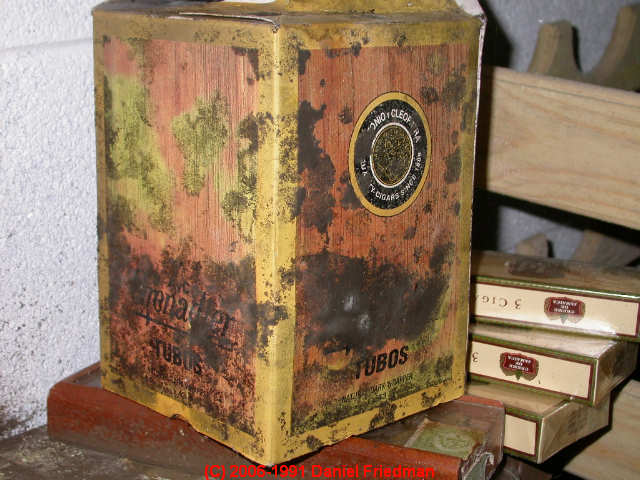
| CARDBOARD BOXES, mold on | Stachybotrys chartarum; Aspergillus sp.; |
Also harder cardboard or other paper boxes such as shoe boxes, cigar boxes. See GREEN MOLD PHOTOS for photos of very moldy cardboard box. |
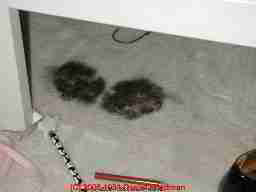
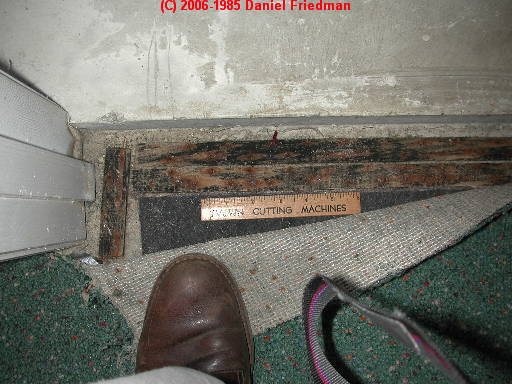
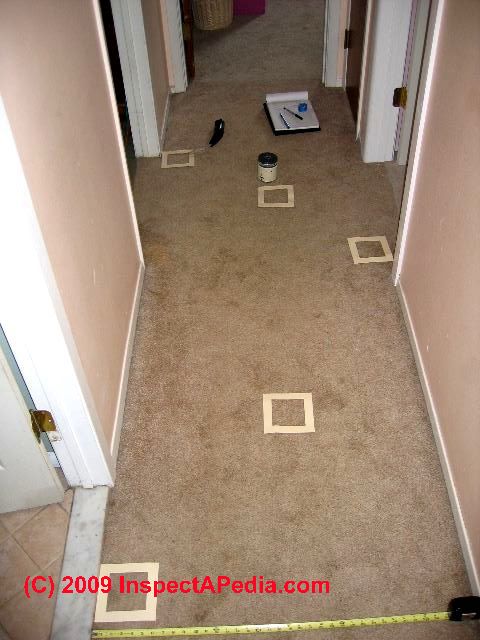
Carpeting, VISIBLE MOLD on CARPETS & RUGS and CARPET PADDING. Note that mold contamination on carpeting is primarily where carpet has been wet, but may |
Various molds and yeasts. | Varies by carpet material, fiber type, and exposure to food, animal dander, other. |
| Cedar closet materials: wall boards, composite cedar sheathing | Aspergillus sp.; Penicillium sp.; |
|
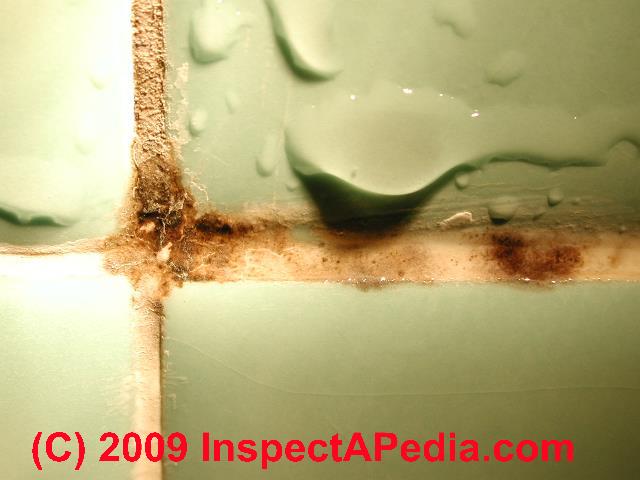
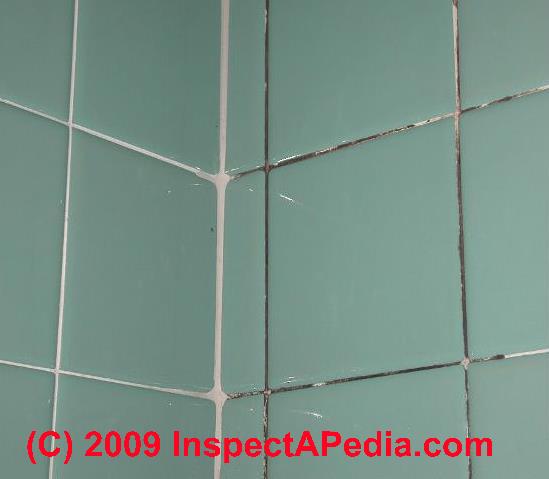
| Ceramic tile, TILE GROUT, tile CAULK/SEALANT in baths and other areas | Cladosporium sp.; C. sphaerospermum; | more common where tile, grout, or caulk is left wet and has become coated with soap or other organic material - normally small in area & impact unless hidden leaks occurred behind tile or marble surfaces |
| Ceiling tiles, visible and hidden mold | Aspergillus sp./A. versicolor; Penicillium sp.; Yeasts. |
Varies by material used, plastic vs. paper surfaces, painted or not |
| CHIPBOARD or PRESSBOARD used for cabinets, counters, furniture, or for shelving | Aspergillus sp./A. versicolor; Penicillium sp.; Yeasts. Trichoderma sp./T. viride.. |
|
| Closet mold, visible and hidden mold commonly found in closets & PANTRIES | ||
| Clothing, visible and hidden mold | Aspergillus sp.; Penicillium sp.; |
Varies by fabric, natural vs. synthetic fiber, leather vs. cloth, exposure to food or other contaminants See clothing cleaning advice at SALVAGE BUILDING CONTENTS |
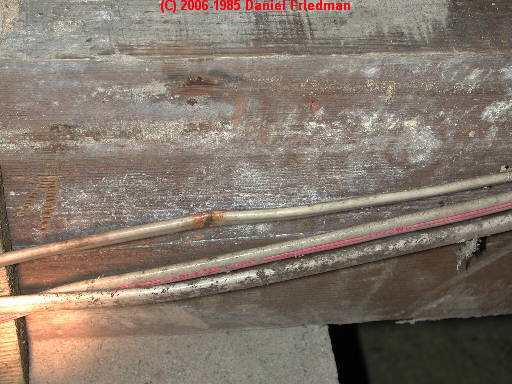
| Copper piping, mold growth on piping surfaces | uncommon | Mold growth may appear on painted copper surfaces or on organic dust and debris settled on copper surfaces; |
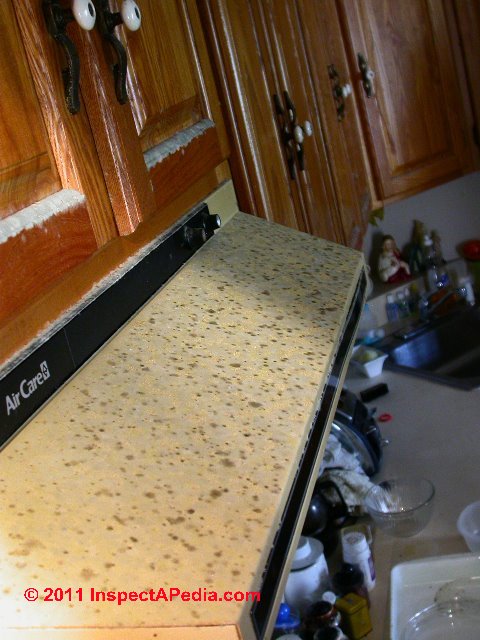
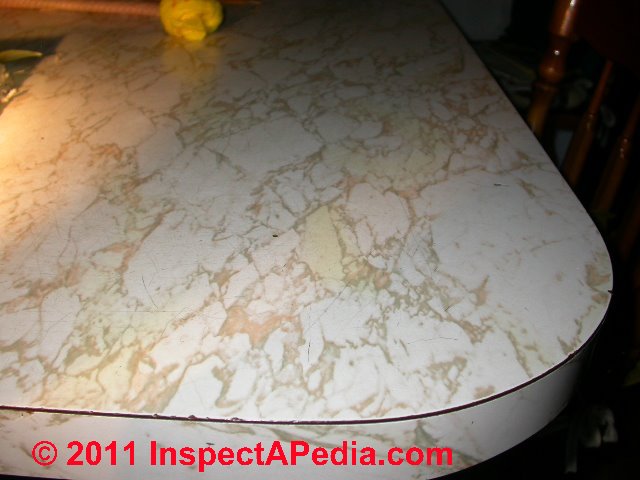
Counter tops, kitchen or bath, plastic laminates. |
Aspergillus sp.; Penicillium sp.; on un-finished surfaces. |
Plastic laminates. Mold growth on stone counter tops is rare and usually depends on the presence of biological contaminants such as food. |
| Dirt, crawl space surfaces, visible and hidden mold | Various basidiomycetes; soil fungi; | See MOLD on DIRT FLOORS and |
| Doors, hollow core luan or vinyl-coated, painted and un-painted surfaces, visible and hidden mold | We find that different mold genera/species grow on different hollow core surfaces where wood species vary, for example different molds will be found on the luan door face than on the pine door edges. | |
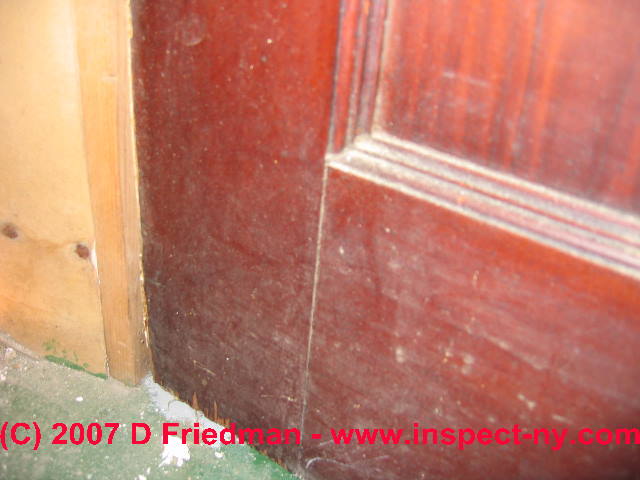
| Doors, solid wood, pine, painted or CLEAR-COATED and unpainted, visible and hidden mold | See SALVAGE BUILDING CONTENTS | |
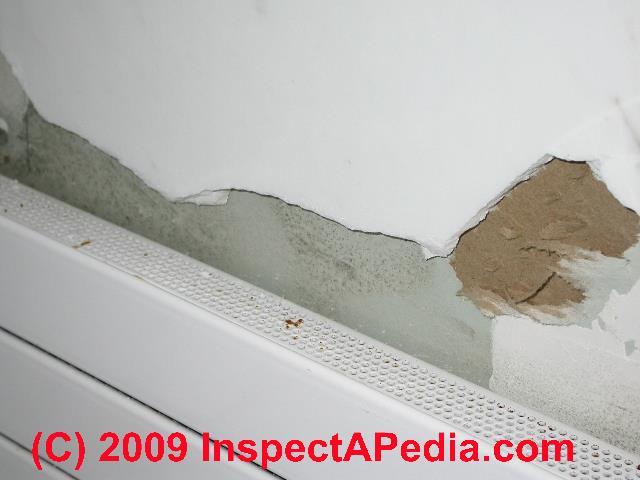
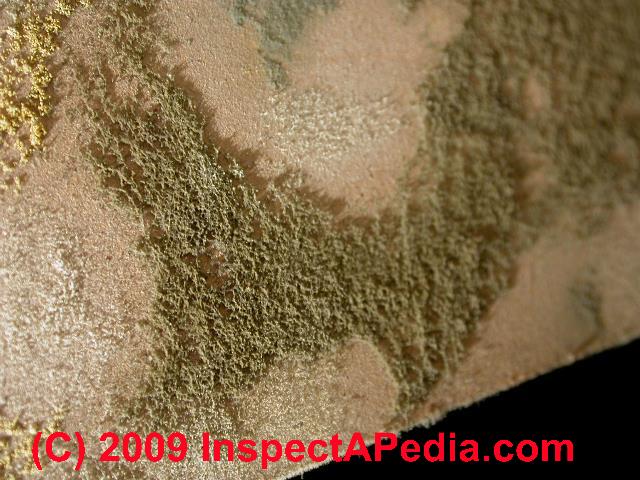
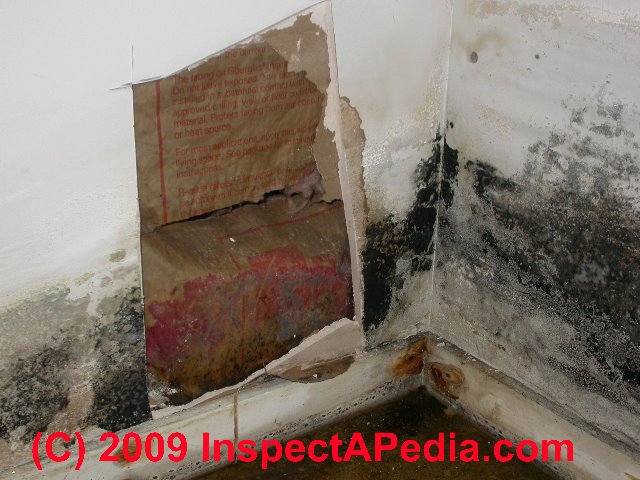
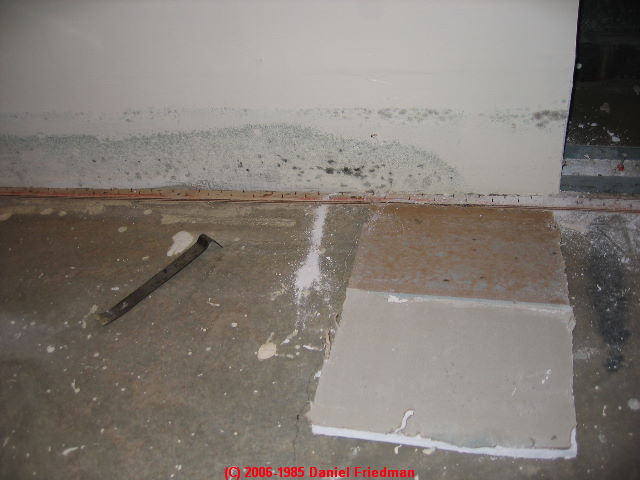
DRYWALL / GYPSUM BOARD, visible Drywall gypsum board (such as Sheetrock™), not treated for mold resistance, visible and hidden mold |
Stachybotrys chartarum - most wet area. Cladosporium sphaerospermum, Aspergillus sp., A. flavus. Penicillium sp.; |
Synonym: gypsum board. Significantly, mold growth may be rare or absent on un-painted joint compound at tape joints. Mold growth on drywall generally varies by genera/species at different heights from a wet floor as moisture level in the material varies. Mold growth on drywall may be interrupted at horizontal drywall joints. Mold growth on the exposed "room side" of drywall may be a different genera/species and also very different in quantity from mold growth found on wall-cavity side. See SAMPLING DRYWALL for an example of three different molds on drywall at different moisture levels and heights from a wet floor. See BLACK MOLD IDENTIFICATION for photos of several different black molds on drywall. See RED MOLD PHOTOS for very moldy wall cavity side of drywall that showed no mold on the exposed or room side. Also see SHEATHING, GYPSUM BOARD. Many mold species, varying by moisture level in the drywall at different locations or distances from the moisture source (such as a wet floor in a basement or a laundry room) |
| Ducts, fiberglass-lined HVAC, visible and hidden mold | Cladosporium sp.; C. sphaerospermum; Rare: |
See Why does mold grow in fiberglass? for discussion of mold in HVAC ducts |
| Ducts, plastic lined HVAC, visible and hidden mold | Rare. | Depends on the presence of house dust (containing organic debris) and presence of moisture. |
| Doors, interior, hollow core, visible and hidden mold | Aspergillus sp.; Penicillium sp.; |
Varies by wood species and coating. Hollow core luan doors show different mold genera/species on the luan surface from that found on the surface of solid pine used in door edges. Variations also among coatings: paint, stain, varnish, polyurethane. See WHITE MOLD PHOTOS for photos of moldy solid and hollow core doors. |
| Doors, interior, solid pine, visible and hidden mold | Aspergillus sp.; Penicillium sp.; |
Varies by coating. |
| Fiberglass, visible and hidden mold | see Insulation | |
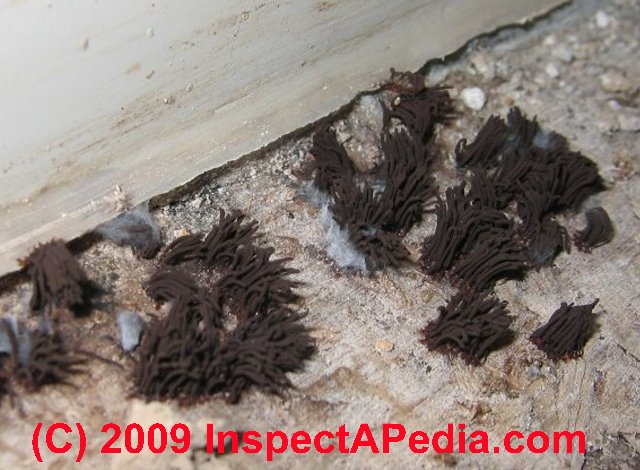
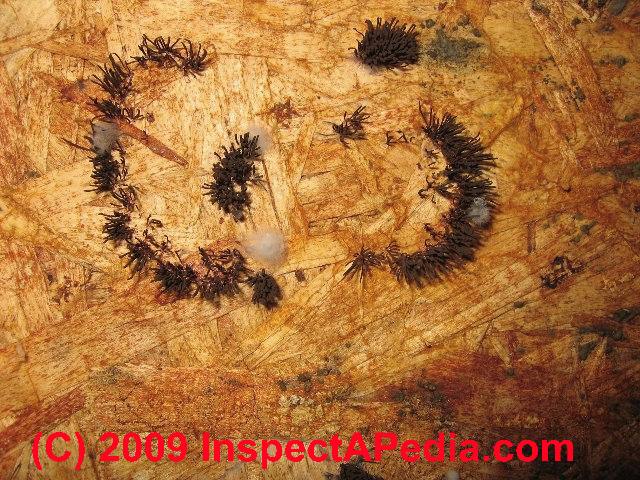
| Floor sheathing, OSB oriented strand board, visible and hidden mold | Cladosporium sp.; C. sphaerospermum; Stemonitis sp. |
See BROWN MOLD PHOTOS for photos of mold on OSB including stunning photos of Stemonitis sp. on a bathroom floor. |
| Floor sheathing or subflooring, plywood, visible and hidden mold | Aureobasidium pullulans common in attics on roof sheathing; Cladosporium sp., C. sphaerospermum, common on roof sheathing; Less common: |
See BLACK MOLD IDENTIFICATION for photos of Taeoniella sp., T. rudus, and other dark molds on plywood. See GREEN MOLD PHOTOS for photos of green mold on plywood subfloor over a wet crawl space. |
| Floor sheathing, pine tongue & groove, visible and hidden mold | Aspergillus sp.; |
|
| Flooring, vinyl tiles or sheet vinyl, visible and hidden mold | ||
| Flooring, wood strip, visible and hidden mold | ||
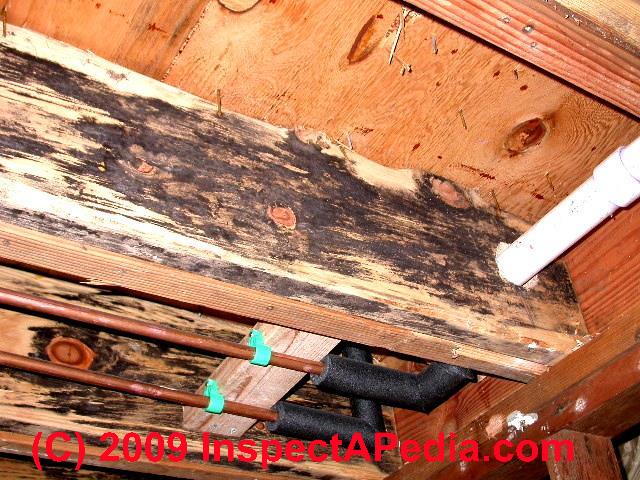
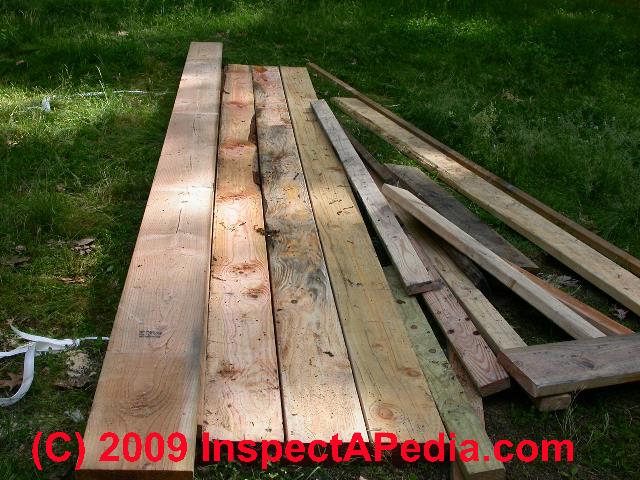
| Framing lumber, wall studs, ceiling joists, roof rafters, un-treated lumber not painted, visible and hidden mold | Ceratocystis/Ophistoma black mold group - see Cosmetic Mold Cladosporium sp. / C. sphaerospermum; Less common: Aureobasidium pullulans; (more common on plywood sheathing) |
May vary by wood species; We find parasitic mold growth on top of cosmetic mold growth on some lumber, both un-treated and treated. See MERULIPORIA HOUSE EATING FUNGUS for a mold that causes structural damage. |
| Framing lumber, treated wood, visible and hidden mold | Ceratocystis/Ophistoma black mold group - see Cosmetic Mold Aspergillus sp. and Penicillium sp. have been found growing parasitically on cosmetic molds on lumber, particularly common on treated lumber. Cladosporium sp.; |
Wood treated for insect or rot resistance, may vary depending on treatment chemicals. |
| Furniture, indoor wood, visible such as this ASPERGLLUS sp. on a PINE DESK, and hidden mold | Cladosporium sp.; |
Depends on wood species, wood coating; Check un-coated surfaces such as under bureau drawers and the under-side of chip board or particle board furniture such as game tables and pool tables. See GREEN MOLD PHOTOS for photos of green mold on indoor cabinets & furniture. |
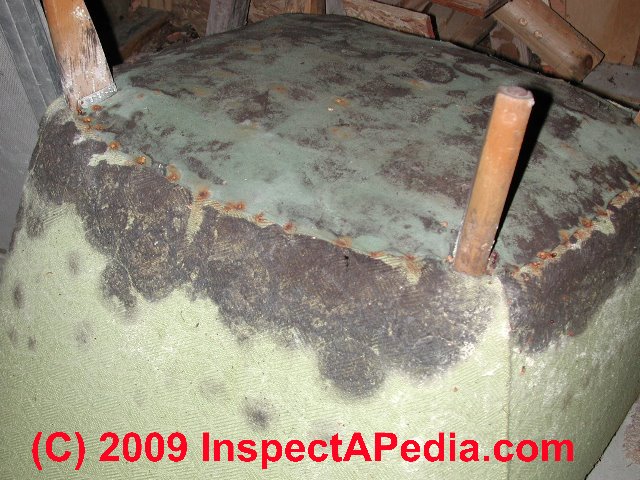
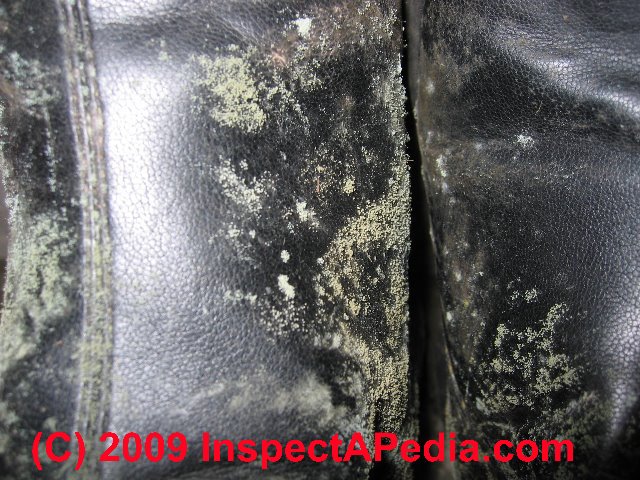
| FURNITURE UPHOLSTERY, visible and hidden mold | Cladosporium sp.; Stachybotrys sp.; Aspergillus sp; |
In addition to surface mold, mold growth inside of upholstered furniture may be present and may be detected by vacuum methods. See BLACK MOLD IDENTIFICATION for photos of moldy upholstered furniture. |
| Glass surfaces indoors, visible and hidden mold | Cladosporium sp.; | Depends on deposition of organic debris; |
Hardboard products such as Masonite, used for PEGBOARD, paneling, or for works of art as a painting substrate |
||
| Homasote & other fiberboard insulating board and sheathing products, mold, visible and hidden | Aspergillus sp.; | Uncommon, found in flooded homes subject to extreme mold growth lso see |
HVAC equipment: air conditioner or heating system AIR HANDLERS & BLOWERS, especially where organic house dust and debris accumulate |
Cladosporium sp.; | |
| Insulation, asbestos pipe, visible and hidden mold | Stachybotrys sp.; Aspergillus sp.; |
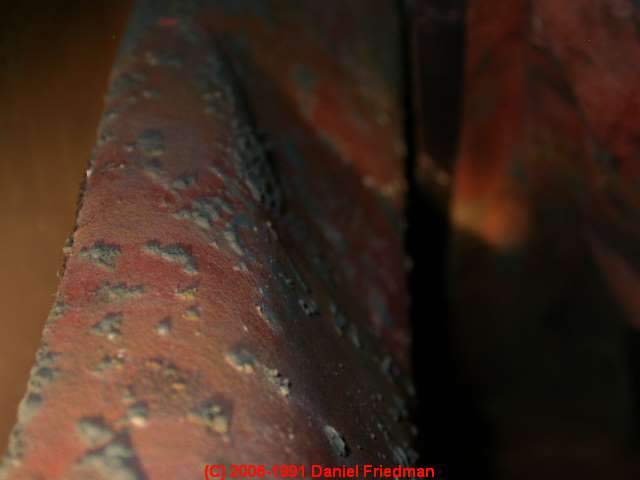
Mold growth depends on paint coating, fabric fibers (cotton wrap), and moisture exposure. See See BLACK MOLD IDENTIFICATION for photos of mold on asbestos pipe insulation. |
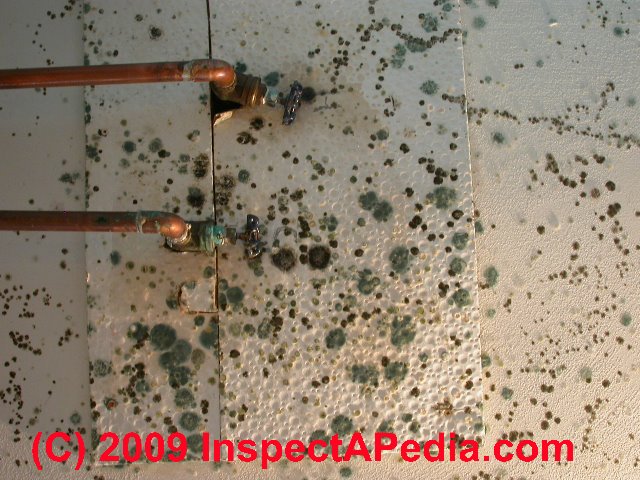
| Insulating boards, styrofoam, urethane foam, others, visible and hidden mold | ||
| Insulation, cellulose, visible and hidden mold | None of our field samples have detected mold contamination in this material. | We postulate that the fire retardant chemicals used on blown-in or loose-fill cellulose building insulation retard mold growth. The life expectancy of this mold resistance may be affected by time or by exposure to water. |
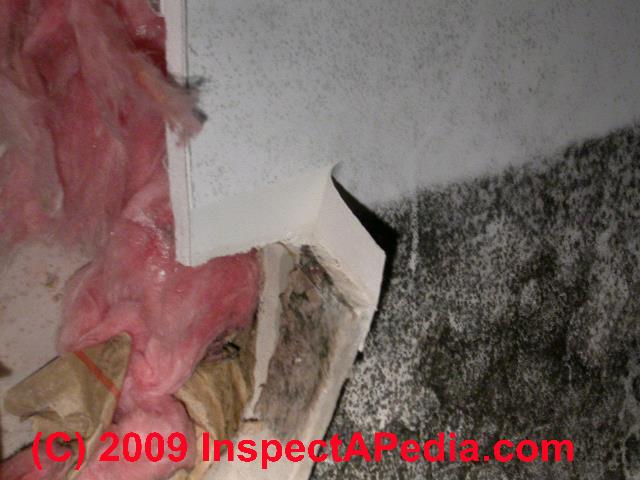
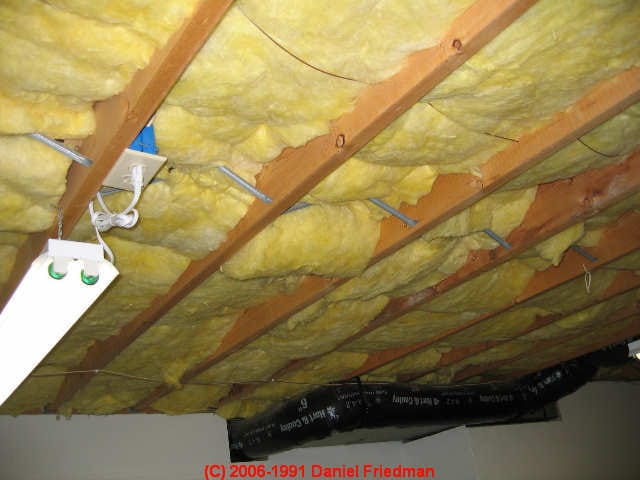
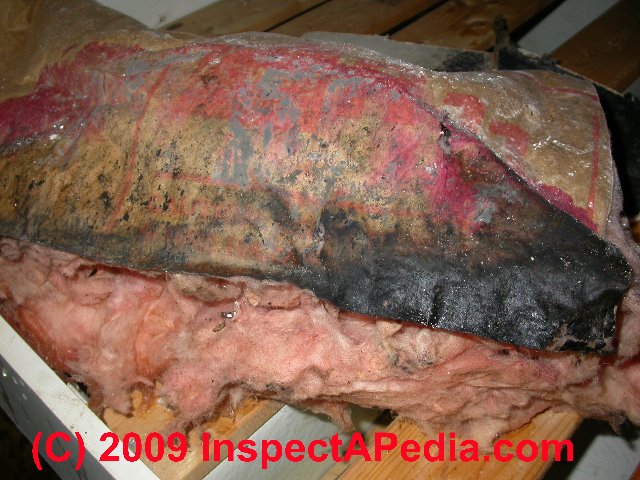
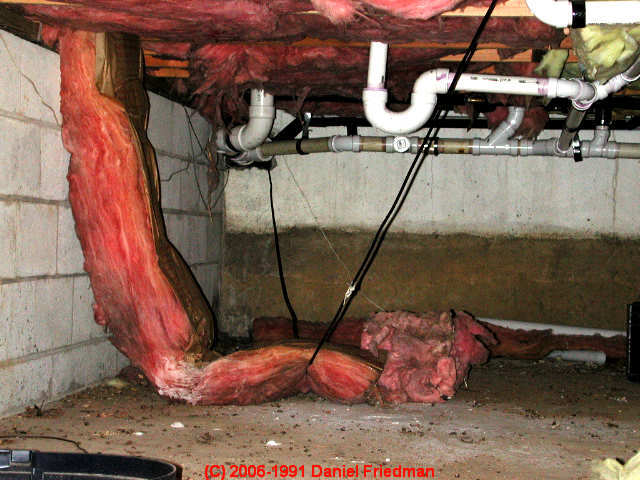
Insulation, fiberglass,in the FIBERGLASS visible and hidden mold including both and on INSULATION KRAFT PAPER subject to WET CONDITIONS |
Penicillium/Aspergillus sp. inside of fiberglass insulation in floors, walls, attics, cathedral ceilings where leaks have occurred | Significant levels of mold contamination may be present but not visible to the naked eye, in insulation that has been wet or exposed to high moisture, or exposed to high levels of airborne mold from building demolition. Special insulation vacuum test methods are used. Additional mold genera/species appear on foil or kraft-paper insulation facing. |
| Insulation, foam board, visible and hidden mold | Cladosporium sphaerospermum; | Mold growth on closed-cell foam insulating board is invariably surface-only and appears to depend on the presence of organic dust or debris. May vary by type of foam and by foam board coatings such as foil or paper. |
| Insulation, sprayed icynene, visible and hidden mold | We have not detected mold growth on this material | Mold growth may be possible on icynene foam depending on its exposure to airborne organic dust and debris. |
| Leather clothing, shoes, LEATHER FURNITURE, visible and hidden mold | Aspergillus sp.; | Professinal cleaning may salvage some of these items. |
Lumber, framing, visible and hidden mold, including COSMETIC MOLD on LUMBER from the lumber supplier |
||
| Mattresses, not covered by other materials, visible and hidden mold | May vary by mattress cover fabric type, cotton vs. synthetic mix; mold growth inside of mattresses may be present and may be detected by vacuum methods. | |
| Mattresses or bed linens that smell moldy - MVOC contamination | Aspergillus sp.; Penicillium sp.; Cladosporim sp.; Trichoderma sp.; others. Usually more-significant: allergens such as dust mites & mite fecals. |
It's unlikely a moldy mattress that was actually wet or suffered mold growth can be cleaned adequately, but unfortunately that experience also extends to a mattress that has had prolonged exposure to MVOCs and just "smells moldy" - usually a smelly mattress is also replaced as part of mold remediation |
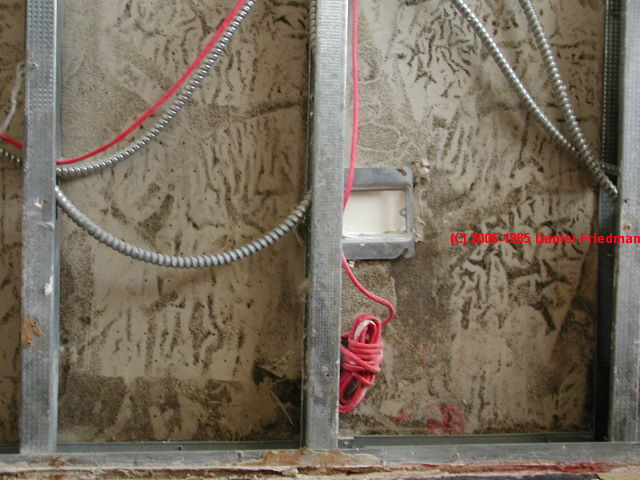
| Metal stud walls & metal stud wall cavities, visible and hidden mold | Typical molds found on drywall or paneling; | See MOLD on METAL STUD WALLS |
| Metal surfaces, e.g. stainless steel kitchen sink, visible and hidden mold | Mold growth probably depends on the presence of food or other organic dust and debris
|
|
| Mobile homes, visible and hidden mold in various locations associated with most common moisture and leak risks on these structures: wall cavities below windows, floors, subflooring, crawl area insulation, roof cavities | See MODULAR HOME MOLD CONTAMINATION Also see MOBILE HOMES, DOUBLEWIDES, TRAILERS |
|
| Modular homes, visible and hidden mold in cavities and locations peculiar to modular home construction methods and due to leaks during transport of modular home units in wet weather | See See MODULAR HOME MOLD CONTAMINATION Also see MODULAR HOME CONSTRUCTION |
|
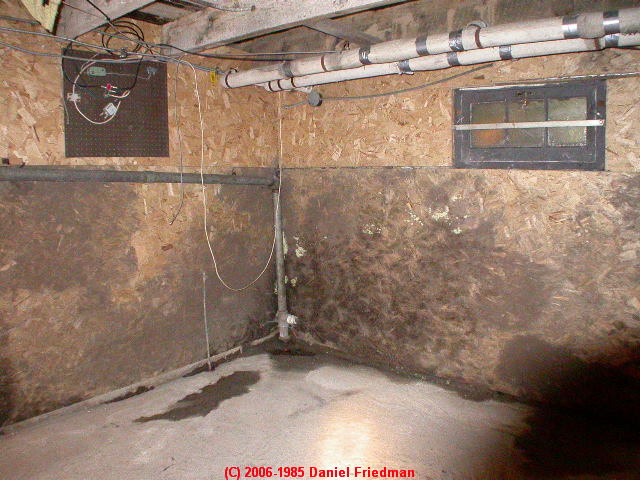
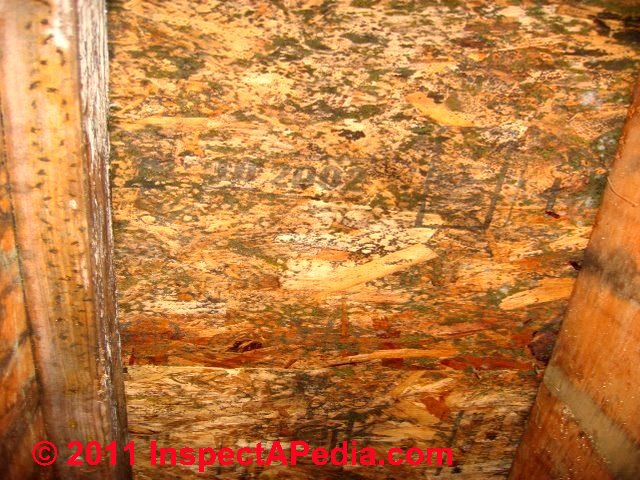
| OSB, oriented strand board sheathing for roofs, walls, floors, subfloors, visible and hidden mold | Stemonitis sp., Aspergillus sp., Ulocladium sp., Cladosporium sp., Pithomyces sp., Basidiomycetes, on occasion, Meruliporia incrassata. | Photo of very moldy OSB subfloor from basement side Also see SHEATHING, OSB. |
| Painted surfaces, wood, visible and hidden mold; painted masonry including brick & masonry block as well as poured concrete foundations | Aspergillus sp.; Penicillium sp.; Yeasts; |
Mold genera/species may vary by paint chemistry. See GREEN MOLD PHOTOS |
| Paneling mold, visible and hidden mold | Aspergillus sp.; Penicillium sp.; Yeasts; |
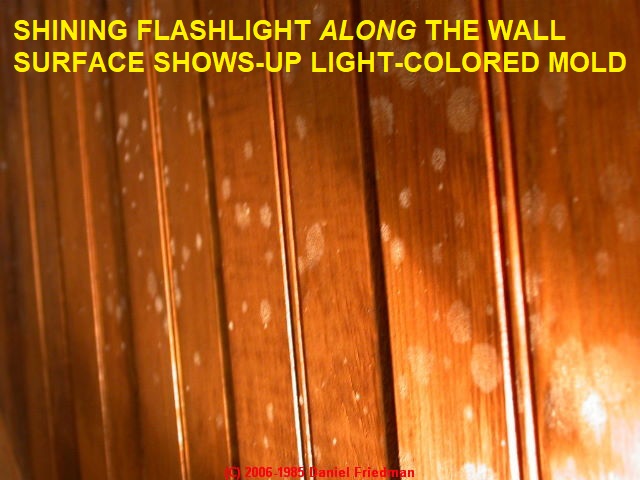
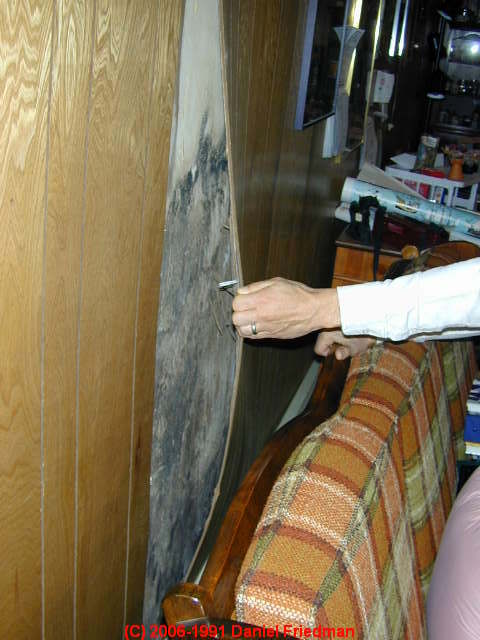
Varies by type of paneling, wood species, paneling coating, painted paneling, vinyl-covered paneling, and wood paneling. See HIDDEN MOLD in PANELING See WHITE MOLD PHOTOS for photos of moldy solid pine paneling and wainscot. See USING LIGHT TO FIND MOLD for tips on spotting hard-to-see light colored mold on wall paneling and similar surfaces. |
| Papers, files, file folders, newsprint, visible and hidden mold | In order from most-wet to less-wet: Stachybotrys chartarum/ Stachybotrys sp.; less often, Memnoniella sp.; Cladosporium sp./ C. sphaerospermum; Aspergillus sp. / A. flavus, A. versicolor
|
Mold genera/species probably varies by paper chemistry, newsprint vs. cardboard, clay-coated vs un-coated papers, rag content See SAMPLING DRYWALL |
| Pergo type laminated flooring products, visible and hidden mold | Uncommon. | Flooring that has been flooded needs to be removed where water has passed below. |
Pine boards, solid pine wood used for trim, paneling, flooring, or subflooring with variation with subflooring age and exposure to moisture, and between painted or coated-sealed sides and un-finished (usually wall cavity) side, visible and hidden mold |
Aspergillus sp. / A. flavus, A. versicolor Trichoderma sp.; Cladosporium sp.; |
|
| Plaster walls, ceilings, raw plaster & painted plaster, visible and hidden mold | ||
| Plastic ceiling & wall covering materials | In areas subject to flooding & extreme mold growth conditions | |
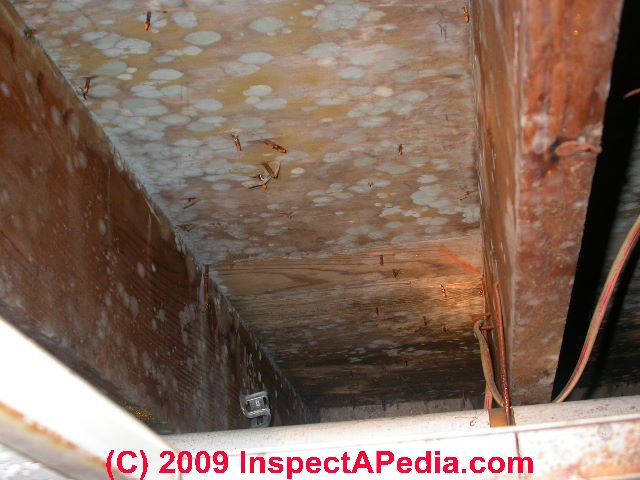
| Plywood, building roof sheathing, wall sheathing, plywood subflooring, furniture backs, bottoms, counters, cabinets, visible and hidden mold | Taeoniella sp., T. rudus, on plywood subfloor exposed to leaks such as at sliding entry doors. Aureobasidium pullulans common in attics on roof sheathing; Cladosporium sp., C. sphaerospermum, common on roof sheathing; |
Varies depending on presence/absence of coating (e.g. painted plywood), and by level of moisture encountered. Also see SHEATHING, PLYWOOD |
| Porcelain surfaces, visible and hidden mold | Cladosporium sp.; | Mold growth probably depends on presence of organic dust and debris. Easily washed clean. |
| Roof sheathing, OSB oriented strand board, visible and hidden mold | Cladosporium sphaerospermum; Aureobasidium pullulans; |
|
| Roof sheathing, pine boards, T&G, visible and hidden mold | Aspergillus sp.; Penicillium sp.; Trichoderma sp., T. viride (green), and T. harzianum |
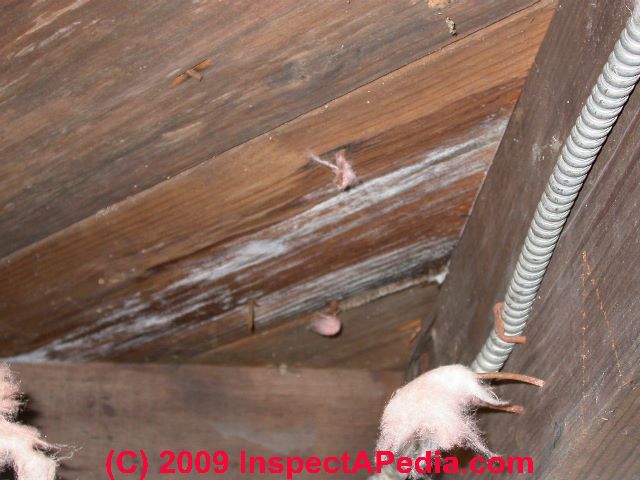
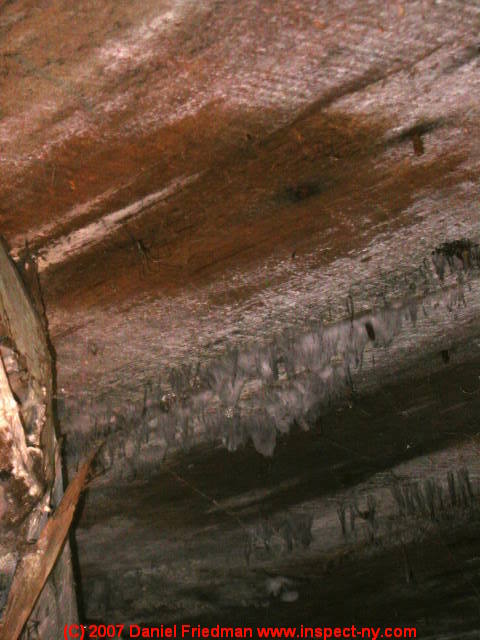
Found in poorly vented and leaky attics of older homes; found in some attic knee wall areas on roof and floor sheathing; See WHITE MOLD PHOTOS for photos of moldy tongue and groove roof sheathing. |
| Roof sheathing, plywood, un-treated, visible and hidden mold. Also see OSB sheathing discussed above. | Cladosporium sphaerospermum; Less common: |
Mold growth depends on moisture exposure from leaks and inadequate attic ventilation; See BROWN MOLD PHOTOS for photos of mold on plywood. |
| Shoes, cloth, vinyl, leather, visible and hidden mold | Aspergillus sp. Penicillium sp. |
|
| Stainless steel surfaces, visible and hidden mold | uncommon | Appears on these surfaces when also contaminated with soap, organic debris, and in extremely moldy conditions in buildings. Easily washed clean. |
| Stereo speakers, visible and hidden mold on wood or cloth surfaces, also on paper materials such as speaker cones | Aspergillus sp.; Penicillium sp.; Basidiomycetes; |
Mold growth varies by material: cloth, wood, vinyl, metal |
| Subfloors in buildings, visible and hidden mold | ||
| Tile, asphalt flooring, visible and hidden mold | We rarely find mold growth on this material except when the surface includes organic debris or dust. | Usually exposed surfaces are easily washed clean. Mold may be trapped between layers of flooring material. |
| Tile, ceramic, bathroom, kitchen walls, visible and hidden mold | Cladosporium sp.; | Mold growth on ceramic surfaces depends primarily on the presence of organic debris such as soap film, skin cells, house dust. |
| Tile caulk, bathroom, kitchen walls, visible and hidden mold | Cladosporium sp.; | |
| Tile grout, bathroom, kitchen walls, visible and hidden mold | Cladosporium sphaerospermum; | |
| Tile, vinyl flooring, visible and hidden mold | ||
| Trim, interior vinyl | typically on or in glue or organic debris on these surfaces | |
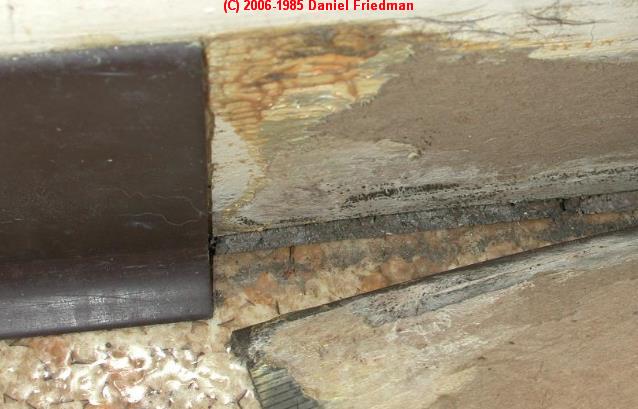
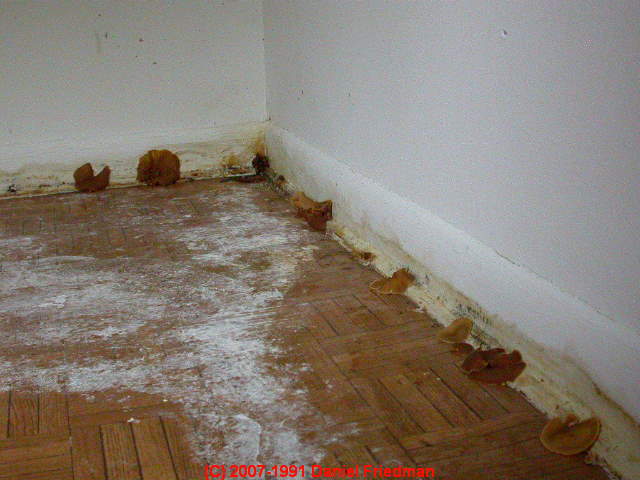
| Trim, interior wood, visible and hidden mold including wood rotting fungus and even sprouting mushrooms indoors where wet conditions are common | Aspergillus sp.; Penicillium sp.; Yeasts; rare: Meruliporia incrassata |
Varies by wood species, coating (paint, stain), and exposed vs. hidden surface. Also see Also see ROT, FUNGUS, TERMITES. |
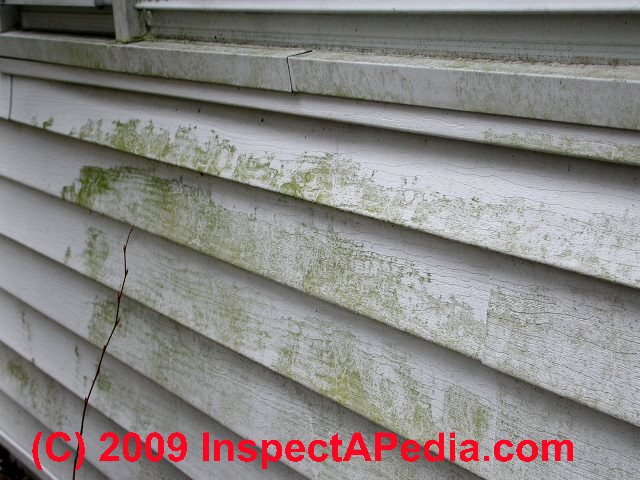
| Vinyl sheet flooring, visible and hidden mold; vinyl exterior siding | Cladosporium sp.; | Varies between upper surface and underside, flooring materials, paper, glue or adhesive, and presence of organic debris Don't mistake algae on vinyl exterior siding for mold; |
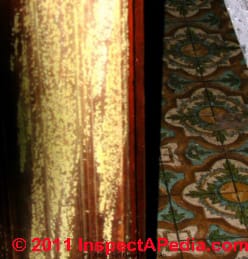
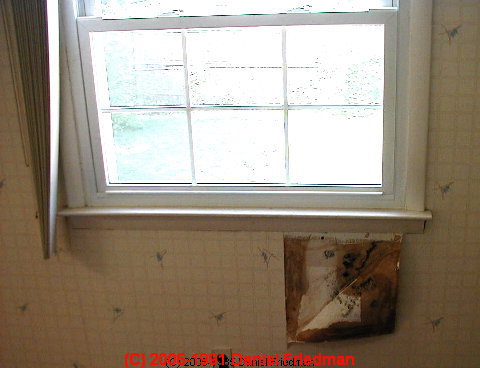
| Wallpaper, visible and HIDDEN WALLPAPER MOLD | Stachybotrys chartarum, especially on hidden surface where leaks have occurred or in baths. See BLACK MOLD IDENTIFICATION for photos of S. chartarum behind wallpaper. |
Mold growth on wallpaper varies by age, wallpaper colors, pigments, dyes, and adhesive;
Arsenic green, also called Scheele's green (copper arsenite or acidic copper arsenite, CuHAsO3) was first described in 1775 by Swedish Scientist Wilhelm Scheele who observed that poisonous copper arsenate produced a darkened "pea green" color that had commercial potential. Scheele's green was improved by Wilhelm Sattler (1814) by combining arsenic and verdigris to produce a more-stable colour that is probably what is found in wallpaper products, still referred-to as Scheele green. Scheele green was particularly popular in the U.K. The death of 19-year-old Matilda Scheurer in 1861 was ultimately ascribed to her work as an artificial flower maker who used arsenic green for her flower colours. Arsenic green or Scheele green in wallpaper and other applications was never outlawed but fell from use after 1861 as its danger became well known. - Kassia St. Clair, The Secret Lives of Color, Penguin books 2016. Mold growth on wallpaper, including at least some species of two mould families - Scopulariopsis and Paecilomyces, releases arsine gas - a toxic but otherwise invisible airborne poison whose level also varies by material, paper, vinyl, fabric, and also by coating, foil, paint, vinyl, plastic. The toxicity of arsenic release where Scheele green colouring was used also varies by surface, room-side vs. wall-side of wallpaper may be completely different, or present only on the hidden side of wallpaper. See details about arsenic poisoning found |
| Wall sheathing, fiberboard, Homasote™ (also used as insulating board inside of building foundations), visible and hidden mold | Aspergillus sp; |
Homasote™ and similar soft fiberboard materials are made of paper or softwood fibers. We have found significant mold growth only when the material was subjected to very wet conditions for a protracted period in basements or wall cavities. |
| Wall sheathing, plywood, visible and hidden mold | Cladosporium. sp.; |
See HIDDEN MOLD in CEILINGS / WALLS |
| Wall sheathing, OSB, visible and hidden mold | Cladosporium. sp./C. sphaerospermum; Aureobasidium pullulans; |
See BROWN MOLD PHOTOS for photos of mold on basement OSB wall sheathing. |
| Water heaters & other painted or porcelain coated steel jacketed appliances, metal surfaces | Cladosporium. sp./C. sphaerospermum; | |
| Windows, interior side, visible and hidden mold | Cladosporium sphaerospermum often found on window muntins subjected to water from condensation; many molds are deterred from window growth by exposure to light and UV. | Varies by window material, wood, vinyl, metal, and by coating, paint, stain, un-finished. |
| Wood building sheathing, roof or exterior wall, visible and hidden mold. | See Roof Sheathing See HIDDEN MOLD in FRAMING / SHEATHING See MERULIPORIA HOUSE EATING FUNGUS see YELLOW MOLD PHOTOS for a mold that causes structural damage. Also see ROT, FUNGUS, TERMITES |
|
| Wood framing lumber | See Lumber;
Also see ROT, FUNGUS, TERMITES and see ROT, TIMBER FRAME |
|






Notes to Table above
1. We have been using special methods to test fiberglass building insulation for Penicillium/Aspergillus sp. in areas where the insulation has been wet or where insulation has been exposed to active mold growth such as over a wet crawl space or a moldy basement.
2. Some of the molds listed in this table, even though found indoors, are unlikely to be indicative of a growing mold reservoir of that genera/species. For example, we often find Cladosporium herbarium and certain Basidiomycetes such as Ganoderma sp./G. applanatum/G. tsuge in indoor air samples but we have not found these genera/species growing on building materials. Rather they enter in outdoor air.
3. In conclusion, this interesting table needs additional research with data provided by expert building investigators rather than self-collected data by individuals who spot first and sample first dark molds on building surfaces. Readers should
see HOW to LOOK FOR MOLD.
4. Sedlbauer, Klaus. PREDICTION OF MOULD FUNGUS FORMATION ON THE SURFACE OF AND INSIDE BUILDING COMPONENTS [PDF] Fraunhofer Institute for Building Physics (2001): 75-141.
Reader Comments, Questions & Answers About The Article Above
Below you will find questions and answers previously posted on this page at its page bottom reader comment box.
Reader Q&A - also see RECOMMENDED ARTICLES & FAQs
On 2021-06-22 by inspectapedia.com.moderator (mod) - look in the microscope for clues to IAQ & health hazards ... with care to get expert help!
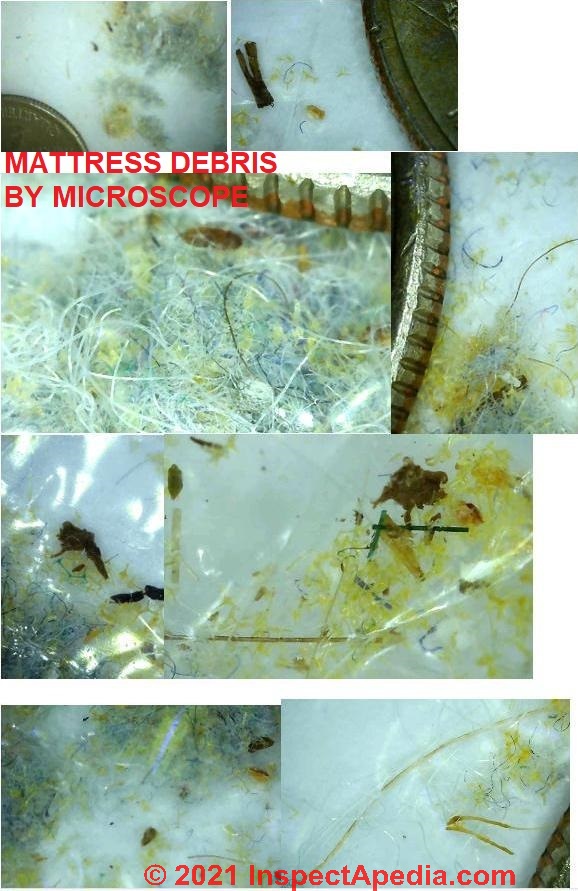 @Anonymous,
So sorry but I really can't make out much from your photos. I think I see a dime for scale in some of your photos (cute);
I see what looks like a lot of fibres, one possible ascomycete (normal, harmless), and some dark objects that might be mite or other fecals.
You're right that various fibres are ubiquitous, and I'll add that in a typical surface sample or vacuum sample or "tweezed-out sample" one wouldn't expect them to be deposited homogeneously on a mattress or in other crevices on mattresses or furniture, carpets, etc.
There is not much chance that those fibres as I see them in your photos would explain occupant health complaints. Nor do they address a mold concern.
I must emphasize that while it's fun and interesting to look at stuff under the microscope, experts spend a lifetime in the lab and in formal training learning how to use the microscope, how to prepare slides, choice of mountants, refractive indexes, types of light, immersion oils, and an endless range of particle identification classes to become reasonably competent at particle and mold identification.
Even after nearly forty years of work in this field I don't consider myself anywhere near a top expert. Yet I have spent years in multiple classes at McCrone Research (forensic microscopy, particle identification), at the Harvard School of Public Health (mold & pollen identification), and at numerous clinics, summer spore-camps, and IAQ conferences and courses (field and lab methodology); usually most of the attendees were older than I (not any more as I'm old now) and some had already spent 40 years behind the microscope.
And many of my classmates knew ten to fifty times what I did. We try to pool our areas of expertise.
Really? So don't expect that even a smart and motivated homeowner or amateur with a microscope is going to quickly produce reliable results.
Watch out: also for a capture error: your attention may be so captured by one indoor health hazard theory that you fail to look more-broadly and may miss more-significant or more-urgent health or safety hazards.
Your doctor is wrong to look at you as if you're crazy, but quite right that it's not likely that what you're showing in these photos explains a health complaint.
Take a look at MOLD by MICROSCOPE https://inspectapedia.com/Microscopy/Mold_Spore_Photographs_by_Microscope.php
as that may give you a reference; most of those photos - at least mine - are shot at 300 x to 1200x in transmitted light, or polarized light, using various mounting liquids, chosen to suit the search target (mold vs pollen vs fibres etc) and sometimes having to vary the mountant refractive index as well.
You can collect surface or dust samples for a non-quantitative but in some regards more-reliable screen of mold-suspect materials that you find and can send them to any qualified mold or environmental test lab.
But instead of sending your mattress lint, consider these steps
- Ask your doctor
what environmental contaminants or IAQ hazards might cause or exacerbate your health complaints: which of those might be sought in your indoor environment to see if they are there at high levels - Hire an expert:
if your doctor agrees that screening your home is worthwhile, then have an expert examine the whole building to identify the most-likely problem areas or sources or visible evidence of hazards bearing further investigation
MOLD / ENVIRONMENTAL EXPERT, HIRE ? - for help in deciding if it's appropriate to bring in an expert.
Watch out: don't hire someone who's just going to stop by and collect some samples to toss over the wall to a lab. It's the thorough inspection by an expert who knows what to look for that's more immediately needed than "testing"
ACCURACY OF AIR TESTS for MOLD offers an explanation of why tests alone are not helpful
See also LAB PROCEDURES MICROSCOPE TECHNIQUES https://inspectapedia.com/Microscopy/Microscope_Techniques.php
and TAPE & BULK SAMPLING & TESTS for MOLD https://inspectapedia.com/mold/Mold_Test_Adhesive_Tape.php
On 2021-06-22 by Anonymous
@inspectapedia.com.moderator, @inspectapedia.com.moderator, Thanks so much for replying so quickly!!! You all (behind this website) are phenomenal!
I don't know enough to know which pictures are diagnostic, so I screen shotted a few and am uploading them as a jpeg. I hope that's okay! I have MANY more (and more detailed), but again, don't know enough to know which are even helpful to look at!
Thank you again!
On 2021-06-22 by Anonymous
Hello, and thank you SO much for all the careful work you're doing to provide us all with this critical info!! I'm wondering if you might be able to tell me if this looks at all like it could be mold/fungal and what kind of lab I should send it to in order to get tested? (I hope this is okay to ask--I don't mean to exploit your generosity here at all so pls tell me if I should ask elsewhere!).
I took pictures with 1000x magnification. It is debris I found in the creases of a mattress in our home. To the naked eye, there were two different kinds of substance-- one that was blue-ish and looked like lint and the other that was yellowish and looked grainy.
What's odd about this is that we only ever have had white sheets on the bed (which is very rarely used), and while I understand microfibers/plastics are all over now, I don't think that explains why they would be separated by color! That is what made me suspect it might be fungal. And under magnification, my (very uneducated) suspicions were heightened.
When I noticed it, I took a small sample and then I cleaned it up, enclosed the mattress in two allergen encasements (no idea if that did anything). When I sampled, I (stupidly) mixed the two different "kinds" I noticed in different places. We have far more generic looking mold elsewhere and are about to do a remediation (via a contracted professional) as we are all showing signs of significant mold illness.
I am also dealing with a **potential** dermatological fungal infection and so naturally, when I saw this debris (located on the mattress in the room where I work all day long), I wondered if this might be a culprit. I've shown pics to doctors who looked at me as if I was crazy for suggesting this might be a part of the problem.
I'd like to send the debris for proper testing, but I don't even know how to classify it so am not sure where or how to get it tested. I'm about to submit an EMRI test and the lab (Envirobiomics) generously said they could try, but I don't even know if this could be mold.
Any direction you can provide would be SUPER appreciated!! Thanks so much again for all your work (and so sorry for lengthy comment!!)
On 2020-08-28 by Helen Martin
Yes, there is a need for additional research from our side as well. The presence of mould is a serious concern. I got to know this when I hired the home inspection company, and the building inspector from Perth told me that protection of mould is only possible through its detection.
Following are some useful detection ways:
• Be aware of water leaks
• Periodical Testing of the home plumbing system
• Get a mould inspection once in every year.
Thanks, hope all these are helpful for everyone.
On 2018-10-15 by (mod) - Is "Toxic black mold" worse than green or other colured moulds? - NO.
Matt
You ask a very important question that points to an area of much misunderstanding.
Is "Toxic black mold" worse than green or other colured moulds?
Some time ago a news article about a black mold contamination case involving Stachybotrys chartarum and serious illness led to a media focus on "toxic black mold" in articles that can be misleading.
It is not the case that "black mold" is necessarily more harmful nor more toxic than moulds of other colours.
In fact it is rarely the case that only one mold genera/species will be found in an area of mold contamination anyway. The conditions that make one mold grow will make several or more grow. However dark coloured moulds are easier to see than light coloured molds, so are often over-reported and over-tested while lighter coloured moulds are missed and under-tested and under-reported.
Nevertheless some of these lighter or green (or other coloured) moulds can be even more harmful than the most famous "toxic black mould" of S. chartarum I mentioned above.
For example Aspergillus sp. mold is very very common in buildings, more-common than Stachybotrys chartarum. Aspergillus sp. is often a green, blue, or gray mould but can be other colours as it is a large family or genera with many sub-species of various colours.
Let's compare a few features of Aspergillus sp. and Stachybotrys c.
Stachybotrys chartarum ( black mold) spores are large, black, and sticky. The mould evolved to be spread by sticking to cows' feet as cows trampled through mouldy straw. It can be highly toxic and produces toxic mold volatile organic compounds (MVOCs).
However because of its stickiness this mould is not easily made airbourne and becomes so only when violently disturbed, such as during demolition of moldy drywall.
And because of its large size this mould spore is not normally breathed deeply into the lungs. A doctor who specializes in mold-related illnesses told me that Stachybotrys-related mold illnesses manifest first in the upper airway - such as nose and sinus infections, while Aspergillus-related mold illnesses often manifest as lung infections - I'll explain further below. He noted that he could make a good guess about what sort of mold spore - by size at least - was the cause of a person's illness by the type of illness: sinus vs. lung, for example.
In comparison
Aspergillus sp. spores can be as small as 1 micron (1 / 50th the diameter of some human hairs) - less than 1 10th the size of an Stachybotrys spores.
These spores are easily made airbourne, are highly toxic, and worse, are breathed deeply into the lung (hence the very serious if not so common illness Aspergillosis).
Like bird-watching, if there are big black birds and small green birds, and if your "bird expert" is only looking for big black birds, she won't see and won't report those small, viscious, pecking little green birds.
But they're there.
To be fair to Aspergillus, it's a huge family. According to the US CDC,
Types of Aspergillus. There are approximately 180 species of Aspergillus, but fewer than 40 of them are known to cause infections in humans. Aspergillus fumigatus is the most common cause of human Aspergillus infections. Other common species include A. flavus, A. terreus, and A. niger. - source: U.S. CDC, retrieved 2018/10/15 original source: www.cdc.gov/fungal/diseases/aspergillosis/causes.html
which is ironic since the CDC source page is named for the causes of Aspergillosis - an Aspergillus infection of the lung not mentioned in their summary.
It is important to understand further that the very small size of those harmful Aspergillus spores means that they travel in air like a gas, riding gleefully and easily on air currents throughout a building, moving through tiny openings wherever air moves and ranging far afield.
Stachybotrys spores, big sticky fellows, are far less venturesome.
Finally about your photo:
Watch out: when you see very extensive visible mold such as in your photo that environment is absolutely unsafe, and the area should not be occupied nor even entered without wearing the appropriate protective clothing, respiratory, eye protection etc.
Professional cleaning involving inspection, definition of the extent of demolition and cleaning needed, and then removal of the mold and moldy materials, followed by more cleaning and by correction of the cause of the mold growth.
Thanks for asking. Let me know if you have more questions.
On 2018-10-15 by Matt
Why do some mould's appear green, wheras other mould's create a black toxic colour?
Is the black mould any more dangerous than the green mould?
IMAGE LOST by older version of Clark Van Oyen’s Comments Box code - now fixed. Please re-post the image if you can. Sorry. Mod.
On 2017-07-10 by Jimmy
@Kate C.,
My name is Jimmy Smith and I posted the question about the air handlers in our building.
On 2017-06-29 by Jimmy
The three air handlers where I work recently had fungal surface sampling done with the following results: (Unit 1) raw ct. 205 -540,000 spores/unit and 3+ growth, (Unit 2) 150 raw ct. 390,000 and 3+ growth and (Unit 3) raw ct. 65, 170,000 spores/unit count and 2+ growth. What does this mean to us who have been breathing this air for 10-15 years? Many of us have upper respiratory conditions....
On 2017-01-30 by Kate C.
May I know the exact date these informations are posted and who is the author.
On 2016-01-25 by Daniel
Hi, We are building a home and I think our OSB walls roof have aspergillus on them. It's probably 5-6 small areas the size of a dime. What's the best way to get rid of it? The roof is really tall, so I'm not sure how we are going to deal with that.
Question: mold on the basement floor
(Sept 15, 2012) Jay said:
White mold underneath boxes on basement floor - 2001 property, I assume there is no poly underneath the slab. Currently fixing it by sealing the floor with 3 coats of DryGard mildew resistant block sealer.
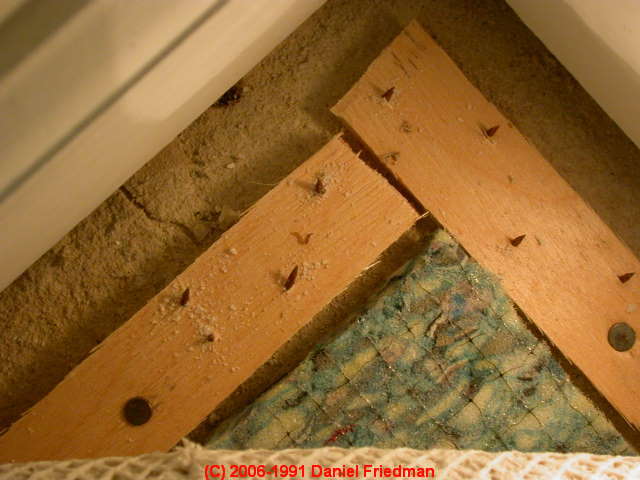
White mold underneath upstairs hypoallergenic carpet padding on 3\4" OSB sub floor which is sealed with oil based Kilz mildew blocker. ( sub floor had stains from previous owner )
The carpet pad is not able to breath. The padding is just like memory foam and contains a fiber 2x2mm meshing on the OSB side. This house stinks like minty mildew and has proper ventilation including ERV, HVAC and always under 50% RH. 39 to 45% usually.
Reply:
Jay, carpet on a basement floor over a slab is often a source of mold and other problems - I prefer not to use carpeting in such locations. I'd eliminate it entirely; Abd from the design you describe I'd check for a hidden mold reservoir on the underside of that OSB subfloor and any sleepers on which it rests.
The two approaches are: dry out the area by finding and fixing the source of water entry or dampness and use a design that does not invite mold growth by choice of different materials for floor covering.
You'd be better off with ceramic or vinyl tile on the concrete.
...
Continue reading at MOLD GROWTH ON SURFACES, PHOTOS or select a topic from the closely-related articles below, or see the complete ARTICLE INDEX.
Or see these
Recommended Articles
- ACCURACY OF AIR TESTS for MOLD
- BLACK MOLD, HARMLESS - Photos of of often recognizable, usually harmless or cosmetic black mold on wood
- LAB PROCEDURES MICROSCOPE TECHNIQUES
- MOLD / ENVIRONMENTAL EXPERT, HIRE ? for help in deciding if it's appropriate to bring in an expert
- MOLD APPEARANCE - WHAT MOLD LOOKS LIKE - Photos of what mold looks like in buildings, organized by mold color and appearance.
- MOLD APPEARANCE - STUFF THAT IS NOT MOLD - Photos of material that is not mold but is sometimes mistaken for mold
- MOLD ATLAS & PARTICLES INDEX, Pathogens, Allergens and Other Indoor Particles - actual and possible medical health effects of Mold (separate online document)
- MOLD FREQUENCY in BUILDINGS - Table of what mold genera/species are frequently found in indoor mold tests.
- MOLD GROWTH ON SURFACES, PHOTOS - Photos of what mold looks like in buildings on more than 100 surfaces, organized by mold growth on various kinds of building surfaces and contents or items found in buildings. Mold in situ.
- MOLD GROWTH on SURFACES, TABLE OF - Summary table of what mold genera/species are frequently found on various building surfaces and materials
- MOLD BY MICROSCOPE - Mold under the microscope - photo identification of the most common indoor molds found in buildings
- MOLD in the PETRI DISH, PHOTOS - what mold looks like on culture plates or in culture-type mold test kits
- MOLD RELATED ILLNESS SYMPTOMS - Mold Related Illness: Index of Symptoms. Readers should not rely on this document for medical diagnosis and instead should consult with their physician or with a specialist such as a medical toxicologist
- MOLD RESISTANT CONSTRUCTION - how well do different building materials resist mold growth?
- TAPE & BULK SAMPLING & TESTS for MOLD
Suggested citation for this web page
MOLD GROWTH on SURFACES, TABLE OF at InspectApedia.com - online encyclopedia of building & environmental inspection, testing, diagnosis, repair, & problem prevention advice.
Or see this
INDEX to RELATED ARTICLES: ARTICLE INDEX to MOLD CONTAMINATION & REMEDIATION
Or use the SEARCH BOX found below to Ask a Question or Search InspectApedia
Ask a Question or Search InspectApedia
Try the search box just below, or if you prefer, post a question or comment in the Comments box below and we will respond promptly.
Search the InspectApedia website
Note: appearance of your Comment below may be delayed: if your comment contains an image, photograph, web link, or text that looks to the software as if it might be a web link, your posting will appear after it has been approved by a moderator. Apologies for the delay.
Only one image can be added per comment but you can post as many comments, and therefore images, as you like.
You will not receive a notification when a response to your question has been posted.
Please bookmark this page to make it easy for you to check back for our response.
Our Comment Box is provided by Countable Web Productions countable.ca
Citations & References
In addition to any citations in the article above, a full list is available on request.
- A BRIEF GUIDE to MOLD, MOISTURE, and YOUR HOME, [PDF] U.S. Environmental Protection Agency US EPA - includes basic advice for building owners, occupants, and mold cleanup operations. See http://www.epa.gov/mold/moldguide.htm
- US EPA - UNA BREVA GUIA a MOHO / HONGO - en Espanol
- A BRIEF GUIDE to MOLD, MOISTURE, and YOUR HOME, [PDF] U.S. Environmental Protection Agency US EPA - includes basic advice for building owners, occupants, and mold cleanup operations. See http://www.epa.gov/mold/moldguide.htm
- "Management of Powdery Mildew, Leveillula taurica, in Greenhouse Peppers," Ministry of Agriculture and Lands, British Columbia - Original source: www.agf.gov.bc.ca/cropprot/peppermildew.htm
- Fifth Kingdom, Bryce Kendrick, ISBN13: 9781585100224, - we recommend the CD-ROM version of this book. This 3rd/edition is a compact but comprehensive encyclopedia of all things mycological. Every aspect of the fungi, from aflatoxin to zppspores, with an accessible blend of verve and wit. The 24 chapters are filled with up-to-date information of classification, yeast, lichens, spore dispersal, allergies, ecology, genetics, plant pathology, predatory fungi, biological control, mutualistic symbioses with animals and plants, fungi as food, food spoilage and mycotoxins.
- In addition to citations & references found in this article, see the research citations given at the end of the related articles found at our suggested
CONTINUE READING or RECOMMENDED ARTICLES.
- Carson, Dunlop & Associates Ltd., 120 Carlton Street Suite 407, Toronto ON M5A 4K2. Tel: (416) 964-9415 1-800-268-7070 Email: info@carsondunlop.com. Alan Carson is a past president of ASHI, the American Society of Home Inspectors.
Thanks to Alan Carson and Bob Dunlop, for permission for InspectAPedia to use text excerpts from The HOME REFERENCE BOOK - the Encyclopedia of Homes and to use illustrations from The ILLUSTRATED HOME .
Carson Dunlop Associates provides extensive home inspection education and report writing material. In gratitude we provide links to tsome Carson Dunlop Associates products and services.
 | HOME | ABOUT | ASK a QUESTION | CONTACT | CONTENT USE POLICY | DESCRIPTION | POLICIES | PRIVACY | |
| © 2024 - 1985 Publisher InspectApedia.com - Daniel Friedman | |||||||||