
InspectAPedia® FREE Encyclopedia of Building & Environmental Construction, Diagnosis, Maintenance & Repair |
Question? Just ask us! InspectAPedia
|
 Dust, Mold & Particle Forensic Test Lab Services
Dust & Particle
Testing for Black Mold and other Indoor Air Quality IAQ Contaminants
- POST a QUESTION or COMMENT about mold test lab services: what does a forensic particle lab do with dust or mold or paint chip test samples
Forensic & mold test lab services:
This article describes forensic microscopy and aerobiology test laboratory methods & services used to accept and test both mold-expert-collected mold samples and client-submitted test samples for toxic mold, allergens, gases, odors, sewage backups, other indoor particles or other indoor contaminants that may be present in buildings.
This website provides free, in-depth information and procedures for finding, testing, cleaning and preventing indoor mold, toxic black mold, green mold, testing building indoor air quality, and other sick house / sick building investigations.
We give in-depth information about mold and other indoor air quality problems: causes of respiratory illness, asthma, or other symptoms such as neurological or psychological problems, air quality investigation methods, and remediation procedures such as mold cleanup, handling toxic mold contamination, and building or mechanical system repairs.
InspectAPedia tolerates no conflicts of interest. We have no relationship with advertisers, products, or services discussed at this website.
Mold or Environmental Test Laboratory Analysis Services
How to Find a Mold or Environmental Testing Laboratory
Watch out: DO NOT SEND ANY SAMPLE of ANY FORM to any testing lab nor individuals before discussing your needs with them. Otherwise your sample collection, packaging, or usefulness may be wasted as well as your money and everyone's time.
For environmental or forensic investigative support and lab work, you can use any forensic lab provided you first check that their area of expertise matches your needs.
In most countries there are lists of certified testing laboratories for asbestos; water testing labs are usually state or province-licensed; mold testing laboratories usually participate in a national or federal certification program that varies depending on your country.
For strange particle analysis, building dust analysis, fiberglass particle screening, mold contaminant screening contact these expert forensic microscopists
Example Web Search to Locate Your Expert
Try a web search using any search engine and look for a phrase such as
- "Environmental testing" + mytown" [replace "mytown" with your city and country"]
- "Environmental test laboratory" + "mytown"
- "Mold inspector" + "mytown"
- "Industrial Hygienist" + "my business location city"
Mold test laboratory service includes analysis of expert-prepared field samples as well as processing of consumer-prepared kits (easy and inexpensive) mold or other particles.
See TEST KIT for DUST, MOLD, PARTICLES: INSTRUCTIONS
For example, our mold testing lab provides identification services for bioaerosols such as mold, mildew, dust mites, pollen, and other allergens. We have considerable experience examining samples collected on tape, Zefon™ cassettes, MCE filter cassettes, slides, impaction air samplers, carpet, furniture, and other soft-goods vacuum samples, and in bulk material.
Mold culture and bacterial surface contamination evaluation is available, and most environmental test consultants also offer testing for carbon monoxide or carbon dioxide, formaldehyde, and other gases.
Mold test laboratory education and experience should include advanced indoor air quality, culture plate identification of fungal genera/species, house dust analysis, mold fungal spore quantitative analysis (spore counts in air), and qualitative analysis (particle types and what they mean), organic, and inorganic particle and fiber identification, mold culture methods and culture speciation.
We have experience and special interest in identification of particles in building dust, paint failure field and lab analysis, paint sample analysis, and general forensic microscopy.
Mold test equipment education and experience should include biological microscopy, forensic microscopy, particle identification using microscopic particle manipulation, microchemistry, transmitted light microscopy, polarized light microscopy, dispersion staining, determination of refractive index, interference patterns, phase-contrast, darkfield, focal screening, and other advanced techniques.
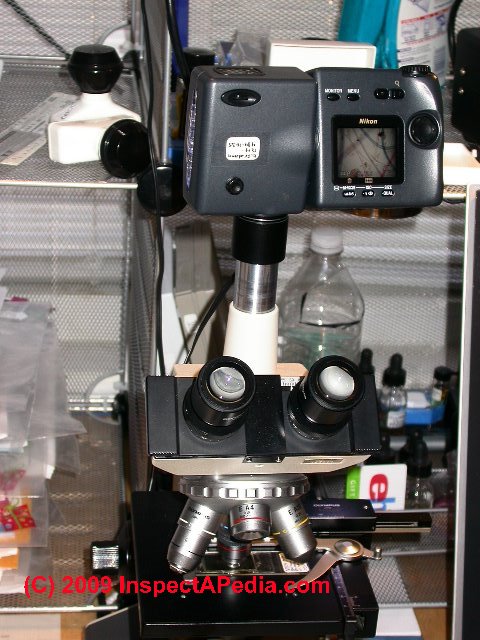
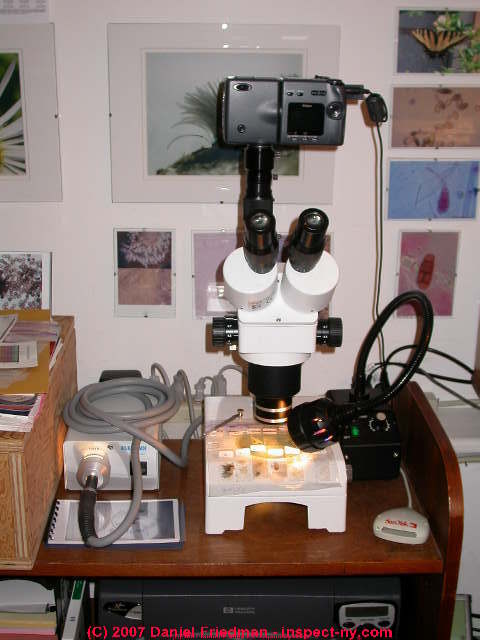 In the lab technicians make use of a variety of microscopes: low-power stereoscopic examination (photo at left) of samples for characterization and high-power microscopic
examination (Page top photo, up to 1920x) for broad scope particle identification (not just mold) using transmitted and polarized light as well as darkfield and phase contrast
microscopy.
In the lab technicians make use of a variety of microscopes: low-power stereoscopic examination (photo at left) of samples for characterization and high-power microscopic
examination (Page top photo, up to 1920x) for broad scope particle identification (not just mold) using transmitted and polarized light as well as darkfield and phase contrast
microscopy.
Forensic particle identification can extend well beyond biological matter (mold spores, cat or dog dander, insect fragments, dust mites, mite fecals) to include both organic and inorganic particles and fibers.
Particle identification is supplemented by use of Cargille™ refractive index liquid particle differentiation for identification of biological particles such as mold spores, pollen grains, animal allergens, dog, cat, mouse dander, mite fecals, cockroach and other insect particles, and non-biological particles in house dust and debris such as road dust, tire particles, diesel soot, oil burner soot, copier toner, wood and paper fragments, skin cells, possible bacteria.
These methods help assure that the lab report accurately represents the character of the samples which were submitted.
Mobile Microscopy Lab: For immediate on-site particle determination where emergency response or remediation/salvage operation evaluation is necessary some experts (and we used-to)
offer MOBILE FIELD LAB FORENSIC SERVICES [photo] including field preparation of test samples and light microscopic examination for particle identification.

Field samples are used to prepare slides for examination by light microscope. Our own field work collects mold or biological particle samples using a variety of methods.
From the public your test lab will usually accept mold surface samples using clear tape such as the DIY dust or mold sampling method described
at TEST KIT for DUST, MOLD, PARTICLES: INSTRUCTIONS
Chemical treatment and mounting media are selected based on the sample type, often including potassium hydroxide, acid or basic fuchsin, Calberla's solution, lacto phenol cotton blue, or other preparations.
When lab work is in support of legal proceedings or if otherwise appropriate we prepare permanent-mount slides using glycerine jelly or other media. Slides are examined at magnifications of 10x, 100x, 400x, and 1000x using tungsten and polarized light, darkfield, etc. as appropriate.
|
ONSITE INSPECTION / INVESTIGATION AVAILABILITY NOTICE: Except for special cases including our pro-bono services we no longer provide onsite building investigations. DO NOT SEND SAMPLES of ANY SORT to InspectApedia nor to our editors or staff. For on-site building, home inspections or environmental inspectors see the extensive list of building inspectors and specialists at |
Identification of toxic, allergenic, or cosmetic mold genera/species in the Mold Test Lab
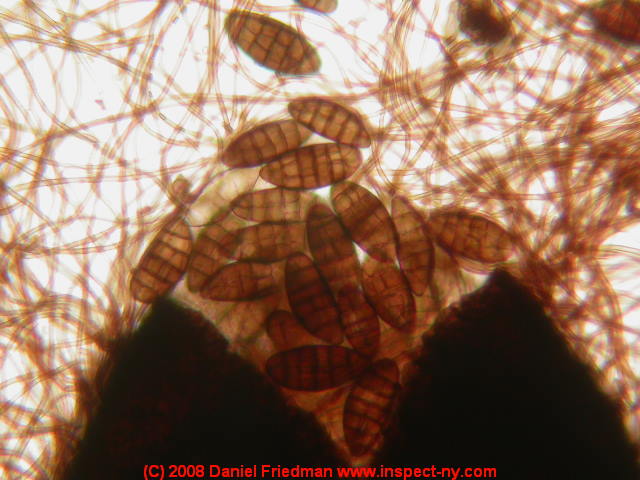
Genera/species identifications are made based on experience, education, reference texts, comparison with known samples, and when appropriate, consultation with fellow mycologists and other experts.
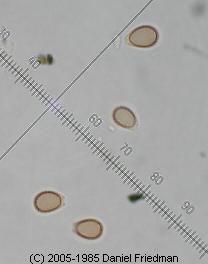
There are more than 70,000 mold species which have been identified and an estimated 1 million remaining to be identified, so it is common to encounter unidentified spores. (Our lab photo, above, shows an Pleospora sp., an Ascomycete, being released from its perithecium.)
However fortunately, in most areas there common protagonists which have been studied and which can be identified to genera and often to species.
Because mold toxicity varies widely within a particular genera, speciation is an important step, omitted by some high-volume labs and investigators who may fail to distinguish between harmless amerospores such as basidiomycetes and potentially harmful Penicillium/Aspergillus spores in samples.
Typical Particle ID or Mold Test Lab Report Contents
 A detailed written mold test laboratory report of laboratory finding, medical information, and recommendations is provided. The lab report describes:
- "Significant/dominant particles" in each sample examined: likely to be most important in the Building
- "Other spores/particles present" in each sample at notable but not dominant frequency, possibly important
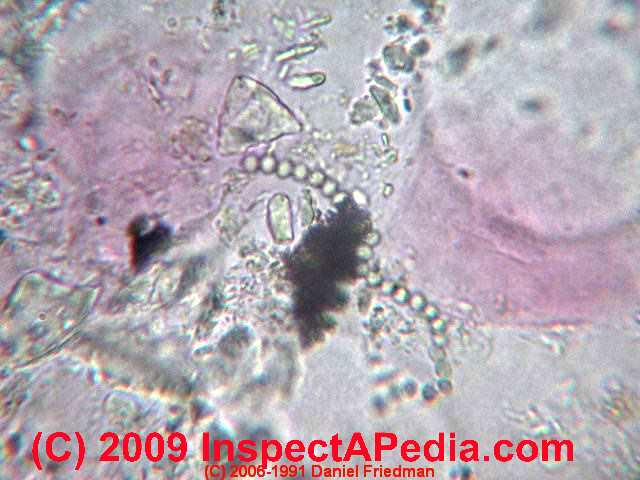
- "Incidental spores or particles detected", which in special cases may still be diagnostic even though the absolute spore count is so low that many labs and consultants ignore this data. An example is the Aspergillus niger spore-chains in our lab photo (left).
The presence of these spores in chains suggests nearby active indoor growth of this toxic mold, even though the actual spore count would be reported as just 31 spores! - Good mold or forensic test lab reports use clear, specific DEFINITIONS of "MOLD LEVELS" and will explain what certain particle findings suggest about the area or surface from which the sample was collected.
Study of sample contents with special understanding of mycology and building science is important:
Similarly, the appearance of certain fungal structures, such as Penicillium/Aspergillus spore chains in an indoor sample may be an important indicator of a local problematic mold reservoir, even though a quantitative analysis alone would produce an apparently low spore count and would fail to detect this problem indicator. - Quantitative analysis such as fungal spore or particle counts per cubic meter of air sampled are also available when such measures are appropriate.
- Significant microscopic observations are documented in some lab's reports
using MICROPHOTOGRAPHY. (Most do not include this service)
Our tips for taking digital photographs through the microscope - photomicrographs, or microphotographs if you prefer - are
at MICROSCOPE DIGITAL PHOTOGRAPHY - Photographic documentation of site conditions and laboratory observations should be provided with the report from your on-site inspector.
Watch out: in our OPINION, simply "testing" for mold, without a thorough on-site inspection of the building and a review of its history of leaks, events, and occupant complaints, will be of limited use. - Lab reports may also include a summary of contemporary medical information about particles identified.
This Low-Cost Do-it-Yourself Inexpensive Mold Test Kit Can Provide Useful Results

Use this simple, economical mold test
kit by following our instructions on how to collect and mail mold samples to a lab
TAPE & BULK SAMPLING & TESTS for MOLD - using simple clear adhesive tape and freezer-type zip-lok plastic bags.
also see DUST SAMPLING PROCEDURE for collecting particles or dust other than mold-suspected material.
Review MOLD CULTURE TEST KIT VALIDITY to learn why a particle sample from settled dust might be more reliable than mold culture kits.
...
Continue reading at ACTION GUIDE - WHAT TO DO ABOUT INDOOR MOLD or select a topic from the closely-related articles below, or see the complete ARTICLE INDEX.
Or see these
Recommended Articles
- ACCURACY OF AIR TESTS for MOLD
- ASBESTOS TESTING LAB LIST
- DIGITAL PHOTOGRAPHY & the MICROSCOPE.
- DUST SAMPLE TYPES
- DUST SAMPLING PROCEDURE
- ENVIRONMENTAL INSPECTORS & TESTING SERVICES - mold test labs
- FIBER & HAIR IDENTIFICATION
- FIBERGLASS PARTICLE CONTAMINATION TEST
- FORENSIC BUILDING INVESTIGATION SERVICES
- FORENSIC LAB TECHNICAL PROCEDURES - home
- MOLD TEST PROCEDURES - review of popular mold test methods, pros and cons of each
- MOLD CULTURE TEST KIT VALIDITY
- MOLD / ENVIRONMENTAL EXPERT, HIRE ? - do you need an on-site expert?
- MOLD INSPECTORS & MOLD TESTERS
- MOLD TEST KIT AIDS
- MOLD LAB REPORTS
- MOLD TESTING METHOD VALIDITY
- SWAB & PCR SAMPLING & TESTS for MOLD
- SWAB TEST KIT PROCEDURE
- TAPE & BULK SAMPLING & TESTS for MOLD - also see DUST SAMPLING PROCEDURE
- DIGITAL PHOTOGRAPHY & the MICROSCOPE.
- TEST KIT for DUST, MOLD, PARTICLES: INSTRUCTIONS - a simple, low-cost dust or mold sampling procedure
- VACUUM CASSETTE FILTER SAMPLE TESTS for DUST / MOLD
Suggested citation for this web page
FORENSIC & IAQ LABORATORY SERVICES at InspectApedia.com - online encyclopedia of building & environmental inspection, testing, diagnosis, repair, & problem prevention advice.
Or see this
INDEX to RELATED ARTICLES: ARTICLE INDEX to MOLD CONTAMINATION & REMEDIATION
Or use the SEARCH BOX found below to Ask a Question or Search InspectApedia
Ask a Question or Search InspectApedia
Questions & answers or comments about mold test lab services: what does a forensic particle lab do with dust or mold or paint chip test samples
Try the search box just below, or if you prefer, post a question or comment in the Comments box below and we will respond promptly.
Search the InspectApedia website
Note: appearance of your Comment below may be delayed: if your comment contains an image, photograph, web link, or text that looks to the software as if it might be a web link, your posting will appear after it has been approved by a moderator. Apologies for the delay.
Only one image can be added per comment but you can post as many comments, and therefore images, as you like.
You will not receive a notification when a response to your question has been posted.
Please bookmark this page to make it easy for you to check back for our response.
Our Comment Box is provided by Countable Web Productions countable.ca
Citations & References
In addition to any citations in the article above, a full list is available on request.
- Allergen Detection What various indoor allergens look like - identification photos to help identify pollen, dust mites, animal dander, toxic or allergenic mold - Common Mold and other Allergens, Irritants, Remedies & Advice
- Animal Allergens: Dog, Cat, and Other Animal Dander - Cleanup & Prevention Information for Asthmatics and regarding Indoor Air Quality.
- Associations: A Directory of IAQ, Sick Building, Mold Allergen Testing, Building Investigation Service Providers
- Associations: Sick House, Sick Building, SBS - Air Quality, Government, Private Associations and Information Resources
- BASKETBALL MOLD SYNDROME - BBMS - sudden attention to old clues in buildings makes them seem brand new to some observers
- Bibliography of Mold Identification, Aerobiology, Forensic Microscopy - References we use in our Laboratory
- Directory of Building Air Quality and Mold Investigators: field and lab work, sick Building syndrome, air quality measurements, cleanup
- Indoor Air Pollution : Introduction for Health Professionals- IAQ Indoor Air Quality Concerns - US CPSC Book
- Indoor Air / Toxic Mold Field Investigation & Lab Reports - what to look for in a toxic mold field investigation report and mold test laboratory report ©
- Indoor Air / Toxic Mold Test Lab Reports - what to look for in a toxic mold test laboratory report ©
- How to Report Mold Levels in Mold Test Samples of Surfaces in buildings - suggested non-quantitative definitions
- Sick House Investigation Questionnaire used to collect occupant and Building information that may aid the investigator ©
- FAQs on Mold - Frequently Asked Questions About Mold -- check this FAQ List & Site Map to see if you can find a quick answer to your mold concern
- FAQs on Accuracy - Website/Author credibility
- Mold Test Kits - How to Collect and Send Your Own Mold Sample to our mold testing lab
- House Dust from an HVAC system frightened building occupants unnecessarily
- Lighting, using to find mold - proper use of a flashlight can help spot mold on paneling and other building surfaces
- Mold Detection - What Does Mold Look Like? Mold spores in the Home - a Photo ID Library for detection and identification of mold allergens
- Mold Detection - Lighting Proper use of lighting discloses hard to see but toxic light or white mold colonies on building surfaces - read this if you're doing your own tape sampling for mold.
- Mold Detection - How to Find and Test for Mold in buildings - Looking for Mold - A "how to" photo and text primer on finding and testing for mold in buildings
- Mold Detection - Stuff that is Not Mold but is often mistaken for it - things you may not want to test. Not all "black mold" is toxic or harmful.
- Mold Detection - in Fiberglass Insulation Moldy fiberglass building insulation © 2005 comments about a field study in process, & more about health hazards from fiberglass insulation - DJF
- Mold Detection - Investigation Tips Mold Investigation Guide for Home Inspectors how to find mold, where to look, what is likely to be important. Advice to Building inspectors intending to inspect or test for toxic or problematic mold indoors, mold inspection methods, and mold test methods which are valid or invalid
- Meruliporia incrassata the house eating fungus or "poria" may be mistaken for wood rot.
- Prevention of Mold Mold-Resistant Building Practices some suggestions from an expert
- Products - Mold & Allergy Products: Allergy/Asthma, Air Quality, Cleaning, Filtering, Ventilating, Dehumidification
- Our recommended books about building & mechanical systems design, inspection, problem diagnosis, and repair, and about indoor environment and IAQ testing, diagnosis, and cleanup are at the InspectAPedia Bookstore. Also see our Book Reviews - InspectAPedia.
- ENVIRONMENTAL HEALTH & INVESTIGATION BIBLIOGRAPHY - our technical library on indoor air quality inspection, testing, laboratory procedures, forensic microscopy, etc.
- Adkins and Adkins Dictionary of Roman Religion discusses Robigus, the Roman god of crop protection and the legendary progenitor of wheat rust fungus.
- Kansas State University, department of plant pathology, extension plant pathology web page on wheat rust fungus: see http://www.oznet.ksu.edu/path-ext/factSheets/Wheat/Wheat%20Leaf%20Rust.asp
- A BRIEF GUIDE to MOLD, MOISTURE, and YOUR HOME, [PDF] U.S. Environmental Protection Agency US EPA - includes basic advice for building owners, occupants, and mold cleanup operations. See http://www.epa.gov/mold/moldguide.htm
- US EPA - MOLD REMEDIATION in SCHOOLS & COMMERCIAL BUILDINGS - - US EPA
- US EPA - UNA BREVA GUIA a MOHO / HONGO - en Espanol
- A BRIEF GUIDE to MOLD, MOISTURE, and YOUR HOME, [PDF] U.S. Environmental Protection Agency US EPA - includes basic advice for building owners, occupants, and mold cleanup operations. See http://www.epa.gov/mold/moldguide.htm
- "Disease Prevention Program for Certain Vegetable Crops," David B. Langston, Jr., Extension Plant Pathologist - Vegetables, University of Georgia (PDF document) original source: www.reeis.usda.gov/web/crisprojectpages/209797.html
- Disease Prevention in Home Vegetable Gardens [PDF], Patricia Donald,Department of Plant Microbiology and Pathology,
Lewis Jett
Department of Horticulture, University of Missouri Extension - extension.missouri.edu/publications/DisplayPub.aspx?P=G6202 - "Management of Powdery Mildew, Leveillula taurica, in Greenhouse Peppers," Ministry of Agriculture and Lands, British Columbia - Original source: www.agf.gov.bc.ca/cropprot/peppermildew.htm
- Fifth Kingdom, Bryce Kendrick, ISBN13: 9781585100224, - we recommend the CD-ROM version of this book. This 3rd/edition is a compact but comprehensive encyclopedia of all things mycological. Every aspect of the fungi, from aflatoxin to zppspores, with an accessible blend of verve and wit. The 24 chapters are filled with up-to-date information of classification, yeast, lichens, spore dispersal, allergies, ecology, genetics, plant pathology, predatory fungi, biological control, mutualistic symbioses with animals and plants, fungi as food, food spoilage and mycotoxins.
- Fungi, Identifying Filamentous, A Clinical Laboratory Handbook, Guy St-
- US EPA: Mold Remediation in Schools and Commercial Building [Copy on file at /sickhouse/EPA_Mold_Remediation_in_Schools.pdf ] - US EPA
- Mycology, Fundamentals of Diagnostic, Fran Fisher, Norma B. Cook, W.B. Saunders Co. 1998, ISBN 0-7216-5006-6
- In addition to citations & references found in this article, see the research citations given at the end of the related articles found at our suggested
CONTINUE READING or RECOMMENDED ARTICLES.
- Carson, Dunlop & Associates Ltd., 120 Carlton Street Suite 407, Toronto ON M5A 4K2. Tel: (416) 964-9415 1-800-268-7070 Email: info@carsondunlop.com. Alan Carson is a past president of ASHI, the American Society of Home Inspectors.
Thanks to Alan Carson and Bob Dunlop, for permission for InspectAPedia to use text excerpts from The HOME REFERENCE BOOK - the Encyclopedia of Homes and to use illustrations from The ILLUSTRATED HOME .
Carson Dunlop Associates provides extensive home inspection education and report writing material. In gratitude we provide links to tsome Carson Dunlop Associates products and services.
 | HOME | ABOUT | ASK a QUESTION | CONTACT | CONTENT USE POLICY | DESCRIPTION | POLICIES | PRIVACY | |
| © 2024 - 1985 Publisher InspectApedia.com - Daniel Friedman | |||||||||