
InspectAPedia® FREE Encyclopedia of Building & Environmental Construction, Diagnosis, Maintenance & Repair |
Question? Just ask us! InspectAPedia
|
 Photos of Mold in Buildings
Appearance of in-situ Mold Contamination on 120 Different Materials & Surfaces
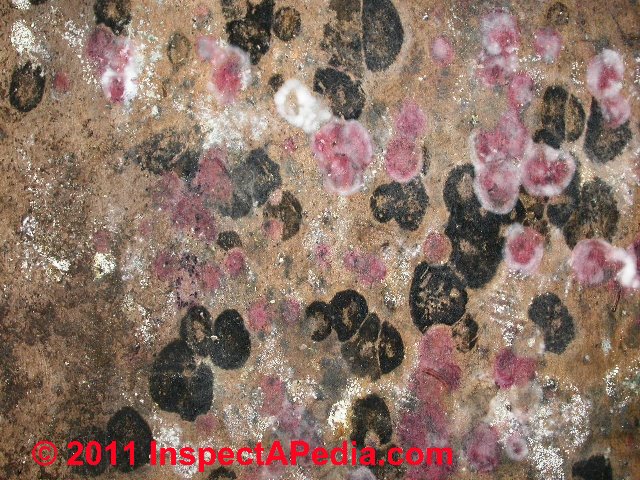
- POST a QUESTION or COMMENT about what mold looks like in buildings, including mobile homes and trailers
Photographs of mold growth in buildings:
Here is an extensive photo guide to fungi, mushrooms & mold growing on all kinds of surfaces of all kinds of materials found on or in buildings:
A photographic guide to the appearance of mold as it is found growing on more than 120 indoor building surfaces and materials such as building contents, furnishings, trim, walls, wood, and personal or even plastic items found in buildings. What genera & species of mold commonly grow on different building surfaces? Mold on artworks, paintings, cultural artifacts is included.
What does mold look like growing on various building & other material surfaces? Beginning here is an online reference photo library of various kinds of mold as it is found growing on a wide range of surfaces and materials found on or in buildings.
These photos of mold on indoor various materials or "mold growth substrates" may help you recognize mold in buildings, recognize probably-cosmetic mold, and recognize stuff that is not mold and does not need to be tested.
InspectAPedia tolerates no conflicts of interest. We have no relationship with advertisers, products, or services discussed at this website.
Pictures of Mold on Various Building Surfaces and Materials
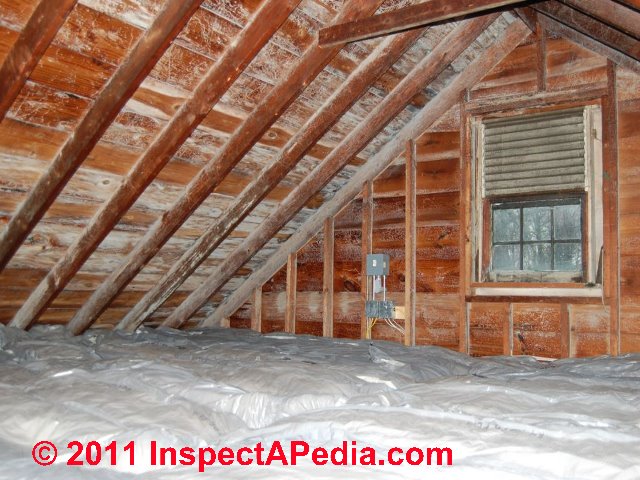
Here we provide a large collection of in-situ photographs of all types of mold growths found in buildings.
We illustrate what mold looks like on various building surfaces & materials as well as on items often found in buildings, including foods, fruits, vegetables, even water.
[Click to enlarge any image]
Directories of atlases or indices of building mold
- BLACK MOLD, HARMLESS - Photos of of often recognizable, usually harmless or cosmetic black mold on wood
- MOLD APPEARANCE - WHAT MOLD LOOKS LIKE - Photos of what mold looks like in buildings, organized by mold color and appearance.
- MOLD APPEARANCE - STUFF THAT IS NOT MOLD - Photos of material that is not mold but is sometimes mistaken for mold
- MOLD ATLAS & PARTICLES INDEX, Pathogens, Allergens and Other Indoor Particles - actual and possible medical health effects of Mold (separate online document)
- MOLD FREQUENCY in BUILDINGS - Table of what mold genera/species are frequently found in indoor mold tests.
- MOLD GROWTH ON SURFACES, PHOTOS - Photos of what mold looks like in buildings on more than 100 surfaces, organized by mold growth on various kinds of building surfaces and contents or items found in buildings. Mold in situ.
- MOLD GROWTH on SURFACES, TABLE OF - Summary table of what mold genera/species are frequently found on various building surfaces and materials
- MOLD BY MICROSCOPE - Mold under the microscope - photo identification of the most common indoor molds found in buildings
- MOLD in the PETRI DISH, PHOTOS - what mold looks like on culture plates or in culture-type mold test kits
- MOLD RELATED ILLNESS SYMPTOMS - Mold Related Illness: Index of Symptoms. Readers should not rely on this document for medical diagnosis and instead should consult with their physician or with a specialist such as a medical toxicologist
Index to Photographs of & Notes on Mold Growing on Building Surfaces and Materials
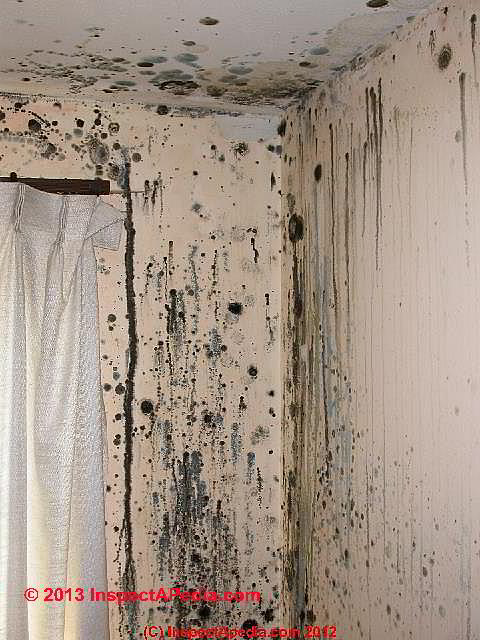 Links listed below provide photographs of mold that we have photographed, sampled, and tested on a wide range of surfaces and substances found on building surfaces or on items and contents found in buildings.
The very moldy walls, ceiling and curtain in our photo at left were observed in the home that inspired this mold-in-situ article. The home had suffered a burst heating pipe and remained wet for months. At our investigation there was mold growing on just about everything in the building including the building itself and all of its contents.
In fact it was more interesting to observe the few surfaces where there was no apparent mold growth.
Having the advantage of our own aerobiology lab and several rolls of adhesive tape, we collected many samples in this building in order to begin to learn what fungal genera/species prefer just what surfaces and materials commonly found in residential buildings.
CONTACT us to submit photographs of mold growth on other man-made or building-related materials.
Note: for page loading speed we have divided this article into several sections.
At the end of each of these mold-in-buioldngs photo collections just use the link
MOLD APPEARANCE on VARIOUS SURFACES INDEX - photo guide index
to return to this alphabetical index / list of photographs of the appearance of mold on various building materials & contents.
-
-- MOLD PHOTOS GROUP 1 --
- MOLD on/in AIR DUCTS in HVAC systems
- MOLD in AIR HANDLERS of air conditioners and heating furnaces
- MOLD on ALUMINUM SURFACES such as building siding
- MOLD on APPLIANCES refrigerators, etc.
- MOLD on ARTWORKS, paintings, painting substrates, other artworks
- MOLD on ASBESTOS PIPE INSULATION
- MOLD on/in ATTIC SURFACES and attic surfaces
- MOLD on ATTIC STAIRS
- MOLD on/in AUTOMOBILES, boats, cars, RVs
- MOLD on BARN FRAMING, new construction
- MOLD on BASEMENT SURFACES wood, framing, insulation, other surfaces - please also see this detailed article BASEMENT MOLD
- MOLD on BASKETS and woven organic materials
- MOLD on BATHROOM CONTROLS
- MOLD on BATHROOM SURFACES
- MOLD on BEDDING - such as pillowcases, sheets; varies by material type, cotton
- MOLD on BLEACHED SURFACES - yep, mold is still present and may sill be viable
- MOLD on/in BOOKS & book bindings, papers, documents, photos, "foxing"
- MOLD on BRICK surfaces outdoors or inside
- MOLD on/in CABINETS and Vanities
- MOLD on CACTUS in la Yerbabuena, at the foot of the Colima Volcano, Mexico. Also see MOLD on CACTUS, NOPAL PRICKLY PEAR MOLD.
- MOLD on CARDBOARD such as boxes
- MOLD on/in CARPETS & Carpet Padding and on carpet tack strips or subfloor below carpeting
- MOLD on /in CARS, BOATS, RVs, TRUCKS, & aircraft, moldy or mold-smelling vehicles - also Lichens
- MOLD on CDs &amkp; DVD's
- MOLD on CEDAR WOOD surfaces
- MOLD on CEILING FANS - try sampling the leading edge of fan blades
- MOLD on CEILING TILES - different molds on upper & lower surfaces
- MOLD on CEILINGS
- MOLD on CERAMIC SURFACES - gas fireplace ceramic surface
- MOLD on CHAULKBOARDS - surprise
- MOLD on /in CLOSETS & PANTRIES - hidden under shelving
- MOLD on CLOTHING, CLOTH, BEDDING - varies by material type, cotton, wool, etc.
- MOLD on COMPUTERS & Electronic Equipment
- MOLD on CONCRETE BLOCK - walls and foundations, painted or un-painted
- MOLD on CONCRETE, STONE, or MASONRY Surfaces
- MOLD on CONDENSED MILK
- MOLD on COPPER PIPES
- MOLD on COUNTERTOPS & counter undersides
- MOLD on /in CRAWL SPACE FRAMING & Subfloors
- MOLD on DIRT SURFACES e.g. in crawl spaces, mold on soil
- MOLD on DOORS, INTERIOR, HOLLOW-CORE
- MOLD on DOORS, INTERIOR, SOLID WOOD
- MOLD on DRYWALL & SHEETROCK®
- MOLD on/in DUCTWORK - see MOLD on/in AIR DUCTS in HVAC SYSTEMS
- MOLD on DUCT SUPPLY or RETURN REGISTERS
- MOLD in DUST SAMPLES
- MOLD on FIXTURES, PLUMBING
- MOLD on FLEX DUCT
- MOLD on FLOOR TILES
- MOLD on FLOOR TRIM
- MOLD on FLOORING, RESILIENT
- MOLD on FLOORING, WOOD
- MOLD on FRAMING LUMBER, Joists, Studs, I-Joists
- MOLD on FURNITURE
- MOLD on GARDEN HOSE
- MOLD on GAS FIREPLACE CERAMIC
- MOLD on GLASS SURFACES
- MOLD on HARDBOARD, Masonite™
- MOLD (MILDEW) on HOUSEPLANTS
- MOLD on INSULATING BOARDS, Homasote™ Celotex™
- MOLD on /in INSULATION, FIBERGLASS, FOAM
- MOLD on LUGGAGE (mold on nylon or other synthetic fabric)
- MOLD on MATTRESSES, BEDDING
- MOLD on METAL STUD WALLS
- MOLD on METAL SURFACES, Filing Cabinets, Stainless Steel Sink, Steel Columns
- MOLD in MOBILE HOMES DOUBLEWIDES & TRAILERS
- MOLD in MODULAR HOMES
- MOLD in MOTOR OIL & LUBRICANTS
- MOLD on ORANGES
- MOLD on OSB SHEATHING BOARD
- MOLD on PAINTED DRYWALL
- MOLD on PAINTED MASONRY
- MOLD on PAINTED WOOD
- MOLD on PANELING, WOOD
- MOLD on PAPERS, FILES
- MOLD on PHOTOGRAPHS, CLEAN-UP
- MOLD on PINE PANELING, TRIM, BOARDS
- MOLD on PIPES
- MOLD on PLANTS = MILDEW
- MOLD on PLASTER CEILINGS, WALLS
- MOLD on PLASTIC SURFACES
- MOLD on PLASTIC NASAL SPRAY BOTTLE
- MOLD on PLASTIC PVC PIPES
- MOLD on PLASTIC WINDOWS
- MOLD on PLUMBING ACCESS
- MOLD on PLUMBING DRAIN
- MOLD on PLYWOOD
- MOLD on POTTERY, CERAMICS
- MOLD on PORECELAIN SURFACES - also see MOLD on TOILETS URINALS & OTHER PLUMBING FIXTURES
- MOLD on RAFTERS
- MOLD on ROOF SHEATHING
- MOLD on RUBBER
- MOLD on SHELVING
- MOLD on SHOES
- MOLD on SHOWER MATS
- MOLD on SIDING, Vinyl
- MOLD on SIDING, Wood
- MOLD on SKIN, human/animal
- MOLD on SOIL - see MOLD on DIRT SURFACES
- MOLD on STEREO SYSTEMS, Speakers
- MOLD on STONE SURFACES, outdoors
- MOLD on STRAWBERRIES stored on a kitchen counter
- MOLD on SUBFLOORING
- MOLD on SWIMMING POOLS, Liners, Tiles
- MOLD on TANKS, WATER, OTHER
- MOLD on TELEPHONE CORDS
- MOLD on TILE, CERAMIC
- MOLD on TILES, ROOF
- MOLD on TOILETS URINALS & OTHER PLUMBING FIXTURES - also see MOLD on PORECELAIN SURFACES
- MOLD on TORTILLA CHIPS
- MOLD on TRIM, WOOD
- MOLD on TUB & TILE GROUT & CAULK
- MOLD on VINYL WINDOWS
- MOLD in / on WALL CAVITY SURFACES
- MOLD on WALLBOARD & LAMINATES
- MOLD on WALLPAPER
- MOLD on WASHING MACHINE GASKETS
- MOLD on WATER, un-sweetened lemon-water
- MOLD on WATER HEATERS
- MOLD on WATER TANKS
- MOLD on WINDOWS, TRIM
- MOLD on WOOD Surfaces, Other
-- MOLD PHOTOS GROUP 2 --
-- MOLD PHOTOS GROUP 3 --
-- MOLD PHOTOS GROUP 4 --
-- MOLD PHOTOS GROUP 5 --
-- MOLD PHOTOS GROUP 6 --
-- MOLD PHOTOS GROUP 7 --
-- MOLD PHOTOS GROUP 8 --
-- MOLD PHOTOS GROUP 9 --
-- MOLD PHOTOS GROUP 10 --
Photographs of mold found on the surface of items, materials, & surfaces found indoors
Mold on/in Air Ducts & in Air Handlers in HVAC systems
These photographs, courtesy of Florida home inspector and past ASHI President Mark Cramer illustrates mold growth in HVAC ducts and in or on an air conditioner air handler.
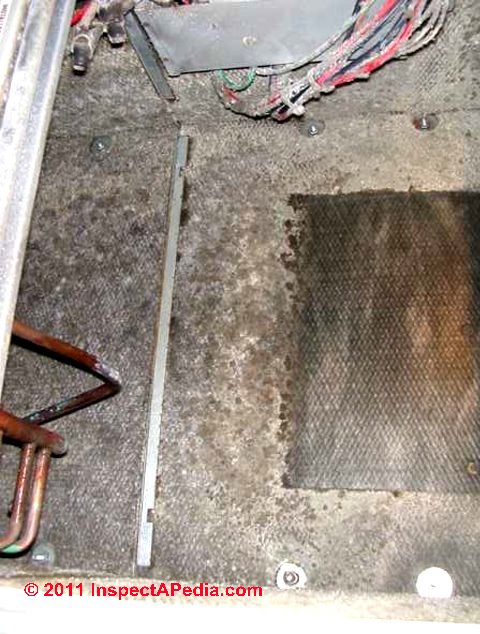
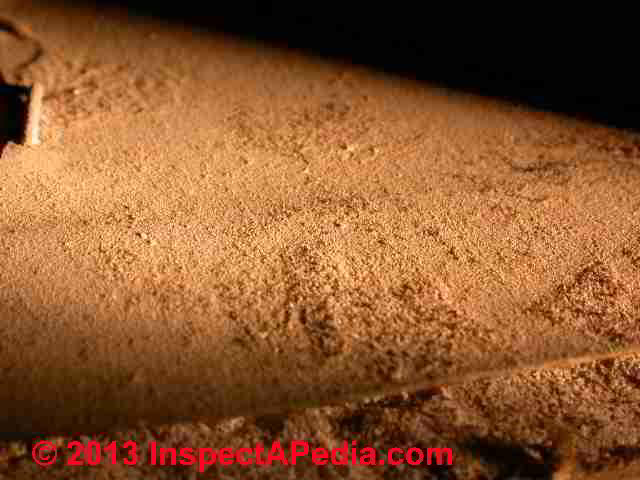
The most common particles found in the dust and debris in air ducts are fabric fibers and skin cells.
Dust mite fecals and insect fragments are allergens found there more often than mold. When we do identify mold in air conditioning or heating ducts it is most often found where water droplets were sprayed into the ductwork from a blower unit or where there were water leaks into or condensate in duct system.
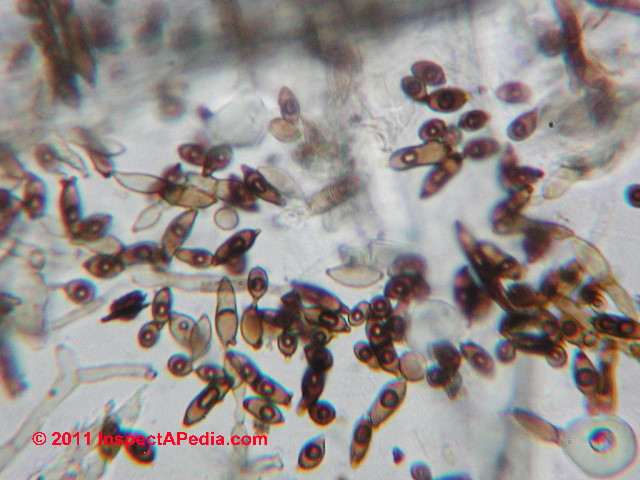
The most common mold genera we find in this location is Cladosporium sp.
Mold on Fiberglass Air Ducts
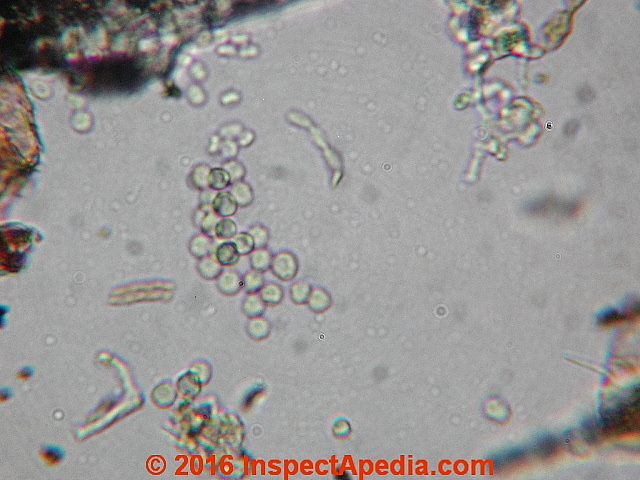
Below: Photographs provided by an InspectApedia reader and by our own microscopy lab include a photograph of white or light gray mold growth on the interior surface of a fiberglass-lined air duct and a second photo of Pen/Asp spore chains found in this sample.
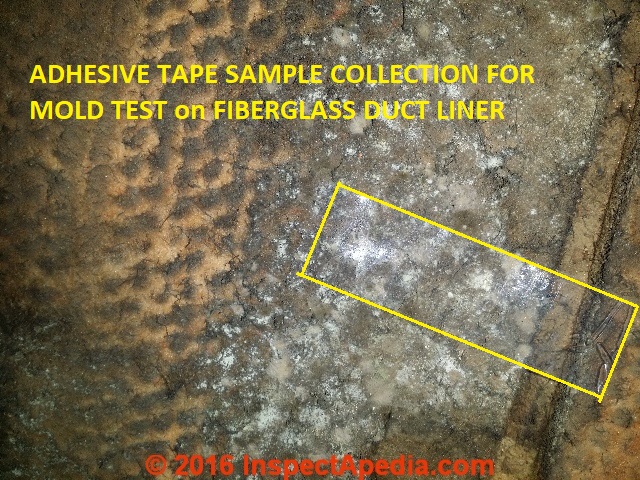
A study of this mold found Cladosporium sp., Aspergillus sp. and Penicillium sp. in heavy growth in the ductwork. Details of this air duct mold contamination study are found
at FIBERGLASS AIR DUCT MOLD TEST
Also see more photos at MOLD on/in FLEX DUCT [photos]
Information about moldy air handlers and ductwork is
at AIRBORNE PARTICLE & MOLD LEVELS in DUCTWORK
and
Mold in Air Handlers & Fan Blower Units of Air Conditioners & Furnaces
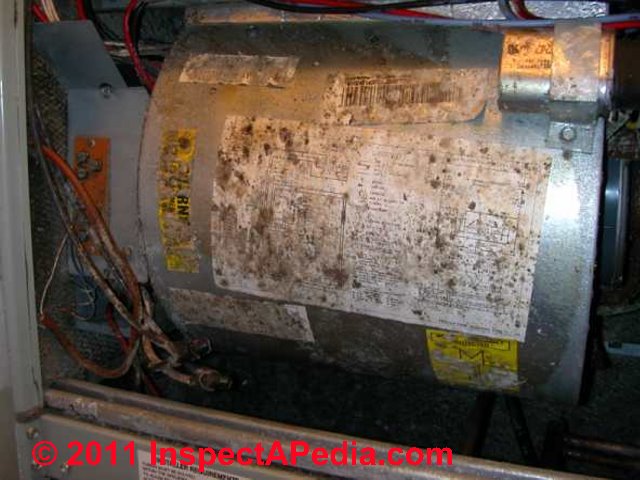
You will note that mold growth is present on the air handler insulation, on the metal surfaces of the blower assembly, on refrigerant and condensate piping, and even on the paper labeling on the blower cage.
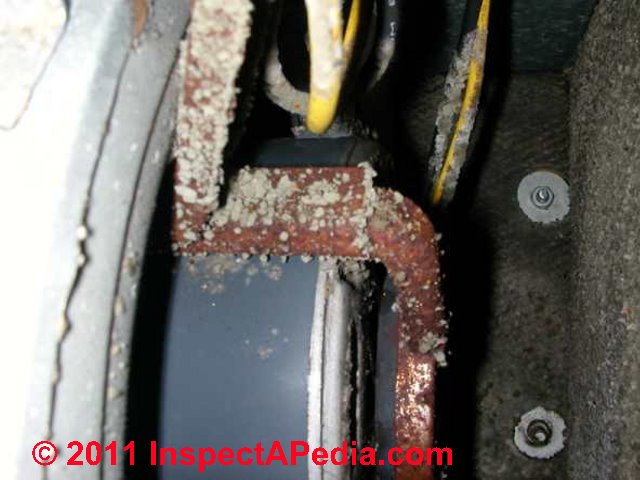
When mold growth is on unpainted metal in an air handler it is most likely dining on organic dust and debris found on those surfaces.
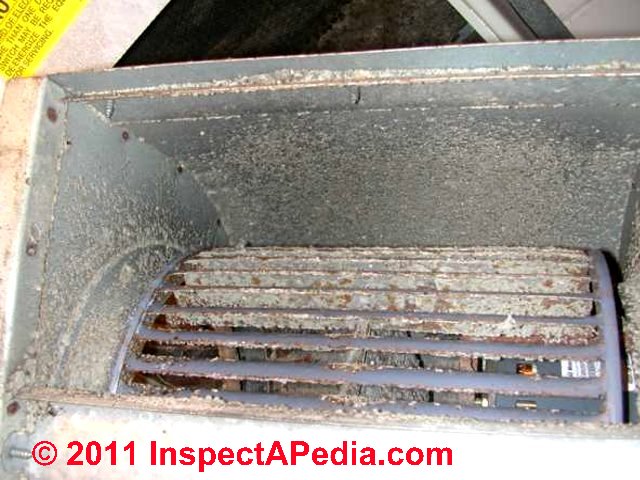
Below we illustrate a dirty, mold-contaminated air conditioner blower squirrel cage fan.
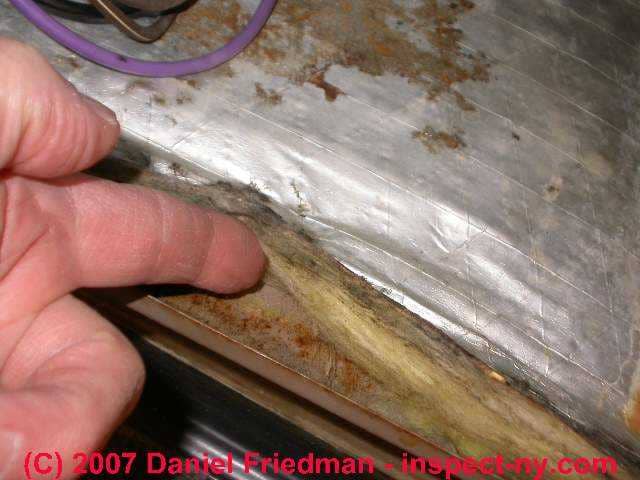
And just below we show what amounts to a small amount of mold contamination on and in the fiberglass insulation of a New York air conditioning system's blower unit.
Below is our lab photo of mold collected from the air handler shown at above right - identifying this fungus as Cladosporium sp.
Important information about moldy air handlers and ductwork is
Mold on Aluminum surfaces such as building siding
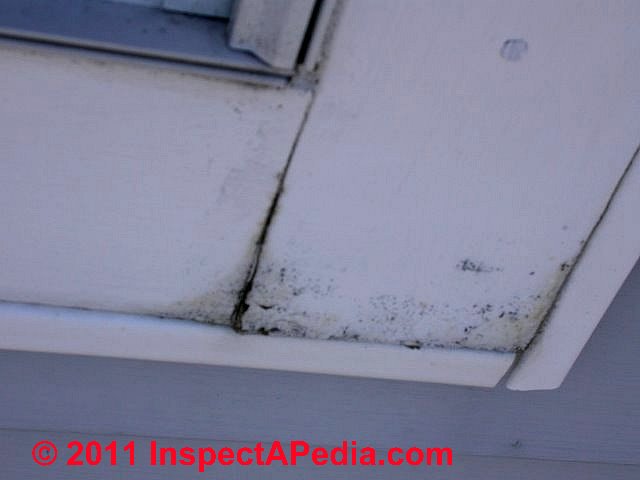
This photograph illustrates mold growth on aluminum siding and trim.
Mold on Appliances, refrigerators, etc
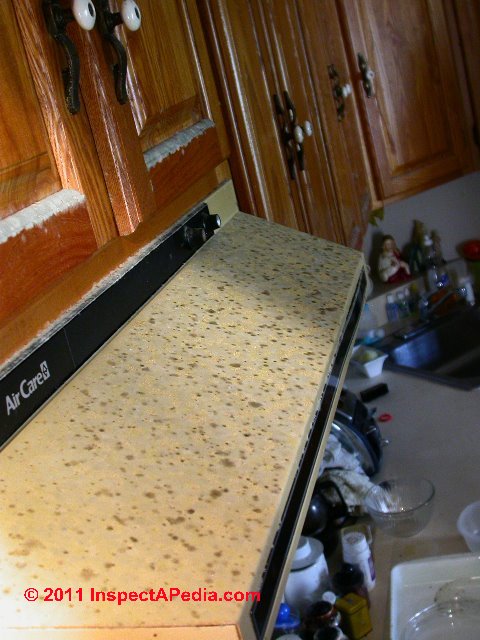
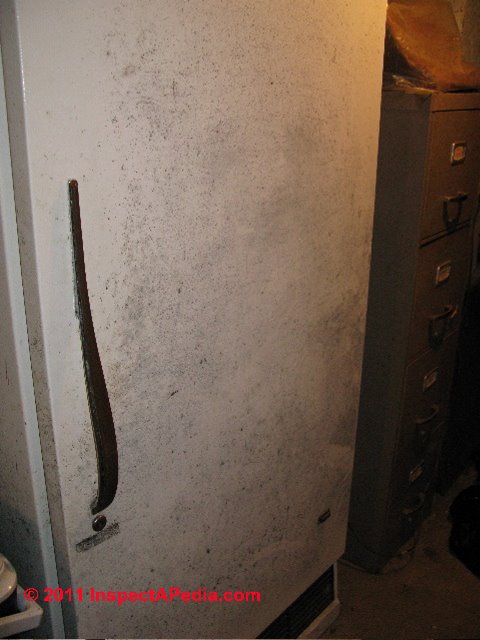
This photograph pair illustrates mold growth on a kitchen range fan hood (below left) and a refrigerator door surface (below right).
Below our pictures show mold growth on plastic controls for a kitchen stove and on the oven door handle, also a plastic component.
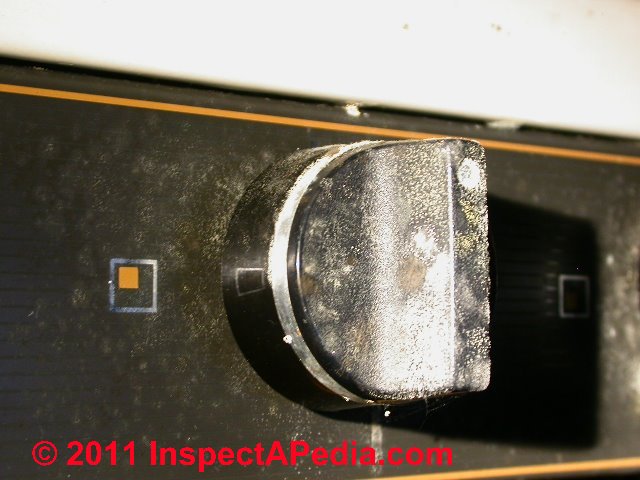
This home had been subject to flooding that was undiscovered for weeks or longer.
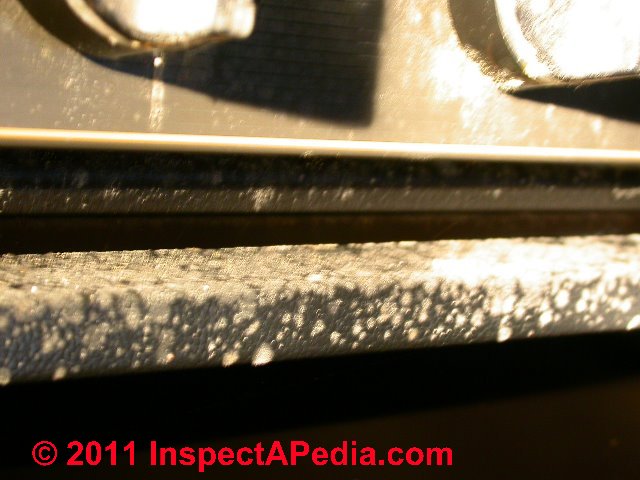
Mold on refrigerator and freezer door gaskets is common, is not likely to be a health concern in a building, should be handled by normal household cleaning, and is not illustrated here.
Mold on Art Works, paintings, painting substrates, other artworks or cultural artifacts

We assist museums & curators with mold diagnsosis, cure, & prevention on works of art.
Details and more illustrations of paintings or other artworks being examined for mold contamination are
at MOLD on ART WORKS, TESTING FOR
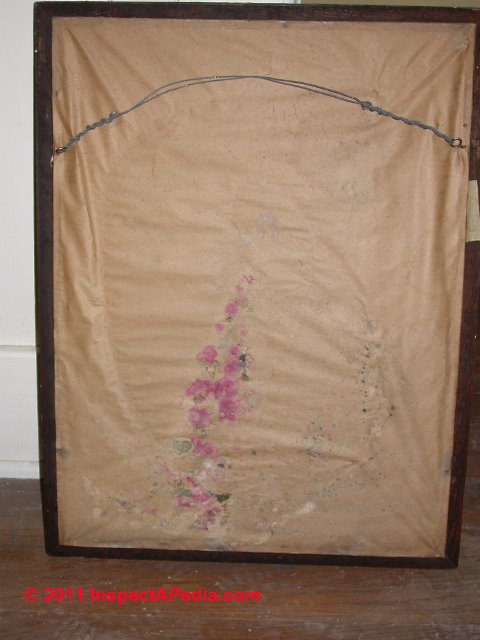
At MOLD RESISTANT CONSTRUCTION we discuss methods to reduce the risk of mold growth not only on building surfaces but on and in the contents found in buildings, including works of artifacts and works of art such as paintings.
At ART CONSERVATION - Cultural Heritage and Aerobiology we describe a text that offers some help in controlling mold and other sources of damage to paintings as well as other cultural artifacts.
Mold on Asbestos Pipe Insulation
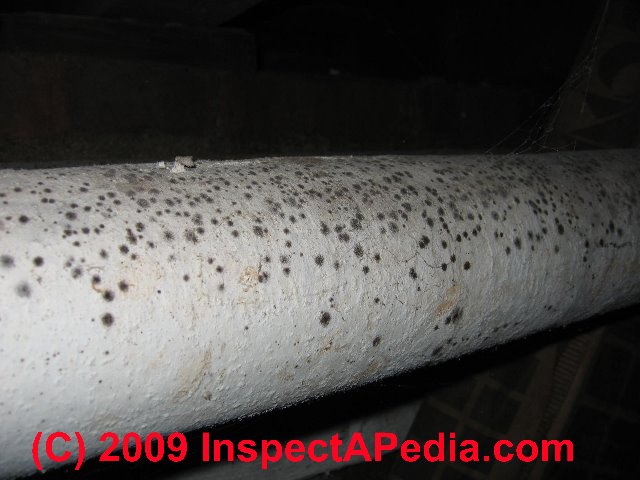
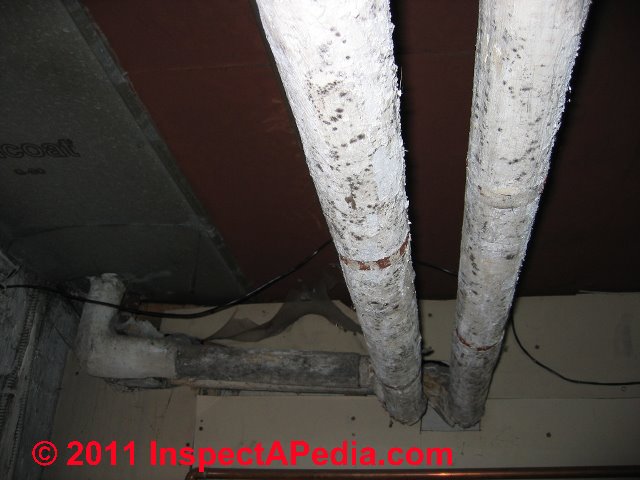
Our photo above and our two moldy asbestos pipe insulation pictures below

all show black and gray mold colonies as smaller "spots" growing on the painted surface of cloth covering asbestos pipe insulation.
Mold on/in Attics and attic surfaces (roof sheathing)
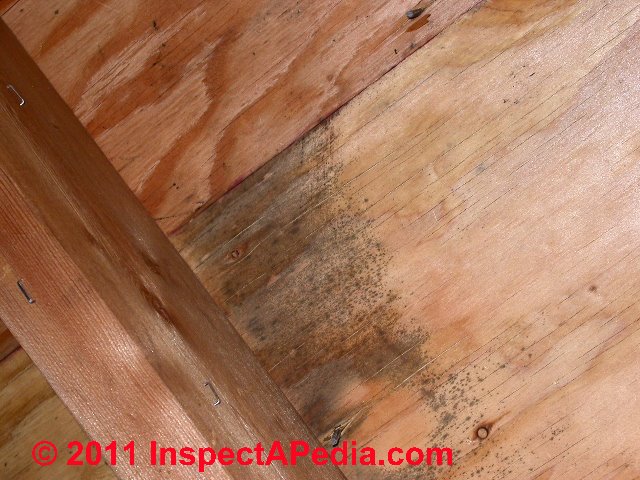
The photographs below illustrate mold growth on plywood roof sheathing. At left is evidence of a serious roof leak or attic moisture condensation problem (black plywood) and at right a much smaller brown mold growth on the plywood roof sheathing of a newer home.
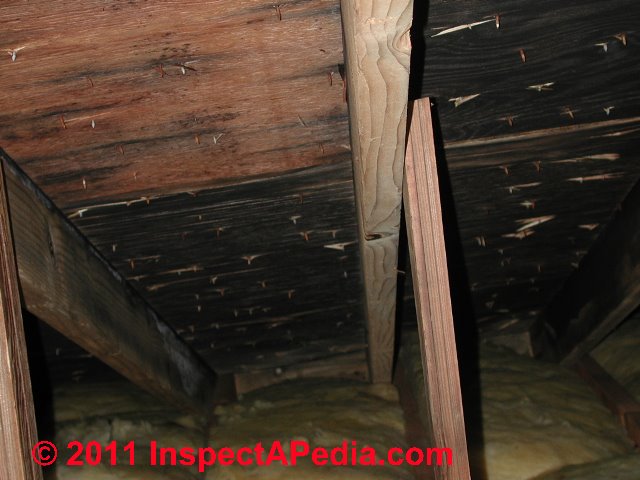
We may find mold growth like that shown at right just above a bathroom ceiling fan that vents directly into the attic space.
These molds are very often Aureobasidium pullulans, C. cladosporoides, C. sphaerospermum, or Cladosporium sp. though other dark or brown molds (such as Taeoniella sp.) may be present too. Remember, mold identification by naked eye is unreliable; lab sample analysis is usually necessary.
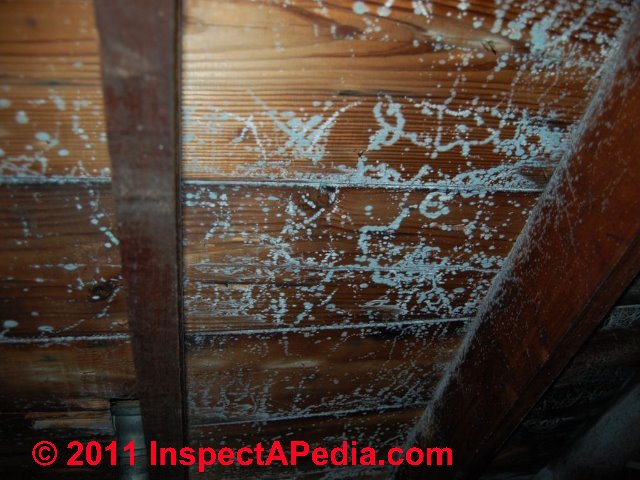
The photographs below illustrate mold growth on tongue and groove roof sheathing in an attic.
These molds are often Aspergillus sp. or Penicillium sp.
Mold on/in Attic Stairs
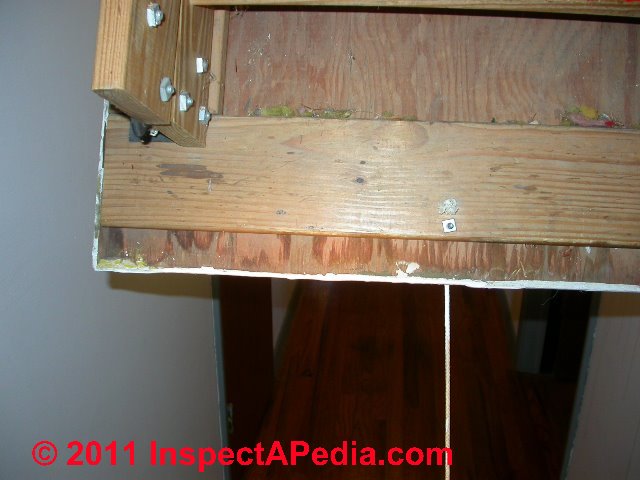
This photograph illustrates trivial, hard to spot mold growth on a pull-down attic stair.
We also have found mold growth concentrated on an attic floor around the attic stair entry opening.
We suspect that extra air movement leaking into the attic from below deposited extra moisture in that location, inviting mold growty.
Mold on/in Automobiles, boats, cars, RVs
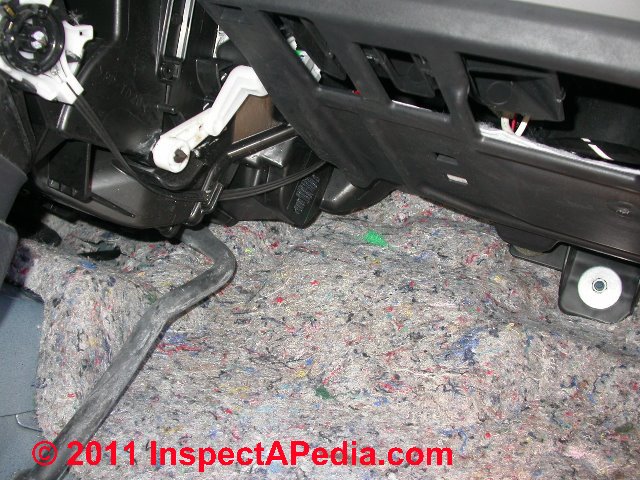
This photograph illustrates automobile floor carpet padding and sound insulation that smelled moldy even though mold was not easily visible to the naked eye. Leaks from the windshield pillars had soaked the automobile's carpet and carpet padding.
Extreme car mold contamination of most of the surfaces inside of the vechile is illustrated by our photo below
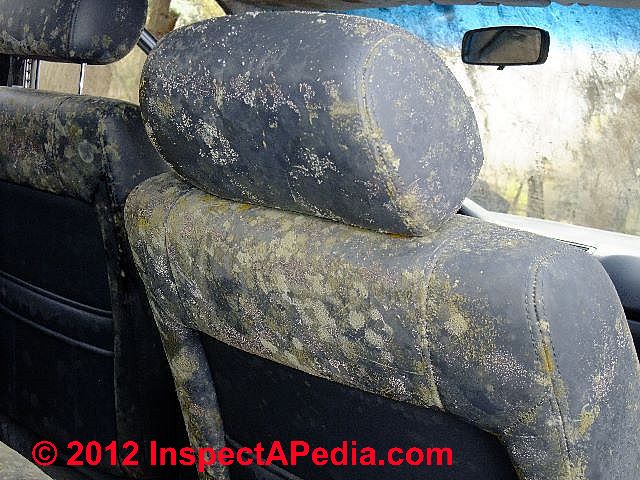
This photograph of car mold illustrates an extremely-serious case of car mold contamination -
see CAR MOLD CONTAMINATION for details.
Mold on Barn Framing, new construction
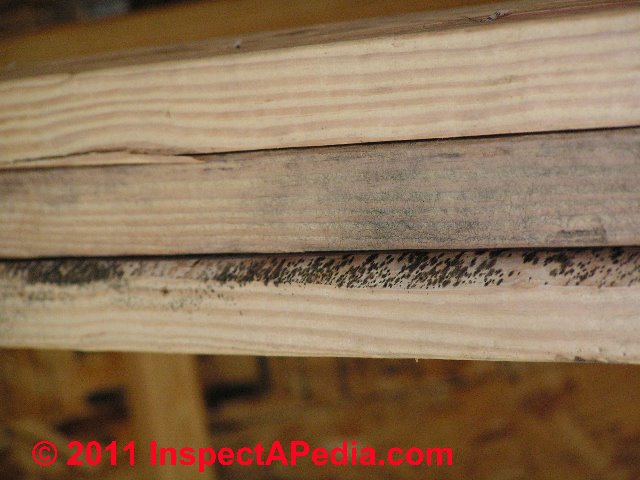
This photograph illustrates mold growth on framing lumber used in construction of a new barn.
The growth pattern and color and localization of the black mold to only individual framing members even though they were touching to form a built-up beam was compelling evidence that this mold was present on the lumber at the time of delivery - it was not growing in the structure.
Most likely this is a cosmetic mold such as Ceratocystis/Ophistoma -
see BLACK COSMETIC MOLD for details.
Reader Comments, Questions & Answers About The Article Above
Below you will find questions and answers previously posted on this page at its page bottom reader comment box.
Reader Q&A - also see RECOMMENDED ARTICLES & FAQs
On 2021-02-03 by (mod) - don't just look for "black mold"
Certainly,
Particularly if some molds are got into a cut or open sore on the skin or worse, into an eye or other sensitive body area the result can be a fungal infection.
Tara, but let's avoid the mistake of thinking we only care about "black mold" - of the 200 or so most-common harmful indoor molds found in buildings, some are dark coloured but many are white, gray, green, red, yellow, brown.
Getting some genera/species of mold into a sensitive body area including an open cut or sore or even an eye can cause a fungal infection.
If you have that concern see your doctor: don't try to diagnose and treat with online informants. Nobody can make a safe accurate guess from text or even photos.
On 2021-02-01 by Tara Lance - Can black mold effect soneones skin?
Can black mold effect soneones skin?
On 2020-07-19 by (mod) - identify mold growing on automotive paint, surfaces, logos
 JF
JF
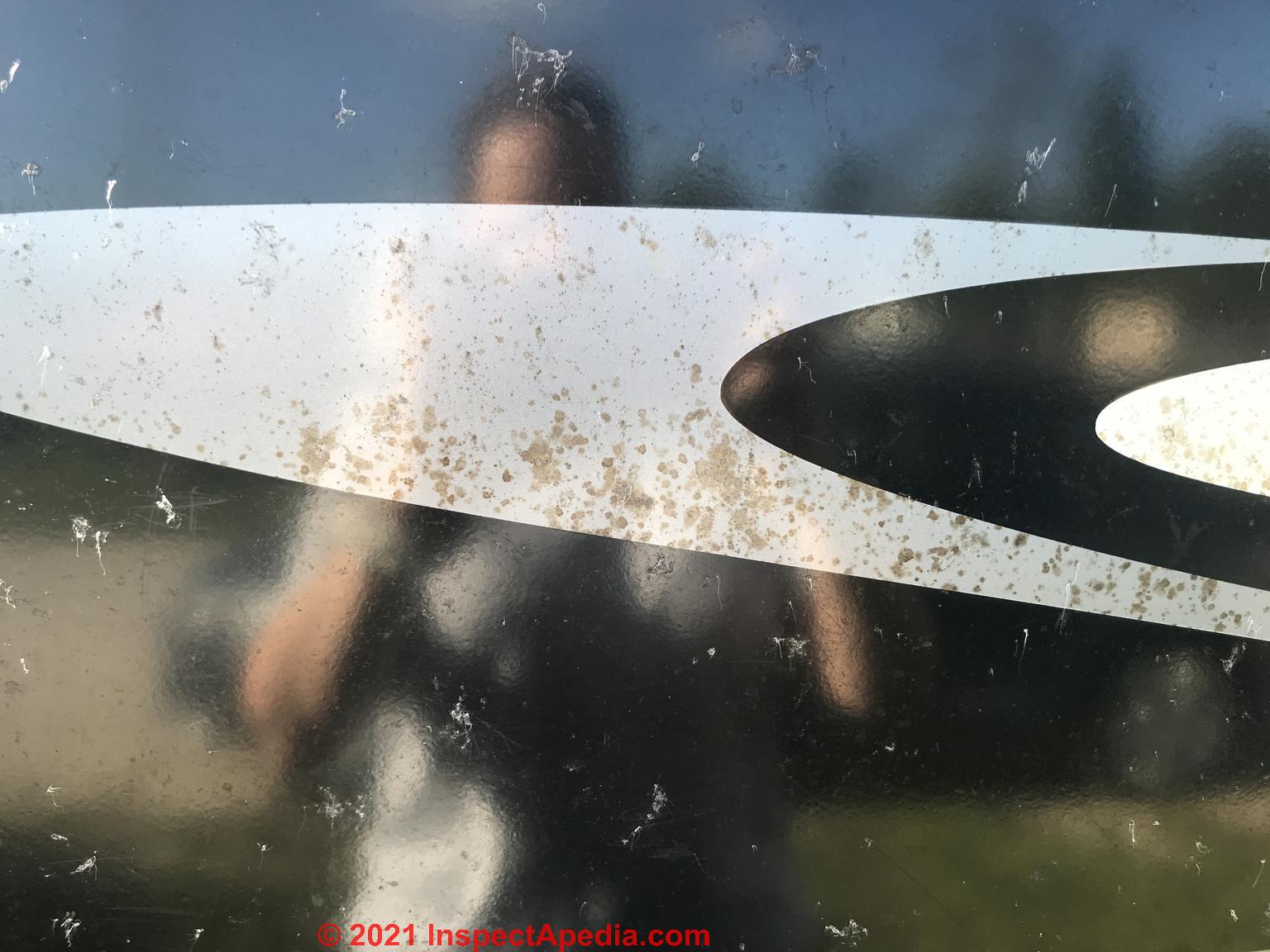
Indeed that looks like a fungus growing mostly in the white paint of the RV logo.
Identifhing the mold generas/species cannot be done from a photo, and in fact doesn't matter in that knowing the mold's name (e.g. Cladosporium sphaerospermum) won't change what's needed to be done one bit.
Try scrubbing with a gentle plastic scrubby sponge and dish detergent; if stains remain, I've had success using a spray-cleaner that includes bleach, but
Watch out: to rinse thoroughly and quickly so as to avoid bleached streaks down the siding surface. Test first on an unobtrusive area.
On 2020-07-19 by J Fallon
Can someone please identify this substance? Mold maybe? Covering the front of an RV? It’s only on the front on aluminum and fiberglass. As a detailer I’ve never seen anything quite this bad! How to tackle it is the help I need. Thanks
On 2020-06-02 by mod) - mold growth on organic debris & dust in metal ductwork
Eso
The photo is a bit blurry so I'm not certain but that looks as if it could be some mold growing inside your metal ductwork.
Various species of mold will grow on the organic component of dust and debris that is deposited on the interior of h v a c ducts
On 2020-06-02 by esolo4691
I attached an image but for some reason it doesnt appear in my post
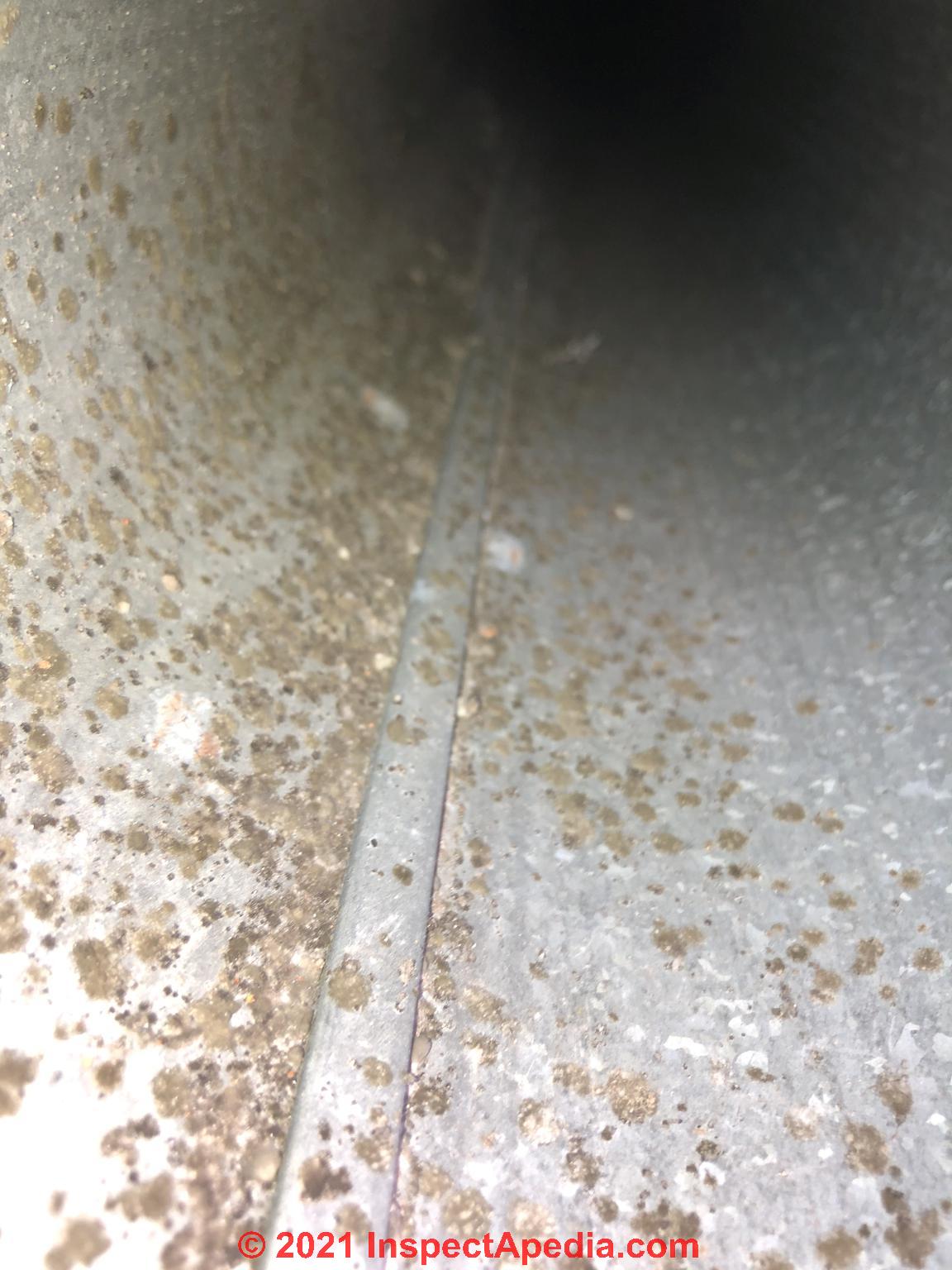
On 2020-06-02 by esolo4691
Can anyone verify if this greenish brown stuff at the bottom of my ducts is mold?
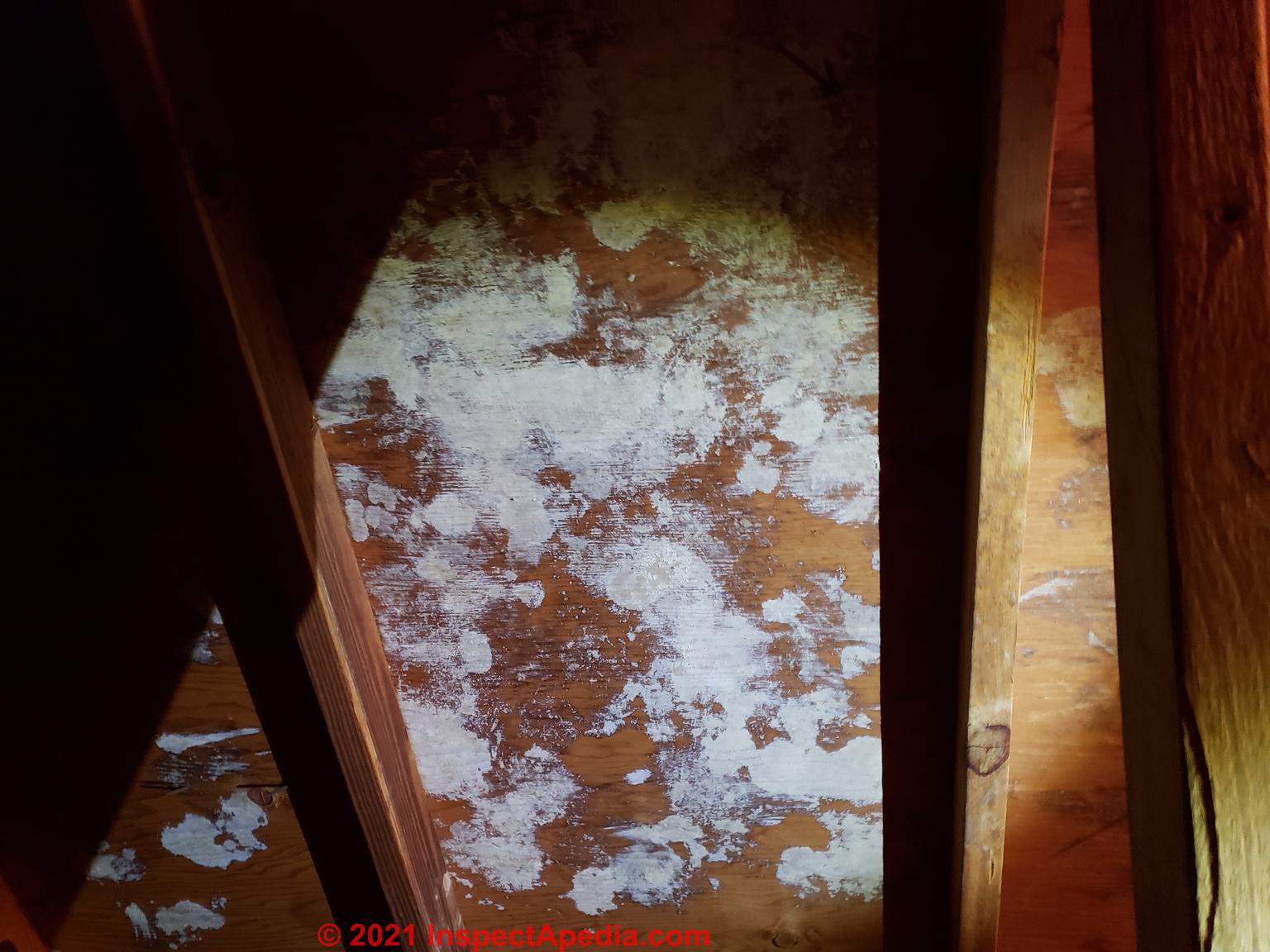
On 2019-10-09 by (mod) - is this white paint or mold?
 Bill
Bill
That could indeed be a white fungus or "mold" growth on roof sheathing.
Though I have to say it looks a lot like white paint blots.
There are some adjacent dark areas that could hiint at moisture and mold in an attic. From a sharper photo more-close-up one might be sure if it's paint or not;
Is it mold? Diagnostic tip: if there are mold-growth-conducive conditions in your attic, where you see heavy mold growth on plywood roof sheathing you are likely to see at least some mold growth continue up onto rafters or other framing, particularly where the rafters touch the "mold-suspect" white stuff on the plywood.
If it's paint it probably won't smear off on a paper towel or gloved finger.
Frankly nobody who actually knows mycology and mold would, from looking at the white growth on a surface by naked eye, assert that it is a species of Aspergillus. Therefore we already know something about your third remediator. Aspergillus might be white but it can be any of many other colors, and there are plenty of other white molds that are not Aspergillus.
WHITE MOLD PHOTOS inspectapedia.com/mold/White_Mold_Pictures.php offers some details - a spot where I'll re-copy our discussion here as you have such a nice white mold photo.
Aspergillus occurs as about 180 different sub-species (some sources list 250 species) of which about 20 are commonly found on building surfaces. ( US CDC www.cdc.gov/fungal/diseases/aspergillosis/causes.html )
The color of Aspergillus mold colonies ranges from black or very dark brown (A. niger) through greens, yellows, tans; A brand new Aspergillus colony may appear as a white growth but usually when we see species of Aspergillus on a building surface it's not brand new (hours to days old) and it's got color.
As the Aspergillus colony matures it darkens to green, green-gray, or green-brown with a white apron at the margin, very much depending on the species of Aspergillus and possibly as well as on what the Aspergillus has to eat - what material it's growing upon.
Furthermore it's unusual for there to be only one mold genera/species in a building where mold contamination is found. For example I can identify three entirely different mold genera/species on the same piece of drywall simply by collecting samples at different heights from a wet floor.
That's because the moisture gradient varies, with drywall higher from the floor being less wet and thus growing different genera/species. That's also why any single surface test or most other samples do not characterize the building's mold family.
Fortunately, despite a near-overwhelming attention given by mold remediation companies and their websites to mold color and what it means, or to scaring the devil of people with a mis-placed attention to "toxic black mold" (as mold may be harmful across the entire rainbow of colors), the color of the mold doesn't mean a darn thing about what you need to do about it. That is, the color of mold does not affect the mold remediation plan.
Remove the mold, clean the surfaces, fix its cause.
There are occasionally reasons to identify the mold genera / species found in a building, most-often to aid a doctor's work on a sick patient and occasionally to prove that a remediation containment was successful - or not.
Details are at MOLD TEST REASONS inspectapedia.com/mold/Reasons_to_Test_for_Mold.php
More examples of mold often seen in attics are found in our series of article on attic mold, including ATTIC MOLD, WHAT IT LOOKS LIKE https://inspectapedia.com/mold/Attic_Mold_Identification.php
On 2019-10-09 by Bill M - is the white stuff in my photo Aspergillus mold?
Any thoughts on what this might be? In attic. 2 out of 3 remediators said it was not mold. The third said immediately that it was an Aspergillus. I have not sent for testing yet.
...
Continue reading at MOLD APPEARANCE on VARIOUS SURFACES_GROUP_2 to continue reviewing our photographs of mold growth on all sorts of items, building surfaces, building contents, or select a topic from the closely-related articles below, or see the complete ARTICLE INDEX.
Or see these
Recommended Articles
- BLACK MOLD, HARMLESS
- MOLD APPEARANCE on VARIOUS SURFACES index to photos of mold on all kinds of surfaces and materials
- MOLD APPEARANCE - WHAT MOLD LOOKS LIKE - home
- MOLD APPEARANCE - STUFF THAT IS NOT MOLD
- MOLD ATLAS & PARTICLES INDEX
- MOLD FREQUENCY in BUILDINGS
- MOLD in BUILDINGS
- MOLD CONTAMINATION IN BUILDINGS - home
- MOLD by MICROSCOPE - mold under the microscope
- MOLD in the PETRI DISH, PHOTOS - mold on culture plates or in culture-type mold test kits
- MOLD RELATED ILLNESS SYMPTOMS
- MOLD RESISTANT CONSTRUCTION
- ROT TYPES, BROWN SOFT WHITE
Suggested citation for this web page
MOLD APPEARANCE on VARIOUS SURFACES at InspectApedia.com - online encyclopedia of building & environmental inspection, testing, diagnosis, repair, & problem prevention advice.
Or see this
INDEX to RELATED ARTICLES: ARTICLE INDEX to MOLD CONTAMINATION & REMEDIATION
Or use the SEARCH BOX found below to Ask a Question or Search InspectApedia
Ask a Question or Search InspectApedia
Try the search box just below, or if you prefer, post a question or comment in the Comments box below and we will respond promptly.
Search the InspectApedia website
Note: appearance of your Comment below may be delayed: if your comment contains an image, photograph, web link, or text that looks to the software as if it might be a web link, your posting will appear after it has been approved by a moderator. Apologies for the delay.
Only one image can be added per comment but you can post as many comments, and therefore images, as you like.
You will not receive a notification when a response to your question has been posted.
Please bookmark this page to make it easy for you to check back for our response.
Our Comment Box is provided by Countable Web Productions countable.ca
Citations & References
In addition to any citations in the article above, a full list is available on request.
- In addition to citations & references found in this article, see the research citations given at the end of the related articles found at our suggested
CONTINUE READING or RECOMMENDED ARTICLES.
- Carson, Dunlop & Associates Ltd., 120 Carlton Street Suite 407, Toronto ON M5A 4K2. Tel: (416) 964-9415 1-800-268-7070 Email: info@carsondunlop.com. Alan Carson is a past president of ASHI, the American Society of Home Inspectors.
Thanks to Alan Carson and Bob Dunlop, for permission for InspectAPedia to use text excerpts from The HOME REFERENCE BOOK - the Encyclopedia of Homes and to use illustrations from The ILLUSTRATED HOME .
Carson Dunlop Associates provides extensive home inspection education and report writing material. In gratitude we provide links to tsome Carson Dunlop Associates products and services.
 | HOME | ABOUT | ASK a QUESTION | CONTACT | CONTENT USE POLICY | DESCRIPTION | POLICIES | PRIVACY | |
| © 2024 - 1985 Publisher InspectApedia.com - Daniel Friedman | |||||||||