
InspectAPedia® FREE Encyclopedia of Building & Environmental Construction, Diagnosis, Maintenance & Repair |
Question? Just ask us! InspectAPedia
|
 Mold Action Guide after Flooding: How to Prevent Future Mold After a Building Leak or Flood
- POST a QUESTION or COMMENT about the most effective measures to prevent future mold contamination in buildings that have been flooded, wet or storm-damaged
Mold prevention after building flooding:
This article in our series on removing mold in flooded buildings describes general steps to be taken after the initial mold cleanup, in order to prevent a future mold problem in a building.
If your building has been flooded, this website provides an easy to understand guide for flood damage assessment, setting priorities of action, safety, and we provide special information about avoiding or minimizing mold damage.
InspectAPedia tolerates no conflicts of interest. We have no relationship with advertisers, products, or services discussed at this website.
GENERAL MOLD PREVENTION Advice to Consider After Building Flood Damage or Water Entry Damage has Been Repaired
If your building is already moldy or if you suspect mold related illness in your building, we link to a step by step MOLD ACTION GUIDE dealing with toxic or allergenic indoor mold and other indoor contaminants: when and how to inspect or test for mold, when to hire an expert, how to clean up a moldy area, when and how to perform post-remediation mold testing.
- Keep unwanted outside water out of the building. This means attention to the roof drainage system (gutters and leaders), surface drainage,
and at some sites, unusual levels of ground water. In buildings where I find recurrent basement water entry, most of the time the underlying cause is
inadequate maintenance of gutters and downspouts, with roof spillage against the foundation.
Preventing indoor mold by keeping outside water out also means proper construction of all exterior components, roofing, siding, windows, doors, trim, steps, patios, exterior light fixtures, even downspout straps, to keep water out of building walls and cavities.
See VAPOR BARRIERS for a discussion of vapor barriers behind vinyl siding. The importance of flashing and house wrap on conventional construction pales next to the importance of property detailing when problem-prone building exteriors such as EIFS Synthetic Stucco are used since if workmanship is not exactly correct with those materials leaks into the building cavities trap water and often lead to costly damage, rot, or mold.
See EXTERIORS, Landscaping, & Siding - Inspection, Repairs, Product Failures for a discussion of exterior building materials and defects. - Humidity levels in the building: Maintain Proper Indoor Humidity Levels to avoid mold.
See HUMIDITY CONTROL & TARGETS INDOORS - Leak Prevention: proper roofing and flashing details are critical to avoid longer term building leaks at the roof and at other building penetrations such as windows, doors, plumbing vents. Indoors, replace corroded plumbing traps, use burst-resistant washing machine hoses and fixture supply risers. When possible, turn off water when leaving a building vacant for some time.
- Mold-resistant Building Materials: should be used where possible, especially in high-risk areas
such as basements and bathrooms.
See MOLD PROOF DRYWALL - Mold-Friendly Building Materials: should be avoided in high risk areas. Do not put mold-friendly construction materials (stuff on which mold grows readily) into damp areas.
- Ventilation: to avoid indoor mold, proper venting avoids build-up of high moisture in building cavities and avoids, in freezing climates, leaks into
building cavities from ice dams.
See ATTIC CONDENSATION CAUSE & CURE - More Mold Prevention Steps Review the building and correct leaks or moisture sources that tend to cause mold growth independent of flooding.
See MOLD PREVENTION GUIDE for more details.
FURTHER STEPS TO PREVENT MOLD Growth After Flooding in a Building
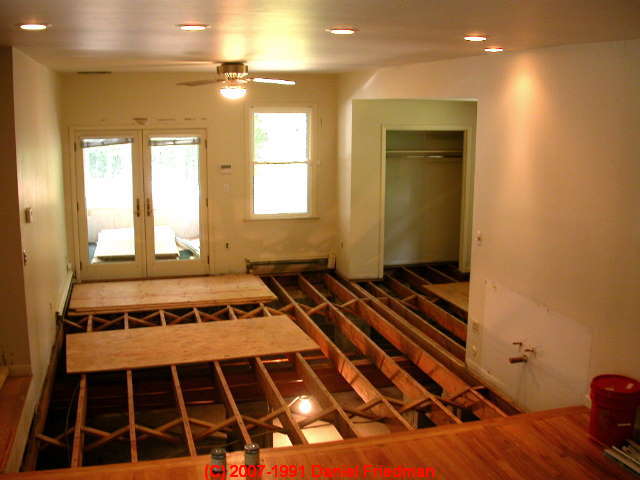
Earlier we recommended our Flood Response Checklist which lists key actions you should take after building flooding to minimize mold damage, and includes some safety warnings. Our photograph at page top shows a building after extensive demolition and cleaning of a basement and of first floor flooring. Walls and ceilings above the floor were left intact.
If your building has been flooded, this website provides an easy to understand guide for flood damage assessment, setting priorities of action, safety, and we provide special information about avoiding or minimizing mold damage.
We also list after-flood "anti-mold" procedures that do not work or are unsafe - to help you avoid unnecessary expense in dealing with mold after a building flood. If your building is already moldy or if you suspect mold related illness in your building,
we link to a step by step Mold Action Guide dealing with toxic or allergenic indoor mold and other indoor contaminants: when and how to inspect or test for mold, when to hire an expert, how to clean up a moldy area, when and how to perform post-remediation mold testing.
If your septic system has been flooded we link to an article outlining what to do about that system as well. Extensive, technically detailed in-depth articles on other mold detection, testing, and prevention methods are organized at
our Mold Information Center
Once the immediate safety and de-watering and drying steps outlined above have been addressed, here are additional steps to clean up, remove, or prevent mold growth in a building or in and on its contents.
- Do Not Work in a Moldy Building without proper respiratory protection (HEPA-filter respirator) and other appropriate protection such as goggles, protective clothing, gloves. People who are asthmatic, suffer from COPD, compromised immune systems, or who are elderly or infant should not be in a moldy environment and certainly should not be performing the cleanup.
- Eye Protection: do not put a moldy finger in your eye such as to scratch an itch. You risk serious infection or even blindness. Wash your hands before eating our touching your eyes.
- Skin Protection: do not expose skin to mold, sewage, or cleaning chemicals. Extra care should be taken to keep these materials out of cuts, sensitive tissues, and the eyes.
- Cleaning Furniture and other Hard-Surfaced Items After Flooding: hard-surfaced items from a flooded area, if they have not been actually damaged by the flood water itself,
can and should be cleaned using ordinary surface cleaning methods. Detergents or even soap and water are fine.
However if sewage backed into the building during flooding, disinfection may be appropriate. For disinfection of surfaces use 1 cup of bleach to a gallon of water to clean the item, then rinse it thoroughly so that it won't be damaged by the bleach. We ar gloves and dye protection whenever using bleach. Don't use bleach and ammonia together - toxic chlorine gas will be given off. - Furniture that cannot be cleaned: thick upholstered furniture such as couches, and also cushions, pillows, if they were wet from flooding, cannot be effectively cleaned. Don't waste money on steam cleaning or ozone "treatments" that don't work. If an upholstered chair is a valuable antique it may be possible to have the old upholstery stripped, the frame cleaned, and new upholstery applied. Generally it's less costly to buy a new chair.
- Cleaning Soft Goods like Clothes & Bedding after Flooding: curtains, blankets, bedding, clothing should be laundered or dry-cleaned.
- Cleaning Books and Papers after Flooding: there are professional services that can clean or "de-mold" books and papers, typically using a
freeze-drying procedure. If you have materials that are going to require this process, protect them from further moisture and have them
collected for treatment as soon as possible. This is a very costly process that won't be reasonable for ordinary popular literature or non-critical
documents.
See BOOK / DOCUMENT MOLD & WATER DAMAGE RESTORATION for details. - Heating and Air Conditioning Systems Treatment after Flooding: HVAC systems that move air through a building will need thorough and meticulous
inspection and possibly cleaning. If insulated ducts or insulation inside air handlers were flooded,
those materials need to be replaced as it is not possible to effectively clean the insulating material after flooding.
Additional inspection of the equipment electrical and fuel systems is needed to be sure that they are safe to operate.
See HEATING EQUIPMENT, FLOOD DAMAGE REPAIR - It would be best if you DO NOT run the central air conditioning system or hot air heating system after flooding and before the building has been dried
and cleaned, as to do so risks contaminating its interior with mold or pathogens that will require extensive replacement.
On the other hand, since we know that some people are going to insist on running the heat or air conditioning to try to assist the building drying process, if conditions demand that you run this equipment temporarily, you may do so (after a safety inspection) with the assumption that you are causing them to be contaminated, that they are blowing moldy air throughout the building, that they will need to be replaced, and that other building areas served by the same duct system may need additional special cleaning. - If you must run a hot air heat or central air conditioning system to aid in drying out the building, you should include that system in the final cleaning, inspection, and testing steps to assure that any mold or other contaminants have been removed.
- Hot water heating systems and electric heaters such as by baseboards or radiators as well as free-standing heaters and dehumidifiers and fans can be operated to help dry a building, as soon as the equipment has been inspected for safety. The safety inspection of the equipment is important because there may be fire or shock hazards present if it's turned on without inspection.
- Watch for Mold Growth and Mold Odors After Flood Cleanup: even taking the steps discussed above, if a building is not dried to a sufficient level, including the moisture level
of its ceiling and wall cavities, there is a real risk of the development of both visible and hidden mold.
If you see mold forming, additional steps to remove moldy material and to further dry the building are needed. If you don't see mold developing, an inspection of the most-suspect building cavities for hidden moisture or mold would be a smart step before you return the building to service. If there are persistent mold odors, further investigation is in order to be sure you have not missed a hidden mold reservoir in the building. - Flooded Septic Systems: If your building is served by a private onsite septic system,
see SEPTIC SYSTEM FLOOD DAMAGE REPAIR for details of what to do after a septic system has been exposed to flooding - Crawlspace Dryout Procedures: even after a flooded building has been cleaned and repaired, it is important to correct sources of future leaks and water entry if we want to avoid future water and mold damage.
See CRAWL SPACE DRYOUT PROCEDURES for advice.
Reader Question: building under construction soaked by Hurricane Sandy in 2012 - what to do next?
I live in central PA and I am currently building a new home. With the recent rains from hurricane Sandy, my project was at a standstill for over a week (and still is). My first floor walls and second floor "deck" (sub-floor) is installed but not under roof. I made every attempt to tarp the second floor subfloor during the rain to prevent water from leaking down below to the first floor. ....which seemed to work fairly well. I also made attempts to squeegee the water off during the rains.
I still had standing water on the sub-floor from wind driven rain. Things have started to tryout and there is no more standing water but some areas of the sub-floor and some framing has what I think would be cosmetic mold or slight staining that is a little darker than the rest. My framer had to leave my job to assist with an emergency repair related to the storm and might not be back for a week. We are not expected to have any significant rainfall in the next week or so. I have a few questions:
- Is this something to be concerned about?
- Is there any sort of treatment (spray with bleach?) that you would recommend as a preventive measure before closing in the walls or installing floor coverings (still a few months away at best). Should I sand the subfloor to remove any staining prior to installing floor coverings?
- Should I continue to tarp the second floor to prevent frost from forming on it each night or let it naturally freeze/thaw? I would think that the tarp would trap moisture and not allow to dry out.
This house is out in the open with naturally windy conditions so there is opportunity for things to dry.
Reply: drying & cleaning suggestions for a building under construction and that was exposed to water or flooding
A competent onsite inspection by an expert usually finds additional clues that help accurately diagnose a problem that together you and I didn't realize. But that said, here are some things to consider:
- if there is visible, active mold growth on the building under construction (not likely to occur in a day or so if local conditions are quite cold) then it should be cleaned before continuing with framing. As your building includes no insulation nor finish materials, I recommend power washing with deck cleaner; When the building is roofed give it time to dry thoroughly if possible before installing the windows and doors and certainly don't bring any insulation, drywall, or other moisture-vulnerable materials into the building before dry-in phase and confirmation that it has dried.
- If the building under construction was inundated with floodwaters, after removing mud, silt and debris from the site, because of the possibility of sewage contamination, I'd wash or power-wash the structure using a sanitizer, and let it dry before proceeding.
- if you can establish that there was simply some cosmetic mold pre-existing, it's typically harmless - as you can read in our article on that topic. Take a look at where joists or rafters are end-cut and abut other materials. If the "mold" doesn't grow across the cut, it was pre-existing on the lumber.
- if there are simply some gray stains on framing or subflooring on the building, simple drying and sweeping off before continuing construction will usually be sufficient. Sanding is non normally necessary. If you are concerned, some fungicidal sealant paint applied on dry surfaces before continuing construction is "cheap insurance".
See MOLD SANITIZER, SPRAY, BIOCIDE USE GUIDE - Tarping the building to keep it dry makes sense if there is more rain and construction is not going to continue at the immediately next dry area, but
Watch out: tarping over wet building materials is inviting a mold problem, warping, and other problems, so if the building is wet I'd leave it in open air. - Discuss the case with your insurance company, or with the builder's insurance company if appropriate. If the building was damaged by floodwaters or the hurricane, or by construction delays caused by the recent disaster, (such as delaminated or warped plywood subflooring or sheathing) then the cost of those replacements might be an allowable insurance claim.
Building Mold Contamination Prevention Articles
- MOLD PREVENTION GUIDE - home
...
Continue reading at MOLD RESISTANT CONSTRUCTION or select a topic from the closely-related articles below, or see the complete ARTICLE INDEX.
Or see these
Recommended Articles
- FAILURE TO PREVENT FUTURE MOLD
- MOLD PRODUCTS, INEFFECTIVE - after-flood "anti-mold" procedures that do not work or are unsafe - to help you avoid unnecessary expense in dealing with mold after a building flood.
- MOLD CLEANUP GUIDE- HOW TO GET RID OF MOLD - home
Suggested citation for this web page
FLOOD-CAUSED MOLD PREVENTION at InspectApedia.com - online encyclopedia of building & environmental inspection, testing, diagnosis, repair, & problem prevention advice.
Or see this
INDEX to RELATED ARTICLES: ARTICLE INDEX to MOLD CONTAMINATION & REMEDIATION
Or use the SEARCH BOX found below to Ask a Question or Search InspectApedia
Ask a Question or Search InspectApedia
Try the search box just below, or if you prefer, post a question or comment in the Comments box below and we will respond promptly.
Search the InspectApedia website
Note: appearance of your Comment below may be delayed: if your comment contains an image, photograph, web link, or text that looks to the software as if it might be a web link, your posting will appear after it has been approved by a moderator. Apologies for the delay.
Only one image can be added per comment but you can post as many comments, and therefore images, as you like.
You will not receive a notification when a response to your question has been posted.
Please bookmark this page to make it easy for you to check back for our response.
Our Comment Box is provided by Countable Web Productions countable.ca
Citations & References
In addition to any citations in the article above, a full list is available on request.
- Johanning E1, Auger P, Morey PR, Yang CS, Olmsted E., "Review of health hazards and prevention measures for response and recovery workers and volunteers after natural disasters, flooding, and water damage: mold and dampness", Environ Health Prev Med. 2014 Mar;19(2):93-9. doi: 10.1007/s12199-013-0368-0. Epub 2013 Nov 20.
Abstract: Health problems and illnesses encountered by unprotected workers, first-responders, home-owners, and volunteers in recovery and restoration of moldy indoor environments after hurricanes, typhoons, tropical storms, and flooding damage are a growing concern for healthcare providers and disaster medicine throughout the world. Damp building materials, particularly cellulose-containing substrates, are prone to fungal (mold) and bacterial infestation. During remediation and demolition work, the airborne concentrations of such microbes and their by-products can rise significantly and result in an exposure risk. Symptoms reported by unprotected workers and volunteers may relate to reactions of the airways, skin, mucous membranes, or internal organs. Dampness-related fungi are primarily associated with allergies, respiratory symptoms or diseases such as dermatitis, rhinosinusitis, bronchitis, and asthma, as well as changes of the immunological system. Also, cognitive, endocrine, or rheumatological changes have been reported. Based on the consensus among experts at a recent scientific conference and a literature review, it is generally recommended to avoid and minimize unnecessary fungal exposure and use appropriate personal protective equipment (PPE) in disaster response and recovery work. Mycologists recommend addressing any moisture or water intrusion rapidly, since significant mold growth can occur within 48 h. Systematic source removal, cleaning with "soap and water," and "bulk removal" followed by high-efficiency particulate air vacuuming is recommended in most cases; use of "biocides" should be avoided in occupied areas. Public health agencies recommend use of adequate respiratory, skin, and eye protection. Workers can be protected against these diseases by use of dust control measures and appropriate personal protective equipment. At a minimum, a facial dust mask such as the National Institute for Occupational Safety and Health (NIOSH)-approved N95 respirator should be used for mold remediation jobs. For any large-scale projects, trained remediation workers who have medical clearance and use proper personal protection (PPE) should be employed. - Repairing Your Flooded Home American Red Cross and FEMA - PDF - English
- Como Reparar su Hogar Inundado American Red Cross and FEMA - PDF - espanol
- A BRIEF GUIDE to MOLD, MOISTURE, and YOUR HOME, [PDF] U.S. Environmental Protection Agency US EPA - includes basic advice for building owners, occupants, and mold cleanup operations. See http://www.epa.gov/mold/moldguide.htm
- US EPA - UNA BREVA GUIA a MOHO / HONGO - en Espanol
- Our recommended books about building & mechanical systems design, inspection, problem diagnosis, and repair, and about indoor environment and IAQ testing, diagnosis, and cleanup are at the InspectAPedia Bookstore. Also see our Book Reviews - InspectAPedia.
- ENVIRONMENTAL HEALTH & INVESTIGATION BIBLIOGRAPHY - our technical library on indoor air quality inspection, testing, laboratory procedures, forensic microscopy, etc.
- In addition to citations & references found in this article, see the research citations given at the end of the related articles found at our suggested
CONTINUE READING or RECOMMENDED ARTICLES.
- Carson, Dunlop & Associates Ltd., 120 Carlton Street Suite 407, Toronto ON M5A 4K2. Tel: (416) 964-9415 1-800-268-7070 Email: info@carsondunlop.com. Alan Carson is a past president of ASHI, the American Society of Home Inspectors.
Thanks to Alan Carson and Bob Dunlop, for permission for InspectAPedia to use text excerpts from The HOME REFERENCE BOOK - the Encyclopedia of Homes and to use illustrations from The ILLUSTRATED HOME .
Carson Dunlop Associates provides extensive home inspection education and report writing material. In gratitude we provide links to tsome Carson Dunlop Associates products and services.
 | HOME | ABOUT | ASK a QUESTION | CONTACT | CONTENT USE POLICY | DESCRIPTION | POLICIES | PRIVACY | |
| © 2024 - 1985 Publisher InspectApedia.com - Daniel Friedman | |||||||||